Messages

Msg 01 Frnk God

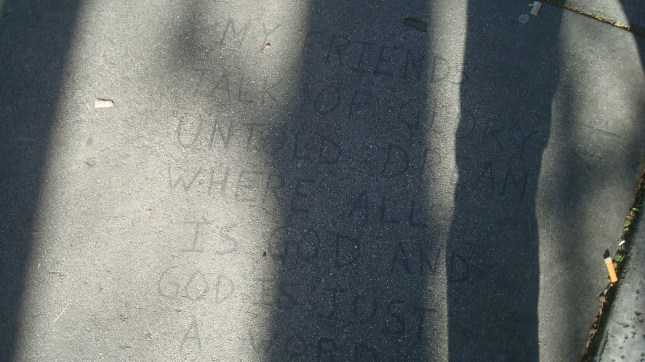
Walking around LA you see messages all over the place. I’m not talking about ads or street signage. I’m talking about messages posted by individuals. These might be handwritten or printed, they might be taped to a streetlight or scrawled on the ground.

There are obviously lots of people with lots of things to say. For a while now I’ve been snapping photos of these messages. Sometimes they’re poetic. Sometimes they’re political. Sometimes they’re bewildering. But all of these people are trying to communicate with us. In some cases it seems like they feel a desperate need to tell us what’s on their mind.

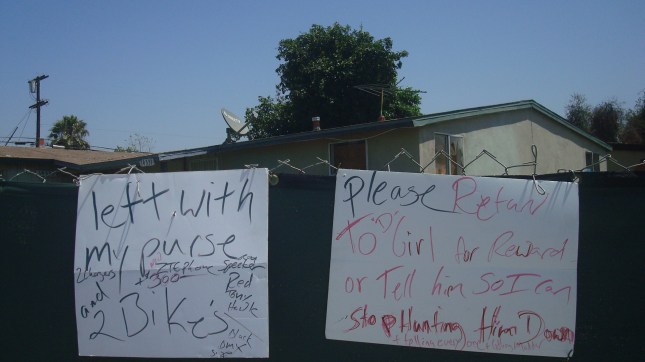
This first shot was taken in Panorama City in front of a vacant house that some homeless people were camped out in. Just a straightforward plea from someone who’s trying to get their stuff back.

Msg 10 House Signs

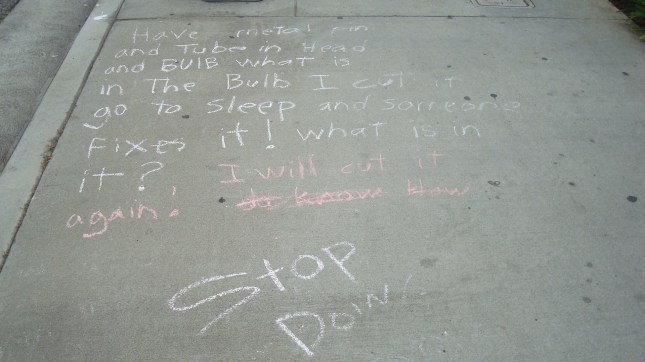
I found this next one on the sidewalk as I was walking down Lankershim in Studio City. Really sad and disturbing. This is obviously someone who’s mentally ill, and feeling pretty desperate.

Msg 20 Chalk 1

And I found this one a little farther down the road.

Msg 25 Chalk 2

Some people have ideas about how to solve the country’s problems.

Msg 30 Good Jobs

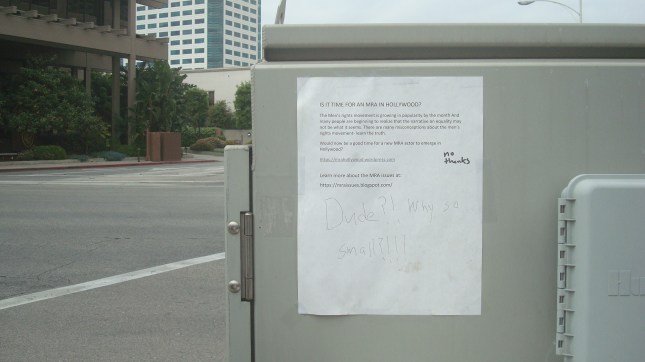
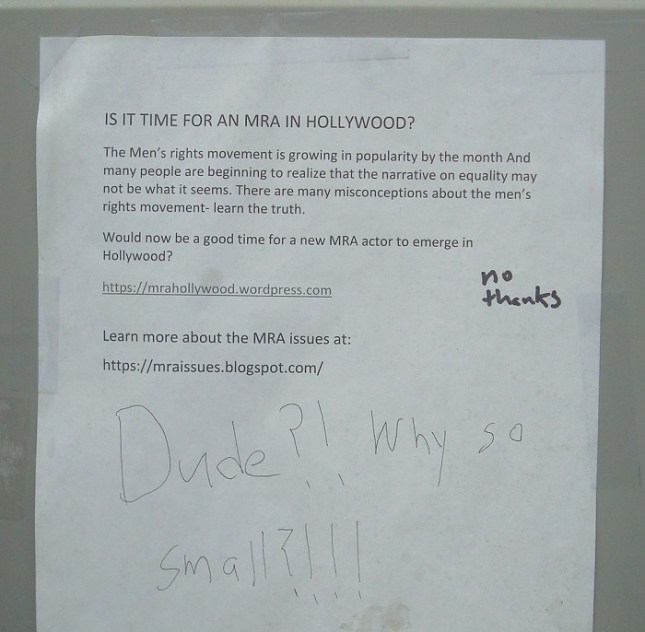
This one took me by surprise. I was in Burbank, and saw it on the side of a utility box. I guess the Me Too backlash has already begun.

Msg 40 Burb 2

Here’s a closer view so you can read the text. The comments are interesting.

Msg 45 Burb 6 CROPPED

I miss the good old days when it was easier to scrawl stuff in wet concrete. Seems like contractors are a lot more careful about protecting their work these days. I’m guessing this dates back to the 90s.

Msg 50 Concrete

I found these words on Franklin in Hollywood.

Msg 60 Frnk So Much

Another message, not too far from the first.

Msg 70 Frnk No Purse

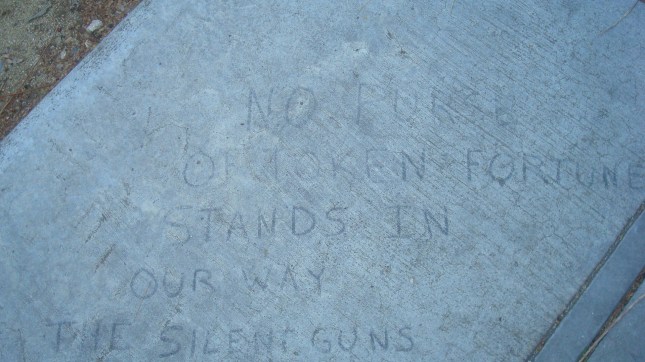
It’s continued in the next shot. I know the text in these isn’t totally clear, so I’ve tried to transcribe it below. Can’t guarantee it’s completely accurate.

Msg 75 Frnk Silent Guns

NO PURSE
OF TOKEN FORTUNE
STANDS IN
OUR WAY
THE SILENT GUNS
OF LOVE WILL
BLAST THE SKY
WE BROKE THE
RUPTURED STRUCTURE
BUILT [?] OUR WEAPONS
WERE THE TONGUES OF
CRYING RAGE

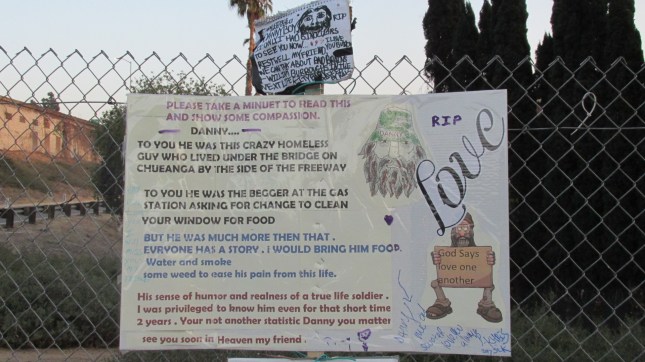
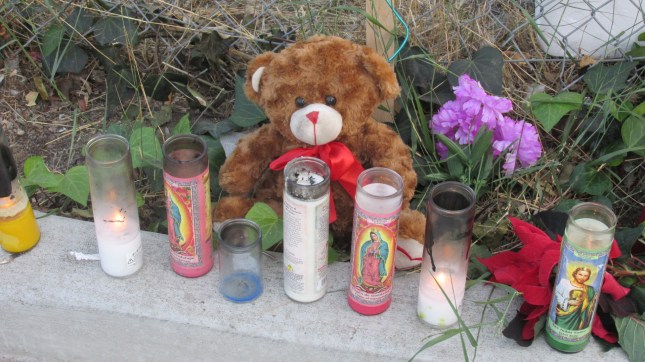
This last one was hung on a fence at the freeway onramp on Cahuenga. It’s a memorial for a homeless man who had died.

Msg 80 Danny 1

Here’s what the author has to say about his friend.

Msg 82 Danny 2

When I first read this it made me sad. But after a while, I started to think it was actually pretty beautiful. Like I wrote at the beginning of this post, there are a lot of people in this town who have things they want to say, but often no one’s paying attention. It sounds like Danny’s life was pretty hard, but at least for a while toward the end he connected with somebody who took the time to listen.

Msg 85 Danny 3


Where Is this Bridge Going?

B6 00 1708 Wide Long 2

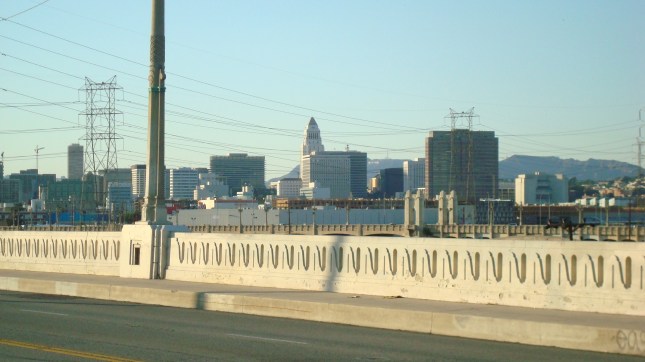
The old Sixth Street Bridge is gone. It was torn down early in 2016. The demolition was necessary because the concrete in the original structure was decaying. Work has begun on constructing a new Sixth Street Bridge, and right now it looks like it will be finished in 2020. (For the record, the formal project title is the Sixth Street Viaduct Replacement Project.)

Bridges are about making connections. The original structure was built in 1932, and was one of a series of bridges that spans the LA River. This ambitious infrastructure project started in the 20s and continued through the 30s, eventually allowing numerous crossings between Downtown and East LA. Here are a few photos of the old Sixth Street Bridge.

B6 1310 05 Base

A shot from the base of the bridge.

B6 1310 10 Truck

A truck coming down the west side.

B6 1310 15 View Dntn 1

A view of the bridge facing west.

B6 1310 17 View Side Dntn

Downtown in the distance.

B6 1310 18 View Dntn Trains

A view of the San Gabriel Mountains from the old bridge.

The renderings of the new bridge are striking. It was designed by architect Michael Maltzan, but the project is a team effort, and the goal is to produce something much more than a bridge. Here’s a quote from Maltzan’s web site.

The design team including Michael Maltzan Architecture (Design Architect), HNTB (Engineer and Executive Architect), Hargreaves Associates (Landscape Architect), and AC Martin (Urban Planning) began with the fundamental understanding that the Viaduct is more than a simple replacement thoroughfare crossing the Los Angeles River. The project instead foresees a multimodal future for the City, one that accommodates cars, incorporates significant new bicycle connections. It also increases connectivity for pedestrians to access the Viaduct, not only at its endpoints, but along the entirety of the span, linking the bridge, the Los Angeles River, and future urban landscapes in a more meaningful relationship.

The project also includes a park and an arts center. You can see some images here.

Sixth Street Viaduct/PARC from LA Bureau of Engineering

Here are some shots of the project site from March 2017, when work on the new bridge was just beginning.

B6 1703 05 Road Closed

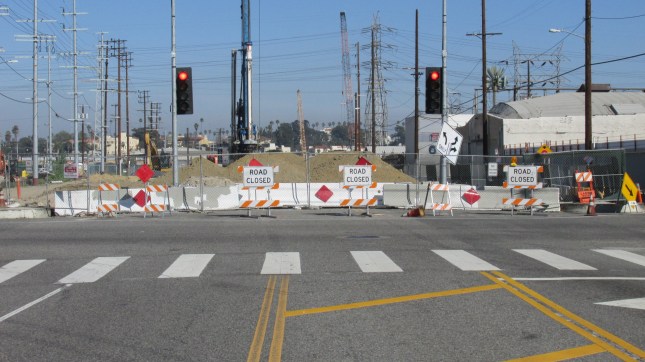
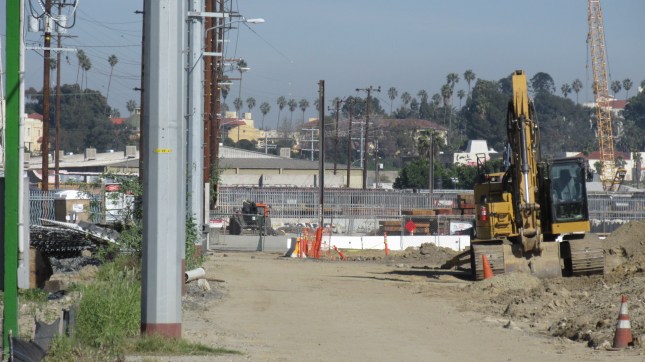
For the time being, this is where Sixth St. ends.

B6 1703 12 Orange Crane

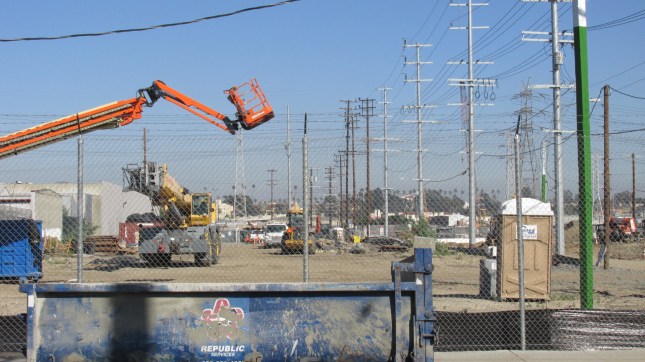
Lots of machinery on the project site.

B6 1703 15 Fence Machinery

Looking across the river toward East LA.

B6 1703 25 Riv Wide Straight

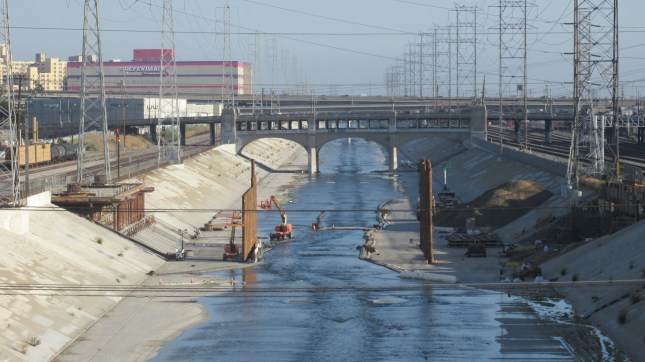
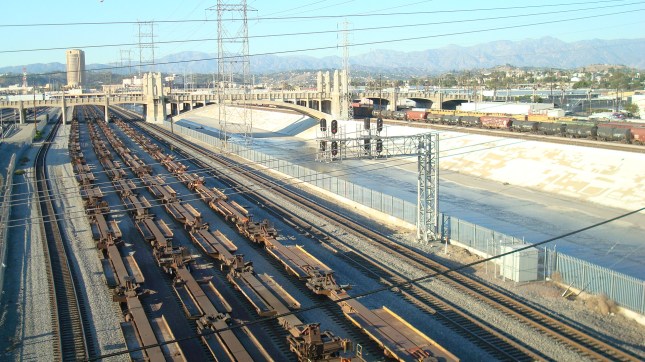
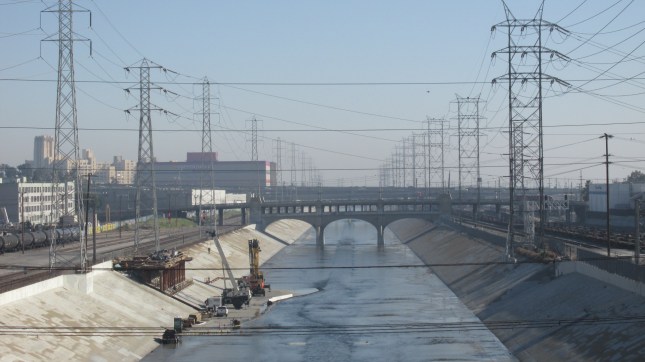
A shot of the riverbed when construction was just starting.

B6 1703 27 Riv Tower Mach

Another angle.

And here are some shots from August 2017.

B6 1708 05 Wide

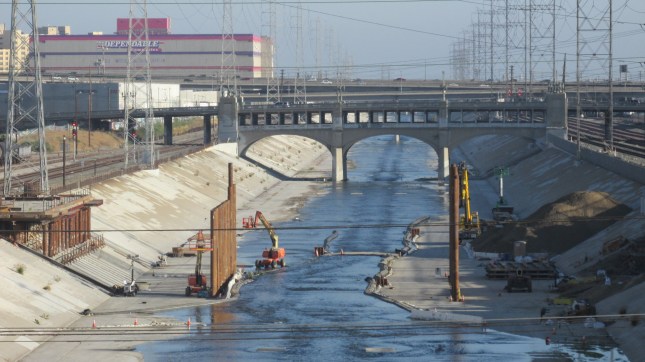
A little more progress has been made.

B6 1708 10 C w Crane 2

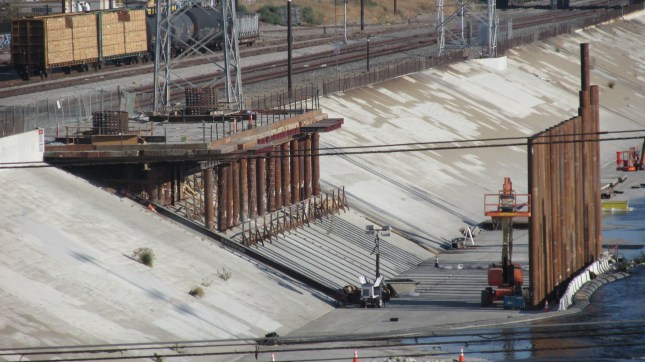
A closer view.

For the team involved with the design, this project is all about bringing things together, creating connections and offering new ways for people to experience this space. One of the chief goals is to link the Arts District with Boyle Heights and the LA River. That sounds pretty cool in the abstract, but in actual fact there are a lot of reasons to worry about the downside. I’m sure Maltzan and his team see this project as a positive thing, but that’s not surprising. They’re architects and engineers engaged in creating a spectacular new piece of infrastructure. And of course the City’s website  is all about the upside.  But really, the City’s glib promo materials don’t begin to describe what’s happening here. By itself, the new bridge may sound great, but if you look at it in the larger context of the area’s culture and economy, you start to realize that this project could have serious negative impacts.

Any large scale infrastructure project, any attempt to remake the landscape, is going to affect the surrounding communities. These impacts can be good or bad, and often it’s a mix of the two. In this case, the biggest issue is one that never gets mentioned on the City’s web site. It’s the same issue that communities all over LA are dealing with. Displacement. Downtown LA has been going through a massive construction boom, with high-end housing and high-end retail largely transforming that community into an upscale enclave. Now developers are eyeing neighborhoods on the other side of the river.

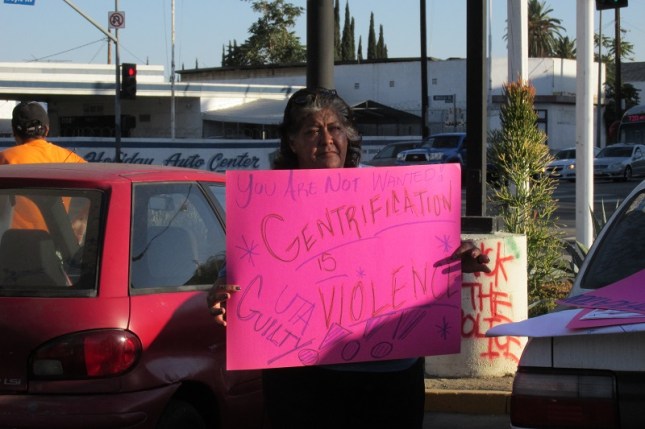
The residents of Boyle Heights are already feeling the effects of gentrification, as real estate investors looking for cheap land and big profits have been buying up parcels in the area. Evictions are already happening, and many people who live in this largely Latino community are afraid they’ll be next. You may have read about the protests that have taken place in recent years. Here are some shots from an action staged by East LA residents in September 2016.  Protesters met at the intersection of Whittier and Boyle, where the old bridge touched down on the East Side.

ELA 10 No Se Vende

“Boyle Heights Is Not for Sale.”

ELA 15 Group 2

Families are worried about losing their homes.

ELA 20 G Is V

Many people on this side of the river see gentrification as violence.

ELA 80 Bandana

New art galleries are seen as harbingers of displacement.

The protest movement in Boyle Heights has gotten a fair amount of media attention, partly because in some cases the protesters have used aggressive tactics in trying to shut down a new coffee house and some local galleries. They see these businesses as the first outposts of coming gentrification. There are people who have questioned the protesters’ methods, complaining that they’ve gone too far. But let me ask you this. If you were in danger of losing your home and being driven out of your neighborhood, how far do you think you’d be willing to go?

It’s no accident that communities like Boyle Heights have been targeted by real estate investors. Land is cheaper there than in Downtown, and they know that the completion of the bridge and the accompanying amenities will make the area more desirable to upscale residents. We’ve already seen something similar happen in the Arts District. A largely low-income community has been rapidly transformed by a massive influx of developer dollars, and the people who had lived there for years, in fact, the people who actually built the community, have been driven out.  A similar scenario has been unfolding in Hollywood, and with the construction of the Crenshaw/LAX line you can see the same thing happening in communities like Leimert Park.

Investment in a community can be a good thing, but not when it drives out the people who have spent their lives there. And these days it’s not a gradual evolution. City Hall works with developers to target areas for rapid growth, almost all of it geared toward affluent new residents. When the City or County lays plans for new infrastructure, like light rail or parks or, in this case, a bridge, real estate investors move in quickly.  Often these investors are well connected at City Hall and already have possible projects in mind.  In other cases they’re speculators just snapping up parcels that they know will rise in value. They don’t plan to build anything, since they know they can make a profit just by sitting on the property until new infrastructure is in place.  And Mayor Garcetti gleefully promotes the aggressive transformation of these communities, apparently without giving a thought to the real suffering that displacement is causing for thousands of Angelenos. It seems he feels he was elected just to serve the affluent.

These days I hear so much talk about making LA a “world class city”, and I’m really sick of it. Garcetti’s idea of creating a “world class city” is about pouring billions into new infrastructure so that developers can cash in by building upscale enclaves for the affluent. Personally, I don’t care what class LA is in. If we can’t help hardworking people stay in their homes, if we can’t support communities that people have invested their lives in building, then this city is a failure.
You can spend all the money you want on bridges and parks and rivers and rail lines. All that stuff is meaningless if at the same time we’re dismantling our communities, the human infrastructure that really holds this city together.

ELA 97 Skyline 1

This Sporting Life

MG 01 Shot

When was the last time you went miniature golfing? I hadn’t played for years. Actually, more like decades. But a while ago I was hanging out with some friends, and when the subject of miniature golf came up, it resonated deep within me. I knew that something had been missing in my life. Now I knew what it was.

Over the weekend I went with my friends Christen and Kasmira to a course in Sherman Oaks. I was surprised at how crowded it was. But on thinking about it, I realized that there are probably thousands of people like me who also feel that void in their lives, and that we were all drawn there to fill that void.

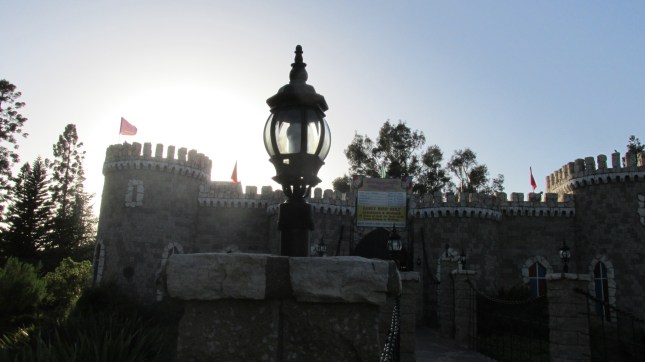
MG 05 Castle

The sun was sinking below the castle parapet as we arrived.

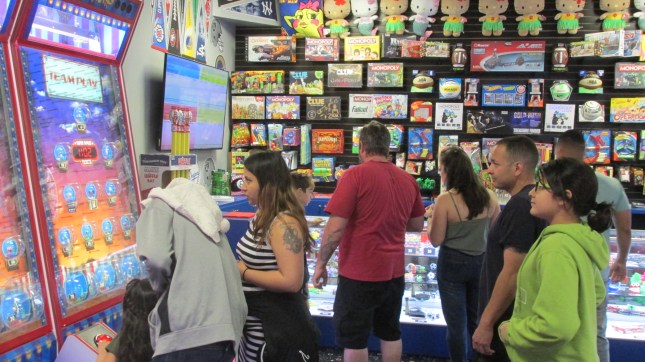
To get to the golf course, we had to make our way through the arcade. That was intense. Honestly, I never play arcade games, but there’s something about the non-stop onslaught of piercing sound and day-glo colors that appeals to me. Though I probably wouldn’t want to spend more than fifteen minutes in that environment.

MG 10 Arcade

A total sensory assault.

MG 14 Win

You mean I can only win 1,000?

MG 12 Stooges

Obviously this is a class joint.

MG 18 Staff

The crowd of golfers was keeping the staff busy.

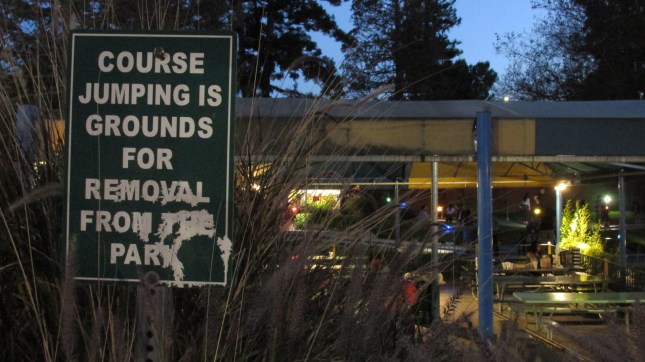
Before you tee off, make sure you know the rules.

MG 20 Jumping

If you want to play another round, you have to pay for it.

MG 22 Deface

Keep that spray paint in your pocket.

I have to tell you, in the weeks leading up to our miniature golf rendevous I was subjected to a debilitating psychological assault by my “friends”, and it definitely took a toll. Playing the first few holes, I was a mess. I couldn’t focus, my shots were all over the place, and I went way over par. But with intense concentration I managed to balance my chi, and by the fourth hole I had steadied my game.

MG 30 Waiting

Waiting to tee off.

MG 34 Smile

Gloating over a successful shot.

Unfortunately, I never recovered completely. When the totals were added up at the end of the game, Kaz was the winner, and I came in second place. But I’m not discouraged. We’re already talking about a rematch.

MG Chr Kaz

Sometimes the layout was challenging.

In spite of the humiliation of ending up as “the first loser”, I have to say I had a great time. The news is so bad these days, it was great to get away from the real world for a little while. It was a mild April night in the Valley. There were kids running around. We chatted with some of the other folks on the course. It was a great way to unwind.

MG Couple

On this course nobody minds if you pull out your phone.

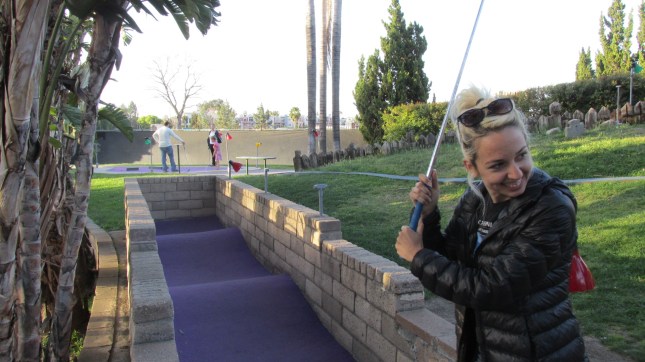
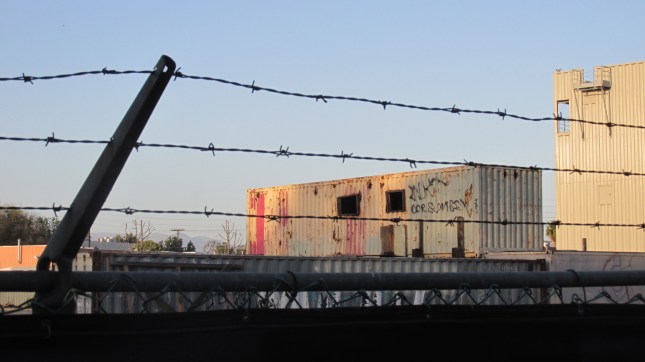
While we were strolling around I was checking out the scenery, both on the course and beyond. Looking over the fence to the north I saw what looked like a desolate urban wasteland. But when I said something about it to Christen, she told me it was a training academy for the Fire Department. Apparently during the week it’s filled with recruits learning how to fight fires. Not so desolate after all. I stopped to get a shot of the structures beyond the fence. Kaz wondered aloud whether the barbed wire was to keep us out, or to keep us in. Way too heavy a question for a miniature golf course. We moved on to the next hole.

MG 50 Wire

Looking through the barbed wire at the LAFD training grounds.

As the sun went down, colored lights came on. When we first arrived, we were debating whether to play one round or two. I have to admit, after eighteen holes I was exhausted. Obviously, not having played in years, I didn’t have the stamina I had when I was twelve.

MG 60 Lights

Around sunset the colored lights came on.

Finally, we added up the score and turned in our clubs. The game was over. But it was great to forget about the real world, even for a little while.

MG 62 Stroller

Glendale Puts Hold on Grayson Repowering

GCH 10 GTU

On Tuesday night protesters gathered in front of Glendale City Hall to oppose spending $500 million on rebuilding the Grayson Power Plant. Glendale Water and Power (GWP) has put forward a plan to replace obsolete generating units with newer ones, increasing the plant’s output significantly. The process is called repowering, and the GWP says it’s necessary to provide a reliable supply of electricity for the city.

GCH 20 Sign Speaker

Speakers talked about the problems with the current plan for Grayson.

But there are many who feel that upping Grayson’s output is a bad idea, since it means a big increase in the plant’s fossil fuel consumption. Debate over Glendale’s plan has been intense, with environmentalists claiming that the GWP has failed to explore clean energy alternatives. They point out that repowering Grayson would mean significant increases in CO2, ozone and particulate emissions.

GCH 50 Cam 2

The media showed up to cover the protest.

The Grayson plan was on the City Council’s agenda that night, and council members would be deciding whether or not to approve the project’s Environmental Impact Report (EIR). The rally broke up as the meeting was starting. I went home and watched the proceedings on my laptop. It was long night. I wanted to hang on until the Council voted, but at 10:00 pm they were still taking public comment, and I finally gave up.

GCH 60 Table

Volunteers manning the table.

The tone of the meeting was civil, but tense. Evan Gillespie spoke on behalf of the Sierra Club, and he questioned some of the claims made by GWP. The utility had initially said that Grayson needed to produce 250 megawatts or there was a danger of power shortages, but then later said they might be able to do with less. He also was skeptical of the claim that the cost of the current plan wouldn’t mean raising rates down he road.

Angela Johnson Meszaros, a staff attorney with Earth Justice, stated that the EIR had serious problems. The EIR says that the project’s emissions woudn’t be significant because of offsets provided by the South Coast Air Quality Management District (SCAQMD). How does this work? Polluters can bank credits for emissions they don’t produce, which in turn can be traded to polluters who produce more than they should. But wouldn’t Grayson still be pumping a lot of dirt into the sky over Glendale? You bet, and Johnson Meszaros pointed this out. The idea that emissions offsets will somehow even things out across the LA area sounds good in theory, but if you live anywhere near the power plant you’ll still be breathing a lot of dirty air. She also said that the biggest problem with the EIR was that it didn’t present enough viable alternatives, especially with respect to clean energy.

GCH 70 Writing

Sometimes you just can’t find a sturdy surface to write on.

Like I said, I bailed before the end of the meeting, but this morning I sent a message to the folks at Stop Grayson Expansion. They responded with the news that the Council voted 4 to 1 to put a hold on things for 90 days and issue a Request for Information (RFI). This means they’re going to look for alternative solutions for Glendale’s energy needs, including clean energy options. Stop Grayson had been hoping for an independent study of possible alternatives, but they believe that if the RFI is prepared carefully it could be a step in the right direction.

Bottom line, we need to get away from fossil fuels. This isn’t going to happen right away, but it’s never going to happen if we don’t push aggressively for alternatives. Thanks to all those who showed up at the rally on Tuesday, and thanks to all the groups who worked so hard to change the discussion about Grayson. This isn’t over yet, but things are looking a whole lot better.

GCH 90 Crowd Light

Talking to the MTA

DSC04388

I’ve spent a fair amount of time slagging the MTA, so I want to make sure I don’t overlook the things they do right. Recently I learned about the agency’s NextGen Bus Study, which is an effort to redesign the bus network with an eye toward building ridership. This is an important step. Ridership has been declining for years now, and the MTA really needs to rethink what it’s doing. I was glad to hear that they were taking a good, hard look at the bus system, and I was wondering what kind of public outreach they’d be doing.

That outreach has taken the shape of Telephone Town Halls, so far two of them, held earlier this month. It’s a virtual town hall meeting where people can join using their phone or their computer. MTA staff members were on hand, and they took questions directly from callers. At intervals they asked the audience to take quick surveys, and the results were revealed wihin minutes.

I thought it was great. While I still think public meetings in physical spaces are important, I loved the fact that I could participate while sitting in my living room. I was afraid most of the meeting would be about bureaucrats explaining spreadsheets, but my fears were unfounded. The bulk of the time was given to answering questions from participants. And it was interesting to learn from the surveys what other peoples’ priorities were.

Two of these virtual town halls isn’t nearly enough. This one was actually split between the NextGen Bus Study and a discussion of budget issues. I hope the MTA schedules more of these focussed specifically on redesigning bus service. I think the decline in ridership is in large part due to the fact that the agency has lost touch with its core ridership. They really need to find out what people want, because otherwise the declines will continue.

And along those lines, I hope the MTA plans to reach out specifically to the low-income immigrant communities that depend on busses to get around. I noticed they did provide Spanish translation at the town hall I attended. I hope they were also providing translation in other languages. Many of the people who ride the MTA don’t speak fluent English, and their voices need to be heard.

But this was certainly a step in the right direction. I’d definitely log on for another one of these.

NextGen Bus Study


Liberty Park Saved!

LP X Curve 2

A while back I wrote a post  about the battle to save Liberty Park.  It was in danger of being erased by a large mixed-use project.  But local activists mounted a strong defense, and on March 7 the City Council voted unanimously to designate it a historic cultural monument.

The folks at Save Liberty Park did an amazing job of rallying the community behind this effort.  Not only does their web site tell the story of the fight to save the park, but it also tells why it’s such an important resource for the community.  If you haven’t visited the site already, check it out.

Save Liberty Park


Rain in Downtown LA

Rain 01 Woman Umb

This has been a pretty dry winter, so I was really glad that it rained most of the afternoon today. I was in Downtown and I took some photos.

Rain 05 GP Wood

Not many people in Grand Park today.

Rain 10 GP Conc

Nobody hanging out at the tables.

Rain 15 Crosswalk

I’m guessing the few people who were on the streets probably just wanted to get somewhere dry.

Rain 20 Bus

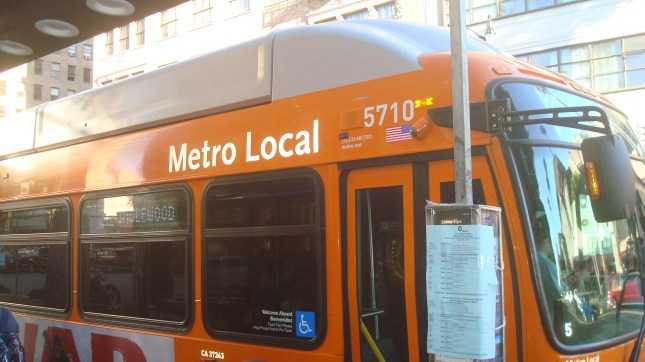
On rainy days, it’s always a relief when the bus rolls up.

Rain 50 CH Park

The park outside City Hall was drenched.

Rain 52 CH Park 2

Sheets of water were running across the pavement.

Rain 70 Sculpture

A row of trees outside LAPD Headquarters.

Rain 80 Spring Trees Bare

The rain kept falling through the afternoon.

Even with the rain we’ve had so far this month, we’re still well below our annual average.  Hopefully there are more storms on the way.

Rain 90 Broadway


West Hollywood Is Taking Action. Why Can’t LA?

IMG_1488

Level Furnished Living in Downtown LA

A friend just sent me an article from Wehoville. Last year the City of West Hollywood issued a ruling that Korman Communities, operator of the AKA extended-stay hotel, was breaking the law by offering units as short-term rentals. There are actually 190 units in the complex, which was originally approved by the City as residential condominiums. When the site was purchased by Korman, they announced that the units would instead be offered for extended-stays. This is key, because this use is allowed, since guests would be residing there for more than 30 days.

But after doing some research, Interim Director of Planning John Keho concluded that the 110 units in the west tower were actually being offered as hotel rooms. He found evidence on-line that AKA was promoting the building as a hotel and decided the City had to put a stop to it. Korman is appealing the decision, and there will be a hearing this week.

The reason I’m bringing this is up is that there’s a similar situation at Level Furnished Living (LFL) in Downtown LA, and City Hall has done absolutely nothing about it. The project was approved back in 2013 as 303 residential condominiums and 7 commercial condominiums. But when it actually opened, the units were being offered not as condos but for extended stays. Again, this is legal, because the guests are staying for longer than 30 days. But last year the LA Weekly reported that the units were being offered for short-term stays. In other words, they’d become hotel rooms. This is not legal.

And what has the City of LA done about it? Absolutely nothing. The owners of the building claimed they were working with the Department of City Planning (DCP) to get a transient occupancy permit. This may be true, but the DCP hasn’t approved anything yet, and the building is still operating as a hotel. In other words, while the folks at City Hall are telling us we have a housing crisis every chance they get, they’re allowing the owners of LFL to turn over 300 residential units into hotel rooms.

So what does the City have to say for itself? I was at a meeting last month where a guy from the City Attorney’s office spoke. He first told us that they just didn’t have the staff to go after illegal short-term rentals (STRs). He went on to say these cases were really difficult because the City had to send inspectors out to the site to actually see that there were guests who were staying there illegally. This was tricky, because inspectors worked during the day, and tourists were usually only in their rooms at night. So, according to him, the City’s hands were tied.

What rubbish.

How hard is it to find evidence that LFL is offering units as hotel rooms? I just went to Hotels.com and did a search. It came up right away. I punched in some dates and found I could stay there for as little as one day.

LFL from Hotels Book One Night 180313 CROPPED

But is that really evidence? Even if they’re posting on Hotels.com, maybe no one has ever actually booked a room as a short-term guest. So I went to Yelp! next, and found these reviews….

“My family decided to travel back to LA over Thanksgiving. Since we are a family of four with two little kids we didn’t want to inconvenience anyone by staying in their home. That being said, since we had kids we needed to also have a kitchen and ample living space for our brief stay, enter Level Furnished Living.”

“I ended up staying at Level after a nearby hotel messed up my reservations multiple times and could not host me. The staff at Level were so accommodating and wonderful! We were given an early check in time and they answered all questions we had.”

“Last weekend I traveled to LA for a fun filled weekend of football. On Saturday I watched a great game between the Texas Longhorns and USC. The next day I saw one of thenew LA teams the Chargers play my home team the Miami Dolphins. Now even though those experiences were great, I had to give kudos to the place were I stayed. Which wasLevel Furnished Living!”

People do really seem to love the place. And I should point out that some guests who posted reviews had stayed for months. But it’s clear from these postings that LFL is offering units as hotel rooms.

So why hasn’t the City taken action? Back in 2016, when short-term rentals were becoming big news, City Attorney Mike Feuer held a press conference and announced that he was going after four apartment owners who had illegally turned units into STRs. But we’re coming up on two years since that press conference, and last time I checked none of those cases had been resolved. Feuer is good at putting on a show for the media. Not so good when it comes to cracking down on wealthy developers.

And would Feuer even have to file a suit against LFL? No. The City could start by simply sending a letter to the owners saying that the City had evidence that the building is operating as a hotel, and telling them to either shape up or face the consequences. If they failed to comply, then the City could open an investigation. I don’t care how short staffed they are. This isn’t a duplex where the landlord is making some extra cash on the sly. This is a tower with over 300 units in the heart of Downtown. It was approved as residential housing. The DCP keeps approving new luxury towers in Downtown, insisting that the area needs more housing. Why isn’t it cracking down on people who are illegally taking housing off the market?

Actually, the answer is simple. City Attorney Mike Feuer, Councilmember Jose Huizar and Mayor Eric Garcetti really have no interest in providing housing for the people of LA. They also have no interest in prosecuting wealthy deveopers, no matter how many laws the developers break. They’ll give you a lot of excuses, but in reality they just don’t give a damn.

Bottom line, the City of West Hollywood is taking action. The City of Los Angeles is not.

If you want to read about city officials who actually feel it’s their responsibility to serve the public, here’s the story from Wehoville.

AKA Appeals City Decision that Its Short-Term Luxury Rentals Are Illegal

We Need Trees, Not Fees

T C Vn Bldg 2

The City has a problem. The Urban Forestry Division (UFD) has scores of trees sitting in boxes in storage that it can’t plant. Why is this? In large part it’s because when developers remove trees to build projects, they agree to replace them by purchasing new ones for the City to plant elsewhere. Unfortunately, due to budget cuts, the UFD has no staff to do the planting. And worse, when trees are stuck in boxes for long periods of time, their health declines, sometimes to the point where they’re not viable any more.

Actually, the City has an even bigger problem than this. We’re losing a huge chunk of our urban forest. Years of dry weather has already impacted the health of thousands of trees in the LA area, but now there’s a worse threat. A beetle called the shot hole borer has come to the region. It nests in trees and in the process often kills them. The die-off has already begun, and if it continues at its current pace we can expect to lose millions of trees throughout Southern California over the next several years. This isn’t just a matter of erasing pretty landscapes. As a result of this massive reduction of our urban forest, there will be impacts to our water resources, our air will be dirtier, and our cities will grow hotter than they are already.

So you’d think we’d be doing everything we can to protect the trees we’ve got. Unfortunately, that’s not the case. Aside from the natural threats to our trees, development is taking a toll on the urban forest. City Hall is pushing hard to boost construction of housing and hotels, as well as office and commercial space. Which brings us back to the first point. Developers generally want to squeeze as much square footage as they can out of a project. Often they ask the City to reduce required setbacks, or even let them build right out to the property line. In many cases they also ask the City to reduce the requirements for open space. The Department of City Planning (DCP) is usually pretty generous in granting developers’ wishes, especially if it’s a housing project that includes some affordable units.

To give you an idea of how bad things have gotten, let’s talk about the City’s Protected Tree Ordinance (PTO). Some species are considered so important that we should afford them special protection. A while back the City Council approved the PTO in order to prevent their removal except under extraordinary circumstances. So how’s that working out? Not so good. In November of last year Councilmembers Paul Koretz and Mike Bonin introduced a motion to strengthen the ordinance. Here’s a quote.

”Unfortunately, trees are not being adequately protected and departments are not working well together to protect them. Trees are being cut before development permits are applied for, trees are not being protected during construction activities, and building permits are routinely issued without the Department of Building and Safety being aware of the presence of protected trees on the affected properties, all resulting in an accumulating net loss of trees, tree canopy and the accompanying ecosystem services across the City.”

This is serious. We need trees. Our water resources are increasingly stressed. LA’s air quality ranks among the worst in the nation. And temperatures in the city continue to rise. A robust urban forest would help us deal with all of those problems, but instead of enhancing our tree canopy we’re cutting it down.

IMG_2559

The reason I’m bringing all this up is that there’s a proposal before the City right now to allow developers to fulfill the requirement for replacing trees simply by paying a fee. For new projects that remove trees, the City would calculate the required number of replacements (usually at a ratio between 2 to 1 and 4 to 1), and then bill the developer for in-lieu fees of $2,612 per tree. This amount would cover the cost of procurement, planting and providing water for three years.

At first glance, this might look like a good deal. The UFD doesn’t have staff to plant the replacement trees it’s been receiving, and storing them for long periods of time impacts the trees’ health. There apparently has been talk of restoring some of the UDF’s funding in the City’s next budget, which could lead to the hiring of personnel to plant trees. But that’s definitely a roll of the dice, since LA is struggling with a structural deficit, and for years now its budgets have been held together with scotch tape and bubble gum. Many City departments suffered staff cuts during the recession, and they’re all lobbying to restore those positions. So without any certainty over staffing for the UFD, the in-lieu fee probably seems pretty attractive, since the cost of planting and watering is built in. The City is outsourcing a lot of work already, and it could just hire a contractor to do the job.

But really, there are a number of problems with just charging an in lieu-fee….

First, it makes it even easier for the DCP to allow developers to do away with trees. If, in theory, all the trees that are removed will be replaced at a 2 to 1 ratio or better, and if the money collected includes planting and watering, then why would they hesitate to reduce setbacks and open space? Let the developers do whatever they want! Problem solved. But in reality, we have no guarantee that this system will work as promised. Think about it. Supposedly the current system of requiring developers to replace trees was going to solve the problem. And what actually happened? We have a lot of trees sitting in City-owned storage areas. Some have been sitting in boxes so long that they’re no longer viable. And at the same time developers have been cutting down trees and putting hardscape in their place.

But the City would certainly spend the money they collect. Right? Not necessarily. You may recall that back in 2015 City Controller Ron Galperin did an audit of fees collected from developers. He found $54 million that had been sitting in City-controlled accounts for at least three years. This money had been collected, but it hadn’t been spent. Unfortunately, City Hall isn’t always great about following through.

Second, while charging the in-lieu fees may lead to a better replacement rate in the future, there’s no guarantee that the City will do anything about the trees the UFD currently has in stock. If the budget for the next fiscal year doesn’t include funds for additional staff, these trees could easily sit in storage until they die. It’s been suggested that non-profits could step in to do the planting. If that’s a possibility, why hasn’t it already happened?

Third, and most important, this is not a solution, it’s a quick fix. In order to find a solution, you have to first identify the problem, and the City hasn’t done that. It’s proposing in-lieu fees as a way of replacing trees that are cut down for development, but that’s really just one aspect of the situation.

The real problem is that we’re facing a potentially devastating loss of our urban forest.

If we fail to maintain our urban forest, our air quality will suffer, our water quality will be diminished, and LA will continue to grow hotter than it already is.

LA needs a comprehensive, holistic approach to managing our urban forest. We must do a complete inventory of the city’s tree canopy, and also an inventory of space available for planting trees. We then need to use this data to develop a unified policy based on actual science that will address all aspects of the problem. Rather than coming up with quick fixes to deal with tree loss caused by new development or sidewalk repair or insect infestation, we need an integrated approach that brings all these things together.

In other words, we need to gather the data, look at the science, and then develop an actual plan.

If we don’t do this, our urban forest will continue to decline, and we will suffer the consequences.

If you want to take a look at the proposed ordinance, here’s the link.

Tree Replacement In-Lieu Fee

If you want to contact your City Council rep about this issue, be sure to include this council file number in the subject line.

CF-16-0461

And to make sure your comments are included in the file, don’t forget to copy the City Clerk.

cityclerk@lacity.org

Finally, if you want to voice your comments in person, this issue will be considered by the Community Forest Advisory Committee (CFAC) later this week.

CFAC Meeting
Thursday, March 1, 1:00 pm
City Hall, 200 N. Spring St, Room 361
[USE MAIN ST. ENTRANCE.]

For more information, follow the link below.

CFAC Meetings

IMG_2608


I Remember When Artists Used to Live There

AE 800 Traction

800 Traction

Back in November I posted about a protest by Downtown artists facing eviction. I’d been wanting to follow-up, so earlier this month I went to a gathering at 800 Traction to check in with the folks there. Unfortunately, there’s not a lot to report. The artists who’ve been living and working in this building for years, in some cases for decades, still don’t know what the future holds for them. They’ve hired a lawyer, and negotiations with the developer are currently underway. No one had any current news about The Artists’ Loft Museum Los Angeles (ALMLA), which is a short walk away, at 454 Seaton. This is another group of creative people who have called the area home for years. They were served with eviction papers in 2017, and have been wrangling with lawyers since then.

AE ALMLA

454 Seaton

But I wanted to write a post anyway, if only to keep this situation in peoples’ minds. As gentrification continues to spread across LA, the pace of evictions is accelerating. Evictions from apartments covered by the Rent Stabilization Ordinance (RSO) have been increasing for years, with 1,824 units taken off the market in 2017 alone. Over 23,000 RSO units have been lost since 2001. But this only tells part of the story, since there’s no mechanism in place to track the number of tenants who are forced out of non-RSO units. It’s commonplace these days for people living in a building not covered by rent control to find that the landlord has suddenly hit them with an exorbitant increase. If they can’t pay, they have to leave, and no one has been keeping track of how often that’s happened in recent years. If you’re not covered by the RSO, you have no protection. Unfortunately, that’s the case for the artists at 800 Traction.

So many people have highlighted the irony of an Arts District that’s forcing artists out, it seems redundant to bring it up again. The folks at City Hall certainly don’t care. They’ve been actively assisting real estate investors in a massive overhaul of the area. The change in the neighborhood’s vibe is both striking and depressing. Even going back just 10 years, I can remember aging warehouse spaces filled with struggling artists who didn’t have much money, but who had still managed to create a lively community. Most of those people are gone now. And where there used to be cheap dive bars and funky little stores, now the streets are being taken over by clothing shops and chain restaurants. More and more these days the neighborhood seems like a giant outdoor shopping mall.

AE Umami

The people at City Hall keep talking about how they want to create vibrant communities, and insist that the onslaught of high-priced apartments and upscale retail is helping to achieve that goal Downtown. In reality, what they’re doing is creating enclaves for the affluent that automatically exclude anyone making less than $70,000 a year.

If these artists are eventually forced out of their homes, it’ll be one more win for the developers. And a huge loss for LA.

AE Live Work