Following Through on Earthquake Safety

Photo of building damaged in earthquake from LADBS web site.

Photo of building damaged in earthquake from LADBS web site.

For a while now I’ve been meaning to follow up on a post I did in 2014 about seismic retrofitting. Back then Mayor Garcetti proposed evaluating buildings based on how they’d weather an earthquake, and to make the information available to the public. This was to be the first step in creating a program to reinforce thousands of soft-story apartment buildings, i.e., older wood-frame structures with parking tucked under the units.

It was a great idea, but I have to admit I was skeptical about the Mayor pulling it off. Everybody agreed that it was important to upgrade these older buildings, but implementing such a program meant that landlords and tenants would have to shell out a lot of money to make it happen. I was afraid that after the initial hype faded away, the initiative would die a quiet death at the hands of some committee at City Hall.

I was wrong. Garcetti brought Lucy Jones on board, and she successfully spearheaded the effort to make this happen. The City Council adopted the ordinance in 2015. Earlier this year the Department of Building and Safety started sending letters to property owners letting them know what they have to do to comply. The program will be rolled out in phases, tackling the most risky buildings first. Landlords will be allowed to pass a portion of the cost along to tenants.

The Mayor deserves credit for making this happen, as does Lucy Jones. It wasn’t easy selling it to anxious landlords and tenants. It’ll take years for the process to be completed, but this ordinance will save lives when the next earthquake hits.

If you’d like more information, follow this link to the page at the Department of Building and Safety.

Soft-Story Retrofit Program at LADBS

How Bad Is Rent Control?

apt-05-big-small-1

A while ago I was at a neighborhood council meeting in Hollywood, and things were getting pretty heated. The topic was the conversion of a rent-controlled apartment building into a boutique hotel, and the people who spoke weren’t shy about saying which side they were on. It was the tenants versus the property owners, and there was no middle ground. Each side was convinced they were absolutely in the right.

The tension was so thick you could cut it with a knife. And it only jacked things up higher when one of the pro-business attendees jumped into the debate. I can’t remember her exact words, but she said something like, “Let’s face it. The vast majority of economists are against rent control.”

I didn’t believe it. I thought she was just trying to bolster her own position. But I didn’t get a chance to call her on it, because the meeting was running late, and ended up lurching to an abrupt halt. The crowd wandered slowly out of the room, with little groups banding together to keep the debate going, while the security guard kept trying to herd us all toward the exit.

Later on, I got on the net to find out what economists really had to say about rent control. And I found out she was right. The vast majority of economists are totally against it. It really floored me when I found a piece Paul Krugman wrote back in 2000 where he argues forcefully that rent control discourages new construction, thereby limiting supply, and inevitably driving rents up. I have a lot of respect for Krugman. I figured if he said it was bad, then it had to be bad.

But the more I thought about it, the more I began to question whether the economists really knew what they were talking about. They’re making the standard argument, that prices rise when supply is short and demand is high, and that prices fall when supply starts to outstrip demand. It’s one of the basics of economic theory, and you can find thousands of examples where the market works exactly that way.

So who am I to tell Paul Krugman he’s wrong? He’s got a Nobel Prize. I don’t even have a college degree. But actually, I don’t think his view lines up with the facts. And here’s why….

apt-yellow-white

In surfing the net, I learned that there are two schools of thought on rent control. The economists who argue that it’s inevitably bad point can point to a mountain of evidence in their favor. But the evidence they’re basing their conclusions on is mostly decades old. In the early- to mid-twentieth century, you had “hard” rent control, which meant setting absolute limits to what landlords could charge for a unit. Once the price was fixed, there was no changing it. The result was poor maintenance, black markets, and little or no construction of new units. But this kind of rent control largely vanished after WWII. And yes, the reason it disappeared in the US was because of a building boom that created huge numbers of houses and apartments, aided by federal policies that made it possible for the average person to get a home loan. Supply-siders please take note. The federal government actively supported middle-income families who wanted to buy a home, spurring the creation of housing developments nationwide.

The second generation of rent control came in the 70s, when rental prices started climbing rapidly. Numerous US cities passed some kind of ordinance to keep a lid on rising rents. And right there the supply siders should see a problem with their argument. If the absence of rent control led to plentiful supply and cheap housing, then nobody would have felt the need to impose regulation. The fact that municipalities all over the US felt pressure from renters to take action indicates that the free market wasn’t working the way it was supposed to.

But the ordinances passed in the 70s were different from “hard” rent control. These measures mostly took a “soft” approach, meaning they didn’t set absolute limits. The Rent Stabilization Ordinance (RSO) passed in LA allowed gradual yearly increases. Also, it only applied to units constructed before 1978. There are economists who are argue that even measures like this still suppress construction, but that didn’t happen in LA. In fact, in the mid-80s the city saw a building boom that created around 100,000 units in the space of a few years. Another feature of “soft” rent control was vacancy decontrol, meaning that when a tenant moved out the landlord could raise the rent as high as they wanted.

But according to the supply siders, it doesn’t matter how you structure it, rent control is bad. And many of them cite LA as a classic example of why it doesn’t work. “Of course tenants are paying outrageous prices there,” they say. “It’s because they’ve got rent control. It drives prices up.” The problem with this argument is that most of the people making it don’t even know which LA they’re talking about. Generally they’re thinking of the County of Los Angeles, not the City of Los Angeles, and there’s a big difference. The County is made up of 88 different cities, and only a few of them have rent control. If the argument put forward by the supply-siders was true, then rents within the City of LA would be higher than rents in surrounding cities that don’t have rent control. But that’s not necessarily the case.

apt-50-rectangle-b

Before I go any further, let me say that finding useful data to make any judgments at all about rent-control isn’t easy. I looked at a number of sources before writing this post, and gradually realized that it’s hard to find reliable, objective info about prices for apartments that are currently on the market. My first move was to look at US Census data, and I quickly ruled it out because it records what tenants are paying instead of prices for units that are currently being offered. That would definitely drive the numbers down in rent-controlled cities, so I had to look elsewhere. I checked out a number of sites that list current rentals, and I was astounded by how high the prices were on some of them. But this is because these sites are mostly geared towards newer apartments, and they often get revenue, directly or indirectly, from the companies that are marketing the units. Another problem is that most commercial sites tend to focus on the hotter markets. Zumper covers the entire US, and regularly issues reports on rental prices. The data they collect is cited by many who write about the market, including journalists. But after taking a closer look I have to question the reliability of Zumper’s info. Check out this map they published this summer about the rental scene in LA.

LA Rental Prices from Zumper, Summer 2016

LA Rental Prices from Zumper, Summer 2016

Based on the data from this sampling, they report that the median rent for a one-bedroom in LA is $1,970, and that LA is the seventh most expensive city in the nation. Let’s take the second claim first. It’s not true. LA may be the seventh most expensive major city in the nation, but there are many cities that are more expensive, including a number in California, like Santa Clara, Redwood City, Dublin, and Cupertino. And none of them have rent control.

Second, this map includes three cities besides the City of Los Angeles. It shows Santa Monica, Beverly Hills, and Culver City. If you think this is nitpicking, let’s move on to the fact that the map actually only shows about half of the City of Los Angeles. It doesn’t include anything east of Downtown or north of the Hollywood Hills. While it includes some neighborhoods where rents are lower, the map seems to have been deliberately drawn to focus on the hottest areas. Why isn’t East LA in the picture? And how come the entire Valley is left out? Is this Zumper’s idea of objective data? There are some pricey neighborhoods in the Valley, but if they’d included Van Nuys, Arleta, Panorama City, Pacoima, Reseda and Sylmar it would almost certainly have brought the median rent for a one-bedroom down. The fact that Zumper’s map is centered on the neighborhoods where prices are highest makes their conclusions seem pretty dubious.

So where do you go to get credible data on current market rates? Honestly, I don’t think there’s any source you can trust completely, but I did find one that seemed more reliable than the others. Rentometer not only covers all of LA, but it also offers information on specific neighborhoods. Its data covers the range of units currently being offered, both new and old. Also, since I wanted to compare LA with other cities that don’t have rent control, I needed a site that would give data limited to a certain area. You may think that’s pretty basic, but I’ve been to sites where I punch in a zip code and they give me everything within a five mile radius.

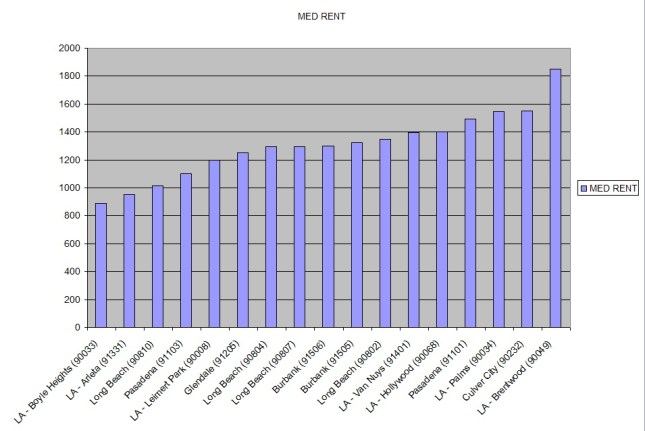
So using Rentometer, I started entering zip codes to compare prices in neighborhoods all over LA County.* Here’s the data I found based on the median rent for a one-bedroom.
LA Rental Prices from Rentometer, Summer 2016

LA Rental Prices from Rentometer, Summer 2016

The first thing the graph shows is that there’s a huge range of prices just within the City of LA. This may sound obvious, but again, most commercial sites focus on the high end, and really don’t give an accurate picture of how much variation there is. You can find a huge difference in prices even in neighborhoods that are right next door to each other. I was skeptical about how high the median price given for Van Nuys was, but looking at a map I found that the area covered by this zip code was just west of Valley College. Definitely a more upscale neighborhood than what you’d find around Van Nuys Blvd. and Sherman Way. I was also surprised by how low the median rent was on the west side of Pasadena, but a friend who lives in that city told me that housing around the Foothill Freeway is definitely cheaper.

The second conclusion I came to is that prices don’t seem any lower in cities with no rent control. Neither Burbank nor Long Beach have rent control, but they come out right about in the middle. Pasadena and Culver City don’t have rent control either, and they both appear at the high end. Comparing Palms and Culver City seems like a good way to make my point, since they’re right next to each other. The first is part of the City of LA and subject to rent control, while the second is an independent city where there is no rent control. But the median price for a one-bedroom is almost exactly the same.

I’m sure there are those who will say that this comparison is flawed, since these cities are all within LA County, and that the RSO is causing a spillover effect, pushing up prices even where there’s no rent control. To those people I say, take a look at Orange County. None of the cities within its boundaries have rent control, but you’ll find pretty much the same range of prices.
apt-60-bland

Is this data conclusive? Or course not. If there’s anybody who can come up with a better source and compile a more comprehensive sample, I’d love to see the results. But based on the data I’ve found, I don’t see any reason to believe that rent control drives prices up. To me it looks like the deciding factor is how desirable an area is for people who have money to spend.

Yes, it’s true that the majority of economists are opposed to rent control. But it’s also true that there’s a younger generation of economists who see the situation as being more complex than your standard supply side formula. I found an article on-line by economist Richard Arnott, (Time for Revisionism on Rent Control?, Journal of Economic Perspectives, Winter 1995) that makes a compelling case for a more nuanced view. Arnott acknowledges that the older “hard” rent control measures were counter-productive, but he doesn’t believe that the newer “soft” measures necessarily have the same damaging impacts.

Arnott also talks about imperfect markets. These are markets where there are forces in play that disrupt the standard dynamic, creating situations that can’t be explained using a simple supply side equation. Twenty first century LA is a great example. Fifty years ago if you built an apartment complex in LA you were most likely marketing your units to people who lived in LA. That’s not true any more. These days developers are pitching their product not just to prospective tenants all over the US, but in some cases all over the world. To them it doesn’t matter if the average Angeleno can’t afford their prices. There’s probably somebody in New York, or Paris, or Seoul, who can.

Here’s something else to consider. With interest rates at record lows, real estate is one of the few sectors that has offered a high rate of return. Investors have been plowing their money into development in search of big payoffs. Why should they waste their time building modest housing for middle-income renters when they could reap huge profits building luxury skyscrapers for the wealthy? This has led to a speculative binge that’s caused real estate prices to skyrocket, and made it difficult for anyone to build housing for middle-income or low-income families. The higher prices charged for new units distort the numbers, and push the so-called “market rate” higher than it should be. A report produced by LA’s Housing + Community Investment Department (HCID) in November 2015 found that there was a 12% vacancy rate in units built since 2005. At the same time, the overall vacancy rate in the city was around 4%. To my mind this shows that these days developers aren’t building units geared toward the people who actually live in LA. If they were, you wouldn’t be seeing such a huge disparity in vacancy rates.

apt-70-ktwn-high-rise

Short-term rentals (STRs) are also having an impact. If landlords find that renters can’t afford their units, no problem. You can actually make just as much money (or more) by listing the units on the net as STRs. Why should a landlord bother with pesky renters who expect a livable dwelling in return for their money, when they can cash in by turning the place into a weekend crash pad? City Hall recently passed legislation to clamp down on this practice, but it’s too early to tell if it’s having any effect.

Again, I’m not going to claim that the data I’ve collected proves anything conclusively, but if anyone wants to argue that rent control is evil, they’ll have to come up with something better. I believe that skyrocketing rents in LA have nothing to do with rent control, and everything to do with a speculative market that’s been actively encouraged by the politicians who run this city. And anyone who wants to make a supply side argument had better show how they’ve factored in the forces described above. When it comes to housing, the landscape has changed. I don’t believe the old rules apply.

If you’re interested in reading more on the subject, I recommend Arnott’s article. Here’s the link.

Time for Revisionism on Rent Control?

*
I should note that when I started checking prices on Rentometer, the site allowed you to search by zip code. That changed recently, and now you have to search by neighborhood. When I looked up the last couple of communities for the graph, I searched by neighborhood and then found the corresponding zip codes.
apt-20-hillside-b

How Do We Help the Homeless?

Notice outside of vacant homes on Roscoe Blvd. in Panorama City.

Notice outside of vacant homes on Roscoe Blvd. in Panorama City.

If you live in LA, by now you’ve gotten used to the fact that homeless people are part of the landscape. No matter where you go, Downtown, Koreatown, Hollywood, Van Nuys, you see people living on the streets. It used to be that homelessness was one of those things you could escape by running to the suburbs, but not any more. Nowadays Burbank, Glendale, Encino, all have their share of people living in tents and cardboard boxes. The homeless are everywhere, and there’s no simple solution.

The homeless population in Panorama City has been growing for a long time. For a while there was a large encampment off of Van Nuys Blvd. over by Smart & Final. Not too long ago the City dismantled it, but of course, that didn’t solve the problem. The residents of the camp were dispersed, but they didn’t go away. They just bundled up their stuff and moved it somewhere else.

Homeless encampment near Roscoe and Lennox.

Homeless encampment near Roscoe and Lennox.

Another shot of the makeshift shelter.

Another shot of the makeshift shelter.

At the corner of Roscoe and Lennox there was a row of houses that were empty. A developer had bought them intending to tear them down, but since work on the project hadn’t started yet, the homes just stood there, vacant. It wasn’t long before a group of homeless people decided to move in. The police chased them out, but instead of leaving the area, they simply created a makeshift shelter on the parkway in front of the houses. As weeks went by the shelter grew larger and longer, until it was difficult to pass on the sidewalk.

Vacant houses near Roscoe and Lennox.

Vacant houses near Roscoe and Lennox.

A view from the alley behind the vacant homes.

A view from the alley behind the vacant homes.

I was curious to find out what was going on with the empty houses, so I contacted Councilmember Nury Martinez’ office. I got a call back from her Communications Director, Adam Bass, who told me that the developer had pulled a demolition permit for the houses, though he wasn’t sure when they’d actually be bulldozed. I asked how Councilmember Martinez was dealing with the homeless situation in her district, and he informed me that earlier this year a new program had been launched in CD 6. The Homeless Outreach and Proactive Engagement (HOPE) initiative brings together the LAPD, the Bureau of Sanitation, and the LA Homeless Services Authority to engage with those living on the streets. While the City still clears away illegal encampments, the idea is to offer assistance to those who want it. Bass told me that since May, the HOPE initiative had helped dozens of homeless people in the Valley, in some cases finding them space in shelters and in others giving a hand to those looking for jobs. Over the summer the program expanded into the LAPD’s Central and West bureaus, and next month it’ll move into South LA.

This is a big improvement over the City’s past efforts. Some of City Hall’s recent attempts to deal with the homeless have been outrageously heavy-handed. Their efforts were so draconian that they were challenged in court three times, and the City lost every time. So the idea of a multi-pronged approach that brings different agencies together to offer assistance is a welcome one, and I’m glad it’s been successful so far. But unfortunately, the problem is so big and so complex that it’s going to take a lot more to bring about real change.

There are no easy answers. I’ve talked to a lot of people about this issue, and everybody’s got ideas, but there’s no consensus. In November there will be a measure on the City ballot to approve a $1.2 billion bond which would pay for construction of permanent supportive housing. At the same time, the County is expected to ask voters to approve a quarter cent sales tax increase which would help provide new services to the homeless. These initiatives could make a big difference, but really they both have to pass in order to make things work. To construct new housing without expanding staff to provide support for the homeless would be a waste of money, and the same goes for offering additional support without getting people off the streets.

And it could be that both of these measures will go down. In this upcoming election, the City, County and State are asking voters to approve billions in taxes and bond measures, and it seems possible that many voters, overwhelmed by the flood of initiatives, won’t be in the mood to approve anything.

As for other ideas on how to help the homeless, some people have suggested that the City use existing vacant housing to provide shelter. My feeling is that without support services, this would be futile. The idea of gathering tens of thousands of homeless together in empty buildings without offering mental health services, help for addicts or counseling seems like a recipe for disaster. Another proposal is to get the state and/or federal government to kick in more money. Garcetti already tried that. It went nowhere.

Personally, I think the most important thing is to keep people from becoming homeless in the first place. This probably sounds so obvious you may ask why I’m even mentioning it, but it’s important to keep in mind. One of the leading causes of homelessness is eviction, and thousands of LA tenants have been kicked out of their homes in recent years. In part, this is because the City offers incentives to developers that make it very tempting for them to take advantage of the Ellis Act. If City Hall really wants to make a dent in the homeless problem, our elected officials need to stop rewarding landlords who throw their tenants out. The recent passage of an ordinance to crack down on “cash for keys” scams is a good start, but City Hall needs to do more. If you don’t want people living on the streets, then you need to do everything possible to keep them in their homes.

Demolition of the houses on Roscoe.

Demolition of the houses on Roscoe.

Earlier this month, the homeless encampment on Roscoe was dismantled. Around the same time, the houses that had been standing empty were demolished. But it’s only a matter of time before another makeshift shelter springs up in the neighborhood. This problem isn’t going away any time soon.

pc-a7-flat-alley

Tenants Take a Stand

ya-address

There’s been a noticeable shift in City Hall’s public stance on evictions recently. A couple years ago, the Mayor and the City Council weren’t saying much, and certainly weren’t doing much, about the wave of displacement that was sweeping across LA. Ellis Act evictions had been rising steadily, thousands of tenants had been forced out of rent-stabilized apartments, and City Hall’s reaction was pretty much, “Who cares?”

But now that the issue is getting media attention and our elected officials are taking some serious heat for their inaction, the change in attitude at City Hall is noticeable. Mayor Garcetti has unveiled the Home for Renters campaign, designed to inform tenants of their rights. The Housing & Community Investment Department (HCIDLA) web site is offering booklets renters can download in English and Spanish to learn about how the law protects them. There’s also been an accompanying media blitz to get the word out. I have to wonder if City Hall’s sudden concern for LA’s renters will last beyond next year’s election, but right now you can tell the politicians are nervous.

One of the most striking examples of this turnaround can be found in the story of a group of tenants living in the apartment building at the corner of Yucca and Argyle in Hollywood. The building is home to 44 households, including singles, couples, families with children, seniors and veterans. It’s subject to LA’s Rent Stabilization Ordinance (RSO), which means that rents can only go up about 3% every year. A while ago they got word that the building was going to be sold to Champion Real Estate, a developer that had plans to build a luxury high-rise on the site. It seemed like it would just be a matter of time before the new owner started handing out eviction notices.

ya-yucca

But that hasn’t happened. Yet. And a large part of it has to do with the fact that the tenants decided they weren’t going to let themselves be pushed around. They connected with the LA Tenants Union (LATU), which helped them organize the Yucca Argyle Tenants Association (YATA). They spoke out. They took part in public actions. They got support from their neighborhood council. They let the world know they weren’t going without a fight.

In fact they made so much noise that the developer stepped forward with pretty unusual offer. I asked Sasha Ali, of YATA, for an update, and here’s her response.

The developer recently stated at the Hollywood United Neighborhood Council’s Planning and Land Use Management meeting that he is willing to offer affected tenants the right of return to the proposed development at their existing terms of rent. He also offered to relocate returning tenants in Hollywood during construction and subsidize their rent.

When you think about the fact that many tenants evicted under the Ellis Act have to fight to get the payments that the law requires, this is pretty impressive. It’s a sign that the media attention about displacement is having an impact. Remember, this is happening in Councilmember Mitch O’Farrell’s district, and O’Farrell has been getting a lot of heat about widespread evictions happening on his watch. Could he have asked Champion to make some concessions in order to cool things down? Well, O’Farrell is up for re-election next year.

There’s no way of saying for sure what will happen next. Sasha said that at this point, eviction notices have not been served, and in fact Champion hasn’t actually bought the building yet. The tenants have retained a lawyer to help them negotiate with the developer.

I’m glad that the tenants at Yucca and Argyle are demanding a fair deal, and I wish them the best. But the dynamics that have created this situation are still wreaking havoc across LA. The eviction juggernaut is being driven by the huge profits developers can reap by buying an existing building, knocking it down, and putting up something much larger. This usually works pretty smoothly, because the City Council is mostly willing to grant whatever entitlements the developer asks for. Want a zone change? Sure! Boost the floor area ratio? No problem! Reduce setbacks to zero? Hell, yeah! Developers feel pretty confident they can make a bundle on these projects because they know all they have to do is hand a wish list to someone like O’Farrell, and he’ll do everything he can to make their wishes come true.

ya-front-hotel

The City Council has no legal authority to stop Ellis Act evictions, but they need to stop incentivizing the practice. They need to stop handing developers massive profits by approving endless entitlements. If you want to talk about building higher density, fine. Let’s create community plans that will allow the City to increase density in an orderly way. Let’s revise our zoning so that developers can work within a consistent framework. (And I’m not talking about wasting time on a worthless sham like re:code LA.) And then let’s make the City Council abide by those plans, instead of making exceptions for every project that comes their way.

Hopefully things will turn out okay for the folks at Yucca and Argyle. But we need to stop the practices that create these situations in the first place. The City Council needs to stop handing out favors and start doing some planning.

ya-destruct

A Big Win for Tenants

Members of Union de Vecinos and the LA Tenants Union at a gathering on Thursday.

Members of Union de Vecinos and the LA Tenants Union at a gathering on Thursday.

It’s not uncommon these days to hear about a group of investors buying an apartment building and forcing the tenants out. Sadly, this kind of thing happens all too frequently in LA, and we’ve seen thousands of apartment dwellers lose their homes in recent years. Many renters don’t know their rights and leave without putting up a fight. Those that try to stay can get ground down by long and costly court battles.

But every once in a while the tenants win out.

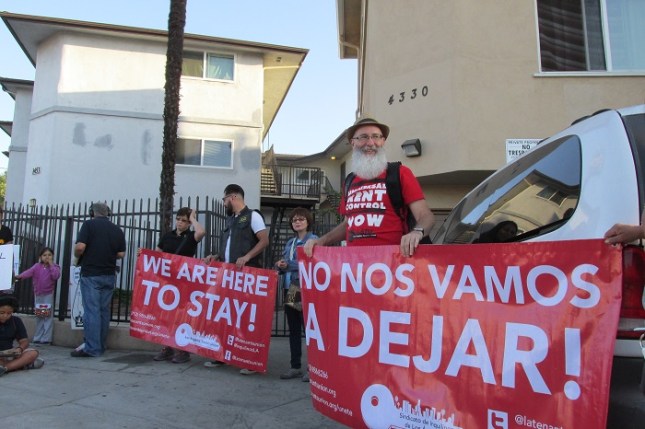
Apartments at 4330 City Terrace.

Apartments at 4330 City Terrace.

Earlier this year the apartments at 4330 City Terrace were bought by Manhattan Manor, LLC. (Love the name. It’s so classy.) The new owners immediately imposed a steep rent increase on the tenants, certainly knowing that most couldn’t pay and would have to leave. Carolina Rodriguez’ rent went from $1,250 to $2,000, far beyond what she could afford. She could have thrown in the towel and left, hoping to find another place she could afford. But she decided to fight, and last month, she won.

With the help of the Los Angeles Center for Community Law and Action (LACCLA), Carolina went to court, and the jury sided with her. In fact, not only did the jury decide that $2,000 a month was unfair, they said that the apartment she occupied needed major repairs and was only worth $1,050 in its current state. Must’ve been a shock to Manhattan Manor.

Celebration on City Terrace after the victory in court.

Celebration on City Terrace after the victory in court.

On Thursday a crowd of people gathered at 4330 City Terrace to celebrate this victory. In addition to residents from the building, members of Union de Vecinos (UV) and the Los Angeles Tenants Union (LATU) showed up to hear speakers talk about Carolina’s struggle, and to remind everyone that the struggle is still going on. Noah Grynberg, the lawyer from LACCLA who argued the case, gave an energetic speech about the importance of protecting people’s rights. Elizabeth Blaney, of UV, emphasized that there was still a long way to go in the battle against gentrification and displacement.

Noah Grynberg, of LACCLA, speaks to the crowd.

Noah Grynberg, of LACCLA, speaks to the crowd.

And Carolina took the mike to talk about how she came to the point where she felt she could stand up to the landlords. She mentioned another tenant who lived in the building, Jesus Baltazar, who had been a major influence. Though he was very ill, Jesus had insisted passionately that the tenants had to make a stand, that they shouldn’t be pushed around. His determination inspired her, and she decided to go to court. Sadly, he has passed away. His daughter, Georgina, is still fighting eviction.

Carolina Rodriguez tells how she decided to fight eviction.

Carolina Rodriguez tells how she decided to fight eviction.

The struggle goes on. Property owners will continue to kick people out of their homes in their pursuit of higher profits. But this story shows that tenants can fight back, and they can win.

If you’d like more info about the organizations mentioned above, the links are below. They all deserve your support.

Union de Vecinos

Los Angeles Tenants Union

Los Angeles Center for Community Law and Action

ct-a-70-stop-dis

How Many Hotels Do You Need?

DSC02054

Hotel construction is booming in Hollywood. Obviously, tourism is big business and brings a lot of money into the area, so it makes sense to build accommodations for visitors. But there are also tens of thousands of people who actually live in the community, and they need to be considered, too. Is City Hall thinking about them? Why don’t we ponder that question as we do a quick rundown of the hotels that are coming to Hollywood. It’s quite a list. We’ll start with the ones that are currently under construction.

1 Camden

The Camden
There’s the nearly completed Camden at the corner of Vine and Selma. In addition to the beautifully appointed rooms, the Camden also offers a heated saltwater pool, a movie lounge, a dog den, and the “The Garden”, a “quiet zen filled space to meditate and reflect.”

2 Dream

Dream Hollywood
According to the web site, “Dream Hollywood is an ultra-luxury merger of familiar and fantasy, where the line between entrée and exclusivity is refreshingly blurred.” Geared toward the “creative class”, it offers 179 “hyper-chic, yet comfortable” rooms and suites, along with a rooftop pool, restaurant and lounge “destined to become a player in the Hollywood skyline scene.”

3 Argyle Hotel b

Argyle Hotel
Currently under construction, the Argyle Hotel will rise 16 stories above the intersection of Yucca and Argyle. It will feature 225 rooms, 6,000 square feet of meeting space and 3,000 square feet of restaurant space. There are also two residential high-rises planned for this same intersection, one already under construction. Afternoon rush hour traffic on Argyle is already pretty bad. Expect it to get way worse.

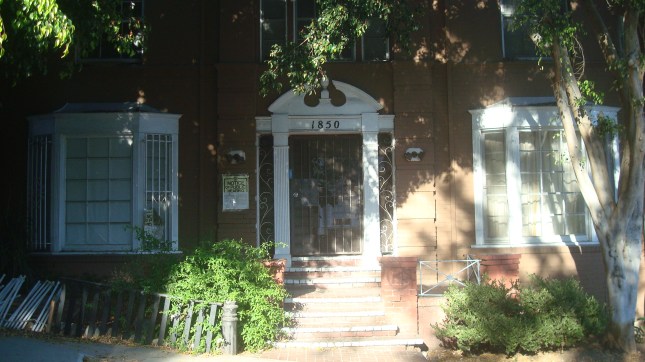
4 1850 Cherokee

1850 Cherokee
The owner of this formerly rent-controlled apartment building realized he could make more money by evicting the tenants and turning it into something else. He used the Ellis Act to get rid of the residents a few years ago, saying that he was going to build condos on the site. When that project fell through, he decided to turn the building into a boutique hotel. The owner asked the City for a zone change to make it happen, and no surprise, the City let him have it.

A similar scenario has also played out at the historic Villa Carlotta on Franklin. The owners evicted the tenants from their rent-controlled units with the aim of turning it into a boutique hotel. It was only through the efforts of dedicated activists that the change of use was thwarted. But the evictions have already taken place, and 50 rent-controlled units were taken off the market.

5 Crossroads

Crossraods Hollywood
This massive project would be situated near the intersection of Sunset and Highland. Three skyscrapers are planned, including a 32-story hotel tower featuring 308 guest rooms and 10,500 square feet of ground-level retail and restaurant space. The developers are also asking for a Master Conditional Use Permit for “the sale of alcoholic beverages and for live entertainment in connection with a total of 22 alcohol-related uses”. You read that right. Twenty two new places for folks to buy alcohol in this one project. In addition, approximately 80 rent-controlled units will be demolished to build this behemoth, which the developer says will be replaced by approximately 80 affordable units. Even if the current tenants are granted right-of-return, where they’re supposed to live during the construction phase isn’t clear.

6 Ivar Gardens

Ivar Gardens
The Department of City Planning(DCP) decided this 21-story hotel at the extremely congested intersection of Sunset and Cahuenga didn’t need a full Environmental Impact Report. Instead, planners have been trying to rush this through with a Mitigated Negative Declaration, a much lower level of environmental review. The traffic study claims that PM rush hour traffic northbound on Cahuenga flows freely with no significant delays. Anyone who’s made that trip at rush hour knows how ridiculous that claim is. But that didn’t stop the LA Department of Transportation from approving the report. Just further proof that when a developer with deep pockets wants something to happen, the City of LA is only too happy to oblige.

1919 Wilcox
One more example of how Hollywood area developers are pushing hotels into residential neighborhoods. While a small hotel does exist on Franklin just to the south, apartment buildings are directly adjacent to this proposed project on the north and west boundaries of the site. Residents were not happy to learn that they might have a 6-story, 150 room hotel next door. It didn’t help matters that the developer is seeking a liquor permit for a 1,200 sq. ft. bar/lounge in the lobby and a 3,500 sq. ft. restaurant/lounge on the north side of the site. Who cares if Chief Beck has written to the DCP warning about the oversaturation of locations that serve alcohol in Hollywood and the resulting problems with violent crime? Certainly nobody at the DCP. They keep handing out liquor permits like there’s no tomorrow.

1717 Wilcox

Also on Wilcox, but closer to Hollywood Blvd., is this planned 134-room hotel with a 2,500 sq. ft. ground floor restaurant and a rooftop bar. You can never have too many rooftop bars, right? Who cares if the people in the apartment building next door don’t like it? And as traffic on Cahuenga continues to spill onto neighboring streets, you can bet these two projects will help turn Wilcox into a parking lot at rush hour.

The point of all this is not to say that we shouldn’t have hotels in Hollywood. The point is that these 8 hotels are just a few of the over 60 projects currently proposed for the Hollywood area. All of these projects will have impacts on infrastructure, air quality, traffic, and LAPD response times, but the City of LA isn’t making any serious effort to assess the cumulative effects of all this development. Whenever possible the DCP tries to approve these projects with a quick MND, and even when they do an EIR there’s no credible attempt made to calculate the collective impacts caused by this massive building binge. The Hollywood Community Plan Update was thrown out by a judge, in large part because the City inflated its population figures, but that hasn’t stopped the City from going full speed ahead. With no community plan in place, the DCP continues to approve thousands of new residential units, hundreds of thousands of square feet of commercial, and who knows how many new hotels.

No doubt all these classy new hotels will make Hollywood a great place for tourists. Just not so great for the people who actually live in the community.

Moving Forward in Reseda

The Reseda Theater

The Reseda Theater

A little over a year ago I wrote a post about how people in Reseda were frustrated. For years the business district in the heart of the community has been struggling, and projects that were supposed to revitalize the area somehow never materialized.

Well, there’s been some progress since then. Just recently a deal was struck to reopen the long vacant Reseda Theater as a multiplex, and to create 34 units for senior citizens adjacent to the building. The multiplex will be operated by Laemmle Theatres, which played a part in revitalizing North Hollywood with its complex there.

This deal is just a first step. Members of the community have been struggling for years to revitalize the neighborhood, and many hope that this project signals a turnaround. The Reseda Neighborhood Council and Councilmember Bob Blumenfield have worked hard to engage the community and rustle up the money to make this happen. For more details, see this article from the Daily News.

Reseda Theater to become Laemmle Multiplex

But redevelopment is only part of the equation. Bringing new life to a community requires a lot more than investment. It’s really about people. Creating community means creating a sense that the people who live in the area are connected, that they share something more than a zip code. This piece from the LA Weekly caught my attention.

Reseda Rising Artwalk Proves the Valley Is Cool

The artwalk was put together by 11:11 ACC and the Department of Cultural Affairs. I’d never heard of 11:11 ACC before, so I took a look at their web site and found out that they’re an artists’ collective operating in the San Fernando Valley. Sounds like an interesting group. If you want to check them out, here’s the link.

11:11 ACC

Seems like things are finally happening in Reseda. Hopefully this is just the beginning.

Pushing for Change at Jordan Downs

Aerial view of proposed Jordan Downs redevelopment project.

Aerial view of proposed Jordan Downs redevelopment project.

Sometimes you hear people complain that our elected officials are afraid to try anything new, that they devote most of their careers to propping up the status quo. I’ve said it myself, and I do feel like our politicians need to spend more time thinking outside the box.

But there are reasons why the folks at City Hall don’t like taking chances. It’s one thing to come up with an innovative idea. Making it a reality is a whole different story. It’s not uncommon for good ideas to get ground into dust by the system. Pushing for change can be a long, brutal process, sometimes dragging on for years and wearing everyone involved down. It’s not easy changing the status quo.

I first read about the Jordan Downs redevelopment initiative back in 2013. The idea was to take an aging housing project that was mired in poverty and remake it from the ground up. But this wasn’t just about knocking down one building and putting up another one. The idea was to create an expanded mixed-income complex where low-income families would live next door to middle class families. The project also included a new park and over 100,000 square feet of retail, bringing jobs and amenities to a community that hasn’t had had easy access to either.

Back in 2013 it was clear there were plenty of challenges, and the path hasn’t been easy. Though many of the current residents support the project, there are also fears about gentrification and displacement. And the process was complicated further by the news that the soil on the site was heavily contaminated, meaning that a long, costly clean-up would be necessary.

On top of all that, getting the funding for the project has been a huge hassle. Councilmember Joe Buscaino didn’t hide his anger when a grant application was rejected by the US Department of Housing and Urban Development (HUD), at least in part because the city agency handling it hadn’t submitted all the required materials. This was the second time that HUD had declined to award funds for the project.

But things are still moving forward, and it’s hoped that construction will begin by the end of this year. No doubt there will be more challenges. The concerns about displacement are certainly well founded. The Housing Authority of the City of Los Angeles (HACLA) has said that tenants “in good standing” will be guaranteed units in the new complex. However, they haven’t yet defined exactly what “in good standing” means. This could be a problem. A recent affordable housing project in Boyle Heights proposed the demolition of existing units to allow the construction of new ones. This sounded like a good idea until the residents of the existing units learned that strict conditions regarding right of return would have excluded many of them from moving into the new units.

The contamination also needs to be dealt with. I wondered how the clean-up was progressing, so I sent an e-mail to Joe Buscaino’s office. I got an answer within hours from Planning Deputy Heather Anderson. To put it in context, it’s important to understand that HACLA purchased additional property adjacent to Jordan Downs, and her response focusses on work at that site.

The Housing Authority of the City of Los Angeles (HACLA) purchased the property knowing that it was a former industrial site, and with the intent to remove the contamination and clean up the property. They have been in the process of remediation with the oversight of the California Department of Toxic Substances Control (DTSC) for a few months now. After removing 200,000 tons of contaminated soil, they are close to finished with the remediation. There has been testing of the soil around the site to ensure that nearby soil is safe.

She also attached a report documenting the clean-up through February. It sounds like the City and State are taking this seriously, which is good news. But it’s important to remember that there’s also concern about contaminants within the site that Jordan Downs currently occupies. Hopefully, as demolition of the existing buildings progresses, the City and State will continue to do the same thorough job of remediation.

There are those in the community who are skeptical about how this will all play out. This article from the LA Wave reports some of their concerns.

Feds Greenlight Plan to Redevelop Jordan Downs

Buscaino and Congressional Rep Janice Hahn both deserve credit for staying with this redevelopment effort. They could have stuck with the status quo and saved themselves a lot of headaches. And the residents of Jordan Downs also deserve a lot of credit for the hard work they’ve done as they’ve fought to improve their neighborhood. No doubt community activists and elected officials will be facing off as further issues arise. That’s to be expected. But hopefully everybody will continue to work together to build a better future for the people of Jordan Downs.

There are all sorts of possible pitfalls, but here’s the bottom line. If this project doesn’t go forward, the residents of Jordan Downs will continue to be trapped in the same cycle of poverty that has held the community back for decades. And that’s not an option. We can’t accept the status quo.

 Aerial view of Watts, looking northeast. Jordan Downs can be seen at lower center.  Photo by Howard D. Kelly, 1956.  From the Los Angeles Public Library, Kelly-Holiday Collection.


Aerial view of Watts, looking northeast. Jordan Downs can be seen at lower center. Photo by Howard D. Kelly, 1956. From the Los Angeles Public Library, Kelly-Holiday Collection.

Death by a Thousand Cuts

MTA 4

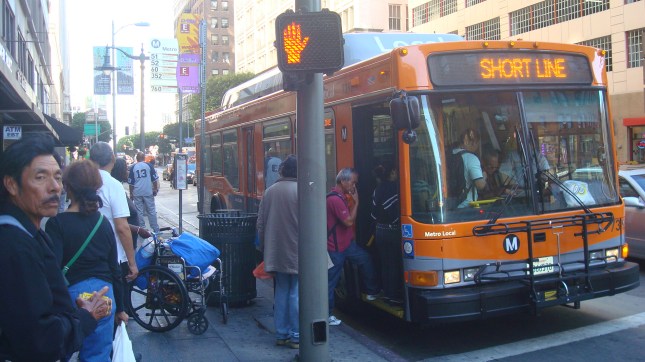
Not too long ago I was riding the bus and saw a pamphlet on display. The title was Public Hearing on Proposed Service Changes. Even before I picked it up, I more or less knew what it was about. The “service changes” are mostly service cuts, yet another round of reductions by the MTA.

This isn’t surprising. Last I checked, the MTA was running an operating deficit of over $30 million a year, and that deficit will continue to grow. One solution would be to raise fares, but the last time they did that there was a decline in ridership. Of course, ridership has been going down for a while now. Some argue that the decline may be reversable, and point to the rail extensions that are currently under construction. New rail stops will bring new riders, but they will also increase operating costs. And actually, fares don’t nearly cover what it takes to run the system. I really doubt that increased ridership from these extensions will make a serious difference in the budget picture.

There’s no simple solution here. While I’m not happy about further cutbacks, I know Metro is probably doing the best they can to balance their budget under challenging circumstances. But I’ve gotta say, it’s getting harder and harder to get around LA on public transit. A number of the lines I use regularly run only once an hour. The Rapid busses, which were great to start with, don’t run as often as they used to. I don’t read when I ride the bus, but I’ve started taking a book with me when I’m going somewhere because I never know how long I’ll be waiting to make a connection.

What I’m leading up to here, is that I’m really starting to question the MTA’s long term strategy. For years now we’ve been told that we need to invest in rail to solve our transit problems. Well, we’ve built a lot of rail, and things don’t seem to be getting any better. Looking at the budget issues and the trend in ridership, I don’t believe the rail we’re building now is going to make a huge difference. At some point we have to ask ourselves if this approach is working.

That brings us to Measure R2, the ballot initiative we’ll be voting on in November, which will increase the sales tax to raise billions for transit. About 40% of the projected revenue will go to rail projects, and looking at the results we’ve gotten from rail so far, I’m increasingly skeptical about whether this is the right way to go. Trains are great if you’re travelling in a straight line from point A to point B, but as soon as you get away from that straight line, things start getting complicated. Rail works great in New York, where the system is centered on a very dense urban core. LA is much more spread out, and even though Downtown is attracting more residents and businesses, it doesn’t function as the City’s center the way Manhattan does. There are those who argue we need to build high density hubs along transit lines, which sounds good, but City Hall has been pushing that policy for years and it’s not producing the promised results. Transit ridership is down. If our leaders had pursued a policy of building affordable housing that would make job centers easily accessible by rail, it might be a different story. But renting near rail stops is pretty pricey. A studio at Noho Commons goes for $1,777. Digs at the Jefferson in Hollywood start at $2,238. And I don’t know what they’ll be charging at the Wilshire Grand, but I’m pretty sure it’ll be more than the average transit rider can afford.

MTA 5 a

Measure R2 will deliver other things besides rail, and I don’t want to say I’m opposed to it, but at this point I can’t say I’ll vote yes. It seems like there are others who have doubts as well. This post on StreetsBlog breaks down the MTA’s 2016 budget, and raises some important issues. The comments are worth reading, too.

A Preview of Metro’s $5.6 Billion Fiscal Year 2016 Budget from StreetsBlog LA

I also came across this article in the Daily News that talks about how the Valley has gotten less than its share of transit infrastructure in the past, and how leaders on that side of town are worried about getting shortchanged again with R2. One of the points the author makes is that with big infrastructure projects, the longer they’re delayed, the more expensive they become.

What the Valley Would Get, and Not Get, in New Transportation Tax from Daily News

LA County is promoting R2 in order to fund a massive expansion of our rail network. Basically I’m asking if rail is really worth the money, time and trouble. Busses are much cheaper and much more flexible. Also, investing in busses won’t saddle the MTA with a huge debt load the way these infrastructure projects will. Debt service already accounts for a significant portion of the agency’s budget, and expanding the rail lines will make that burden even heavier.

You’re going to be hearing a lot about R2 in the coming months. City, County and State officials are already making an aggressive push to promote it. Again, I’m not saying I oppose it, but as you listen to our elected officials give their spiel, ask yourself if our public transit policy is taking us in the right direction. And if not, is it time to change course?

MTA 1

Creating Community

New development in Boyle Heights, right next to the historic Mariachi Hotel.

New development in Boyle Heights, right next to the historic Mariachi Hotel.

I’ve heard people complain that Angelenos don’t know their neighbors. To a large degree that’s true. We tend to build our own little self-contained worlds, and get nervous when outsiders try to invade. In order to make it through the day, I try to keep interaction with strangers to an absolute minimum. In part, this is because I’ve found that some strangers want way more than I’m willing to give. Living in the city, you have to be at least a little wary.

But the downside is that there are very few places in LA where you can find a real sense of community. You might find a scene where you can hang out with people who share your passions, but chances are they’re coming from all over the city. You don’t find too many neighborhoods where everybody knows each other. And because of that, we don’t know our neighborhoods. The tenants in the building next to ours could be getting evicted for a condo conversion, and we might not be aware of it until the construction crews show up. Even when we find out what’s going on, we’re likely so wrapped up in ourselves that we don’t start worrying until the eviction notice shows up in our own mailbox.

So I was really intrigued when I heard about Union de Vecinos (UV), which could be translated as Neighbors United. It’s a grassroots group that’s been working in Boyle Heights for twenty years. They got their start back in 1996 when public housing in Pico Aliso was threatened with demolition, and they worked to protect renters threatened by displacement. But UV isn’t just reactive. They’re also creative. Starting with neighborhood committees, they work within the community for positive change. This is from their web site.

[Union de Vecinos promotes] economic and environmental justice, civic engagement, preservation of housing, and building healthy and stable community neighborhoods. We do this through community organizing, popular education and direct action. In our model, solutions to a problem are developed by those most affected – community – this is what drives us and is at the heart of our work.

The part of this paragraph that jumps out at me is, “solutions to a problem are developed by those most affected.” So often in the City of LA we have elected officials meeting behind closed doors with bureaucrats and business interests to devise plans that really don’t address the needs of the citizens. When they do hold public meetings and ask for input, it’s generally just for show. They’ve already decided what they want to do, and the meeting is really about selling their own agenda.

Banner on fence at a construction site on First Street.  Art by Gabriella Claro, Salma Sosa, and Tatei Torres Thomas.

Banner on fence at a construction site on First Street. Art by Gabriella Claro, Salma Sosa, and Tatei Torres Thomas.

So the idea of a neighborhood group that sets its own priorities and creates its own agenda sounded really good to me. I went to Boyle Heights to talk to UV members Leonardo Vilchis and Elizabeth Blaney about the challenges the Boyle Heights community is facing these days. A lot of it has to do with development, and the related problem of gentrification.

In early 2015, the Metropolitan Transit Authority (MTA) announced plans for a project to be built on Mariachi Plaza. Unfortunately, the MTA didn’t bother to ask the community how they felt about it. There was a huge public outcry, and Union de Vecinos was one of the groups that raised their voices in protest. The MTA shelved the project for the time being, but they’re planning to come back with another version. I asked Leonardo if he thought the public would have more of a voice this time.

“They said they’d reach out to us, but it’s really just pro forma,” he said. “The MTA sets up these meetings with focus groups, where you have to be invited.” He didn’t seem optimistic about the process. “They have these meetings, but they don’t really seem to be seeking input.”

Elizabeth spoke about UV’s engagement with the East LA Community Corporation, one of the developers building on and around MTA land. ELACC is working on creating affordable housing in Boyle Heights, but displacement of low-income families is still an issue. “We want affordable housing for the 7,000 families that make less than $25,000 in our community,” she explained, “but if they’re demolishing existing units, we have to make sure that those tenants will be welcome in the new project.” Recently UV negotiated a deal with ELACC to ease some restrictions to allow displaced tenants the right of return.

I asked what kind of projects UV was working on in the neighborhood.

“Garcetti talks about his Great Streets Initiative…,” Leonardo said with a smile, “but we’ve been doing great streets here in Boyle Heights for years.” When local alleys were attracting criminal activity, UV got residents involved in finding a solution. Elizabeth spoke with pride about the way the community turned the situation around. “We held movie nights and swap meets to reactivate these spaces. Residents went on to build street furniture, paint murals and install solar-powered lighting. Before people had been afraid to walk down these alleys, and now they’re gathering places for the community.”

What a concept. People taking responsibility for their neighborhood and working together to make it better. It’s not a new idea, but it’s something many of us who live in LA have forgotten how to do. Maybe we could learn a few things by following Union de Vecinos’ example.

If you want to learn more about what they’re up to, here’s the link to their web site.

Union de Vecinos

Leonardo Vilchis and Elizabeth Blaney of Union de Vecinos.

Leonardo Vilchis and Elizabeth Blaney of Union de Vecinos.