Westlake Residents Speak Out Against “Design District”

CDW Audience

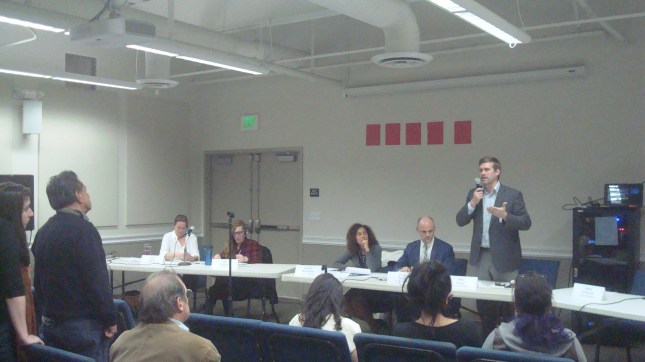
Attendees at a community forum on the North Westlake Design District.

It’s clear that the people at City Hall think they know better than we do how our communities should grow. The latest example of their arrogance is the proposed North Westlake Design District (NWDD). It’s another attempt to put money in developers’ pockets by pushing for gentrification and displacement in low-income communities. Check out the language from the notice announcing a hearing held by the Department of City Planning (DCP) back in 2014.

“The proposed Design District is being considered to guide new development that will complement the existing character of the neighborhood, create a pedestrian friendly environment, and provide neighborhood-serving amenities. The proposed zoning ordinance is initiated by the City of Los Angeles.”

Pay attention to that last sentence, because it’s the key to what’s happening here. This “design district” is not something that the community asked for. It’s something City Hall wants. Are any of the area’s residents in favor? Local activists organized a community forum in January. I was there for about an hour, and I only heard one speaker who thought this was a good idea. Everybody else who spoke while I was there was against it. Why? Well, there were a lot of reasons, but it boils down to the fact that a lot of them are worried they’re going to get kicked out of their own community.

Why are they afraid that’s going to happen?

Because that’s what’s been happening in communities all over LA for well over a decade. As real estate investment interests have moved into places like Echo Park, Highland Park, Boyle Heights and Hollywood, low-income residents have been forced out by rising rental prices. Even units protected by the Rent Stabilization Ordinance (RSO) aren’t safe. In 2017 landlords took 1,824 RSO units off the market using the Ellis Act. Over 23,000 RSO units have been lost since 2001. So the residents of the Westlake area, including Historic Filipinotown, have good reason to be worried.

Real estate investors are already buying up property in the area. The City Planning Commission recently approved The Lake, a huge mixed-use project that includes a hotel and a 41 story residential tower, at Wilshire and Bonnie Brae. Other projects in the works are a 54-unit building at 1246 Court and a 243-unit mixed-use complex at 1800 Beverly. As investors move in, you can bet a lot of locals will be forced out.

The impacts are already being felt in the community. One of the speakers talked about how the office building he works in was recently purchased by a new owner, and the non-profit the speaker works for has already received an eviction notice. Another speaker complained that a project containing over 200 condos at Temple and Hoover will take away what little open space the neighborhood has.

CDW Glesne

City planning staff responds to community concerns.

There were a lot of unhappy people at the forum. Speaker after speaker came forward to talk about their concerns, and some weren’t shy about expressing their anger. Three representatives from the DCP attended, and they did their best to defend the design district. Personally I didn’t think their arguments were persuasive, but at least they showed up. The organizers of the forum invited Councilmember Mitch O’Farrell to come and hear what the community had to say, but he was a no-show. Didn’t even send a rep from his office. I guess that shows just how much he cares about the folks who live in the area.

We’ve seen this all before. The City pushes a plan that will create a “pedestrian friendly environment” and bring “neighborhood-serving amenities”. They talk about “walkable”, “vibrant” urban spaces, where people can shop, dine, drink and party. The only problem is, once the City’s done with its makeover of these areas, the people who get to enjoy them are the affluent newcomers who’ve taken the place over. Families who used to call the neighborhood home have to leave. They can’t afford to live there any more.

In response to the NWDD, a group called The Coalition to Defend Westlake has been formed. To view their Facebook page, click on the link below.

Coalition to Defend Westlake

CDW Line

People wait in line to have their say about the NWDD.

Long Beach Museum of Art

LBMA Gallery

Yesterday I took the train down to Long Beach, and since I was in the neighborhood, I decided to stop in at the Long Beach Museum of Art (LBMA). It was well worth the trip.

After getting off the train I could’ve taken a bus, but I ended up just walking down Ocean Blvd. and checking out the neighborhood. I haven’t been to Long Beach for years, so I wanted to take in the sights. While there’s lots of new construction going on downtown, Ocean Blvd. offers a panorama of the city’s history. I saw low-rise apartment buildings from the post WWII era, grandiose structures that go back to the 20s, and a few homes that I imagine were among the first to be built to be built in the area. I didn’t realize the LBMA has been around since 1950. It’s been located in the historic Elizabeth Milbank Anderson House since 1957.

LBMA Mus Ext

There were two shows on view. Most of the gallery space was devoted to works by Young-Il Ahn. His early canvasses were vaguely figurative, but over the course of his career he’s moved to total abstraction. Some of the most recent works were large horizontal paintings that seemed almost monochromatic.

LBMA Ptng Red Wide

I say “almost” because on looking closer you see how subtly he uses color. While the canvas is largely filled with countless small, precise strokes of red, you can find traces of other hues bleeding through.

LBMA Ptng Red Close

Ahn is obsessed with water. Here’s an early painting called Harbor Mist, which is almost representational.

LBMA Ptng Harbor Mist

His later paintings are also inspired by water, but the end result is less pictorial than poetic.

LBMA Ptng Mag

Here’s a closer look.

LBMA Ptng Mag Close

There was also a small show of sculpture by Ann Weber. Something about her work grabbed me right away. She takes discarded cardboard and weaves it into suggestive forms. Like these.

LBMA Sclp Vert

Weber’s work is worth spending some time with. You can see that the finished product is the result of painstaking process.

LBMA Sclp Vert Close

I loved this one, titled Moon over San Pedro.

LBMA Sclp MoSP

The Ahn show was over this weekend. Weber’s sculptures will be on view til February 4. To learn more about the museum, follow the link below.

Long Beach Museum of Art

LBMA Hall

What Does this Building Mean?

Pkr Ctr 01 Vert

What does a building mean?

It’s an interesting question, and there’s no easy answer. Any building is going to have different meanings to different people. But the question is crucial when you start talking about preservation. Maybe we want to save a structure because it’s beautifully designed. Or maybe it held a special place in the community. Sometimes we want to hang on to a structure because of the role it played in the city’s history. Then again, there may be reasons why people want to see a building go away….

Back in 2016 I was at a City Planning Commission (CPC) hearing when Parker Center was on the agenda. The former home of the LAPD, the building has been closed for years. It was built in the mid-50s, and was orginally called the Police Administration Building (also the Police Facilities Building).* It was renamed Parker Center after the death of Chief William Parker in 1966. But it’s been empty since the LAPD moved into its new headquarters almost a decade ago. And since then the City has been trying to figure out what to do with it.

Pkr Ctr 10 Sign

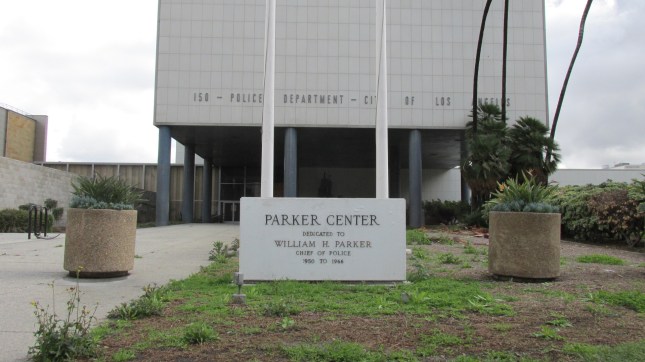
The marker at the entrance bearing the dedication to Chief Parker.

Actually, it doesn’t seem like there was much debate at City Hall over the building’s fate. A new master plan has been proposed for the Civic Center, and there seems to be general agreement that Parker Center needs to be demolished. But the LA Conservancy argued that the structure should be preserved, both because of its design and the role it played in LA history.

So on the day I was at the CPC hearing there were two speakers on different sides of the issue. One was Jeremy Irvine, who argued for saving Parker Center. He pointed out that it was designed by Welton Becket & Associates, an innovative architectural firm that played a crucial role in shaping the look of mid-century LA. Irvine went on to talk about the building’s place in the life of the city, arguing that it was an important piece of LA history.

Pkr Ctr 30 Side Clouds

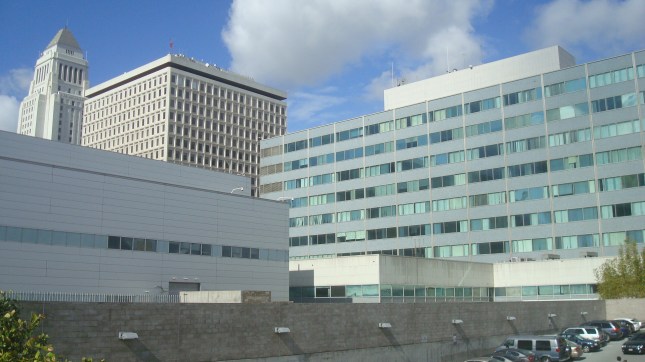
A side view of Parker Center

The other speaker agreed that the building had played a role in LA history, but from her perspective it represented pain, loss and prejudice. Ellen Endo is a journalist with deep roots in Japanese community. She talked about how at the beginning of the 20th century Little Tokyo’s boundaries extended far beyond where they lie now, and how over the years LA power brokers have carved out large chunks of the neighborhood. The site where Parker Center stands now used to be a part of Little Tokyo. Endo said that for many in the Japanese community the building represented prejudice and opression.

Pkr Ctr 40 From First

A view of Parker Center from First Street

So at the hearing in 2016 the CPC heard two very different versions of what Parker Center means. And really, I think the discussion was moot. The Conservancy’s efforts delayed the process, but I believe it was decided long ago that the building’s coming down. The Board of Public Works will be reeciving bids for demolition through February 21. It will probably be gone by the end of the year.

Pkr Ctr Ent Sculp 2

The main entrance to the building.  The sculpture, by Tony Rosenthal, is meant to depict a policeman protecting a family.

As to what’s going to replace it, I think that’s still an open question. While the City has an ambitious master plan for Civic Center, nobody knows where they’ll get the money to build it. The plan lays out a long-term vision with multiple phases, and it could be years before any real decisions are made. If you want to learn more, check out this article from the Downtown News.

New Civic Center Master Plan

(* Sam Fuller fans may remember that Parker Center is featured in The Crimson Kimono. Shot in Downtown during the late 50s, the film spends a good deal of time documenting life in Little Tokyo. It’s an amazing view of the community at that time.)

Pkr Ctr 90 Side Glare


To Have and Have Not

Bilt Where Will

I was so bummed. I desperately wanted to go to UCLA’s 32nd Annual Land Use Law & Planning Conference. Unfortunately, the $535 registration fee was a little too pricey for me. But just the thrill of being close to all the movers and shakers who were attending the conference drew me to Downtown. Even though I couldn’t afford to go in I just stood on the sidewalk across from the Biltmore, gazing up at the windows where I knew the attendees were debating lots of heavy issues.

Bilt Angle

The conference brochure definitely made it sound cool. They had a bunch of high-powered attorneys and consultants on hand to talk about CEQA reform, the housing crisis, infrastructure and other important stuff. And beyond all those big, heavy issues, they even found time for a session entitled Community, Health, and Planning for Environmental Justice. I mean, okay, they kind of jammed that into a half hour slot along with about half a dozen other topics, but I’m sure they covered everything they needed to.

Unfortunately, my reverie was interrupted by a bunch of noisy protesters who were standing nearby, holding signs and chanting slogans. What were they complaining about? Well, they were angry because one of the speakers was Sacramento superstar Scott Wiener, the Senator from San Francisco. The protesters had a problem with a bill the Senator just introduced, SB 827, which takes zoning authority away from cities. Wiener says if we override local zoning to allow developers to build housing up to eight stories along transit corridors, we can solve both our housing problems and fight climate change. Doesn’t that sound great? According to Wiener, his bill will let developers build tons of new units so housing prices will definitely go down. And because the new units are close to transit, everybody will dump their car and jump on the train.

I wonder if anybody at the conference asked Wiener about a recent report from UCLA that shows transit ridership is way down in Southern California, even though local officials have been approving pretty much any crazy project developers propose as long as it’s near transit. If so, I really would’ve liked to hear his response. I’m sure Wiener had a ready answer for the cynics who point out that in New York housing is still outrageously expensive even though the city has been building tens of thousands of new units every year. And so what if cities like Vancouver and Toronto have thousands of units sitting empty while middle-income and low-income families struggle to pay the rent? Foreign investors need homes, too, although, okay, maybe they don’t always really need them.

Bilt Speaker

At lunch all the power players adjourned to the Gold Room, where they heard the keynote address from Richard Rothstein, author of The Color of Law: A Forgotten History of How Our Government Segregated America. Rothstein apparently talked about how federal, state, and local governments have implemented and upheld racist policies to create and maintain segregated communities since this country’s inception. Of course, he’s absolutely right. I wonder if he spoke about the fact that many of these policies were formed as a result of intense lobbying by development and real estate interests that wanted to protect their investments? Kind of like the development and real estate interests that are pouring money into Sacramento right now. It would’ve been nice to hear what he had to say about research from the Urban Displacement Project, which shows that current government policies promoting transit-oriented development have resulted in gentrification, pushing low-income people of color away from transit hubs in LA and the Bay Area.

Bilt Hand

Even though I was standing across the street, I could feel the soothing vibrations emanating from the collective wealth and wisdom gathered inside the Biltmore. So what if most of these people make six figures, live in single-family homes, and drive nice cars? So what if most of them rarely ride transit and never had to worry about getting evicted? They’ve got college degrees and lots of money and they go to a lot of conferences. They’re well qualified to tell the rest of us what to do about housing and transit.

But the protesters kept disrupting all the good vibes I was getting from the Biltmore. I guess some of them are facing eviction, or they’ve already been evicted, and they’re ticked off because they’re losing their homes. Yeah, okay, that’s a bummer. But they need to trust the folks inside the Bltmore. All we need to do is listen to people like Scott Wiener and let developers build tons of new housing around transit. Just because the median income for people living around rail lines in LA is mostly between $30,000 and $40,000 a year, and they could never afford the new units, which usually start around $2,000 a month, is no reason to keep the developers at bay. I’m sure at some point we’ll have such a housing glut that these new units will lose 50% of their value, and then the families that were kicked out could return to their neighborhoods.

So, okay, it could take decades. And yeah, it might never actually happen. But that’s no reason to rethink policies that are displacing the poor and destroying communities.

Is it?

Bilt No Nos


From Benevolence to Malevolence: The Awful Story of PAMC

PAMC 01 Flowers

It’s amazing how running across a random news story can open doors you never knew existed. A couple days ago I was flipping through the Downtown News web site and I came across an editorial dealing with the closure of the Pacific Alliance Medical Center (PAMC). I’d never heard of it before, but the article made clear that shuttering the facility was a major problem for the low-income Asians, Latinos and Blacks that live in the area. Local politicians were apparently talking to County and State officials to try to find other healthcare options for the community.

Like I said, a week ago I didn’t even know PAMC existed. After a few hours of surfing the net, I’d read enough to realize that this facility wasn’t just a crucial part of the local healthcare network. It had also played an important role in the City’s history. It began as a laudable effort by 19th century Angelenos to care for the people of the community. Sadly, it seems to have ended as a result of the greed and dishonesty that plague our healthcare system.

PAMC 20 Front Wide 2

View of Pacific Alliance Medical Center at Hill and College

It was a surprise to me that back in 1860 there was a significant French community living in what we now call Downtown. When it became clear that LA’s first hospital, St. Vincent’s, couldn’t provide care for the growing population, local leaders banded together to form the French Benevolent Society. In time they acquired some land at what is now the corner of College and Hill, and built the first version of the French Hospital. The lovely building that stands there today is much larger than the original structure. It was expanded and remodelled a few times over the years. According to the LA Conservancy, architects W. S. Garrett (1916), Armand Monaco (1926 remodel), and R. C. Nielsen (1964 remodel and expansion) were among those involved. If you want to learn more about the history of LA’s early French community and the origins of the hospital, here’s a link to the blog Frenchtown Confidential.

Joan of Arc in Chinatown: A Brief History of Los Angeles’ French Hospital

PAMC 25 Joan

Statue of Joan of Arc

The hospital has been operating continuously since it was founded, but in the 80s it ran into financial trouble and was acquired by a group of doctors and investors. That’s when it became the Pacific Alliance Medical Center. By that time it had become a crucial resource for the Chinatown community, serving the local Asian, Latino and Black population. It offered healthcare to thousands of low-income residents who were covered by Medicare and Medicaid. Also important, staff at PAMC spoke a variety of languages that enabled them to communicate with patients who spoke little or no English.

Fast forward to fall of 2017. In early October PAMC abruptly announced that the hospital would be shutting down. The owners claimed that they were closing the facility because it didn’t comply with seismic safety requirements, and said they couldn’t afford to build a new structure. PAMC was shut down on November 30. With less than two months notice, the patients who had been receiving care there had to find other doctors, and over 500 employees were out of a job. Here’s the editorial from the Downtown News that makes clear what a hardship this is for the community.

Pacific Alliance Closure from Downtown News

The owners claimed they closed the place because they couldn’t afford to comply with State earthquake requirements, but some people suspected there were other reasons. Earlier in 2017 PAMC had paid a $42 million settlement as the result of a Justice Department investigation. A whistleblower had accused PAMC of creating marketing arrangements that provided kickbacks to physicians and also of paying inflated rates to rent office space. The owners denied this had anything to do with the closure.

PAMC 40 Green

A small green space at one corner of the building

Arranging for kickbacks to doctors and boosting payments for office space may sound bad, but there are reasons to believe it’s a lot more serious than that. I took a look at PAMC’s filing on the California Secretary of State’s web site dated November 18, 2016. It listed Dr. Carl Moy as the CEO. A quick search revealed that his reviews on Yelp were lousy. But I also found Moy listed on another filing at the State web site, this time as Secretary for a company called SynerMed.

Never heard of SynerMed? I hadn’t either. Turns out they’re one of the country’s largest medical practice management companies, with hundreds of thousands of patients in California. They work behind the scenes, acting as a middle-man for doctors and clinics, collecting millions of dollars in payments from Medicare and Medicaid. Unfortunately, it looks like a lot of that money wasn’t going to patient care. In early October Synermed’s Senior Director of Compliance, Christine Babu, presented a report to her bosses. Apparently for years company employees had been improperly denying care to patients and faking documents to cover up the practice. According to Babu, the company made an effort to keep her quiet. Not long afterward her report ended up in the hands of state regulators.

SynerMed has announced that it will be closing down, and the State has launched an investigation. But the thing that caught my attention was the connection with PAMC. Dr. Moy has been listed as an officer for both companies. And it was just days after Christine Babu first presented her report that PAMC announced it was shutting its doors. In light of that, I have a hard time believing the seismic safety story. Just months ago they paid $42 million to settle a suit related to kickbacks, and now someone who served as a corporate officer is tied to a company that’s under investigation for massive Medicaid fraud. To me it sounds like there’s been shady stuff going on at PAMC for years, and it’s finally caught up with them.

If you want more details on what’s gone down at SynerMed, here’s the story the Daily News ran.

Managed-Care Firm SynerMed Improperly Denied Care to Thousands

PAMC 50 Sign

Sign posted on the side of the building facing Hill

This is really a tragedy. Whatever level of care PAMC was providing to the Chinatown community, the patients are out in the cold now. Some of them will find other places to go, but it’s getting harder and harder for low-income families to find providers who will welcome them. Add to that the fact that many of the patients are seniors who may have difficulty travelling farther, and those Asian patients with limited English skills could be hard pressed to connect with doctors who speak their language.

So that’s the story. A hospital is founded in the 19th century by a group of citizens who realize that the community needs healthcare. In the 20th century it expands to meet the challenge of providing care to a diverse, low-income neighborhood. And now, less than two decades into the 21st century, its doors are closed, seemingly the result of rampant greed and dishonesty.

Why do I feel like this story is just one more depressing reflection of the times we live in?

PAMC 90 Man Cane


Headworks Update

HW 01 1711 Site

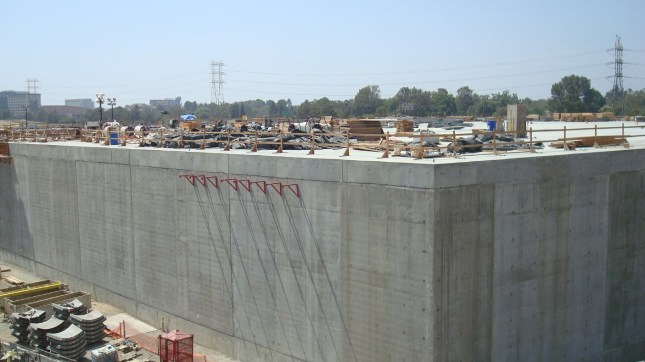
Anybody who’s used Forest Lawn Dr. over the past few years has seen the massive construction site running along the LA River. This is the Headworks project, which involves building two giant underground reservoirs to replace the DWP’s Silverlake complex. I posted about it back in 2014, when phase one, Headworks East, was under construction, and it was completed in June 2015. At that time it was reported that the second phase would be finished in 2017. That didn’t happen. Though the City held a groundbreaking ceremony for Headworks West in 2016, progress since that time has been slow. Apparently this is because of unusual soil conditions at the site, which required extensive remediation.

When completed these two huge concrete tanks will hold a combined total of 110 million gallons. The plan is to cover them with soil and native vegetation, creating a park and wetlands with areas for hiking, cycling, and riding horses.. The project also involves the construction of a hydroelectric power plant.

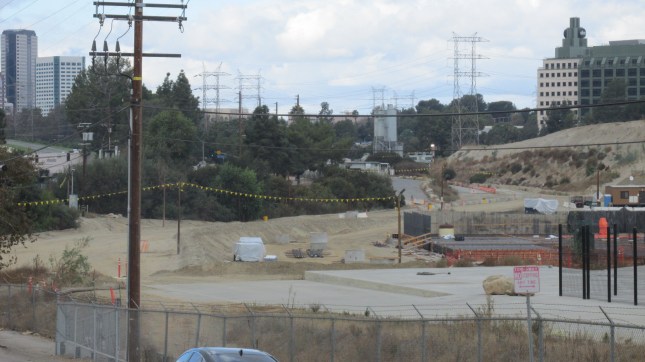
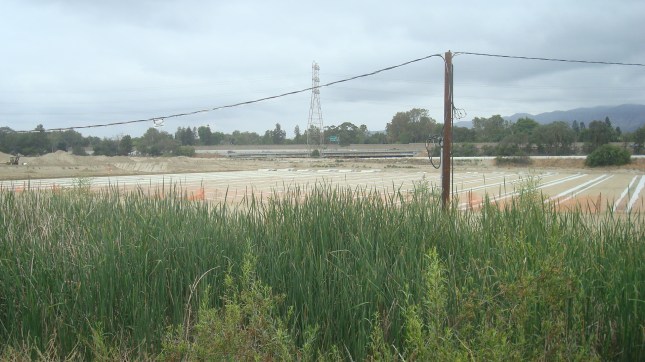
Now and again I ride my bike along Forest Lawn Dr., and I’ve taken some photos of the site over the past couple years. Here’s a shot from June 2016 that was taken from the edge of the site near the entrance to Griffith Park.

HW 10 1606 Side Road

You may be wondering why I’m bothering to post a picture of a low hill covered with weeds. Now let me show you a photo taken from roughly the same perspective during the first phase of construction.

HW 15 Concrete Corner

The tank that was completed in 2015 lies beneath the soil you see in the first photo. Eventually a park will cover the entire site. Here’s another shot of from a different angle that shows the road which goes around the perimeter of the tank.

HW 22 1606 Mtn Cloud

Moving on to the site for the second phase of the project, Headworks West. You can see a huge mound has been formed by displaced soil.

HW 24 1606 Mound

Here’s a shot of the site as preliminary work was being done.

HW 26 1606 Rows 1

The following images show the site a couple months later, in August 2016.

HW 30 1608 Rows w Fwy

In this photo you can see the exposed side of the first reservoir.

HW 32 1608 Rows Tank 1

And here are some images from November 2017, when the structure was actually starting to take shape. In the first one you see the side of the completed reservoir again.

HW 40 1711 Dark Bed Tank 1

Here it looks like they’re laying out frames.

HW 42 1711 Frames Crane

I’m assuming the wall at the left marks the perimeter of the new reservoir.

HW 44 1711 Wall Frames

The rebar starts to define the shape of the reservoir.

HW 46 7111 Frame

The date for the completion of Headworks West is a little murky. One fact sheet published by the DWP says it’ll be done in 2018. But another, more detailed, fact sheet from the DWP says they’ll wrap it up in 2022. It also says they’ll finish the power plant in 2023, and the ecosystem restoration in 2024. So it could be some time before you’re able to ride your bike through the park.

A few links. The first is a video about the project from the DWP.

Headworks Video from DWP

The second link gives some background, and offers a detailed timeline.

Headworks Background, Fact Sheet and Timeline

And this last link shows a map of the completed project.

Map Completed Project

HW 90 1711 Site


Housing Near Freeways: We Can Do Better


Breath 40

A truck passes by the recently completed Da Vinci in Downtown, where balconies offer a stunning view of the freeway.

The folks at City Hall have known for years that building housing within 500 feet of freeways significantly increases the risk of health problems for inhabitants. Years of research have shown that people who live near freeways are at a higher risk of asthma, heart disease, stroke and lung cancer. The dangers for children are especially alarming, because long-term exposure to the high concentrations of pollutants near freeways can inhibit the development of their lungs and lead to lifelong respiratory problems.

So it shouldn’t have been a surprise when, at a recent City Planning Commission (CPC) hearing, Commissioner Dana Perlman voiced concerns about approving a residential project sited around 200 feet away from the Harbor Freeway. Specifically, Perlman didn’t like the fact that the units facing the freeway had balconies. He pointed out that living next to freeways is unhealthy, and said residents shouldn’t be encouraged to spend time out of doors where they’d be exposed to auto exhaust coming off the 110. While the developer had agreed to reduce the size of the balconies, Perlman argued for turning them into “juliet” balconies, in other words, making them strictly decorative.

Perlman’s suggestion makes perfect sense, and you’d think the other Commissioners would be in total agreement. But no. CPC President David Ambroz interrupted Perlman and asked a staffer to talk about the measures that the project included to mitigate the health impacts of living next to the freeway. Department of City Planning (DCP) staff explained that the developer was required to do a Health Risk Assessment, and it was found that the risk of siting the project 200 feet away from the 110 “didn’t reach any level, threshold that SCAQMD* recognizes”. Also, per city code requirements, the developer would be required to install high-quality air filtration systems and maintain a record of their inspection and maintenance for 5 years.

This is a classic example of how the DCP uses bureaucratic double-talk to shut down any honest discussion of a project’s negative impacts. Just because the SCAQMD doesn’t recognize a problem doesn’t mean it’s not there. Over two decades of research shows significant increased health risks for those who live near freeways. For a survey of the literature, follow this link….

USC Environmental Health Centers

City Hall knows about the health impacts. The DCP has been reminded of this issue repeatedly. And still they have the nerve to pretend that a problem doesn’t exist because the SCAQMD doesn’t see one.

Just as disturbing is the fact that they respond to Perlman’s complaint by saying the developer will install MERV 13 air filtration systems. It should’ve been obvious to everyone at the hearing that these systems will do absolutely nothing to protect someone who’s sitting outside on a balcony. And, as Perlman also pointed out, the requirement to maintain these systems for five years is completely inadequate. It’s likely these buildings will stand for decades. Basically the City is saying that they don’t care what happens to the residents after five years. Unbelievable.

During the discussion it came up that the project also included an internal courtyard, and according to Curbed (Planning Commissioner Rails Against Balconies), Ambroz offered the brilliant observation that, “It’s the same air.” Yeah, David. It’s all bad. But Ambroz’ response is typical of his pro-developer attitude. He often refuses to see a problem even when it’s staring him in the face.

The larger issue here is the City’s approach to building housing near freeways. For years scientists have been talking about the health impacts. City Hall argues that the housing crisis is so severe we can’t afford to rule these areas out. For the sake of discussion, let’s accept City Hall’s argument. So if we have to build near freeways, when we know that it puts residents at increased risk of lung disease, stroke, and cancer, shouldn’t we be making every effort to protect these people? Shouldn’t the City be working with healthcare experts to develop a strict set of guidelines to minimize the risks? LA’s planning code requires projects to include a certain amount of open space. Shouldn’t we consider waiving that requirement for freeway-adjacent housing in view of the potential health problems? Shouldn’t we ban balconies and rooftop decks when it’s clear that using them will expose inhabitants to toxic air? Shouldn’t we mandate enclosing recreational space in these projects? Shouldn’t we require inspection and maintenance of air filtration systems in perpetuity?

But Ambroz’ move to cut Perlman off in favor of a meaningless recitation by DCP staff tells you how much the City cares about these issues. For the most part, the folks who work at the DCP and serve on the City Council don’t give a damn about what happens to the people who live in these buildings. Do they care about whether these tenants live in a healthy environment? No. It’s just about greenlighting projects.

You think I’m being too harsh? Remember, our elected officials have known about this problem for over a decade. The entities that have warned about the effects of near-roadway air pollution include the University of Southern California, the California Air Resources Board, and the Environmental Protection Agency. So finally in 2012 the CPC approved the Advisory Notice Regarding Sensitive Uses Near Freeways. What does it do? Not much. It talks in vague terms about health impacts and offers some recommendations, but does not include any new requirements for developers building in these areas. And here’s the really crazy part. While the City mandates that this notice be given to all applicants for new projects within 1,000 feet of a freeway, there is no requirement that residents of these buildings be given any notice at all. Many people probably understand that living next to a freeway isn’t the best thing for their health, but I doubt most realize that prolonged exposure to that level of pollution makes it more likely they’ll develop heart disease or suffer a stroke. And how many parents know that choosing a freeway-adjacent apartment could result in lifelong damage to their children’s lungs?

If City Hall insists that we have to build near freeways, the least they could do is require that rental and purchase agreements contain a paragraph outlining the potential health risks. That way people who are thinking of renting or buying in these areas can make an informed decision. It makes no sense for the City to share this information with developers without requiring that the same information be shared with prospective inhabitants.

But our elected officials’ lack of concern for the health of LA’s citizens is nothing new. In fact, it’s completely in line with their total disregard for rational planning. Forget the endlessly recycled clichés you get from the Mayor and the City Council about building healthy communities. It’s really all about keeping the developers happy.

I respect Perlman for taking a stand on this issue. Unfortunately, it didn’t make a damn bit of difference. He voted no. The rest voted yes. The future residents at 31st and Figueroa will be able to step out on their balconies and enjoy a view that will take their breath away. In some cases, literally.

If you have a problem with developers including balconies and rooftop decks on freeway-adjacent housing, please write to Director of Planning Vince Bertoni and tell him to put a stop to it.

Here’s a suggested subject line….

“No Balconies or Rooftop Decks Near Freeways”

Here’s Bertoni’s e-mail address. And while you’re at it, might as well copy the Mayor.

Vince Bertoni, Director of Planning
vince.bertoni@lacity.org

Mayor Eric Garcetti
mayor.garcetti@lacity.org


* South Coast Air Quality Management District

IMG_9369

Traffic on the Harbor Freeway at rush hour.


The News Keeps Getting Worse: So Long, LA Weekly

LAW 01 Main

Back in October the word came down that the LA Weekly had been bought by Semanal Media, a company no one seemed to know anything about. It didn’t look good, and this week our worst fears were confirmed. The new owners got rid of most of the Weekly staff, firing all the editors and all but one writer. Shortly after a notice appeared on the Weekly web site listing some of the people behind Semanal. The group includes real estate players Paul Makarechian and Michael Muger who hold extensive assets in Southern California and beyond, Kevin Xu, a wealthy biotech entrepreneur, and David Welch, an attorney who apparently specializes in marijuana law. The announcement also said that Erwin Chemerinsky, Dean of UC Berkeley’s law school, “plans to invest”. It’s interesting that even though Chemerinsky isn’t on board yet, the new owners decided to include him anyway. Possibly to add some kind of scholarly legitimacy, since only one of the people involved has any background in journalism at all.

LAW 05 Straight

Is it possible this group of investors is seriously committed to maintaining the Weekly’s reputation as an energetic and engaged observer of life in LA? Sure. It’s also possible we could wake up to a snowstorm tomorrow. But don’t bet on it. Let’s just think about the way they handled the purchase of the paper and the firings. A group of investors hiding behind a newly invented company buy the Weekly while keeping their identities a secret. Doesn’t sound like they have much interest in openness or transparency, both requirements for legitimate journalistic enterprises. Then, instead of approaching the staff shake-up by letting employees know what their intentions are and preparing a transition plan, the new owners keep the staff in the dark for weeks, finally letting the axe fall days before they reveal who they are. Can’t say their methods inspire much confidence. And honestly, it seems to me they reveal a deep streak of cowardice.

LAW 10 Thelma Louise

The recent shutdown of LAist and its sister news sites was bad news. The turn of events at the Weekly is beyond bad. I’d like to cling to a desperate optimism and hope for the best, but the more I read about the new owners, the more depressed I get. Brian Calle, who will be taking over editorial management of the paper, wrote the post on the Weekly web site that finally revealed the names of the investors. Here’s a quote….

“Our new ownership team is a patchwork of people who care about Los Angeles, care about the community and want to once again see an incredibly relevant, thriving L.A. Weekly with edge and grit that becomes the cultural center of the city.”

I may be pessimistic, but to me this sounds like nothing more than insincere drivel. Is it just me, or do the words “incredibly relevant” sound to you like the kind of marketing-speak you get from second-rate publicists? Generally I feel like the people who throw around words like “edge and grit” are desperately trying to make themselves feel “authentic”.

LAW 15 Cops

I’d never heard of Calle before this week, so I went looking for info on the web. This piece from the OC Weekly didn’t give me much hope. While the writer takes some nasty swipes at the LA Weekly, he also gives some disturbing background on Calle’s tenure as an editor at the Orange County Register. Forget about sincerity. It sounds like the guy has a hard time reaching for accuracy.

LA Weekly’s New Head Honcho from OC Weekly

LAW 20 Chast
And so the outlook for local journalism in LA keeps getting more and more bleak. There are still good reporters at the Times, but it seems like it’s probably only a matter of time before Tribune Publishing/TRONC manages to kill it. The Daily News has been struggling for a while. LAist is gone, and while LA Observed does good work, they don’t have the resources to reach a broad audience. CityWatch is a great grab bag of local news and opinion, but I get the feeling its audience is also limited.

Like everybody else in print journalism, the Weekly has struggled in recent years. I’m kind of a pack rat, and I have a few boxes stuffed with old newspapers. Yesterday I pulled out an issue of the Weekly from August 2001. It contained almost 200 pages. Recent editions run anywhere between 40 and 70. Back in the 80s and 90s it not only covered local politics but national politics as well. At its peak, the Weekly did a phenomenal job of keeping its readers in touch with the latest in art, music, film, theatre, and whatever else was happening on the local scene. And despite shrinking resources in recent years, the staff still made a valiant effort to cover LA news and culture.

I’d love to be proven wrong. I’d love to see the new owners show that they “care about Los Angeles [and] care about the community”. Nothing I’ve seen from them so far gives me any hope that they’re sincere.

LAW 90 End

Mama Shelter, DJs and the DCP


MS Side

Side view of Mama Shelter

[This post has been updated.  The first version implied that the DCP had deliberately failed to send me a notice for the Mama Shelter hearing.  But I was cleaning out my inbox recently, and found the e-mail, unopened.  I must have let it slip past.  So my fault, not theirs.]

Last week I went to a hearing down at City Hall. The agenda item I was concerned about was a request by a Hollywood hotel, Mama Shelter, to allow live entertainment, including DJs, on their rooftop until 2:00 am.

Let me explain why I was worried. I like to have a drink and listen to live music as much as anyone, but the Hollywood party scene has grown to the point where it’s really causing problems for the community. I don’t live close enough to the boulevard to be bothered by the noise, but over the years I’ve heard many people complain that sometimes it gets so bad they can’t sleep. There are a number of apartment buildings close to Mama Shelter, and senior housing just a couple blocks away. The other problem is that as the party scene grows, the crowds are getting increasingly rowdy. Violent crime in Hollywood has been rising for years, and the LAPD doesn’t have enough staff to keep up. Check out this recent report and you’ll see that, except for homicide, violent crime has risen in every category over the past two years.

LAPD Hollywood Area Profile, November 2017

So I had some definite concerns about Mama Shelter’s request, and on the day of the hearing I was going to let everybody in the room know I was not happy. But instead I got a nice surprise. The first person to speak was the rep for the hotel. He said they knew the community was concerned about the noise, and for the time being they were withdrawing their request for live music on the roof. He didn’t say it was completely off the table, but the hotel will try to work with the LAPD to find a compromise. I was impressed. Who knows what the eventual outcome will be, but at least these people are listening. I do hope a compromise can be reached. I should also mention that LAPD vice officers spoke at the hearing, and they gave the hotel high marks for adhering to the law. Hollywood has had numerous problems with bad operators, so it was encouraging to hear their praise for Mama Shelter.

MS Grnd Floor

The problem for Mama Shelter is that they’re dealing with increased competition from new hotels that are springing up all around it. City Hall has decided they want to turn Central Hollywood into party central, and the Department of City Planning (DCP) is approving pretty much every crazy request they get from developers. Almost every hotel project that’s been pitched for the area in recent years includes a rooftop bar/lounge. Hollywood has been a mix of residential and commercial for over a hundred years, and it’s always been a balancing act. But in recent years the City has shown increasing contempt for the people who live in the area. There are already well over 60 places you can get a drink in Central Hollywood, and the DCP keeps approving more liquor permits, showing little concern for alcohol-related harms. And they don’t seem to care about people getting a good night’s sleep either, as they continue to approve requests to offer live entertainment. Do they have any idea how much extra work they’re creating for the LAPD? I have no problem with people coming to Hollywood to have a few drinks and hear some music, but more and more it seems to be drawing party animals who just want to get wasted and cut loose. Not good for the community.

Actually, I have a few problems with the DCP. Not only have they shown a growing disregard for rational planning practices, but the agency is becoming increasingly opaque and dishonest.  The experience with the hearing for Mama Shelter is a classic example.  When a friend forwarded the hearing notice, I saw that to review the impacts of allowing music on the rooftop they’d done an addendum to Mama Shelter’s original environmental assessment. (Put simply, they’re using the hotel’s original environmental assessment and adding a new section to talk about what impact live music might have on the community.) I was thinking I’d like to take a look at the addendum, but I couldn’t find it on the net. So on Monday, November 6, I send an e-mail to the zoning administrator (ZA) asking if he can forward it. A couple days go by. No response. On Wednesday I send another e-mail. This time he writes back to say….

“In reviewing the case file, as the size and overall mode of operation will not change, a categorical exemption in lieu of the reconsideration will be prepared for the project.”

There are a couple of big problems here. In the first place, the ZA is saying that even though Mama Shelter is asking to allow live music on the rooftop until 2:00 am, the “overall mode of operation will not change”. What?! The DCP’s original determination for Mama Shelter specifically prohibited live music. Now the ZA is saying that having DJs on the roof doesn’t represent a change in the way they operate? This is ridiculous, and to my mind it shows how the DCP is willing to completely ignore reality in order to serve the interests of property owners.

But the second problem is even more serious. The hearing notice said this change of use was being assessed by an addendum to the environmental assessment. Now, less than a week before the hearing, the ZA tells me that it’s being handled with a Categorical Exemption (CE), which means that the DCP sees no significant impacts at all. Forget about that fact that they’re pretending live music on the rooftop won’t impact the neighborhood. Now the ZA is changing the content to be considered less than a week before the hearing. And what’s even more bizarre, no revised agenda was ever posted. I checked the DCP web site the day before the hearing. It still said the addendum would be discussed.

I brought all this up at the hearing, and the gentleman who presided said he would discuss it with the ZA. Since Mama Shelter had withdrawn their request for live music it didn’t seem important to take it further. But this isn’t an isolated incident. This may seem like a relatively minor case, but I’ve been following development issues for years now, and more and more the DCP has been resorting to shady maneuvers like this to slide things through.

You want some examples?

Let’s talk about the North Westlake Design District (NWDD). The DCP wants to create a zoning overlay for the area roughly bounded by Temple/Beverly, Glendale, Third, and Hoover. The 2014 draft proposal says it will “guide new development that will complement the existing character of the neighborhood, create a pedestrian friendly environment, and provide neighborhood-serving amenities.” Translation: This community is next on City Hall’s gentrification hit list. Why do I think this? The first thing on the list of permitted uses: art galleries. The list also includes bakeries, bars, restaurants and cafés. And what are the prohibited uses? This list includes pretty much any business related to cars, including sales, storage, upholstery and repair. This list also prohibits bowling alleys, public storage facilities, and recycling sites. The latest version of the NWDD has dropped this list of approved and prohibited uses, but the intent is still clear. Many of this low-income community’s existing businesses would gradually be phased out to create another upscale enclave populated mostly by white people. And who proposed this new zoning overlay? Did it come from the community? Or course not. The draft proposal says up front, “The zoning ordinance is initiated by the City of Los Angeles.” Why isn’t the DCP instead initiating an update of the Community Plan, starting with public meetings to get input from residents? Because that would thwart City Hall’s plans to turn the area over to developers for yet another round of gentrification and displacement.

Or how about this item. Earlier this year the City Planning Commission (CPC) approved the tommie, a hotel slated for a vacant parcel on Selma near Wilcox in Hollywood. This 8-story building will have bar/lounges on the ground floor and rooftop deck and will offer live entertainment. This will be a party hotel, and the developer reps at the CPC hearing said they hoped to draw the crowd from the Cahuenga club scene. I mentioned earlier that I was concerned about the DCP’s willingness to dump projects like this on an area that’s already dealing with rising violent crime over the past few years. But to really understand how little the DCP cares about the community, you should take a look at the environmental assessment. In the section entitled Surrounding Uses, it fails to mention that Selma Elementary School is less than 500 feet away. (ENV-2016-4313-MND, See page II-5) What’s worse, even though the members of the CPC were informed during public testimony that the school was there, they never mentioned it once during their deliberations. They didn’t question the assessment’s conclusion that construction of the hotel would not make a significant difference in the quality of the air these kids were breathing. Apparently diesel exhaust and particulate emissions from trucks and heavy equipment during the 23 months of construction would not impact their health. It also seems that noise from the construction site would have no impact on classroom instruction. Unbelievable.

This last example is hot off the presses. Just this month the LA Weekly reported that a high-rise apartment building in Downtown has been transformed into a hotel. During the DCP’s approval process, Onni Group’s Level Furnished Living (LFL) was described as a residential project. The City argued that the building would provide new dwelling units at a time when housing supply is tight. But when the Weekly asked Onni about the change of use, a representative responded that the DCP was in the process of finalizing a permit that would allow transient occupancy at LFL. In other words, it seems that the city agency that approved the construction of the project claiming that it would supply badly needed housing, has now decided that housing isn’t so important after all, and is willing to turn these units into hotel rooms.

Sure, the DCP’s bizarre switch in advance of the Mama Shelter hearing is a minor problem. But it’s just one more example of this agency’s dishonest and deceptive practices. When the ZA wrote to say they were going with a CE, I wrote back saying I still wanted to see a copy of the addendum. That makes three times I requested a copy. I never got it. Based on the ZA’s sudden shift to a CE, I have a feeling the addendum was never prepared. My guess is that it was just language inserted into a notice to make it look like the DCP was following the rules.

It’s clear they’re not.

MS Roof