Use Your Creative Mind

Crenshaw Sign 1

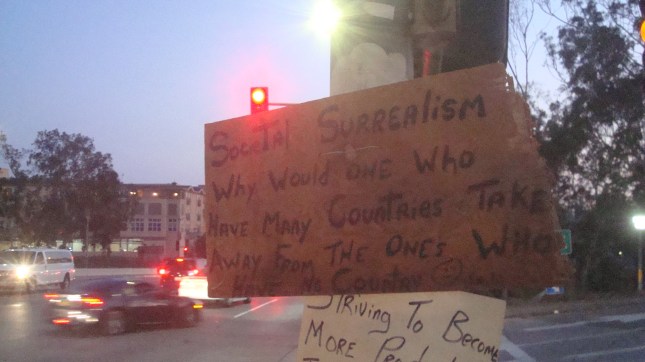
Last night I was walking down Crenshaw at dusk.  As I came up to the onramp for the Santa Monica Freeway I saw some signs fixed to a pole.  I thought the message was cool, so I pulled out my camera and snapped a few photos..

Crenshaw Sign 2

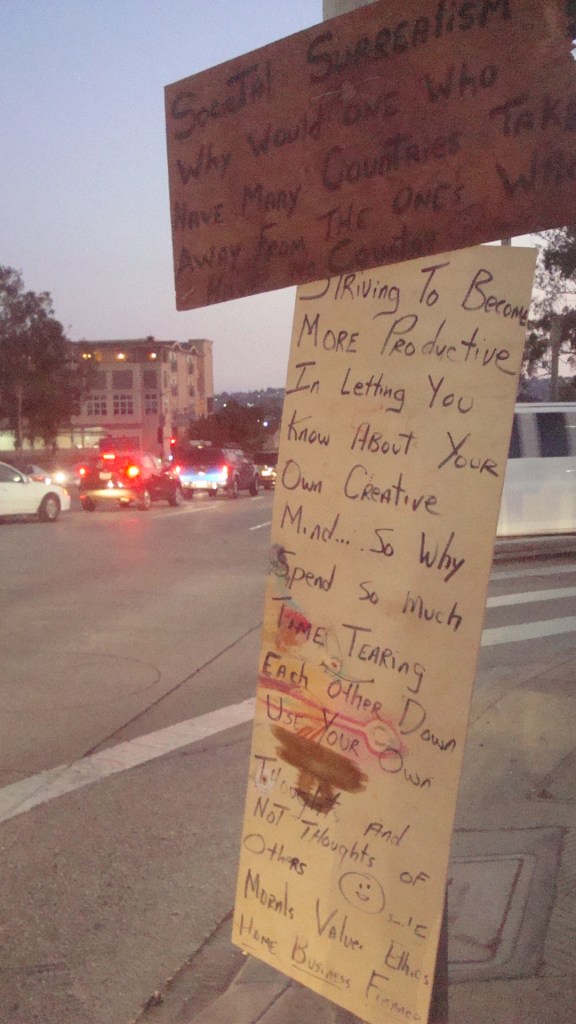
As I was taking the pictures, I wondered who put these signs up.  I didn’t have to wonder long.  He was standing a few feet away.  He came up to me and asked me why people didn’t use their creative mind.  It was a good question, and I didn’t have an answer.  We started talking.  He told me he thought the richest soil in the world was the soil you find in a cemetery, because so many people take their thoughts to the grave.

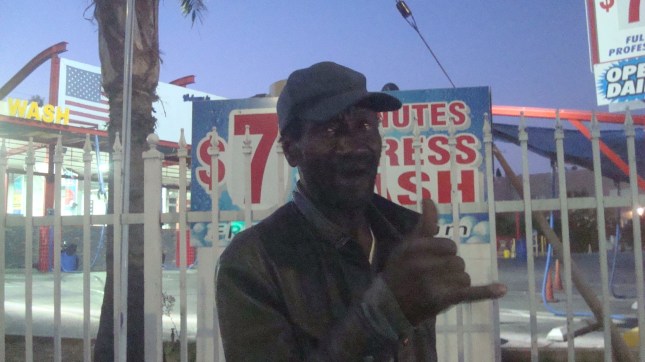
He told me his name was Lovell.  I told him I did a blog about LA, and asked if I could take his picture.  He said fine.

Crenshaw Lovell 1

We probably talked for about ten minutes.  Then I said goodbye and moved on.  But I was really glad I met Lovell.  He’s interesting guy, and he’s an optimist.  He really believes people can make the world a better place if they just allow themselves to explore their own potential.

It was a message I needed to hear.  The world seems so scary these days.  There’s so much violence and hate.  So much poverty and fear.  At times it feels like there’s no hope at all.  So it was good to talk to someone who does have hope.  Someone who believes we can change things for the better, if only we can just change ourselves.

Crenshaw Sign 3


A Crash Course in Asian American Activism

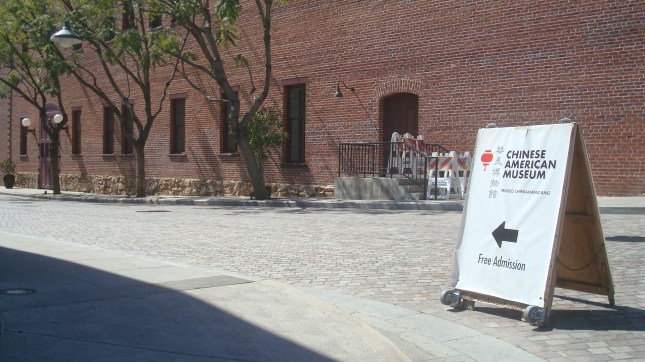
CAM 01 Ext Sign Stand

A while ago I read in the LA Weekly that the Chinese American Museum was presenting an exhibit about the Asian American activist movement from the 60s through the 80s.  It caught my attention for two reasons.  First, I had no idea that Asian Americans played a significant part in that era’s counterculture.  Second, I didn’t even know we had a Chinese American Museum in LA.  So I figured it was time to learn more about both.

It was well worth taking the trip to Downtown.  The museum is in a historic building just off the plaza at El Pueblo de Los Angeles.  Before I even got to the exhibition about Asian American activism, I spent some time with two smaller shows on the ground floor.  Journeys and Origins deal with Chinese migration to the US and the formation of Chinese communities in LA.  These shows are small, but beautifully put together, with a rich collection of artifacts.

CAM 10 Imm Room

Exhibits on the first floor document Chinese migration to the US.

CAM 12 Imm Page

Documents and photos help tell the story.

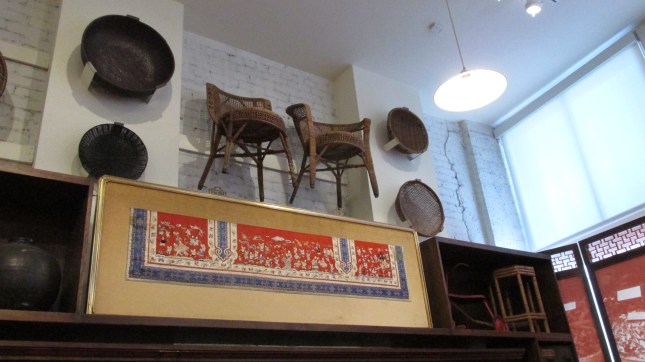
CAM 14 Imm Chairs

Furniture, cookery, toys and textiles are featured.

CAM Imm Abacus

Does anyone under 40 even know what an abacus is?

Then I went upstairs to check out the main attraction, Roots, Asian American Movements in Los Angeles, 1968-80s.

CAM 20 Rts Title

This show was a real eye opener.  Like I said before, I had no idea Asian Americans were so much a part of the counterculture in the 60s and 70s.  In one respect what they accomplished is even more impressive than the Black and Latino movements, because the Asian community was so much more diverse.  Activists representing Japanese, Korean, Chinese, Filipino and other cultures made a conscious effort to work together to push for change.  These groups did not have a shared history, and at times had been bitterly divided, but they realized they had a better chance of being heard if they spoke with one voice.

CAM 22 Rts Shirts

Silkscreened T-shirts were one way of spreading the message.

CAM 23 Rts Buttons

Activists worked to address a variety of issues.

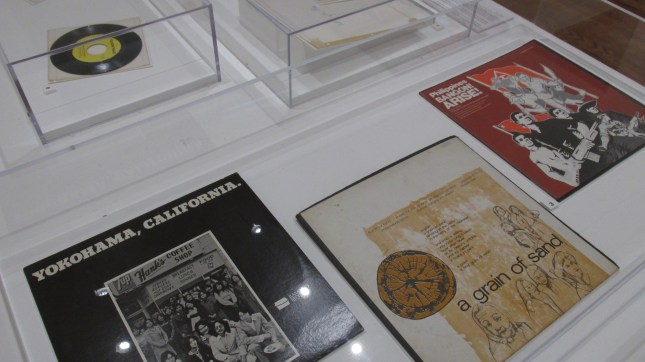
CAM 24 Rts Records

Music was another way of reaching out.

CAM 26 Rts Gidra

Gidra published news, commentary and art from 1969 through 1974.

CAM 28 Rts X

Come-Unity promoted cooperation across racial boundaries.

In the 60s pop culture was exploding, and members of the movement recognized that mass media was a powerful tool for getting the word out.  The show includes records, magazines, posters and other artifacts from the era.  Staging concerts, printing posters and making T-shirts helped spread awareness beyond the community.  While these activists addressed issues that affected Asian Americans, they also reached out and forged bonds with the wider protest movement.  It was a time when boundaries were being erased, and people of all kinds were coming together to address the problems facing the country.  If only we could revive that spirit these days.

The show runs through June 11, 2017.  If you want more info, here’s the link.

Chinese American Museum

CAM 50 Rts Posts

Post-it notes left by museum visitors.

Mayor Missing in Action

garcetti-mia

On Wednesday, February 15, eight neighborhood councils sponsored a forum for candidates in the mayoral race. Almost all of them showed up to share their views on the state of the City and to present their vision for the future. Unfortunately, incumbent Eric Garcetti couldn’t make it. Certainly the Mayor is a busy guy, and it might be understandable if he couldn’t appear in person, but his office did tell the organizers that he would be sending a representative to speak in his place. Inexplicably, Garcetti’s representative didn’t make it either. Why is this?

As everybody who lives in LA knows, we’re facing major challenges right now. Nine of the eleven candidates for mayor felt it was important to show up and speak to the community. Apparently the Mayor didn’t feel like it was worth his time.

The neighborhood councils organizing this event spent a lot of time putting it together. Citizens concerned about their communities gave up their Wednesday night to learn where the candidates stood on the issues. But the Mayor couldn’t even send a representative to outline his agenda for a second term. Spokesman Yusef Robb didn’t offer an explanation for Garcetti’s absence, stating only that he was “unavailable”. Anastasia Mann, President of the Hollywood Hills West Neighborhood Council, said she was told by the Mayor’s office that Garcetti didn’t need to be at the event since the other candidates weren’t doing well in the polls. Mann expressed her disappointment at the Mayor’s decision. I’m disappointed, too.

While we’ve seen improvement in LA’s economy during the last four years, Garcetti seems unable (or unwilling) to deal with a number of problems that have only grown more pronounced during his tenure. Families are struggling to cover spiralling costs for housing. Homelessness has risen dramatically. Some of LA’s communities have seen huge spikes in crime. The City’s budget is awash in red ink, even though revenue is up. And in spite of the Mayor’s insistence that the City is promoting transit-oriented development, transit ridership continues to decline.

If you ask me, it’s clear that Garcetti’s tenure as Mayor has been a disaster for Los Angeles, and maybe this explains why he didn’t show up at the forum. If he had been there, he would have had talk about why the City is in such dire straits. So it’s really not surprising that he didn’t have time to appear at this event.

On the other hand, the Mayor does have time for events where he has a chance to suck up more campaign cash. He apparently flew to Sacramento on Wednesday to meet with state officials and attend a fundraiser. It’s clear he hopes to run for higher office, probably governor or senator, and doesn’t plan on serving the full term if re-elected. Maybe that’s why he doesn’t seem terribly interested in solving LA’s problems. Running a city can suck up a lot of time, and who needs the headaches when your number one priority is funding your political career?

Garcetti’s spokesman was right. He is “unavailable”. Also disinterested and disengaged. Apparently the only thing he’s really passionate about is fulfilling his political ambitions. It shouldn’t be hard to find a candidate who cares more than the Mayor about finding solutions to the City’s problems, because the Mayor doesn’t seem to care at all.

Following Through on Earthquake Safety

Photo of building damaged in earthquake from LADBS web site.

Photo of building damaged in earthquake from LADBS web site.

For a while now I’ve been meaning to follow up on a post I did in 2014 about seismic retrofitting. Back then Mayor Garcetti proposed evaluating buildings based on how they’d weather an earthquake, and to make the information available to the public. This was to be the first step in creating a program to reinforce thousands of soft-story apartment buildings, i.e., older wood-frame structures with parking tucked under the units.

It was a great idea, but I have to admit I was skeptical about the Mayor pulling it off. Everybody agreed that it was important to upgrade these older buildings, but implementing such a program meant that landlords and tenants would have to shell out a lot of money to make it happen. I was afraid that after the initial hype faded away, the initiative would die a quiet death at the hands of some committee at City Hall.

I was wrong. Garcetti brought Lucy Jones on board, and she successfully spearheaded the effort to make this happen. The City Council adopted the ordinance in 2015. Earlier this year the Department of Building and Safety started sending letters to property owners letting them know what they have to do to comply. The program will be rolled out in phases, tackling the most risky buildings first. Landlords will be allowed to pass a portion of the cost along to tenants.

The Mayor deserves credit for making this happen, as does Lucy Jones. It wasn’t easy selling it to anxious landlords and tenants. It’ll take years for the process to be completed, but this ordinance will save lives when the next earthquake hits.

If you’d like more information, follow this link to the page at the Department of Building and Safety.

Soft-Story Retrofit Program at LADBS

How Will Communities Stay Connected?

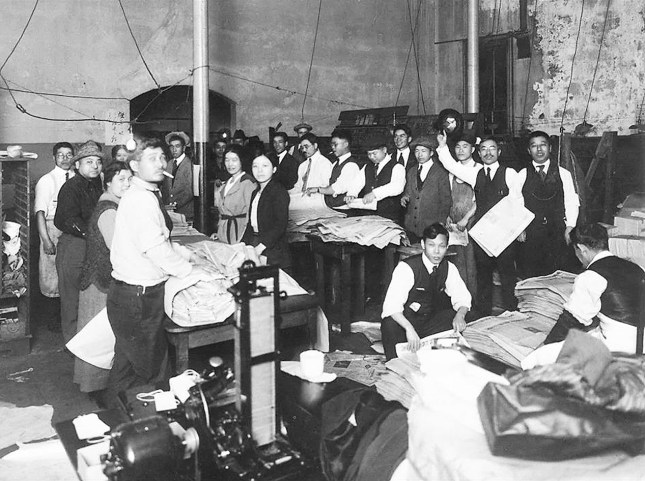
Rafu Shimpo staff circa 1920.

Rafu Shimpo staff circa 1920.

Recently a friend sent me a link to a story about the Rafu Shimpo, a Los Angeles-based newspaper that serves the Japanese-American community. Publisher Michael Komai released an open letter explaining that the paper has been losing money for years and is in danger of closing. Not a big surprise, but still sad news. Newspapers everywhere have been struggling to survive in a world awash in new media options. Technology offers more ways for people to get their news than over before, although I’m often surprised at what folks call “news” these days.

Newspapers may not disappear altogether, but they’re going to occupy much less space in our culture than they did thirty years ago. LA’s major English-language papers, the Times and the Daily News, have seen their circulation and their staff shrink drastically. Our Spanish-language daily, La Opinión, is a shadow of what it used to be. Many of the smaller publications that serve specific communities or cultures have gone on-line or gone away.

The disappearance of these small community papers is troubling. It seems to me we’re losing something important here. These little, independent publications came into being to give a voice to people who didn’t have one. They covered events and issues that were often underreported or completely ignored by the mainstream media. And even with stories that got lots of play in the media, these papers sometimes offered perspectives that weren’t being heard anywhere else.

No question, the internet also gives people a chance to make their voice heard, sometimes far beyond the boundaries of their community. But even though you can reach a huge audience through social media, sometimes it’s hard to figure out who you’re talking to. Two of the key factors that used to bind groups together were place and race. The internet can render both of those things meaningless, or at least effectively obscure their meaning. Is this a good thing? Nowadays people can create their own cyber communities based on the music they like, their sexual orientation, or TV shows they watched as children. You can make friends with people on the other side of the planet, and you don’t even need to speak the same language.

All of that’s great, but every once in a while we have to drag ourselves away from the net and get back to our lives in the physical world. Even if we’re not crazy about the place we live or the people we live with, we still need to deal with that reality. You may be able to fly in cyberspace, but if the sidewalks on your block are buckling, you could fall flat on your face when you go for a stroll. There are a zillion amazing musicians to be found on the net, but the musician who plays at the local bar, who may even be your neighbor, would probably really appreciate your support. And if your community is threatened by neglect or crime or overdevelopment, your only hope of turning the tide is by connecting with the people next door.

The internet can help with that. It’s one more tool we can use to create connections. But small papers like the Rafu Shimpo exist to keep people connected to what’s happening in their own community. Their whole purpose is to bring people together. It may be that advances in technology and market dynamics will slowly bury them. But we will be losing an important resource. Don’t kid yourself that social media is going to fill the void. Sharing kitty videos with a million strangers may be loads of fun, but in the long run you’ll be better off if you take the time to learn what’s happening in your own neighborhood.

Here’s a link to the letter from Michael Komai.

Open Letter from the Publisher of the Rafu Shimpo

Who Are the Real Criminals?

East Los Angeles Courthouse

East Los Angeles Courthouse

Last week the trial of a group of Black Lives Matter activists ended in a hung jury. The seven defendants had participated in an act of civil disobedience that involved stopping traffic on the Hollywood Freeway. They were charged with two misdemeanors, obstructing a thoroughfare and refusal to comply with a police order. The protest was one of many that occurred nationwide after a Missouri grand jury decided not to indict a police officer in connection with the shooting death of Michael Brown.

The question I’m asking is, Why the hell did the City bother with this? Why did they waste the court’s time and the taxpayers’ money in an attempt to convict non-violent protesters of two misdemeanors? Does City Attorney Mike Feuer have nothing better to do with his time?

Before I go any further, I should mention that I know one of the defendants, so you can certainly question my objectivity.  But did this trial serve any real purpose?    I know that the Black Lives Matter movement is controversial. You may not agree with their statements. You may not approve of their actions. That’s fine. But by engaging in a non-violent act of civil disobedience, these people were continuing a tradition that goes back to this country’s origins. In arguing the case, prosecutor Jennifer Wexler is reported to have said, “Voice your opinion, but do it legally.” That’s interesting. Would she have given the same advice to Susan B. Anthony, Rosa Parks and Cesar Chavez?

But I suspect the justification for this idiotic waste of time and money has nothing to do with upholding the law. A friend told me that the defendants were offered a plea deal in advance of the trial, and one of the conditions was that they’d refrain from protesting for two years. Sounds to me like the City’s real goal was to quash dissent.

Was this trial really necessary? There are so many other people that deserve to be prosecuted for acts that have done real damage. We could start with Mayor Eric Garcetti, who took thousands of dollars in campaign cash from a lawn replacement company and gave them a plug in his State of the City speech. The company went on to suck up millions in rebates from the MWD, even though it did substandard work which may have actually done mare harm than good. Or maybe we could go after Ex-Councilmember Tom LaBonge, who attempted to destroy pretty much every document contained in his offices before stepping down. Among the thousands of records destroyed were files pertaining to major development projects and the disbursement of discretionary funds.

Instead the City Attorney goes after seven people who engaged in a non-violent protest, trying to convict them of two misdemeanors. I will be keeping this in mind when Mike Feuer is up for re-election.

Watchin’ the Tide Roll Away….

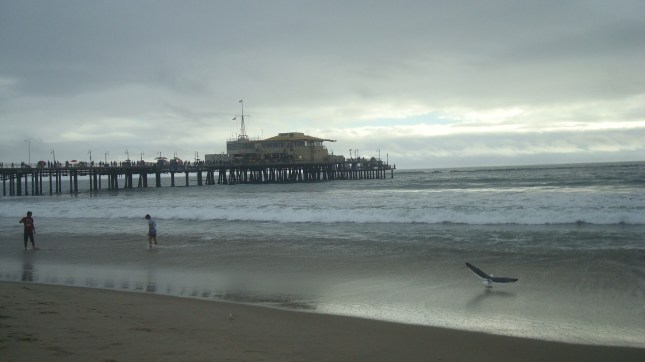
SM 01 Bch Pier

What’s the point of living in LA if you never go to the beach?

That’s a question I’ve been asking myself a lot lately. I love the beach, but I hardly ever get out that way. I guess it’s one of those things, you figure it’ll always be there, so you keep putting it off. But a few weeks ago, I made up my mind I was going out to Santa Monica.

SM 05 Bch Cars

It was a grey day, and I was wondering if anybody else would be out and about. The beach itself wasn’t very crowded.

SM 10 Bch Few

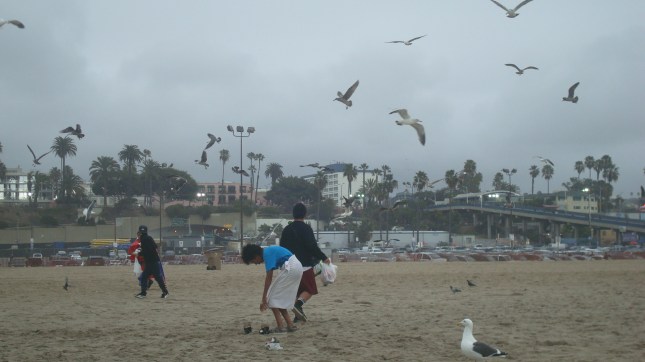
Not crowded with people, at least. There were plenty of seagulls.

SM 15 People Gulls

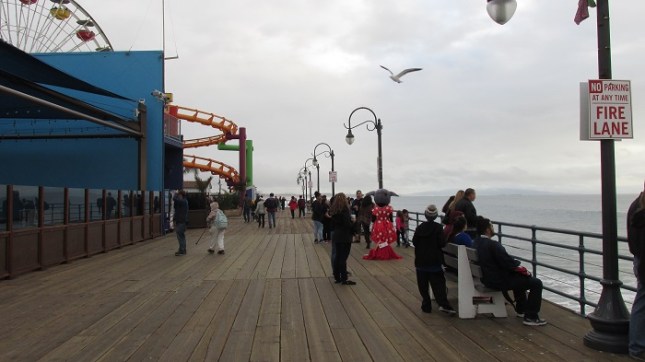
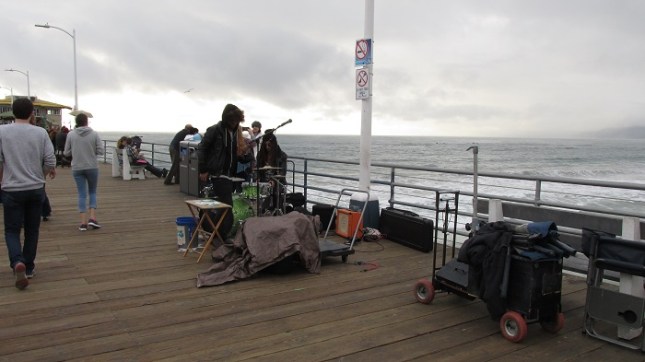
The pier was pretty lively, though. There were lots of folks strolling around, and lots of opportunities for them to spend their money. Aside from the amusement park and the restaurants, there was an artist doing portraits and a band playing for passersby.

People hanging out on the pier.

People hanging out on the pier.

An artist waiting for customers.

An artist waiting for customers.

Musicians setting up their stuff.

Musicians setting up their stuff.

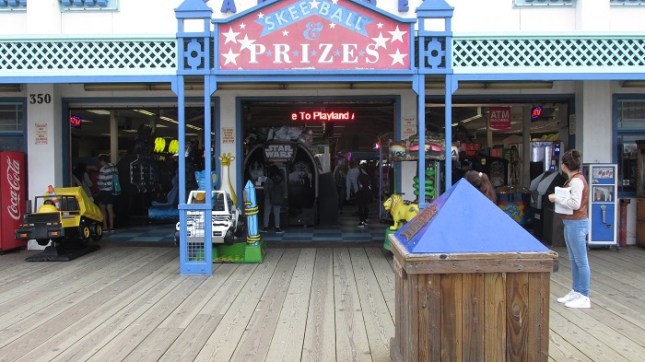
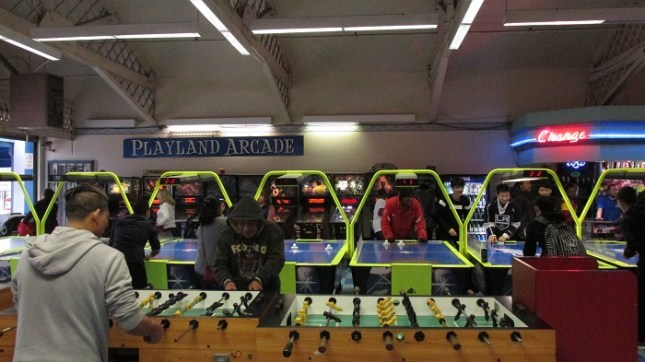
I was glad to see there was still an arcade. These days they’re almost extinct. But this one seemed to be doing decent business.

Entrance to Playland.

Entrance to Playland.

Some people still like the old school games...

Some people still like the old school games…

...though I didn't see anybody playing skeeball.

…though I didn’t see anybody playing skeeball.

How could you resist?

How could you resist?

I don’t know why I’m so fascinated with arcades. I never play the games, but I like wandering through them. Maybe it’s just a nostalgic thing.

The amusement park was drawing plenty of customers. The kids on the Scrambler seemed to be having a great time.

The entrance to Pacific Park.

The entrance to Pacific Park.

Spinning out on the Scrambler.

Spinning out on the Scrambler.

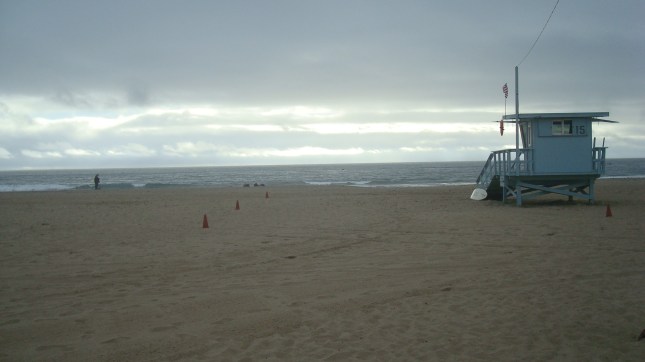
I love walking along the sand, but what really draws me to the beach is the ocean.

SM 60 Bch Lfgd

On the day I was there, it looked cold and grey and endless.

SM 70 Bch Two Walk

Heavy clouds hung overhead, but there was a rim of silver light lining the horizon.

SM 72 Bch Girls

I was glad I came.

SM 74 Bch Surf 1

Outdoor Ad Onslaught

Billboards at Highland and Franklin

Billboards at Highland and Franklin

I’ve written before about how our elected officials often try to cut the public out of the decision-making process. It’s happening again. This Thursday the City Planning Commission will be considering a number of proposals backed by outdoor advertising companies to increase their presence in our communities. There is significant opposition to these proposals among LA’s neighborhood councils, but the CPC has scheduled their vote without giving the NCs and other neighborhood groups a chance to weigh in.

Mini billboard tacked on to a mini mall

Mini billboard tacked on to a mini mall

This is hardly surprising. These companies want to increase the number of billboards they can put up, get amnesty for illegal billboards and clear the way for more digital billboards. It probably won’t surprise you if I tell you that they’ve spent over a million dollars lobbying our elected officials. But what if I tell you that they spent that much in just the first half of this year? They’ve actually spent many millions over the years to press their case with City Hall. Here’s an article with more details.

LA Billboard Companies Spend Over $1 Million Lobbying from Ban Billboard Blight

I’ve been making an effort to follow this issue, but I hadn’t heard anything at all about a possible vote by the CPC until I took a look at CityWatch earlier this week. That’s where I found this article. It gives a detailed breakdown of what’s going down, and also gives a clear picture of how the City has tried to slide this past us.

Sign Companies Call the Shots at City Hall from CityWatch

As the author points out, the CPC will argue that they heard public comment on this issue when it was before the Commission back in 2009. But the Planning & Land Use Management Committee has made significant changes to the previous proposals. The City has not given anybody (except the outdoor ad industry) a chance to be heard on the changes.

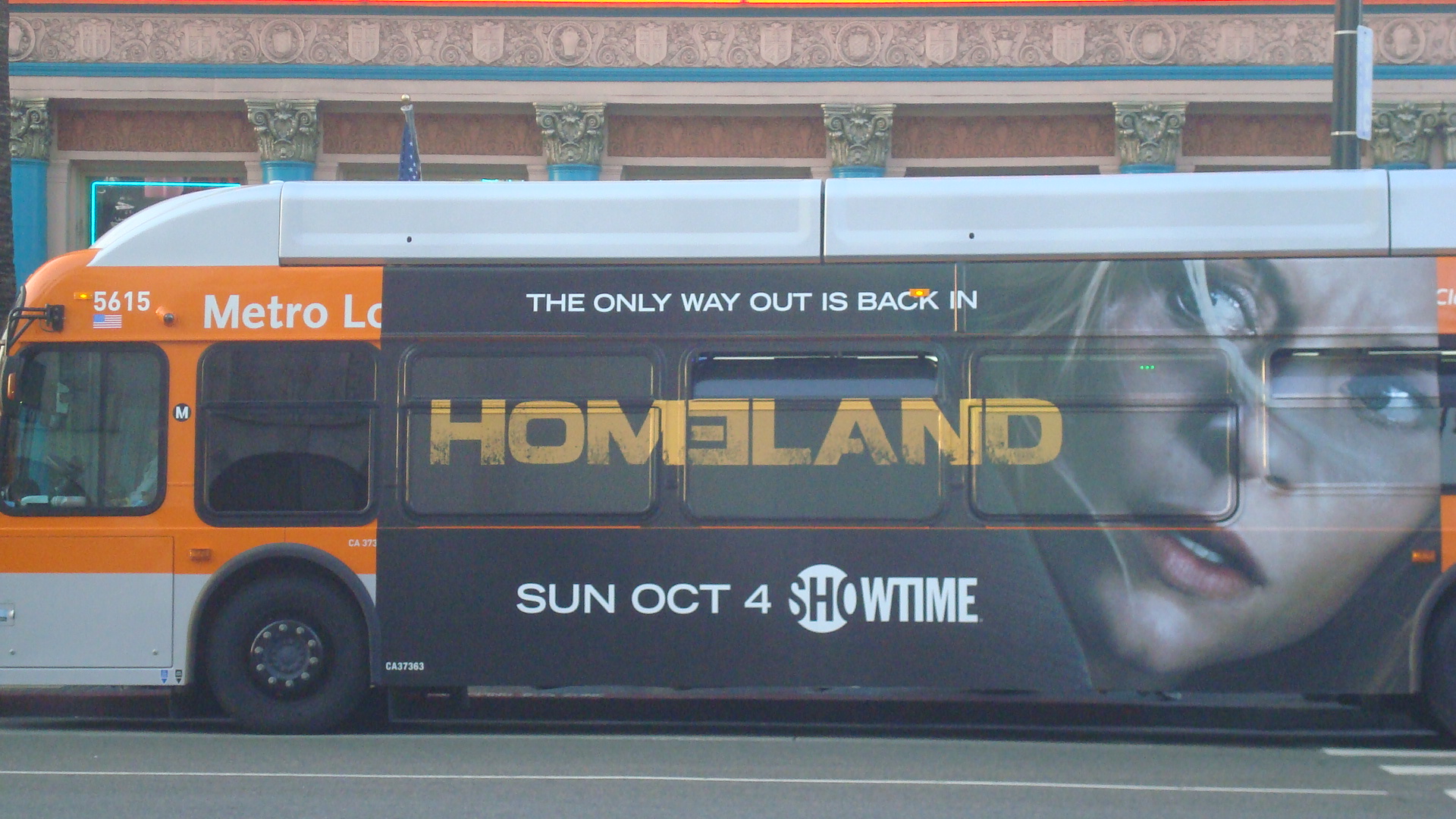
Ads on busses

Ads on busses

Both of these articles originated on the web site Ban Billboard Blight. If you’re concerned about this issue, I urge you to take a look. The site contains a number of worthwhile resources.

Ban Billboard Blight

I know that billboards are a part of life in the big city, and I’m not out to ban them. But we shouldn’t be giving these outdoor advertising companies permission to go hog wild just because they’re spending millions to lobby our elected officials. If anything, we need to set stricter guidelines for advertising in public spaces.

Here’s a link to the agenda for the CPC meeting.

CPC Meeting, Thursday, September 24

If you care about this issue and can make it down there, great. If you can’t make the meeting, you can still e-mail your comments to the Commission at the address below. Please use the subject line “CPC-2015-3059-CA, Citywide Sign Ordinance Changes”.

CPC@lacity.org

Ads at bus stops

Ads at bus stops

No Need to Get the Public Involved

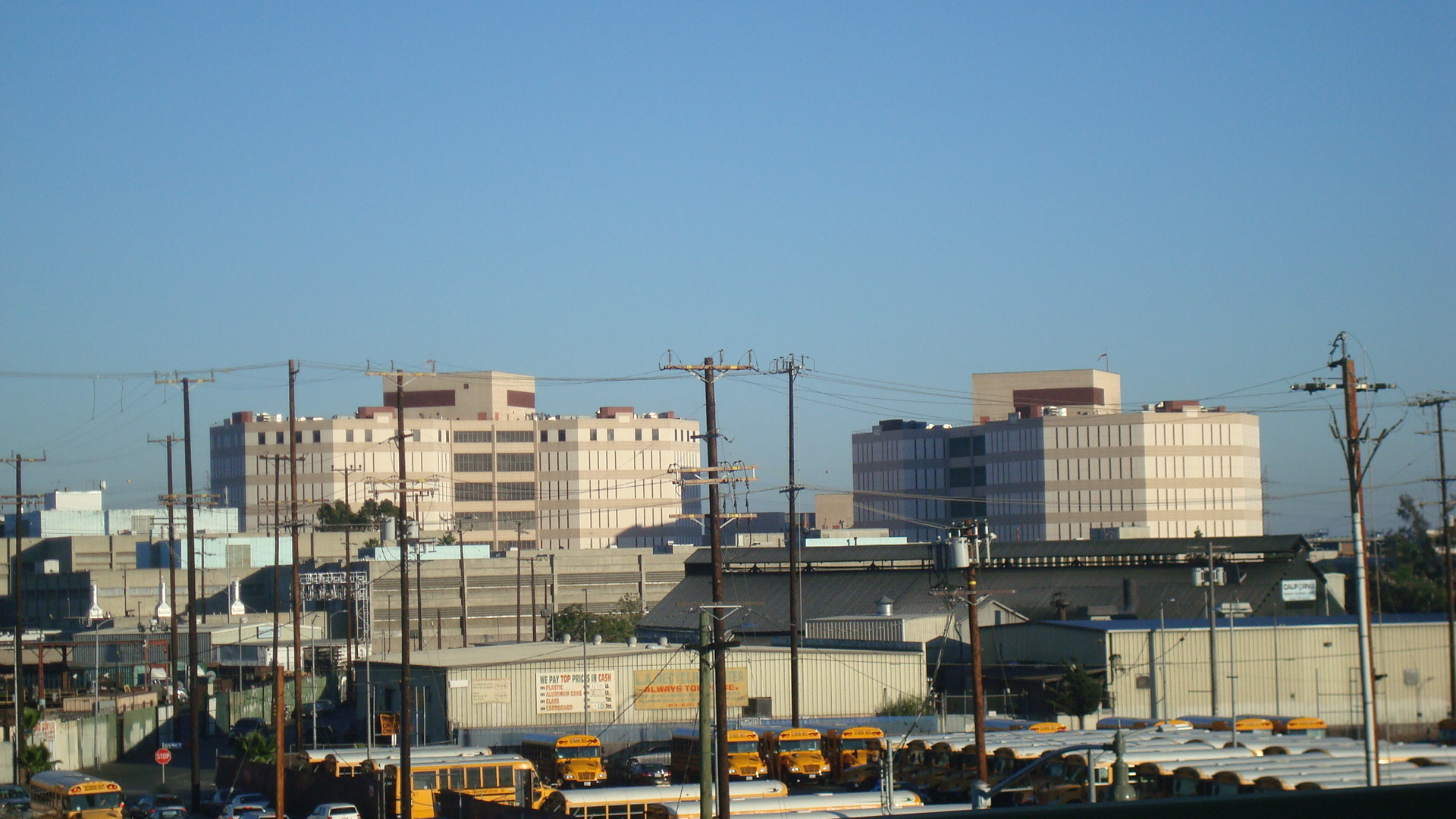
Twin Towers Correctional Facility near Downtown LA

Twin Towers Correctional Facility near Downtown LA

Last week the LA County Board of Supervisors voted to approve the construction of two new jails, at a combined cost of more than $1 billion. By itself, this probably doesn’t seem too alarming, since the County has been facing severe criticism over the conditions in its jails for years. But in their rush to approve these projects, the Supervisors forgot one little detail. Somehow they neglected to let the public know that this item was coming up for a vote.

These projects have been under consideration for a while, and the need to fix this problem is very real. But the agenda posted before the meeting says absolutely nothing about taking action on this issue. The agenda did mention that a proposal to transfer mentally ill prisoners to a different facility was going to be discussed, and they’re claiming that the vote to approve the jails was related business. What a joke. The public was completely bypassed. There was no serious debate. The three alternatives considered were not properly analyzed. This is a travesty. And aside from being a travesty, it’s totally illegal. The Brown Act requires elected representatives to give adequate notice for any item they plan to take action on.

The Board has had transparency problems before. Back in 2011 it held a secret meeting with Gov. Jerry Brown to discuss the transfer of mentally ill prisoners, which triggered a lawsuit by Californians Aware. Last year the Board refused to turn over records detailing payments to private lawyers who had defended the Sheriff’s Department in excessive force cases.

But the County isn’t alone in its efforts to shut the public out. The sad fact is, this kind of thing is common practice for our elected officials and government agencies. The City of LA has a less than stellar record when it comes to public participation. City agencies hold public meetings, declaring that they want to hear from the citizens, but often these meetings are so poorly publicized that nobody knows about them. They scheduled a series of five open forums on re:code LA, a massive overhaul of the City’s zoning code. I did receive notice of the meetings. Unfortunately it didn’t arrive until the first three had already taken place. I wasn’t able to attend the last two. I still remember the meeting held by the Housing and Community Investment Department a while ago in Pacoima. The purpose of the meeting was supposedly to get input from the community on how to use millions of dollars in federal funding. Only about 20 people showed up, and they were all either city employees or reps for non-profits. Why were there no citizens from the communities that might benefit from the funding? It came out during the meeting that the HCID had neglected to contact local groups within these communities in order to help publicize the event. They hadn’t even distributed flyers within the areas under discussion.

It happens at the regional level, too. Earlier this year the Southern California Association of Governments (SCAG) announced a series of open houses to get comment on their Regional Transportation Plan/Sustainable Communities Strategy (RTP/SCS). I bet a lot of people would’ve liked to attend. Unfortunately, all but one of the meetings were scheduled during working hours, meaning anybody with a job would have to take time off to be there. On top of that, of the six open houses planned, none of them were located in the City of LA. In other words, there wasn’t going to be a single meeting within the boundaries of the largest city that SCAG serves. SCAG took some heat for this, and they did end up scheduling three more meetings. But why do we have to put the screws on just to have our voices heard?

This is really maddening. These people are supposed to be serving us. Instead, they’re routinely shutting the public out of discussion on important issues. And with the Board of Supervisors voting to spend $1 billion without even putting the item on the agenda, we seem to be hitting a new low.

If you want to contact your Supervisor to let them know how you feel about this, here’s the link.

Board of Supervisors

Campaigning for Re-Election on Our Dime?

Garcetti Logo Signs

If you live in LA, you’re probably aware that the City is using all kinds of media to get the message out about water conservation. And if you’ve been paying attention to the news, you may also know that Mayor Garcetti is gearing up for his 2017 re-election effort. Why am I leading off with these two apparently unrelated items? Well, because actually it seems they are related. Even though they shouldn’t be.

I was standing at a bus stop where the bench displayed one of the water conservation ads. The first time I saw it I didn’t pay much attention. It was just another public service announcement, and I’d already gotten the message about cutting my water use. But after looking at it a few times, something caught my eye. Like most PSAs, it carried a few logos to let you know who was behind it. And one of them belonged to our Mayor.
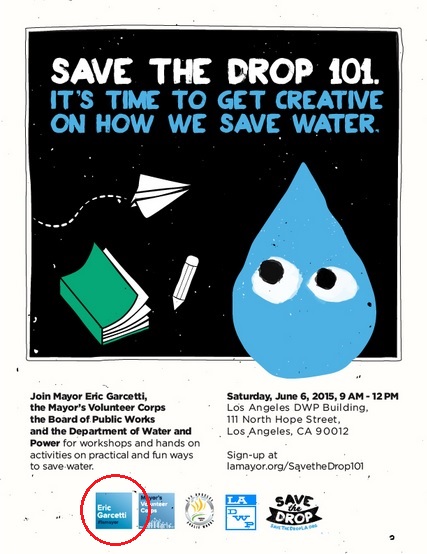
Poster for Save the Drop campaign

Poster for Save the Drop campaign

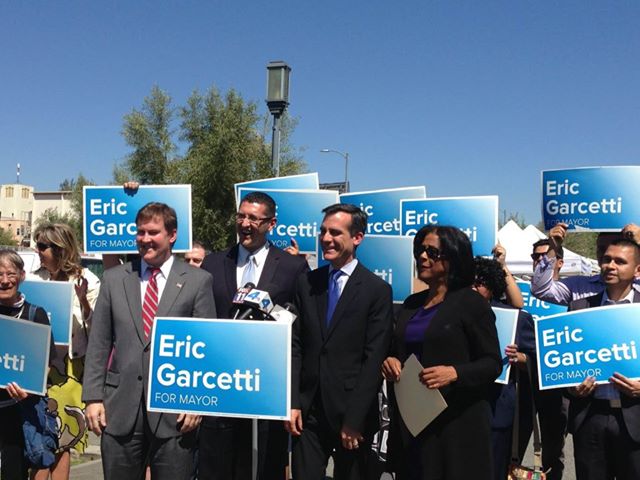
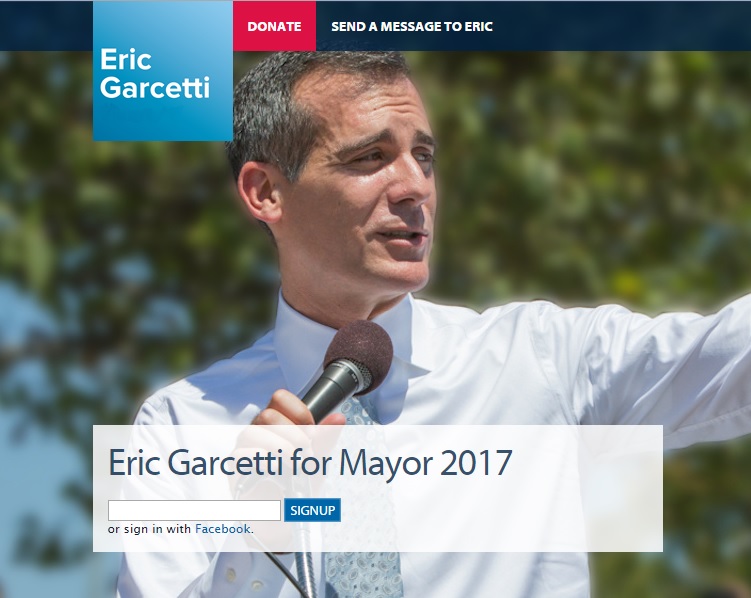
You’re probably asking, So what? Shouldn’t the Mayor be throwing his weight behind this campaign? No argument there. It’s an important initiative. The thing that struck me was that the logo used here was remarkably similar to the one Garcetti used when he was campaigning for mayor in 2013, which is almost exactly the one that he’s using for his re-election bid.

Announcement from Garcetti's 2013 campaign

Announcement from Garcetti’s 2013 campaign

Screen shot from web site for Garcetti's 2017 campaign

Screen shot from web site for Garcetti’s 2017 campaign

If you live in LA, you must’ve seen it by now. A blue square containing the Mayor’s name in crisp, white, sans-serif type. There are a few different versions. The text varies slightly depending on when and where it appears. It’s a nice piece of design. It could suggest a clear blue sky, or crystal clear water, or a kind of zen serenity, or almost any other abstract positive association, which is one of the key concepts behind political advertising. It suits Garcetti perfectly. He’s a master salesman, and he’s spent several years refining his own brand. The hip, smart, 21st century guy who’s leading us all toward a brighter future.

All that’s fine. I congratulate the Mayor on his marketing savvy. But he should not be using a logo designed for his campaign on a PSA paid for by our tax dollars. Aside from the issue of using public money to support a private brand, this also confuses the City’s efforts to educate the public with the Mayor’s efforts to get himself re-elected. And this goes beyond the water conservation campaign. If you look at the City’s web page for the Mayor’s office, it displays the same logo.
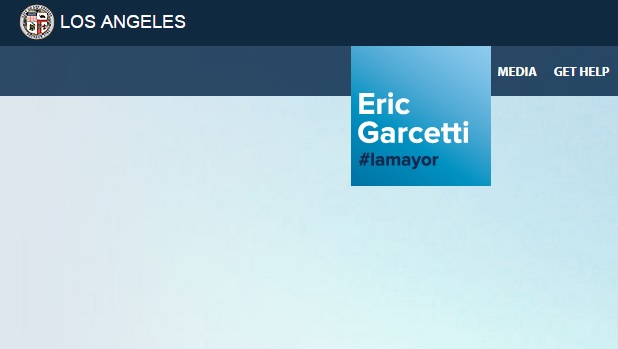
Screen shot from the home page for the Mayor's Office

Screen shot from the home page for the Mayor’s Office

And the same goes for e-mails sent by the Mayor’s Office relating to public business. I realized in the course of writing this post that I had been confusing e-mails sent by the Mayor’s Office with e-mails sent by the Garcetti campaign. The headings are different, but the inclusion of the same logo on both makes it seem like they emanate from the same source.

E-mail sent by the Mayor regarding his State of the City speech
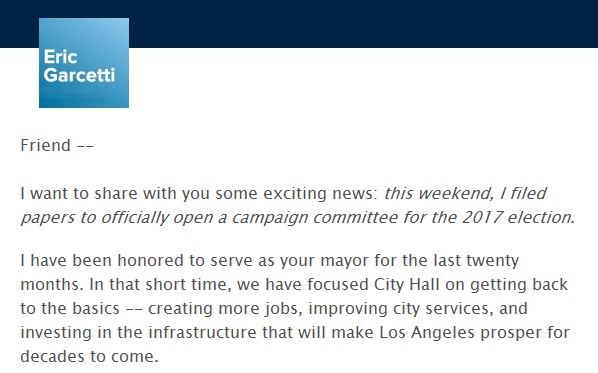
E-mail sent by the Mayor regarding his State of the City speech

E-mail sent announcing Garcetti's re-election campaign

E-mail sent announcing Garcetti’s re-election campaign

And this is really a problem. Eric Garcetti is the Mayor, that is, he’s an individual who’s been elected to serve in that capacity. But he is not the Mayor’s Office. That’s a separate entity which has been occupied by many people over time. To use the same graphic for communications from a politician seeking re-election and an office that exists to serve the people of Los Angeles creates a dangerous confusion.
If Garcetti is unhappy with the traditional seal for the Mayor’s office, he should ask City staff to redesign it, but it should be completely distinct from the logo he’s using for his re-election campaign. The Mayor’s communications regarding official business need to be clearly differentiated from his efforts to win another term. Sure, most politicians use their office for self-promotion of one kind or another, but we shouldn’t be subsidizing the practice. The Mayor needs to remove any graphics related to his campaign from all media used by the City to conduct official business. And he needs to do it now.