We Still Haven’t Crossed the Finish Line

front of N.F. Stokes Residence

front of N.F. Stokes Residence

I was thrilled last week when I heard that LA’s Cultural Heritage Commission voted unanimously in favor of designating the N.F. Stokes Residence a historic cultural monument. The building, at 1905 Grace, dates back to 1917 and is one of the few structures from that era still standing in the Hollywood area. At the same meeting the CHC voted to consider the Mosaic Church, at Hollywood and La Brea, for designation as well. There were a number of people in the community who have worked long and hard to save these buildings, and reading the e-mails from those involved it seemed like everyone was breathing a collective sigh of relief.

But the fight isn’t over yet.

I don’t want to rain on anyone’s parade, but we have to remember that the Stokes house won’t actually be declared a monument until the City Council votes on it. That’s when it becomes official. And as for the Mosaic Church, I was at a meeting last week where a developer’s representative flatly declared that the building did not deserve monument status. Now, you might be thinking, Hey, the CHC vote was unanimous. They clearly believe that both buildings are worth saving! How could the City Council ignore their recommendation?

Better think again. Not too long ago Mayor Garcetti pushed for the demolition of the Oswald Bartlett House over the loud objections of the preservation community, and he got his way. That house is gone. Over the past few months the Mayor has overridden the City Planning Commission to revive two major developments that faced strong opposition from the neighboring communities. There are no guarantees here. Recent history has shown that the Mayor and the City Council will do what they want. Which is often exactly what the developers want.

So we need to keep the pressure on. If you live in Council District 4, where the Stokes Residence and the Mosaic Church are both located, you might want to contact newly elected Councilmember David Ryu. His support will be crucial. Here’s his info.

Councilmember David Ryu
david.ryu@lacity.org
323 957-6415

And if you don’t live in CD 4, you can still contact your councilmember and let them know you think these buildings are worth saving.

Mosaic Church

Mosaic Church

Reyner Banham Loves Los Angeles

Reyner Banham adjusting his rear-view mirror.

Reyner Banham adjusting his rear-view mirror.

I was surfing the net today and came across an amazing artifact from LA’s past. Reyner Banham was an achitectural theorist and historian. He was born in England, but came to America and fell in love with the place, especially Los Angeles. In 1972 he made a film essay about the city for the BBC. He called it Reyner Banham Loves Los Angeles. These days that title might not strike you as unusual, but back in the early seventies LA was seen by most architects and planners as a disaster on a massive scale. For Banham, a respected writer and professor at UC Santa Cruz, to proclaim his love for LA, loudly, frequently, unabashedly, was really controversial.

I’m not going to tell you it’s a great film, because it’s not. But I think anybody who cares about this city will be fascinated. First, you’ve got this really smart, perceptive guy giving you his thoughts on what most commentators at the time thought was an urban wasteland. Second, the movie gives you a good, long look at what LA was like back in 1972, and if you weren’t around in those days, you’ll find the contrast startling.

The film is slow in places, and kind of disjointed. Also, because it’s only an hour long, Banham doesn’t have time to take more than a cursory glance at some aspects of LA. The worst part is that the print is badly faded. In some scenes it’s hard to even make out what’s on screen. But you get to see images of Watts, Hollywood, Downtown and Venice as they looked over forty years ago. It’s a real time capsule. Here’s the link.

Reyner Banham Loves Los Angeles

The film is an entertaining artifact, but it just gives you a taste of what made Banham such an interesting and provocative character. If you want to learn more about him, check out his 1971 book, Los Angeles: The Architecture of Four Ecologies. Don’t be put off by the academic sounding title. It’s a fresh and entertaining exploration of the aspects of this city that make it unique. I recommend it to anybody who wants to gain a better understanding of LA.

Criminalizing Homelessness

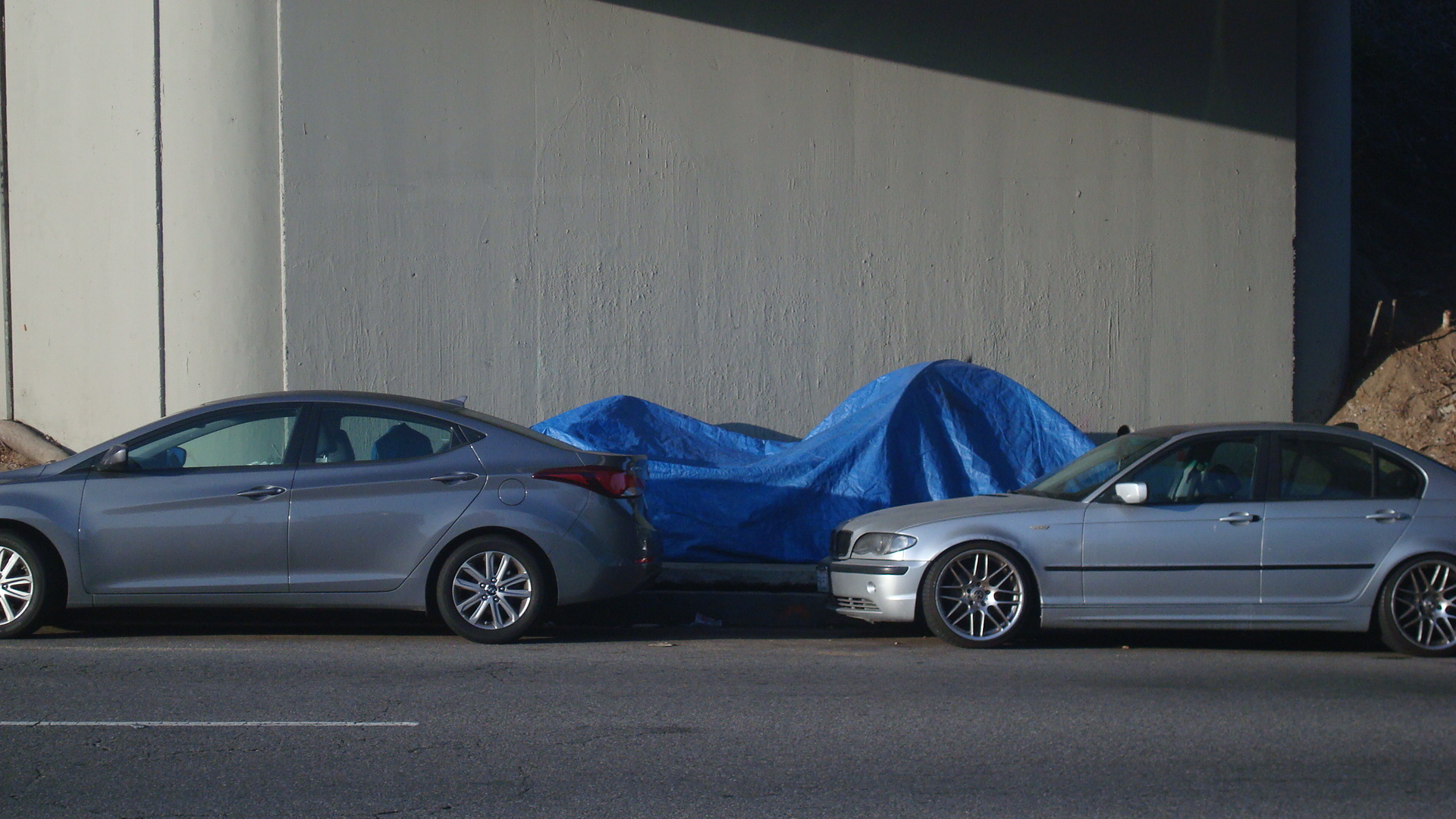
DSC09677

Once again our elected officials have shown us how little they really care about improving the quality of life in LA. On Tuesday the City Council passed two ordinances to make it easier to get rid of homeless encampments. Gil Cedillo cast the only dissenting vote. All the others fell right in line.

I totally understand that there are serious health and safety issues with the homeless camps that have been springing up all over LA. I know we have to deal with this. But as usual, the City Council has chosen to attack the symptoms rather than try to address the cause.

The reason people are living in tents is because we have an appalling shortage of affordable housing. The Mayor and the City Council continue to back to developers that want to build pricy condos and high-end apartments, but they seem to have no interest in providing homes for anyone besides the rich. Their meager efforts to build affordable housing are pathetic. LA real estate is being sucked up by developers with deep pockets who only care about maximizing their profits. In the past few years they’ve created thousands of new units that go from $2,000 a month on up into the stratosphere. And these same developers have taken thousands of rent-controlled units off the market as they demolish or refurbish older buildings.

According to the LA Times, the City’s homeless population currently stands at 26,000, a 12% increase over the past two years. This problem is not going away. It’s getting worse. Councilmember Cedillo makes the point that the vast majority of the funds the City spends on homelessness go toward law enforcement. This is crazy. The police can’t solve this problem.

Now you may be asking, can anyone solve this problem? The answer is yes. Follow the link below to an article from the LA Times about how Utah is dealing with chronic homelessness. They’ve made huge progress, and the state is actually saving money by providing housing for people who’ve been living on the streets.

Utah Is Winning the War on Chronic Homelessness

Of course, LA is not Utah. And I don’t mean to imply that there is a simple solution. But we could do a hell of a lot more than we’re doing now. And we need to start by making a serious effort to provide affordable housing.

For more info on the ordinances passed by the City Council, here’s a link to the story in the Times.

Vote Makes It Easier to Clear Homeless Camps

Landmark? What Landmark?

Circus Disco

Circus Disco

When a proposed project might have significant impacts on the surrounding community, state law requires the developer to prepare an Environmental Impact Report (EIR). In theory, this is a good thing. The idea is to make sure that negative impacts are identified so that everyone is aware of how the project will affect the area. In practice, the whole EIR process is questionable. The basic problem is that the developer is the one who pays for the report, which means that it almost invariably focusses on the positive impacts, and either minimizes or ignores the negative impacts.

This is exactly what’s happing with the Lexington Project. The developer wants to build almost 700 residential units on a city block between Lexington, Santa Monica, Las Palmas and Seward. The EIR tells us it’s a terrific project with numerous benefits for the area. But there a lot of the people in the community who see things differently.

The aspect of the project that’s gotten the most media attention is the fact that the developer will be demolishing the Circus Disco. You may be wondering why this is a big deal. Hollywood is full of places to dance. But the Circus is an important landmark for the LGBT community in LA, and especially for non-white gays and lesbians. Back in the 70s, when disco was big, there were plenty of clubs where gay men could party all night long. Unfortunately many of those clubs didn’t admit blacks and Latinos. But the Circus Disco was open to everyone, and it’s been cherished for years by the LGBT community because of that.

But while the EIR mentions the Circus in its survey of structures on the property, the report concludes that, “… [N]one of these buildings appears eligible for listing in the National Register, California Register, or for local City of Los Angeles Historic-Cultural Monument designation.”

This is interesting. Sure, it would be hard to make a case that the Circus was significant enough to make the national or state registers. But are they saying it’s not a significant part of LA history? If so, it seems that the City of LA’s Office of Historic Preservation has a different view. Survey LA is a program initiated by the OHR to document significant buildings. Last year they released a document entitled LGBT Historic Context Statement which gives an overview of the community’s history and identifies potential landmarks. And the Circus Disco is on the list.

LGBT Historic Context Statement from Survey LA

But it’s not just the Circus that’s threatened. The French Market and Catch One, both of which hold a significant place in the LGBT community, may soon be gone. And let’s not forget that back in 2011 the building that originally housed A Different Light, an early gay bookstore, was demolished. That was the same year that the Spotlight, according to some the oldest gay bar in Hollywood, closed its doors. The building still stands, but now it’s just another upscale nightclub. It does seem like the LGBT community is losing a huge chunk of its history.

Not that any of us should be surprised. Preservation has never been a high priority in LA. Groups like the Los Angeles Conservancy and Hollywood Heritage keep fighting to save these buildings, but City Hall seems more interested in keeping the developers happy.

If you want to learn more, this article from the Daily News offers a good summary.

Disco to Become Site for Condominiums

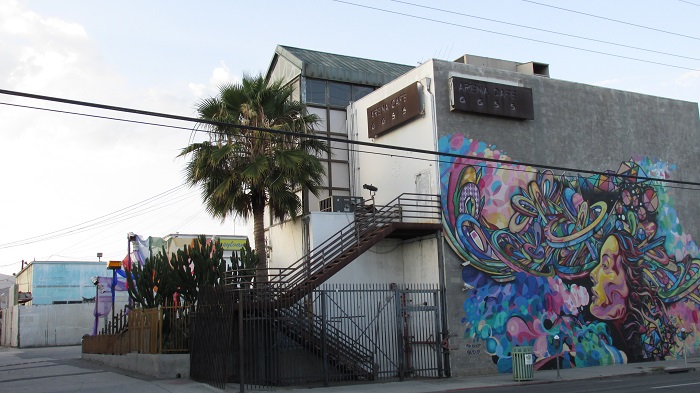
Mural on the front of the building

Mural on the front of the building

This Is a Public Servant?

Cnsw Banner Crop

If you haven’t heard this story already, I’d like to draw your attention to a piece that ran this week on CityWatch. According to the article, 17 tenants are being evicted from four rent-controlled buildings in Beverly Grove and the Fairfax district. Now, you might be saying, why is this news? Evictions like this are a common occurrence in LA these days. All over the city developers are kicking people out of their homes so they can build high-end residential units. Why is this story special?

The reason this story deserves your attention is that the evictions are being carried out by Bulldog Partners, and the principal at Bulldog is Matthew Jacobs. Who is Matthew Jacobs? He’s the chairman of the board at the California Housing Finance Agency. Yes, this is a state agency that’s supposed to help people find housing. Not kick them out of their homes. The CalHFA web site says that their purpose is to “create safe, decent and affordable housing opportunities for low to moderate income Californians.”

Is this sick or what? Does this guy understand the mission of the agency he’s chairing? Doesn’t sound like it to me. That’s why I sent an e-mail to Jerry Brown asking that he be removed from the CalHFA board. If you’d like to contact the governor as well, here’s the link.

Contact Gov. Brown

And here’s the link to the story on CityWatch.

Evictions Spread to Fairfax

Crazy times we live in.

Losing the View

A view of construction underway at Sunset and La Cienega

A view of construction underway at Sunset and La Cienega

People have been building things along the Sunset Strip for a long time now. There are plenty of reasons to want to build there. Probably the people who put up the first houses and apartments along the winding hildside road were drawn by the view. The developers who came along in the twenties had something different in mind. Because at that time the area was unincorporated and beyond the reach of the LAPD, it was a great place to put bars and clubs. In the sixties the nightlife was still a draw, but it also became a hotspot for the counterculture. The clubs attracted bands that were playing all kinds of music, and the Strip in general became a magnet for anyone looking for a different kind of lifestyle.

So even before people began taking LA seriously as a city, the Strip had a reputation for being incredibly hip. Developers saw the potential for profit, and the number of high-rise apartments and hotels grew. Out of towners would come to the Strip to have a drink at the Viper Room or catch a band at the Whiskey. And if they had enough money they could rent a room at one of the hotels that offered a spectacular view of the city spreading out all the way to the horizon.

North side of Sunset at La Cienega

North side of Sunset at La Cienega

I’ve never had enough money to stay in one of those hotels, but I’ve still been able to enjoy the view. I remember ambling along Sunset as a kid, heading for Tower Records or Book Soup, turning my head now and then to gaze out over LA. Though there were a number of high-rises, much of the Strip was lined with one and two-story buildings. There were long stretches that allowed you to gaze out at incredible vistas.
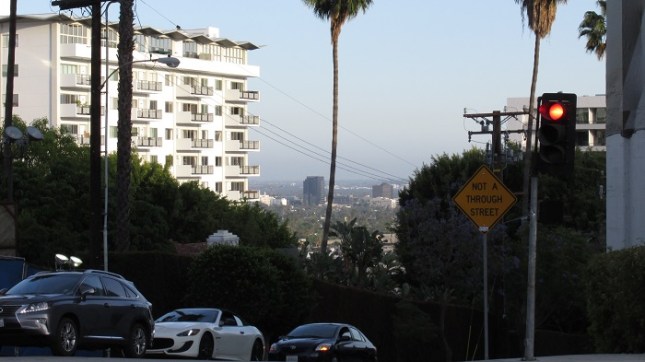
A view of the city from Sunset

A view of the city from Sunset

But these days those views are disappearing. A new spate of development is rising up along the Strip, making it harder and harder to see those breathtaking vistas. There’s a massive project under construction right now which will occupy a good stretch of Sunset on both sides of La Cienega. And there are other projects under consideration, such as 8150 Sunset.
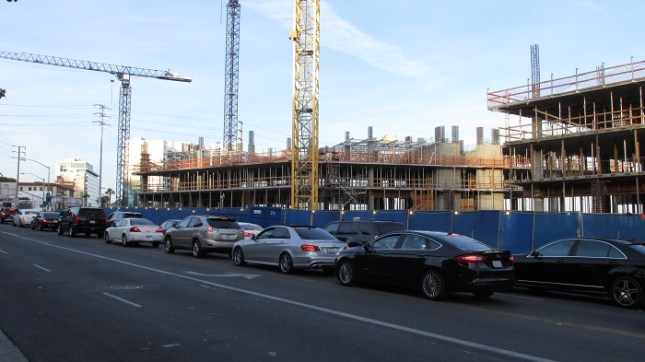
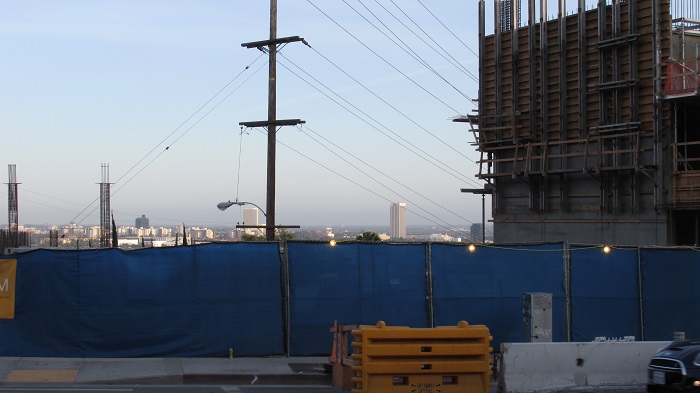
Construction site on Sunset west of La Cienega

Construction site on Sunset west of La Cienega

Many of the hillside residents are freaking out, and one of the reasons they’re upset is that these projects will block their view. (There are other reasons, too, including increased traffic and crumbling infrastructure.) Of course, the fact that the folks in the hills are mad about losing their view has riled the pro-development crowd. They’ve been reviled as elitist snobs who want to stop progress just so that can stand on their deck at sunset and gaze at the vast landscape below. It’s interesting, though, that the developers haven’t been the focus of similar criticism. Let’s get real. One of the main reasons they’re building high-rises along the Strip is so they can sell the view. The hotel rooms and condos in these new projects will go for outrageous prices precisely because they offer fantastic views. And if you think we really need another upscale high-rise in LA, I think you’re completely out of touch with reality. Developers are pushing these projects because they can make a mountain of cash. Meanwhile, there’s a serious shortage of affordable housing, in large part because the current wave of development is driving housing prices sky high.

Another view of construction at Sunset and La Cienega

Another view of construction at Sunset and La Cienega

As for me, I do feel like the Strip is losing something. It used to be that just standing on the sidewalk you could see a large swath of the city laid out before you. It was something free that anybody could enjoy. These new projects will make those views harder to find. And beyond that, I feel like the whole Strip is getting so pricey that ordinary people are being squeezed out. While there have always been ritzy restaurants and high-end clothing stores, there were also plenty of places where you could hang without spending a lot of money. Those cheaper places seem to be disappearing.

Another view of construction at Sunset and La Cienega

Another view of construction at Sunset and La Cienega

Maybe it’s just me. Now that I’m older, I do spend a fair amount of time reminiscing about how great things used to be, and I should probably focus more on the present. But back in the seventies when I wandered along Sunset I used to see all kinds of people on the street. There were rich kids in expensive clothes and vagrants without a nickel in their pocket. Beverly Hills types lunching at sidewalk cafes and runaways living on handouts. It seemed like the Strip was open to anyone, that everybody was welcome.

I feel like that’s changing. Is it just me, or is all this new development burying the welcome mat?

Looking down La Cienega from Sunset
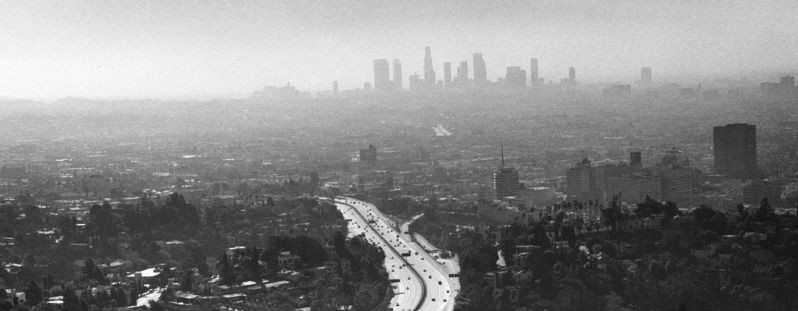
Looking down La Cienega from Sunset

Trying to Keep a Roof Over Their Heads

Protesters on Crenshaw Blvd.

Protesters on Crenshaw Blvd.

I was riding the bus along Crenshaw yesterday, when I saw a group of people gathered in front of a building holding banners and signs that read “Stop Evictions” and “Defend Affordable Housing”. I wanted to know what was going on, so I hopped off the bus at the next stop and walked back to check it out.

The protest was being held in front of the the apartment building at 1625 Crenshaw, and many of people involved were tenants there. Last December they’d been told they had 90 days to get out. Seems the owner has decided to kick everybody out in order to turn the building into high-end housing. Since it isn’t covered by the Ellis Act, the landlord is under no obligation to offer money for relocation.

Ms. Bannister and Frances Bell

Ms. Bannister and Frances Bell

I talked to Frances Bell, who’s been a tenant there for 22 years. Because she pays market rate for her apartment, she’s been given additional time to leave, but she hasn’t yet found a new place to live. Moving can be expensive, and covering the cost herself is a hardship. There’s a sad irony to Frances’ story, because she works for the Department of Mental Health. One of the things she does as part of her job is help people relocate when they’ve been forced out of their home. Little did she know she’d one day be in the same predicament as her clients at the DMH.

Mark Simon

Mark Simon

I was surprised to run into a friend of mine, Mark Simon, who was holding up one of the banners. Mark lives in Hollywood, and he had told me a while ago that his landlord was trying to evict all the tenants in his building. They’ve been fighting it in court, and have managed to delay the process, but they’ll have to leave in January of next year unless something changes.

Walt Senterfitt

Walt Senterfitt

Then I talked to Walt Senterfitt, who lives in Los Feliz. He’s dealing with the same thing at his building, and to fight the evictions he’s helped organize the Rodney Drive Tenant Association. He feels that renters need to band together in order to push back. In recent years, thousands of Angelenos have been forced out of their apartments as landlords decide to pursue wealtheir tenants. It’s hardly surprising that the homeless population has increased sharply if you look at the all the people who have been evicted so that owners can jack up rents.

Hopefully the passage last year of AB 2222 will put a stop to this trend. But it won’t help any of the people I spoke to yesterday, because their landlords started the process before the bill was signed into law. Rents are skyrocketting across the city, and tenants in rent-controlled buildings will have a hell of a time finding a new home for a comparable price. It’s especially hard for seniors who are living on a fixed income.

Here’s the link for the Rodney Drive Tenant Association, if you want to get in touch with them.

RDTA

And if you believe that the LA City Council needs to take action to create more affordable housing, send them an e-mail and let them know how you feel.

LA City Council

Blocking Progress

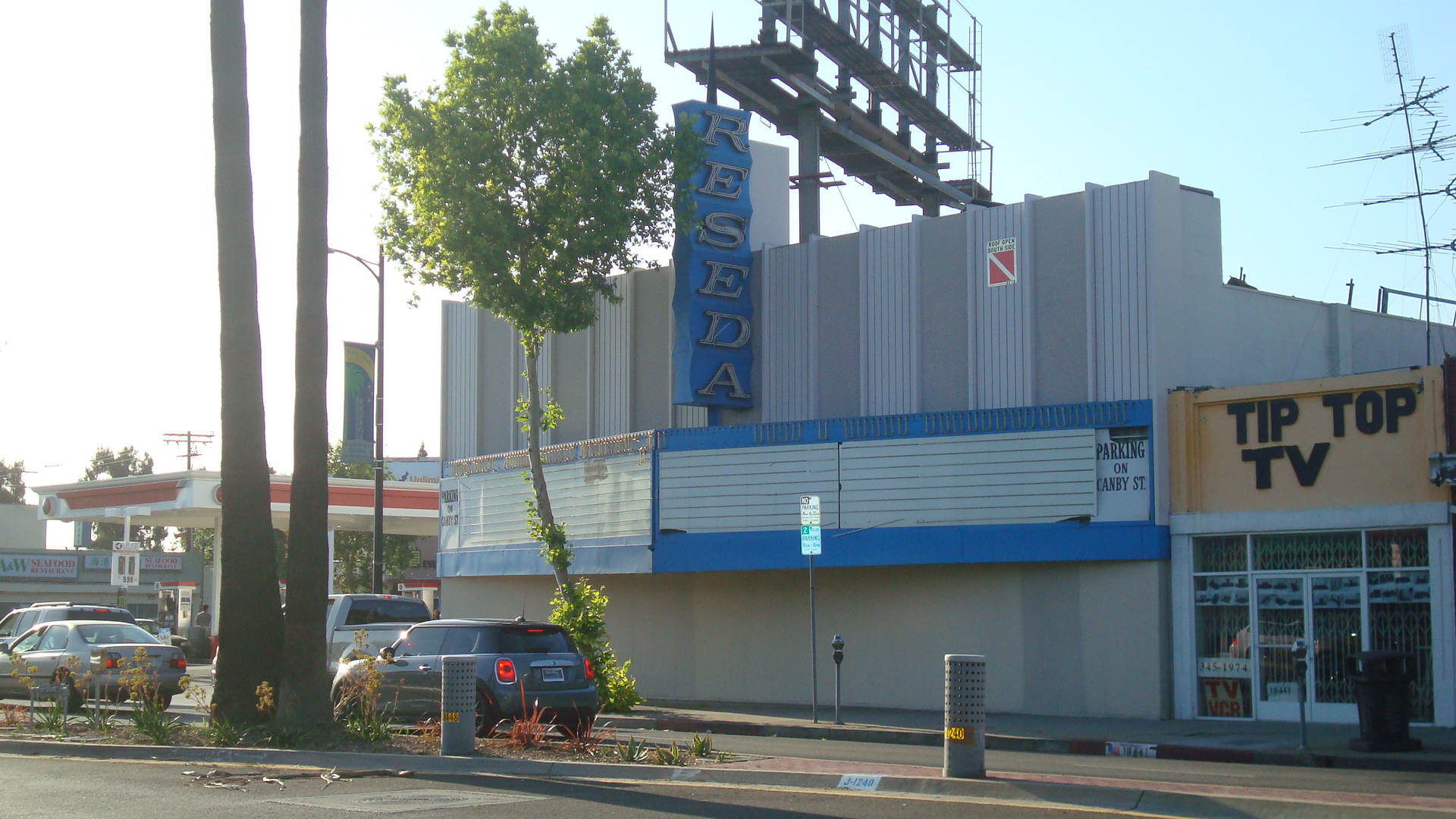
The Reseda Theater

The Reseda Theater

The Reseda Theater has been sitting vacant for over 25 years. Built it 1948, it was part of a small business district clustered around the intersection of Reseda Blvd. and Sherman Way. As the suburbs grew in the years after WWII, neighborhood theatres like this popped up all over the Valley, showing inexpensive double features and drawing crowds of kids on weekends with matinees.

Those days are long gone. The Reseda closed in 1988, and suffered damage in the 1994 Northridge quake. Community members spent years trying to make something happen at the site, and in 2008 it looked like their efforts might pay off. The Community Redevelopment Agency (CRA) announced a public-private partnership with developer CIM, and each of them purchased additional parcels near the theatre. The idea was that The Reseda would be reopened as a dinner theatre, hosting different kinds of entertainment. The additional parcels would be used to further revitalize the neighborhood.

A row of shops directly opposite the theater

A row of shops directly opposite the theater

But that never happened. In an article that appeared in CityWatch last week, former LA City Councilmember Dennis Zine laid the blame squarely on CIM. Zine claims that after raising the community’s hopes, the developer never followed through. Instead, CIM has been sitting on their parcels for years, with no intention of developing them. According to Zine, their plan is to sell the parcels to the City at a profit.

Vacant lot directly behind the theater

Vacant lot directly behind the theater

After reading Zine’s piece, I wanted to get more details, so I contacted Revitalize Reseda, a non-profit formed by community members who hope to inject some life into the area. The response I got from Walt Sweeney pretty much echoed what Zine had to say. “CIM was not a good business partner in Reseda,” he writes. “By stalling the project, CIM eventually ran into funding problems. The recession was the final nail in the coffin.” Sweeney says that CIM has received offers on their parcels that would have allowed them to sell out at a profit, but have decided instead to sit on the properties, to the detriment of the neighborhood. “Even though CIM has the expertise, money, and manpower, I would rather see anyone else develop this project. CIM has shown itself to not be a good community partner.”

Sounds pretty frustrated. And who can blame him? There’s substantial support in the community to bring this neighborhood back, but there’s no hope as long as the developer hangs on to these properties. If CIM doesn’t want to do anything with the parcels, they should sell them off. As it is, they’re just holding the community back.

The marquee of The Reseda Theater

The marquee of The Reseda Theater

If you want to read Dennis Zine’s piece in CityWatch, here’s the link.

Development in LA Is Out of Control

And if you want to connect with Revitalize Reseda, click on the link below.

Revitalize Reseda

Another view of the shops opposite the theater

Another view of the shops opposite the theater

Why Do We Have So Many Homeless?

A tent settlement in Downtown LA

A tent settlement in Downtown LA

By now it’s clear to anyone who’s paying attention that the homeless population in LA is growing. Not only is Skid Row more crowded than ever, but we’re seeing people living on the streets in communities all over the county. Burbank is a relatively affluent city, and forty years ago it was unusual to see a homeless person on the street. Now it’s a common sight.

So the article in today’s LA Times about the rise in the homeless population doesn’t come as a big surprise. The number of people living on the streets in LA County has risen 12% since the last count was taken two years ago. The Times article was prompted by a report from the Los Angeles Homeless Services Authority (LAHSA). According to the report, one of the key factors driving people out into the streets is the lack of affordable housing.

The cost of housing in this city is too damn high. A recent study from UCLA’s Luskin School of Public Affairs found that LA is the most unaffordable rental market in the country. While the cost of housing in New York and San Francisco is sky-high, incomes are also significantly higher. Rental units may be cheaper in LA, but the average income is so much lower that it eats up a larger share of the tenant’s paycheck.

And here’s an interesting comment from Paul Ong, one of the authors of the UCLA study.

“During periods of increasing inequality, the burden has grown even more severe,” Ong said. “Vacancy rates have risen only slightly — even dipping at times when the housing burden has increased. And renters are paying more for the same quality housing, suggesting that neither market forces nor changing housing quality fully explain the increasing rents.”

So if market forces aren’t driving prices higher, what is? Could it be greed? Developers are falling all over themselves in the scramble to build high-end housing in this city. But there’s almost no interest in building affordable housing. In fact, we’ve lost thousands of affordable units in recent years. And because the interests of our Mayor and our City Council are so closely aligned with interests of the developers (campaign cash may be a factor), they’ve made no serious attempt to reverse the trend. The fact that the number of homeless has risen by 12% shows that the City’s meager efforts to create affordable housing are not nearly enough.

Anyway, if you haven’t seen the Times article, a link is below. I’m also including the report from the Los Angeles Homeless Services Authority. And if you aren’t totally depressed after reading the first two, there’s a link to a press release that summarizes the findings of the UCLA study.

Homelessness up 12%

Los Angeles Homeless Services Authority

LA Most Unaffordable Rental Market in the Nation

So if you read all this stuff, and feel like you’d like to do something about it, this final link will take you to the Skid Row Housing Trust. These are good people doing good work. They deserve your support.

Skid Row Housing Trust

Erasing Hollywood’s History

A view of 1905 Grace from Grace Ave..

A view of 1905 Grace from Grace Ave..

UPDATE: A time has been set for the meeting to consider this building as a historic landmark. Here are the details:

CULTURAL HERITAGE COMMISSION
SPECIAL MEETING
Tuesday, May 12, 2015, 10:00 am
200 North Spring St.
Room 1050, City Hall

You might also want to take the time to read the comment at the end of this post from John Girodo of Hollywood Heritage. He gives more information about what’s happening.

Thursday night I heard some disturbing news. An American Colonial mansion that was built in 1917, located at the corner of Grace and Franklin in Hollywood, is slated for demolition. A developer wants to knock the building down, probably with the intention of constructing high-end residential units.

Hollywood Heritage is trying to have the mansion nominated as a historic monument, but things don’t look good. The Office of Historic Resources will be holding a hearing to consider the nomination, but it’s on such short notice that it will be hard to rally the community. The meeting is scheduled for Tuesday, May 12. The last I heard, the time hasn’t been set.

It seems like the City is trying to rush this through, which doesn’t surprise me given their recent record. In just the last year the City has allowed developers to level the Mole-Richardson Building on La Brea and the Oswald Bartlett House in Los Feliz. Those are just the two most recent casualties of the current wave of development.

Can anybody stop this? I don’t know. It would be great to have a good turnout at the meeting on Tuesday. Hollywood Heritage says people must show up in person to express their views, but it’s hard to plan on attending when the time hasn’t even been set. Hopefully the OHR will nail that down pretty soon. It also might be helpful to find out what CD 4 candidates Carolyn Ramsay and David Ryu have to say about this. They’ve both said they want to preserve Hollywood’s history. Let’s find out if they really mean it.

Carolyn Ramsay

David Ryu

If you can’t make it to the meeting on Tuesday, you might still let the OHR know how you feel about this. The link is below.

Office of Historic Resources

[For an update on 1905 Grace, click here.]

A view of 1905 Grace from Franklin Ave..

A view of 1905 Grace from Franklin Ave..