We Still Haven’t Crossed the Finish Line

front of N.F. Stokes Residence

front of N.F. Stokes Residence

I was thrilled last week when I heard that LA’s Cultural Heritage Commission voted unanimously in favor of designating the N.F. Stokes Residence a historic cultural monument. The building, at 1905 Grace, dates back to 1917 and is one of the few structures from that era still standing in the Hollywood area. At the same meeting the CHC voted to consider the Mosaic Church, at Hollywood and La Brea, for designation as well. There were a number of people in the community who have worked long and hard to save these buildings, and reading the e-mails from those involved it seemed like everyone was breathing a collective sigh of relief.

But the fight isn’t over yet.

I don’t want to rain on anyone’s parade, but we have to remember that the Stokes house won’t actually be declared a monument until the City Council votes on it. That’s when it becomes official. And as for the Mosaic Church, I was at a meeting last week where a developer’s representative flatly declared that the building did not deserve monument status. Now, you might be thinking, Hey, the CHC vote was unanimous. They clearly believe that both buildings are worth saving! How could the City Council ignore their recommendation?

Better think again. Not too long ago Mayor Garcetti pushed for the demolition of the Oswald Bartlett House over the loud objections of the preservation community, and he got his way. That house is gone. Over the past few months the Mayor has overridden the City Planning Commission to revive two major developments that faced strong opposition from the neighboring communities. There are no guarantees here. Recent history has shown that the Mayor and the City Council will do what they want. Which is often exactly what the developers want.

So we need to keep the pressure on. If you live in Council District 4, where the Stokes Residence and the Mosaic Church are both located, you might want to contact newly elected Councilmember David Ryu. His support will be crucial. Here’s his info.

Councilmember David Ryu
david.ryu@lacity.org
323 957-6415

And if you don’t live in CD 4, you can still contact your councilmember and let them know you think these buildings are worth saving.

Mosaic Church

Mosaic Church

Reyner Banham Loves Los Angeles

Reyner Banham adjusting his rear-view mirror.

Reyner Banham adjusting his rear-view mirror.

I was surfing the net today and came across an amazing artifact from LA’s past. Reyner Banham was an achitectural theorist and historian. He was born in England, but came to America and fell in love with the place, especially Los Angeles. In 1972 he made a film essay about the city for the BBC. He called it Reyner Banham Loves Los Angeles. These days that title might not strike you as unusual, but back in the early seventies LA was seen by most architects and planners as a disaster on a massive scale. For Banham, a respected writer and professor at UC Santa Cruz, to proclaim his love for LA, loudly, frequently, unabashedly, was really controversial.

I’m not going to tell you it’s a great film, because it’s not. But I think anybody who cares about this city will be fascinated. First, you’ve got this really smart, perceptive guy giving you his thoughts on what most commentators at the time thought was an urban wasteland. Second, the movie gives you a good, long look at what LA was like back in 1972, and if you weren’t around in those days, you’ll find the contrast startling.

The film is slow in places, and kind of disjointed. Also, because it’s only an hour long, Banham doesn’t have time to take more than a cursory glance at some aspects of LA. The worst part is that the print is badly faded. In some scenes it’s hard to even make out what’s on screen. But you get to see images of Watts, Hollywood, Downtown and Venice as they looked over forty years ago. It’s a real time capsule. Here’s the link.

Reyner Banham Loves Los Angeles

The film is an entertaining artifact, but it just gives you a taste of what made Banham such an interesting and provocative character. If you want to learn more about him, check out his 1971 book, Los Angeles: The Architecture of Four Ecologies. Don’t be put off by the academic sounding title. It’s a fresh and entertaining exploration of the aspects of this city that make it unique. I recommend it to anybody who wants to gain a better understanding of LA.

Criminalizing Homelessness

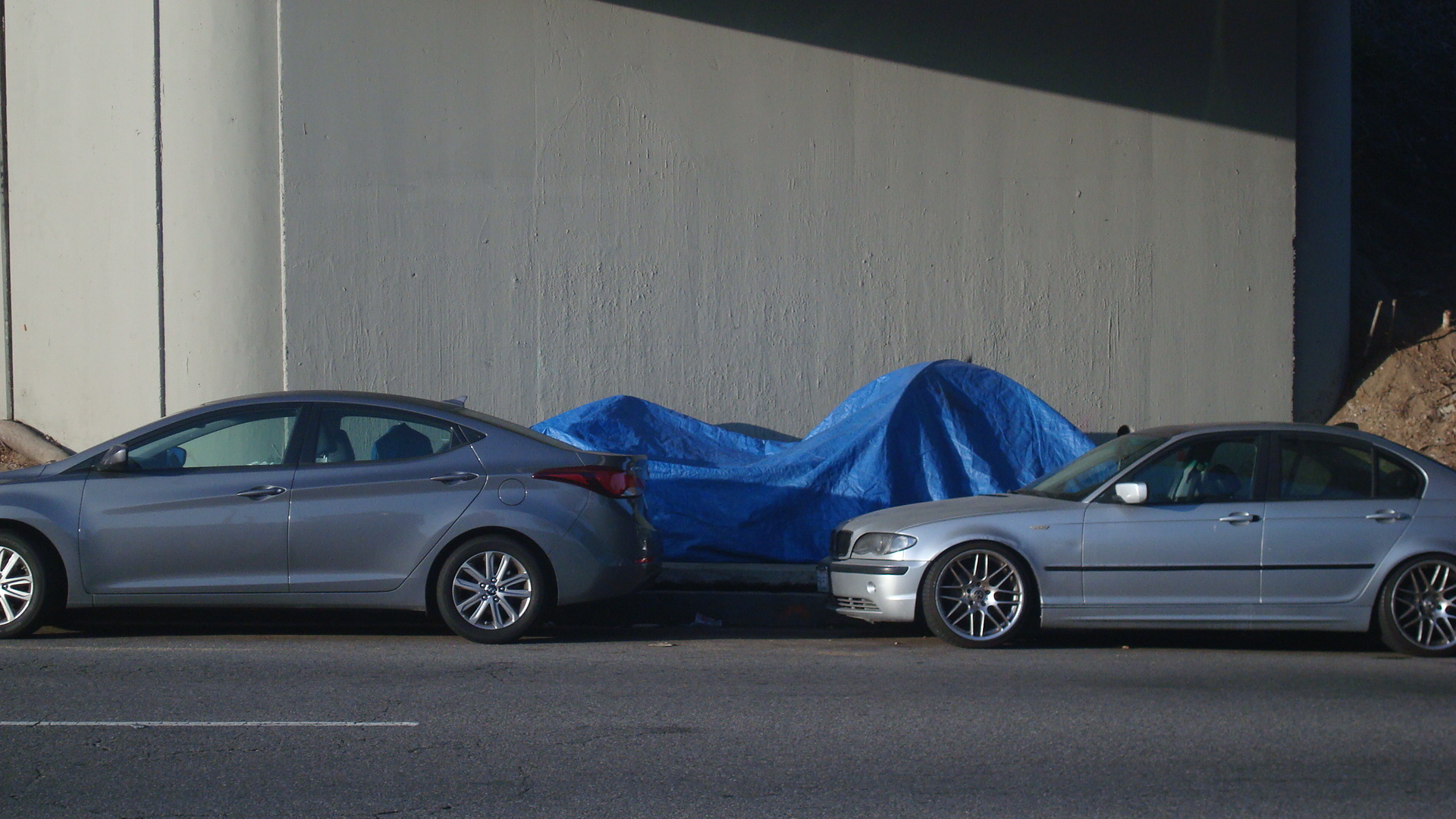
DSC09677

Once again our elected officials have shown us how little they really care about improving the quality of life in LA. On Tuesday the City Council passed two ordinances to make it easier to get rid of homeless encampments. Gil Cedillo cast the only dissenting vote. All the others fell right in line.

I totally understand that there are serious health and safety issues with the homeless camps that have been springing up all over LA. I know we have to deal with this. But as usual, the City Council has chosen to attack the symptoms rather than try to address the cause.

The reason people are living in tents is because we have an appalling shortage of affordable housing. The Mayor and the City Council continue to back to developers that want to build pricy condos and high-end apartments, but they seem to have no interest in providing homes for anyone besides the rich. Their meager efforts to build affordable housing are pathetic. LA real estate is being sucked up by developers with deep pockets who only care about maximizing their profits. In the past few years they’ve created thousands of new units that go from $2,000 a month on up into the stratosphere. And these same developers have taken thousands of rent-controlled units off the market as they demolish or refurbish older buildings.

According to the LA Times, the City’s homeless population currently stands at 26,000, a 12% increase over the past two years. This problem is not going away. It’s getting worse. Councilmember Cedillo makes the point that the vast majority of the funds the City spends on homelessness go toward law enforcement. This is crazy. The police can’t solve this problem.

Now you may be asking, can anyone solve this problem? The answer is yes. Follow the link below to an article from the LA Times about how Utah is dealing with chronic homelessness. They’ve made huge progress, and the state is actually saving money by providing housing for people who’ve been living on the streets.

Utah Is Winning the War on Chronic Homelessness

Of course, LA is not Utah. And I don’t mean to imply that there is a simple solution. But we could do a hell of a lot more than we’re doing now. And we need to start by making a serious effort to provide affordable housing.

For more info on the ordinances passed by the City Council, here’s a link to the story in the Times.

Vote Makes It Easier to Clear Homeless Camps

Landmark? What Landmark?

Circus Disco

Circus Disco

When a proposed project might have significant impacts on the surrounding community, state law requires the developer to prepare an Environmental Impact Report (EIR). In theory, this is a good thing. The idea is to make sure that negative impacts are identified so that everyone is aware of how the project will affect the area. In practice, the whole EIR process is questionable. The basic problem is that the developer is the one who pays for the report, which means that it almost invariably focusses on the positive impacts, and either minimizes or ignores the negative impacts.

This is exactly what’s happing with the Lexington Project. The developer wants to build almost 700 residential units on a city block between Lexington, Santa Monica, Las Palmas and Seward. The EIR tells us it’s a terrific project with numerous benefits for the area. But there a lot of the people in the community who see things differently.

The aspect of the project that’s gotten the most media attention is the fact that the developer will be demolishing the Circus Disco. You may be wondering why this is a big deal. Hollywood is full of places to dance. But the Circus is an important landmark for the LGBT community in LA, and especially for non-white gays and lesbians. Back in the 70s, when disco was big, there were plenty of clubs where gay men could party all night long. Unfortunately many of those clubs didn’t admit blacks and Latinos. But the Circus Disco was open to everyone, and it’s been cherished for years by the LGBT community because of that.

But while the EIR mentions the Circus in its survey of structures on the property, the report concludes that, “… [N]one of these buildings appears eligible for listing in the National Register, California Register, or for local City of Los Angeles Historic-Cultural Monument designation.”

This is interesting. Sure, it would be hard to make a case that the Circus was significant enough to make the national or state registers. But are they saying it’s not a significant part of LA history? If so, it seems that the City of LA’s Office of Historic Preservation has a different view. Survey LA is a program initiated by the OHR to document significant buildings. Last year they released a document entitled LGBT Historic Context Statement which gives an overview of the community’s history and identifies potential landmarks. And the Circus Disco is on the list.

LGBT Historic Context Statement from Survey LA

But it’s not just the Circus that’s threatened. The French Market and Catch One, both of which hold a significant place in the LGBT community, may soon be gone. And let’s not forget that back in 2011 the building that originally housed A Different Light, an early gay bookstore, was demolished. That was the same year that the Spotlight, according to some the oldest gay bar in Hollywood, closed its doors. The building still stands, but now it’s just another upscale nightclub. It does seem like the LGBT community is losing a huge chunk of its history.

Not that any of us should be surprised. Preservation has never been a high priority in LA. Groups like the Los Angeles Conservancy and Hollywood Heritage keep fighting to save these buildings, but City Hall seems more interested in keeping the developers happy.

If you want to learn more, this article from the Daily News offers a good summary.

Disco to Become Site for Condominiums

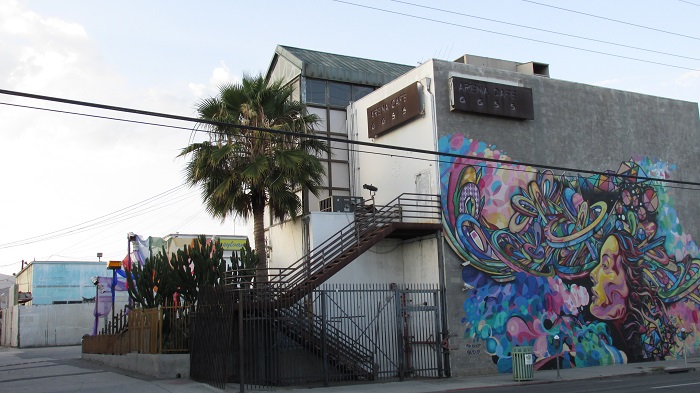
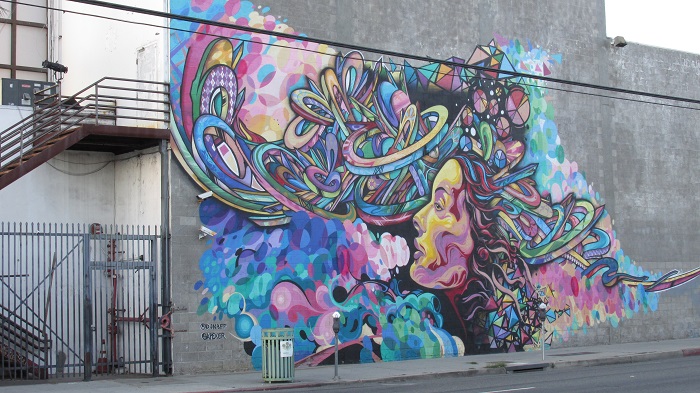
Mural on the front of the building

Mural on the front of the building

Losing the View

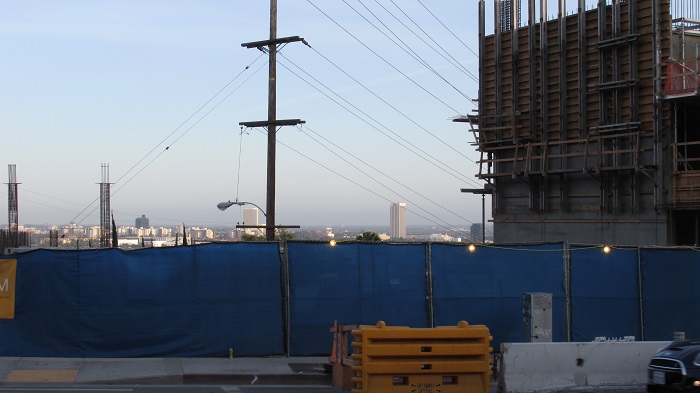
A view of construction underway at Sunset and La Cienega

A view of construction underway at Sunset and La Cienega

People have been building things along the Sunset Strip for a long time now. There are plenty of reasons to want to build there. Probably the people who put up the first houses and apartments along the winding hildside road were drawn by the view. The developers who came along in the twenties had something different in mind. Because at that time the area was unincorporated and beyond the reach of the LAPD, it was a great place to put bars and clubs. In the sixties the nightlife was still a draw, but it also became a hotspot for the counterculture. The clubs attracted bands that were playing all kinds of music, and the Strip in general became a magnet for anyone looking for a different kind of lifestyle.

So even before people began taking LA seriously as a city, the Strip had a reputation for being incredibly hip. Developers saw the potential for profit, and the number of high-rise apartments and hotels grew. Out of towners would come to the Strip to have a drink at the Viper Room or catch a band at the Whiskey. And if they had enough money they could rent a room at one of the hotels that offered a spectacular view of the city spreading out all the way to the horizon.

North side of Sunset at La Cienega

North side of Sunset at La Cienega

I’ve never had enough money to stay in one of those hotels, but I’ve still been able to enjoy the view. I remember ambling along Sunset as a kid, heading for Tower Records or Book Soup, turning my head now and then to gaze out over LA. Though there were a number of high-rises, much of the Strip was lined with one and two-story buildings. There were long stretches that allowed you to gaze out at incredible vistas.

A view of the city from Sunset

A view of the city from Sunset

But these days those views are disappearing. A new spate of development is rising up along the Strip, making it harder and harder to see those breathtaking vistas. There’s a massive project under construction right now which will occupy a good stretch of Sunset on both sides of La Cienega. And there are other projects under consideration, such as 8150 Sunset.

Construction site on Sunset west of La Cienega

Construction site on Sunset west of La Cienega

Many of the hillside residents are freaking out, and one of the reasons they’re upset is that these projects will block their view. (There are other reasons, too, including increased traffic and crumbling infrastructure.) Of course, the fact that the folks in the hills are mad about losing their view has riled the pro-development crowd. They’ve been reviled as elitist snobs who want to stop progress just so that can stand on their deck at sunset and gaze at the vast landscape below. It’s interesting, though, that the developers haven’t been the focus of similar criticism. Let’s get real. One of the main reasons they’re building high-rises along the Strip is so they can sell the view. The hotel rooms and condos in these new projects will go for outrageous prices precisely because they offer fantastic views. And if you think we really need another upscale high-rise in LA, I think you’re completely out of touch with reality. Developers are pushing these projects because they can make a mountain of cash. Meanwhile, there’s a serious shortage of affordable housing, in large part because the current wave of development is driving housing prices sky high.

Another view of construction at Sunset and La Cienega

Another view of construction at Sunset and La Cienega

As for me, I do feel like the Strip is losing something. It used to be that just standing on the sidewalk you could see a large swath of the city laid out before you. It was something free that anybody could enjoy. These new projects will make those views harder to find. And beyond that, I feel like the whole Strip is getting so pricey that ordinary people are being squeezed out. While there have always been ritzy restaurants and high-end clothing stores, there were also plenty of places where you could hang without spending a lot of money. Those cheaper places seem to be disappearing.

Another view of construction at Sunset and La Cienega

Another view of construction at Sunset and La Cienega

Maybe it’s just me. Now that I’m older, I do spend a fair amount of time reminiscing about how great things used to be, and I should probably focus more on the present. But back in the seventies when I wandered along Sunset I used to see all kinds of people on the street. There were rich kids in expensive clothes and vagrants without a nickel in their pocket. Beverly Hills types lunching at sidewalk cafes and runaways living on handouts. It seemed like the Strip was open to anyone, that everybody was welcome.

I feel like that’s changing. Is it just me, or is all this new development burying the welcome mat?

Looking down La Cienega from Sunset

Looking down La Cienega from Sunset

Blocking Progress

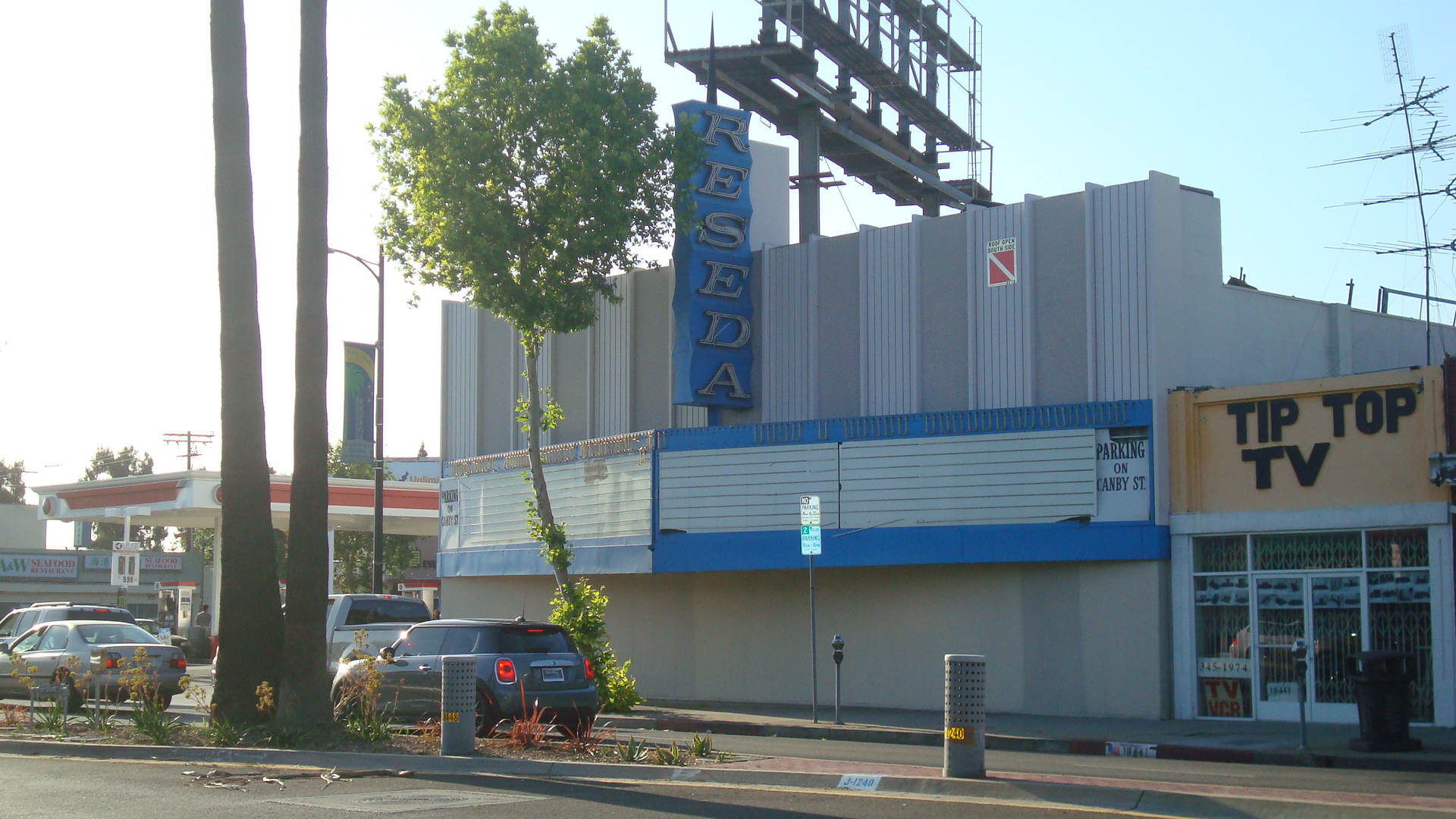
The Reseda Theater

The Reseda Theater

The Reseda Theater has been sitting vacant for over 25 years. Built it 1948, it was part of a small business district clustered around the intersection of Reseda Blvd. and Sherman Way. As the suburbs grew in the years after WWII, neighborhood theatres like this popped up all over the Valley, showing inexpensive double features and drawing crowds of kids on weekends with matinees.

Those days are long gone. The Reseda closed in 1988, and suffered damage in the 1994 Northridge quake. Community members spent years trying to make something happen at the site, and in 2008 it looked like their efforts might pay off. The Community Redevelopment Agency (CRA) announced a public-private partnership with developer CIM, and each of them purchased additional parcels near the theatre. The idea was that The Reseda would be reopened as a dinner theatre, hosting different kinds of entertainment. The additional parcels would be used to further revitalize the neighborhood.

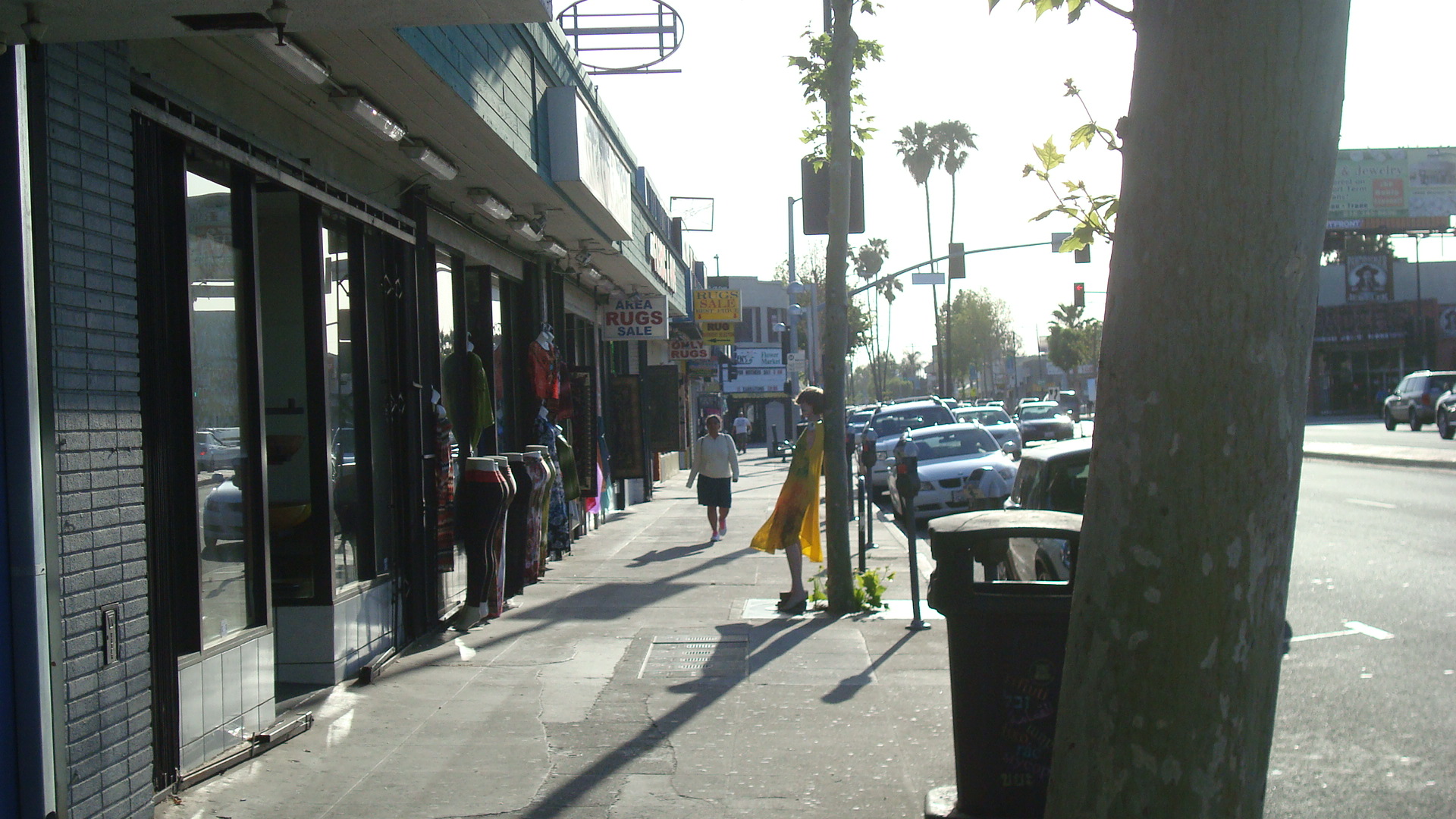
A row of shops directly opposite the theater

A row of shops directly opposite the theater

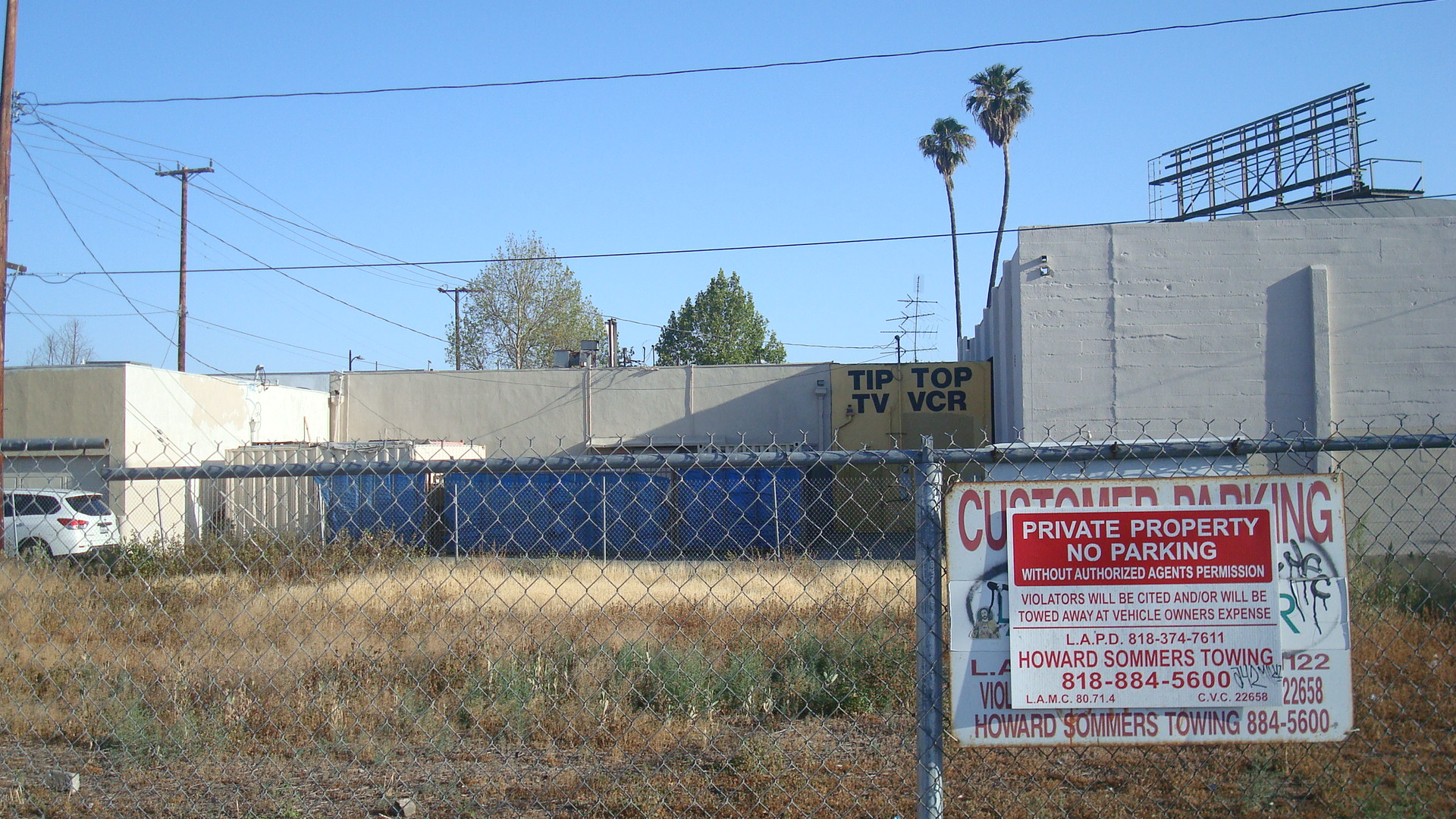
But that never happened. In an article that appeared in CityWatch last week, former LA City Councilmember Dennis Zine laid the blame squarely on CIM. Zine claims that after raising the community’s hopes, the developer never followed through. Instead, CIM has been sitting on their parcels for years, with no intention of developing them. According to Zine, their plan is to sell the parcels to the City at a profit.

Vacant lot directly behind the theater

Vacant lot directly behind the theater

After reading Zine’s piece, I wanted to get more details, so I contacted Revitalize Reseda, a non-profit formed by community members who hope to inject some life into the area. The response I got from Walt Sweeney pretty much echoed what Zine had to say. “CIM was not a good business partner in Reseda,” he writes. “By stalling the project, CIM eventually ran into funding problems. The recession was the final nail in the coffin.” Sweeney says that CIM has received offers on their parcels that would have allowed them to sell out at a profit, but have decided instead to sit on the properties, to the detriment of the neighborhood. “Even though CIM has the expertise, money, and manpower, I would rather see anyone else develop this project. CIM has shown itself to not be a good community partner.”

Sounds pretty frustrated. And who can blame him? There’s substantial support in the community to bring this neighborhood back, but there’s no hope as long as the developer hangs on to these properties. If CIM doesn’t want to do anything with the parcels, they should sell them off. As it is, they’re just holding the community back.

The marquee of The Reseda Theater

The marquee of The Reseda Theater

If you want to read Dennis Zine’s piece in CityWatch, here’s the link.

Development in LA Is Out of Control

And if you want to connect with Revitalize Reseda, click on the link below.

Revitalize Reseda

Another view of the shops opposite the theater

Another view of the shops opposite the theater

Who Really Benefits?

Zimas 3

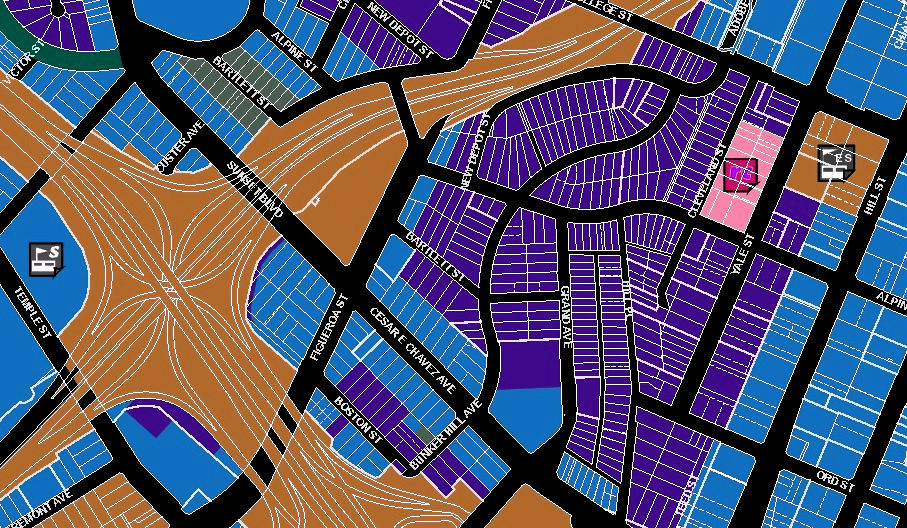
If you haven’t already seen it, I’d like to direct your attention to a piece that Dick Platkin wrote for CityWatch on re:code LA. If don’t know what re:code is, you’re not alone. In spite of our city officials’ claims that they’ve done extensive outreach, I bet less than one percent of the population has heard of it.

Briefly, it’s an attempt to redo the City’s zoning code, and there’s no question that the existing code is hopelessly out of date. The problem is, it seems like the people behind this effort seem more interested in serving developers than serving the people of LA.

But Platkin says it much better than I can. Click on the link below to learn more.

All That Glitters Is Not Gold

Where’s the Water Coming From?

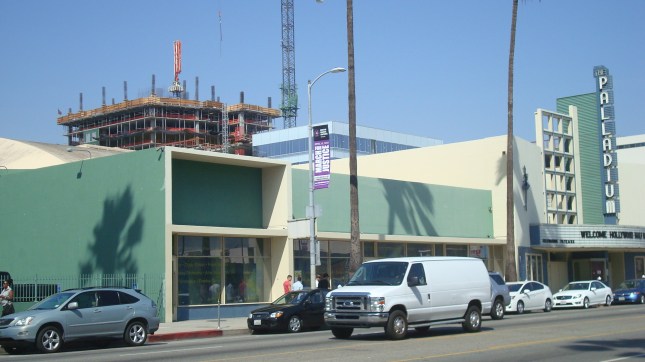
The Palladium, with Columbia Square rising in the background.

The Palladium, with Columbia Square rising in the background.

There’s a hearing at City Hall this Wednesday on a project proposed for the site surrounding the Palladium on Sunset. The project is called Palladium Residences, and there are two ways it could go. Either 731 residential units, or 598 residential units and a 250 room hotel. Both options include 24,000 sq. ft. of retail and restaurant space.

My question is, where is the water for this going to come from? I think by now everybody in LA knows there’s a drought going on. In fact, an extreme drought. Gov. Brown has declared a drought state of emergency and soon the Metropolitan Water District will be cutting deliveries to its Southern California customers, including Los Angeles. Angelenos have already been asked to voluntarily cut their water consumption by 20%, but the move by the MWD means we have no choice.

So let’s look at the Palladium project in this context. How will it impact water usage in the Hollywood area?

First, in its current state, the site needs very little water. Aside from the Palladium, it’s pretty much all parking lot, so unless there’s a show going on, consumption is zero. Whatever the developer builds, it’s going to cause a large increase in water usage. Even if we assume that the project will be built utilizing every water conservation measure imaginable, we’re probably looking at a net increase of between 100 and 200 acre feet per year.

But that’s just looking at the Palladium Residences in isolation. The site is surrounded by a number of other projects that are already under construction. Right next door, we have Columbia Square, which includes 200 residential units, over 400,000 sq. ft. of office space and 30,000 sq. ft. of retail.
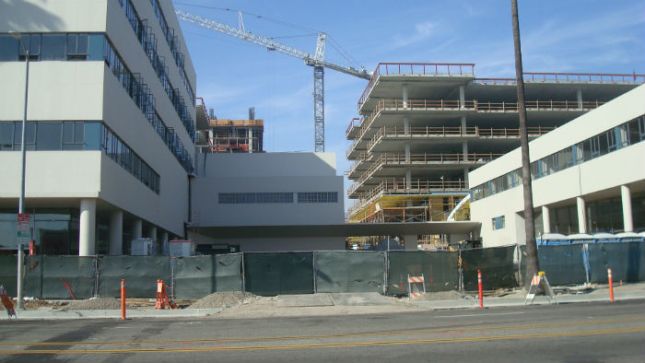
Columbia Square

Columbia Square

On the opposite side and just to the north the new Camden is going up, offering 287 rooms.

The Camden

The Camden

Just across the street from that is 1601 Vine, an 8-story office building. Relatively speaking, office space doesn’t require a lot of water, but since the site was previously a parking lot, there will still be a net increase in water use.

1601 Vine

1601 Vine

A couple blocks to the west, the new 182-room Dream Hotel is rising over Selma.

The Dream Hotel

The Dream Hotel

And just beyond that is the Mama Shelter Hotel, with 70 rooms, which will occupy a building that was previously vacant.

Mama Shelter Hotel

Mama Shelter Hotel

Remember, all of these projects are being built on sites that previously consumed little or no water. It’s important to say, too, that all these hotels will have at least two restaurants, and will be hosting banquets, which drives water use way up. So putting all this together, conservatively speaking, we’ll probably see a net usage increase of at least 500 acre feet of water per year.

But wait. There’s more. Aside from the projects I’ve already mentioned, there are around 60 others proposed for the Hollywood area, many of them just as large as the ones listed above. So we’re not just talking about 500 additional acre feet of water per year. We’re talking thousands more. And that’s just Hollywood. If you look at Downtown, you’ll see a similar number of projects, some of them way bigger than anything proposed for Hollywood. There are also plans for major developments for Wilshire Blvd., the Crenshaw District and Boyle Heights.

Does anyone see a problem with this?

I’m not saying we should put a halt to development. But we do need to figure out how much development we can actually support. The DWP says that LA is in fairly good shape in the near term, but they’re only looking a couple of years ahead. Some scientists think this drought could last for several more years. By now everybody who lives in California knows that many of our reservoirs are at less than half of capacity, and the snow pack has shrunk to 6% of what’s normal for spring. The wells in the San Fernando Valley that we used to rely on have become contaminated, and it will take years before they’re cleaned up.

We need to figure out a water budget. First the DWP needs to prepare a realistic estimate of how much water we can rely on for at least the next five years. Then the Department of City Planning needs to make sure they have solid numbers regarding the water that will be consumed by each proposed project. With that information, they can make a cumulative assessment of the impact all these projects will have on our water resources, and prioritize them based on how beneficial they’ll be to the community. Let’s get real. We don’t have the water to build all this stuff. Even if we have supplies to last for the next year or two, these projects will be consuming water for decades, and some scientists believe this drought could get much worse than it already is. We need to know how much water we can realistically count on, and then we need to plan accordingly.

The Mayor has been telling us that we need to cut our water use by 20%, but at the same time he’s pushing this aggressive development agenda which is guaranteed to boost water consumption even as Angelenos are told they need to conserve. And let’s be honest. We haven’t made much progress in cutting our water use. Even with the threat of a massive drought, we’re using about as much water as we always have. So residential towers and high-rise hotels are just pushing us farther into the danger zone.

We need development, but it has to be planned development. If the City of LA wants to grow, it needs to find out first how much water we have, and how much each of these projects is going to consume. Much of the reason we’re in trouble today is that for decades the City allowed massive growth without proper planning. We’ve been sucking up water from all over the Southwest to build a vast metropolis in an area that has very little water of its own. We can’t do that any more. We need to start living within our means.
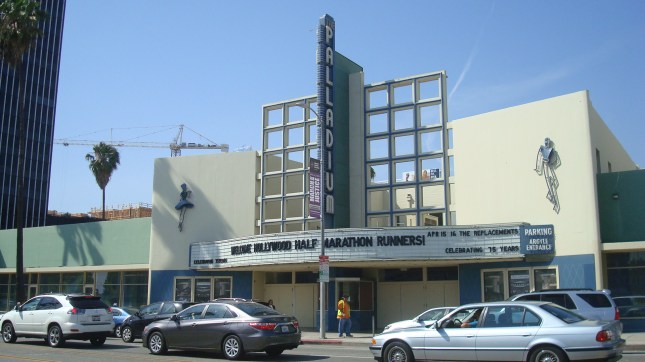
Another view of The Palladium, now with The Camden construction site in the background.
Another view of The Palladium, now with The Camden construction site in the background.

Alcohollywood

Hlwd Bars 1 Rd St

I want to go on record here. I like to drink. I’ve spent a fair amount of time hanging out in bars. But even I’m getting scared of how accessible booze is in Hollywood. The neighborhood is packed with bars and clubs, and it seems like every new restaurant that opens gets a full liquor license. If it was just a matter of dealing with crowded sidewalks and noisy drunks, I might be able to handle that. But the problems we’re seeing are actually much worse.

In fact, it’s getting so bad that last October LAPD Chief Charlie Beck wrote a letter to Linn Wyatt, the City’s Chief Zoning Administrator. In he talks about the “oversaturation of ABC [Alcohol Beverage Control] locations”. He mentions how these establishments “have generated numerous crime reports” which are straining police resources. And the crimes he lists include collisions involving pedestrians, DUIs, assault with a deadly weapon, robberies, thefts, fights, shootings and rapes. But don’t take my word for it. Click on the link to read the letter yourself.

Letter from Chief Beck

It doesn’t seem like anybody at the Department of City Planning read Chief Beck’s letter, because they keep on handing out liquor licenses like they were candy. I get the impression that public safety is something they don’t worry about much at the DCP.

Hlwd Bars 2 Vogue

But we’ve gotta draw the line somewhere. Recently I received a notice from the Department of City Planning regarding a project at the corner of Hollywood and Hudson. Hollywood Dreams, LLC plans to remodel an existing building to house a bar and four restaurants. They’re asking for five — yes, five — full liquor licenses. I was stunned. With all the problems we’re already seeing in the area, they want five more places selling liquor on the boulevard?!

I wasn’t the only one taken aback. Gilbert Mora and Robin Yoo of Behavioral Health Services were so concerned they made a list of existing ABC locations in the same census tract, roughly a half square mile. For this area, the California Department of Alcoholic Beverage Control says that no more than two on-site liquor permits should be authorized. By my count, there are already 15 on the list. (If you include stores and caterers that have off-site liquor permits, the number rises to 21.) So the City of LA has already allowed over 7 times what the state allows. And now this developer is asking for five more permits for a single location. Remember, too, that this is just one tract. There are dozens of other bars, clubs and restaurants that serve alcohol in Hollywood.

But let’s take a look at the actual statistics for crime in the neighborhood around this project. I went to CrimeMapping.Com and entered the address. Click on the link to see what’s happened within a one mile radius over the past two weeks.

6529 Hollywood Blvd.

As you can see, this neighborhood gets a lot of action. The crimes include assault with a deadly weapon, robbery, and vehicle theft. A total of 79 crimes. Still, we need to check out some other location for comparison. So let’s go down the road about a mile and see what it’s like on a stretch of Melrose where there are far fewer bars and restaurants that serve alcohol. I wonder what kind of crime they have down there.

6500 Melrose Ave.

So just a mile down the road, there have been only 38 crimes in the past two weeks. Less than half. Does anybody think that just maybe there’s a link between the amount of alcohol being consumed in Hollywood and the amount of crime that’s occurring there?

Hlwd Bars 3 Fox

And it’s only going to get worse. There are many other developers that want to get permits in the area. Ten more hotels are planned for Hollywood, including three that are under construction right now on Selma Ave., which is just a block south of Hollywood Blvd.. The DCP has already given full liquor licenses to all three.

This is ridiculous. Enough is enough. There’s a hearing on Tuesday, March 10 at 9:30 am, and I’m going to be there. I want to ask the zoning administrator why they keep handing out these permits when there’s a clear threat to public safety. If you feeling like joining me, the more the merrier. Here’s the address.

Los Angeles City Hall
200 North Spring Street, Room 1020
(Enter from Main Street)

And if you can’t make it to City Hall, you can still send an e-mail to the DCP. Here’s the info. It’s a good idea to include the case number in the subject line.

Staff Contact:
Matthew Quan
Matthew.Quan@lacity.org
Case No: ZA 2014-2008(MCUP)

If you do send an e-mail to the DCP, please copy me on it. I’m wondering how many other people out there are as ticked off as I am. Here’s my address.

thehorizonandtheskyline@gmail.com

I’m fine with people coming to Hollywood to have a good time, but this has gotten way out of hand. We need to stop handing out liquor permits to anyone who asks for one.

Hlwd Bars 4 Loaded

A Trip to the Mall

Outside Macy's Plaza in Downtown LA.

Outside Macy’s Plaza in Downtown LA.

I hate shopping. Slob that I am, I’ll wait until my clothes are coming apart before I force myself to go out and buy new ones. And when I do finally get to a store, I grab the stuff I need, pay for it and leave as quickly as possible. I just want to get it over with.

So hating shopping like I do, you probably won’t be surprised to hear that I also hate malls. They seem so big and impersonal. But obviously I’m in the minority, because millions of people flock to malls every week, and seem to enjoy the experience. It’s been said, and I know it’s true, that malls have become the social center for communities, replacing parks and town squares. Whether I like it or not, they’ve become an important part of the fabric of American life.

When I do finally break down and go shopping, I usually head for Macy’s Plaza in Downtown. That’s where I went last Saturday night to pick up a couple pairs of pants. The main reason I like this mall is that there’s usually nobody there, and that was the case on Saturday. I breezed in, bought what I needed and breezed out, without having to fight my way through crowds. It was fairly painless.

But obviously, what makes Macy’s Plaza attractive to me is a sign that it’s not really attractive to other people. If nobody’s showing up to shop, stores can’t survive. This mall has been struggling for years. It’s never drawn the kind of crowds you’ll find in Burbank or Sherman Oaks or Santa Monica. There are times when I’ve visited that the place seems more like a ghost town.

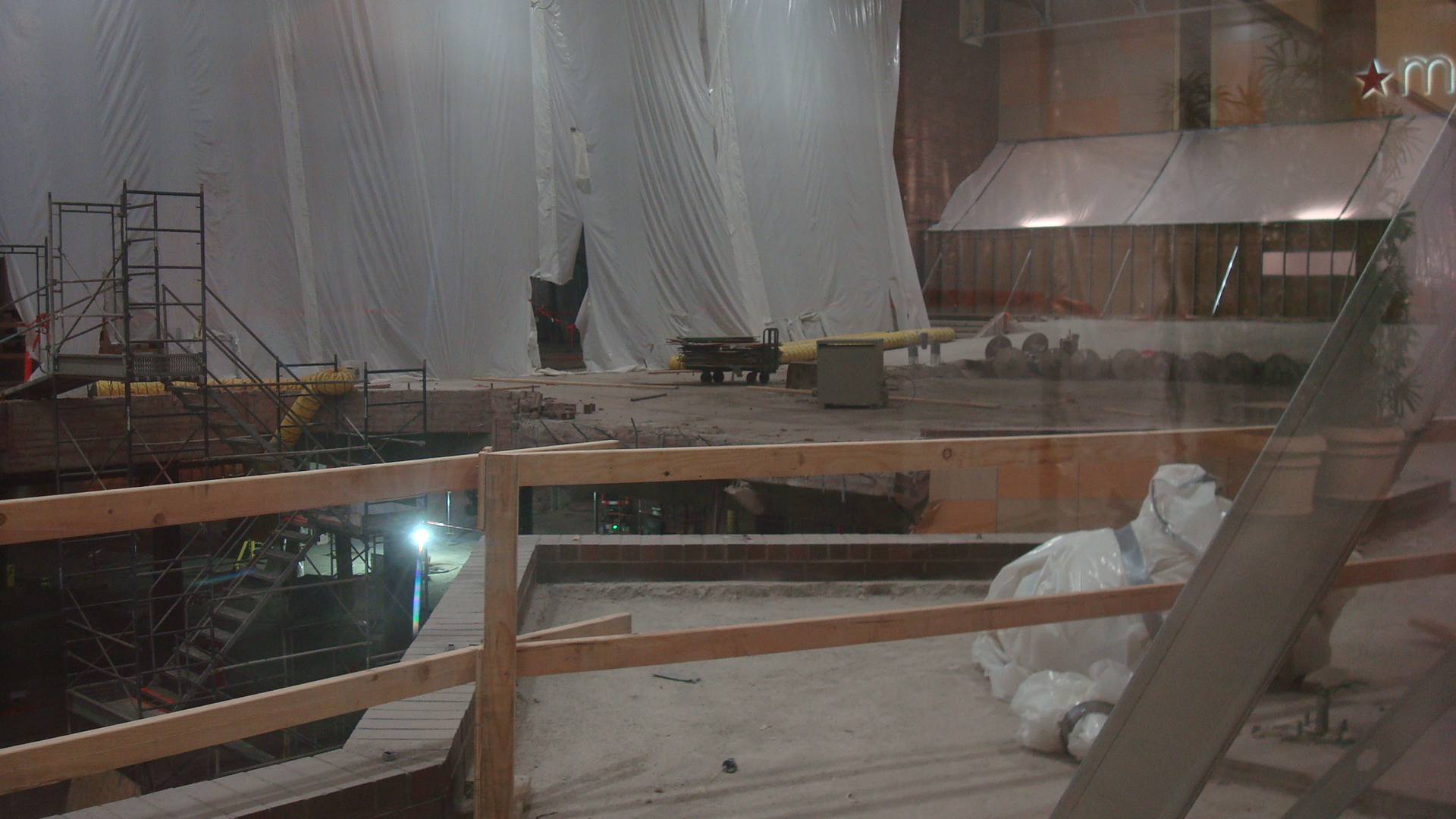
So somebody’s trying to change all that. A couple years ago a developer bought the property and they’re pouring millions into a massive makeover. Construction has been going on for months. As I was walking out I stopped a moment to take a look at the work they’re doing in the central court. Here are a couple photos.

Interior court at Macy's Plaza under construction.

Interior court at Macy’s Plaza under construction.

Another shot of the interior court.

Another shot of the interior court.

Apparently this area will be opened up and turned into a public plaza, which is a smart move. This area will offer direct access to the subway as well, which also makes a lot of sense. If you’d like to see some renderings, take a look at this post on Curbed.
What Macy’s Fortress Will Become

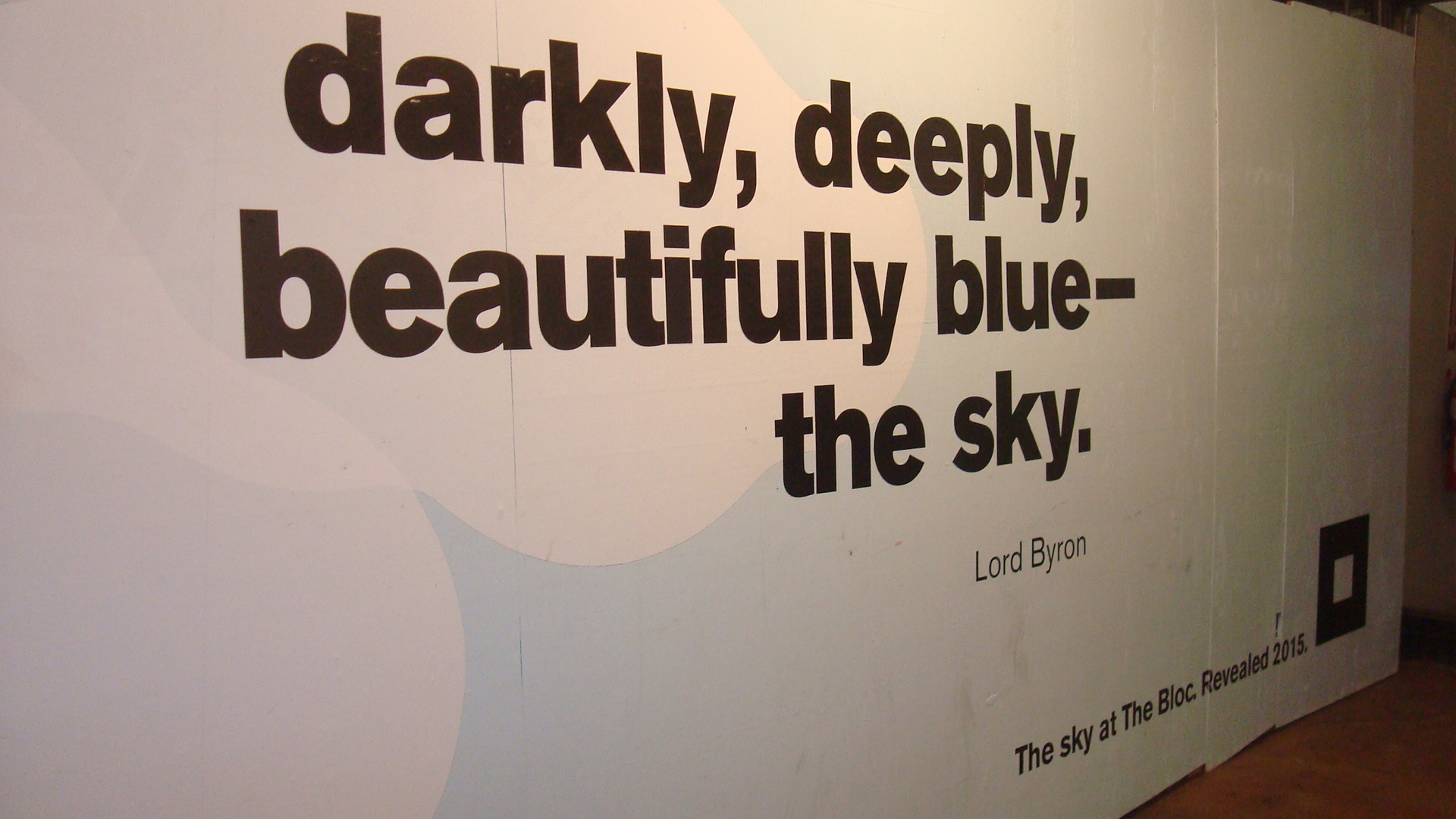
Of course, if you’re throwing all this money into an extreme makeover, you’ve also got to throw a lot of money into rebranding the place. And this was the thing that really caught my eye on Saturday night. Apparently once the remodelling is done, the mall will be renamed The Bloc. The campaign they’re using to promote the change is interesting. Check out the temporary barriers that currently line the entrance to the mall.

Construction barrier with a quote from Byron.

Construction barrier with a quote from Byron.

Construction barrier with a quote from Euripides.

Construction barrier with a quote from Euripides.

Construction barrier with a quote from Hafiz.

Construction barrier with a quote from Hafiz.

I can’t remember the last time I went shopping and was greeted by quotes from Thoreau, Euripides and Hafiz. It definitely made me stop and look, but I wonder how these guys would feel about having their work used in a marketing campaign for a mall. On the other hand, it’s definitely better than having the place plastered with massive, garish images of supermodels and food.

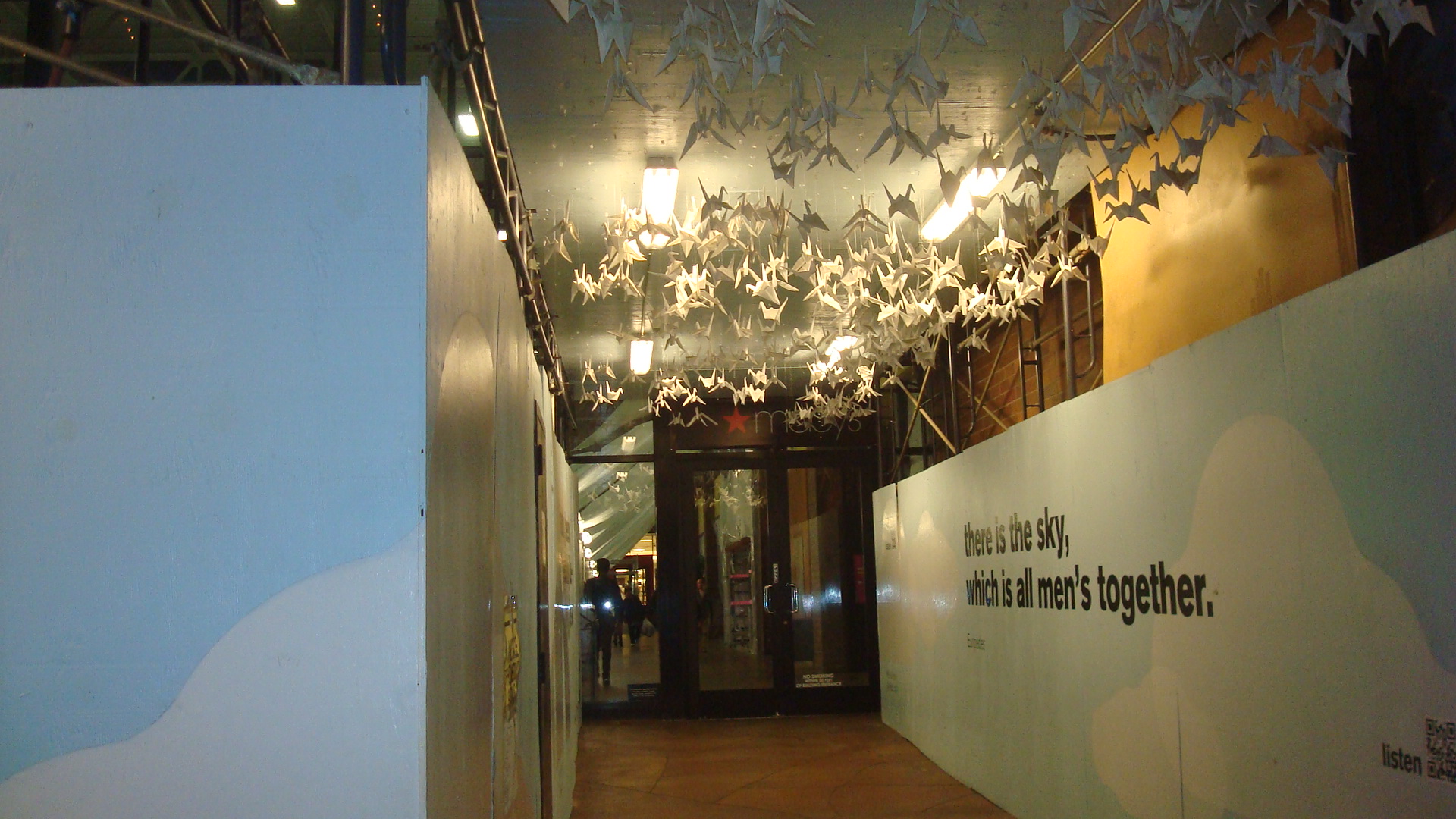
And as I was snapping these photos I looked up and saw dozens of origami cranes hanging overhead.

Origami cranes suspended from scaffolding.

Origami cranes suspended from scaffolding.

For the past few years the only cranes I’ve seen in LA have been the massive metal kind that dominate the horizon. It was nice to see the other kind for a change. Something small, graceful and beautiful tucked into a hidden corner of the urban jungle.