A short video I shot this morning in Griffith Park.

A short video I shot this morning in Griffith Park.

Today I was down at the Central Library and stumbled across a very cool show about growing old in Los Angeles. Journalist Ruxandra Guidi and photographer Bear Guerra spent time with seniors living in four communities along Broadway: Lincoln Heights, Chinatown, Downtown and South LA. The show is called Going Gray in LA: Stories of Aging Along Broadway, and it documents a side of the city that most of us pay little attention to. The images the media presents of LA are generally focussed on the young and beautiful. Senior citizens, unless they’re rich and famous, are usually ignored.
You can see the show like I did, in two small galleries on the first floor of the Central Library.
Going Gray in LA at Los Angeles Central Library
If you do make the trip Downtown, you can pick up a free print version of the material, with text in English, Spanish, Japanese and Chinese.
You also have the option of viewing the images and stories on KCRW’s web site.
Either way, you should check it out. The images are beautiful and the stories open a window on a world most of us don’t pay enough attention to.

The Metropolitan on Sunset
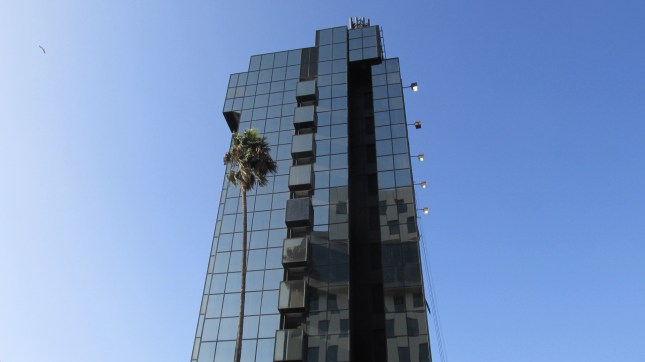
If you needed any more proof that City Hall has no real interest in solving our housing crisis, you should have come to the September 12 hearing held by the Central Area Planning Commission. On the agenda was an appeal of a decision by the Department of City Planning (DCP) to approve a Conditional Use Permit (CUP) for transient occupancy at the Metropolitan Lofts on Sunset near Van Ness. There’s a long, complicated story behind this, but basically the owners want to be able to turn apartment units into hotel rooms. Susan Hunter, of the LA Tenants Union (LATU), filed an appeal to try and overturn the CUP. But the Commissioners sided with the owners, and gave them the go ahead to allow transient occupancy at the Metropolitan.
The September 12 session was actually continued from the August 8 hearing when the appeal was first heard. Taken together, these two hearings were a mind-numbing demonstration of the DCP’s arrogance and callousness. It has never been clearer that the DCP’s culture is geared toward serving private interests rather than the general public. Most of the Commissioners, along with DCP staff, bent over backwards to make allowances for the owners of the Metropolitan, while throwing the building’s tenants, and renters in general, under the bus.
The story of the Metropolitan is long and complicated, but to give you some background, here’s a brief recap….
The building originally started as a hotel back in the 80s. It ended up getting a reputation as a place to party, and by the 90s it was getting a lot of attention from the LAPD. After a while the owners decided they’d be better off turning it into an apartment building, and the DCP signed off on that in 2006. In their determination letter, the City Planning Commission said the conversion of the Metropolitan’s 52 units was consistent with both the General Plan and the Community Plan, and stated that the change would, “provide increased opportunities for residential living in Hollywood where it is appropriate and needed.”
Fast forward about 10 years. Hollywood has always been a hot spot for tourism, and with the advent of Short-Term Rentals (STRs), property owners can make a bundle posting units on AirBnB or any of the other popular sites that offer “home sharing”. This is especially attractive to landlords, who realize they can make a lot more money by getting rid of tenants and opening the door to tourists. The folks who own the Metropolitan were thinking they could cash in by turning the building back into a hotel, but they came up with a very creative way to do it. They didn’t just ask the City to turn the place back into a hotel, they requested a zoning overlay to make it into a Transit Occupancy Residential Structure (TORS), while maintaining the residential use. This way the owners could use the units as either apartments or hotel rooms, depending on how they feel on any given day.
Do you see a problem here? The small group of tenants who were still left at the Metropolitan sure did. You see, the owners decided they weren’t going to wait for the City’s approval. They actually allowed a company that specializes in STRs, Senstay, to start offering some units to travellers. The tenants started to see all kinds of strangers wandering up and down the halls with their luggage trailing behind. They found themselves letting in guests who didn’t have a key because there was no front desk to help visitors. They sometimes had to wait to use the laundry rooms because housekeeping staff was there ahead of them. And they started to worry about break-ins because things were getting stolen. These problems were piled on top of the problems they already had to deal with, like lighting that didn’t work, long periods when the AC was down, and elevators that were frequently out of service. And to make things even worse, they were required to pay fees for utilities, trash, and sewage through an on-line service which often added late charges for bills paid on time, in addition to a “convenience fee”.
It’s pretty clear that the Metropolitan owners don’t care about their tenants, and would like to get rid of them. Jerry Neuman, the owners’ representative at the hearing, claimed that they treated their tenants well, and that they didn’t intend evict anybody. That doesn’t jibe with the facts. All the residents I spoke to at the Metropolitan confirmed the problems listed above. And while the owners claim they’re not removing housing to make way for hotel rooms, they had allowed the number of tenants to dwindle to 15, and offered those who still remained money to leave. This sounds to me like they’re planning on turning the Metropolitan back into a hotel.
Which brings us back to Senstay. To give Commission President Jennifer Chung-Kim credit, she confronted Neuman with evidence supplied by appellant Hunter that the Metropolitan owners had been renting rooms to tourists for a while. Neuman’s response was one of the few amusing moments in an otherwise grimly depressing ordeal….
“As I understood it, that was a corporate lease. That was not…. I don’t…. and we…. our understanding…. and we have not rented our facility for temporary occupancy.”
But let’s take a look at the way Senstay presents itself on its own web site….
“Building upon Airbnb’s monetization and subsequent creation of a new asset class, we are passionate about bringing our own meld of ‘the sharing economy’ and traditional real estate investing to our clients.”
Senstay exists to facilitate STRs. That’s the business it’s in. When Commissioner Chung-Kim handed him the document, Neuman finally realized his clients were busted, and he decided not to say any more on the subject. There’s some ambiguity about whether the LA Municipal Code allows individuals to rent their homes as STRs, but it is illegal for landlords to turn multiple apartment units into STRs. So did the Commission follow up on this? Did they turn to the representative of the City Attorney’s office, who was sitting right there with them, and ask for an investigation? Did they recommend that the Housing & Community Investment Department take action against the owners for illegally offering apartments as STRs? Nope. They did nothing. They let the Metropolitan owners off the hook without any consequences whatsoever. The Commission just let it slide.
With the exception of Vice President Daphne Brogdon, it seemed like the Commission was ready to give the Metropolitan owners pretty much whatever they wanted. At the August 8 hearing, Brogdon repeatedly questioned the wisdom of allowing 52 apartments to be turned into hotel rooms in the middle of a housing crisis. She pointed out that allowing this dual use could be a precedent, leading to other landlords making the same request.
Neuman’s response? “As much as you may say that Hollywood…, that we have a housing crisis, we have an equal amount of crisis in the number of temporary occupancy units available in Hollywood.” It’s true that tourism is booming, and there is a demand for more hotel rooms throughout the city. But there are 25 hotels within a 1 mile radius of the site, and in Hollywood there are 13 more either under construction or currently making their way through the approval process. On top of all this, AirBnB alone offers hundreds of listings in the Hollywood area, without even counting those offered by platforms like VRBO, Oasis Collections, Housestay, and One Fine Stay. Oh, and let’s not forget Senstay. Honestly, I haven’t heard any stories about tourists sleeping on the street because they couldn’t find a hotel room.
But there are thousands of homeless people sleeping on LA’s streets, and Ellis Act evictions continue to climb, with over 1,000 rent-stabilized units being taken off the market annually. It’s amazing that in Neuman’s eyes the lack of hotel rooms for tourists represents a crisis equal to the lack of housing for residents.
So it was great to have Brogdon at the August 8 hearing to ask tough questions about adding the transit occupancy use. Unfortunately, that was her last day on the Commission. When the hearing continued on September 12, her seat was vacant, and no one was left to speak up for the tenants.
And speaking of the tenants, where were they during all this? None of the tenants that Hunter was representing made it to the August 8 hearing. It’s not always easy for people who work to make it to City Hall at 4:30 pm on a work day. But 4 of them showed up for the continuation in September. They came down because they wanted to speak about the habitability issues they’d experienced at the Metropolitan, and about the difficulty of living in a building that had already been partly converted to a hotel, and about their fears that the owners were planning on getting rid of them.
But they never got the chance to speak. Commission President Chung-Kim decided that since they’d already heard public comment on August 8, there was no need to hear any more. She had mentioned earlier that it was difficult to reopen public comment once it had been closed. Somehow, though, she had no problem doing exactly that back in August when she wanted to hear from the owners’ rep. Toward the close of that session, Chung-Kim wanted to get Neuman’s input on a possible compromise, and it seemed pretty simple to reopen public testimony. But in September somehow that wasn’t possible. This is actually something I’ve often seen at hearings held by the DCP’s various Commissions. They always seem more than willing to let the developers and their reps babble on endlessly, but public comment is usually strictly controlled. At the August hearing and the September continuation, Jerry Neuman had ample opportunity to talk about why his clients needed the CUP, and I’d be willing to bet he spoke more than any other individual in the room. But the tenants Hunter was representing, the people most affected by the change of use, weren’t allowed to say a single word.

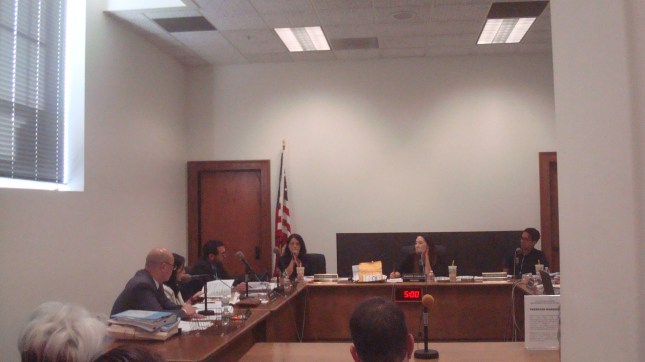
A shot of the September hearing.
I’ve been to a number of Commission hearings over the years, and I do feel like there’s definitely a bias in favor of owners and developers. But maybe it’s just me. Maybe I’ve got a chip on my shoulder. Or maybe, since the Commissioners are appointed by the Mayor, they all just share his enthusiasm for aggressive gentrification and rampant displacement. But there could be other reasons, too. It’s interesting that the owners’ rep at this hearing was Jerry Neuman of Liner LLP. In case you haven’t heard of Liner, they’re one of LA’s top lobbying firms. In fact, in the Ethics Commission’s 2nd quarter lobbying report for 2017, Liner ranked number one in terms of payments received, racking up $2,310,565. Pretty impressive. And one of Liner’s top clients is Harridge Development Group. If you take another look at the Ethics report, under the section for clients, you’ll find that Harridge is number 10 in terms of payments reported, having shelled out $118,765. But that’s actually kind of misleading. If you really want to know what kind of money Harridge is throwing around, you should take a look at the number 2 spot on the list. This is where you’ll find Crossroads Associates LLC, which is behind Crossroads Hollywood, a massive complex planned for Sunset and Highland, and even though the name is different, this is also a Harridge project. For this project the client has paid out $393,837, and the recipients were the swell folks at Liner LLP.
So what does all this have to do with the Metropolitan? If you look at the applicant for the Metropolitan’s request to the DCP, you’ll see Brad Woomer, 5825 West Sunset Boulevard, LLC. The company is just another anonymous LLC, but it turns out Woomer is the Chief Financial Officer for Harridge. So the people behind the request for transient occupancy at the Metropolitan just happen to be the same people who figure so prominently on the Ethics Commission’s lobbying report. And the firm handling the request is none other than Liner LLP, which ranked number one in terms of payments recieved in the same report. Liner is definitely well connected. Among the agencies they’ve lobbied for the Crossroads project are the City Attorney, the City Council, Building & Safety, and of course, the Department of City Planning.
But maybe this has nothing to do with how the Metropolitan hearing went. Maybe I’m just a crazy conspiracy freak with nothing better to do than pore over Ethics Commission reports and show up at grindingly dull Commission hearings. (Seriously, I think I need to get a life.) Whatever the reason, the Commissioners voted to deny the appeal and grant the CUP. The Metropolitan owners can now legally turn residential units into hotel rooms. And since this does seem to be a precedent, it opens the doors for other landlords to do exactly the same thing.
Still, the Commission had to make it look like they were taking care of the tenants. So between the August and September hearings, Neuman met with DCP staff to work out a set of conditions that were supposedly going to make everything okay. The conditions included granting the remaining tenants a 4 month extension on their lease, and the option to move to a part of the building where they would be consolidated, the idea being that this would resolve conflicts with short-term guests. The Commission acted as though they were doing everything they could to protect the tenants, but it’s really all a game, because the City rarely enforces any of these conditions. Even when violations are brought to the City’s attention, enforcement is generally so lax as to be meaningless. Agreements like these are put in place to make it look like the DCP is doing its job. Once the hearing is over, it’s just a lot of language to be stuck in a file and forgotten.
So that was it. The Commissioners denied the appeal. The Metropolitan owners got their CUP. And after it was over the tenants stood outside the hearing room, realizing that the City had thrown them under the bus. For me it was one more maddening demonstration of the City’s staggering disregard for the rights of LA’s renters. I can’t imagine how the tenants felt. The DCP seemed to be saying to them, “We just don’t give a damn about you.”
The appellant, Susan Hunter, who’s a friend of mine, was frustrated, but has refused to give up. She’s been working on trying to find legal representation for the tenants so they can get relief from the courts. This isn’t her first fight, and it won’t be her last. I have to give credit to Susan for her tenacity, and to all the others in this town who keep pushing for some kind of justice. It’s got to be tough to keep going when the deck is clearly stacked against you.
P.S.
In the post above I mentioned Jerry Neuman’s claim that the owners had no intention of evicting anybody, and that they just wanted the option to post vacant units for transient occupancy. Well, since the hearing I’ve been told by Susan Hunter that the tenants she does not represent have been told to vacate the premises. They’re supposed to be out by Christmas.


Artists are being forced out of the Arts District. This isn’t news. It’s been happening for years. The news is that now the artists are fighting back.
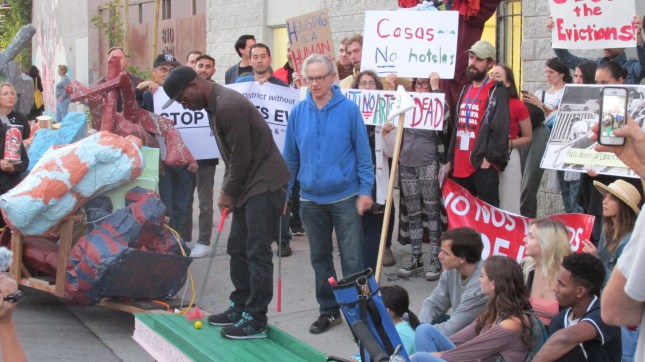
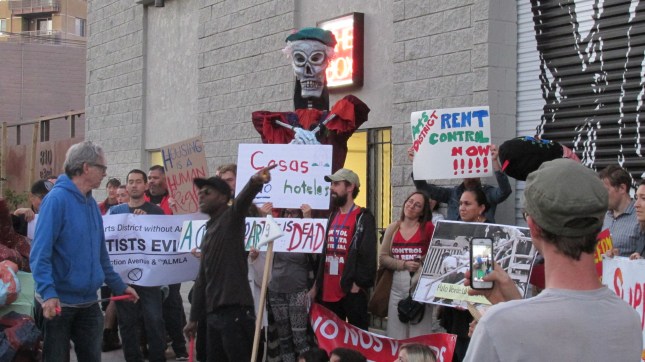
On Saturday, November 4, two groups of artists facing eviction organized a parade to bring attention to the rampant displacement that threatens their community. Earlier this year the residents at 800 Traction were told by the new owners of the building that they’d have to leave. Also this year, the people behind the Artists’ Loft Museum Los Angeles (ALMLA) were hit with a steep rent increase that seems intended to force them out. So the two groups have gotten together to let the world know that they’re not going quietly. On Saturday, November 4 they staged a parade through Downtown.

The parade started in Little Tokyo.

Took a right on Alameda.

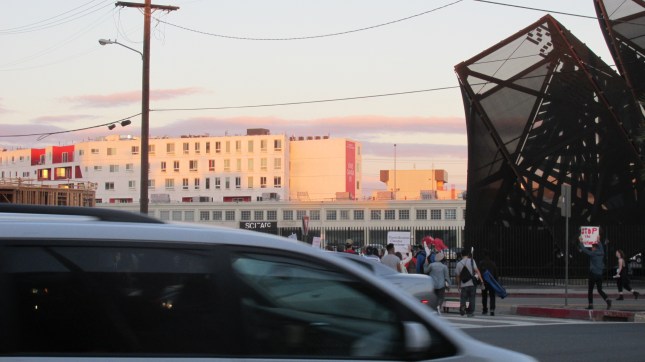
Then the protesters headed down Alameda toward Fourth.
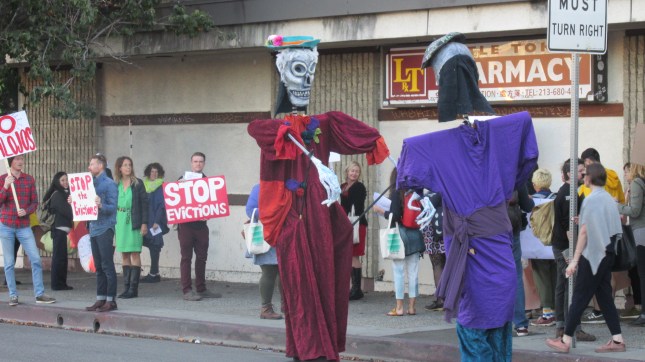
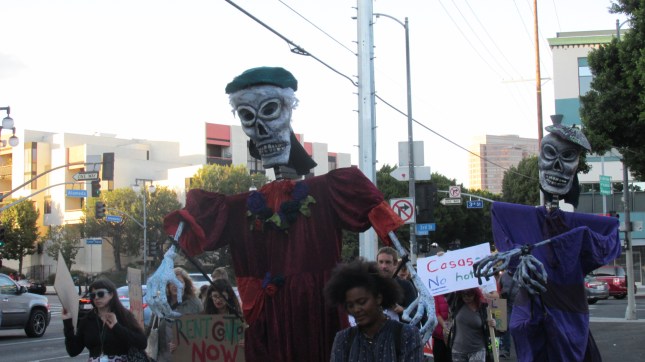
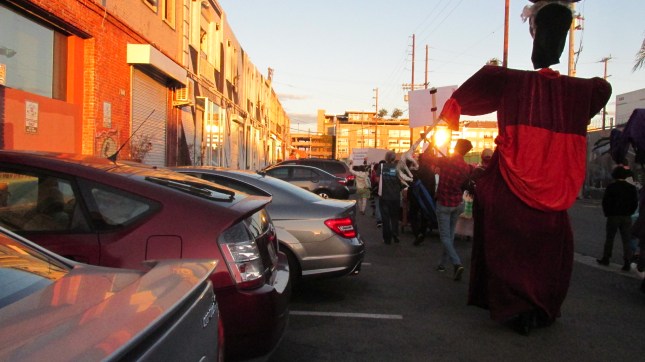
The parade started in Little Tokyo, cut down Alameda to Fourth, then wended its way along Seaton, Fifth and Hewitt, finally winding up at 800 Traction. It was an interesting walk. Protesters waved signs and displayed artwork. Two giant skeleton figures towered over the crowd. A few cars honked to show their support.

A momentary pause on Alameda.

Marching along Seaton.

And then up Merrick.
We passed in front of the building that holds ALMLA, which is actually a brand new enterprise. Michael Parker and Alyse Emdur have lived in this space, along with other artists, for 16 years. Parker says that in just the last 6 years their rent has risen by 200%. The latest increase is beyond what they can pay, and Parker believes it was designed to force them out. So the artists at 454 Seaton decided to create ALMLA, which they hope will draw attention to their situation, and to the larger wave of displacement that’s sweeping across Los Angeles. Just before the museum’s opening, the landlord went to court to shut the event down. Fortunately he failed.
I used to hang out in this area back in the 80s and 90s. It’s depressing to see some of the changes that have taken place. While most of the buildings remain, with the onslaught of gentrification many of them now house chic boutiques and pricey restaurants. Anonymous LLCs have bought up a lot of the real estate, and investors seem bent on turning this part of Downtown into something very close to a suburban mall.

Shop in the Arts District.

Eat in the Arts District.

Gentrify the Arts District.
Like I said, we ended up back at 800 Traction. A number of the artists who live in this building have been here for decades. Some were among the first wave of artists to move to the area back when it was more or less a decaying industrial ghost town. And most of the current residents at 800 Traction are part of the Japanese-American community, which is crucial to this story. This community has hung on in spite of successive waves of forced displacement going back to WWII. In the early part of the 20th century, Little Tokyo stretched far beyond its current boundaries. There were numerous Japanese-owned businesses and Japanese cultural institutions in the area between Alameda and the LA River. The first assault was the internment of Japanese-Americans after Peal Harbor. Since then City Hall has carved out one piece after another. And now these artists, after years of working within the community, are threatened with eviction.

A performance featuring two of the Downtown elite enjoying a round of golf.

They seemed to agree that gentrification wasn’t happening fast enough.
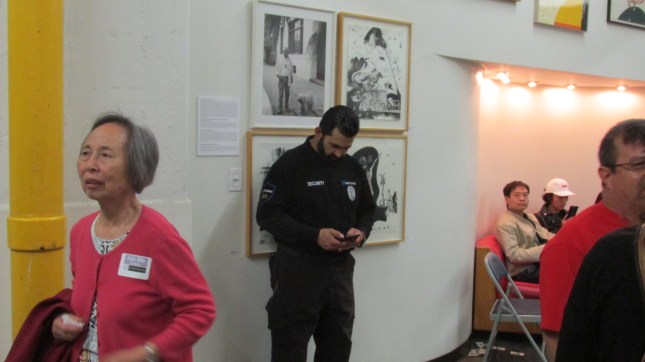
Hanging out with the other party guests, I felt like the room was filled with a kind of giddy energy, but there was also an undercurrent of tension. I spoke with Nancy Uyemura and Jaimee Itagaki, and they gave me the latest news about 800 Traction. The building’s new owners, DLJ Real Estate Capital Partners, had hired a property management firm, Pearson, that seemed intent on sabotaging the gathering. Pearson had called the cops before the party, apparently believing they could shut it down, but it went on as planned. They also sent security guards to keep an eye on the tenants and guests. Harrassment in situations like this is commonplace, and Pearson is doing their best to make things uncomfortable. Uyemura said that the tenants at 800 Traction were told in May that they had to leave, and they were supposed to be out by August. Recently they received an unlawful detainer notice. Their hearing date is in December.

Protesters gathered at 800 Traction after the parade.

I hope the security guards enjoyed the party.

Artists sketched their take on what’s happening Downtown.
The attempt to evict the artists at 800 Traction is bad enough, but there’s another layer to this story that makes it even more disturbing. DLJ has decided to go through the process of designating the building a Historic-Cultural Landmark, which will enable them to get significant tax breaks for renovating the structure. They hired GPA Consulting to do the research for the nomination. GPA’s report talks at length about the building’s architect and Beaux Arts revival style and the food processing industry. They even mention Al’s Bar and LACE. But somehow they completely avoid any mention of the Japanese-American community that thrived in the neighborhood for decades. They also neglect to mention that the current residents have deep ties to the current Japanese-American community, and that some of them were among the first artists to move to the neighborhood back in the 80s.
In other words, GPA’s report completely whitewashes the community’s history. At the Cultural Heritage Commission (CHC) hearing where the nomination was considered, some attendees pointed this out, among them Dorothy Wong, herself a preservation consultant. Wong was baffled by the fact that the report didn’t refer to Little Tokyo once, and made no mention at all of the Japanese-American artists who had lived and worked at 800 Traction for decades. To their credit, the CHC agreed that the report was incomplete and chose to defer their decision until further work was done.
This may seem like a small victory, but it goes to the heart of what’s happening in Downtown. Ruthless investors are kicking artists and others out of the area so they can turn it into a sanitized, upscale urban destination. The Mayor and the City Council are doing everything they can to help make that happen. The people who have lived and worked in the area for much of their lives, the people who built communities and kept them going through tough times, are being told to leave. And while City Hall makes a great show of preserving historic structures, they’re destroying the communities that gave those structures life.
It’s hard to say whether the artists at 800 Traction and ALMLA will win this battle. They’re a determined group, and they seem committed to fighting til the bitter end. But LA has become increasingly hostile to artists, and the Mayor’s vision for Downtown is all about handing the area over to developers.
What have real estate investors put into this community? Money. What do they want out of it? More money.
What have the artists put into this community? Their lives. And what do they want? To continue working with and for the community, as they’ve been doing for years.
Find out more by following these links.


You may have already heard that the local news web site LAist has been shut down. This was actually part of a larger move by the new owner of DNAinfo, which included snuffing out sister sites in New York, Chicago, Washington DC and San Francisco.
The link below is to a piece written by Julia Wick, former editor-in-chief at LAist. I’ll let her give you the gory details. But as sad as it is to see LAist go, there’s a much larger problem here than the loss of a single web site.
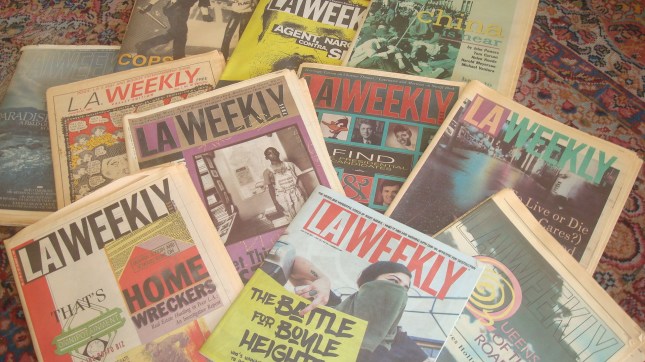
We’re losing local news coverage. The LA Times and the Daily News have suffered massive cutbacks, which means they’re doing much less coverage of city and county politics. The few community newspapers left are struggling to stay alive. Radio is increasingly controlled by large corporations who aren’t interested in covering local news. And forget about TV. They’re so caught up in crime videos and celebrity gossip they hardly pay attention to what’s going on at City Hall or in our schools.
This is a serious problem, because we’re less and less aware of what’s going on around us. Voter turnout has been declining for decades, I think in part because people don’t even know what the issues are. Decreasing public awareness of issues that impact our lives makes it easier for politicians and other power brokers to bend and break the law.
And don’t tell me the internet is going to solve the problem. Sure, it’s true we now have access to more news than ever before, but social media allows people to focus only on the news they want to hear. People visit the web sites that feed their appetites, requiring less and less involvement with the world around them. The people at City Hall like that. It means they don’t have to worry about public scrutiny. It leaves them free to serve the interests that fund their campaigns.
I don’t know what the solution is, but if we don’t reverse this trend, we’re going to be in worse trouble than we are now. And we’re already in a lot of trouble.
Everyone Should Fear What Happened to the Gothamist Sites

Last month the Poor People’s Campaign came to LA. Led by Rev. Dr. William Barber, II, and Rev. Dr. Liz Theoharis, the campaign has been travelling all over the country advocating “a national call for moral revival.” Can anyone deny it’s needed?
If the Poor People’s Campaign sounds familiar, it’s probably because Revs. Barber and Theoharis are building on the efforts of Rev. Dr. Martin Luther King back in the 60s. After the Civil Rights Movement achieved important advances, Dr. King argued that it was time to turn to human rights, focussing on housing, jobs and health care.

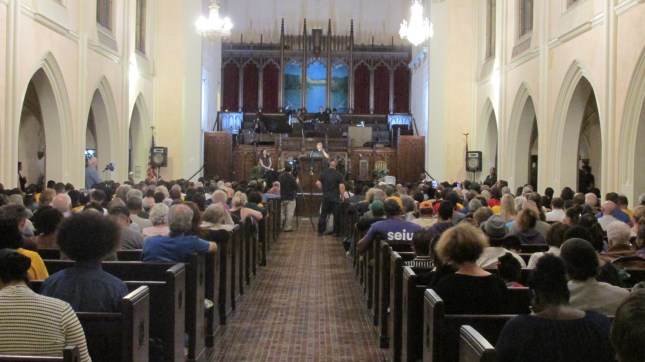
The sanctuary was packed.

A close-up of the crowd.
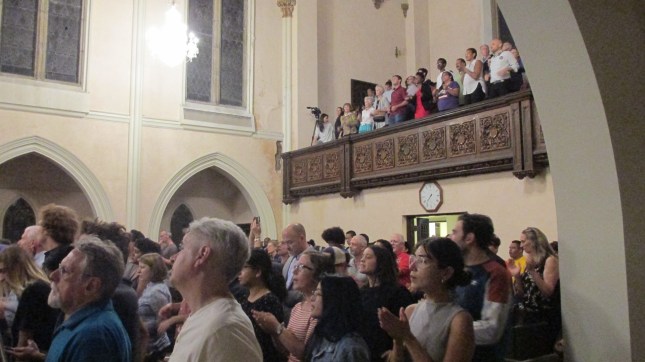
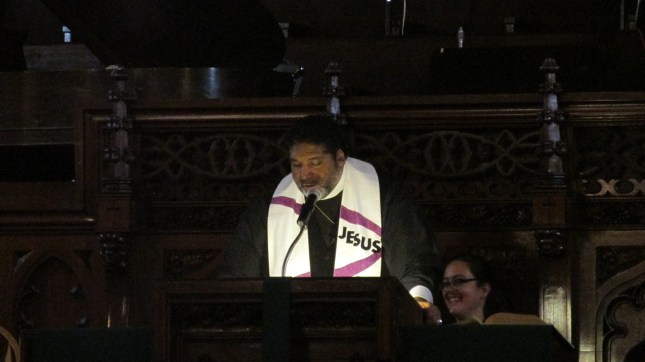
On its stop in LA, the campaign landed at McCarty Memorial Christian Church in West Adams, where Rev. Eddie Anderson serves as pastor. The place was packed with people, and a number of different organizations were there representing labor, immigrants, and tenants. One speaker emphasized that the Poor People’s Campaign was happy to embrace people of all faiths, and even people who don’t belong to any faith tradition. They welcome everybody. A variety of speakers took turns at the pulpit, including some ordinary folks who talked about how hard they’re struggling just to survive.

The crowd overflowed into the aisles.

A close-up of the balcony.
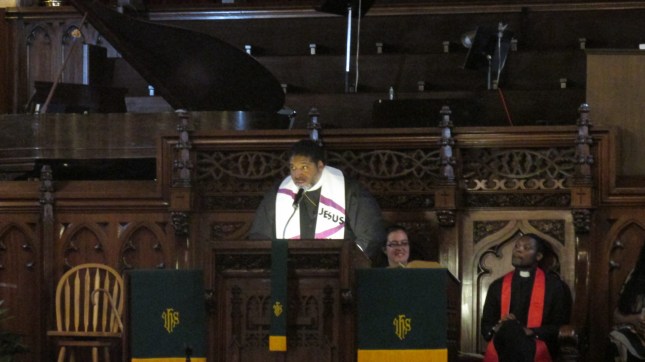
Finally Rev. Barber stepped up to speak. He made it clear that he believes our country is in a moral crisis, citing rampant inequality and economic oppression. He talked about poverty in Los Angeles and California, decrying homelessness and lack of access to healthcare. In Rev. Barber’s view, our society is afflicted by four ills that we must challenge: racism, poverty, ecological devastation, and the war economy.

Revs. William Barber, Liz Theoharis, and Eddie Anderson
It was an inspiring sermon, and the crowd ate it up. I have to admit I didn’t stay til the end, because I had a long bus ride home. But it was exciting to be in a room full of people who believe the country needs to change.
Interested in joining the Poor People’s Campaign? Here’s the link….
During his sermon, Rev. Barber insisted, “It’s time for a breakthrough!”
I couldn’t agree more.

It is definitely time for a breakthrough.

Months ago I was walking through Glendale and came to the corner of Harvard and Louise, where I saw something that freaked me out. The Glendale Central Library was surrounded by chain link fencing covered with green fabric. I knew that meant construction crews were working on the building, and I expected the worst. I love libraries, and the Glendale Central Library has long been one of my favorite places in LA. This brutalist beauty was designed by Welton Becket & Associates and opened in 1973. Its severe concrete exterior contains a wonderfully spacious interior that I’ve wandered through many times. I have fond memories pulling a few books off the shelf and sinking into a cozy chair in the ground floor reading area. When I saw they were remodelling it, I immediately expected the worst. I knew they were going to wreck the place.
But I was wrong. I have to give credit to the City of Glendale, and everyone else involved with the project. The renovated Central Library is total success. While there are a number of changes, they took care to respect the character of the original building. The entrance used to be from the parking lot on Louise. Now there are two entrances, one on Harvard and one at the rear of the library. In addition to upgrading the auditorium and the teen space, several new components have been added, including a Maker Space, a Digital Lab, and a Remembrance Room.

The main entrance has been moved to the Harvard side of the library.

An open area has been added adjacent to the new entrance.

New landscaping on Harvard.
The City of Glendale chose Gruen Associates to oversee the renovation, and Debra Gerod headed up their team. Historic Resources Group was the preservation consultant. There were numerous others involved with the project, from City staff to individual contractors, and I hope they’ll forgive me for not mentioning them all by name.

Another entrance was added at the rear.

While the entrance on Louise has been closed, no alterations have been made to that side of the structure.

Here’s a shot of the lower level.

And here’s a shot of the upper level.
Renovating a historic building is a complex undertaking. Glendale wanted to take their 40+ year old Central Library and bring it into the 21st century, making sure it remains a relevant and useful part of the community. They did a beautiful job. I’m impressed.


Bernie’s Coffee Shop, mural by Dionisio Ceballos
Okay, so I kind of have an obsession with Johnie’s Coffee Shop at Wilshire and Fairfax. When I was younger it was one of a number of coffee shops me and my friends used to hang at after movies or shows. It closed in 2000, and for years now I’ve been wondering if it would ever reopen.
Well, it has. Kind of.
Johnie’s isn’t a coffee shop any more. It’s morphed into something else. During last year’s presidential campaign, the owner of the restaurant offered it to a group of Bernie Sanders supporters, and it became the Sanders HQ in LA. After the campaign ended, the group continued to meet there to talk about ways to keep pressing for a progressive agenda.

Johnie’s/Bernie’s Coffee Shop at Wilshire and Fairfax
I didn’t know about any of this until earlier this year when I was waiting at a bus stop with a friend, and we started talking to a guy about the coffee shop. He told us that it was a meeting place for the Sanders crowd. I immediately wanted to drop in and check it out.
So I was surfing the net in August, and came across a post advertising Bernie’s Norebang at Johnie’s. I knew I had to go.
I showed up at Johnie’s around seven o’ clock on a Friday night. It was early, and nobody was there yet, but the people were really friendly and I was soon deep into a discussion about how we could solve the housing crisis. One of the things that impressed me about everybody I talked to that night was that they all have a genuine desire to change things for the better.
For those of you who don’t know the word “norebang”, it’s the Korean version of karaoke. It was a blast. They asked for a twenty dollar donation at the door, but no one was turned away. Once inside, beer and food were free. I only had one plate of food. I don’t want to talk about how many beers I had.
But rather than tell you about it, let me just show you some pictures….

When I first arrived, there were just a few people setting up.

But soon the place started filling up.

Everybody seemed to be having a good time.

A vocalist cutting loose.

Another vocalist takes a shot at Bowie’s Young Americans.

I started wandering around, and found this mural in a corner of the restaurant.

I wasn’t the only one drinking.

A shot taken from the corner by the mural.
I had a great time. I talked to a lot of interesting people. I sang a few songs. The only disappointment was that I didn’t get a standing ovation for my rendition of the Beatles’ Revolution. It could be that the other guests didn’t appreciate my talent. It could also be that I was on my fourth beer, and was having trouble staying on key.
Bernie’s Norebang was hosted by Ground Game LA. They made it happen three times over the summer. Sorry I only made it to one. It was definitely one of the summer’s highlights.


The speculative real estate binge that’s sweeping across LA right now has drawn a swarm of unscrupulous people willing to do whatever it takes to make a profit. In talking to community members over the past few years I’ve heard some hair-raising stories, but nothing that tops the reports I’ve heard from the tenants of the Sachs Apartments in Silverlake.
To give you some background, the Sachs Apartments (also known as Manola Court) were created by architect Rudolph Schindler for interior designer Herman Sachs. They’re a stunning example of Schindler’s work, a collection of buildings that step gracefully down a hillside, connected by steep stairways and terraced paths. The City of LA has recognized the importance of the site, naming it a Historic-Cultural Monument (HCM) in 2016.

A view of the Sachs Apartments from Edgecliffe.

Another view from Edgecliffe.

A gate leading to a walkway between two buildings.
The Sachs Apartments were purchased by the current owners some years back. While there are three names listed on documents filed with the City, the person who has been dealing with the tenants and supervising the “restoration” is Paul Finegold. I’ve been hearing a lot about Mr. Finegold lately, and most of the comments have been pretty negative.
To start with, a number of tenants claim that Finegold has been harrassing them, and they believe he’s doing his best to get rid of them. There have been reports that he doesn’t maintain the units properly, and is slow to act when problems come up. I wanted to learn more, so last Thursday I showed up for a meeting of the Urban Design & Preservation Advisory Committee of the local neighborhood council. The only item on the agenda was the situation at the Sachs Apartments, and there was plenty to talk about. A number of tenants attended. They talked about water leaking through the ceiling, workers leaving debris on the site, and respiratory issues that may be related to dust from construction. Apparently Finegold has posted at least one unit on AirBnB, and the tenants said the guests are often out of control. One woman said she found a couple having sex right in front of her apartment.
And there’s more. According to the people at the meeting, three tenants have already been evicted by Finegold, who claimed that he, his mother, and a resident manager were moving in. But according to the current tenants, neither Finegold nor his mother nor the manager are living on the site.
Beyond all that, a lot of people are asking whether Finegold is restoring the Sachs Apartments or wrecking them. Remember, this is a Historic-Cultural Monument designed by someone who played a key role in LA’s architectural history. Having pledged to do a careful restoration of the site, Finegold is receiving substantial tax breaks under the Mills Act. But tenants say he’s made significant alterations, reconfiguring the interiors of some units and removing the bathroom from one. They also claim workers have cut down 4 mature trees and removed tiles designed by the original owner, Herman Sachs. Former tenant Judith Sheine, an authority on Schindler’s work, has expressed her concern that Finegold’s crews are doing damage to the complex.
I decided to go to the LA Department of Building & Safety (LADBS) web site to check out some of the permits that Finegold has pulled. Here are some excerpts….
“REMOVE FULL BATH ON FIRST FLOOR AND CREATE A POWDER ROOM ELSEWHERE ALSO ON FIRST FLOOR. NO CHANGE TO PLOT PLAN.”
“CONVERT A 3 UNIT APARTMENT TO A 4 UNIT APARTMENT WITH INTERIOR ALTERATIONS.”
“ADD NEW BATH; REMOVE AND REPLACE SELECTED WINDOWS; NEW ROOFING; NEW COLOR COAT EXTERIOR PLASTER”
Is it really okay to do all this with a building that’s been designated as an HCM? Was LADBS aware that this is a historic building? Obviously, any structure that’s over 80 years old is going to need some work to comply with current codes, but removing a bathroom? Converting one structure from 3 to 4 units? Remember, Finegold is getting tax breaks under the Mills Act for the work he’s doing, and that means he’s required to follow the Secretary of the Interior’s Standards for Rehabilitation. Historic Resources Group, a widely respected consulting firm, helped Finegold file the Mills Act application. Do they know what’s going on at the Sachs Apartments?

A view of the Sachs Apartments from Lucile.

Far corner of the building on Lucile.

Another view of the building from Lucile.
And to top it all off, now Finegold has applied to convert 5 of the units to a bed and breakfast. That may seem like a small number, but remember, we’re in the middle of a housing crisis. And based on their experiences with Finegold, some of the tenants are worried that he eventually plans to convert the whole complex to a bed and breakfast.
So, will the Department of City Planning (DCP) reward this guy by allowing the change of use? Seems likely. In spite of the fact that City Hall keeps telling us that we don’t have nearly enough housing, the DCP has shown itself to be more than willing to work with owners who want to remove rental units from the market. The DCP has heard all about the tenants’ concerns, and so has Councilmember Mitch O’Farrell’s office. But so far nobody from the City seems willing to stand up and ask what the hell is going on at the Sachs Apartments.
If you think somebody from the City should be asking questions, maybe you could let them know you’re concerned. Send an e-mail to DCP staffer Azeen Khanmalek, and be sure to copy Councilmember Mitch O’Farrell.
How about this for a subject line?
Investigate Possible Damage to Historic Sachs Apartments
Azeen Khanmalek, Department of City Planning
Azeen.Khanmalek@lacity.org
Councilmember Mitch O’Farrell
councilmember.ofarrell@lacity.org


Last night I was walking down Crenshaw at dusk. As I came up to the onramp for the Santa Monica Freeway I saw some signs fixed to a pole. I thought the message was cool, so I pulled out my camera and snapped a few photos..

As I was taking the pictures, I wondered who put these signs up. I didn’t have to wonder long. He was standing a few feet away. He came up to me and asked me why people didn’t use their creative mind. It was a good question, and I didn’t have an answer. We started talking. He told me he thought the richest soil in the world was the soil you find in a cemetery, because so many people take their thoughts to the grave.
He told me his name was Lovell. I told him I did a blog about LA, and asked if I could take his picture. He said fine.

We probably talked for about ten minutes. Then I said goodbye and moved on. But I was really glad I met Lovell. He’s interesting guy, and he’s an optimist. He really believes people can make the world a better place if they just allow themselves to explore their own potential.
It was a message I needed to hear. The world seems so scary these days. There’s so much violence and hate. So much poverty and fear. At times it feels like there’s no hope at all. So it was good to talk to someone who does have hope. Someone who believes we can change things for the better, if only we can just change ourselves.