Silverlake in Crisis: Acute Boutique Hotel Shortage

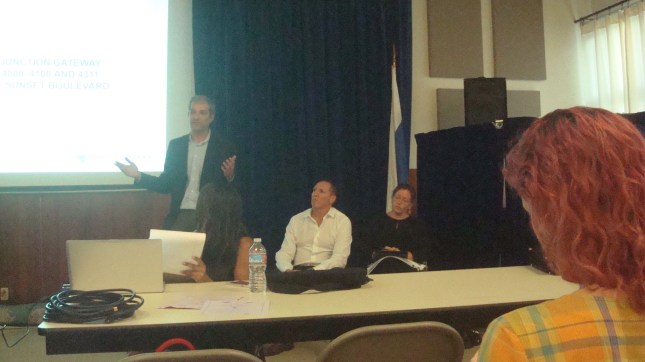
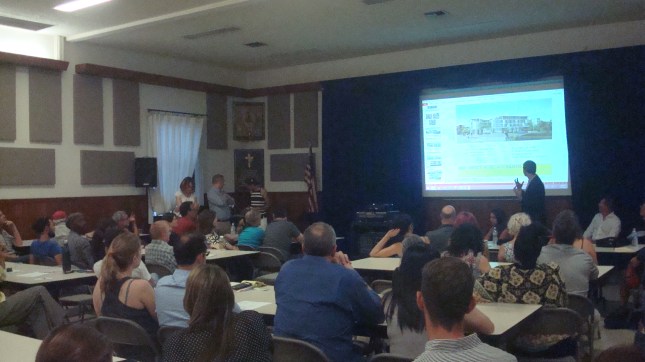
Town hall meeting on proposed Junction Gateway project.

Town hall meeting on proposed Junction Gateway project.

On Wednesday night the Silver Lake Neighborhood Council (SLNC) hosted a town hall meeting where the topic was the proposed Junction Gateway project. For those of you who haven’t been following this story, developer Frost Chaddock wants to build three structures on three sites along Sunset Blvd. in Silverlake. Two of the buildings are mixed-use, including residential, restaurant and retail space. The third is a boutique hotel. Predictably, the developer is asking for a number of entitlements, among them increases height and Floor Area Ratio (FAR). And predictably, a lot of the locals are ticked off.

By my count, the town hall drew about fifty area residents. The developer was there, along with the project architect, and a very smooth land use attorney from a high-powered law firm. They kicked the meeting off with a presentation on the project, emphasizing the ways they felt it would be beneficial to the community. Then two board members from the SLNC took turns reading questions that had been submitted by audience members. I want to say in passing that the SLNC board members handled the whole thing very well. The tension in the air was palpable, but they did an excellent job of minimizing disruption and keeping things on track.

A land use attorney explains why his client's project will be a boon to the community.

A land use attorney explains why his client’s project will be a boon to the community.

I have to admit I left early since I was taking the bus to Burbank and didn’t want to get started too late. But as I listened to the questions being read, it all sounded very familiar. While the developer claimed that Junction Gateway was absolutely right for the neighborhood, the tone of the questions made it clear that there was intense opposition in the community. The land use lawyer kept saying they had met with residents and made changes based on their input. But the changes mentioned were mostly cosmetic, and it was clear that the developer intended to build the project regardless of neighborhood oppostion. For me, the funniest moment was when the developer’s land used attorney insisted that in talking to the community, “We heard over and over again that Silverlake is lacking in boutique hotels.” That was a surprise to me. I know people who live in Silverlake, and I’ve never heard any of them complain about a shortage of boutique hotels.

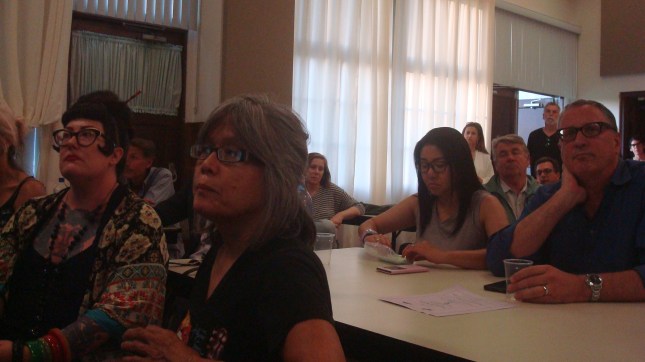
The audience is skeptical.

The audience is skeptical.

But to my mind, the most crucial questions that were raised shouldn’t have been addressed to the developer. They should have been addressed to Councilmember Mitch O’Farrell, whose district includes Silverlake.

First, why are developers continually encouraged to build projects that violate the existing community plan for Silverlake and Echo Park?  According to the Department of City Planning web site, “the 35 Community Plans provide the specific, neighborhood-level detail, relevant policies, and implementation strategies necessary to achieve the General Plan objectives.”  When our City Council reps routinely allow developers to build beyond what the existing framework allows, they make planning meaningless.  Why do we have community plans if our elected officials are happy to toss them out for any developer with deep pockets?

Second, what about doing a meaningful assessment of all projects currently being considered for the area?  The developer’s team pointed out that Junction Gateway has been in process for years, and they argue that their assessment of cumulative impacts included everything that was happening when they started out.  Even if we accept this argument, there are a number of other projects that are coming through the pipeline and there hasn’t been any serious attempt to gauge their impacts on the community.  Infrastructure is already strained, air quality is deteriorating, and the streets are more congested than ever.  And yet O’Farrell keeps pushing new projects forward as though none of these problems existed.

The City of LA’s refusal to respect the planning process shows that our elected officials are far more interested in serving developers than in serving the citizens. Instead of creating a rational planning framework that starts with a genuine effort to engage the community, we get an avalanche of projects being dumped haphazardly on neighborhoods all over LA.

It’s no wonder the people at the meeting were ticked off. Affordable housing in Silverlake is fast becoming a distant memory, small-lot subdivisions are a plague sweeping the community, traffic keeps getting worse, the number of homeless is increasing. And still Mitch O’Farrell continues to back one project after another, blithely insisting that this onslaught of reckless overdevelopment will lead to a better and brighter future for his constituents.

Not surprisingly, a lot of people aren’t buying it. A number of those who attended the meeting belong to a group called Save Sunset Junction. If you’d like to connect with them, here’s the link.

Save Sunset Junction

TH Crwd Cls

Pushing for Change at Jordan Downs

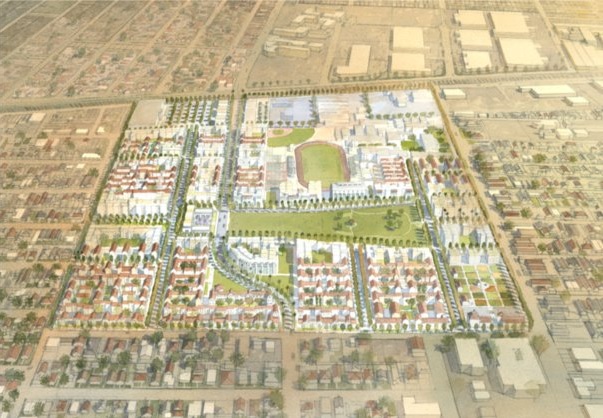
Aerial view of proposed Jordan Downs redevelopment project.

Aerial view of proposed Jordan Downs redevelopment project.

Sometimes you hear people complain that our elected officials are afraid to try anything new, that they devote most of their careers to propping up the status quo. I’ve said it myself, and I do feel like our politicians need to spend more time thinking outside the box.

But there are reasons why the folks at City Hall don’t like taking chances. It’s one thing to come up with an innovative idea. Making it a reality is a whole different story. It’s not uncommon for good ideas to get ground into dust by the system. Pushing for change can be a long, brutal process, sometimes dragging on for years and wearing everyone involved down. It’s not easy changing the status quo.

I first read about the Jordan Downs redevelopment initiative back in 2013. The idea was to take an aging housing project that was mired in poverty and remake it from the ground up. But this wasn’t just about knocking down one building and putting up another one. The idea was to create an expanded mixed-income complex where low-income families would live next door to middle class families. The project also included a new park and over 100,000 square feet of retail, bringing jobs and amenities to a community that hasn’t had had easy access to either.

Back in 2013 it was clear there were plenty of challenges, and the path hasn’t been easy. Though many of the current residents support the project, there are also fears about gentrification and displacement. And the process was complicated further by the news that the soil on the site was heavily contaminated, meaning that a long, costly clean-up would be necessary.

On top of all that, getting the funding for the project has been a huge hassle. Councilmember Joe Buscaino didn’t hide his anger when a grant application was rejected by the US Department of Housing and Urban Development (HUD), at least in part because the city agency handling it hadn’t submitted all the required materials. This was the second time that HUD had declined to award funds for the project.

But things are still moving forward, and it’s hoped that construction will begin by the end of this year. No doubt there will be more challenges. The concerns about displacement are certainly well founded. The Housing Authority of the City of Los Angeles (HACLA) has said that tenants “in good standing” will be guaranteed units in the new complex. However, they haven’t yet defined exactly what “in good standing” means. This could be a problem. A recent affordable housing project in Boyle Heights proposed the demolition of existing units to allow the construction of new ones. This sounded like a good idea until the residents of the existing units learned that strict conditions regarding right of return would have excluded many of them from moving into the new units.

The contamination also needs to be dealt with. I wondered how the clean-up was progressing, so I sent an e-mail to Joe Buscaino’s office. I got an answer within hours from Planning Deputy Heather Anderson. To put it in context, it’s important to understand that HACLA purchased additional property adjacent to Jordan Downs, and her response focusses on work at that site.

The Housing Authority of the City of Los Angeles (HACLA) purchased the property knowing that it was a former industrial site, and with the intent to remove the contamination and clean up the property. They have been in the process of remediation with the oversight of the California Department of Toxic Substances Control (DTSC) for a few months now. After removing 200,000 tons of contaminated soil, they are close to finished with the remediation. There has been testing of the soil around the site to ensure that nearby soil is safe.

She also attached a report documenting the clean-up through February. It sounds like the City and State are taking this seriously, which is good news. But it’s important to remember that there’s also concern about contaminants within the site that Jordan Downs currently occupies. Hopefully, as demolition of the existing buildings progresses, the City and State will continue to do the same thorough job of remediation.

There are those in the community who are skeptical about how this will all play out. This article from the LA Wave reports some of their concerns.

Feds Greenlight Plan to Redevelop Jordan Downs

Buscaino and Congressional Rep Janice Hahn both deserve credit for staying with this redevelopment effort. They could have stuck with the status quo and saved themselves a lot of headaches. And the residents of Jordan Downs also deserve a lot of credit for the hard work they’ve done as they’ve fought to improve their neighborhood. No doubt community activists and elected officials will be facing off as further issues arise. That’s to be expected. But hopefully everybody will continue to work together to build a better future for the people of Jordan Downs.

There are all sorts of possible pitfalls, but here’s the bottom line. If this project doesn’t go forward, the residents of Jordan Downs will continue to be trapped in the same cycle of poverty that has held the community back for decades. And that’s not an option. We can’t accept the status quo.

 Aerial view of Watts, looking northeast. Jordan Downs can be seen at lower center.  Photo by Howard D. Kelly, 1956.  From the Los Angeles Public Library, Kelly-Holiday Collection.


Aerial view of Watts, looking northeast. Jordan Downs can be seen at lower center. Photo by Howard D. Kelly, 1956. From the Los Angeles Public Library, Kelly-Holiday Collection.

Death by a Thousand Cuts

MTA 4

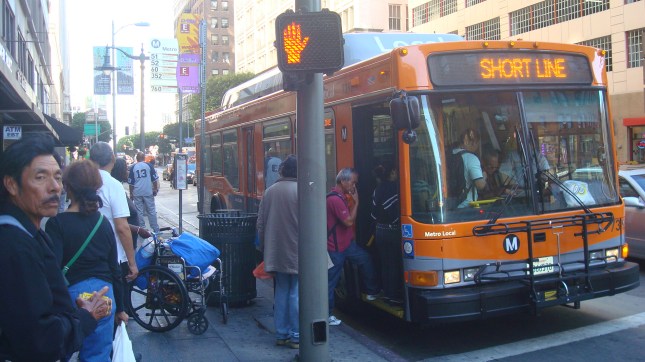
Not too long ago I was riding the bus and saw a pamphlet on display. The title was Public Hearing on Proposed Service Changes. Even before I picked it up, I more or less knew what it was about. The “service changes” are mostly service cuts, yet another round of reductions by the MTA.

This isn’t surprising. Last I checked, the MTA was running an operating deficit of over $30 million a year, and that deficit will continue to grow. One solution would be to raise fares, but the last time they did that there was a decline in ridership. Of course, ridership has been going down for a while now. Some argue that the decline may be reversable, and point to the rail extensions that are currently under construction. New rail stops will bring new riders, but they will also increase operating costs. And actually, fares don’t nearly cover what it takes to run the system. I really doubt that increased ridership from these extensions will make a serious difference in the budget picture.

There’s no simple solution here. While I’m not happy about further cutbacks, I know Metro is probably doing the best they can to balance their budget under challenging circumstances. But I’ve gotta say, it’s getting harder and harder to get around LA on public transit. A number of the lines I use regularly run only once an hour. The Rapid busses, which were great to start with, don’t run as often as they used to. I don’t read when I ride the bus, but I’ve started taking a book with me when I’m going somewhere because I never know how long I’ll be waiting to make a connection.

What I’m leading up to here, is that I’m really starting to question the MTA’s long term strategy. For years now we’ve been told that we need to invest in rail to solve our transit problems. Well, we’ve built a lot of rail, and things don’t seem to be getting any better. Looking at the budget issues and the trend in ridership, I don’t believe the rail we’re building now is going to make a huge difference. At some point we have to ask ourselves if this approach is working.

That brings us to Measure R2, the ballot initiative we’ll be voting on in November, which will increase the sales tax to raise billions for transit. About 40% of the projected revenue will go to rail projects, and looking at the results we’ve gotten from rail so far, I’m increasingly skeptical about whether this is the right way to go. Trains are great if you’re travelling in a straight line from point A to point B, but as soon as you get away from that straight line, things start getting complicated. Rail works great in New York, where the system is centered on a very dense urban core. LA is much more spread out, and even though Downtown is attracting more residents and businesses, it doesn’t function as the City’s center the way Manhattan does. There are those who argue we need to build high density hubs along transit lines, which sounds good, but City Hall has been pushing that policy for years and it’s not producing the promised results. Transit ridership is down. If our leaders had pursued a policy of building affordable housing that would make job centers easily accessible by rail, it might be a different story. But renting near rail stops is pretty pricey. A studio at Noho Commons goes for $1,777. Digs at the Jefferson in Hollywood start at $2,238. And I don’t know what they’ll be charging at the Wilshire Grand, but I’m pretty sure it’ll be more than the average transit rider can afford.

MTA 5 a

Measure R2 will deliver other things besides rail, and I don’t want to say I’m opposed to it, but at this point I can’t say I’ll vote yes. It seems like there are others who have doubts as well. This post on StreetsBlog breaks down the MTA’s 2016 budget, and raises some important issues. The comments are worth reading, too.

A Preview of Metro’s $5.6 Billion Fiscal Year 2016 Budget from StreetsBlog LA

I also came across this article in the Daily News that talks about how the Valley has gotten less than its share of transit infrastructure in the past, and how leaders on that side of town are worried about getting shortchanged again with R2. One of the points the author makes is that with big infrastructure projects, the longer they’re delayed, the more expensive they become.

What the Valley Would Get, and Not Get, in New Transportation Tax from Daily News

LA County is promoting R2 in order to fund a massive expansion of our rail network. Basically I’m asking if rail is really worth the money, time and trouble. Busses are much cheaper and much more flexible. Also, investing in busses won’t saddle the MTA with a huge debt load the way these infrastructure projects will. Debt service already accounts for a significant portion of the agency’s budget, and expanding the rail lines will make that burden even heavier.

You’re going to be hearing a lot about R2 in the coming months. City, County and State officials are already making an aggressive push to promote it. Again, I’m not saying I oppose it, but as you listen to our elected officials give their spiel, ask yourself if our public transit policy is taking us in the right direction. And if not, is it time to change course?

MTA 1

You Can’t Drink Paper Water

UWMP Paper Water b

Why should you care what the DWP’s 2015 Urban Water Management Plan says?

You should care because city officials will use the UWMP when making decisions about future development in LA. They will be relying on the plan’s absurdly optimistic projections regarding future water resources to justify approving projects that could burden our dwindling water supply with unsustainable demands.

But first, let’s put this discussion in the right context. People talk about how we’re in the fourth year of the drought, and the assumption is that even if things are really bad now, eventually the drought will end and we’ll be back to normal. This is a big mistake. Everybody has their fingers crossed, hoping that this year’s heavy precipitation in the Sierras will restore the snowpack and we’ll be okay again. Actually, the snowpacks have been declining for decades, and there’s no reason to believe that trend will reverse itself in the near future. If you’re skeptical about this claim, check out these links.

Snowpack in California’s Sierra Nevada Lowest in 500 Years from NY Times

Declining Snowpacks May Cut Many Nations’ Water from Columbia University

This isn’t just a matter of toughing it out through a few dry years. For the foreseeable future, we’re going to have to use a lot less water than we’re used to. And this is not just a matter of taking shorter showers or getting rid of your lawn. We have to change the way we think about water in LA.

But in spite of the fact that we’re playing a whole new game, the people who run this city are determined to cling to the same old rules. Los Angeles was built largely on real estate speculation. For decades developers kept pushing the City’s boundaries outward, and this was only possible because the people who ran LA kept extending the reach of our water infrastructure. Local groundwater only supplies about 10% to 15% of what we need. The rest comes from sources far beyond the city limits.

We’ve gotten so used to living beyond our means that we still haven’t come to terms with the reality of our shrinking water resources. And in spite of all the rhetoric from City Hall about conservation, when it comes to planning for growth, our elected officials are determined to deliver everything the developers ask for.

So what’s wrong with the 2015 UWMP? In broad terms it does a good job of outlining the challenges that the City faces. But when we get down to specifics, the authors manage to avoid spelling out the severity of the situation. And in talking about the future of our water resources, things get very vague.

You want some examples?

The plan does talk about the fact that we’ll be getting much less water from the LA Aqueduct than we have in the past. In order to mitigate severe environmental impacts to the Owens Valley and Mono Lake, the City has agreed to reduce the amount it imports from the area. In the 70s and 80s, the Aqueduct generally brought us over 400,000 acre feet per year (AFY). That number started to drop in the 90s, and while some years have been better than others, the average has continued to decline, especially in the last four years. In 2014/2015 we received only 53,500 AFY. Less than 14% of what we were getting thirty years ago. This is a record low.

Graph showing LA Aqueduct deliveries from the 2015 UWMP.

Graph showing LA Aqueduct deliveries from the 2015 UWMP.

There’s another figure I’d like to cite in connection with the LA Aqueduct, and that’s the amount of water it delivered to us from April through September 2015.

Zero.

Last year the LA Aqueduct was closed for the first time in its history. A temporary dam was put in place so that the City of LA could fulfill its obligations to maintain the Owens Valley and Mono Lake. During this period, we received no water from the aqueduct. I can’t claim to have read the entire UWMP, but in the reading I have done I didn’t come across any references to this closure. Maybe that’s because it’s such a stark symbolic reminder of the gravity of our situation.

So how are we going to replace the water we used to get from the Aqueduct? Of course, there’s the usual talk about recycling and stormwater capture, both of which are certainly worthwhile, but it will be years before they start making a serious difference with regard to our water supply. And then there’s this section from the Executive Summary under the heading Water Transfers.

LADWP plans on acquiring water through transfers of up to 40,000 AFY to replace a portion of the Los Angeles Aqueduct (LAA) water used for environmental enhancements in the eastern Sierra Nevada. The City would purchase water when available and economically beneficial for storage or delivery to LADWP’s transmission and distribution system.

Wow. That’s great. It’s so simple. We’ll can just suck up another 40,000 AFY through water transfers from the Metropolitan Water District (MWD).  But the problem here is that they’re assuming MWD will reliably have access to that much water.  The UWMP mentions transfers of water originally intended for agriculture in the Central Valley.  What?  Have they seen the photos of landscapes collapsing due to overpumping?  In order to justify the claim that we can rely on these water transfers, the UWMP bases its calculations on the historic average of water supplies going back to the 20s.  They offer a chart titled “MWD Forecast Supplies of Groundwater Storage and Transfers in 2040, Average Year (1922 – 2004 Hydrology) “.  In other words, they’re basing their calculations on conditions that existed well before the current crisis began.  And they’re using those figures to project water supplies 25 years into the future.

But what about groundwater? Right now the supplies we get from aquifers within city limits provide between 10% and 15% of what we use annually. But in the Executive Summary under the heading Water Supply Reliability the DWP offers this startling prediction.

The exhibits show that the City’s locally-developed supplies will increase from 14 percent to 49 percent in dry years or to 47 percent in average years.

What a relief! Using purified wastewater and captured stormwater we’re going to more than triple our groundwater resources! But wait. It gets even better.

These local supplies are not influenced by variability in hydrology, and will become the cornerstone of LA’s future water supplies.

This is really amazing. Our local supplies are not influenced by variability in hydrology! In other words, the same factors that affect water resources everywhere all over the world will not affect the groundwater in LA. Though they don’t provide much in the way of explanation, it seems that the folks at the DWP have somehow cast a magic spell over the City. No matter how hot it gets or how little it rains, we can rest assured that our aquifers will soon be supplying us with almost half of the water we need.

I wonder if that same magic spell protects us from toxic chemicals. Because most of our groundwater comes from wells in the San Fernando Valley, and about half of those wells are closed right now because of industrial pollution. The DWP does have a plan to build two treatment plants that will purify the water from these sources, but it could be years before they break ground. At this point they don’t even have the funding lined up.

But rather than subjecting you to more of my ranting, let me turn this over to somebody who knows a lot more about this stuff than I do and who does a way better job of breaking it down. DroughtMath is a blog that digs deep into water issues, and you can find a detailed breakdown of the 2015 UWMP there. I recommend starting with this post, which clearly lays out how the DWP uses “paper water” to pretend that they’ll have no problem supplying the City with everything it needs. What is paper water? It’s water that “utilities claim they have access to, but is difficult or impossible to access for various reasons.” But go ahead and check out what DroughtMath has to say on the subject.

LADWP’s Paper Water Leverages on MWD Supplies from DroughtMath

He also gives a good overview of the UWMP and its many flaws in this post.

Thoughts on the 2015 Draft UWMP from DroughtMath

I want to wrap up by saying that in spite of the anger and sarcasm in my tone, I do not see the DWP as the bad guy here. While the agency has had its share of scandals, the men and women who work there mostly do an amazing job of making sure that we almost always get the water we need. When you think about the fact that the DWP serves an area of about 400 square miles, and that we have little in the way of local resources, it’s remarkable that they have built and maintained a system that reliably brings us water for bathing, washing, cooking, and cleaning with few disruptions.

The bad guys are the developers and politicians who refuse to recognize that there are very real limits to our water resources. The bad guys are those people who are so blinded by greed and ego that they don’t want the citizens of LA to know how seriously compromised those resources are. The UWMP may seem like just another boring technical report, but it has huge consequences for the City’s future growth.

I am not saying we should stop growth. I’m saying we need to have a realistic picture of how much growth we can support. We can only make decisions about future development if we have an accurate picture of our water resources. The draft 2015 UWMP does not provide that.

If you’re as concerned as I am, I urge you to make your voice heard. The first step is to take a look at the UWMP. I know, I know, it’s a lengthy, intricate technical document and probably nobody’s idea of a good read. But you don’t have to go through the whole thing. Just take a look at the Executive Summary, which provides an overview of the contents and conclusions.

2015 UWMP at LADWP

The first public hearing is already past, but there’s a second one on March 9 from 6 pm to 8 pm at the Sepulveda Garden Center, 16633 Magnolia Blvd., in Encino.

If you can’t make it to the meeting, you can still submit comments by e-mail. The deadline is March 16. Here’s the address.

uwmp@ladwp.com

If you’re concerned about development, or if you just care about the city you live in, please let the DWP know your feelings on this issue. If the DWP Board adopts the current version of the 2015 UWMP, it will be one more instance of our city officials placing the needs of developers with deep pockets over the needs of the people of Los Angeles.
Mariachi Plaza

BH 01 Virg 1

Mariachi Plaza isn’t just a place. It’s a part of LA’s history. A piece of the city’s culture. Musicians have been gathering there since the 1930s, making music, looking for work, hanging out with friends, killing time. The plaza is also a gathering place for the community in Boyle Heights, vendors setting up booths to sell their wares, crowds gathering for a celebration.

Mariachi music is the result of hundreds of years of cultural give and take between the indigenous people of Mexico and the colonists from Spain. It started to take the shape we recognize today in the nineteenth century in the state of Jalisco. Mariachi ensembles come in many different sizes. There are the full orchestras with a string section, a couple of trumpets, a variety of guitars and a harp, but the musicians often play in smaller groups, too. It depends on the occasion and how much money’s being offered.

A view of First Street, bordering the plaza.

A view of First Street, bordering the plaza.

On the plaza there’s a large bandstand that was donated by the people of Jalisco, as well as a small amphitheatre which was built in the process of constructing the MTA Gold Line station. There are also a few modest buildings that have stood on the plaza for years, their walls decorated with colorful murals. Aside from the changes that came with the construction of the Gold Line stop, the plaza has looked pretty much the same for decades.

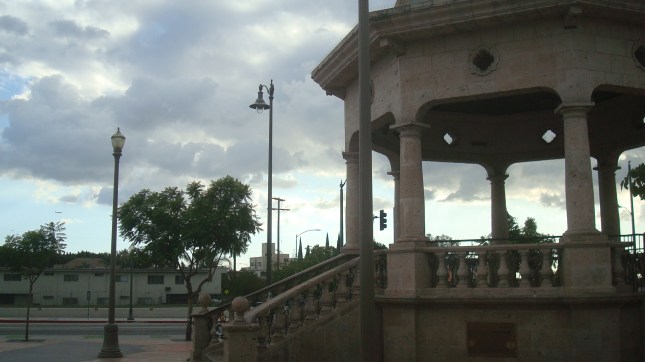
The bandstand.

The bandstand.

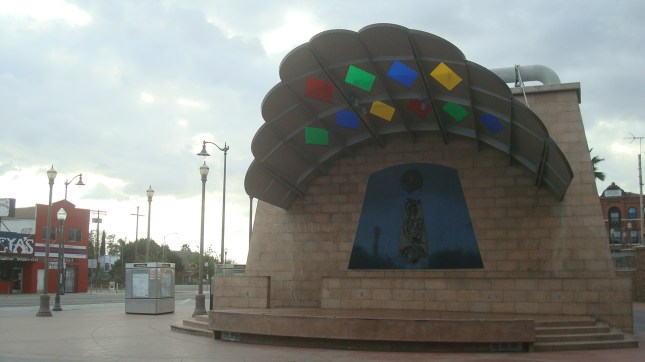
The amphitheatre.

The amphitheatre.

But the future of Mariachi Plaza is being hotly debated now, and it’s hard to say who will win in the struggle to shape its future. At the beginning of 2015 there was a huge uproar when the MTA unveiled its plan to develop the site. In the agency’s view, they were doing the community a big favor by bringing in an eight story project that included medical offices, a gym, restaurants and shops. Unfortunately, the MTA forgot to ask the community how they felt about it. Local residents were furious. The people of Boyle Heights were understandably angry about the fact that City and County officials had not brought them into the planning process. The MTA backed down, saying that they were going to start from scratch, and promising to involve residents this time. Some in the community are concerned, though, that all the agency intends to do is hold a few public meetings to steer people towards a plan they’ve already decided on. If that’s what happens, it wouldn’t be surprising. That’s standard operating procedure in LA.

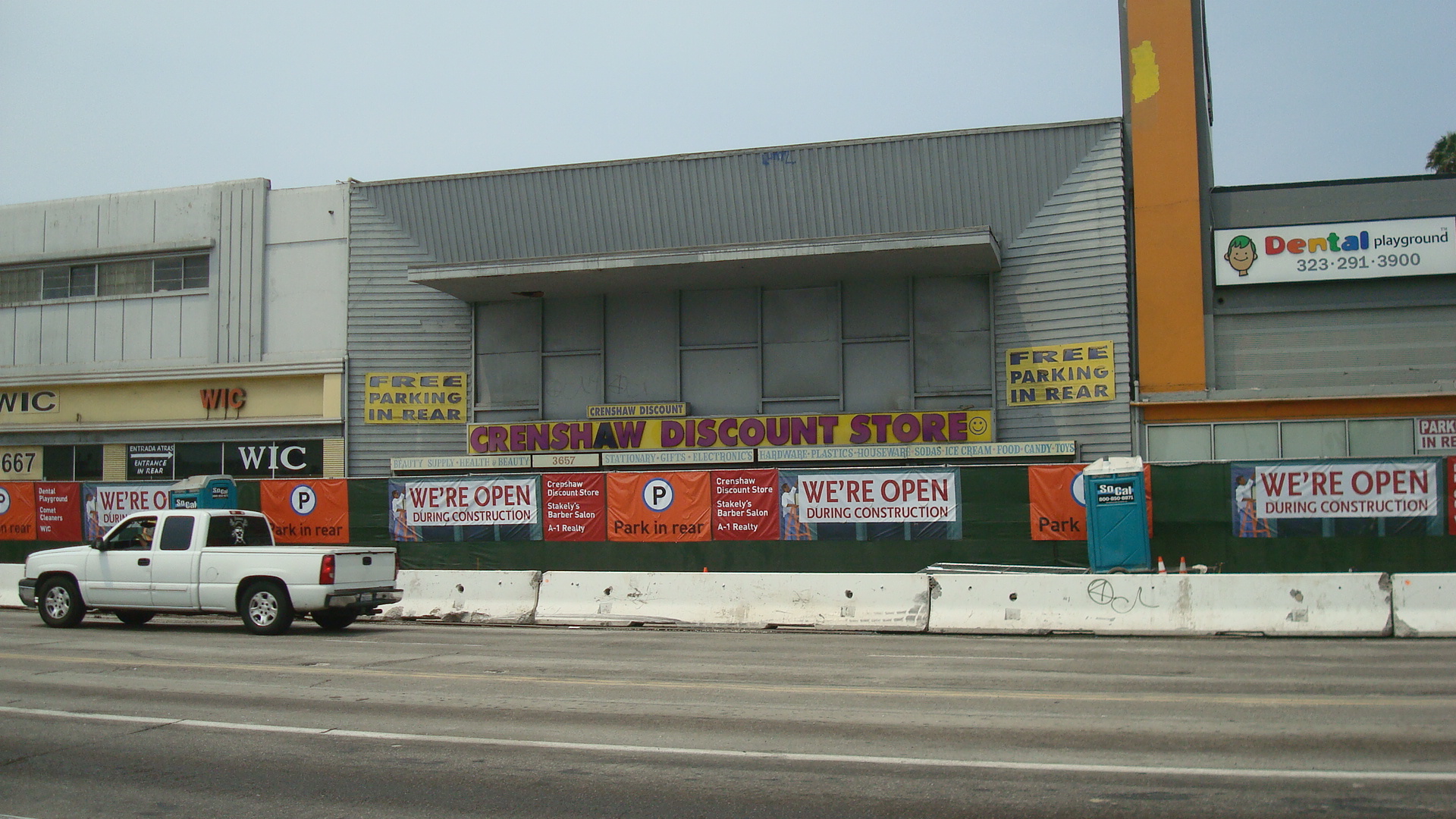
The people of Boyle Heights are used to being ignored. Historically, few people at City Hall have shown much interest in this largely Latino community. It’s only in recent years, with the arrival of the Gold Line and the onset of gentrification that developers have started paying attention to the area. No one would argue that the community needs investment, and some locals feel that Boyle Heights would benefit from “gentefication”, in other words, a push for revitalization that maintained the neighborhood’s Latino character. But the past several years have shown that the City really doesn’t care much about preserving the character of existing communities. Residents of Hollywood, the Crenshaw District, Koreatown, Sherman Oaks and other neighborhoods have been hammered by the unholy alliance between City Hall and real estate speculators.

I went down to Mariachi Plaza a few weeks ago to take some pictures. It was a cloudy day, and not much was happening. This didn’t bother me because I always get a little nervous about shooting photos when people are walking by. I’m not crazy about having my own picture taken, and I don’t want to intrude on other people’s privacy. But then I realized, Hey, you’re at Mariachi Plaza. You’ve gotta get at least one shot of the musicians. And there’s another layer of anxiety here, because I knew some of the guys hanging out on the plaza were probably undocumented. It’s understandable that some immigrants get a little nervous when a stranger with a camera walks up and starts snapping photos. I finally did ask a group six guys if I could take a picture. Three of them walked away, but the other three were cool with it.

Musicians hanging out on the plaza.

Musicians hanging out on the plaza.

On the west side of the plaza you can see the Mariachi Hotel, also called the Boyle Hotel, originally the Cummings Hotel.

The Mariachi Hotel.

The Mariachi Hotel.

It has stood at the corner of Boyle and First since the end of the nineteenth century. Today it’s home to a number of the musicians who populate the plaza. You can see by the sign at the top of the hotel that some residents are concerned about outsiders taking over their community.  It says, “Alto a la Gentrificación.  Un Boyle Heights, Por Boyle Heights, Para Boyle Heights.”  (“Stop Gentrification.  One Boyle Heights, by Boyle Heights, for Boyle Heights.”)

Libros Schmibros

Libros Schmibros

Libros Schmibros is right on the plaza. It’s a lending library dedicated to making books available to everybody. The statement on their web site says that, “Libros Schmibros champions the pleasures of literature and its power to change lives,” which sounds pretty cool to me. Here’s the link if you want to learn more.

Libros Schmibros

Just around the corner I found an artist working on a mural.

Artist working on a mural just off the plaza.

Artist working on a mural just off the plaza.

Another view of the mural.

Another view of the mural.

Sorry, but the alley was really narrow, and I couldn’t get far enough away to take a picture of the whole thing. I guess if you want to see how beautiful it really is, you’ll just have to go down there yourself.

I went back another day and things were much more lively. A band was on stage in the amphitheatre, people were dancing on the plaza, and the place was crowded with booths offering all sorts of stuff.

People having a good time on the plaza.

People having a good time on the plaza.

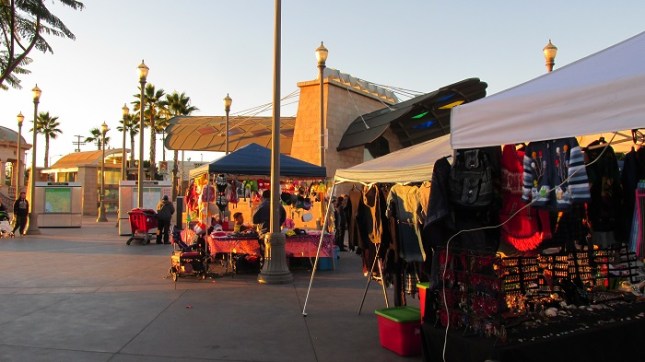
The plaza crowded with booths.

The plaza crowded with booths.

I don’t think many of the residents of Boyle Heights would argue against the need for development. What they want is to have a voice in the planning. So many of the projects proposed in this city are the result of deals made between politicians and developers behind closed doors. That’s got to stop. The only way to plan for a community is to invite the community’s participation. This can be a long, slow, difficult process, but in the end it’s more efficient than the City’s current approach. If the MTA had talked to the people of Boyle Heights first, they could have avoided the huge embarrassment of having their project shut down. If the MTA had spent some time listening to residents, by now they might be well on the way to building something that they community could really support.

If you want to dig deeper into the history of Mariachi Plaza, check out the web site.

Mariachi Plaza

And this essay with photos is worth taking a look at.

The History of the Cummings Block

Banner by artist Dalia Ruiz.

Banner by artist Dalia Ruiz.

We Don’t Have the Water

WP 01 Head

Clearly, the crowd down at City Hall is totally out of touch with reality. They’re completely caught up in the delusion that they’re creating a dazzling new urban landscape, when in fact they’re doing tremendous damage to the City. They say they’re planning for the future, but rational people know that planning for the future means starting with the cold, hard reality of the present.

Here’s the reality. We don’t have enough water to support the current massive surge in development. Not by a long shot.

Recently the Downtown News ran an article listing more than 90 projects planned for Downtown LA. You read that right. Nine zero. But that’s only the beginning, because there are large projects planned for the Crenshaw District, Koreatown, Hollywood, West LA and Warner Center. These projects will bring thousands of new residential units, along with office space, retail and restaurants, and they will boost water consumption in LA by many thousands of acre feet per year. Yeah, I know they’ll have drought-tolerant landscaping and low flush toilets. Let me repeat. These projects will boost water consumption in LA by many thousands of acre feet per year.

Los Angeles, like the rest of the southwest, is facing a severe, long-term water shortage. The TV news tells us that the drought started four years ago, and everybody’s hoping it will end with El Niño. But the conditions that created this shortage have existed for decades. This isn’t just a matter of waiting out a few dry years until things get back to normal. This is the new normal.

Lawns are turning brown all over LA as people try to decide  whether to replace them or just let them die.

Lawns are turning brown all over LA as people try to decide whether to replace them or just let them die.

Let’s start with some basic facts. LA gets its water from four sources, the LA Aqueduct, the California Aqueduct/State Water Project, the Colorado River, and local groundwater. Here’s a breakdown of how each of these resources has been compromised in recent years.

LA Aqueduct
The LA Aqueduct was dammed from April through October of this year. This was done because the DWP has been ordered by the courts to mitigate environmental impacts in the Owens Valley. That means that for roughly six months out of the year, LA received no water from the LA Aqueduct. This is the first time in the one hundred year history of the Aqueduct that it’s been dammed, but there’s a good chance it will happen again as snow packs in the Eastern Sierras continue to decline.

California Aqueduct/State Water Project
The Metropolitan Water District (MWD), which serves LA, received only 20% of its allocation from the State Water Project (SWP) in 2015. The SWP depends on the Sierra Nevada snowpack for most of its water. On April 1, 2015, the statewide snowpack held only 5% of its average water content. Currently there’s no reason to believe that the decline of California’s snowpacks will be reversed in the near future, which means it’s likely that the MWD will receive only a fraction of its allotment for years to come.

Colorado River
This year the Colorado River was the one bright spot in the water picture, and local agencies received 100% of their allocations. But don’t expect that to continue. The amount of water flowing through the Colorado River has been declining for years. Lake Mead and Lake Powell are hitting record lows. It’s almost certain that allocations from the Colorado River will be slashed in the years to come.

Groundwater
For decades contamination from industrial waste has been encroaching on the wells in the San Fernando Valley. Right now about half the wells are closed. The DWP plans to build two new facilities to purify this water, but they haven’t even started construction yet, and it will be years before they’re completed.

Now maybe as you read this you’re saying, Oh, come on. It’s not so bleak. The weatherman says that El Niño is going to bring torrential rains to LA. All we need is a good wet year to fill up the reservoirs and recharge the aquifers and we’ll be okay. The drought will be over. Right?

Wrong.

Believe me, I hope we have a really wet winter this year. And if we get enough rain it could ease the drought for a couple of years. But it won’t solve the problem. All it will do is offer a reprieve.

Because the problem is not that we haven’t been getting enough rain in LA. The problem is that the snowpacks that we rely on for most of our water are shrinking steadily. This is not a new phenomenon. Snowpacks in the Western United States have been declining for decades. Check out this report issued by the American Meteorological Society.

Declining Mountain Snowpack in Western North America
American Meteorological Society, January 2005

It’s a lengthy document, and geared towards academics, so if you don’t want to plow through the whole thing I don’t blame you. Let me just give you this excerpt from the conclusion.

It is therefore likely that the losses in snowpack observed to date will continue and
even accelerate (Hamlet and Lettenmaier 1999a; Payne et al. 2004), with faster losses in milder climates like the Cascades and the slowest losses in the high peaks of the northern Rockies and southern Sierra. Indeed, the agreement in many details between observed changes in SWE [snow water equivalent, or water content of snowpacks] and simulated future changes is striking and leads us to answer the question at the beginning of this paragraph in the affirmative. It is becoming ever clearer that these projected declines in SWE, which are already well underway, will have profound consequences for water use in a region already contending with the clash between rising demands and increasing allocations of water for endangered fish and wildlife.

This report was written in 2005. Ten years later, the authors’ predictions have come true. We’ve seen California snowpacks decline drastically, and the data seems to indicate that they will continue to decline. This isn’t just limited to the West or to the US. This is part of a global trend. Check out the report released earlier this month by the Earth Institute at Columbia University.

Declining Snowpacks May Cut Many Nations’ Water

According to the DWP, between 2006 and 2010 we got about half our water from the Metropolitan Water District (SWP and Colorado River), about a third from the LA Aqueduct, and 11% from local groundwater. The water that flows from the SWP, Colorado River and LA Aqueduct originates as runoff from snowpacks. From all indications, those snowpacks are going to keep receding for the foreseeable future. That means we can no longer rely on the resources that used to supply about 90% of our water. And as for the aquifers that supply us with groundwater, it will be at least five years before the DWP can build the facilities to clean it up.

As the hillsides get drier, the risk of fire increases.

As the hillsides get drier, the risk of fire increases.

There are lots of ideas out there about how to cope with this crisis, recycling, greywater, stormwater capture, desalination. All of them have potential, but it’s going to be a long time before any of them start producing the quantities of water we need for a city of nearly 4,000,000 people. We can’t afford to squander water, but that’s exactly what our elected officials are doing. By allowing rampant, reckless development with no real planning behind it, they’re giving away water that we don’t have.

I am not saying we should put a halt to development. What we need to do immediately is make a realistic assessment of how much water will be consumed by all projects currently under construction, all those that are going through the approval process, and all those that are still in the planning stages. Then we need to set priorities, approving only projects that will truly benefit the people of LA, instead of continually greenlighting high-end high rises and luxury hotels.

Next we need to make a realistic assessment of how much water we can expect to have, and this is a good time to do so. The DWP is currently working on its 2015 Urban Water Management Plan (UWMP), and a draft will be released for public comment early next year. We need to make sure that the UWMP accurately reflects our current situation. The Plan will certainly emphasize conservation, recycling and stormwater capture, and that’s all to the good. But it also needs to reflect the fact that every source of water the City has depended on for a hundred years has been severely compromised.

Finally, we need to make sure that our elected officials acknowledge these limitations and start doing some real planning for the future. These days the people at City Hall are fervently, proudly, recklessly pro-development. That’s nothing new for LA politicians. This City was built by out-of-control, irresponsible development. Except for a few brief periods when voter backlash scared the people at City Hall, developers have almost always gotten their way. But that’s got to end. We can’t afford to keep doing business as usual.

We don’t have the water.

WP 50 River

Talking About Displacement

MTA construction along Crenshaw Blvd.

MTA construction along Crenshaw Blvd.

Speaking at a recent Los Angeles Current Affairs Forum, MTA CEO Phil Washington talked about how the growth of LA’s transit network has been accompanied in some areas by gentrification and displacement. Washington is concerned about the fact that low-income residents are being pushed out of the communities they call home, and he wants the MTA to do more to address the problem.

It’s good to hear somebody at the MTA talking about this. The question is what can actually be done. Earlier this year the MTA Board agreed that when new residential units were built on the agency’s land their goal would be to set aside 35% for low-income renters or owners. That’s fine, but it’s not nearly enough. What we really need is to have the City and the County commit to changing their planning practices. Mayor Eric Garcetti and Supervisor Mark Ridley-Thomas serve on the MTA Board. They should both support Washington and take a public stand against displacement. Then they should push for the City and the County to create policies to address the problem.

While gentrification is happening all over the city, the growth of LA’s transit system definitely seems to be a catalyst. Downtown, Koreatown, Hollywood, and Highland Park have already seen thousands of low-income residents displaced. Leimert Park and Boyle Heights seem to be next on the list as the MTA continues its rapid push to expand, bringing an influx of developer dollars to neighborhoods near rail stops. As property values skyrocket, rents go up, too, and low-income tenants who can’t afford to pay must find somewhere else to live. Tenants in rent-controlled apartments can be forced out by landlords who use the Ellis Act to convert their units to condos.

I’m really glad to hear Washington talking about displacement, and I hope others back him up on this issue. This is a conversation we need to have, and it should have started long ago.

MTA construction in North Hollywood

MTA construction in North Hollywood

Homeless Emergency? Stop Evictions!

DSC00557

The Mayor and the City Council recently declared that LA is in the throes of a homeless emergency. While I’m glad that our elected officials have finally decided to acknowledge how serious the problem is, they still haven’t offered any concrete plan of action. The promise of a hundred million dollars in funding is worthless until we know where that money’s coming from and how it’s going to be spent.

But I’d like to offer a suggestion on how to combat homelessness, and the people at City Hall should be glad to hear that they won’t have to spend a penny to implement it. My proposal is simple. I can give it to you in two sentences.

Stop Ellis Act evictions.

Stop the destruction of affordable housing.

Now, you may be saying, that’s ridiculous. The City doesn’t have the authority to do either one of those things. The Ellis Act, a state law, gives landlords the right to evict tenants if they decide they don’t want to be landlords any more. And the City can’t prevent a property owner from demolishing rental units if the owner does so within the boundaries of the law.

But the City can stop giving landlords incentives to do these things.

As the housing market heats up again, the potential to reap huge profits has drawn a slew of developers to LA. Speculators swoop into neighborhoods offering wads of cash to landlords, but they don’t just want to buy existing buildings. They’re interested in maximizing their profits, which often means kicking tenants out of rent-controlled apartments and either converting the units to condos or knocking the building down and putting up something larger.

And here’s where the City comes in. For developers to accomplish their goals, they often need to get the City to grant variances. They might ask the Department of City Planning to reduce the required setbacks from the sidewalk or neighboring buildings. Or maybe to relax the height limit. In some cases they ask the DCP to change the way an area is zoned, which could allow them to turn an apartment building into a boutique hotel.

All of these entitlements granted by the City increase the value of the property because they increase the potential for profit. The more money there is to made, the greater the attraction for investors. The more money investors offer, the greater the temptation for landlords to evict their tenants and sell the building. During the last housing bubble, this trend peaked in 2005 when over 5,000 rental units were taken off the market. When the recession hit, property values plunged and evictions dropped. But as the market heats up again, we’re seeing this practice becoming popular once more. In 2013, landlords took 308 units off the market. That figure more than doubled in 2014, rising to 725. And as long as housing prices continue to rise, you can bet that evictions will rise as well. For more details, take a look at this article from the KPCC web site.

Ellis Act Evictions in LA on the Rise

While there’s usually some negotiation involved when developers seek variances from the Department of City Planning, they usually get most of what they want. And as long as the DCP continues to hand out entitlements like candy, developers will feel confident that they can make tons of money by converting existing buildings to condos, small-lot subdivisions or boutique hotels. This means more people will be evicted, and more affordable housing will be taken off the market.

DSC00565

I’m not claiming that everybody who gets evicted ends up living on the street, but a significant number do. While I couldn’t fine any data on evictions leading to homelessness in Los Angeles, in New York the data shows that it’s a leading cause. Check out this article from CityLimits.

Evictions Are Top Driver of Homelessness

So if the City of LA is really serious aout tackling homelessness, our elected officials need to stop making it so attractive for landlords to evict their tenants. The Department of City Planning needs to start asking if the needs of wealthy developers outweigh the needs of renters on a limited income. Yes, we are dealing with a homeless emergency. The people at City Hall must start looking at the policies that have contributed to this situation, and think about the changes that need to be made.

Building shelters for people living on the streets is fine. But an even better approach would be to prevent people from losing their homes to begin with. As long as City Hall continues to put the needs of developers over the needs of its citizens, the homeless situation will only get worse.

DSC00562

Showdown on Sunset

Tgt Curve

If you haven’t already heard, the Department of City Planning is holding a hearing this coming Friday on a proposal to restart the half-completed Target on Sunset. The project was stopped by a judge because it violated the Station Neighborhood Area Plan (SNAP). The City wants to create a sub-area within the SNAP which would allow Target to finish the building as is.

For those of you who haven’t been following this long, nasty struggle, the project that Target originally proposed for the corner of Sunset and Western was in compliance with the SNAP, and it seemed like pretty much everybody was on board with the idea. Then, at the behest of city officials, Target significantly increased the height of the project, making it more than double what the plan allowed. The revised design would have also required a number of other variances. At that point, community members who had supported the original project came out against the new, larger version. They filed a law suit, and Target, inexplicably, forged ahead with construction. When the judge sided with the plaintiffs, construction screeched to a halt. And this hulking, half-finished curiosity has been sitting at the corner of Sunset and Western ever since.

Tgt Crnr Side

Why is this happening? Local residents worked with the City for years to formulate the Station Neighborhood Area Plan. The whole idea was to create a framework for development that would stimulate growth without trashing the community. Why did members of the community invest years of time and effort into writing the SNAP if a city official can sweep it aside with a wave of their hand? (Many point the finger at then-Councilmember Eric Garcetti, who’s been pushing for taller buildings all over LA.)

Target gambled when they started construction on a project that was facing a legal challenge. They lost. Why should we bail them out? They should go back to the drawing board and create a project that complies with the law. And if they don’t want to do that, they should forget the whole thing and just sell the site.

But instead of making Target deal with the consequences of their actions, the City of LA is running to the rescue by creating a new sub-area within the SNAP. This is so depressing. But certainly not surprising. When you look at the amount of money that developers have given to the Mayor and City Council, it’s easy to see who’s really running things.

My feeling is that this is probably a done deal. The Department of City Planning is putting on a show this Friday to make it look like the public has had a chance to be heard. After the hearing is over, my bet is that they’ll approve the sub-area, and Target will go ahead and finish their building.

But don’t let my pessimistic, defeatist attitude infect you. In spite of my misgivings, I still sent an e-mail to the hearing officer to let the DCP know I was completely opposed to this stunt. I urge you to write as well, or better yet, show up at the meeting and let them know how you feel. We may not win, but we can go down fighting.

Here’s the info for the meeting.

Friday, October 2, 2015, 10:00 am
City Hall, 10th Floor, Room 1020
200 N. Spring St.

You can send an e-mail to the hearing officer at the address below. Be sure to include the case number in your subject line.

Blake Lamb
Blake.Lamb@lacity.org
Case No. CPC-2015-74-GPA-SP-CUB-SPP-SPR

And here’s the link to the meeting notice.

Target Sunset Hearing Notice

Tgt Sunset

More About Housing and Transit

Post Final

As a follow-up to my last post, I wanted to share this article from LA StreetsBlog. It’s a summary of a panel discussion, Rescuing the California Dream: Policies for an Affordable Future, sponsored by KPCC and the Milken Institute. The participants talked about the challenges posed by LA’s affordable housing crisis, and offered some possible solutions.

Nobody was saying there’s an easy way out, but there are things we can be doing to address the situation. Two things I got from the article were that we need to do a better job of planning, and we need to create local funding sources to support affordable housing. But the panel offered lots of ideas, and the consensus seems to be that we can change things for the better.

Can High-Density Housing Solve Our Regional Housing Crisis? The Answer: It’s Complicated