Be the Light

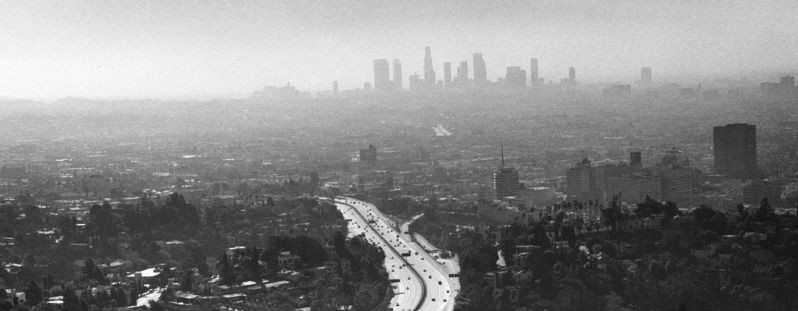
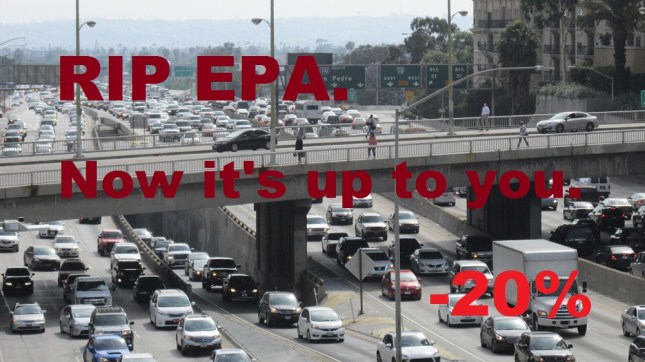
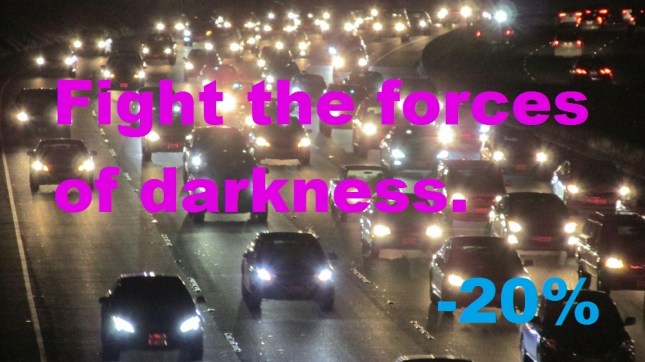
20 Traffic FINAL H Fwy Dark w Lav Blu Txt

It’s clear that the White House doesn’t care about science. In spite of the fact that the overwhelming majority of scientists agree that climate change is real and that it’s caused by human activity, the current administration has dropped out of the Paris Agreement and is aggressively trying to roll back regulations designed to reduce CO2 emissions.

But just because our government is going in exactly the wrong direction doesn’t mean we have to go along. Millions of Americans understand that we have to reverse the effects of climate change. If Washington isn’t going to act, then we have to act ourselves.

Can you reduce your carbon footprint by 20%? We mostly think of CO2 emissions related to transportation and industry, but there are plenty of other things that contribute to our carbon footprint, from plastic bottles to the appliances we have in our home.

Check out this list from the National Geographic. It offers 14 ways you can reduce your carbon footprint. Take a look and see how you can help. Don’t wait for Washington to change course. Make a commitment to take action yourself.

Fourteen Ways to Reduce Your Carbon Footprint

Fight the darkness. Be the light.


Skyscrapers Keep Rising in Downtown, and So Does Crime

DSC06826

There were a couple of articles in the Downtown News that caught my eye this week. The first was a piece about a 67-story residential tower that’s been proposed for a parcel near Figueroa and Seventh. Developers are falling all over themselves in the rush to build high-end high-rises in the area, and City Hall has been bending over backwards to help them along. The article also mentions a few other skyscrapers that are currently in the pipeline, as the the Downtown development juggeraut keeps rolling along. While it’s conceivable that a few affordable apartments will be tacked on to some of these projects in the course of the bargaining process, the vast majority of these new units will be far beyond the reach of the average Angeleno. Here’s the article if you want to take a look.

Brookfield to Build 64-Story Condo Tower

The other article was about the sharp increase in crime Downtown. For those of you who haven’t been following this issue, crime has increased in many of LA’s neighborhoods in recent years, and Downtown is one of the areas hardest hit. Violent crime in the LAPD’s Central Division is up 8.3% through June 3 compared with the same period in 2015. This includes a 15.7% increase in aggravated assault. Property crimes are up 14%, with a 64% rise in burglaries and thefts from vehicles.

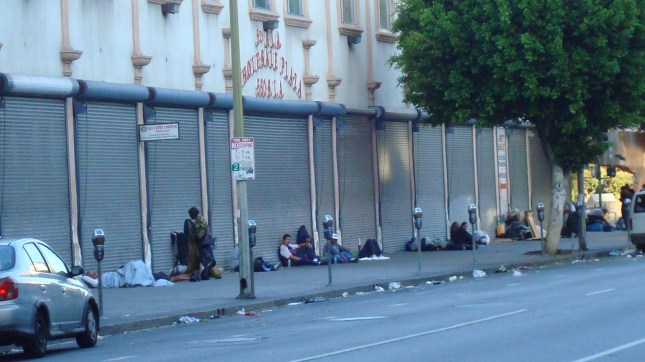
The article acknowledges that rising crime is at least in part due to the fact that the area is seeing an influx of well-to-do residents at the same time that the homeless population continues to rise. In Downtown these days the gap between cozy affluence and desperate poverty is glaringly, disturbingly obvious. As City Hall continues to approve one gleaming skyscraper after another, and takes every opportunity to advertise the booming Downtown scene, its efforts to deal with the growing homeless population are still outrageously inadequate.

It’s not just the current crowd at City Hall that’s to blame for LA’s ongoing homeless crisis. For decades our elected officials have preferred to ignore the problem rather than take steps to address it. Fifty years ago the City’s approach was to try to herd the unsheltered population into Skid Row and keep them contained there. In recent years our elected officials tried more aggressive tactics, confiscating the belongings of people living on the streets and criminalizing homelessness. City Hall only backed off on this approach after losing a series of legal challenges to these practices. And in the meantime, homelessness continued to rise.

Last year it seems the Mayor and City Council finally realized how serious the situation was and how bad it was making them look. There’s been a lot of fanfare about the passage of both Measure H and Measure HHH, which will build permanent supportive housing (PSH) and provide services to treat those with mental health and addiction problems. Certainly this is an important first step, but it’s only a first step. It’ll take years to put the housing and services in place, and it’s hard to say how many units will actually be created. Meanwhile, the 2017 homeless count shows that the population increased from last year’s record high of 28,464 to a new record high of 34,189. A staggering 20% jump.

It’s great that H and HHH passed, but this is far too little, far too late. And still City Hall continues to approve endless luxury high-rises, luring more upscale residents to Downtown. They say they’re concerned about rising crime in the area, but adding more police and encouraging the formation of neighborhood watch groups isn’t going to solve the problem.

City Hall needs to start doing some planning. It needs to step back from the mad rush to build luxury skyscrapers, and start thinking seriously about how to reduce homelessness in Downtown. By now it should be obvious that the “Build, Baby, Build” approach isn’t working. Filling the urban core with high-rises for the rich while people wallow in abject poverty on the streets below has created an unsafe environment for residents and stretched the LAPD’s resources dangerously thin. The Mayor and the City Council need to accept the fact that this strategy is seriously flawed, and scale back further construction until they’ve found a way to create a safer, more equitable environment for EVERYONE who lives Downtown.

You can access the article on rising crime by clicking on the link below. I should point out that the link will take you to an on-line tabloid version of the Downtown News, and you’ll have to flip forward to page 10.

Is Downtown LA Getting More Dangerous?
010

Let’s Stop the Madness

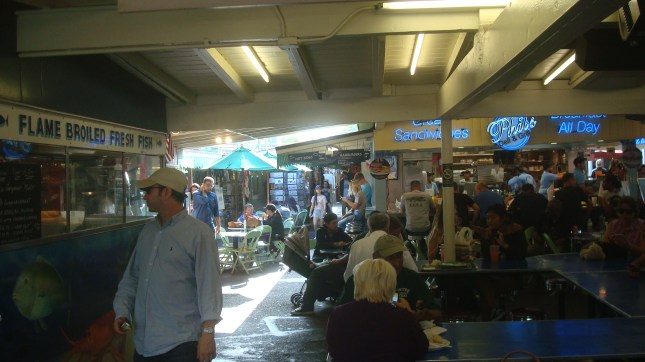
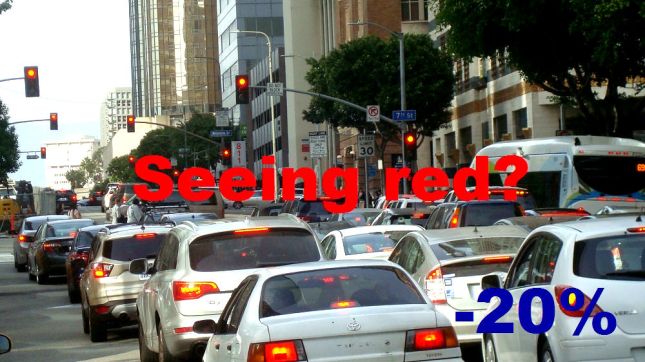
20 Trfc FINAL Hlnd Crowd 2 w Pink Yellow Text

According to an October 2016 poll conducted by the Pew Research Center, 48% of US adults believe climate change is caused by human activity.  And yet millions of those same people get into their car every morning and head off for a commute that often involves a fair amount of time spent sitting in traffic.  We know that climate change threatens the planet, we know we need to reduce emissions, and yet we’re still locked into the same behavior that got us into this mess in the first place.

In the same poll people were asked what would make a big difference in addressing climate change.  Out of six possible responses, the first four were….

> restrictions on power plant emissions

> international agreements

> higher fuel efficiency for cars

> corporate tax incentives

The interesting thing here is that all of these steps would require the government to take action.  And let’s face it, the current administration isn’t gonna do a damn thing about climate change.  So let’s look at the last two responses….

> more people driving hybrids

> people reducing carbon footprints

The people who chose these steps were the people who were ready to take action themselves.  Switching to a hybrid is great, and getting an electric vehicle is even better, but a lot of people can’t afford to buy new car.  So what can they do?

How about cutting your driving by 20%?  Think about how you might reduce the amount of driving you do, either by taking transit, riding a bike, or walking.  Maybe you could find ways to car pool with your friends.

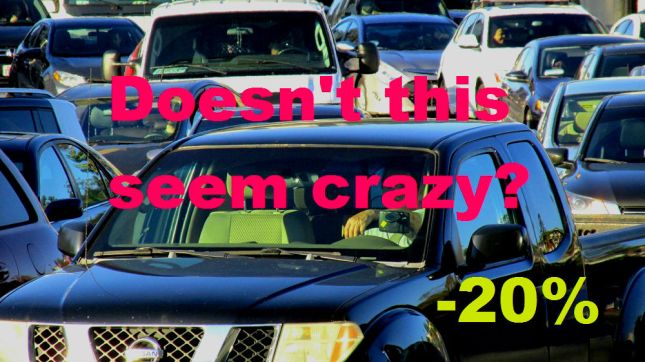
How many times have you been stuck sitting in traffic, staring at an endless line of brake lights, and thought to yourself, “This is crazy!”  And you’re right.  We say we want to fight climate change, but we’re stuck in the same bad habits that created this crisis.

So let’s change our habits.  Let’s stop the madness.


The Climate Is Changing. Can You?

20 Trfc FINAL SD Valley Sized w Yel Text

If you’re waiting for the White House to change its stance on climate change, you’ll be waiting a long time.  And whatever the oil companies say publicly, they’ll do whatever it takes to keep the crude and the profits flowing.

So it’s down to you.

Can you cut your driving by 20%?  If every American citizen who believes climate change is a threat were to spend 20% less time on the road, it would cause a huge reduction in greenhouse gas emissions.  It would also send a message to Big Oil that we want a faster transition to renewable energy.  When their profits start falling, they’ll start listening.

So could you take public transit to work one day a week?  Or car pool with someone you know?  Instead of driving to the park this weekend could you ride your bike?  Instead of taking that epic road trip this summer, could you scale it back a little and go some place closer to home?

You can wait for the government or Big Oil take action, or you can take matters into your own hands.

Stopping climate change starts with you.

Help Koreatown Hang On to Liberty Park

LP 01 Across Med

Los Angeles is notoriously behind the curve when it comes to providing public parks for its citizens. In rating 100 US cities on their park systems, The Trust for Public Land put LA at number 74. And while the city as a whole is lacking in public space for recreation, there are some neighborhoods where the need is especially acute.

Like Koreatown. This dense urban community has plenty of asphalt and concrete, but not much green space. So it’s disturbing news when a proposed project threatens to take away one of the few parks available to residents.

Liberty Park was completed in 1967 as part of Beneficial Plaza on Wilshire Blvd.. Designed by Peter Walker, its graceful curves and striking contrasts make it a unique experience. Walker was just starting his career in the 60s, but has since been become an internationally recognized landscape architect.

LP 10 Walk Pers

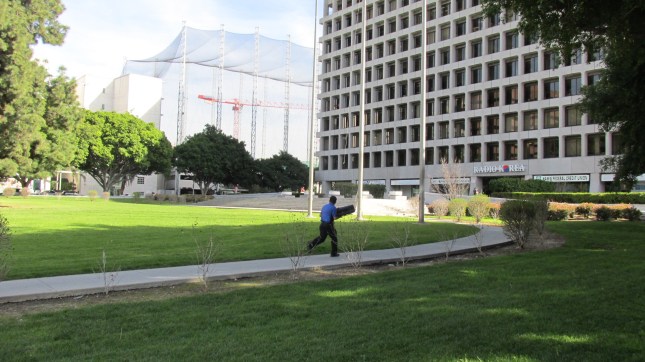
A view of the park facing away from Wilshire.

LP 12 Sm Tree

The park provides much needed green space in Koreatown.


LP 14 Reader

Liberty Park provides a quiet space in the middle of a busy urban area.

LP 20 Steps Const

The park sits at the foot of the former Beneficial Plaza.

But even more important than the park’s design is the place it holds in the community. In an area where parks are scarce, this is one of the few places where people can escape to relax on the grass or read in the shade of a tree. It’s also been a gathering place for the community, whether to celebrate Earth Day or to rally behind the South Korean team during World Cup Soccer.

LP 50 Lawn Shadow

A tall grove of trees provides much-needed shade.

LP 52 Trees Steps Pers

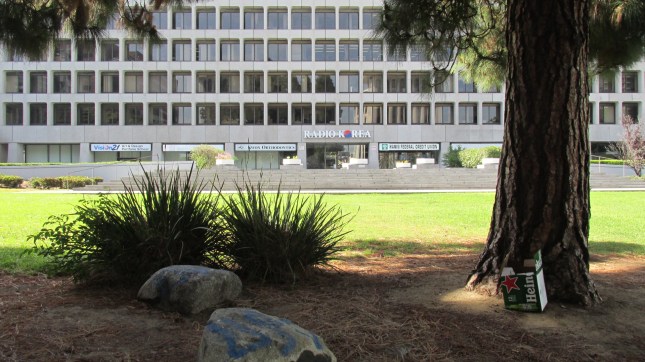
Looking through the trees toward the building that now houses Radio Korea.

LP 56 Trees Beer

The park’s design offers some interesting contrasts.

LP 58 Trees Bldg

Looking up from beneath the trees.

The proposed project is a mixed-use complex rising 30+ stories, and if approved in its current version it would reduce Liberty Park to nothing more than a few scraps of green space. It’s frustrating that the City of LA only required the developers to prepare a Mitigated Negative Declaration (MND) for this new complex, allowing them to get away with a relatively low level of environmental review. It’s even more frustrating that the MND concludes that this project will have no impact on historic resources. This is ridiculous. Beneficial Plaza as a whole holds in important place in the area’s history, and there’s nothing else like Liberty Park in all of LA.

LP 60 Bush Row Orange

A view of the park facing Serrano.

LP 62 Side Run

A view of the park from the Oxford side.

But it’s not too late to preserve this beautiful and unique public resource. A group called Save Liberty Park has been working hard to raise awareness, and hopefully they can get City Hall to change course on this. They need your help. Here’s the link if you want to get involved.

Save Liberty Park

UPDATE: Liberty Park Saved!

LP 90 Red Car

Pipelines Making You See Red?

20 Trfc FINAL Fig Red

In spite of years of protests, the Keystone and Dakota Access Pipelines are both moving forward.  It’s obvious big oil isn’t listening, and neither is the White House.

So what can we do?

Use less oil.  It’s that simple.  Oil companies build infrastructure based on how much money they think they can make off it.  When oil prices started diving a couple of years ago, the industry cancelled or postponed construction of over 20 major projects.  There’s no point spending money on infrastructure if it’s not going to pay off.

What if everybody cut their driving by 20%?  The oil market is already shaky, with soft prices making investors nervous.  If we use less, supply will increase, and that will drive prices lower.  And it will also make oil companies think twice about plowing billions into building new pipelines.

So how about it?  Can you cut the amount of time you spend behind the wheel by 20%?  Not only would you be helping move the country toward clean energy, but you wouldn’t spend so much time stuck in traffic.  It’s win win.

Start Your Own Paris Agreement

20 Trfc FINAL Wstd w Red Yel Text

Millions of Americans are angry about the White House’s decision to withdraw from the Paris Climate Agreement, and certainly their anger is justified. But just because our government won’t take action on climate change doesn’t mean we can’t.

Cut your driving by 20%. If every American who supports the Paris Agreement were to drive 20% less, it would significantly reduce greenhouse gas emissions. There are a number of steps you can take….

Take transit to work, or try car pooling, one day a week.

Ask your boss if you can work from home one day a week.

Walk to the market instead of driving. Or share the trip with a friend who’s also shopping.

Think about taking local outings instead of longer trips.

Use your imagination. Everybody’s lifestyle is different, but ask yourself if you can change your driving habits to spend 20% less time on the road.

If Americans cut their driving by 20%, it would not only send a powerful message to the White House, but also to the oil companies. As long as we keep using fossil fuels, they’ll keep selling them. A 20% drop in their profits would let them know we want a faster transition to renewable energy.

Start your own Paris Agreement. Commit to cutting your driving by 20%.

Lost LA through a Camera Lens

00 Exiles Dntn

A view of Downtown circa 1960 from The Exiles.

Los Angeles has changed a lot over the past hundred years. Rapid population growth, rampant real estate speculation and a slew of technological advances have caused the city to expand and mutate with amazing speed. And one of the most interesting things about LA is that it has recorded those changes since almost the beginning of the 20th century. As the center of the global film industry, and a major hub for all media, it’s always in one spotlight or another. You might say Los Angeles is obsessed with seeing itself in the mirror.

When the film industry first moved west back in the teens, there were a number of production companies shooting silent two-reelers on LA’s streets. Nobody was thinking about documenting the city as it was beginning to grow. Location shooting was just a cheap way to make movies. Hollywood silents made before 1920 are filled with scenes of the city’s early days, but because there hadn’t been much development and few of the familiar landmarks existed, it’s often hard to identify the streets and neighborhoods that appear in the background.

In the 20s Hollywood became studio bound, and for about two decades location shooting was the exception rather than the norm. But in the 40s studio crews started to venture back out into the streets. Many of the crime films shot after WWII used LA as a backdrop for the action. In the 60s, independent filmmakers started shooting all kinds of movies on the city’s streets. By the 80s filmmakers had begun to use the city self-consciously, making deliberate references not just to the city’s past but to its movie past.

Looking at the films shot over the years on LA’s streets we can see a broad panorama of the city’s history, but one that’s still maddeningly incomplete. While some locations appear over and again, there are whole communities that never appear at all. And so much of it is totally random. In a few cases filmmakers deliberately set out to take a good, hard look at the landscape and the people. Others focussed on famous landmarks that have a specific meaning for movie audiences, or used their settings to evoke nostalgia. And others just didn’t have the money to shoot anywhere else and let their location scout call the shots.

I watch a lot of movies, and as I’ve gotten older, I’m more aware than ever of how they reflect the changes that have happened over the course of LA’s history. I’m especially fascinated by images of things that no longer exist. Change is inevitable. The city’s landscape is never the same from one day to the next. Even when the streets and structures stay the same, the people, the customs, the culture keep changing, and that transforms the landscape, too.

In this post I’m pulling together images of places and spaces that have disappeared. I’ve been thinking about doing something like this for a while. It took me months to get around to it. I spent a lot of time trying to figure out which movies to focus on, but I can’t even explain why I ended up choosing these six. The only thing they have in common is that they show pieces of LA that no longer exist. And trying to approach them in some kind of order was impossible. Or maybe better to say there were too many possibilities. Should I have organized them by the year the films were made? Or maybe used the locations to tell some kind of story? Or should I have tried to find a theme that ties them all together?

In the end I just decided to dive in and let my intuition guide me. This post may not even make sense, but hopefully you’ll get something out of the images. Let’s start in Downtown….

In the late 50s, Kent Mackenzie began working on a film set in Bunker Hill that focussed on the Native American community living in the area. The Exiles took over three years to make, and the production had more than its share of problems, but the end result was a unique blend of documentary and fiction that gave voice to people whose voices had never been heard before. Bunker Hill began in the 19th century as one of the city’s first upscale developments. By the middle of the 20th century the rich were long gone, and the aging homes that remained now housed a diverse low-income community. The Native Americans who lived there had left the reservations behind, looking for a different kind of life. In LA they were relegated to the margins of society, but living in Bunker Hill they at least had some kind of community. That lasted until City Hall declared the area “blighted”, and began pushing residents out as civic leaders and business interests pursued a massive redevelopment project.

01 Exiles AF Morn

Angel’s Flight climbing Bunker Hill next to the Third Street Tunnel.

02 Exiles AF 1

A closer shot of Angel’s Flight with apartments in the background.

The Exiles captures the lives of three Native Americans as they live through a single night in Downtown LA. Shot entirely on location, it shows these people in their homes, on the streets, in bars and juke joints, and finally gathering on a hill that looks out over the nighttime landscape. It’s a vivid picture of a vanished world.

03 Exile3 Homes 1

One of the vanished streets of Bunker Hill.

Displacement is a recurring theme that runs through the whole history of Los Angeles. The city’s original Chinatown was situated on the edge of Downtown, straddling Alameda between Aliso and Macy (now Cesar Chavez Avenue). But in the 20s voters approved funds for a new rail terminal, and much of the Chinese community had to relocate to make way for Union Station.

In the late 40s Anthony Mann made a startling series of thrillers, often giving them a sense of immediacy by shooting on real locations. Much of T-Men is shot in LA, and it features glimpses of what was left of Chinatown in 1947. Check out this first still, which shows a determined US Treasury agent walking across Alameda with Union Station in the background.

10 TM Ferg 1

Dennis O’Keefe crossing Alameda Street in T-Men.

Then the camera pans to follow him, and on the west side of Alameda we see Ferguson Alley, a remnant of the original Chinese community.

11 TM Ferg 2

Ferguson Alley, one of the last remnants of LA’s original Chinatown.

Our hero visits a number of herbalists looking for someone who recalls selling a specific blend to a certain man. It’s a brief montage, but it gives us a look at what was left of early Chinatown after WWII. Eventually, these buildings were also levelled. After some false starts, a new, more modern, and more touristy, Chinatown was built to the north and west of the original site.

12 TM Ferg 3

O’Keefe mounts the stairs to an herbalist’s shop.

Crime Wave, directed by André de Toth, was also shot largely on location and gives a sweeping view of Los Angeles in the 50s. While it features a number of Downtown locales, the climactic bank heist takes place across the LA River in Glendale. The suburbs were thriving in the first decade after the war, and the film gives us a view of what Brand Boulevard looked like back in the day. In this scene we’re riding with Gene Nelson and Ted de Corsia as they drive up to the Bank of America at the corner of Brand and Broadway.

20 CW Bank Ext 1

The Bank of America at Brand and Broadway in Glendale.

The suburbs were a product of car culture, and cars are central to the story. The main character is an ex-con who’s forced to become the gang’s getaway driver. The scenes before and after the robbery offer numerous shots from the perspective of the man behind the wheel. And an abandoned car serves as an important key in the cops’ search to track down the criminals.

21 CW Dentist

The corner of Brand and Broadway.

22 CW Bank Int

Ted de Corsia inside the Bank of America.

Crime Wave is tough as nails and brimming with tension, but even if you’re not into classic crime flicks, it’s worth watching for the way it maps out the city in the 50s. The final car chase more or less follows the actual path you’d take from Glendale back to Downtown, speeding down Brand toward the Hyperion Bridge.

23 CW Biz 1

Another shot of Brand near Broadway.

By the late 60s suburbia had spread across the San Fernando Valley. Car culture played a major role in the rapid proliferation of housing tracts tied together by the ever expanding freeway system. Thousands of families moved to the suburbs in pursuit of a placid and prosperous lifestyle.

Which was an illusion. You can escape the city, but you can’t escape reality. The US was going through a violent upheaval, rocked by a string of political assassinations and a growing protest movement. Director Peter Bogdanovich looked past the supermarkets and the swimming pools and saw a side of the suburbs that most people were determined to ignore. Bogdanovich had been doing odd jobs for low-budget director/producer Roger Corman. Through Corman he got a chance to direct his first feature, Targets. The film follows a young man living with his parents and his wife in a tidy little house in the Valley, who one day picks up a gun and starts shooting people.

Targets is an innovative and unnerving look at the suburbs, America’s obsession with guns, and our twisted relationship with the movies. After following the young killer as he randomly picks off a number of unsuspecting victims, Bogdanovich stages a chilling climax that offers a complex reflection of the American landscape at the time. Cars lined up in rows at a drive-in movie, moms, dads, children and teens watching a horror flick unfold, when suddenly a sniper starts shooting at the audience from behind the screen.

30 Targ Sign

The marquee at the Reseda Drive-In.

The film was shot at the Reseda Drive-In, which was located at the corner of Reseda and Vanowen. It survived into the 70s, when it was torn down and replaced by a business park. Aside from the fact that it’s an arresting and original debut feature (one of Bogdanovich’s best), Targets also offers a fascinating glimpse of the vanished world of drive-in theatres. Passionately devoted to movies since childhood, the director records every aspect of the experience, from the people visiting the snack bar to the projectionist putting the reels in motion.

31 Targ Drive In Wide

The drive-in before the show starts.

32 Targ Playground

The playground near the screen.

33 Targ Snack Bar

The snack bar.

34 Targ Booth

The projectionist setting the film in motion.

Hollywood has always been shameless about the strategies it uses to lure audiences to the movies. Two of the most common tactics are jumping on whatever fad is currently sweeping the nation, and exploiting people’s nostalgia for a past that never existed. Xanadu tries to do both at the same time. The story follows the efforts of two men, inspired by a muse, who come together to create a new nightclub that will bring back the glory of the big band era while catering to the roller disco crowd. Yeah, it’s a pretty strange movie, and one that will probably only appeal to those with a taste for bizarre kitsch. But I found out that parts of it were shot at the Pan-Pacific Auditorium, and decided I had to check it out.

40 Xan PP 01 Wide

The front of the Pan-Pacific Auditorium.

41 Xan PP 02 Med

A closer shot of the Pan-Pacific.

For years the Pan-Pacific was a major venue, hosting car shows, sporting events and the Ice Capades. Designed by the firm of Wurdeman and Becket, the striking streamline moderne facade was one of LA’s architectural landmarks for decades. But it closed in the 70s, and though it was later listed on the National Register of Historic Places, no one was able to find a way to make it viable again. It was destroyed by fire in 1989.

42 Xan PP 03 Const

Another view of the Pan-Pacific.

It’s possible that if the Pan-Pacific had survived a while longer, it might have been revived. The local preservation movement was just taking shape in the 80s. But for years Los Angeles was seen as a city without a history, in large part because the people who lived here didn’t have a sense of its history. Buildings were put up and knocked down based on whatever the market dictated, and few people worried about what was lost in the process. Visitors from other places talked about how the city felt impermanent, and complained about a sense of rootlessness.

Having lived here all my life, I don’t see it that way, and I’ve had a hard time understanding what people from other places are talking about. But I think I got a taste of it the last time I watched Wim Wender’s The State of Things. It tells the story of a director shooting a sci-fi film in Europe whose funding dries up, and he flies to LA to get some answers. Friedrich picks up a rental car at LAX and sets out to track his producer down, speeding along the the endless freeways, cruising the wide boulevards of Hollywood and Century City. He seems lost, totally disconnected from the city around him. Watching the film again recently I think I began to understand the sense of disclocation so many complain about. Friedrich is just one more in a long line of European filmmakers who have found themselves wandering LA’s vast landscapes, squinting into the sun as they try to make sense of it all.

50 SoT Fwy 1

Friedrich, played by Patrick Bauchau, cruising down the freeway in a rental car.

Many of LA’s buildings were never meant to be permanent. They were constructed by people who saw a market for a product and moved quickly to jump on whatever trend was popular at that moment. The roadside restaurants and coffee shops that started springing up after WWII weren’t meant to last forever. They were meant to catch a driver’s attention and pull them in before they sped past. The commercial architects who worked on these projects in the 50s quickly realized that the more extravagant and unusual a building was, the more likely it was to draw people in. The building became its own advertisement.

51 SoT TN 1

Tiny Naylor’s at the corner of Sunset and La Brea.

52 SoT TN 3 Car PB

Bauchau orders a cup of coffee from a car hop.

As I said, nobody thought these structures would last through the ages. But as the years wore on, architects and critics began to value these brash, flashy buildings. And the people who had frequented these places had gotten attached to them. In the 60s if a developer had levelled one of these coffee shops, nobody would have batted an eye. By the 90s, preservationists were arguing that they held a special place in the area’s culture and should be protected.

52 SoT TN 4 Roof Car

Another shot of Tiny Naylor’s.

That was too late for Tiny Naylor’s, located at Sunset and La Brea. The building, a Googie masterpiece by architect Douglas Honnold, was designed so that people could park outside and be served in their cars, a common feature of coffee shops from the era. The State of Things, released in 1982, captures Tiny Naylor’s in all its glory. A few years later it was torn down and replaced with a shopping mall.

The argument over what should be saved and what should be torn down will go on for as long as LA exists, and that’s part of the dynamic of any urban area. Cities are formed by the tension between the past and the future. LA will go on changing. And the movies will go on watching it change.

53 SoT Office

Bauchau in an office building at Sunset and Vine, gazing at the LA landscape as it stretches out to the horizon.


A Breath of Fresh Exhaust

Breath 01

The balconies at the Da Vinci offer a view of the Hollywood Freeway.

A while ago I wrote a post about a project going up in my neighborhood. The site was less than 200 feet from the Hollywood Freeway, and the developer was capping it with rooftop decks. In light of the extensive research showing elevated health risks for people living near freeways, this seemed absolutely insane. But after a few phone calls and e-mails I confirmed that both the Department of City Planning (DCP) and the Department of Building & Safety (DBS) had signed off on it. And while I don’t have much respect for the the folks at City Hall these days, this seemed like a new low. I felt like they’d really crossed a line.

I was so wrong. The City crossed that line a long time ago. Turns out they’ve been routinely approving new residential projects near freeways that include rooftop decks and/or balconies. In spite of years of research that has shown strong links between exposure to freeway traffic and increased health risks, especially for children, the DCP and the DBS have okayed a number of projects near freeways that offer these amenities.

For over 20 years, USC has been gathering data on health impacts related to living near freeways. By the early years of the last decade, they were warning that residents in these areas faced significantly higher risk of asmtha, heart attacks and lung cancer, and that children were at risk of suffering permanent lung damage. In 2005 the California Air Resources Board published a handbook that specifically warned against residential construction within 500 feet of freeways. The City of LA, however, argues that the need for new housing outweighs the health risks.

But even if you buy that argument, how can you justify approving amenities that put people in direct contact with some of the most toxic air in the nation? Balconies and rooftop decks are not necessary. And in fact, when they’re placed on residential structures less than 500 feet from a freeway, this clearly fits the definition of a hazardous building as outlined by the LA Municipal Code:

Whenever a building or structure, used or intended to be used for dwelling purposes, because of dilapidation, decay, damage or faulty construction or arrangement, or otherwise, is insanitary or unfit for human habitation or is in a condition that is likely to cause sickness or disease, when so determined by the health officer, or is likely to work injury to the health, safety or general welfare of those living within.  [Emphasis mine.]

So allowing these features creates buildings that the City’s own Municipal Code defines as hazardous. Does that stop the City from approving them? Of course not.

The City does require that new buildings provide a certain amount of open space, and certainly developers will tell you that rooftop decks and balconies are one way of fulfilling that requirement in dense urban areas. But let’s look at a couple of the objectives listed for open space in the City’s General Plan….

2) to provide safer play areas for children

4) to increase natural light and ventilation

Can anybody argue that a balcony placed a couple hundred feet from a dense concentration of nitrogen oxide, CO2 and particulate emissions fulfills these objectives?

Sure, there are a number of apartment buildings near freeways with balconies and/or rooftop decks that were constructed long before the health risks became clear. But City Hall has known about the dangers since at least 2005. Let’s take a look at some of the residential projects they’ve approved over the last ten years or so….

Here’s Patio del Cielo at 4410 Sepulveda in Sherman Oaks. You could translate “cielo” as either “sky” or “heaven”, but obviously the implication is you’ll be living somewhere far removed from the hustle and bustle of the city. Not too far removed from the San Diego Freeway, though, which is just about 200 feet away.

Breath 10

Traffic lining up for the freeway in front of Patio del Cielo.

Breath 12

Rush hour traffic on the San Diego Freeway.

The balconies/decks that adorn these homes along 2775 Cahuenga are between 100 and 300 feet from the traffic on the Hollywood Freeway. And since this housing complex is right on Cahuenga Blvd., from June through September residents can enjoy the spectacle of thousands of cars inching their way past during Hollywood Bowl season.

Breath 20

Balconies at the front of 2775 Cahuenga.

Breath 22

Traffic on the Hollywood Freeway near 2775 Cahuenga.

The Carlton, at 5845 Carlton Way, has both balconies and rooftop decks. I bet you get a stunning view of the Hollywood Freeway from the roof. It’s just about 200 feet away.

Breath 30

The Carlton is the white building on the left.

Breath 32

A view of the rooftop from the rear of The Carlton.

Breath 34

A view of rush hour traffic near The Carlton.

But first prize for really bad planning goes to the Da Vinci, at 909 W. Temple. Developer Geoff Palmer has made a fortune building massive residential complexes near freeways, but this may be his masterpiece. The Da Vinci sits right where the Hollywood and the Harbor Freeways meet. And just like every other Palmer apartment block I’ve seen Downtown, the developer has made sure that residents can get their fill of diesel fumes and particulate emissions simply by stepping out onto their private balcony.

Breath 40

Would you say those balconies are 100 feet away from the freeway?

Breath 45

Traffic on the freeway north of the Da Vinci.

You could argue that a number of Palmer’s buildings went up before the adverse impacts of living near freeways were fully known. But City Hall approved the Da Vinci years after our elected officials had learned about the dangers. Again, they’ll tell you that we can’t afford not to build near freeways. But giving people balconies so they can get a face full of auto exhaust? How do you justify that?

I’ve suggested before that people write to the Mayor if they feel this needs to stop. Obviously, it hasn’t had much impact. But I’d like to suggest something a little different this time. How about writing to the Mayor and copying your congressional rep? Maybe if City Hall heard from someone at the federal level they’d think twice before approving hazardous amenities on apartments next to freeways.

Try using the following subject line….

Why Does the City of LA Keep Putting Residents’ Health at Risk?

Here’s Garcetti’s e-mail address.

mayor.garcetti@lacity.org

And if you don’t know who represents you in Congress, use the link below to find out.

http://www.house.gov/representatives/find/

Columbia Square

CS 01 Front 1

There are a number of different Hollywoods. It can be a noun or an adjective, a brand or a concept, a nostalgic fantasy or a nasty slur. But there’s also a physical place called Hollywood, and it’s been through a lot of changes over the years. About a century ago it became the center of the film industry, and what started out as a sleepy suburb grew rapidly. Its fortunes rose and fell as the studios left, radio and TV moved in, radio and TV moved on, and the internet conquered the world. For decades people have been asking how to bring media back to the Hollywood area to revitalize the local economy.

Columbia Square has played a key role in putting Hollywood, the place, back on the media map. Opening to great fanfare last year, the project brings together residential, office and commercial space to create a media campus. The owners were spectacularly successful in landing major industry tenants long before the project was completed. Columbia Square was widely hailed as a major step forward in Hollywood’s revitalization.

CS 07 EC Side

The El Centro side of Columbia Square

CS 08 Sidewalk

The front of the campus along Sunset

I have to say I’m pretty impressed myself. I was skeptical about how this modern media campus would come out, and I was pleasantly surprised. This was a complex project, and roused a certain amount of controversy when it was first proposed. But the developer did an admirable job, not just engaging the community, but actually responding to residents’ concerns. And here’s it’s probably a good idea to give some background….

Columbia Square, located on Sunset between El Centro and Gower, was first built in the late 30s by the Columbia Broadcasting System (CBS). Creating a major, state-of-the-art radio/recording studio in the area was seen as a boost, not just for Hollywood the place, but also Hollywood the brand. New York had dominated the national radio market since the beginning, but this was a sign that LA was trying to change that. The look of the building was an integral part of getting that message across. CBS chose modernist William Lescaze to design the project, and the building was one more landmark in LA’s long engagement with progressive architecture.

CS 10 Paley

The courtyard at the front of the complex

CS 12 Ctyrd Tree 1

Another shot of the courtyard

CS 16 Ctyrd NH People

One of the restored structures, now occupied by Neue House

CS 18 Ctyrd Out

A view of the courtyard looking toward Sunset

As TV took over in the 40s and 50s, a number of popular shows originated from Columbia Square, but it was radio that kept hanging on through the years. Broadcasts continued to emanate from the studios until 2007, when the last tenant left. Then the building went dark, and for a while no one was sure what would happen to it. The property changed hands a few times, and different ideas were thrown around. In 2009 the City released an EIR for a project that included a 40-story tower. If you’ve been following development in Hollywood for any length of time, you can probably imagine how that went over.

But then a new developer took charge, and things changed dramatically. When Kilroy Realty Group acquired the property in 2012, they took the time to listen to the community and made some changes, crucially lowering the height of the tower to 22 stories. This is pretty amazing when you consider that the City had actually approved 28. They also decided to rethink the layout of the campus, allowing for more open space to engage the public. And they agreed to work with local preservationists to restore the historic Lescaze structures.

CS 22 Stairs

Stairway leading to the rear of the campus

CS 24 Ctyrd Chairs 2

A space to hang out in

The end result is a jewel. I’ve actually gone to Columbia Square a few times since it opened, just to walk around and take pictures. (And because the weather was different each time, the light in the photos keeps changing. Sorry if it’s a little jarring.) I think it’s important to mention the people involved in making this happen. The firm of House & Robertson designed the campus and the new buildings. In restoring the original structures they worked with Historic Resources Group. And the landscapes were created by Rios Clementi Hale Studios. The Los Angeles Conservancy was so impressed with the finished product that they gave the developer their 2017 Preservation Award. It’s worth reading the Conservancy’s description of the project to get an idea of how much time, money, and work went into the restoration process.

Columbia Square from the Los Angeles Conservancy

I’m so knocked out by the new complex, and by the way Kilroy approached the project, that I hate to voice any reservations. While I was writing this post I kept asking myself whether I wanted to make any critical comments, because in some respects the revitalized ColumbiaSquare is a model of what redevelopment should be. But there are a couple of things I think it’s important to note….

First, while the residential tower is beautiful, the prices are way beyond what the average person living in Hollywood could afford. And the addition of a couple hundred high-end apartments is just another step in the ongoing gentrification of the area. Even as I write this, more low-income tenants are being pushed out of their homes.

Second, while the City has tried to portray this, and other projects like it, as transit-oriented development, it’s highly unlikely that the people who live at Columbia Square will be taking transit on a regular basis. The City has been pushing this line for years, and the results have been disastrous. Transit ridership in LA is lower now than it was back in the 80s, and continues to decline. City Hall’s continued insistence that building high-profile, high-end megaprojects is going to get people on busses and trains just shows how clueless our elected officials are.

CS 40 Gower Side 1

The Gower side of the campus

CS 44 Gower Side Benches

Landscaping and benches along Gower

But let’s end on a positive note. I want to congratulate Kilroy, and all the others involved, in coming up with a project that has so much to recommend it. This is an unusual instance where a major developer respected the local context, and more important, the local community. The new Columbia Square is a beautiful piece of design, and it’s brought some major media players to the area, along with hundreds of jobs. Over all, it’s an important step forward for Hollywood the brand, the concept, the industry, and the place.

CS 50 Vert