Taking a Closer Look

Hlwd CS 03 Frnt Hills 2

It’s so strange how you can pass by something a million times, and not really even notice it. Until it’s in danger of disappearing. The Fifth Church of Christ, Scientist, at the corner of Hollywood and La Brea, was built just after I was born. I’ve been driving by it or walking by it all my life. I remember thinking that it was kind of an unusual building, but I never stopped to take to take a closer look. It was always just part of the landscape.

So recently I did take a closer look, and I started to realize what a beautiful building it was. The site is no longer home to a Christian Science congregation. For the last few years it has housed Mosaic, a non-denominational Christian church. The current congregation recently renovated the building, and I’ll talk more about that later.

Actually, the first version of the church was built back in 1915, according to the Pacific Coast Architecture Database. Back then Christian Science was a growing denomination, and the original design stuck to a pretty traditional classical revival style. But in the 1950s the congregation must have decided they needed a different look, and they hired an architect named Howard G. Elwell.

Very little is known about Elwell. One source I found said that he was active in the LA area as early as 1916. I’ve searched the net, but there’s not much documentation of his work. I found a few photos of a movie theatre in Victorville. I found some images of a doctor’s office he may have designed, but the site is unknown. Apparently he also worked on some houses in Pasadena and San Marino.

But the guy definitely had talent. A walk around the church at Hollywood and La Brea shows that it was created by someone fluent in the modern style. Here are a couple photos of the building as it originally appeared.

Fifth Church of Christ, Scientist seen from Hollywood Blvd. circa 1977

Fifth Church of Christ, Scientist seen from Hollywood Blvd. circa 1977

Fifth Church of Christ, Scientist, also from Hollywood Blvd. circa 1977

Fifth Church of Christ, Scientist, also from Hollywood Blvd. circa 1977

It’s too bad they’re in black and white, because the color scheme was one of the unique aspects of the design. If I remember correctly, the curved section at the corner was clad in lavender tile, and the arched windows were painted a similar pastel shade. The effect was subtle and unobtrusive, which is maybe part of the reason it didn’t attract my attention.

Here’s how the church looks today.

Mosaic, Hollywood seen from Hollywood Blvd.

Mosaic, Hollywood seen from Hollywood Blvd.

The Mosaic congregation did a nice job of renovating the building. They didn’t touch the structure, but they completely rethought the textures and colors. Removing the tile cladding to reveal the brickwork gives the corner of the church a rustic look, and painting the arched windows grey creates a nice contrast. The building definitely has more of a presence than it did before.

a view of the church from La Brea Ave.

a view of the church from La Brea Ave.

another view of the church from La Brea Ave.

another view of the church from La Brea Ave.

But the structure still retains Elwell’s design, which is a unique and interesting adaptation of the modern style. The building has the dignity appropriate to a church, but without the rhetorical flourishes that make some other sacred structures look pompous. It occupies the site beautifully, with the curved wall at the corner giving way to symmetrical rows of arched windows on either side. And while some churches are basically a façade stuck on a box, Elwell thought about the whole structure, making sure that the rear of the building adheres to the same pattern of curved surfaces and strong verticals.

a view of the church from the parking lot

a view of the church from the parking lot

another view from the parking lot, this time facing La Brea Ave.

another view from the parking lot, this time facing La Brea Ave.

Now here’s the bad news. This building will probably be gone in a year or so. Developers want to build a project called Horizon Hollywood, which will consist of 400 residential units with retail and restaurants on the ground floor. Some people think the renderings look pretty nice. Honestly, to me the project looks like another set of generic mixed-use towers. But here’s a link to a write-up at Building Los Angeles. You can judge for yourself.

Hollywood and La Brea’s High-Rise Complex

Personally I’d rather have the church. But I don’t think there’s much chance of saving it. The building has not been designated as a historic landmark. And I don’t see any way it could be incorporated into the high-rise project.

But they won’t start construction on the Horizon Hollywood for a while, so if you’re interested in architecture you might want to take a trip over there. It’s a striking example of mid-century modern, and one of the few known buildings by Howard G. Elwell.

The larger concern is that it seems like historic buildings are once again being threatened by the current development boom. We’ve already lost the Morgan, Walls and Clements building on La Brea near Melrose. This one is probably a goner. And there’s talk of demolishing the Pacific Theatre on Hollywood Boulevard. For a while it seemed like LA was getting better at preserving the past. But these days I get the feeling that money is more important than history.

[For an an update on the status of the Mosaic Church, click here.]

Hlwd CS Frnt Angle 1

The two black and white photos above come from the Security Pacific National Bank Collection of the Los Angeles Public Library’s photo archive. No photographer is credited.

We Need to Talk about Water

DSC02222

Recently I posted on Mayor Garcetti’s call for Angelenos to reduce water consumption by twenty percent. As a follow up, I’d like to draw your attention to an article posted by Jack Humphreville on CityWatch. The thrust of the article is that the Mayor’s creation of a Water Cabinet is an attempt to create policy without input from citizens.

Humphreville makes some excellent points. Certainly, given Garcetti’s record, we should be concerned about whether the City will shape its water policy in an open and transparent manner. There’s no question that the DWP will be raising rates significantly in coming years. To some degree this is necessary. Our water infrastructure needs to be upgraded, and we also need to invest in groundwater clean-up. But citizens must be involved in this discussion. A link to Humphreville’s article is below. It’s well worth reading.

Can We Afford the Mayor’s Mandate?

And here’s the link to the Mayor’s Executive Directive 5, which lays out all the measures he wants Angelenos to take to address the water shortage. Many of these steps are reasonable and necessary. It’s the creation of the Water Cabinet that’s worrisome. In LA, too many decisions are already made by insiders, behind closed doors. The Mayor often talks about how we all need to be involved in shaping the city’s future. I wish I could believe he really meant it.

Executive Directive 5

Transit Trauma

DSC07351

I don’t own a car. I take public transit everywhere. Generally it works out pretty well, but I wanted to share a few experiences I had recently….

Last week I spent an afternoon Downtown. I had an important meeting that night, and I figured I’d get on the subway at five, which would leave me an hour to make it back to Hollywood. Should’ve been plenty of time. The Red Line arrived just after five and I got on board. But apparently the brakes on that train had locked up, and after ten minutes the conductor still hadn’t been able to resolve the problem.

I had to make it back to Hollywood by six. Now I had forty five minutes, and it seemed unlikely that a bus travelling at rush hour would get me home in time. So I ended up taking a cab, which cost me twenty five bucks, plus tip.

Monday morning I was heading out to the Panorama City, a trip that takes three busses. Unfortunately, at one of my connecting points, I saw the bus I needed speeding past when I was still a block from the stop. It was five minutes early. I had to wait for the next one, which made me fifteen minutes late.

And then there was Wednesday morning. I got to the Red Line station at Hollywood and Highland. I was waiting on the platform when a voice came over the PA saying that there was no service to the North Hollywood station. Due to a power outage, the trains were only running to Universal City. Immediately I tried to think of other options, but there’s only one bus that goes to North Hollywood and it doesn’t run often. I glanced at the monitor above me to check the time. But the monitor wasn’t working.

I ended up getting on the train to Universal City. Once we arrived, it turned out the escalator to street level was out of order. Actually, it’s pretty common for escalators and elevators serving the subways to be out of commission. This morning it meant that the mass of people climbing the stairs had to contend with the people going down the stairs at the same time.

At Universal I had to get on the 224, which was packed to capacity, to get to North Hollywood. I felt like I was riding in a cattle car. At North Hollywood I got on the Orange Line, which was also packed to capacity, to make the trip out to Van Nuys. Amazingly, I was only fifteen minutes late.

Now I’m not bringing all this up because I want to slag public transit. I like public transit. I definitely prefer it to driving. It’s way cheaper and way less stressful. And most of the time it gets me where I want to go more or less reliably. But I have some serious questions about the direction the MTA is taking things.

In September the MTA raised fares. A day pass went from $5 to $7, and a monthly pass went from $75 to $100, a 40% increase and a 33% increase respectively. I realize that this is the first fare hike in four years, and that the MTA is running a substantial deficit. I also realize that tickets only cover about 28% of operating costs, and that anything less than 33% can jeopardize federal funding. But these are still huge hikes. And the while the MTA has postponed further fare increases for the moment, you can be sure they’re coming. On top of that, the Daily News reports that the MTA is considering further service cuts, even though they’ve already cut hundreds of thousands of service hours in the last few years. Here’s the article.

Fare Hikes Won’t Fix Agency’s Deficit

So here’s what worries me. The MTA seems determined to continue raising fares and cutting service as it struggles to resolve its financial difficulties. I have to ask if this is really going to encourage Angelenos to ride busses and trains. I hear a lot of talk about how people have to abandon cars and embrace public transit, but this course of action seems guaranteed to drive people away. That’s already happened with Metrolink. For the last few years Metrolink ridership has been declining, and customers have cited rising costs and declining service as the reason they’ve gone back to using their cars.

The Mayor and the MTA Board have put Los Angeles on the fast track when it comes to building new transit projects, which sounds good in theory. But these hugely expensive projects are years away from completion, and the MTA seems unable to even maintain current levels of service.

There’s something really wrong here. If the MTA wants us to believe that they’re going to be able to manage a vastly expanded transit system, they need to do a better job of managing the system we’ve got now. Otherwise, instead of attracting new riders, they’re going to lose the ones they’ve got.

When the Well Runs Dry

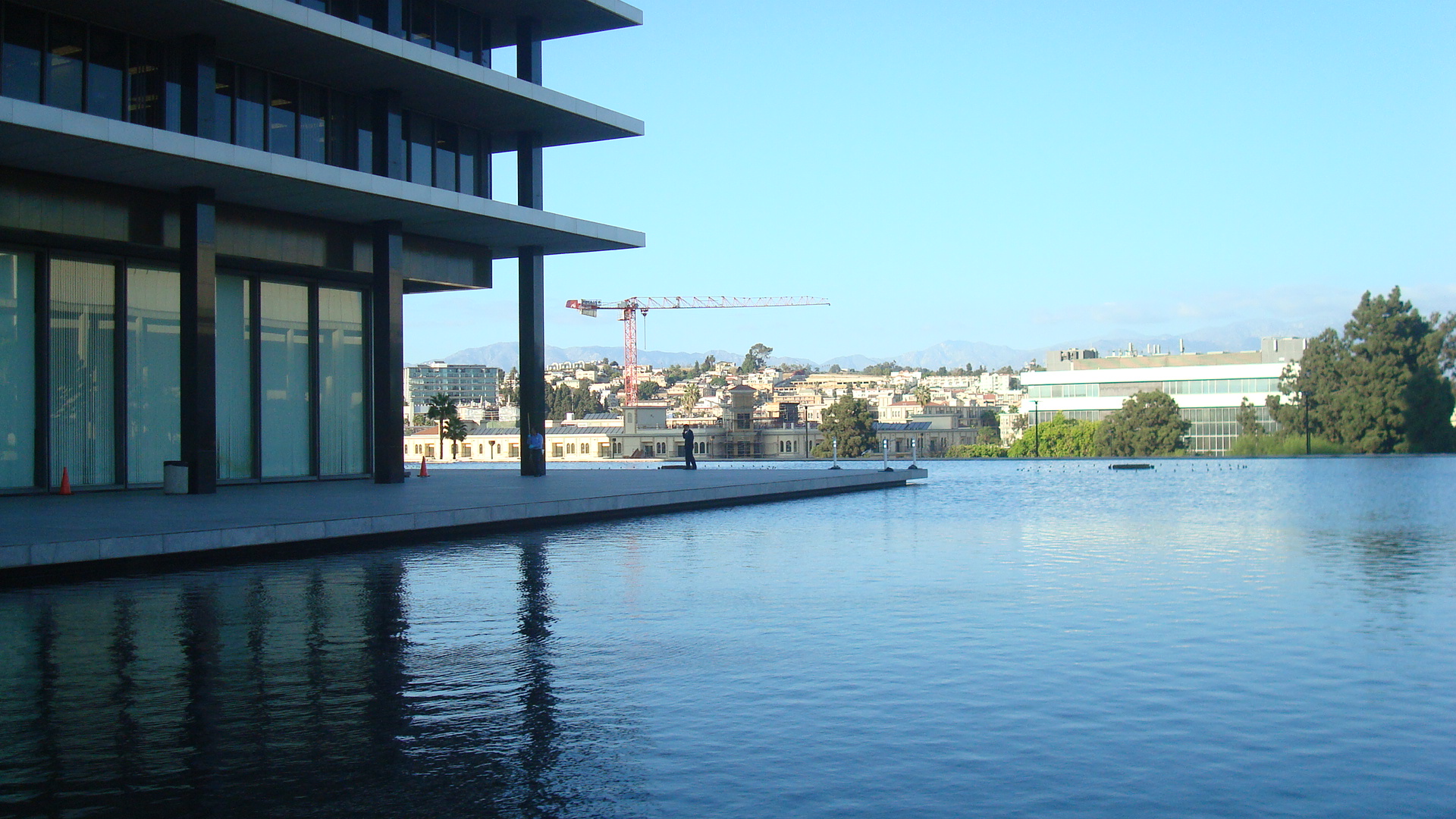
John Ferraro Building (LA Department of Water and Power)

John Ferraro Building (LA Department of Water and Power)

Last week Mayor Garcetti asked Los Angeles residents to cut their water usage by twenty percent. Even though he was basically echoing the governor’s message to all Californians, this was an important step. Angelenos have slowly been climbing on board the conservation bandwagon, but we need to do more.

Over eighty percent of the water we use in Los Angeles comes from outside the city’s boundaries. The only way LA has been able to grow as large as it has is by siphoning water from the Owens Valley and the Colorado River. But due to the current drought, these sources are drying up. In addition, many of the wells in the San Fernando Valley are contaminated, and cleaning them up will be a long, costly endeavor. Here’s a sobering article from the American Society of Civil Engineers web site.

LA to Treat Contaminated Groundwater for City Use

Not only do we need to conserve water in the present, we need to plan for water usage in the future. The City should take a hard look at current requirements for new projects, and ask if there are ways to build structures that are more efficient. In general, we need to look at how future development will impact our water resources. The City needs to consider the cumulative impact of proposed projects on our dwindling supply.

Restaurants in particular should come under special scrutiny, since they consume a great deal of water in their day to day operations. There are a number of ways they can reduce their consumption. Replacing water cooled refrigeration units with air cooled units is a good start. They should also be required to use low volume spray nozzles for washing food. Composting waste instead of using a garbage disposal will also reduce water consumption. I know running a restaurant is difficult, and all these things cost money. Possibly the City could require new restaurants to take these steps, but allow existing restaurants to make the changes over time. And in the long term, adopting these practices will actually save restaurant owners money.

The Department of Water and Power building is a classic modern structure from the sixties, designed by Albert C. Martin & Associates. One of the key elements of the design is the reflecting pool that borders the site. It’s not just beautiful, it’s functional, having been integrated into the system that cools the offices. But it also plays an important symbolic role. Surrounding the Department of Water and Power with an expansive reflecting pool makes a statement about how an area with limited water resources was transformed into a major city, known for its lush green lawns and sparkling swimming pools.

Unfortunately, that isn’t the Los Angeles we’re living in today.

DSC07338

Koreatown

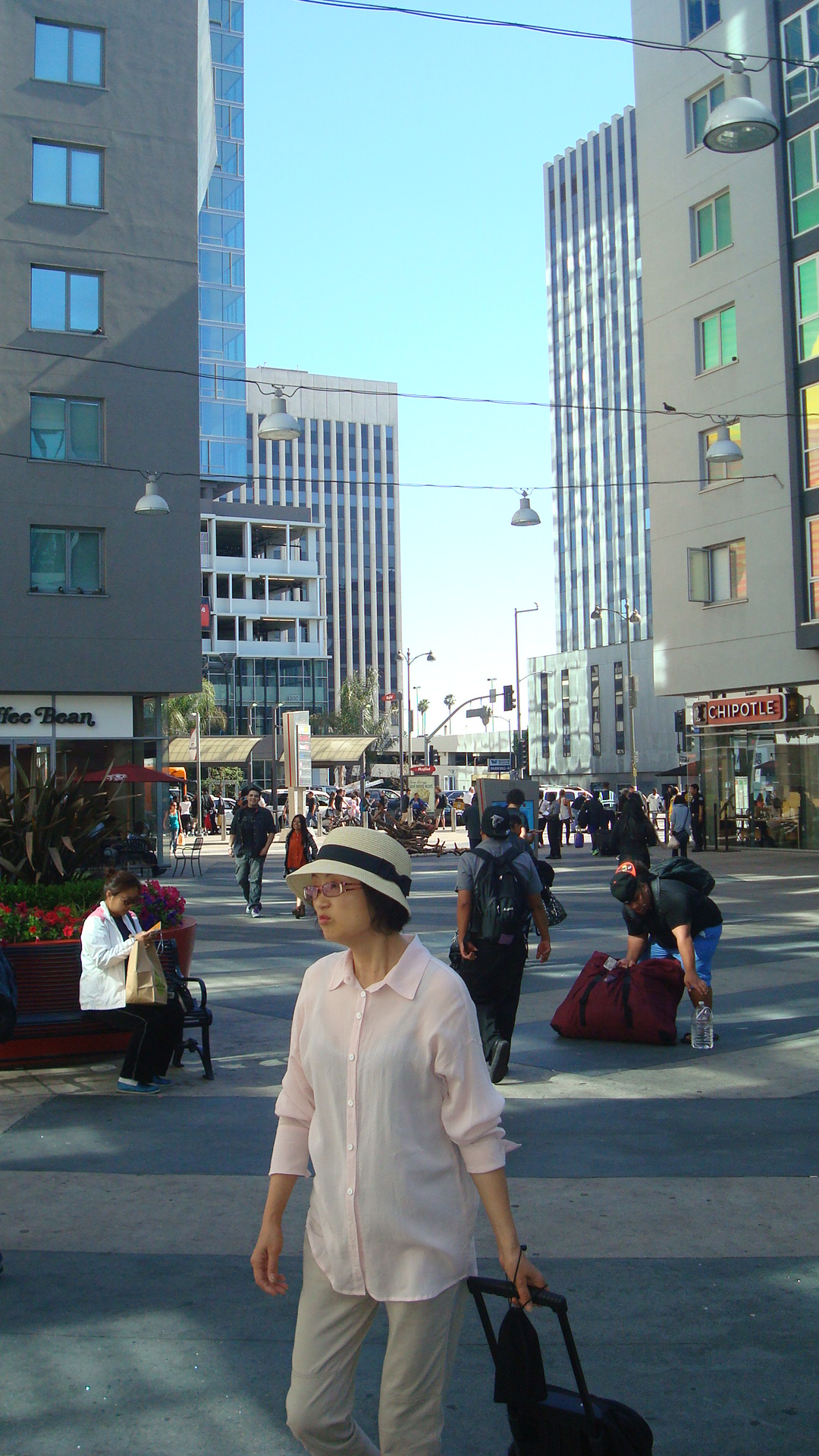
This is the plaza above the Wilshire/Vermont Red Line station.

Ktwn 01 Plaza Woman

And here’s a wider view of the plaza.

Ktwn 10 Plaza Guy

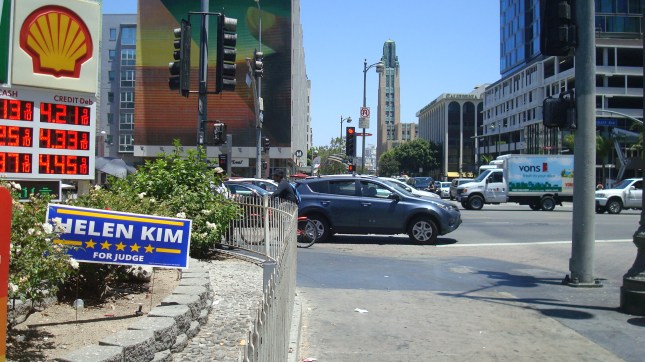
The intersection at Vermont and Wilshire is a busy place. People live here, work here, eat here, shop here.
Ktwn 12 Bldg Bullocks

This is Koreatown. It’s the most densley populated neighborhood in LA County. While the exact boundaries are hard to nail down, roughly speaking the area is bordered by Beverly, Vermont, Olympic and Crenshaw.

It’s important to remember that even though it’s called Koreatown, the majority of the people who live there are Latino. About half the population is of Latin American descent, compared to about a third who are of Korean descent. The area came to be associated with Koreans because the vast majority of businesses are Korean-owned.

Ktwn 13 Vendor

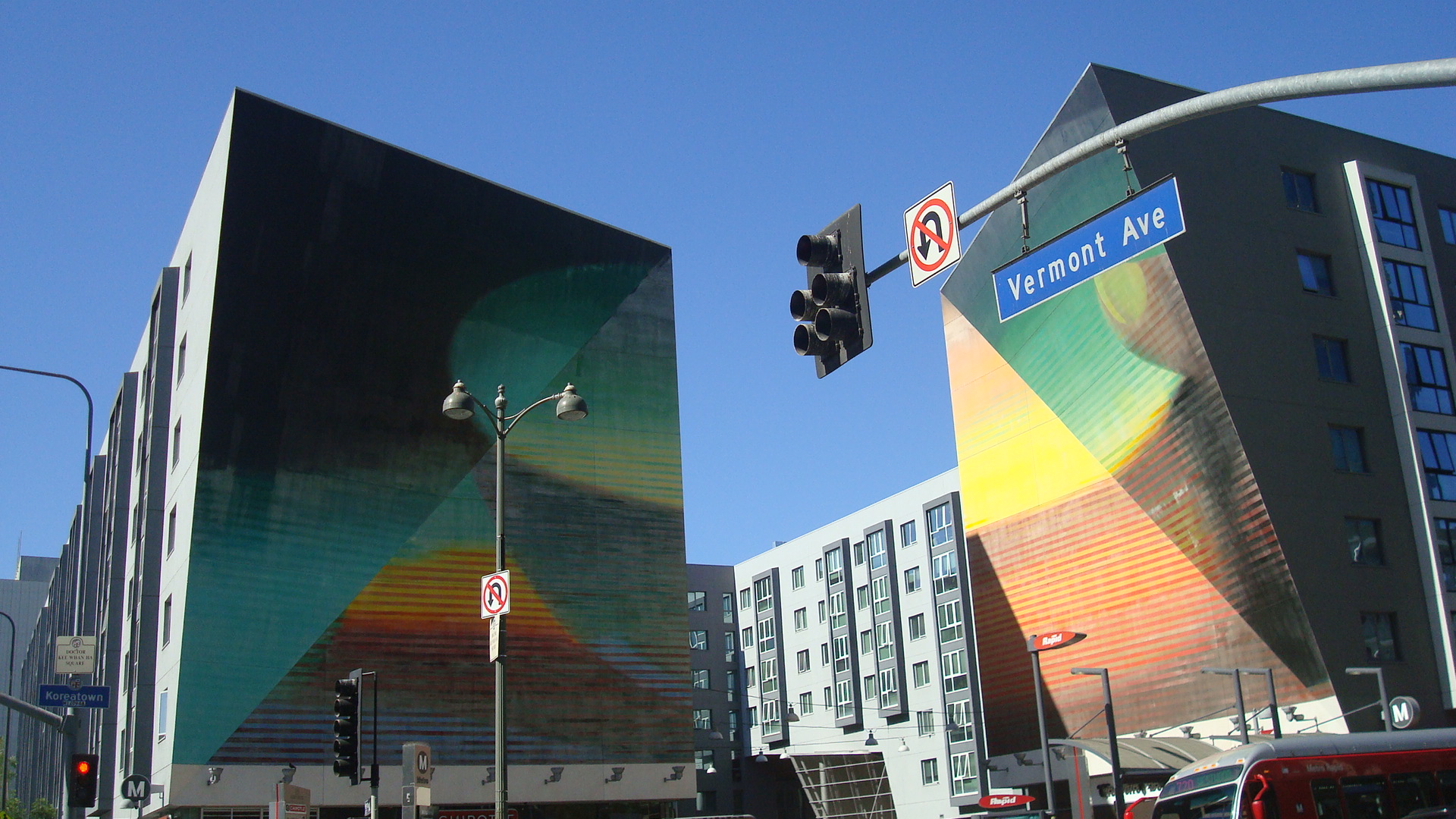
On the sides of the residential complex that rises above the Wilshire/Vermont plaza, you can see April Greiman’s mural “Hand Holding a Bowl of Rice”.

Ktwn 15 Bowl

You can visit the artist’s web site by clicking on the link below.

April Greiman.

Ktwn 16 Bldg New 3Directly across the street is The Vermont, a recently completed residential development comprised of two high-rise towers. This is the kind of high-end project that developers are pushing for all over LA, since they can be extremely profitable. But, not all Koreatown residents are happy about this trend. One concern is that projects like this will push rents up, making it harder for long-time residents to afford housing. Just to give you an idea, a one-bedroom apartment at The Vermont starts at $2,300 a month. In the near future, this trend will almost certainly continue, since The Vermont was recently sold for $283 million. With that kind of money being thrown around, you can be sure that developers will be knocking each other down in their rush to stake a claim in Koreatown.
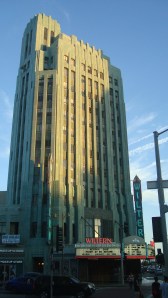
Ktwn 17 Wiltern 2There are some beautiful older buildings in Koreatown, such as the Wiltern Theatre, designed by Stiles O. Clements of Morgan, Walls and Clements. This firm was a major player in LA back in the thirties and forties, designing local landmarks like Chapman Plaza, La Fonda Restaurant, and the El Capitan Theatre. The auditorium was designed by G. Albert Lansburgh, who also created interiors for the Palace and the Orpheum in downtown. I saw Tom Waits there years ago, and I can tell you that the inside is just as impressive as the outside. The Wiltern is actually part of a larger structure called the Pelissier Building, which was completed in 1931. It’s an amazing example of art deco architecture, with its blue-green tile cladding worked into elaborate zig-zag moderne designs. They don’t make ’em like this any more.

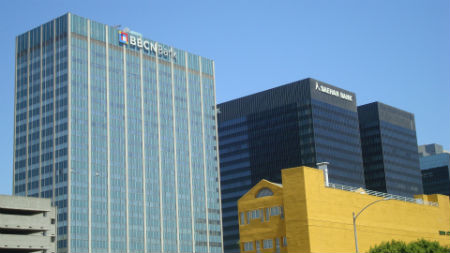
And on this stretch of Wilshire you can also find a number of bland office towers occupied by banks and financial services.
Ktwn 18 Bldgs Tall 2

Among the oldest buildings in Koreatown are the churches.

Ktwn 19 Ch Imm Wide

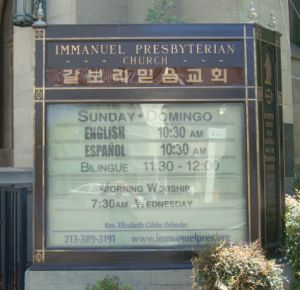
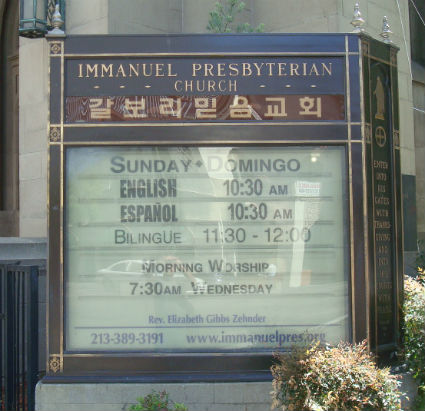
Immanuel Presbyterian Church was constructed in 1928, and for decades was a center for the Anglo community that populated the area up through the middle of the twentieth century. In recent years, many of these older churches have become home to multi-cultural congregations, and have services conducted in multiple languages.
Ktwn 19b Ch Imm Sign

The media has given a lot of attention to Koreatown in recent years, but mostly the stories tend to focus on the night life. Sure, there are plenty of good restaurants, and tons of bars and clubs. But Koreatown is more than just a place where you can scarf kalbi and guzzle soju til you pass out. Like any community, it has many different sides. It’s a place where art, business, technology and politics mingle and collide on a daily basis. Aside from the Korean American population, there are Central Americans, African Americans, Latinos and Anglos. Really it’s impossible to define in terms of a single ethnicity or culture.

Koreatown is relatively young, even by LA standards. The number of Koreans in the city was pretty small until the sixties. It wasn’t until 1965, when the US rewrote its immigration policies, that Koreans started arriving in large numbers. The area we now call Koreatown didn’t really come together until the seventies. Since then it has continued to grow, in terms of both population and area.

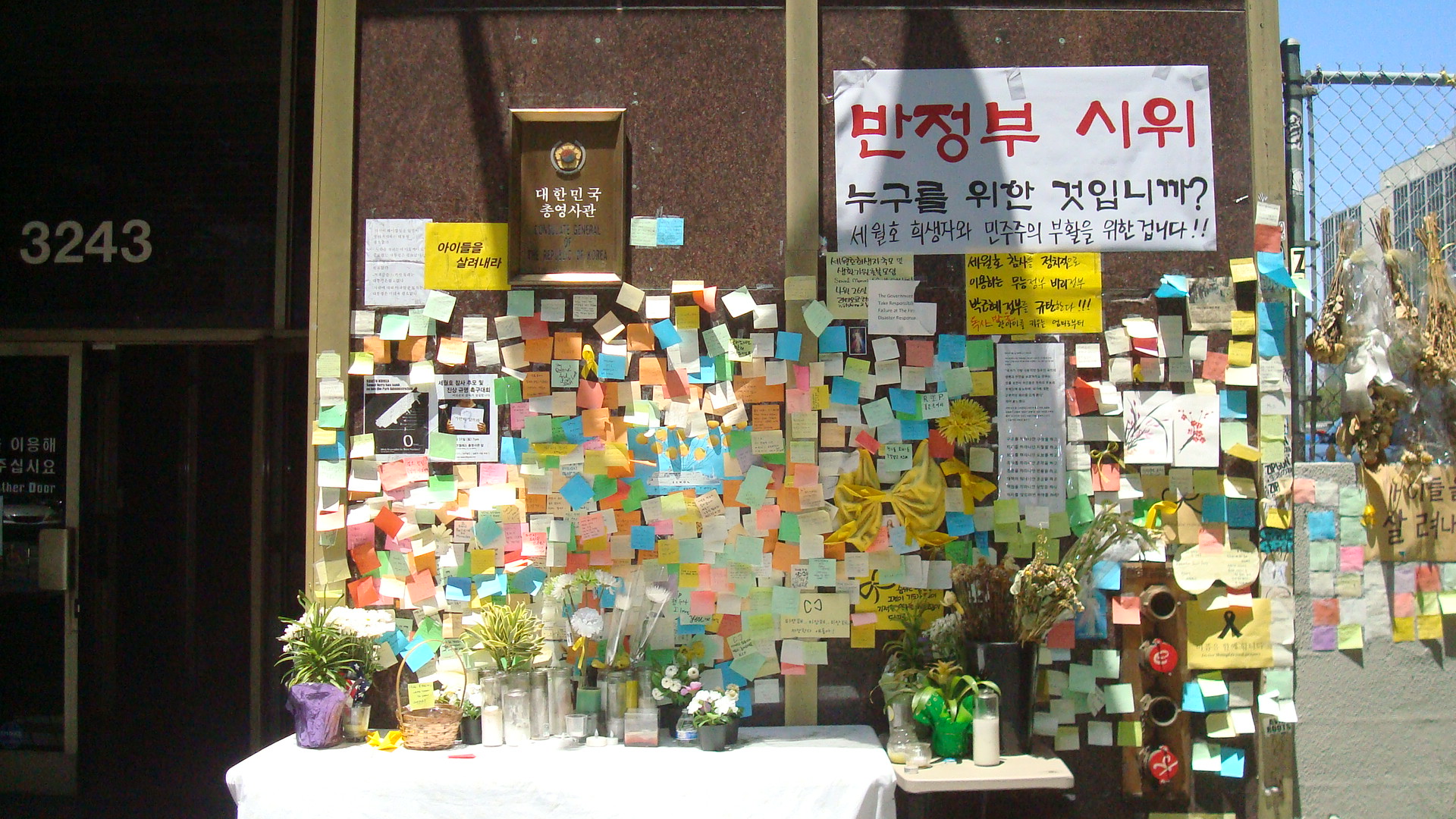
The Korean Consulate is located on Wilshire not too far from Vermont. As I was walking by one day, I saw that community members had created a memorial to the victims of the Sewol ferry disaster.

Ktwn 20 Ferry

Here in the US, the coverage of the Sewol incident was pretty limited and faded from the scene quickly. In Korea, it sparked a huge scandal, as a growing body of evidence suggested it could have been prevented. A series of protests were held in Seoul, with many people accusing the government of a cover-up and demanding that President Park Geun Hye resign. Here’s an article from the Washington Post that gives further details.

Grieving Families Want Independent Probe

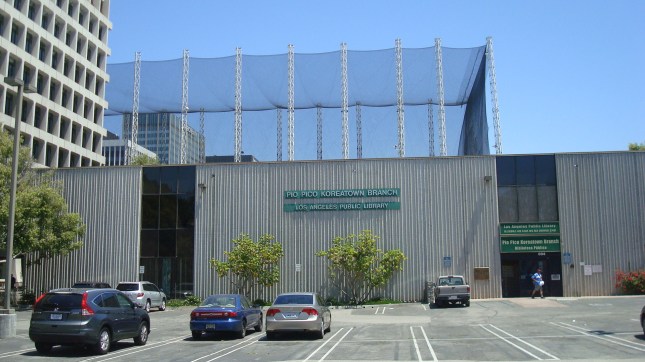
Not too far off Wilshire is the Pío Pico Koreatown branch of the LA Public Library. Pico was the last Mexican governor of California before it was annexed by the United States. For many years he was one of the wealthiest and most influential people in the state, but by the time he died he was living in poverty.
Ktwn 25 Lib Ext

I love libraries. Maybe it’s the quiet. Maybe it’s being surrounded by people reading.

Ktwn 25 Lib Int

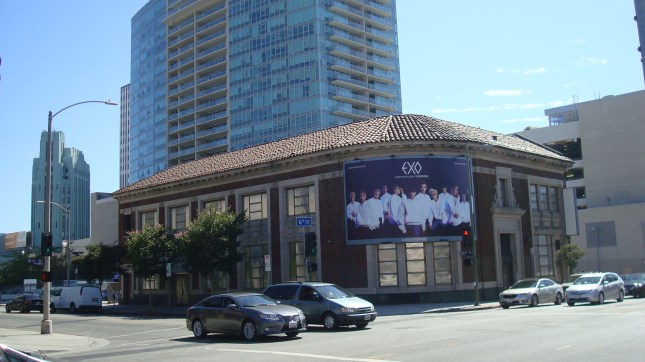
Something about this billboard caught my eye. K-Pop isn’t just huge in Asia. It’s got a significant following in the US, too. EXO is built around an unusual concept. The band actually consists of two groups. EXO-K performs their songs in Korean, and EXO-M performs the same songs in Mandarin.
Ktwn 60 Boy Grp Bldg Wilt

With groups like this, obviously the music is not the focus. Some promoter has gathered a bunch of cute guys that will look good in music videos. People have been doing this for decades, but to me it’s interesting that the Korean media have managed to turn K-Pop into such a cultural phenomenon.

Also on Sixth Street, I dropped in on Red Engine Studios. Actually, that was because of a misunderstanding. I thought the place was a gallery. Turns out it’s a school. The guy at the door seemed uncertain about letting me in, but I guess he finally decided I looked harmless enough. They do have some cool art on the walls, and you can view it by visiting their site.

Red Engine Studios

Ktwn 60 RE Guys 2

There are lots of skateboarders in Koreatown. I saw guys riding up and down the sidewalks everywhere, and there was this vacant lot on Sixth where a bunch of kids were practicing their moves.

Ktwn 60 Skate Comp

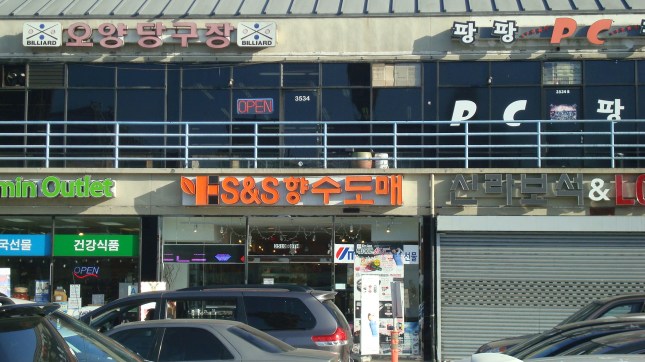
When I think of Koreatown, I think of malls. As I said earlier, Koreatown got its name because Korean entrepreneurs have been spectacularly successful in creating a vibrant community for businesses to thrive.

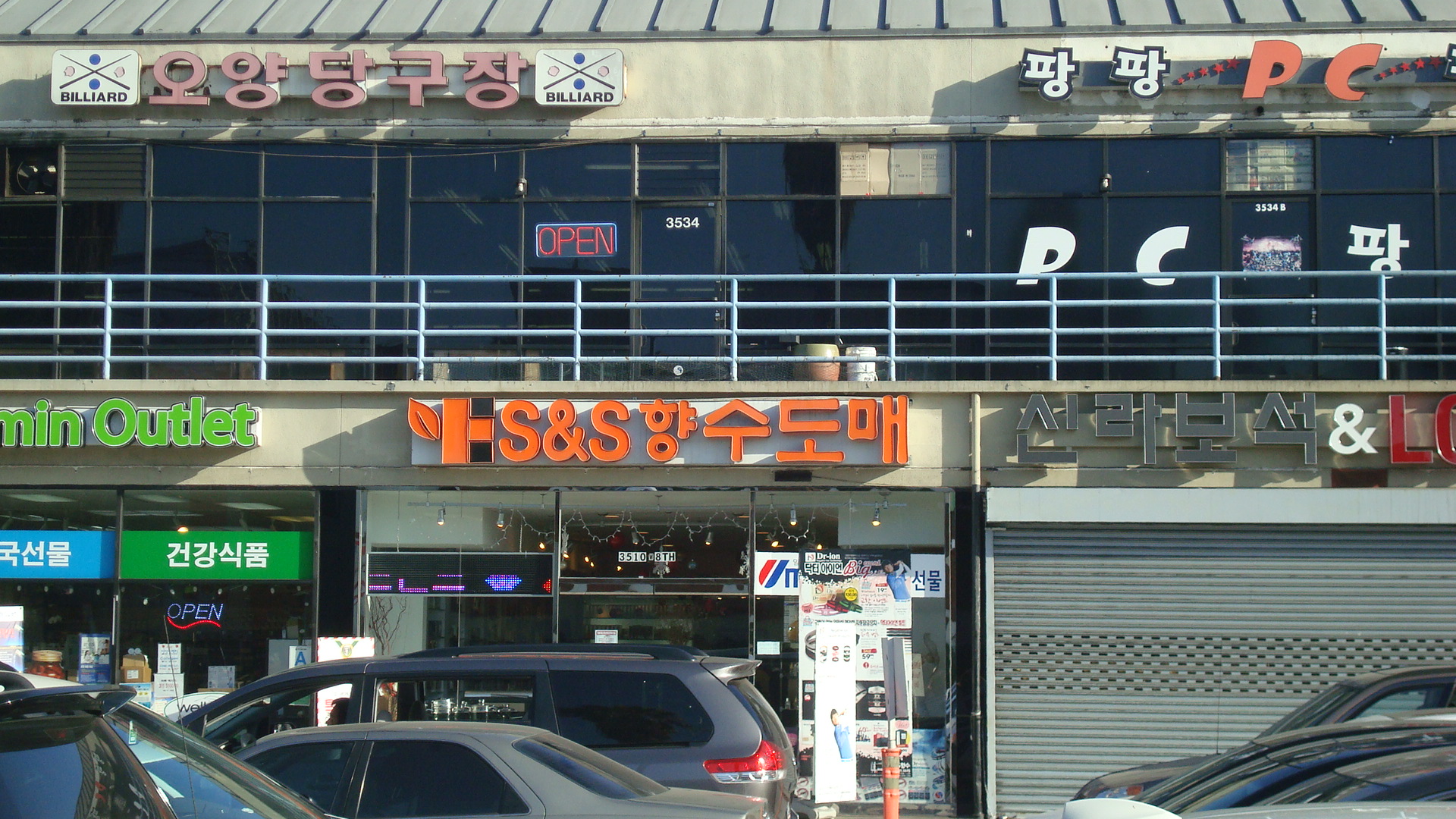
There are newer malls, that were built to house dozens of small shops.
Ktwn 30 Mall S&S

And there are older malls, where a bunch of businesses are crowded around a tiny parking lot.

Ktwn 32 Mall Kids

This one looks like it dates back to the sixties. I’m kind of fascinated by how spaces like this change over time, evolving as the neighborhood changes around them.

Ktwn 32 Mall Rock

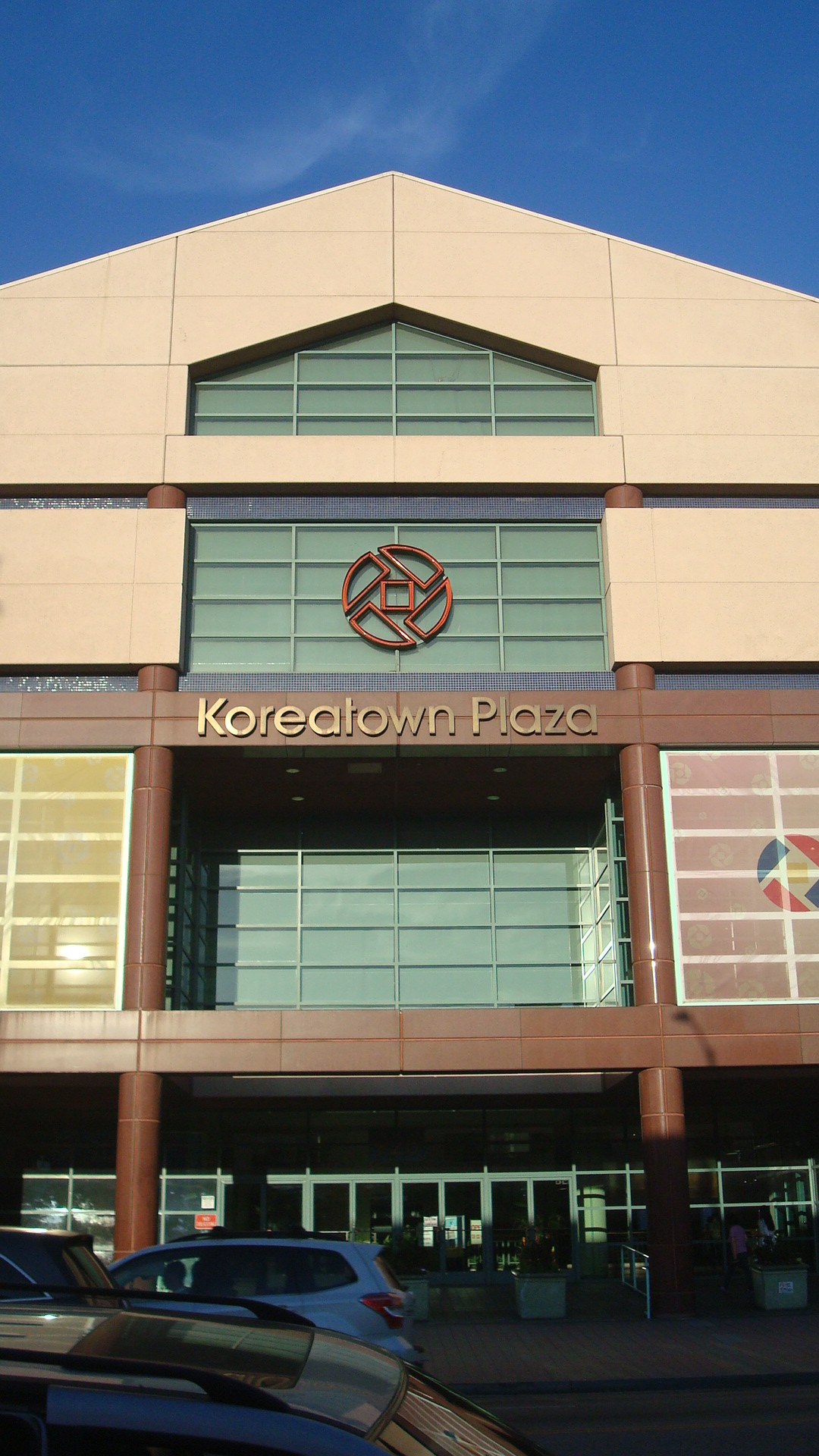
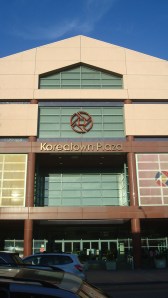
Of course there are also massive indoor malls. Like Koreatown Plaza.
Ktwn 33 K Plaza

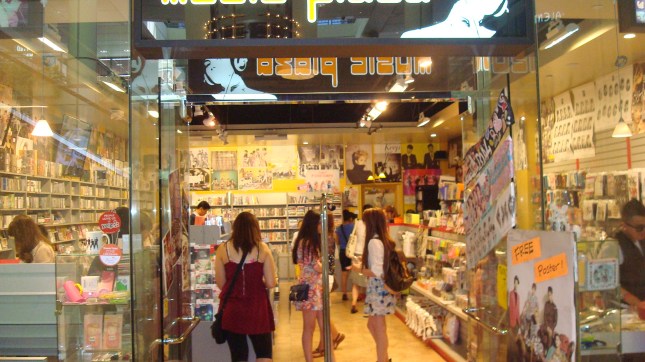
I went into Music Plaza looking for traditional Korean Music. They didn’t have much of a selection. But if you’re looking for the latest K-Pop releases, this is the place to be. It may not look too busy in this photo, but I had to stand in line to make my purchase. And I feel pretty certain that they make way more on the merchandise than they do on the music.
Ktwn 35 Music Plaza

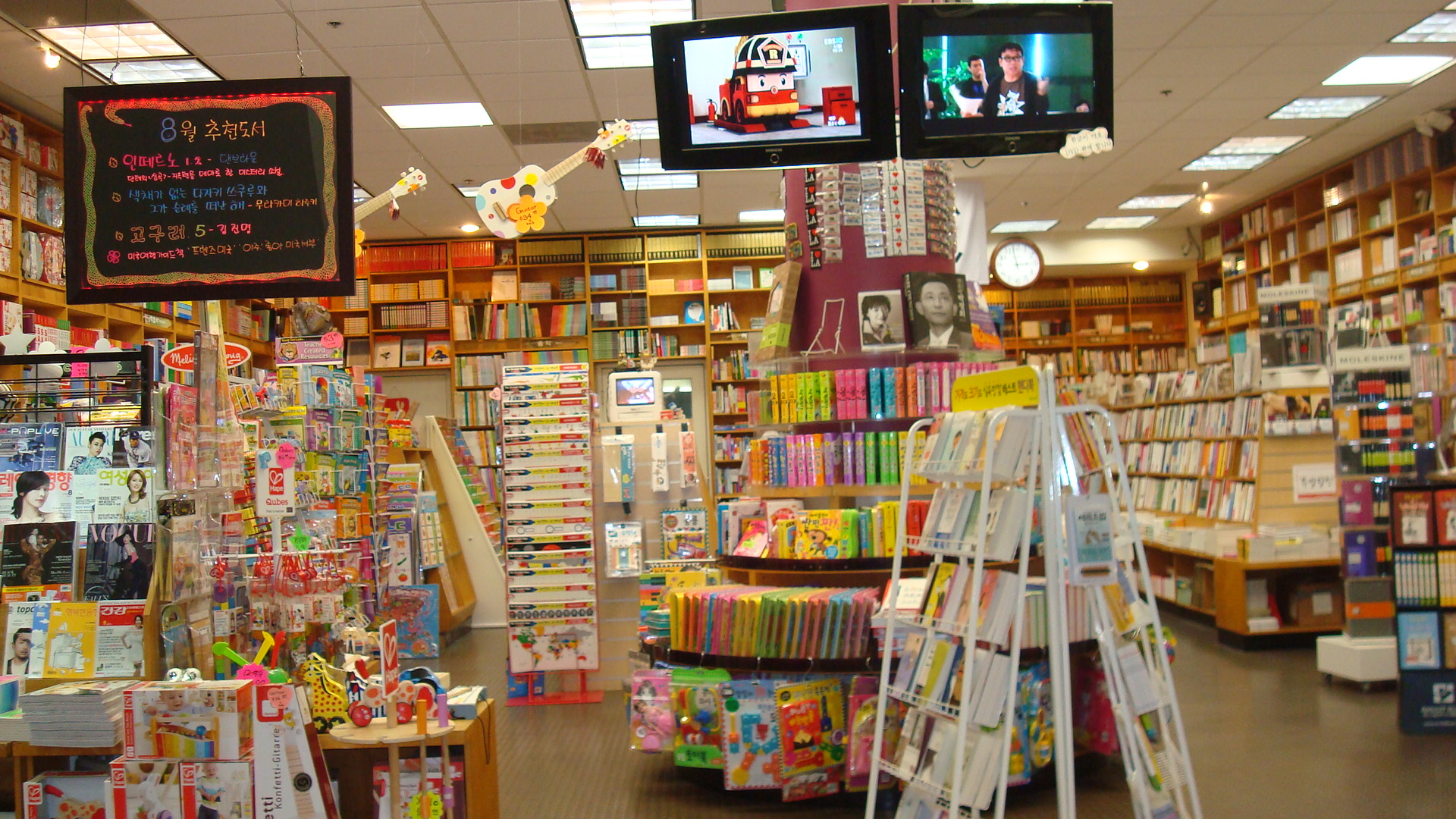
I’m not sure why this bookstore seems quintessentially Korean to me, but it has something to do with the colors.

Ktwn 37 KBC

Like every other mall, Koreatown Plaza has a sizeable food court.

Ktwn 38 K P Court

Walking around the area you see that health and beauty are definitely marketable commodities. There are lots of spas and beauty parlors.

Ktwn 50 Bty All Rev

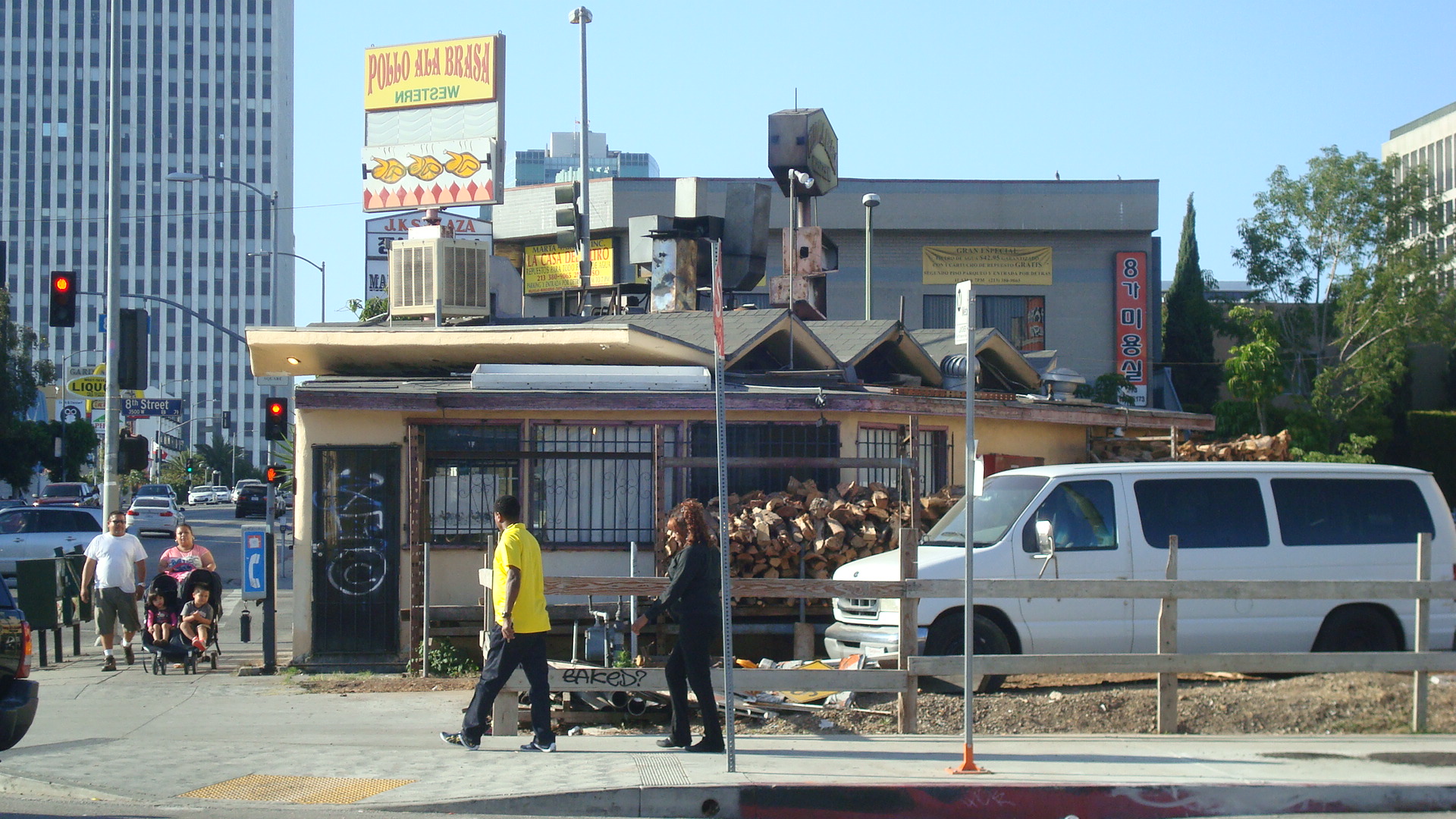
It was the stacks of firewood that made me want to take a picture of Pollo a la Brasa.

Ktwn 68 Pollo

As large swaths of LA get gentrified and prettified, it’s cool to see an old school restaurant that isn’t too worried about its appearance. And in addition to keeping the grills going…

Ktwn 69 Pollo Waiting

…the logs also serve as benches while people wait for the bus.

Yeah, LA’s sidewalks are a mess, but I have to say I have an affection for the huge, overgrown trees that are breaking up the concrete. The thick branches spreading over this stretch of Eighth Street made it seem like a small forest.

Ktwn 70 Eighth Shade

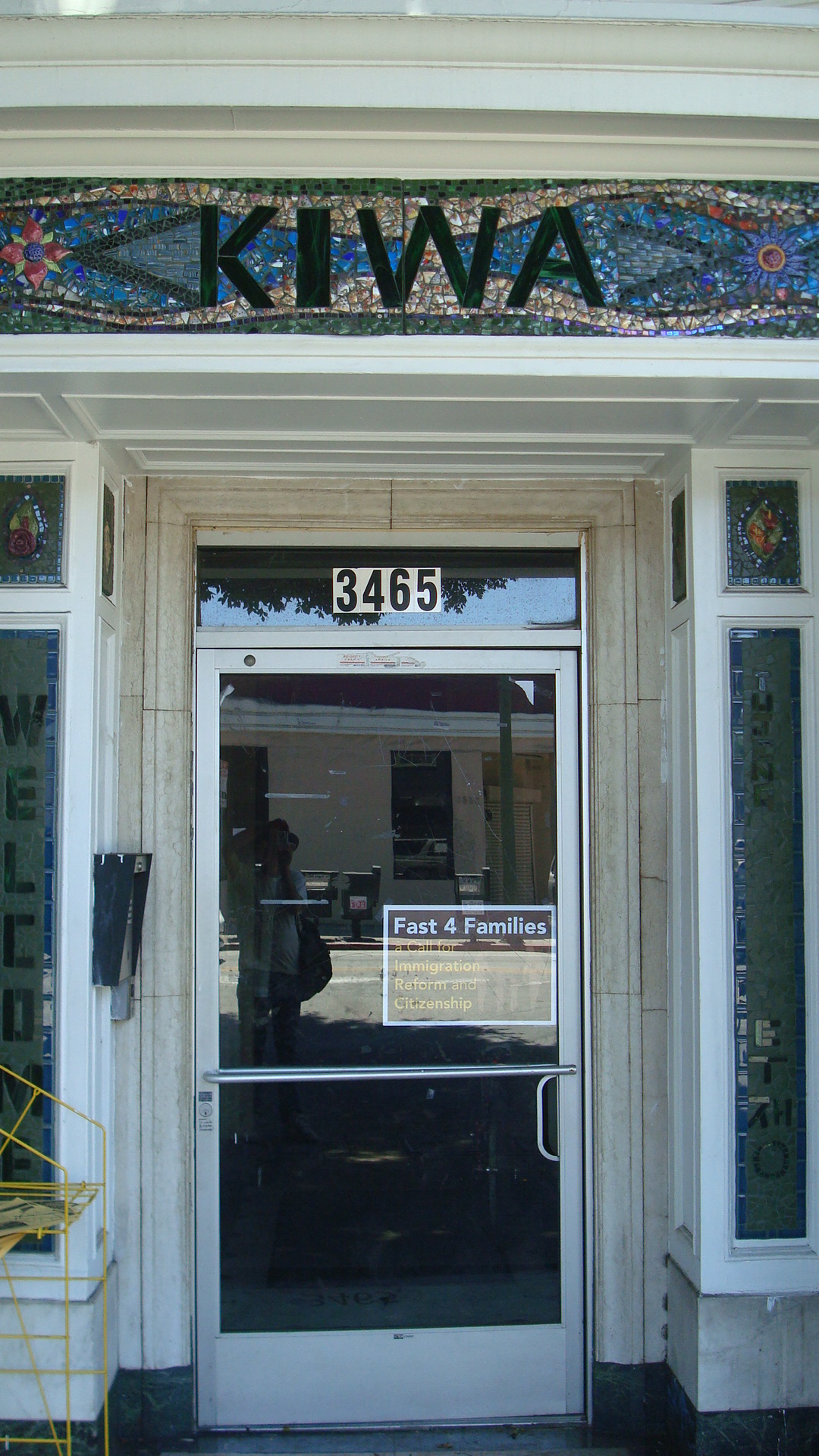
Ktwn 70 KIWAAnd right here on Eighth Street is the Koreatown Immigrant Workers Alliance. KIWA has worked for years to defend the rights of workers, and is currently engaged in a campaign to fight wage theft, which is rampant in LA. One of their notable victories was helping Heriberto Zamora recover wages that had been denied him by Urasawa, a posh restaurant in Beverly Hills. Even after being cited by the California Division of Labor Standards Enforcement for multiple violations related to wage theft, Urasawa resisted paying Zamora what he was owed until just before their final hearing before the DLSE. To find out more about KIWA’s work, click on the link below.

KIWA

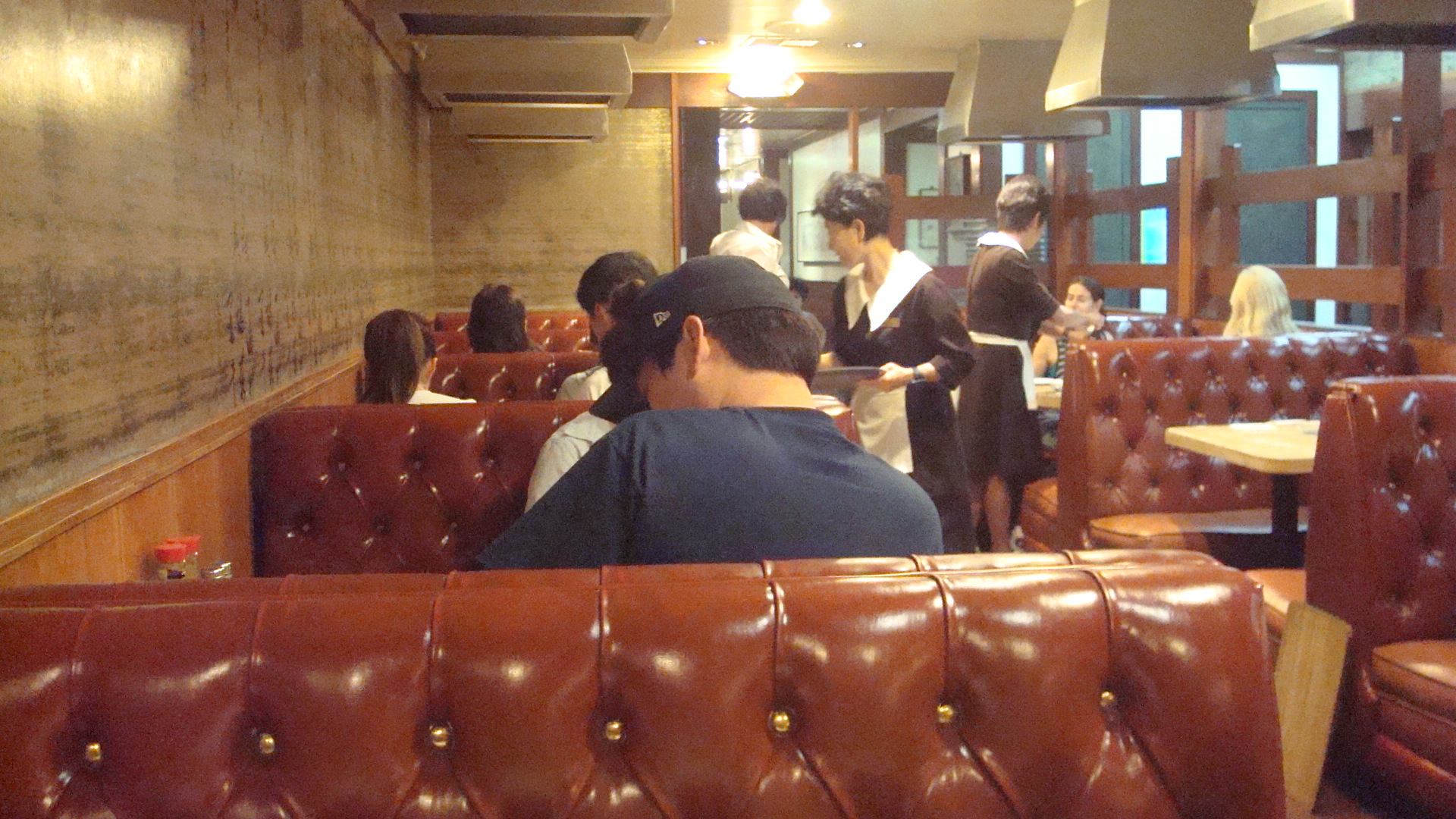
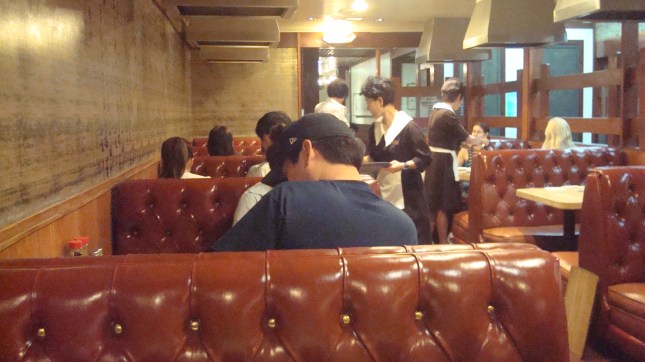
Koreatown is changing rapidly, but pieces of the past still remain. I hadn’t been to Dong Il Jang for decades, and I’d been thinking about stopping by for a while.
Ktwn 91 Dong Int

The waitresses were friendly. The food was good. Even though I hadn’t been there for years, it felt familiar. And it was just reassuring to know that it was still there.

Ktwn 92 Dong Food

Hollywood Journal – A Different Kind of Marathon

DSC06891

March, Nineteen Ninety Nine

A weird, ugly, fun day.

I woke up around ten. Played some music. Robert Goulet, Sid Ramin, June Christy.

Around noon I realized that the hangover I’d been hoping to avoid was kicking in. Lying on the living room floor, I could hear car horns honking outside. Had no idea what that was about. I dozed for a while.

Woke up around two and told myself I’d have to move if I was gonna make the three forty show of Fallen Angels at the Beverly.

I walked out onto the street and saw that Cahuenga was a parking lot. Massive traffic jam. Then it hit me. The marathon.

I was thinking I’d catch the two twelve on Hollywood Boulevard, but the marathon meant Hollywood Boulevard was closed. Should I go back home? Skip the movie?

Nah. I didn’t feel too hung over at that point, and I felt like walking a little might clear my head. I decided to go down to Sunset and catch the bus over to La Brea in the hope that the two twelve would be running that part of its route.

But Sunset was closed, too. So I figured, okay, I’ll go down to Santa Monica. Which I did. The only westbound bus that went by was so packed I couldn’t get on it.

So I walked down to Melrose. By this time I wasn’t feeling too good. I leaned against the pole at the bus stop, wishing the bus would come. Another guy who was waiting told me that it was gone arrive in about five minutes.

Ten minutes passed. Fifteen. I finally decided to just go on walking, and it’s a good thing cuz not a single bus passed me in the time it took me to reach La Brea.

From there it was a short walk down to the theatre. As much trouble as it was, the movies were worth the trip. Fallen Angels was wonderful. And I liked Chungking Express much better seeing it a second time.

FA 2

Boom Town

Dntn Fed 3 Skln

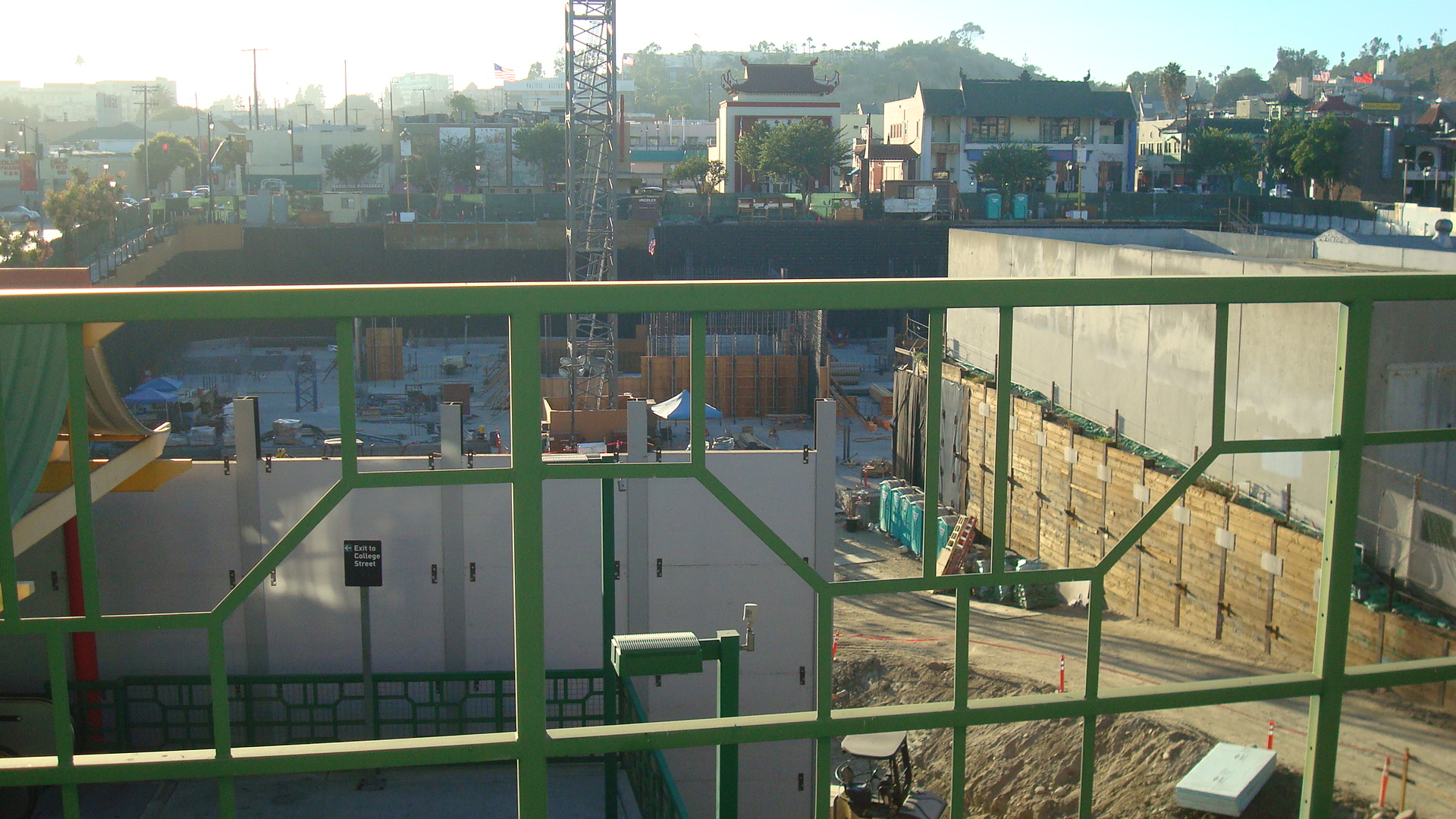
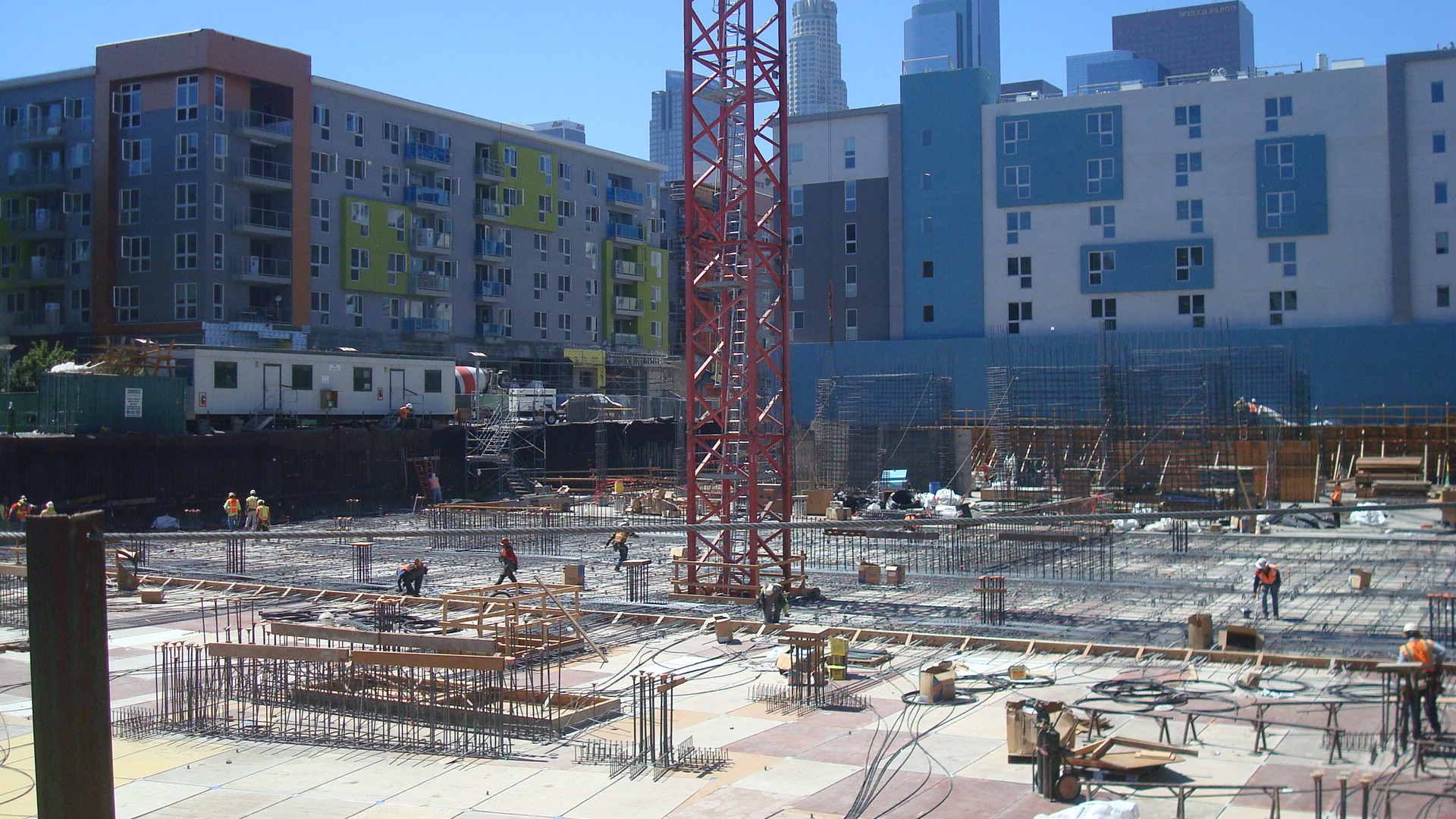
Downtown is exploding. There’s so much construction going on I can’t even keep track of it. Massive new office and residential buildings are springing up all over the place. There are also efforts underway to revitalize a number of older buildings. Some of this stuff is cool, some of it is dumb, but I’m less concerned about the quality of the individual projects than I am with the cumulative impact of all this construction. More on that later.

Let’s start by sampling a few of the projects currently under construction….

Dntn 00 ChTown

This is the Blossom Plaza, which combines retail and residential, including a fair number of affordable units. It took years for this to get off the ground, and there was a recent hitch when workers uncovered remnants of the original Zanja Madre, but things are moving forward. Curbed LA has been following the story for a while, and you can read more about it by clicking here.

Dntn 05 LT Site 2

I had a harder time finding current info about this project. The most recent report I read said this was a 240 unit complex being developed by the Irvine-based Sares-Regis Group. Whatever it is, it looks like it’s going to be huge. The site is located at Second and San Pedro, right next to….

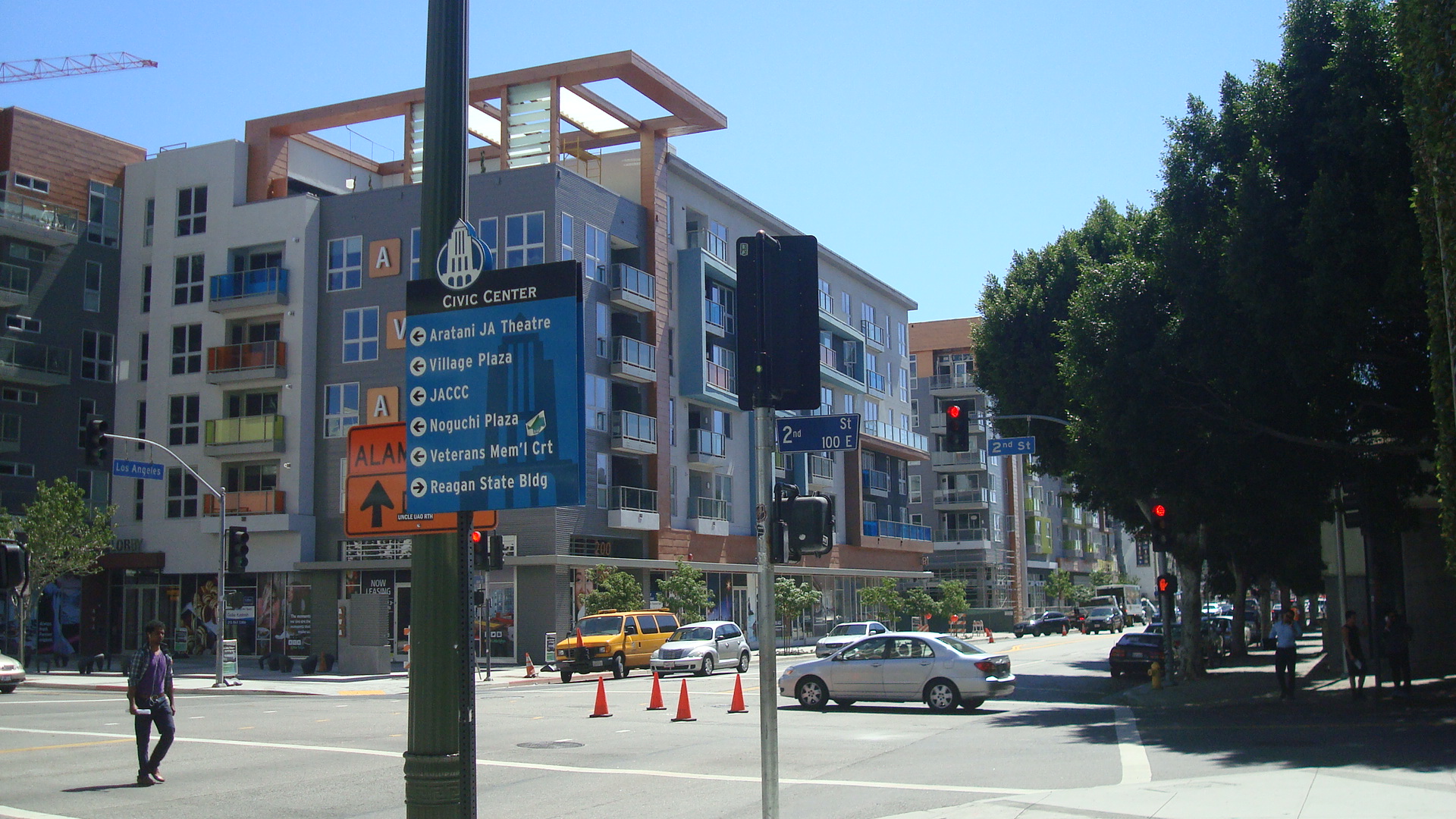
Dntn 10 Ava Trees

….the recently completed AVA Little Tokyo, another massive mixed-use structure. Apparently young people are flocking to Downtown LA these days, and developers are doing everything they can to capture that crowd. Check out this ad, seen in one of the windows on the ground floor.

Dntn 15 Ava Ad

The way I read this is, “If your highest priority is mindless self-indulgence, this is the place for you.”

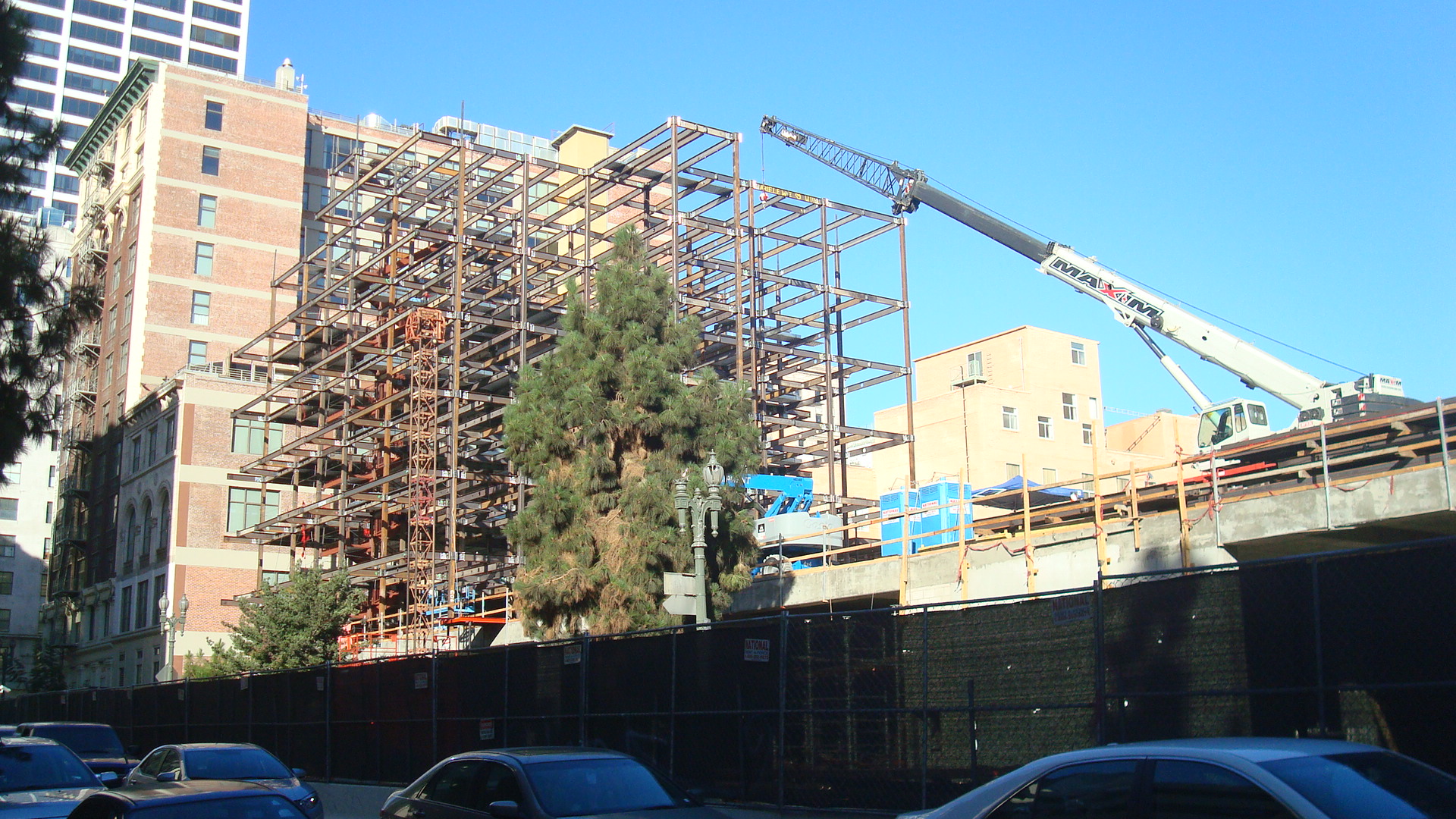
And since we don’t have enough luxury rental units in Downtown LA already, Carmel Partners has generously agreed to build 700 more. As you can see in the photo below, it’ll be a while before the project is complete.

Dntn 20 Bldg Frame

You may want to put a deposit down soon. Given the list of amenities, I don’t doubt that the Eighth & Grand complex will be popular. I was sold when I heard about the rooftop pool surrounded by cabanas. For more details, click here.

Dntn 30 Fed 4 Skln

But let’s talk about a project that might actually benefit the people of Los Angeles. Here’s the new federal courthouse, which is finally going up after being delayed for years. The courthouse is just one component in a larger scheme to revitalize this part of the civic center. Building Los Angeles offers a rundown on some of the related efforts.

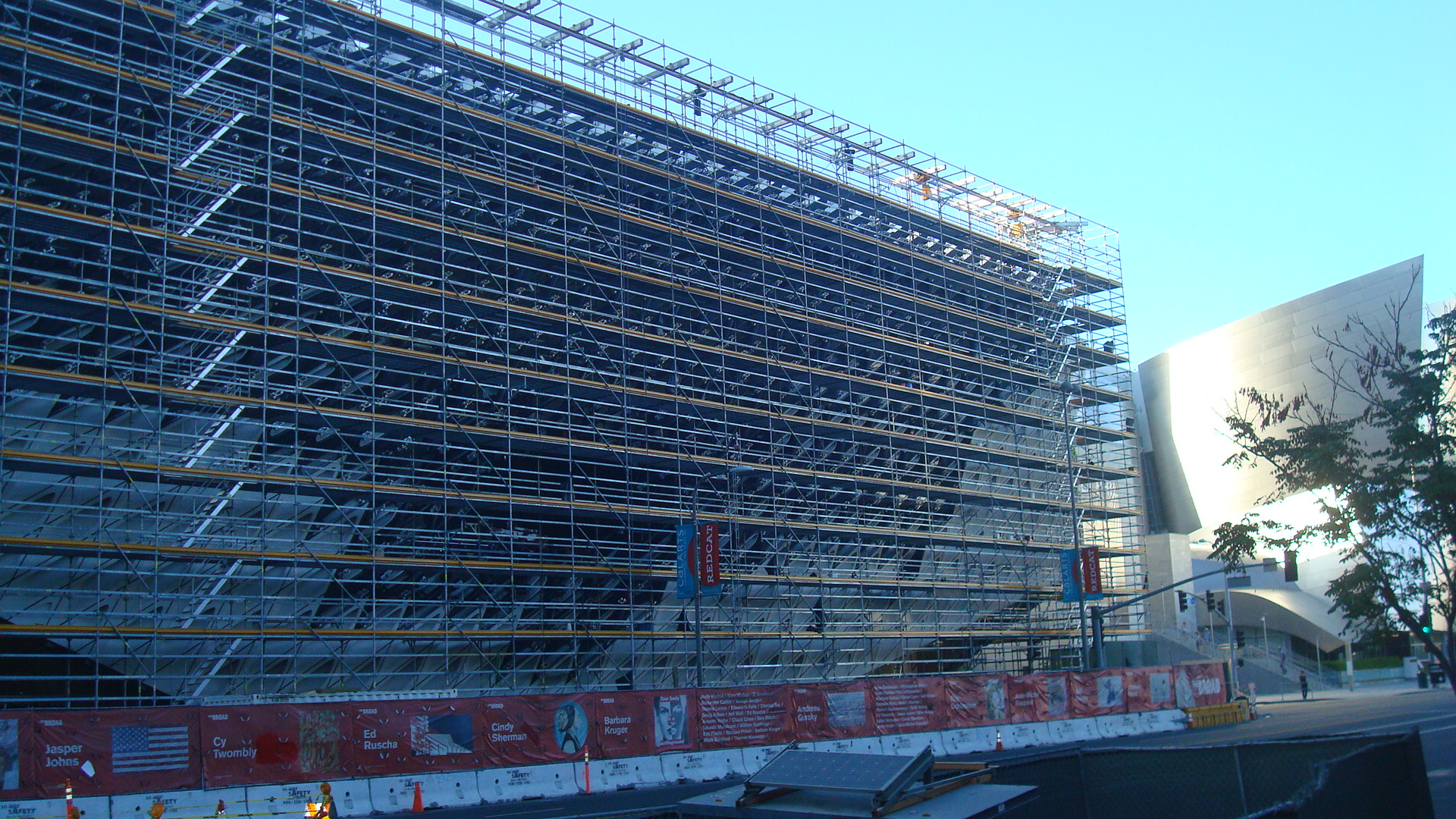
Dntn 35 Broad 3

Honestly, of all the projects under construction in Downtown LA, the only one I can really get excited about is The Broad. It’s still a long way from completion, and the web site just says that it will open in 2015. But it’s something to look forward to. And they’re already doing some cool programming. Click here to find out what’s going on.

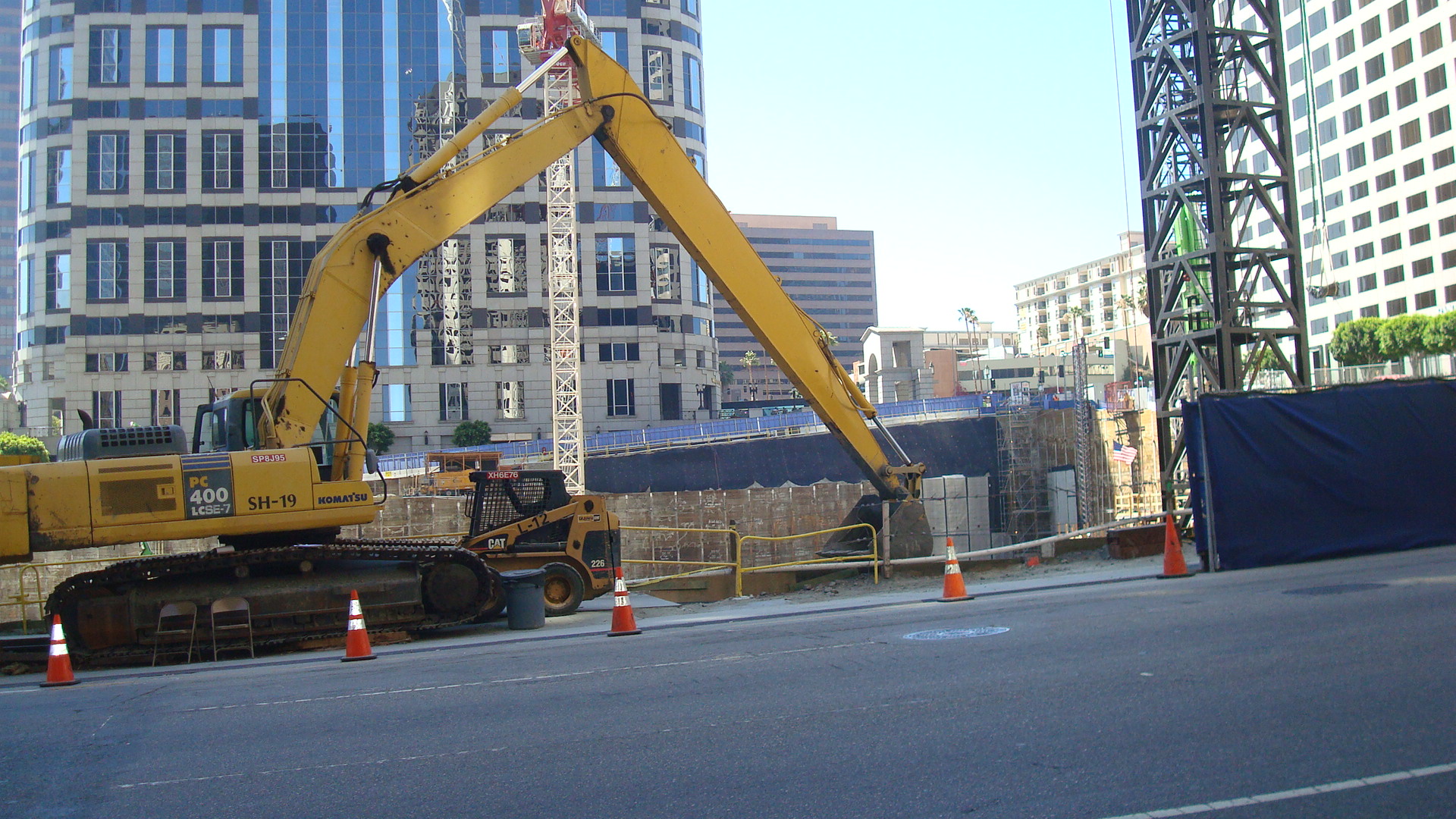
Dntn 40 TB Backhoe

And let’s wrap it up with the New Wilshire Grand. It’s said that when the project is completed, this will be the tallest building west of the Mississippi. Who cares? I’m so tired of this kind of development. Does this really have anything to do with making the city a better place to live? Or is it just another monument to greed and vanity?

There’s a lot of talk right now about how LA has to embrace higher density development. Fine. There are good reasons to create a more compact city, and certainly sprawl has been a major problem throughout our history. But can anybody demonstrate a need for skyscrapers of this size? And looking at the bigger picture, do we really have the infrastructure to support development on this scale? I’m thinking especially of water, since we are in the middle of a drought. The projects I’ve highlighted here are just a few of the dozens that are either currently under construction or in the permitting process.

When I look at the avalanche of development that’s hitting Downtown LA, I have to ask if anybody at City Hall is thinking about the future, because I don’t see any evidence of rational planning. Instead, I see an onslaught of construction driven by developers who are falling all over themselves to get in on the gold rush. I really question whether the Mayor or the City Council have given any serious thought to how this massive growth spree is going to affect LA down the road. I wish I could believe they were really concerned about the well-being of the people of Los Angeles. It seems more likely that their chief concern is keeping their developer buddies happy.

Climate Change in LA

DSC07407

Now in the our third year of drought, it seems pretty clear to me that the climate in LA is changing. We’re getting far less rain than we used to, and the fire season is getting longer and longer. Of course, the same thing is happening all over California and throughout the Southwest. And from the reading I’ve done, it seems that the vast majority of scientists now agree that climate change is related to human activity.

Later this month in New York, the UN Climate Summit will take place. World leaders attending the summit will discuss what measures their countries can take to combat global warming. Honestly, I’m not optimistic. After years of debating this topic, we’ve made very little progress, and the consensus in the scientific community is that things are only going to get worse.

To put some pressure on the politicians, people are taking to the streets all over the globe to call attention to the very real dangers that climate change poses. Here in LA, there’s an event on Saturday, September 20. I’m going to be there. For more info, here’s the link….
Building Blocks Against Climate Change

If you’re not in the LA area, there are events happening around the globe. The link below will take you to a page that shows events all over the world.

People’s Climate Mobilisation

The UN has extensive information on climate change available on their web site.

UN Climate Summit 2014

I know there are people out there who are still skeptical about climate change. And if it turns out twenty years from now that the scientists were wrong, then you can all laugh at people like me and call us gullible fools.

On the other hand, if it turns out they were right, I don’t think anybody will be laughing.

Preserving a Palace

Hlwd Pac Wilc

The Warner Pacific Theatre on Hollywood Blvd. has been boarded up for a while now. The church that was using the auditorium is gone, and the small retail tenants have vanished, too. Apparently the owner, Pacific Theatres, has plans for the building, though no one is sure what they are. Rumors are circulating that the plans may involve structural changes, but at this point nothing specific has been announced.

The fear is that Pacific will make changes to the theatre that would compromise its historic status. The Warner Pacific Theatre is part of the Hollywood Boulevard Commercial and Entertainment District, No. 85000704 on the National Register of Historic Places. This stretch of the boulevard contains a number of movie palaces, and is an important cultural resource for the community. The Chinese, the El Capitan, the Egyptian and the Pantages are all found in this area.

I understand that Pacific needs to make a profit, but it would be a shame if their plans did not make the preservation of the theatre’s historic status a priority. There are numerous examples of classic theatres that have been restored over the years, and many have them are very profitable. The El Capitan has been spectacularly successful since its restoration, and still functions as a first-run theatre. The Pantages has been drawing crowds consistently since it was converted to host live stage shows. The Wiltern is an example of a classic theatre that has become a hot venue for concerts.

Pacific can even look to its own recent history to back up the argument for preservation. In the nineties they announced a plan for the Cinerama Dome that would have included gutting the theatre and putting a restaurant in the lobby. The preservation community was outraged, and to their credit, Pacific listened. They changed course, and built the Arclight, which has become a mecca for movie lovers in the Hollywood area.

For more information about the Warner Pacific Theatre, you can visit the Hollywood Heritage web site by clicking the link below. Choose Preservation Issues from the menu on the left, and then click on Endangered Buildings.

Hollywood Heritage

DSC06196