I heard that thousands of people showed up for the “No Kings” protest in Downtown LA yesterday, but since I’ve been to a number of the gatherings at LA City Hall, I decided to check out some of the smaller local events. The No Kings organizers reported record turnout across the nation, and while you always have to be skeptical about the numbers given by organizers, it does seem like an increasing number of people are angry and frustrated about the direction the country is going in. The war in Iran, ongoing ICE raids and rising prices seem to be at the top of the list of grievances.
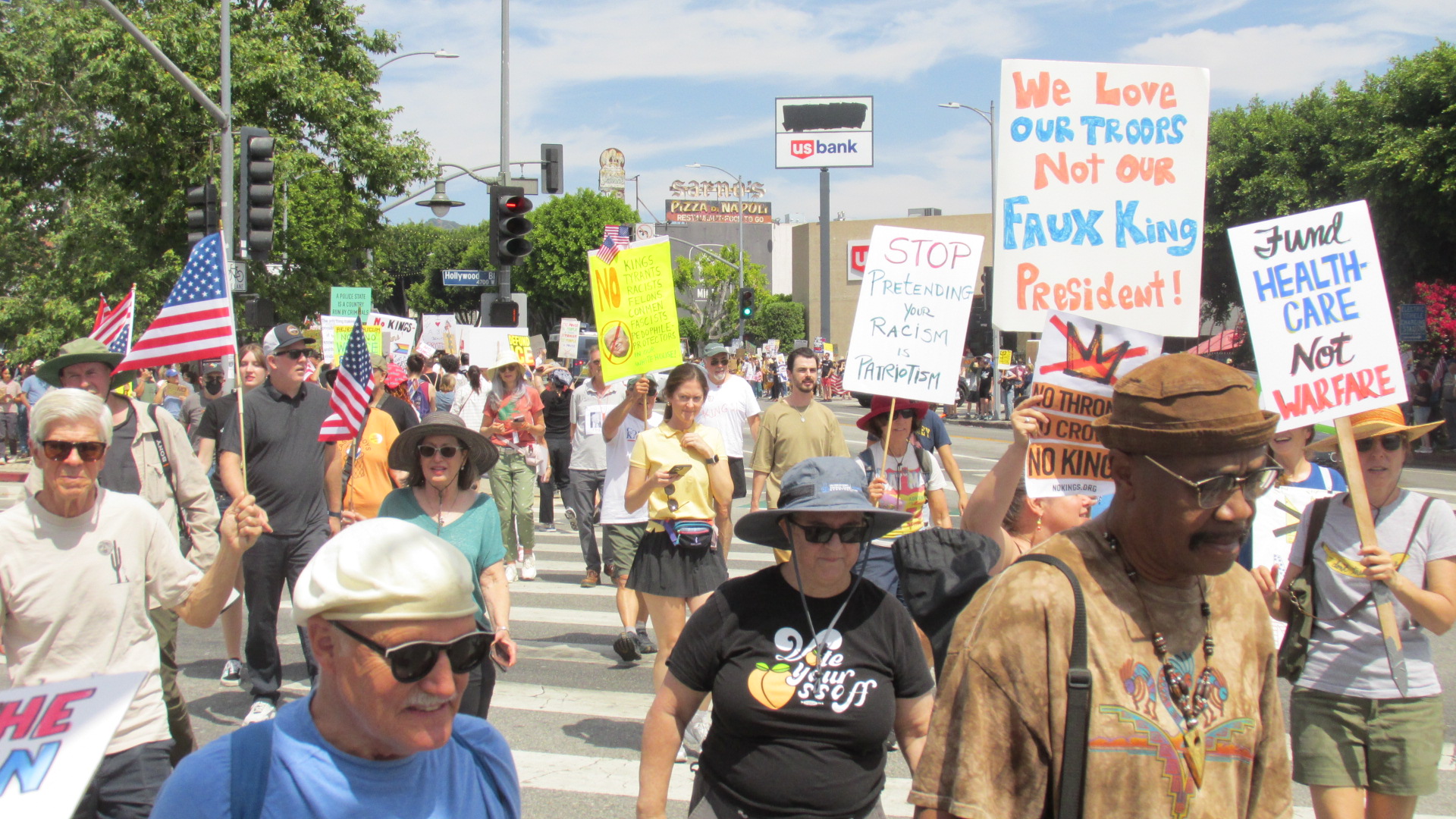
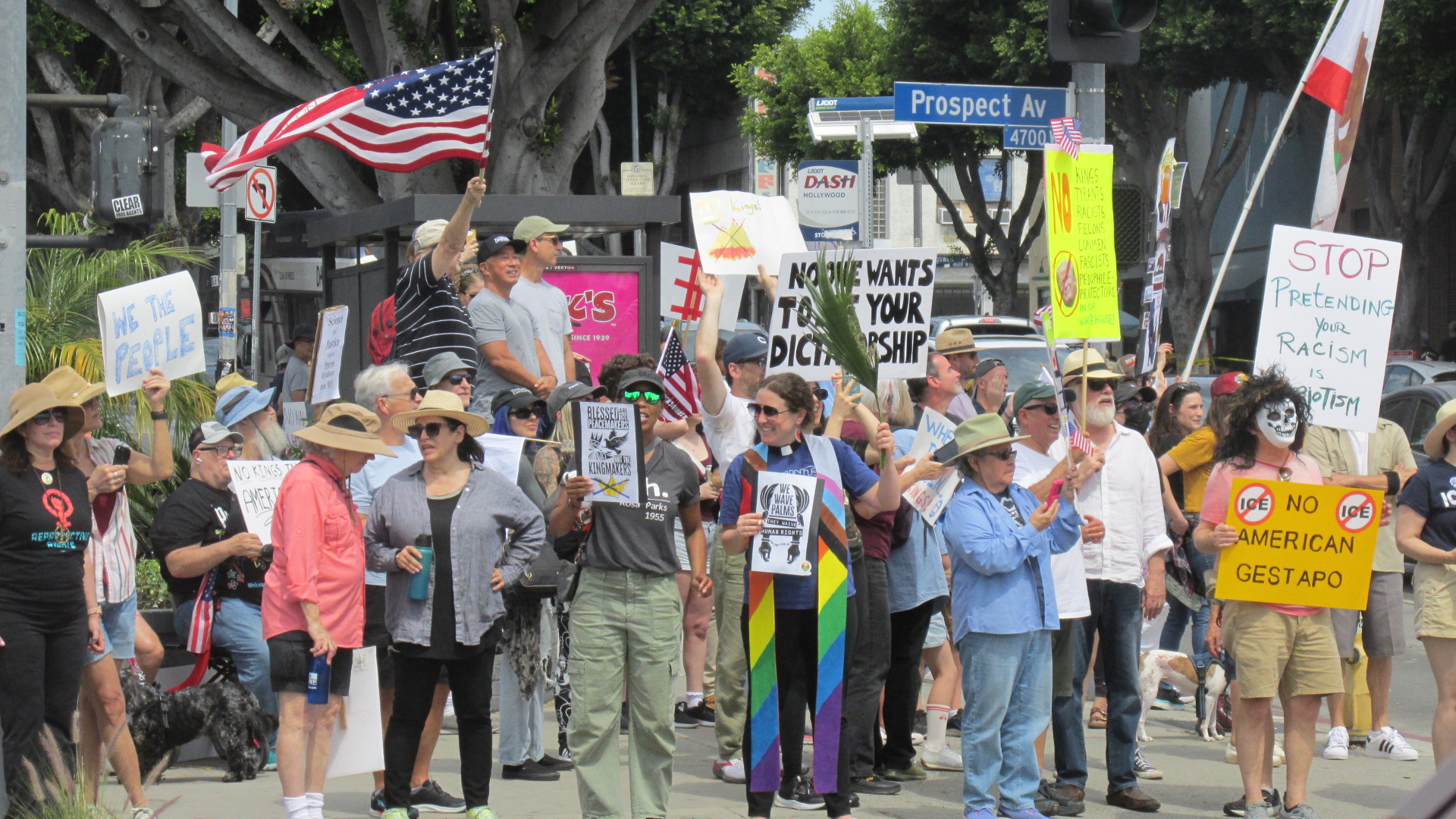
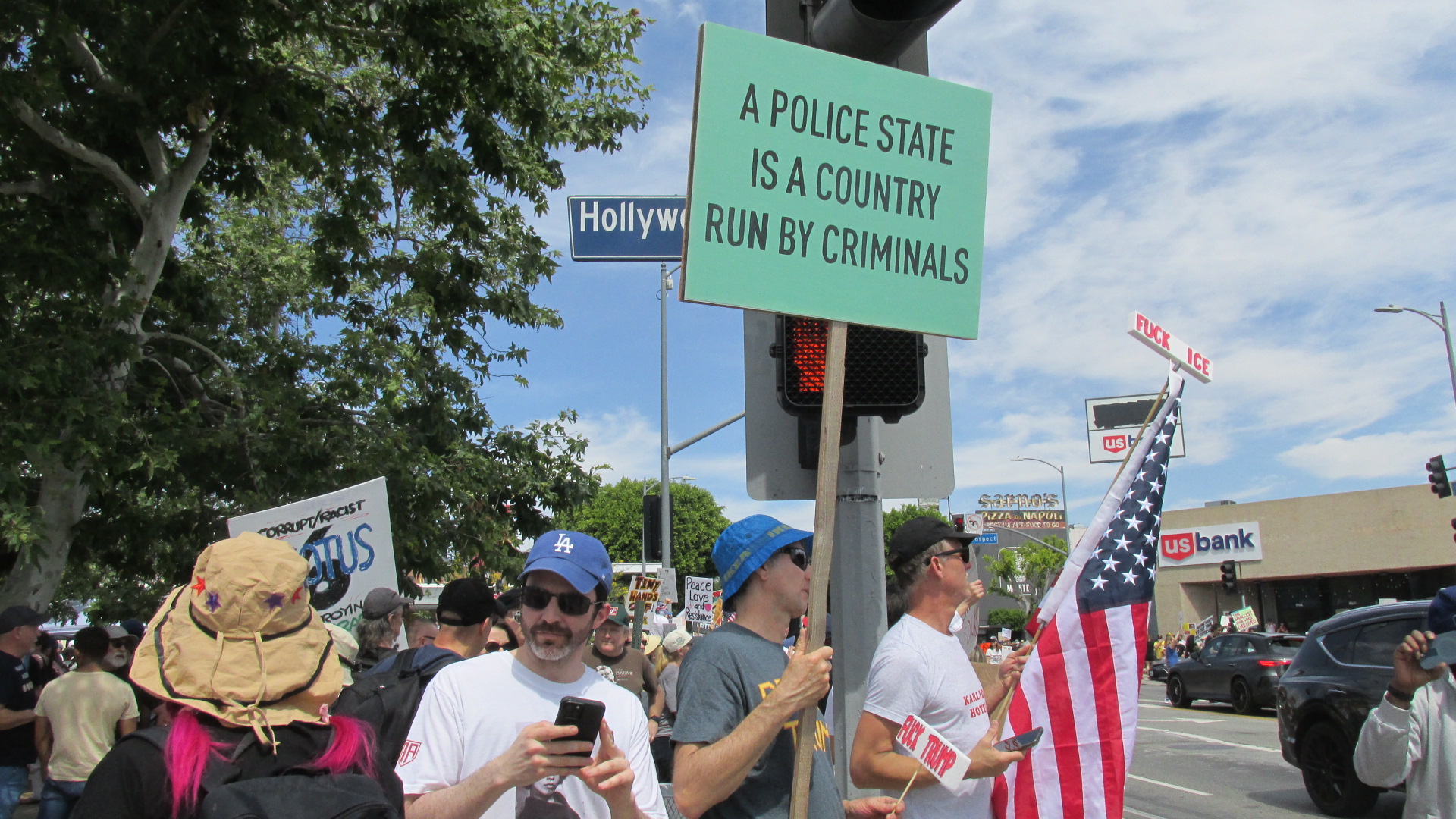
I first went to the protest at Hollywood and Vermont, where it looked like several hundred people showed up. Signs urged passing drivers to honk in support, and lots of drivers responded. I saw one older woman sitting with her hands over her ears. It was pretty loud.
The signs at the Hollywood protest covered a lot of issues.Protesters marched back and forth across the intersection.One woman sat with her hands over her ears. It was pretty loud.
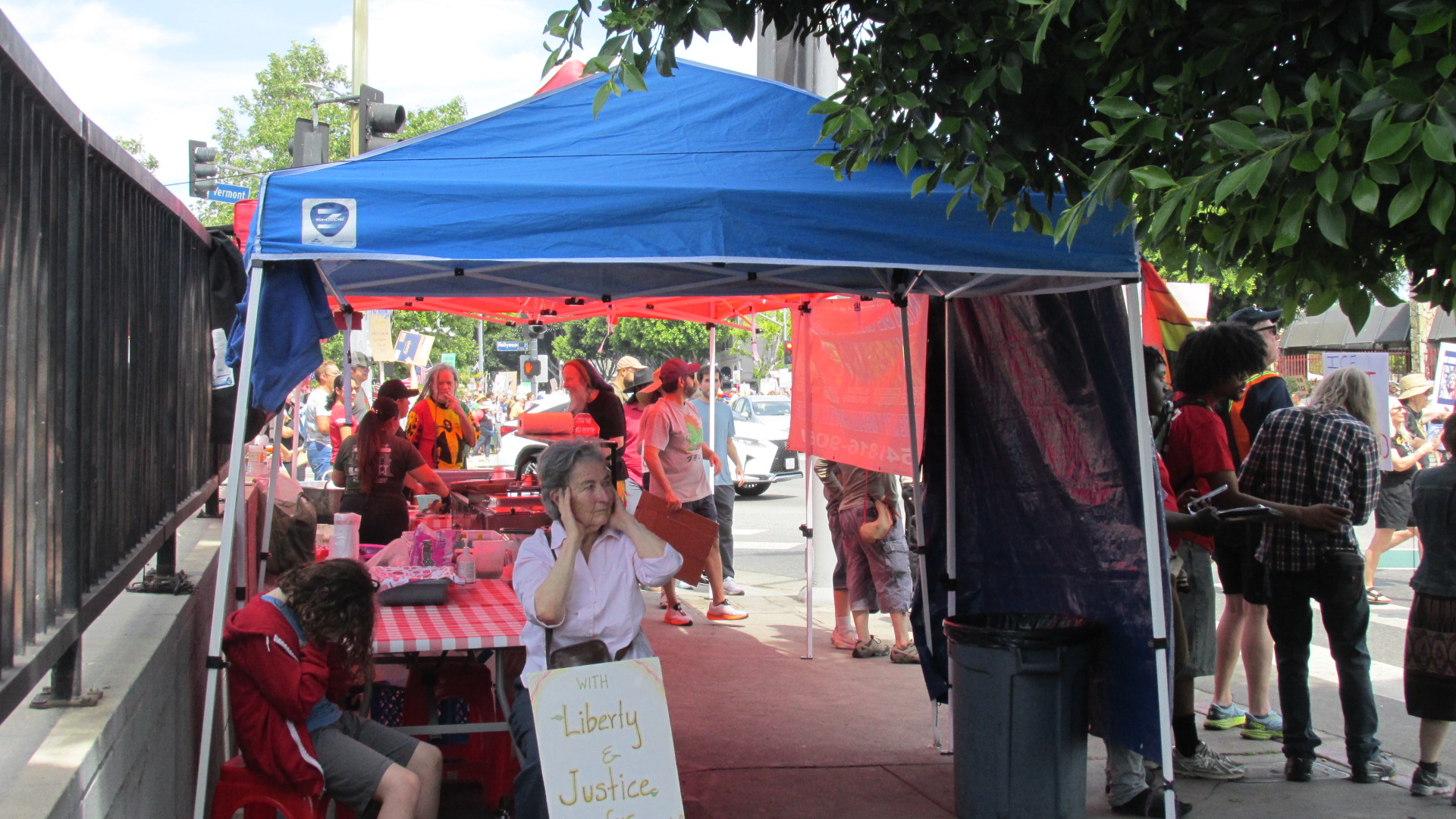
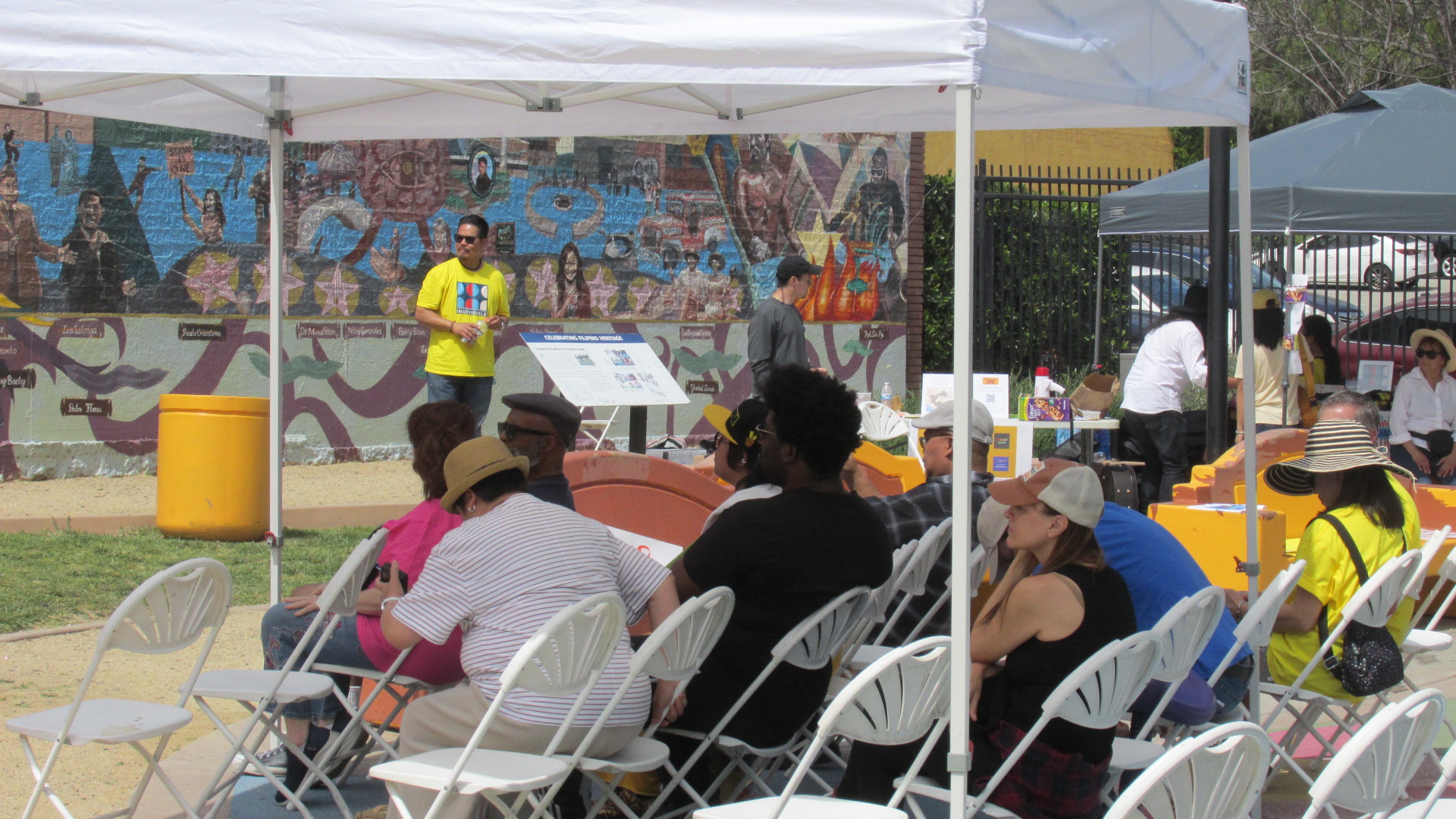
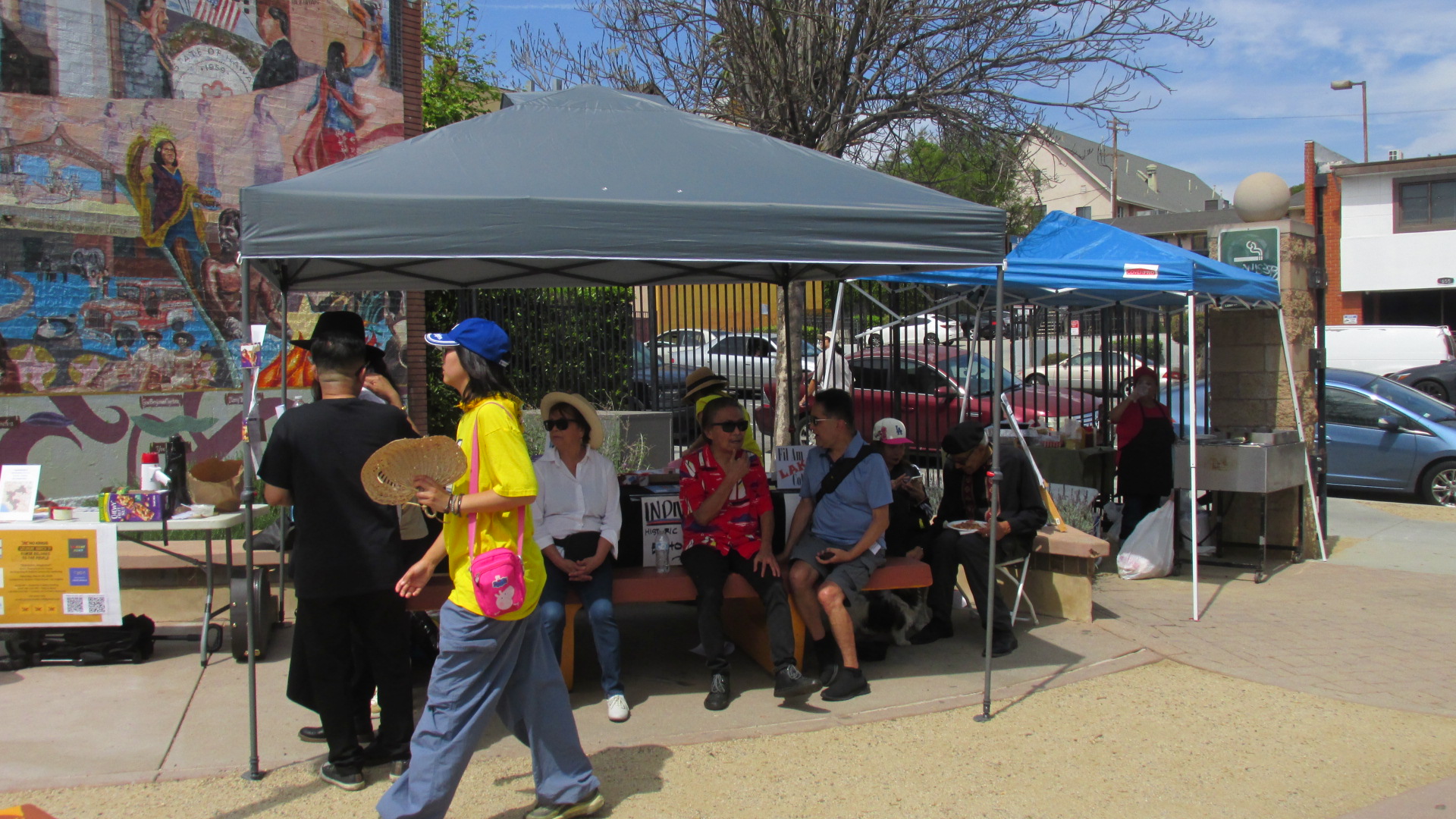
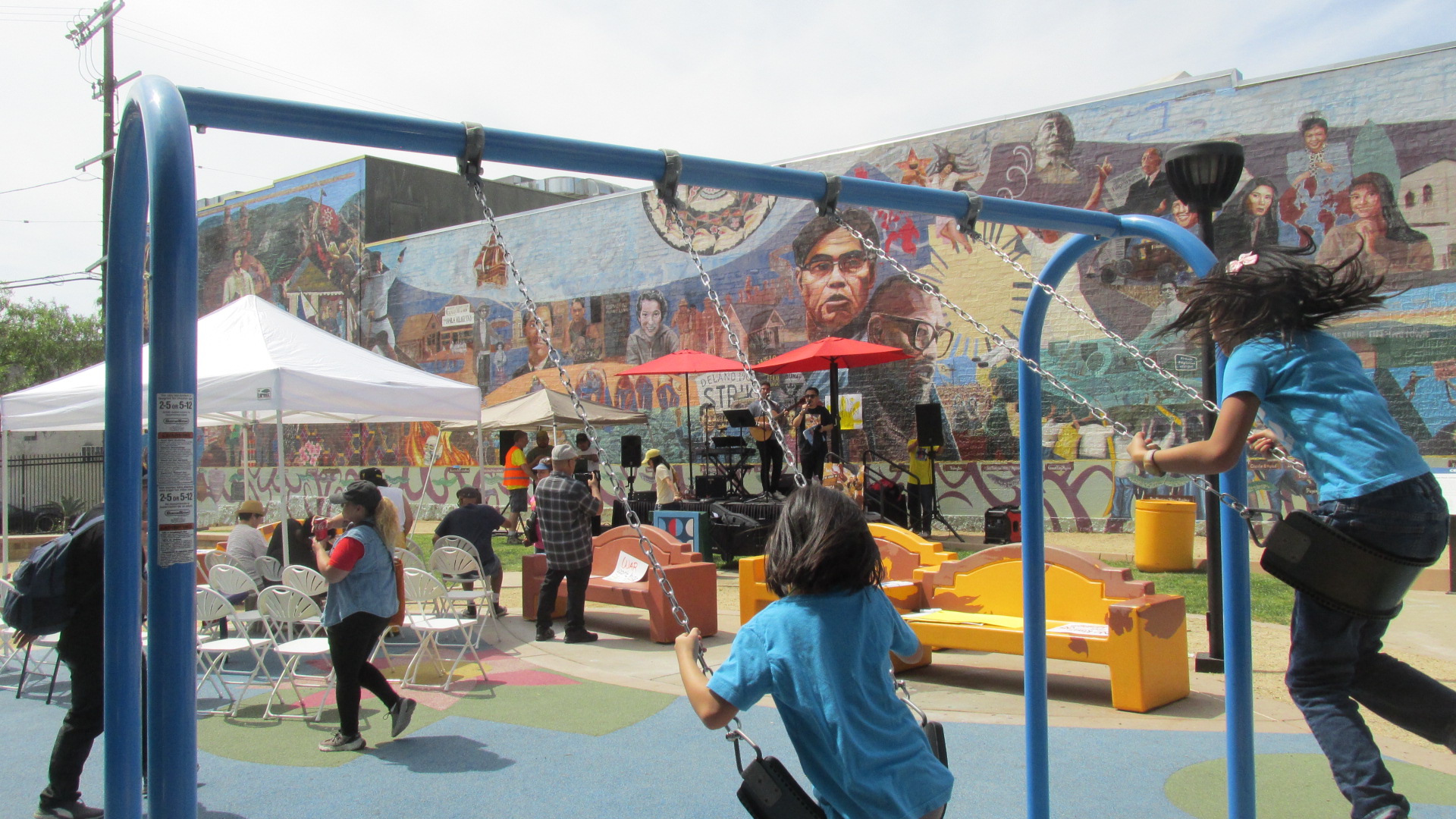
Then I went to small rally held in Unidad Park on Beverly in Filipinotown. I’d say between 50 and 100 people showed up to listen to speeches and music. A number of groups had tables set up where volunteers were engaging attendees on various issues. And some kids were having a great time on the swings.
Attendees gathering in front of the stage at Unidad Park in Historic Filipinotown.
Canopies were set up to shield attendees from the sun.A couple of kids were having a great time on the swings.
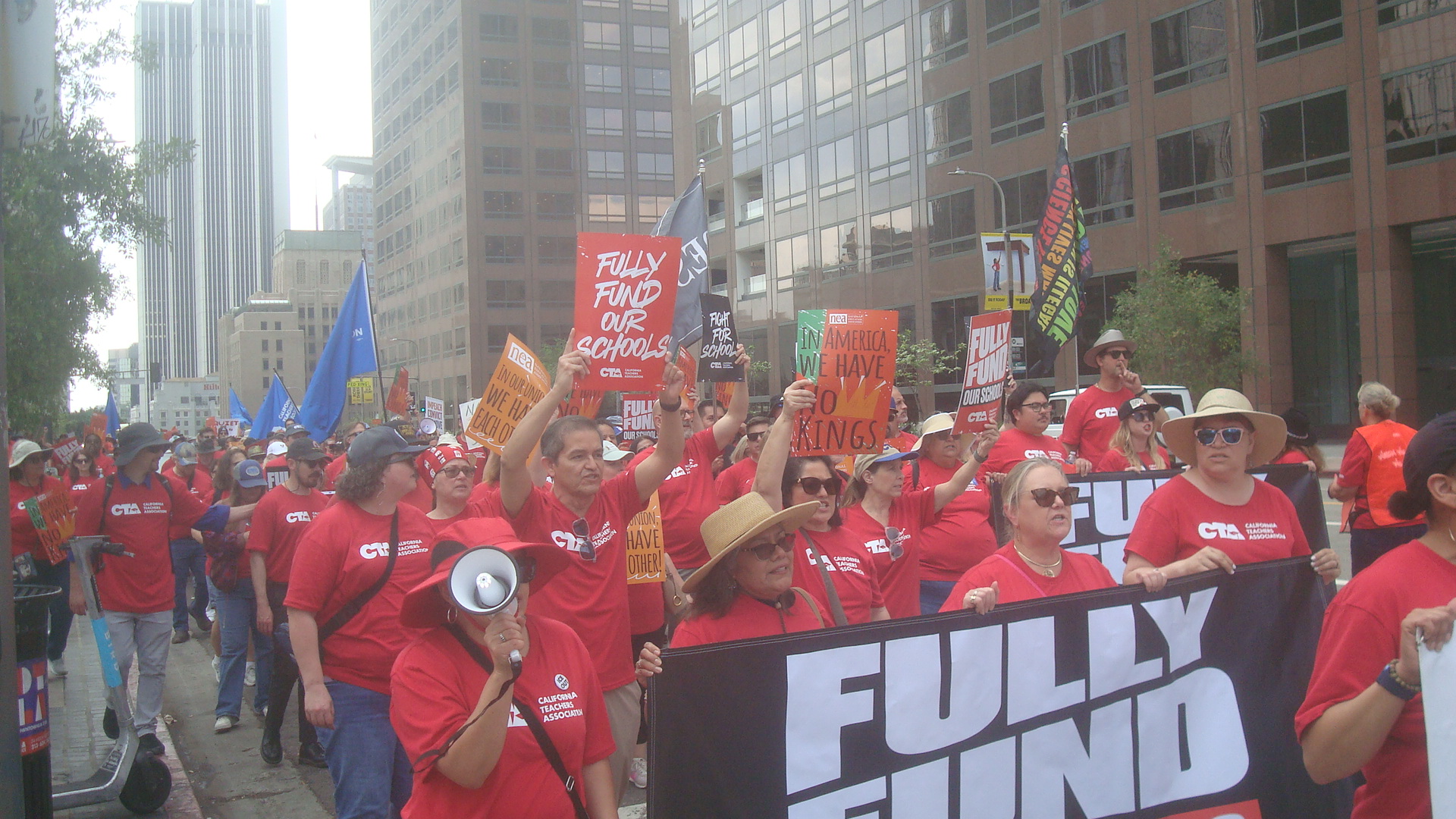
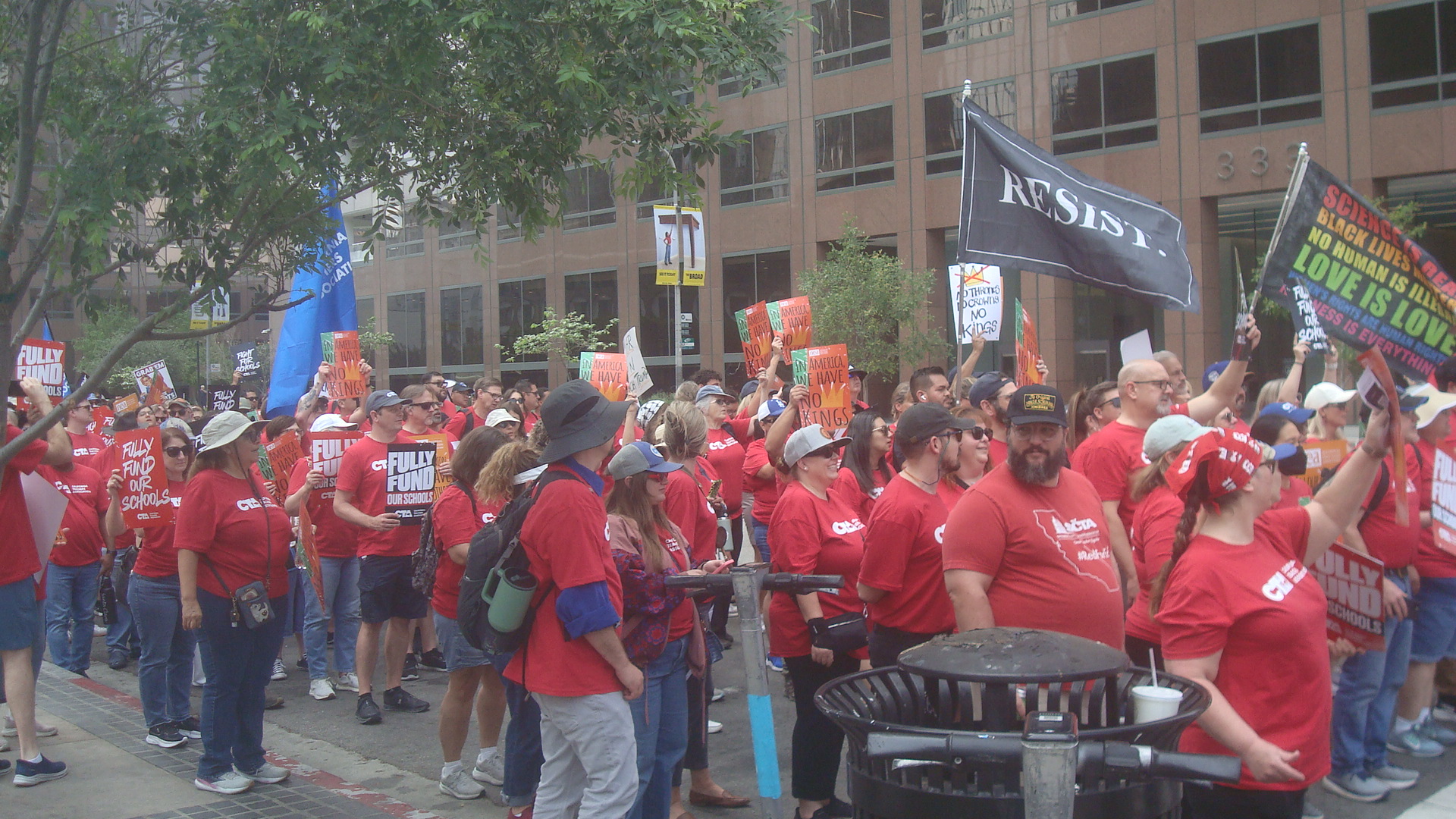
While I didn’t go to the main event at LA City Hall, I did pass through Downtown as I got off the bus to get on the train, and I ran into this group of teachers marching up Grand Avenue. They are not happy about what the current administration is doing to education. I assume they were heading to City Hall to join the crowd at Grand Park.
Teachers marching up Grand Ave. in Downtown LA.The march was well organized and the teachers shouted out slogans as they headed north on Grand.
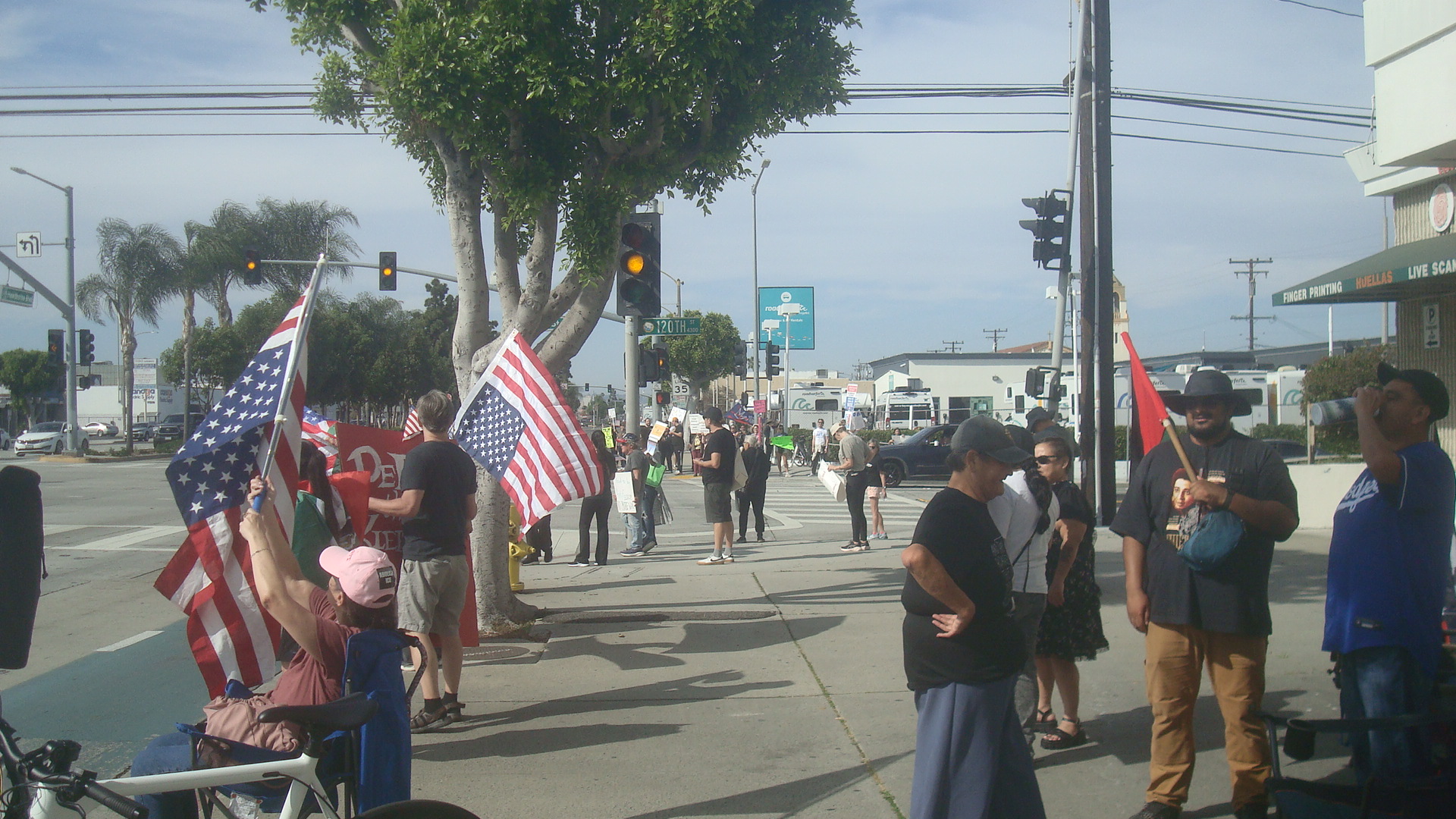
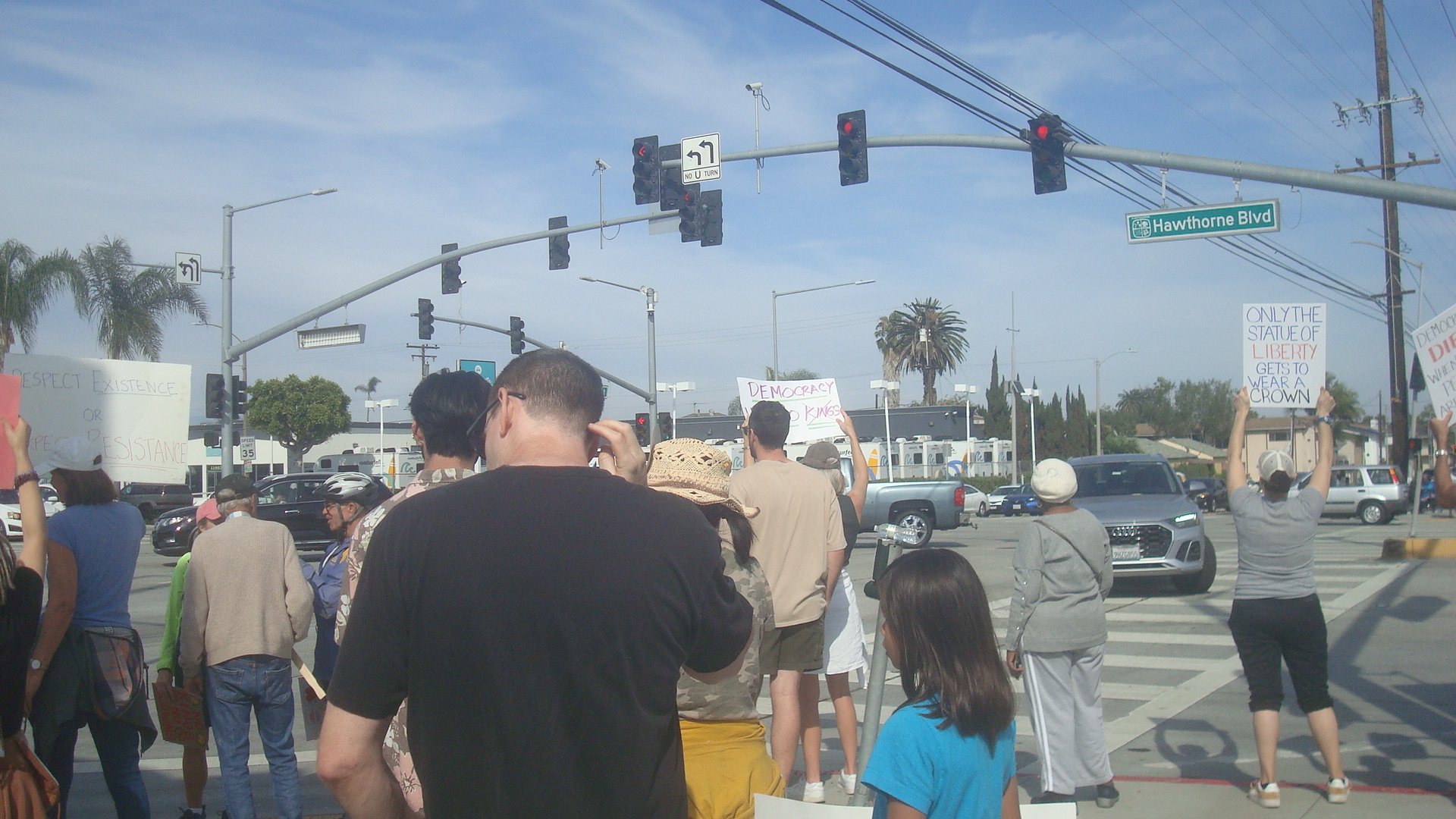
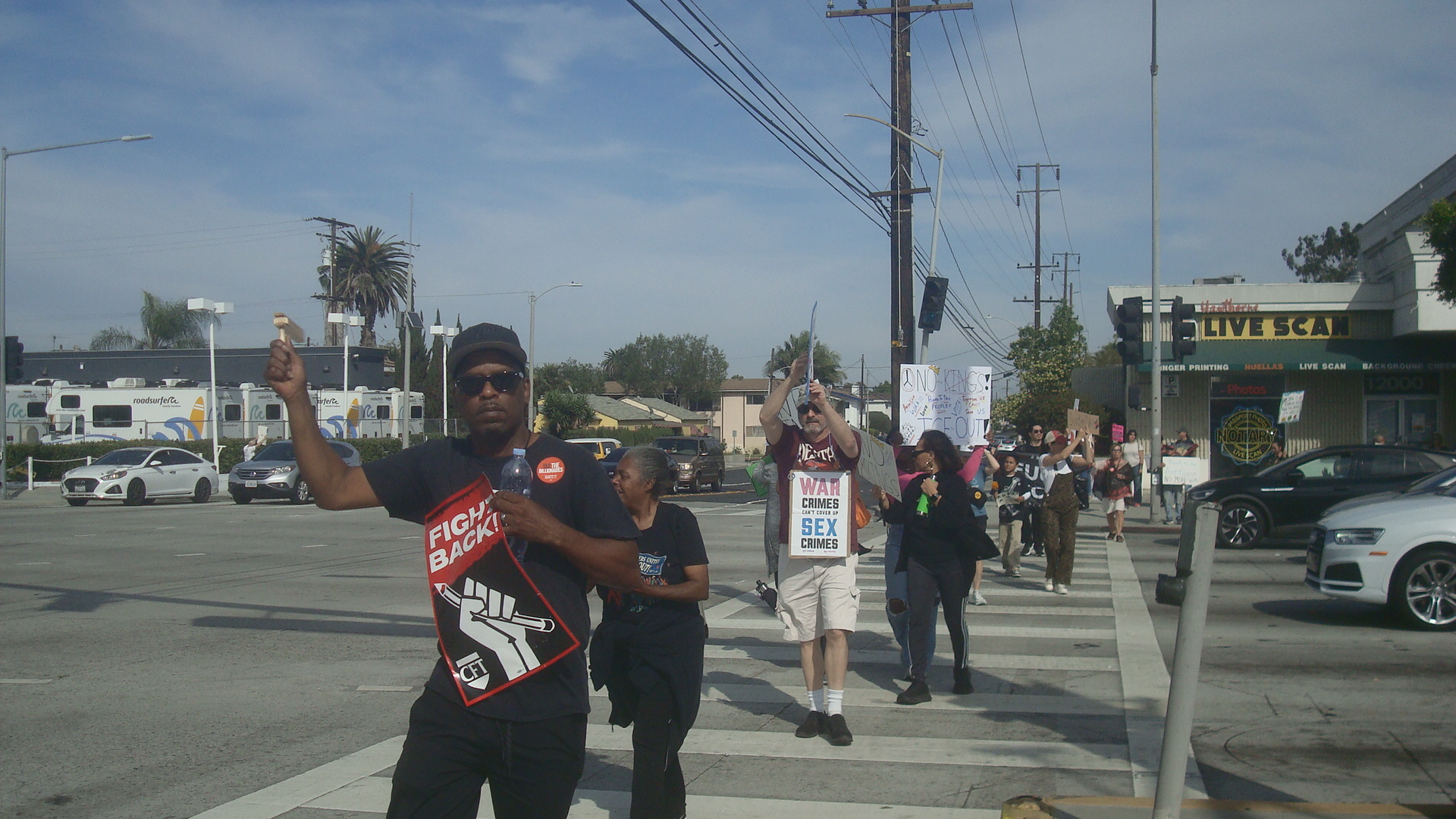
Then I headed down to Hawthorne, where a small but spirited group of protesters gathered at Hawthorne Blvd. And 120th. Attendees stood with signs and flags, marching back and forth across the intersection. They also got some appreciative honks from passing drivers.
Protesters gathered at Hawthorne Blvd. and 120th.
The crowd urged passing drivers to honk in support.
As the lights changed, protesters walked back and forth across the intersection.
I don’t see these protests going away. It seems like there’s growing frustration with the way things are in the US right now. It will be interesting to see what happens in the mid-term elections.
US ships are firing on boats off the coast of Venezuela. Masked ICE agents are grabbing people off the street. Troops have been sent into cities governed by Democratic leaders. The Federal government has cut billions in funding for universities that don’t teach what the President wants them to. This is the new reality under Trump, and millions of Americans are seriously concerned about what they believe are grave threats to democracy and the Constitution.
On Saturday people across the US turned out for No Kings rallies to voice their opposition to the current administration. According to the LA Times, 2,700 protests were scheduled to take place, about 600 more than for the previous day of protest in June. According to the No Kings organizers, more than seven million people turned out to protest yesterday. There were events scheduled throughout the LA area, including Beverly Hills, Burbank, Glendale, Hollywood, Lynwood, Long Beach, Torrance and Whittier.
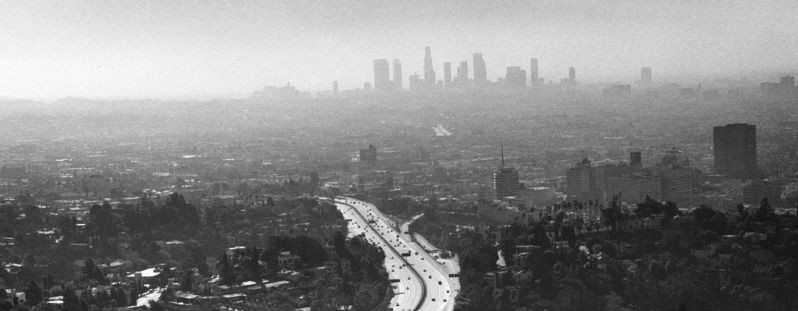
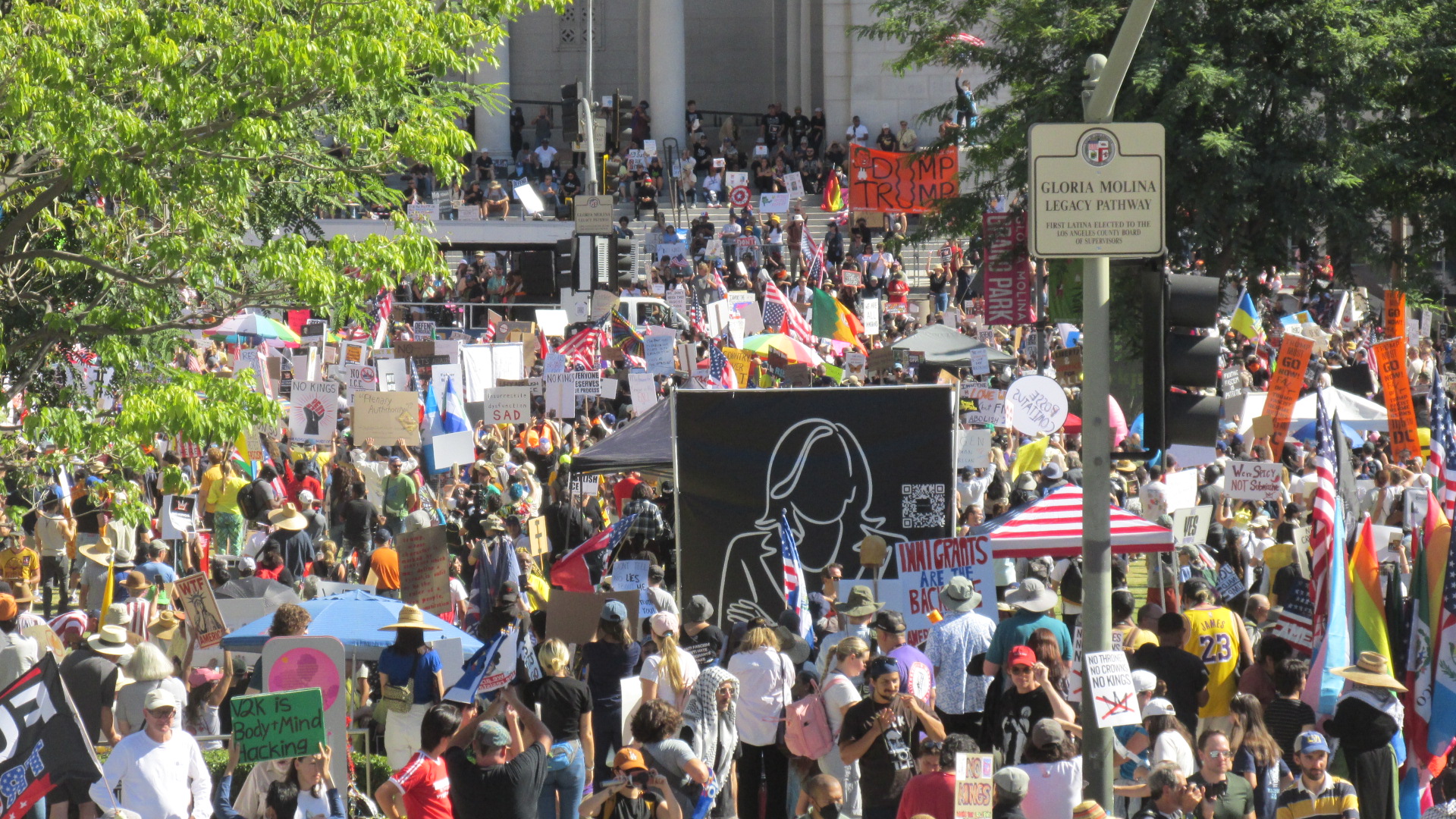
I went to the protest in Downtown LA and took some photos. Actually, the photo at the top of this post was taken several blocks south of the event on Olympic Boulevard. I snapped it while I was on my way to the protest. Something about the size and the colors seemed to capture the urgency of the moment. When I arrived at the Civic Center, crowds were marching into Grand Park carrying all sorts of signs and wearing all sorts of costumes.
Protesters gathered at City Hall in Downtown LA.
Crowd gathered near the steps to LA City Hall.
The fact that many protesters carried US flags seems to undercut the argument that they’re anti-American.
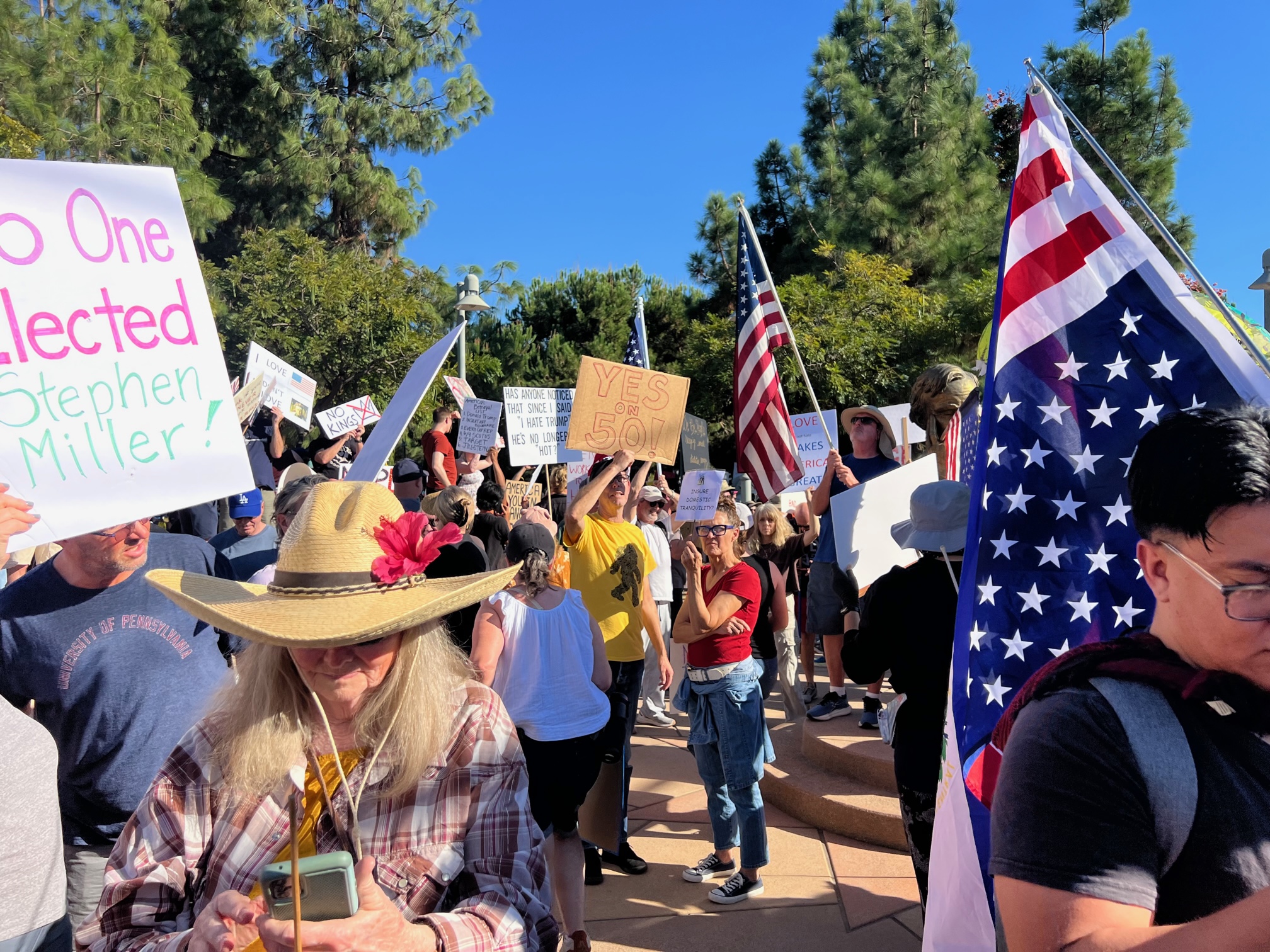
A friend of mine sent me these photos from the protest in Burbank. Looking at these photos it struck me how much that city has changed over the years. When I was growing up in Burbank, it was a fairly conservative town, and I don’t recall ever seeing a protest on this scale in the 60s and 70s. This kind of activism shows how much the city’s politics have shifted. The gathering was held at the intersection of Buena Vista and Verdugo.
Many protesters expressed their anger over troop deployments in US cities.Photo by Michael Golob.I don’t remember seeing anything like this when I was growing up in Burbank.Photo by Michael Golob.Some protesters wore colorful costumes. Photo by Michael Golob.When the introverts are angry, watch out. Photo by Michael Golob.
Thousands gathered at Pasadena City Hall to demonstrate against the Trump administration. Speakers included Congressional Rep Judy Chu, Pasadena Mayor Victor Gordo and Councilmember Rick Cole.
No Kings protest in Pasadena. Photo by Denise Goddard.Another image of Pasadena No Kings protest. Photo by Denise Goddard.
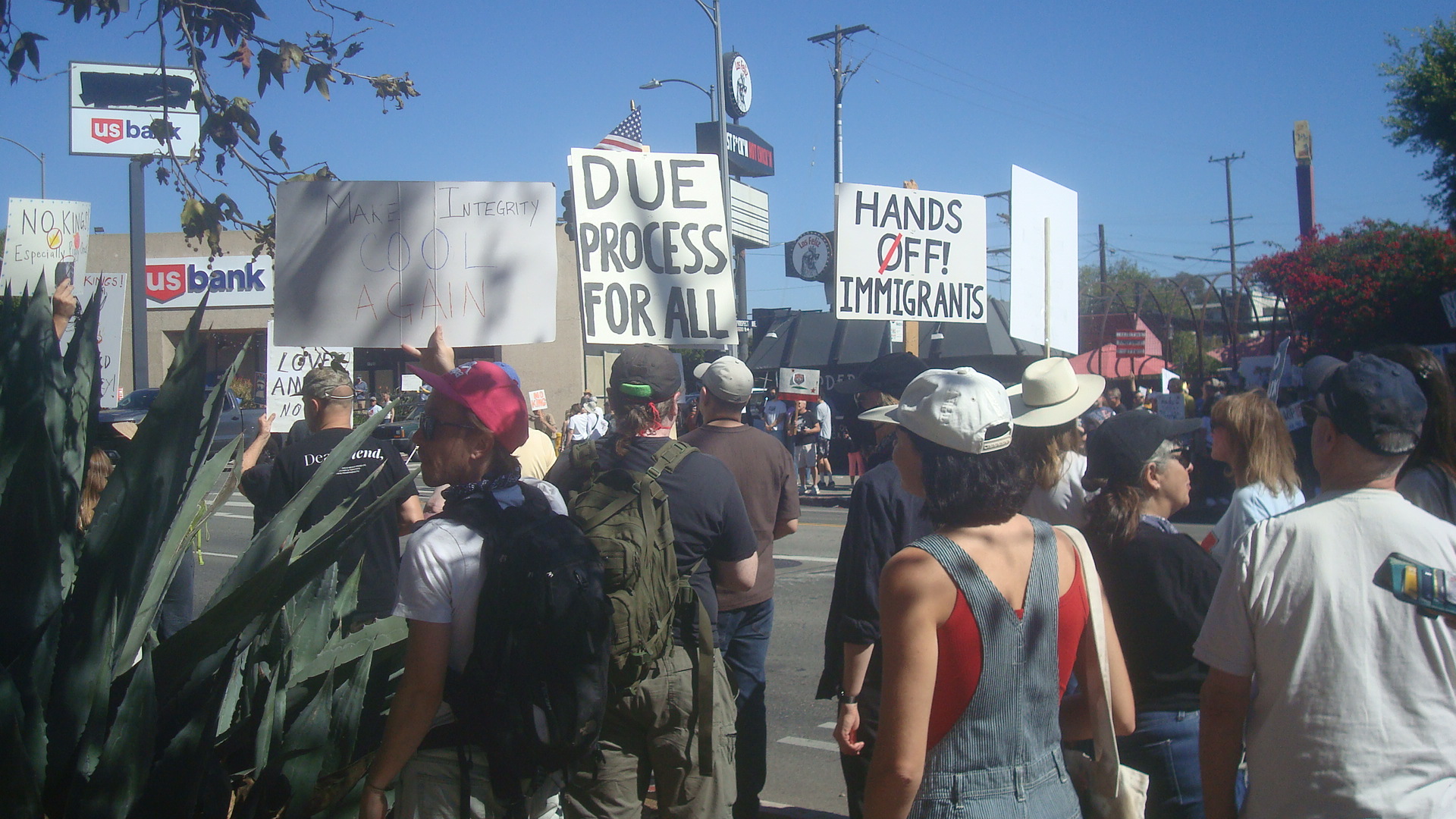
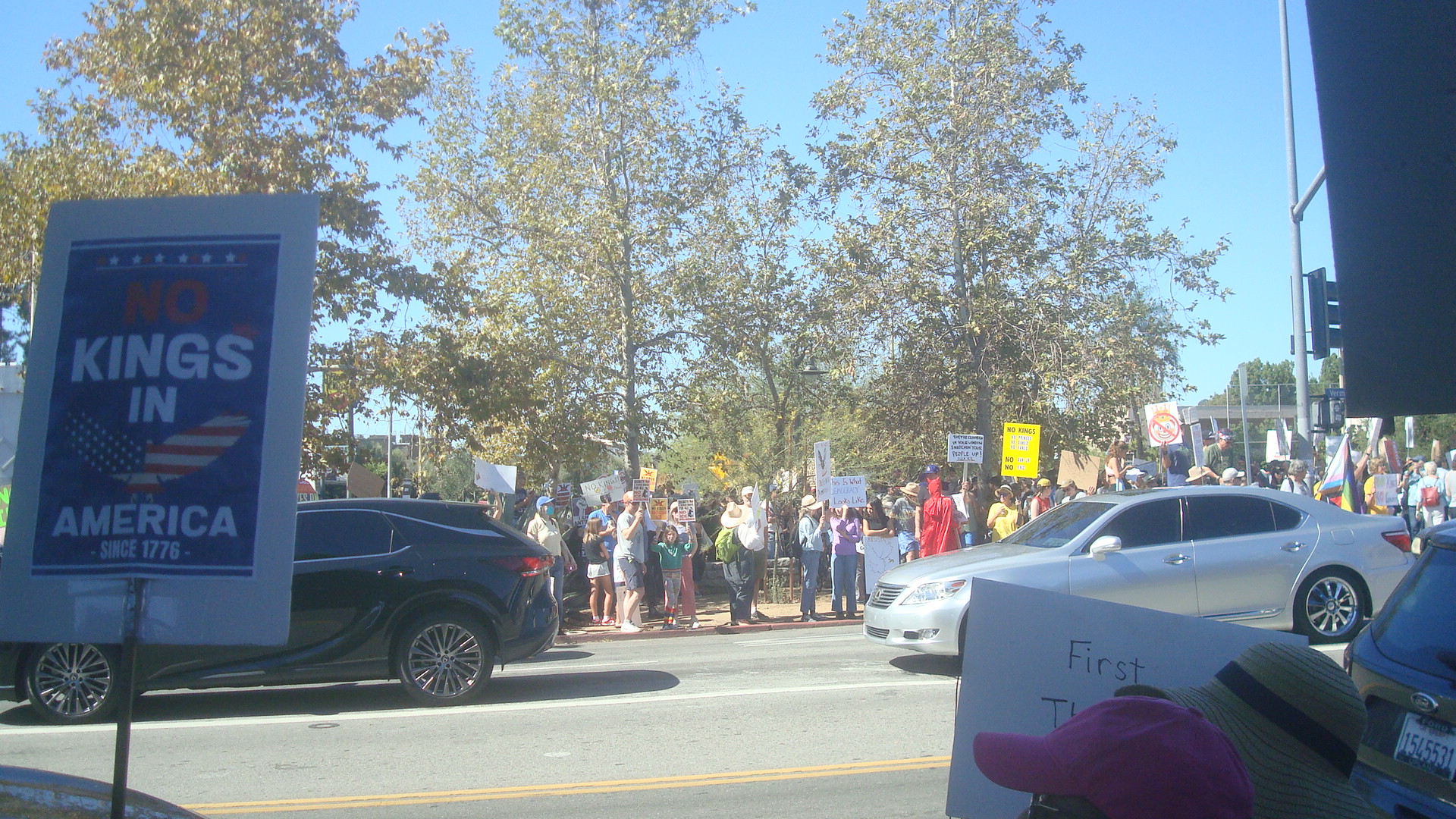
On my way to Downtown, I stopped at the Hollywood event. Protesters gathered at the intersection of Hollywood and Vermont. As people waved signs, drivers passing by honked their horns.
A lively crowd gathered at Hollywood and Vermont.Passing drivers honked their horns in sympathy.
The crowd spilled off the sidewalk and onto the street.
I am really worried about the future of this country, but I’m also really encouraged by the scale of the response. Not only do millions of people think we’re going in the wrong direction, but many of them are willing to show up at events across the country to make their anger known. It ain’t over yet.
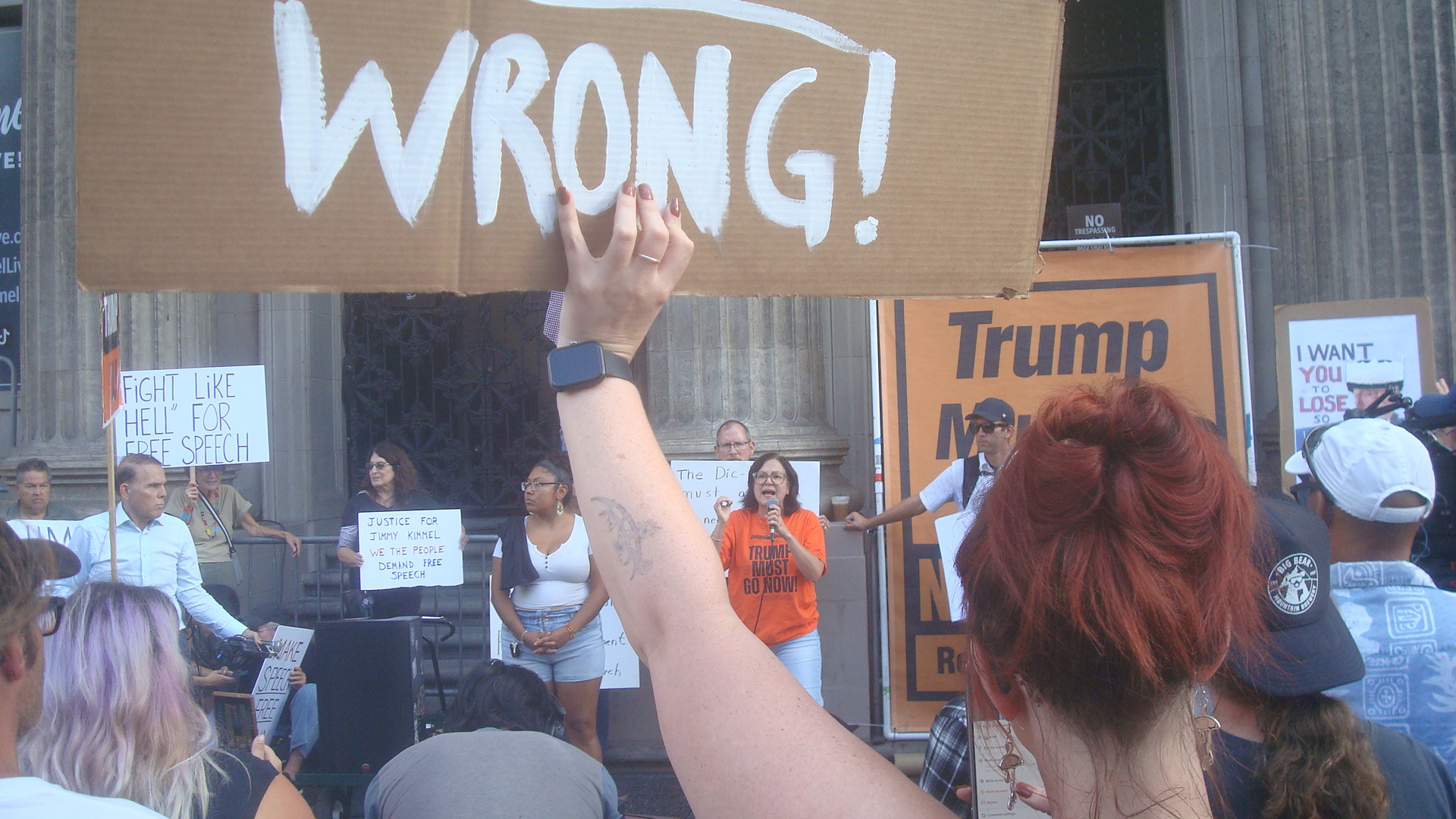
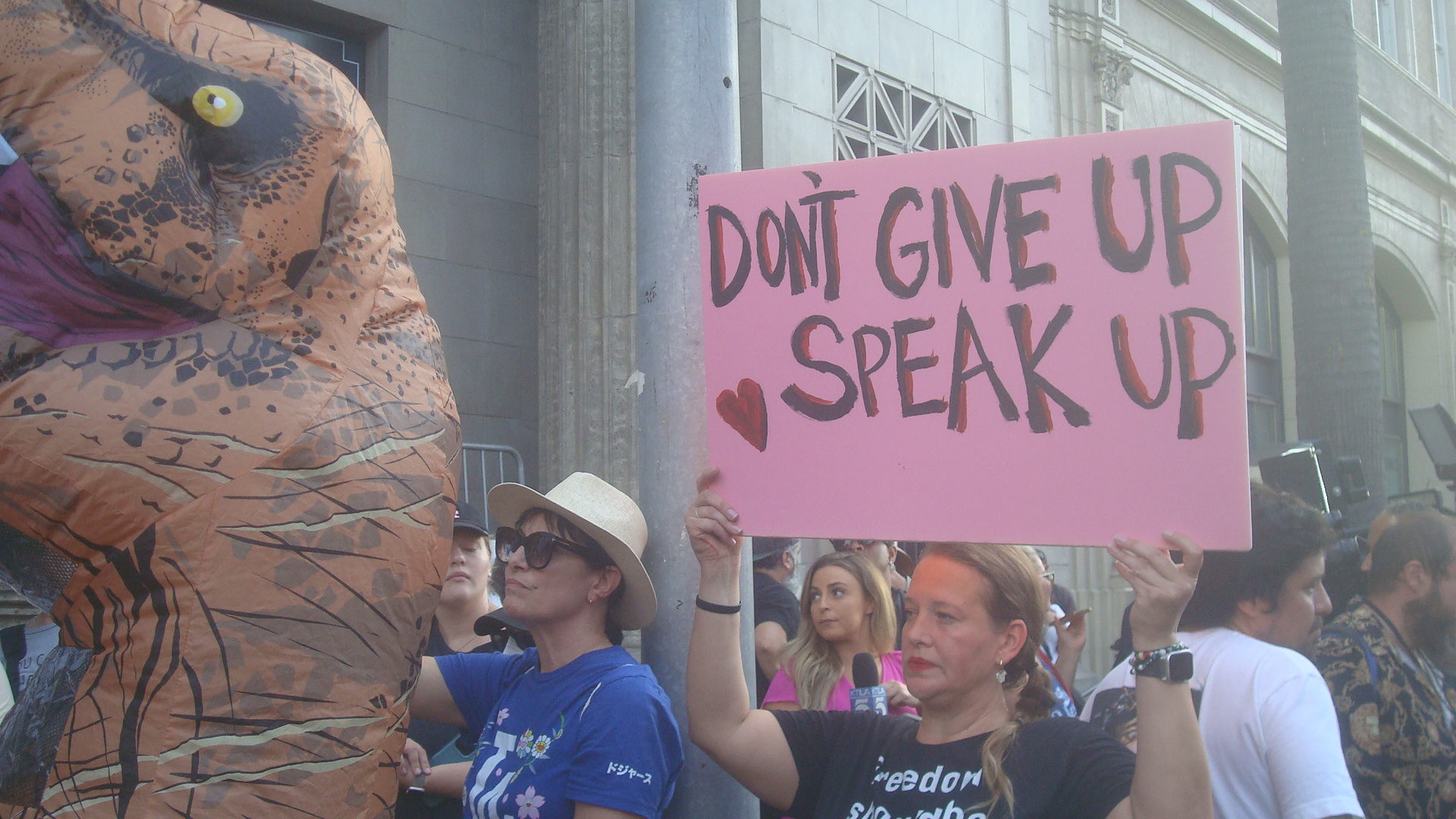
A few hundred protesters gathered in Hollywood on Wednesday night to protest ABC’s decision to pull the Jimmy Kimmel show, at least for the time being. I’ve never seen the show. If I’d heard that he was going off the air for low ratings, it wouldn’t have made any difference to me. But it appears that ABC pulled the show because of pressure from the Trump administration over comments Kimmel made in the wake of the Charlie Kirk shooting. This is really disturbing.
Crowd listening to speaker at protest.
According to both the New York Times and Fox News, in the aftermath of Kirk’s killing, Kimmel said on air that the right was working hard to portray the killer as a leftist in order to score political points. Apparently, Kimmel mistakenly believed that that killer had right wing views. Brendan Carr, the Chair of the Federal Communications Commission appointed by Trump, was angered by Kimmel’s comments, which he believes were part of a concerted effort to lie to Americans. According to the New York Times, Carr stated that broadcast companies needed to “find ways to change conduct and take action”, or the FCC might take action against them.
Unfortunately, while Carr claimed that Kimmel’s statements were part of a “concerted effort to lie to the American people,” I couldn’t find any reports that he gave other example of those lies, or that he talked about who was involved in the effort. No doubt he’s pointing the finger at the “liberal media”, a loosely defined term that seems to include any broadcaster or publisher that presents news that could be seen as critical of Trump.
Plenty of signs objecting to ABC’s action.
None of the published accounts I’ve read quote Kimmel as saying anything negative about Kirk himself, nor does it seem like he made any comments that could be perceived as condoning the killing. He made an inaccurate comment about the killer. TV personalities say things that are inaccurate all the time. They often make inaccurate statements because of their own personal bias. They often say controversial or shocking things because that draws media attention. This is true of celebrities on the right and the left. American popular culture rewards people who create controversy.
As many people have pointed out, when Trump was re-elected he claimed that he was going to restore free speech in America. But just in the last two years, he’s aggressivley gone after news organizations that have published stories he doesn’t like, suing the Wall Street Journal, the New York Times and CBS for billions of dollars. Now it looks like the Trump administration is willing to use the power of the FCC to punish broadcasters that don’t fall in line.
Free speech is under attack. This is a scary time for America.
Hollywood got a new mural earlier this month. A striking image of P-22, the mountain lion that made its home in Griffith Park, now gazes out on the boulevard. P-22 captured the public’s attention by migrating from the western Santa Monica Mountains to Griffith Park, which involved crossing both the 405 and the 101 Freeways. Angelenos mourned the mountain lion’s death in December 2022.
I knew there had been a number of tributes to P-22, but I didn’t realize how many murals he was featured in. There are at least six. Three were painted by muralist Jonathan Martinez. Multi-disciplinary street artist Corie Mattie has also painted three, of which the one on Hollywood Blvd. is the most recent.
It’s great that people remember P-22, but it would be even better if people started thinking about ways to keep these beautiful animals alive. One of the reasons P-22 caught the public’s attention was that he managed to cross two freeways without getting hit. Many mountain lions die from vehicle collisions every year. A 2024 study from the UC Davis Road Ecology Center reports that 613 mountain lions were killed on roads between 2016 and 2023, inclusive. That averages out to about 76 per year.
The P-22 mural is located at 6411 Hollywood Blvd., just a few doors west of Cahuenga.
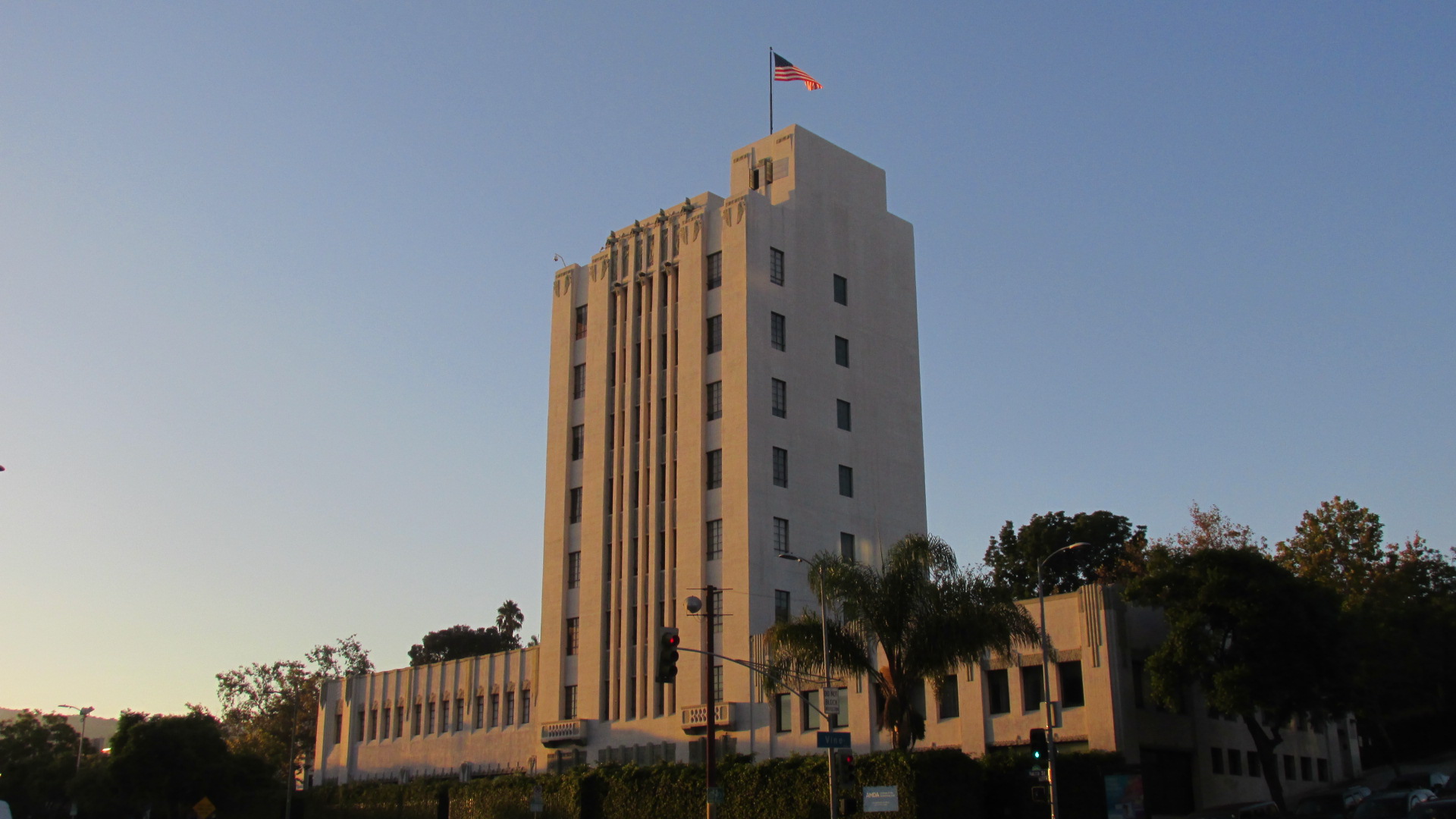
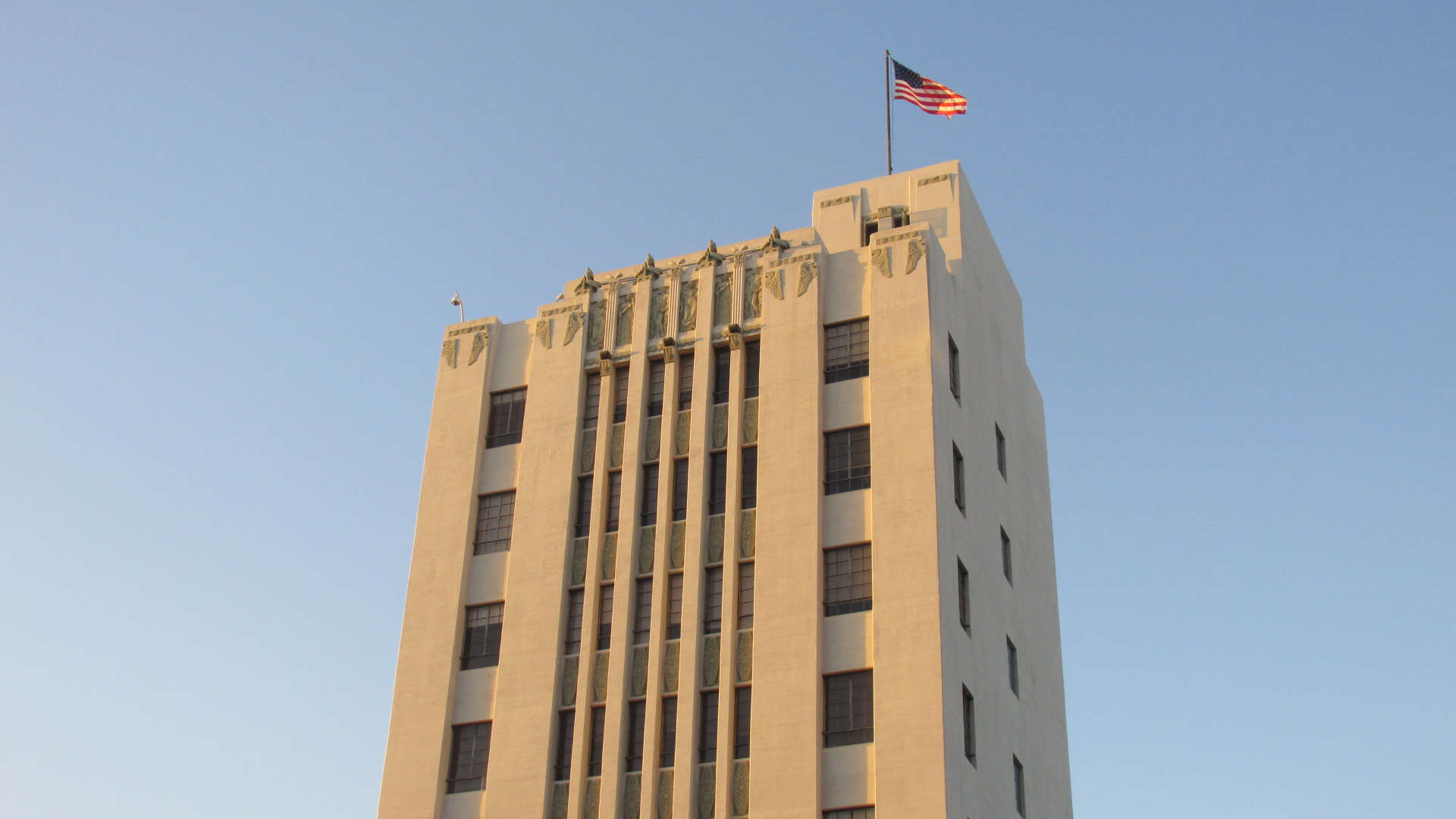
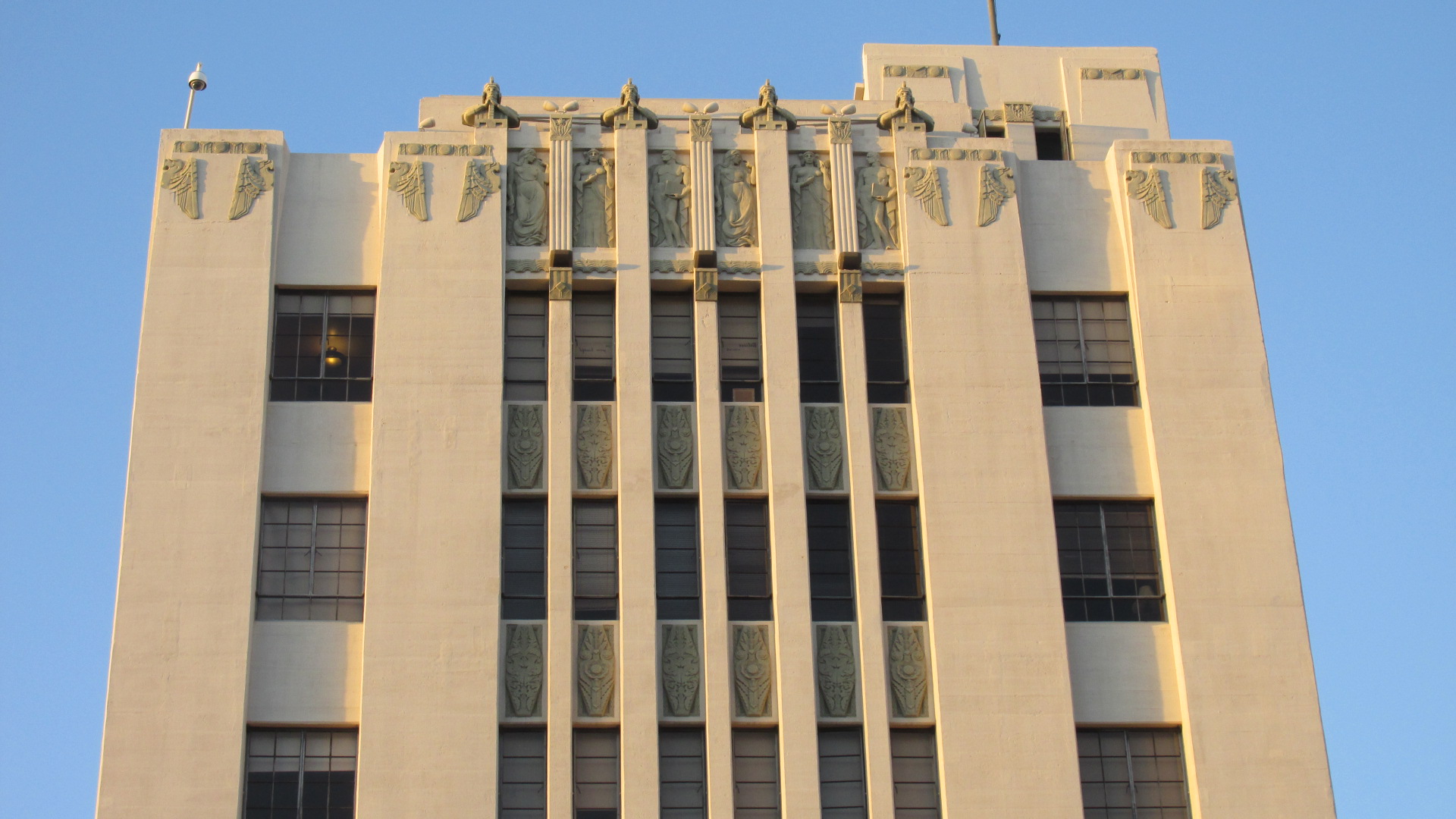
One of Hollywood’s most beautiful buildings is finally getting the recognition it deserves. On April 18, the City of LA’s Cultural Heritage Commission voted unanimously to recommend that the Yucca Vine Tower be designated a Historic Cultural Monument.
View of central tower.Top of central tower.
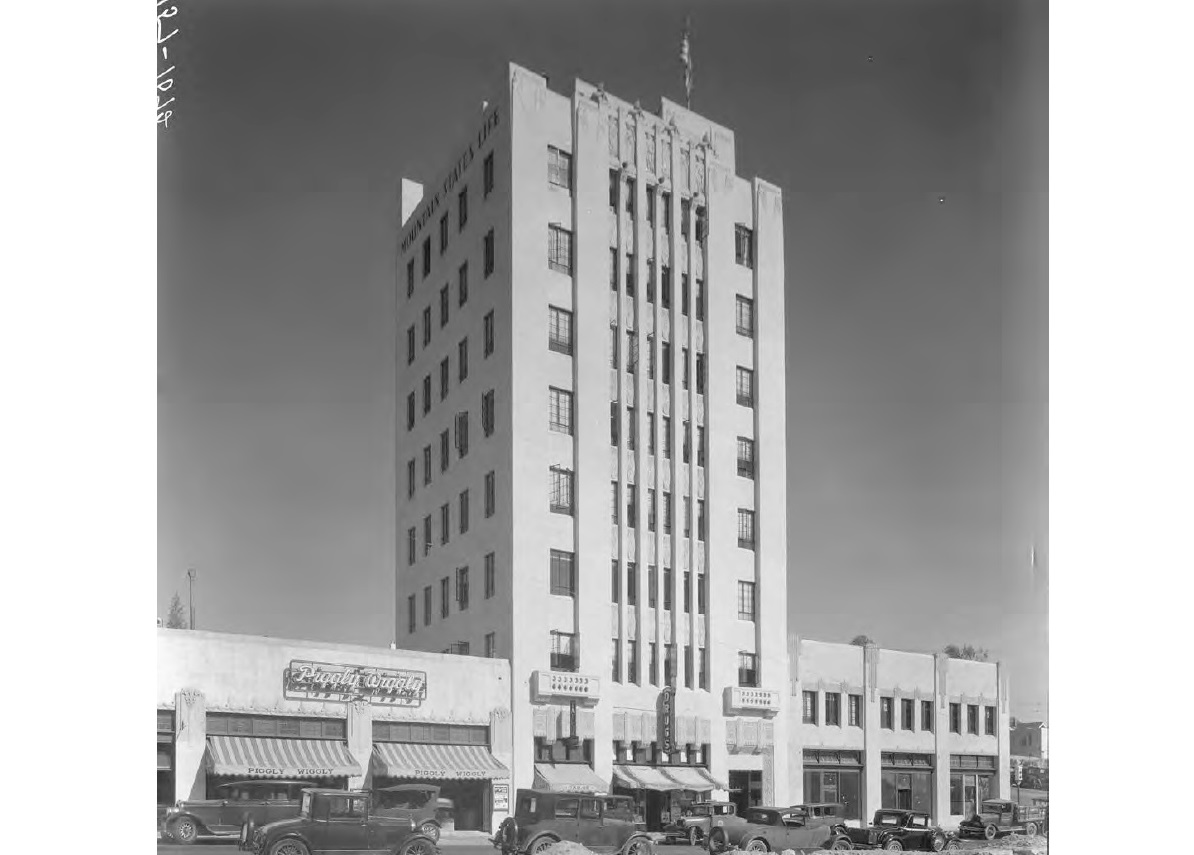
This Art Deco classic, constructed nearly 100 years ago as the Mountain States Life Building, was designed by LA-based architect Henry Gogerty. Currently occupied by the AMDA College of the Performing Arts, the list of former tenants includes Gene Autry’s Western Music Publishing, Motion Picture Daily, the Hollywood Anti-Nazi League, and Chao Praya, one of the first Thai restaurants in LA. In addition to designing other notable buildings in the Hollywood area, Gogerty worked on over 350 schools in Southern California. His firm is also credited with designing the Hughes Aircraft complex in Playa Vista and the Grand Central Air Terminal at the former Glendale Airport.
Historic image of Yucca Vine Tower from California State Library.
Thanks to John Girodo and the Art Deco Society of Los Angeles, who submitted the nomination. Thanks also to Kathleen Perricone, whose thorough research in preparing the nomination made an excellent case for historic designation. For more background on this amazing building, take a look at the CHC agenda packet, which is available here. The packet contains a wealth of historic photos. You can jump to them by clicking on Historic-Cultural Monument Application in the index on the first page.
View of Yucca Vine Tower from west.Detail of base.
The designation isn’t final yet. It still has to be approved by the full City Council. Hopefully they’ll vote soon to give this gorgeous building HCM status.
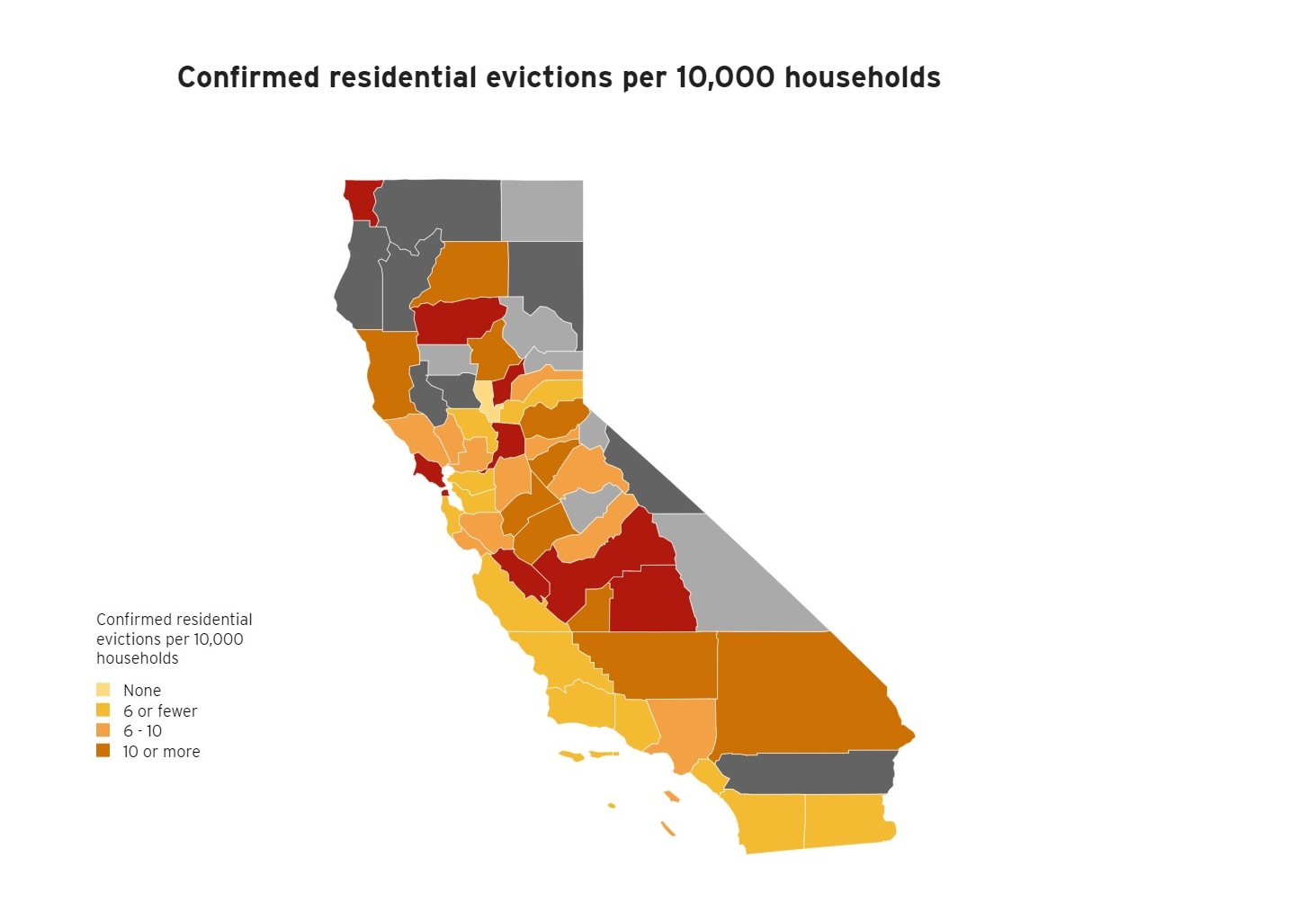
On Thursday morning LA Sheriffs arrived at an apartment building on Cahuenga in Hollywood to serve an eviction notice. Before they were able to enter the apartment, they heard a single gunshot from inside. Eventually they gained entry, and found an individual who had died from “an apparent self-inflicted gunshot wound.”
Earlier this year, the annual survey conducted by the LA Homeless Services Authority found there were 41,980 people experiencing homelessness in the City of LA (a 1.7% increase from 2020) and 69,144 people experiencing homelessness in LA County (a 4.1% rise from 2020). Apparent inaccuracies that have been found in the survey have led many people to believe that the actual numbers are far higher.
In June 2020, the LA Housing & Community Investment Department released a report estimating that there were between 85,000 and 100,000 empty housing units in the City of LA. (See page 5.)
In their 2020 report on vacancy in Los Angeles, SAJE, ACCE and UCLA Law found that the City was producing far more expensive units than affordable ones, leading to excessive vacancies at the high end and a shortage of supply at the low end. (See page 5.)
“Simply put, new expensive housing remains disproportionately vacant, thereby failing to free up units for lower-income families. In addition to the intentional maintenance of overpriced units for rent or sale described above, the system of housing production in Los Angeles has created, on the one hand, a surplus supply of high-rent housing with elevated vacancy for new and higher-priced units, and on the other hand, a massive shortfall of low-cost housing that has contributed to the houselessness crisis.”
We don’t know much about the renter who took his life on Thursday, but it seems likely that, knowing he was about to be evicted from his home, he shot himself because he felt he had no place else to go.
How is that possible in a city where tens of thousands of units sit empty?
Another depressing loss for the Hollywood community. After 32 years, the Bourgeois Pig closed its doors on June 17. Located at the corner of Franklin and Tamarind, the Pig was a cozy space where writers worked on their novels, actors chatted about auditions, and an assortment of locals just lounged on the sofas and sipped their espresso. I was never a regular, but used to drop in once or twice a year. It was a really comfortable place to chill. I loved the twilight atmosphere and the low key vibe.
Apparently the owners are trying to keep the Pig alive, so hopefully they’ll find a new location. They’ve started a GoFundMe page, if you want to make a donation.
Rack outside the Bourgeois Pig where people left cards, flyers, etc.Close-up of the rack.
It’s depressing to see another neighborhood coffee house close down. Corporate chains have taken over more and more of our communities with their oppressive sameness and lousy coffee. The people who ran the Pig had imagination and heart. I’ll miss them.
Anybody who pays attention to the news knows that there’s a heated, ongoing debate in LA, and across California, about how to solve our housing problems. There are lots of different proposals floating around, but the message we hear most often from elected officials and the development community is that we have to upzone to allow a whole lot more density. The argument goes that it’s just a matter of supply and demand. If we upzone our cities and upzone our suburbs, that will unleash the power of the free market and we’ll have plenty of cheap housing for everybody
One idea that’s especially hot right now is the proposal to upzone areas dominated by single-family homes (SFH). Some State legislators have embraced this approach, resulting in bills like SB 1120. The City of LA hasn’t yet made a move to upzone SFH areas, but the concept is popular among local progressives who believe we just need to build more housing. Heated debates have erupted over the topic on social media. At a recent hearing on the Hollywood Community Plan Update (HCPU) some members of the public expressed enthusiastic support for ending SFH zoning.
It’s easy to see why the idea is popular. Young people, especially young people of color, are finding it difficult or impossible to afford housing these days. Whether you’re renting or buying, prices are sky-high. If you accept the argument that just creating more supply will drive prices down, it must seem insane to maintain zoning that only allows single-family homes. The argument is that older, affluent homeowners are selfishly defending their own turf, shutting out young people who struggle to make ends meet. Proponents of upzoning SFH areas also point to the history of racism that used tools like zoning to promote segregation.
Taking the last point first, there’s no question that racism has been a huge factor in housing policy in LA (and across the nation). There’s a well-documented history of real estate interests working with city officials to favor whites over people of color. It’s naive to think that racism doesn’t still play a part in the housing market today. Beyond that, it’s completely understandable that young people who can barely afford to pay the rent would look at the suburbs and ask why some people own single-family homes when they’re just a step or two away from homelessness. And there’s another reason the idea of upzoning SFH areas is attractive: It’s simple. If just building more homes will allow everyone to have housing, how could anyone argue against it?
And that’s the problem. The way case is being stated is too simplistic. It assumes that all we have is a problem of supply and demand. But the 21st century housing market is far from simple. There are many reasons why housing is so inaccessible for so many people. Zoning is a factor, but it’s just one aspect of the problem. The biggest factor, one that’s often ignored in heated housing debates, is that real estate has become a global industry powered by trillions of dollars in investor cash. In The Vacancy Report (SAJE/ACCE/UCLA Law, 2020) researchers point out that in recent decades housing has rapidly become financialized. Private equity and corporate entities have come to dominate the housing market, and they’re only interested in getting the highest rate of return as quickly as possible.
So if we’re talking about upzoning, it’s important to say up front that the value of urban and suburban land is determined by how much you can build on it. As soon as you upzone a parcel, its value increases. The more you can build, the more it’s worth. If you take a parcel that’s zoned for one single-family home and upzone it to allow four, eight or more units, you’re actually making the land much more valuable and therefore much more costly. The cost of land in LA is already extremely high, and increasing allowed density will drive the cost even higher.
If the key issue is the lack of affordable housing, upzoning by itself does nothing to solve the problem. As Patrick Condon points out in his book Sick City, when a city just increases allowable density, it’s really increasing the cost of the land, and that additional cost is ultimately paid by the household that’s renting or buying. The benefit goes to the landowner, not the renter or buyer. For a solution, Condon holds up Cambridge, Massachusetts, where city officials adopted an ordinance that allows increased density but only for the construction of permanently affordable units.
This is a radical solution, and one that probably has no chance of being adopted in a city like LA. The first people to object would be real estate investors, who would argue that they can’t possibly make a profit by building affordable units. Exactly. Because the Cambridge ordinance includes strict affordability requirements, it increases allowable density without jacking up the value of the land. This opens the door to not-for-profit affordable housing developers who can build what we most need: housing accessible to middle-income and low-income people. California legislators claim that bills like SB 1120 will help solve our housing problem just because they increase density, but without an affordability requirement, we might as well just be stuffing cash in the pockets of real estate investors.
And now back to the Hollywood Community Plan Update. The HCPU Community Plan Implementation Overlay (CPIO) is also based on the idea that increasing density will solve all our housing problems. It offers generous incentives for residential projects in Central Hollywood that include some affordable housing. Projects that offer between 10% and 23% affordable can receive a 100% density bonus, along with other incentives like increased floor area ratio (FAR) and reduced setbacks.
This is actually a rehash of the Transit Oriented Community (TOC) Incentives, a program that’s already in place. The City boasts about the affordable housing created by the TOC program, but what they don’t mention is that many TOC projects involve the demolition of existing rent-stabilized (RSO) units. The City does require replacement units to be built, but it allows the developer to count replacement units toward the affordable total. So a project recently approved at 4629 W. Maubert includes 17 new affordable units, but it also involves the demolition of 14 RSO units, meaning we have a net gain of 3 units accessible to low-income households. The TOC approved for 1920 N. Whitley includes 3 affordable units, but replaces 3 RSO units. No gain there. At 1341 N. Hobart the approved project offers 7 affordable units, but will erase 9 RSO units, meaning a net loss of 2. These projects will produce dozens of new high-end units, but there’s no shortage of those. What we really need is housing accessible to low-income tenants.
Since the vast majority of housing in Central Hollywood consists of RSO apartments, the hefty incentives offered by the HCPU are basically putting a target on the backs of renters who live in the area. For instance, a developer buys a property containing a rent-stabilized four-plex where existing zoning would allow 20 units. Taking advantage of the HCPU density bonus, they propose a new building with 40 units, including four extremely low income units to satisfy the affordable requirement. The developer gets a huge profit as a result of doubling the allowed density. The RSO tenants get an eviction notice. And there’s no net gain in low-cost housing. In other words, by jacking up density in Central Hollywood the HCPU incentivizes displacement. And it gets even better for developers. Under the Plan’s CPIO, City Planning can approve the project without holding a single hearing. There’s no requirement for community engagement, and no possibility of appeal. If the project meets the CPIO’s requirements, it’s a done deal.
If just increasing density made housing more affordable, Manhattan would be one of the cheapest places on earth to live. It’s not. It’s one of the most expensive. New York City has been on a building binge over the past decade, with massive upzoning leading to a swarm of super-tall skyscrapers. What’s the result? A glut of units at the high-end of the market, while middle-income and low-income households are still struggling to keep a roof over their heads, in spite of inclusionary zoning requirements that were supposed to deliver affordable housing.
Increasing density can bring benefits, but only when coupled with careful planning. Sweeping proposals to upzone large swaths of urban or suburban land will do nothing to increase affordability. They’ll just funnel more money into the bank accounts of real estate investors. And upzoning urban land can be especially dangerous. Without strong protections for tenants (which the HCPU does not have) density bonus measures will likely lead to even more displacement.
There are no simple answers. Upzoning by itself will not solve anything.
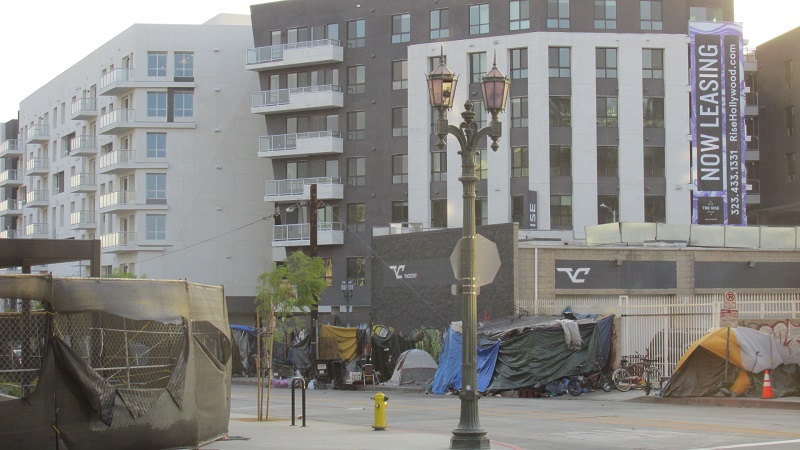
Scene from the corner of Ivar and De Longpre in Hollywood.
I was on my way to the market when something caught my eye at the corner of Ivar and De Longpre. Actually, it was two things. The first was a massive new apartment building on Cahuenga, with a huge banner that exclaimed “NOW LEASING”. The second was a homeless encampment on Ivar. Seeing the pricey new apartments and the row of makeshift shelters so close together struck me as a perfect image of what’s happening in Hollywood these days, and really what’s happening across so much of LA. The City keeps telling us that building expensive new housing will alleviate the housing crisis, but upscale units like these are completely out of reach for the people who need housing most.
Part of what makes the scene so perfect is the banner shouting “NOW LEASING”. I have no idea how many of the units have been rented, and maybe it’s almost full, but I doubt it. A June 2020 report to the LA City Council from the Housing + Community Investment Department offers data on vacancy rates in various LA neighborhoods. While it uses multiple sources to assess vacancies, the report’s authors state that data from the LA Department of Water & Power is probably the most reliable. Does it surprise you that according to LADWP the vacancy rate in Hollywood is 10.7 percent? That’s 1,372 empty apartments in the Hollywood area, and I bet most of them are in new buildings like the one you see in the picture. You know, the ones where the rent for a single starts around $2,000.
Now, the US Census says that the average household size in LA County is 2.8 people. So if we multiply 1,372 units by 2.8 we find that you could house about 3,841 people in the apartments that are sitting vacant in Hollywood right now. Interestingly, the 2020 Los Angeles Homeless Count found that Council District 13, which covers much of Hollywood, has a total of 3,907 people experiencing homelessness. (A 22% jump over 2019.) In other words, you could fit almost all of the homeless people in CD 13 into the units that are sitting empty in Hollywood.
Of course, none of those homeless folks could afford $2,000 for a single. Let alone $3,000 or $4,000 for a one-bedroom or two-bedroom unit. But the LA City Council keeps telling us that if we just keep building housing, any kind of housing, even housing that the average Angeleno couldn’t possibly afford, it will help alleviate the housing crisis.
So they keep on approving high-end apartment complexes. And the homeless population keeps on growing larger.
The last couple of weeks have been intense. Protests throughout the nation sparked by the killing of George Floyd. The National Guard being deployed in major cities. Viral videos exploding across social media. Politicians scrambling like mad to try and cover themselves. It’s been a wild time.
And it’s been pretty wild here in Hollywood. I have not personally been involved in any protests. I’ve been mostly hanging out in my apartment, scanning the news for the latest developments and listening to the sirens wailing outside. And even without having been in the thick of the crowds, it’s been an emotional rollercoaster. Horror over the death of George Floyd. Excitement about the growing protests. Anger over the looting. Depression at seeing the National Guard on LA’s streets. Again.
And then today, I actually feel kind of happy and kind of hopeful. Let me tell you how I got here….
Like I said, I haven’t been to any of the protests, but I was following the news reports of the massive gathering last Tuesday in Hollywood. The next morning I was out on Hollywood Blvd., and here’s some of what I saw.
Boarded-up storefront on Hollywood Blvd..
National Guard troops inside a parked vehicle.
LAPD action at Hollywood and Vine.
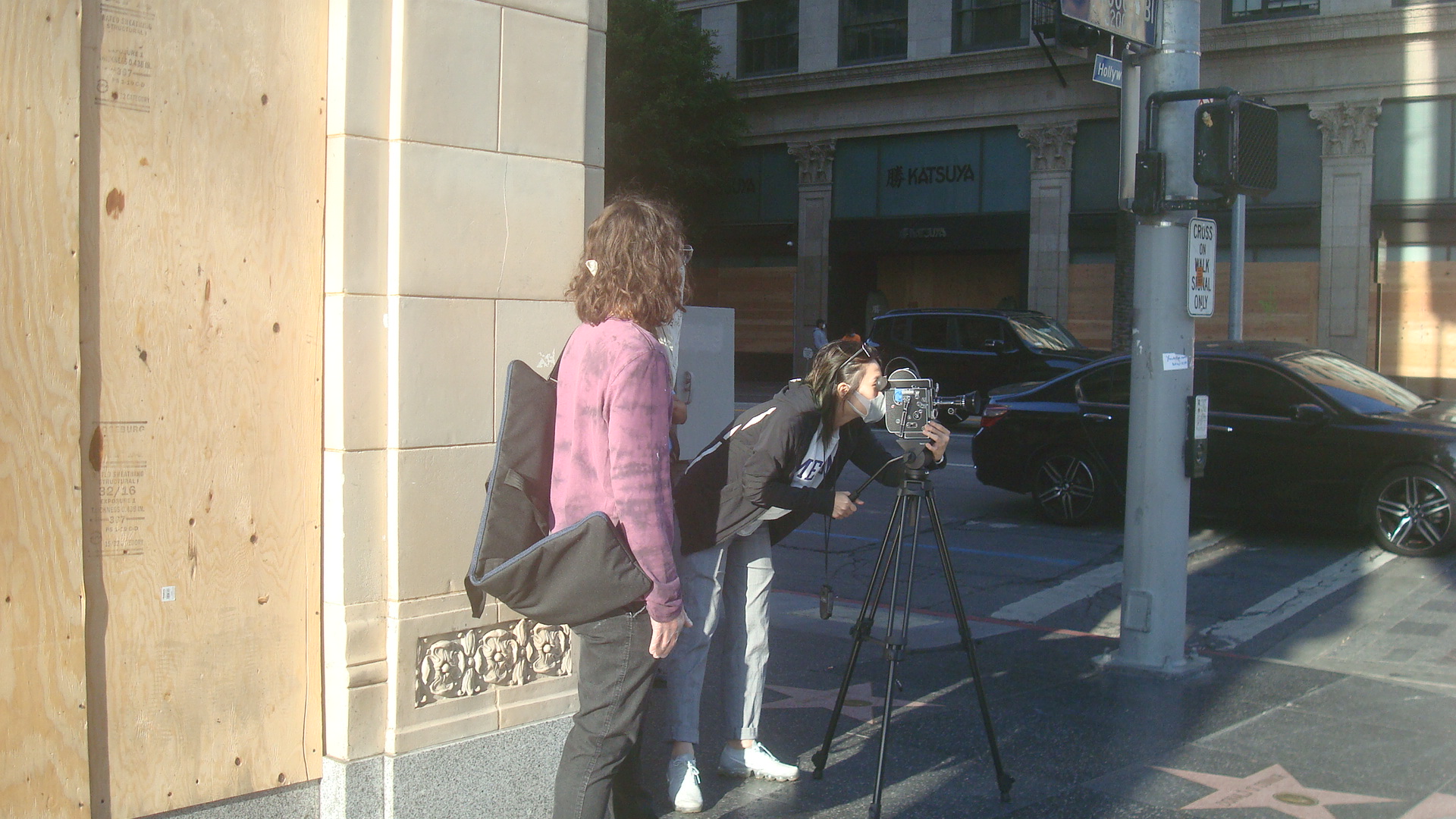
Photographer at Hollywood and Vine with her camera trained on the LAPD.
Discarded sign lying on the sidewalk.
It was definitely depressing to see the boarded up windows and the National Guard vehicles parked on the boulevard. I have vivid memories of the unrest that rocked LA back in 1992. Walking down the street on Wednesday morning it was hard not to draw parallels.
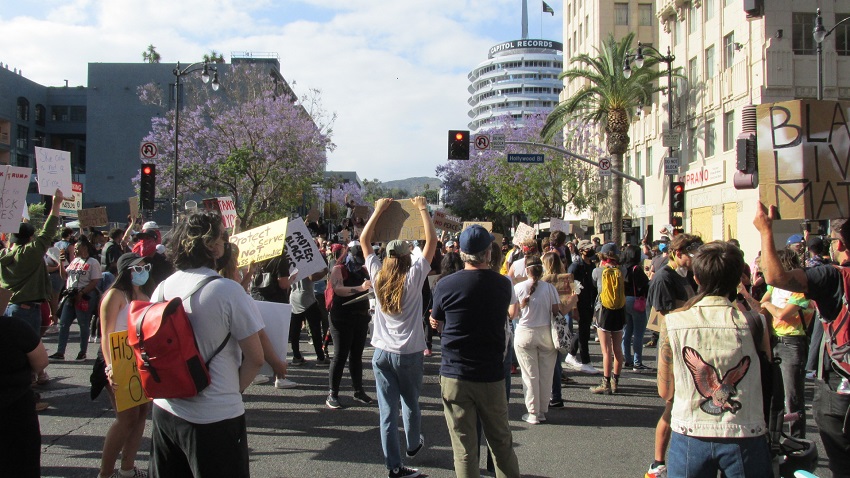
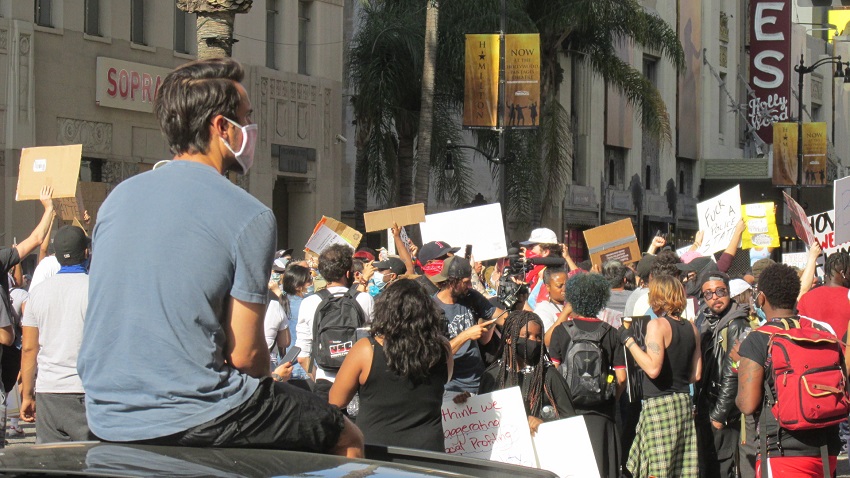
On Saturday afternoon I needed some groceries and when I walked down to the market I caught the tail end of another gathering. A few hundred protesters were blocking the intersection at Hollywood and Vine. Lots of car horns honking. It was hard to tell whether the drivers were mad at the delay or glad to see people taking to the streets.
Protesters at Hollywood and Vine.
Some protesters were sitting on top of cars parked in the street.
Protesters are demanding that funding for the police be cut.
And at the same time that I’m trying to follow what’s happening locally, the national news media is feverishly trying to document the protests, chase down the politicians, and keep up with the seemingly neverending stream of daily controversies. Elected officials across the country are trying to demonstrate their empathy and understanding, with wildly varying degrees of success. A lot of promises have been made, but we’ll see what those promises mean six months or a year from now.
I wish I could say I was completely enthusiastic about this massive uprising, but actually I had a lot of doubts about where this is all heading. First, I don’t have much faith in politicians, and I’m pretty certain that for the most part the carefully thought-out statements they’ve been feeding the press over the last week or so will quickly be forgotten. Second, while I think the protests are a great way to start a movement, making real change happen means taking things a lot farther. It’s exciting to see so many young people take to the streets to demand justice, but the only way to ensure that justice is delivered is to stay on top of elected officials, show up at city council meetings and go to the polls on election day. In other words, it takes years of difficult, sustained work to guarantee progress. Sure, I’m glad to see thousands of people marching for justice, but I wonder if these same people will still be on board for the less exciting and more challenging job of re-writing our laws and re-thinking our budgets.
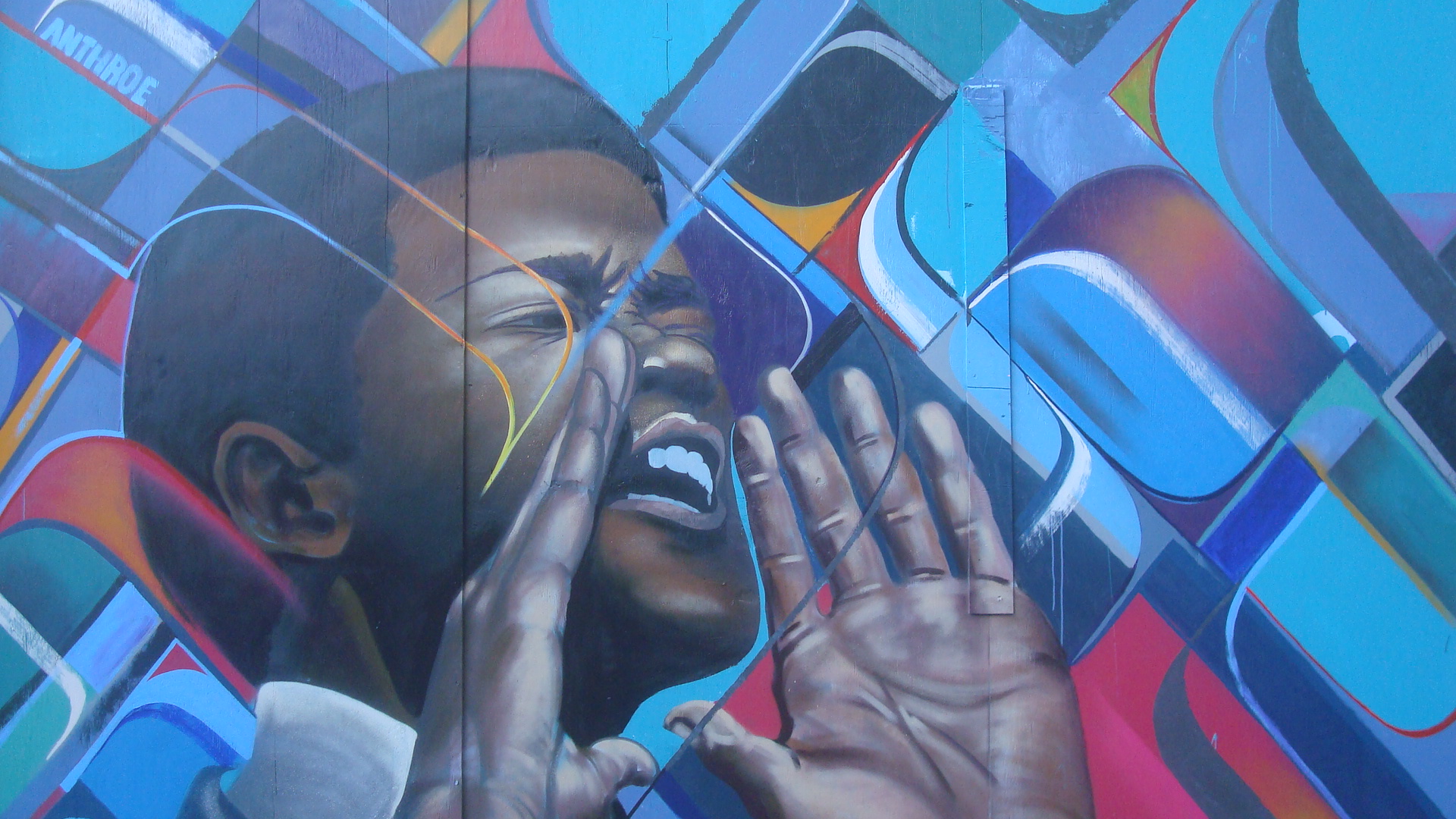
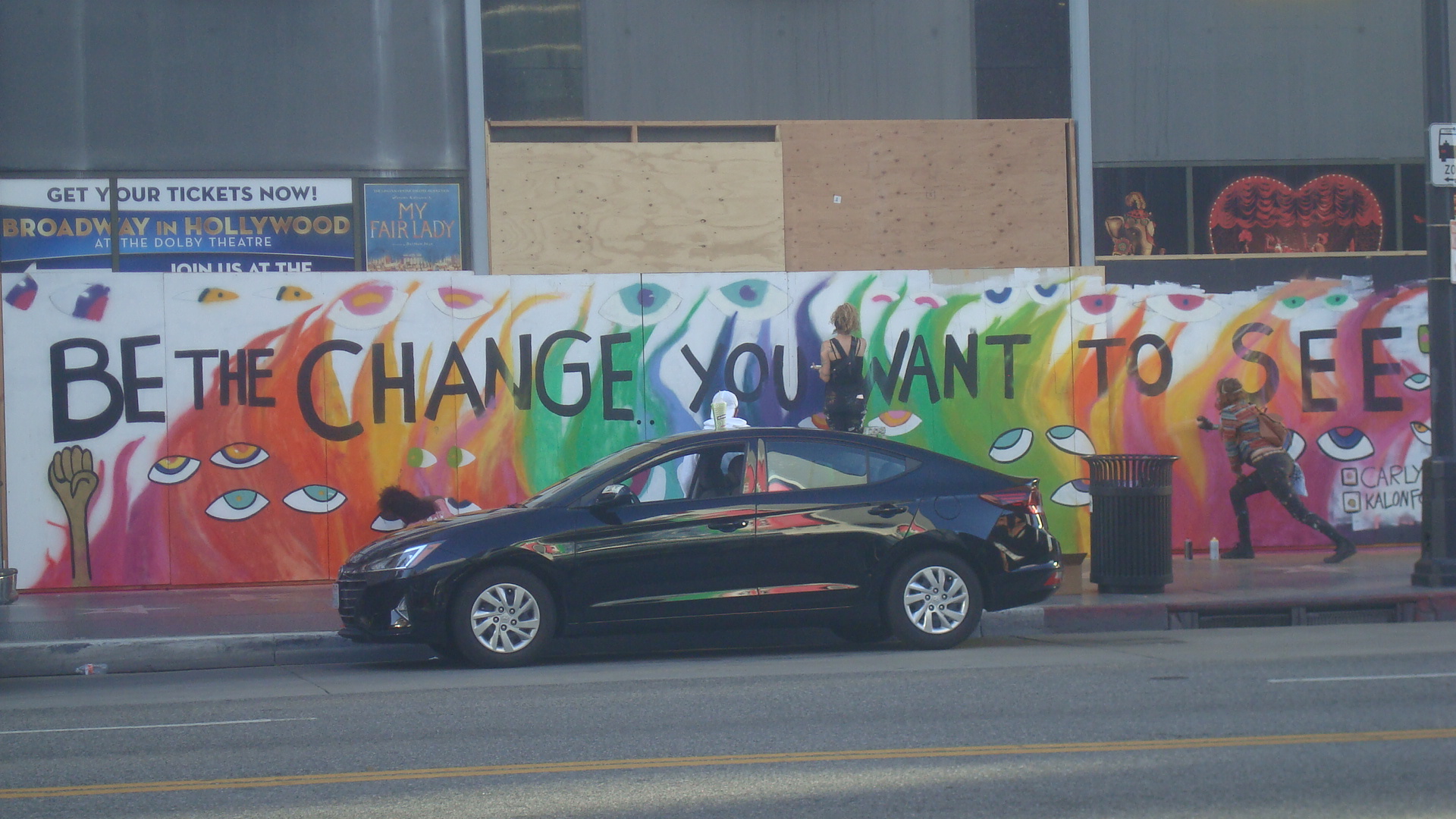
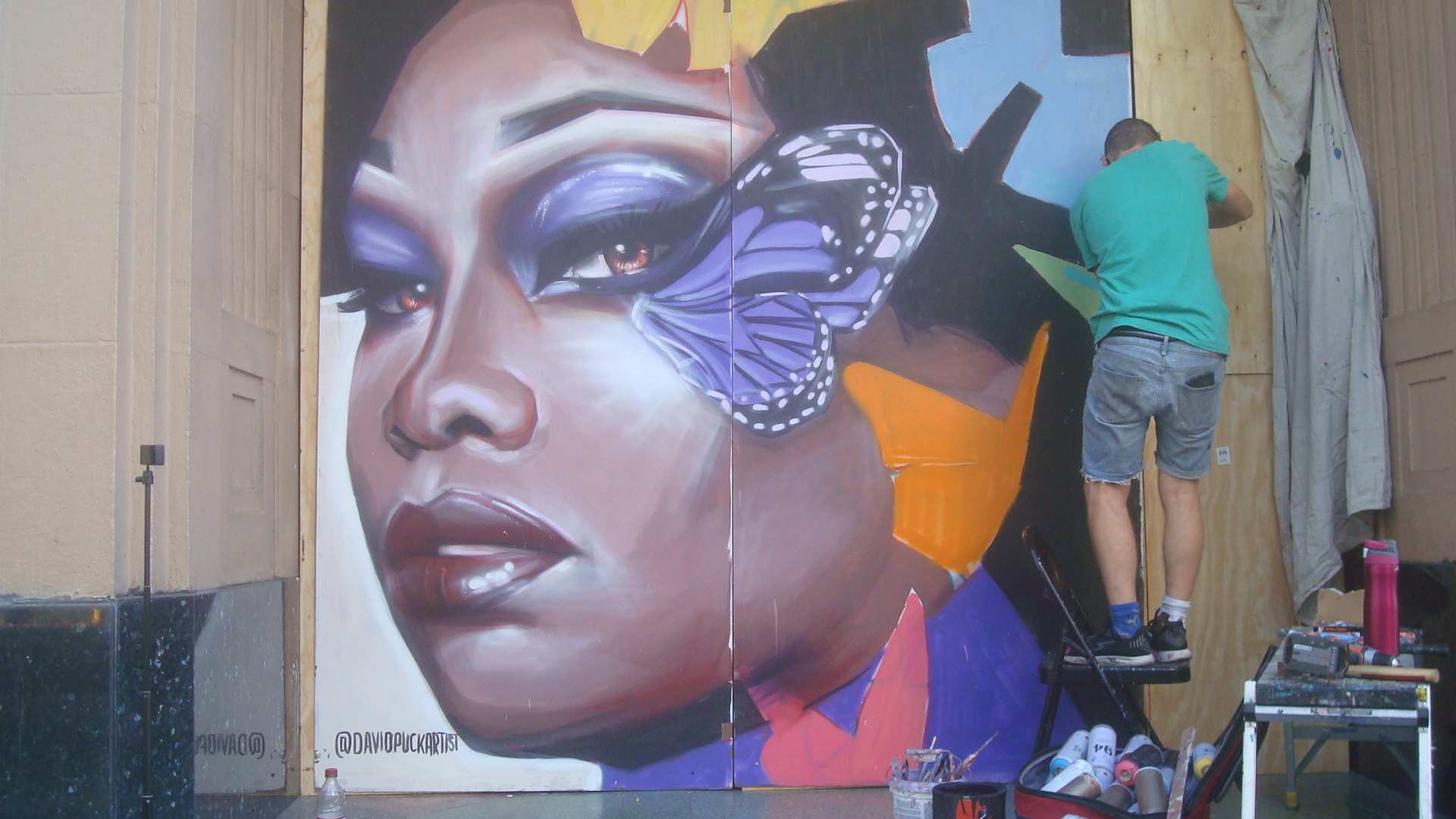
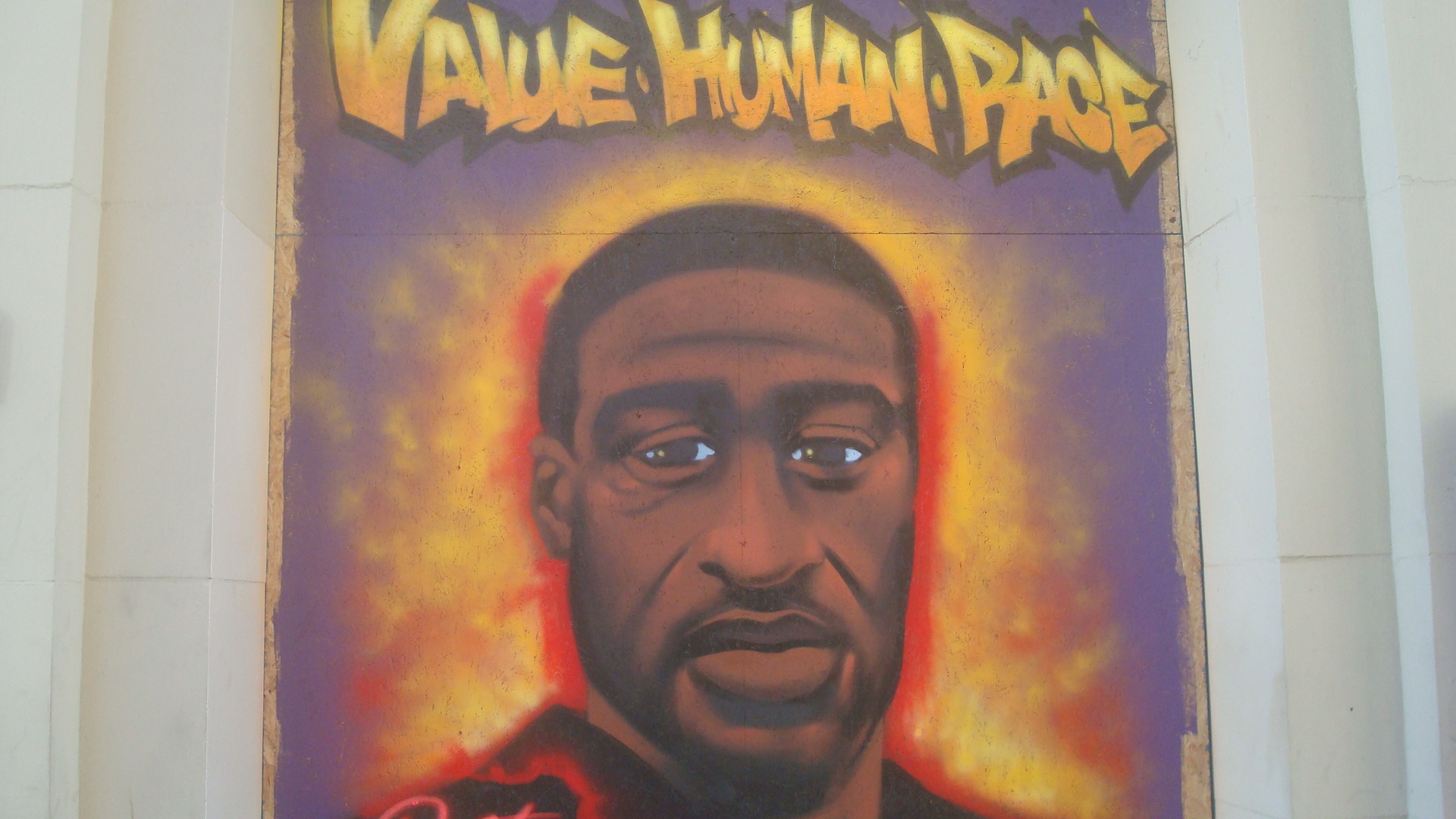
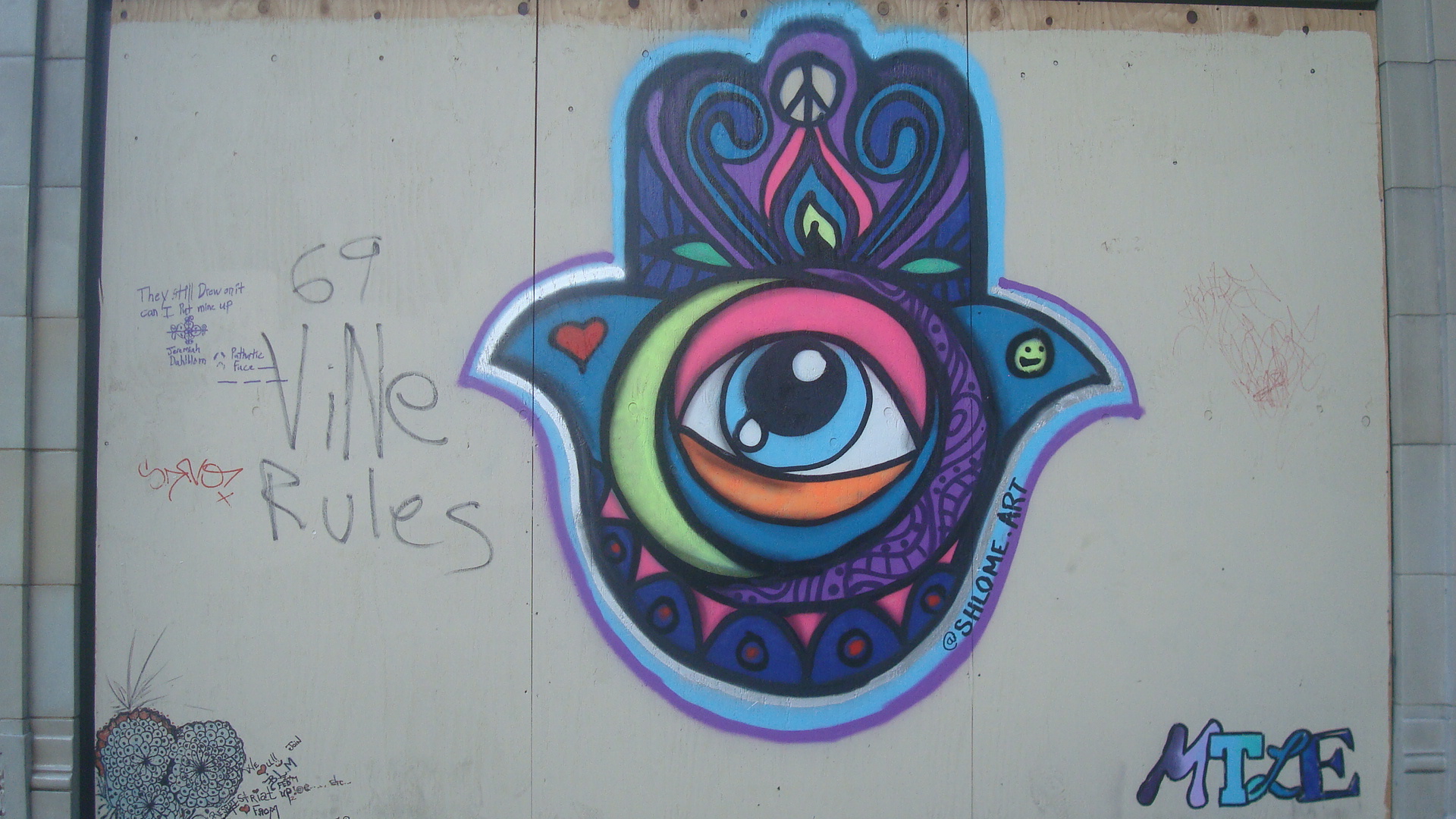
But today all my pessimism magically disappeared. Not to say all my doubts are gone forever, but this afternoon they were pushed way into the background, at least for a while. As I walked along Hollywood Blvd., I saw that artists had transformed all the boarded-up windows into canvasses bursting with color. These are the images that greeted me when I walked out of the Red Line station at Hollywood and Vine.
Be the Change You Want to See
Artists at work transforming the streetscape.
Another artist covering drab boards with vibrant color.
George Floyd
A splash of psychedelia.
Maya Angelou
Like I said, it’s not as though I’ve buried all my doubts, but I forgot about them for a little while. Walking down Hollywood Blvd. today, looking at all this amazing art, I felt happy. I felt hopeful.




















 The Horizon and the Skyline