Would you want these diesel trucks driving through your neighborhood?
How would you like to have hundreds of diesel trucks driving up and down your street, spewing diesel exhaust, 24 hours a day, 7 days a week? Residents living on Redondo Beach Boulevard in the Harbor Gateway area have been trying for years to stop a massive distribution center from being built right across the street from their homes, but it seems that no one at LA City Hall is listening.
Back in 2018 I posted about the LA City Planning Commission’s approval of this toxic project directly across the street from residents’ homes in the Harbor Gateway community. Developer Prologis had filed an application to build a 300,000+ sq.ft. warehouse which would generate hundreds of diesel truck trips every day, and would operate all night long. The LA Department of City Planning had allowed Prologis to slide by with low-level environmental review that didn’t begin to address the impacts. Thankfully the State’s then-Attorney General, Xavier Becerra, stepped in to let the City know that they weren’t doing enough to protect the residents’ health. The people who had been fighting the project were overjoyed, but it turns out the reprieve was only temporary.
Apartments right across the street from the proposed distribution center.
The Prologis distribution center is back, and will be heard again by the City Planning Commission on Thursday, May 8. Given the CPC’s record of approving pretty much everything that comes before them, it’s likely the project will again be given the green light. The folks at LA City Hall do not seem to care that the residents are already subject to vehicle exhaust from the nearby 110 Freeway. Nor do they seem to care that the area ranks in the top 5% for pollution burden and vulnerability according to the California Environmental Protection Agency’s screening tool. And apparently it makes no difference that, in addition to the residential buildings, the project site is surrounded by a public park, an LAUSD school, nursing homes, and two churches. This project will bring the trucks already travelling the freeway right into the neighborhood, and air pollution has been shown to have serious health impacts on children, adults and seniors.
Area residents will be showing up at the CPC meeting to voice their opposition. If you can make it down to City Hall, they’d appreciate your support. The meeting starts at 8:30 am, but it’s hard to say exactly what time the item will be taken up by the Commissioners.
If you can’t make it down, you can also submit comments to the following e-mail address.
cpc@lacity.org
Be sure to identify the project in the subject line.
Following up on my recent posts about funding for parks in the City of LA, I wanted to offer an update on a recent action by the LA City Council. Because of the budget crisis that the City is currently facing, the Council is looking for ways to generate more revenue. Last week they approved a report from the Budget & Finance Committee which asks City departments to report back on a number of possible options, including a bond measure to raise funds for both the LA Fire Department and the Department of Recreation & Parks (RAP). They’re also looking at increasing the base funding formula for RAP in the City Charter. (It’s actually worth reading the whole report. Some of the options are interesting. Some are bound to be controversial.)
Park advocate Ron Bitzer, who serves as a volunteer on the City Park Advisory Board in North Hollywood, also sees a possible opportunity emerging as the City tries to rebuild after the recent fires. Bitzer has written an open letter to Steve Soboroff, who was selected to lead the recovery effort, where he argues that planning for more parks, and creating funding streams, should be part of the process.
In general, I think we should be making sure that open space, green space, and the urban forest are integrated into all of LA’s planning efforts. In recent years both our local and State government have worked to fast-track project approvals, in large part arguing that we just need to build housing as fast as possible. Unfortunately, this has led to the removal of more trees and the loss of more permeable surface area, which will make LA even hotter and drier. Instead of just rushing to build as much as possible, we should be planning to build healthy, sustainable communities.
UPDATE: This post was originally written prior to the LA City Council meeting on Feburary 21. The item about expediting projects for the Olympics was continued, and will now be heard on Friday, February 28. PLEASE NOTE: This meeting will be held at Van Nuys City Hall, 14410 Sylvan St. Van Nuys. You can also call your councilmember to express your views.
***
When the politicians at LA City Hall first approved hosting the 2028 Olympics, they said LA wouldn’t need to build new sports venues or new infrastructure. A post on the LA28 web site says that “The LA28 Games are designed to fit the city as-is [….]”. The talk was that this would be a “no-build” Olympics. The post goes on to say….
As a global leader in sports, entertainment and technology, LA is built to host large-scale, sustainable, global events that benefit everyone and will be the first-ever Games to not build permanent infrastructure. [Emphasis added.]
Well, anybody who believed that obviously hadn’t spent much time around City Hall. Now the LA City Council apparently wants to build a whole lot of new stuff, and they want to be able to build temporary and permanent venues, training facilities, broadcast and media centers, transit infrastructure, and other projects that could be associated with the Olympics or the Paralympics without having to receive planning approvals, obey zoning regulations, observe height restrictions or setback requirements, or any other regulations that could delay construction. You can read the language from the motion yourself. (Council File 15-0989-S47)
This is just crazy. But tomorrow, Friday, February 21, the City Council will likely approve this motion directing City departments to prepare an ordinance to make this crazy idea a reality. If the ordinance is approved, you can bet we’ll see a barrage of new projects being justified because they’re supposedly associated with the Olympics or the Paralympics. These projects will be approved with no public engagement and no environmental review. In other words, once they’re proposed, they’re approved. And don’t be surprised if they use this to greenlight Frank McCourt’s Dodger Gondola project.
In other words, this has gone from being the “no-build” Olympics to being the “no-plan” Olympics. It was pretty clear even before this that our elected officials were in over their heads. Now it seems they’re trying to dig themselves out by eliminating planning, eliminating environmental review, and cutting the public out of the process.
If you have something you’d like to say to the City Council about this, the best thing to do would be to show up at City Hall before 10:00 am tomorrow, Friday, February 21. (You can’t call in anymore, because Council President Marqueece Harris-Dawson doesn’t want you to.) If you can’t make it down there, I suggest you call your council office when they open tomorrow morning and let them know how you feel.
Map of current fires in LA area from Cal Fire, as of January 12, 2025
If you’re looking for updates on the fires in LA, this post won’t offer anything you haven’t heard already. The LA Times, Daily News, and local news stations have been doing an excellent job reporting on the situation. I’m writing this post because I want to talk about what comes next. While the fires are still burning, and may continue to burn through next week, we do need to start talking about the future of LA. And I think the best way to start talking about the future is to begin with the past….
The City of LA was built on real estate speculation. To some degree, this is true of most cities, but it’s especially true of Los Angeles. Writers have commented on the fact that this area lacks a number of the things that are generally the basis for large scale development, most fundamentally a reliable source of water. Nor did the City of LA initially have a port, and only gained one by annexing San Pedro in 1909. That area is only tenuously connected to the rest of the city by a narrow, 20-mile corridor that’s basically just a rail line.
LA did have oil. Drilling began in the 19th century, and in the early 20th century large sections of the city, including Downtown, were covered with oil wells. But real estate investors saw huge amounts of money to be made by residential and commercial development, and gradually most oil wells were either shut down or hidden. (The majority of wells that are still visible are located in the southern part of LA, and the low-income communities that are impacted don’t have the political clout to shut them down.) The real estate investors promoted Los Angeles aggressively, putting ads in newspapers nationwide, essentially selling the climate. LA had lots of sun and little rain. People came, but the investors knew that to sustain new development they’d need to bring more water to the area. The LA Aqueduct was completed in 1913, after business interests used dishonest means to buy up the rights to the Owens Valley’s water resources. As the city continued to grow, LA snagged more water from the Colorado River with the construction of Hoover Dam during the Depression. Then came the construction of the California State Water Project, which extended from the 50s through the 70s. The bottom line is, the City of LA is only able to support a population of almost four million people because it imports about 90% of its water from areas that are hundreds of miles away.
I’m talking about the way LA was built because I think it’s important to understand the city’s history in talking about the fires that have devastated LA’s communities. Real estate investors built LA because there were fortunes to be made. In the first past of the 20th century, the only efforts at planning were driven by investors looking for profit. In the second half of the 20th century, there was more of an effort to plan for growth, but efforts at responsible planning were often overridden by the same investors looking for more profits. In the 21st century, there’s a lot of talk about planning at City Hall, but really most of it boils down to upzoning large swaths of the city to promote more growth. Planning in the City of LA is still largely driven by investors and their lobbyists. If you don’t believe me, please read up on the recent convictions of former Councilmember Jose Huizar, former Deputy Mayor Ray Chan and others who were caught up in a massive scandal involving bribery, fraud and racketeering. And if you think those convicted were the only ones involved, it’s important to remember that projects backed by Huizar were almost without exception unanimously approved by the LA City Council.
Image from Cal Fire Update, January 11, 2025
The point here is that development in LA is not driven by responsible planning. Development in LA is driven by money. If you want to know why projects were approved and are still being approved in fire-prone areas, follow the money. While there have been individuals who chose to build their own homes in areas where fire risk is high, most of the residential development in these areas is the result of the creation of suburban subdivisions. Even when citizens expressed concern about fire risks in these areas, they were almost always ignored by the politicians, who had often received campaign contributions from the developers. The Porter Ranch area has been repeatedly threatened by fires, but that didn’t stop the City of LA from approving The Vineyards at Porter Ranch, a recent multi-phase mixed-use project that includes apartments, a hotel and a large retail component. The project location has been designated by the LA Fire Department as a Very High Fire Hazard Severity Zone (VHFHSZ). Another example is LA City Planning Director Vince Bertoni’s approval of the initiation of a General Plan Amendment (GPA) to make way for the Bulgari Hotel, a massive luxury hotel project that was to be located in another VHFHSZ in the Santa Monica Mountains. The request for the GPA was submitted by developer representative Stacey Brenner, whose husband served as a deputy to former Councilmember Paul Koretz. The project was in Koretz’ district. The Bulgari Hotel was only stopped because area residents put intense pressure on Koretz’ successor, Councilmember Katy Yaroslavsky, who promised to stop the project during her campaign for the office.
Many of the areas that have been burned in the current spate of fires have burned repeatedly before. In the last few decades there have been multiple fires in Brentwood, Bel Air and the Hollywood Hills. Other communities like Baldwin Hills, Sunland-Tujunga and Chatsworth have all been hit by devastating fires. But, with rare exceptions, the City of LA continues to approve new development in fire prone areas.
As fires continue to rage across Los Angeles County, talk of rebuilding has already begun. I wish our elected officials would take some time to think about this. We need to have a tough conversation about rebuilding. I understand that thousands of people have lost their homes, and their dearest wish would be to rebuild and return to their communities. If individuals have the resources to do this, and if they understand the risks, they should be able to make that choice. But with the death toll from the current fires at 16, and damages worth billions of dollars, our elected officials should think long and hard about pushing for large scale development in fire prone areas. In most of these areas, the question is not whether they’ll burn again but when they’ll burn again. The LA area has always been prone to fires. As climate change continues to make the region drier and warmer, the risks will only increase. And while our firefighters can work miracles when conditions are favorable, we’re now seeing a brutal demonstration of how hard it is to control wind-driven fires.
It remains to be seen how strong the push for rebuilding will be once the fires stop. No doubt the real estate investors are already weighing their options. Some may want to bet on rebuilding. Others may think the risk is too great and decide to put their money elsewhere. But California Governor Gavin Newsom has already announced the suspension of laws that would require environmental review for rebuilding in fire prone areas. This is just crazy. After this disaster we should be insisting on stronger environmental review. The California Environmental Quality Act (CEQA) requires an assessment of whether new development will result in wildfire risks. It also requires cities to ask whether fire departments can provide adequate protection and whether the site can be safely evacuated in an emergency. Instead of brushing these issues aside, we should be insisting on careful scrutiny.
CEQA also requires review of a project’s greenhouse gas emissions (GHGs), because of the growing threat of climate change. Most Environmental Impact Reports I’ve read make no meaningful effort to accurately assess a project’s GHG impacts. Instead, the preparers rely on the State’s CalEEMod platform, which allows them to input whatever numbers they want, thereby pretty much guaranteeing that no project will ever appear to cause significant GHG impacts. In reviewing the EIRs, LA City Planning generally accepts whatever the developers claim without question. While the City of LA and the State of California claim to be fighting climate change, in reality both of them usually support new development regardless of what the GHG impacts are.
Again, I totally understand that many of those who lost homes in the fire are anxious to rebuild. If I were in their situation, I’d probably feel the same way. But LA has been repeatedly hit by deadly and devastating fires. As much as we may want to hear inspiring words about rebuilding, we need to ask: Do we want to be reliving this tragedy over and over again?
Let’s think carefully before we start to build again. And let’s demand that our elected officials do the same.
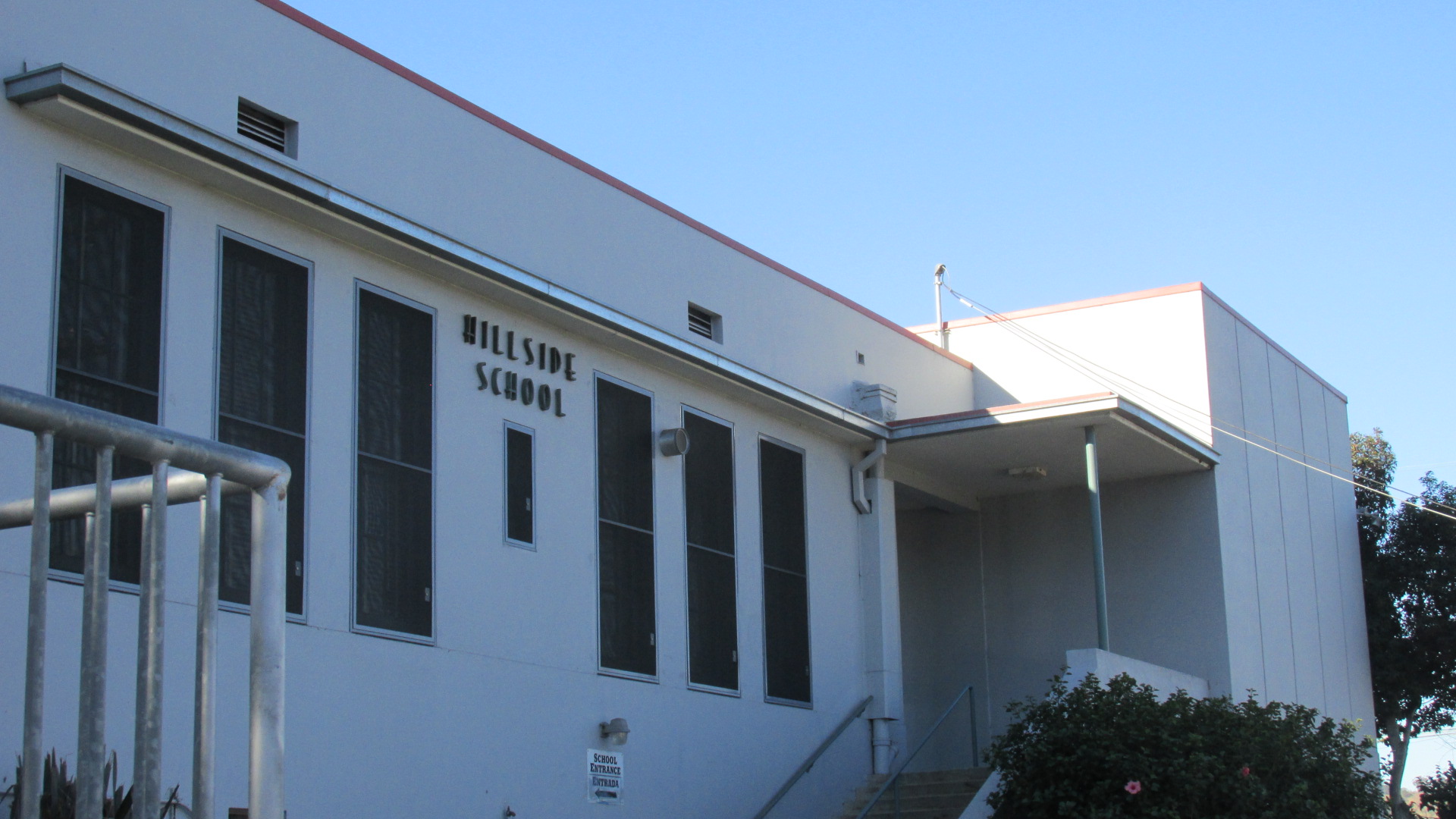
Residents of Lincoln Heights are up in arms over the plan to build a 56,700 square foot e-commerce distribution center at the intersection of Pasadena Ave. and Avenue 35. Not only is the project in close proximity to houses and apartments, it’s less than 300 feet away from Hillside Elementary. The community is understandably upset about the potential for a huge increase in truck traffic and diesel emissions.
Hillside Elementary School
At this point, though, the community is uncertain how to stop it. Xebec, the real estate firm behind the distribution center, believes that the project complies with existing zoning and doesn’t need discretionary approvals from LA City Planning. They’ve already applied for permits from LA Building & Safety. Councilmember Eunisses Hernandez, who represents Lincoln Heights, has come out against the project, and she’s proposed changes to the plan that governs the area. Unfortunately, those changes won’t be approved until December, and Xebec wants to have the permits finalized before then.
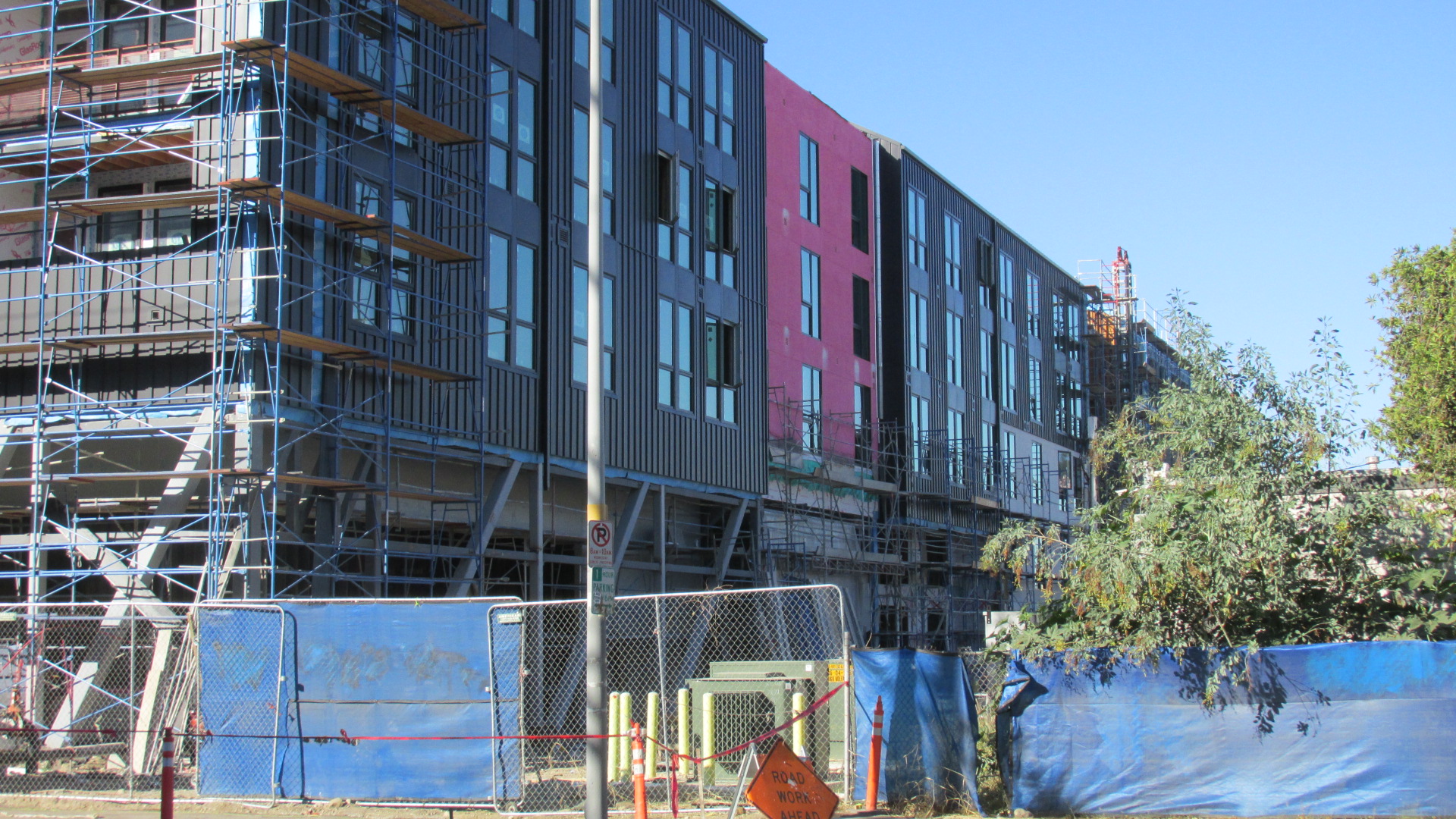
New residential building under construction right next door to 3505 Pasadena
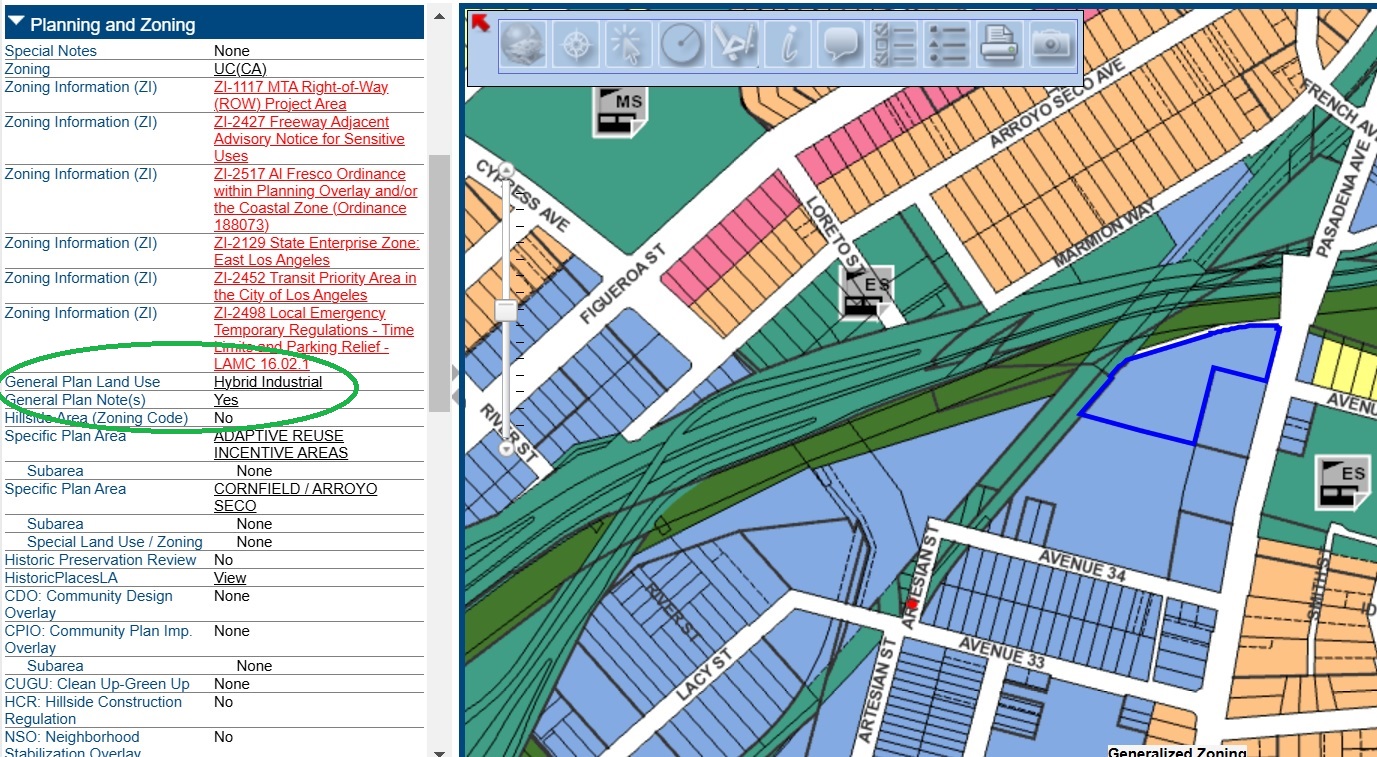
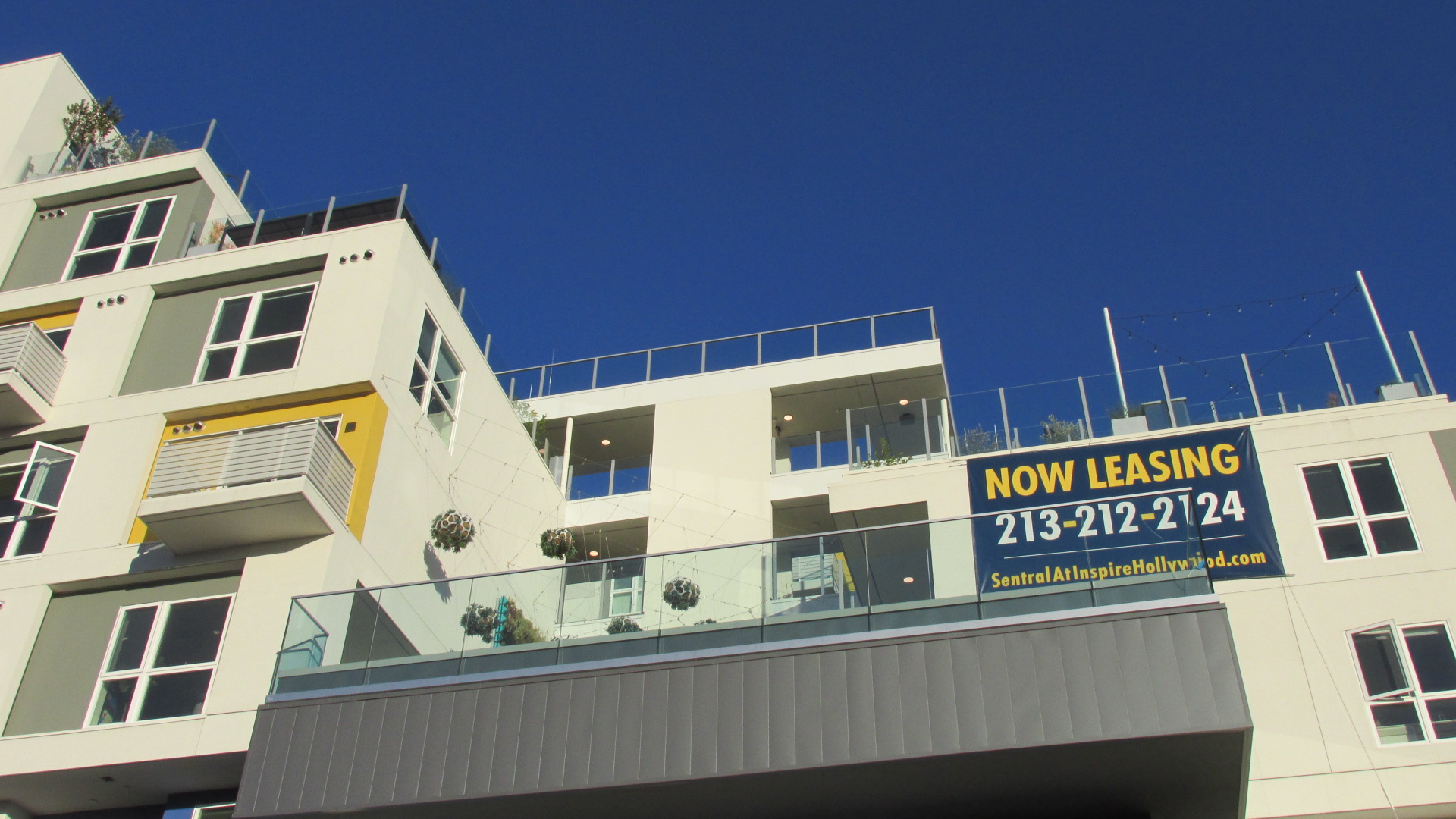
I have to admit, I have trouble understanding the zoning for 3505 Pasadena. According to ZIMAS, the General Plan Land Use designation for this parcel is Hybrid Industrial. The Hybrid Industrial designation was created by LA City Planning to allow residential uses in industrial zones. As a matter of fact, right next door to 3505 Pasadena there’s a massive new residential complex under construction that contains over 460 units. If the Hybrid Industrial designation was created to spur new housing developments in industrial areas where appropriate, the Xebec project seems to violate the whole intention of this initiative. And when those new units go on the market, how many prospective tenants are going to sign a lease when they realize they’ll be living next door to an e-commerce distribution center?
General Plan Land Use designation for 3505 Pasadena is Hybrid Industrial
But whatever the zoning is, this project should be stopped. Just ask yourself if you’d like to have diesel trucks going in and out of a distribution center right across from your home. Or better yet, ask yourself if you think elementary school kids should be breathing the toxic diesel exhaust from these trucks.
The LA City Council rep for the area is already looking for a way to stop this, but it might help to send a note to some people at the State level. If you feel like speaking up, here are the e-mail addresses for the two people who represent Lincoln Heights in Sacramento, State Senator Maria Elena Durazo and Assemblymember Miguel Santiago. I’m also including a staff member at the California Environmental Protection Agency’s Environmental Justice Program.
senator.durazo@sen.ca.gov
assemblymember.santiago@assembly.ca.gov
leticia.syslo@calepa.ca.gov
Here’s a suggested subject line.
Kids Shouldn’t Be Breathing Diesel Exhaust: Stop the Distribution Center at 3505 Pasadena
If you see problems with this project, let the folks in Sacramento know. The people of Lincoln Heights would appreciate it.
In my last post I wrote that the City of LA was thinking about allowing the installation of alcohol vending machines at an apartment building in Hollywood. In doing some research on the building itself, I found that the owner of 1530 Cassil has partnered with a company that offers both residential and travel lodging, effectively turning at least some of the units into extended stay hotel rooms. While technically stays of 30 days or more would be legal, this seemed strange given that the building was approved as a housing project. The City’s determination letter made no mention of hotel rooms.
But the determination letter does state that the project is required to provide 20 units reserved for Extremely Low Income (ELI) households. The developer got a 70% density bonus to build way beyond what the zoning allowed in return for those 20 affordable units. I started wondering how many of those units were actually occupied by ELI households, so I submitted a Public Records Act Request to the LA Housing Department.
The response was disturbing. As of the end of January, the City had only received verification that three of the 20 affordable units were occupied by ELI households. What about the other 17 units? Are they empty? Are they being rented as extended stay vacation lodgings?
The developer of this project received a 70% density bonus under the Transit Oriented Community (TOC) Guidelines, which were the result of the voter-approved Measure JJJ. The idea was that project applicants would be able to build more than what was allowed under existing zoning in exchange for providing a percentage of affordable units. They would also benefit from a streamlined approval process. The City of LA claims that the TOC program is key to providing much needed affordable housing. But how much affordable housing are we really getting if the City isn’t enforcing the affordability covenants? I’m not the first person to raise this issue. Back in 2021, Capital & Main did some research and found that the City of LA wasn’t able to provide an accurate inventory of existing affordable units. They looked at LAHD’s on-line registry of affordable housing, and found that many affordable units were not listed. Capital & Main also reported that the City doesn’t maintain a centralized inventory of affordable units in mixed-income buildings. So how are people in low-income households supposed to find these apartments?
LA City Planning gave a 70% density bonus to the developer of 1530 Cassil, which was worth millions of dollars. In return, the developer agreed to provide 20 affordable units. But if the City’s records are correct, only three of them are occupied. This is a serious problem. City Hall likes to claim they’re creating lots of affordable units, but can we really believe their claims? The waiting list for affordable housing is a mile long, so why aren’t all of these units occupied by low-income households? And beyond that, why is City Planning handing out valuable density bonusses without following through with necessary oversight?
The politicians and the planners make endless promises, but time after time they’ve failed to deliver.
It’s hard to know where to begin. The chain of events that’s unfolded in LA over the past few days is extraordinary, but maybe it’s just the logical outcome of the way this city has been run for the past several years. Honestly, while it’s surprising that the recording of three councilmembers talking about redistricting has been leaked, there’s really nothing surprising about the discussion. Anybody who’s been following LA City politics over the last decade knows that Los Angeles is run by a corrupt elite that’s rigged the system. We should all be angry, but I don’t know why anyone would be surprised.
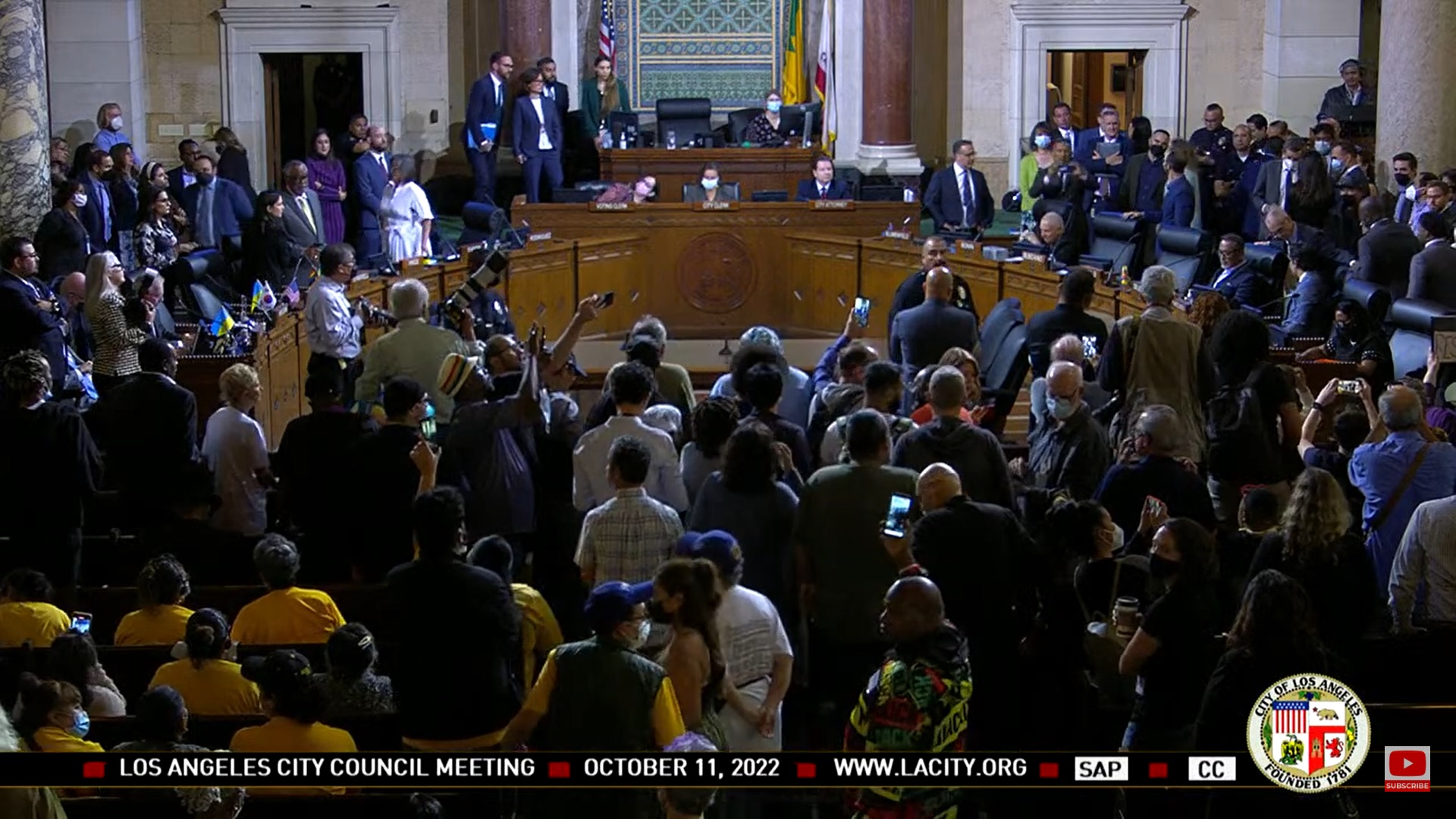
The first City Council meeting after the Times broke the story was intense. I watched it on video. The Council chambers were filled with angry people chanting and yelling. President Pro Tem Mitch O’Farrell kept trying to calm the protesters down, but they were furious and wanted to let the Council know it. The crowd finally got quiet when it was announced that Councilmember Mike Bonin was going to speak. Bonin’s son was the target of one of the numerous racist slurs that Nury Martinez utters on the recording, and Bonin was visibly upset. He gave an emotional speech condemning racism in general, and thanking all those who had reached out to support him and his family since the news broke.
It’s understandable that Bonin was shaken by the release of recording, and I don’t doubt that his speech was heartfelt. He loves his son, and he knows that this episode will likely cause his son to feel pain and anger. But I wish Bonin would acknowledge all the pain that he’s inflicted on low-income people of color during his time in office. When public comment began, I wasn’t surprised to hear one of the speakers accuse Bonin of hypocrisy because of his actions as a member of the City Council. Referring to Bonin, the speaker exclaimed, “The one that’s pointin’ the finger has done the most name callin’. Put us off Venice Beach. All the black people. He put us all off Venice Beach for some real estate. Fuck you, Mike Bonin.”
Now, I’ve never heard Mike Bonin use any racial slurs, but there’s no doubt that Venice has grown a lot wealthier and whiter during his two terms on the City Council. (Bonin didn’t start this trend, but he’s done nothing to stop it, either.) And Bonin has taken plenty of campaign cash from developers and lobbyists during that time. While Bonin may talk about ending racism and creating a just society, he’s voted over and over again, along with the rest of the City Council, to support policies and projects that promote displacement and gentrification.
Former Councilmember Jose Huizar is facing trial on corruption charges, in part because he helped a developer reduce the amount of affordable housing required for the 520 Mateo project in Downtown. Did Mike Bonin object to reducing the affordable housing requirement? Hell no. He voted to approve the project.
Interestingly, many of the biggest residential projects recently approved in Downtown have zero affordable housing, and the developers of these projects are often allowed to skip paying the Affordable Housing Linkage Fee. Other residential projects in LA have to provide affordable units to get increased density, but in Downtown they can get more density by asking for a Transfer of Floor Area Rights. Has Bonin spoken out against developers using this loophole to dodge affordable housing requirements? Hell no. He voted to approve these projects just like the rest of his colleagues on the Council.
When a property owner wanted to demolish 40 rent-stabilized units in Hollywood to make way for a new hotel, did Mike Bonin object to the eviction of low-income families in the middle of a housing crisis? Hell no. He voted to approve the project. Mike Bonin has joined his fellow councilmembers over and over again in awarding zone changes and general plan amendments to developers, delivering huge profits for investors and fomenting real estate speculation while thousands of low-income people of color were kicked out of their homes and LA’s homeless crisis spiralled out of control. During his time on the Council, Mike Bonin has presented himself as a progressive who wants to fight injustice, but if he really wants to learn about the root causes of injustice, maybe he should take a look in the mirror.
The other speaker who caught my attention was Damien Goodmon, of Downtown Crenshaw Rising. Damien’s comments at the meeting were thoughtful and incisive, as usual, but one thing he said rang especially true for me….
“This entire city government is in need of an exorcism.”
That sentence really sums up how I feel about City Hall right now. The environment created by the Mayor and the City Council is so toxic, and the poison has also bled into the City departments and boards and commissions that are supposed to be serving the people.
Instead of real planning to confront the challenges that LA faces, we get plans formulated by lobbyists and land use attorneys that seemed designed to enrich their clients. Instead of meaningful debate on the issues by well-informed public servants, we get cheerleaders who pat each other on the back for doing a great job, no matter how bad the outcomes are.
Damien is right. LA City government needs an exorcism. But holy water and Latin chants aren’t going to do the job. Instead, we, the people, are going to have to take action. This isn’t just a matter of electing a new mayor and a few new councilmembers. This is a matter of changing the deeply corrupt culture at City Hall. We need to pay attention to what they’re doing. We need to call them out when they’re serving themselves instead of the people. We need to show them that there are consequences for their actions, whether that’s at the ballot box or in the courts.
And this isn’t a short-term commitment. This will take much more than a year or two. This is about long-term, concerted activism with the goal of making sure our public servants really serve us.
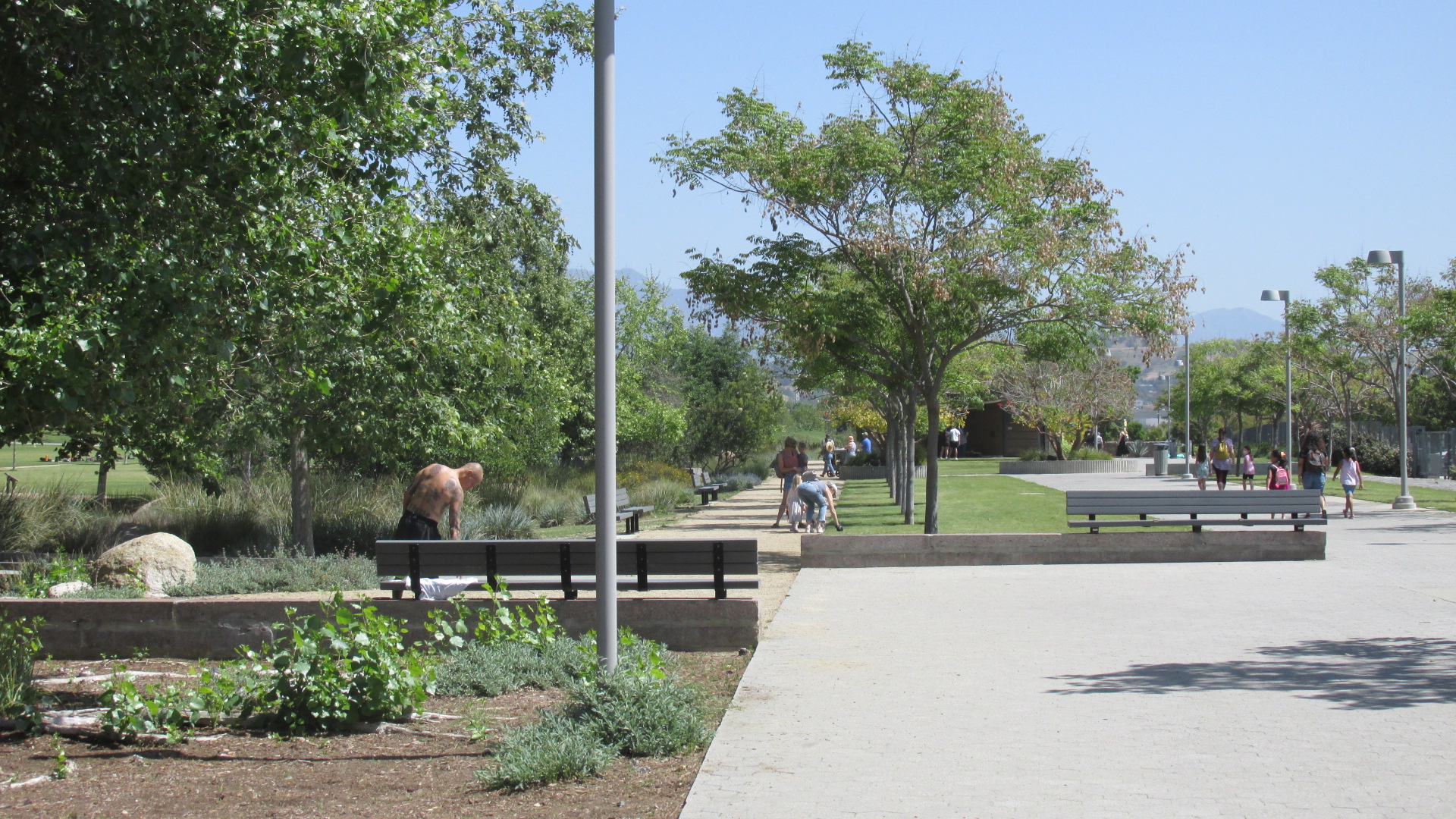
The pandemic wasn’t really over in April, but a lot of people, including me, were tired of being shut up at home. I wanted to get out into the world again. I’d been thinking for a while about paying a visit to Los Angeles State Historic Park on the outskirts of Downtown. I finally just got on the train and headed down there.
The park has been a work in progress for over a decade. I wrote a post about it in 2014, when many people still called it The Cornfield. Back then it was mostly just grass and dirt. Since then, it’s been transformed into a well-manicured open space….
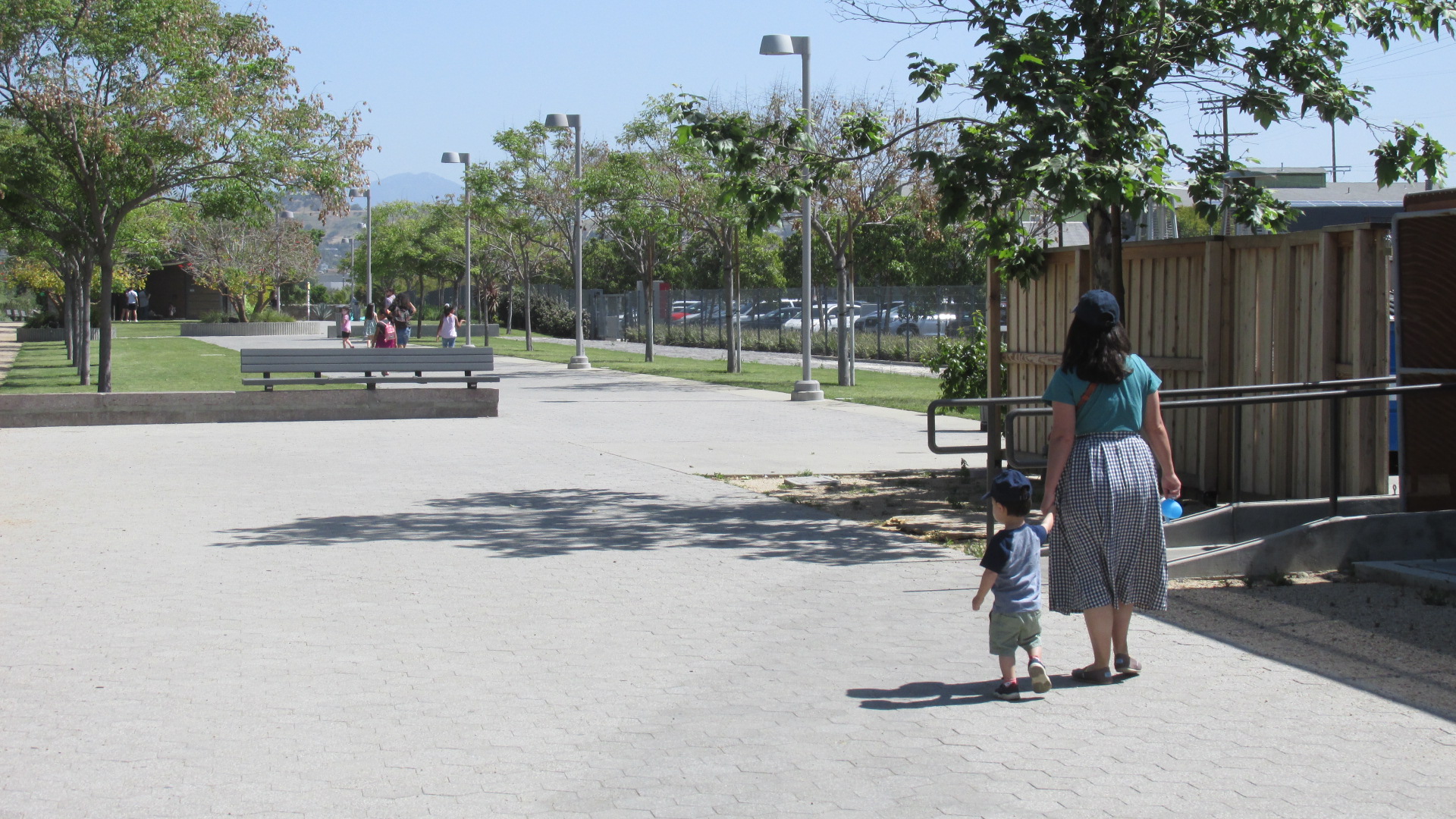
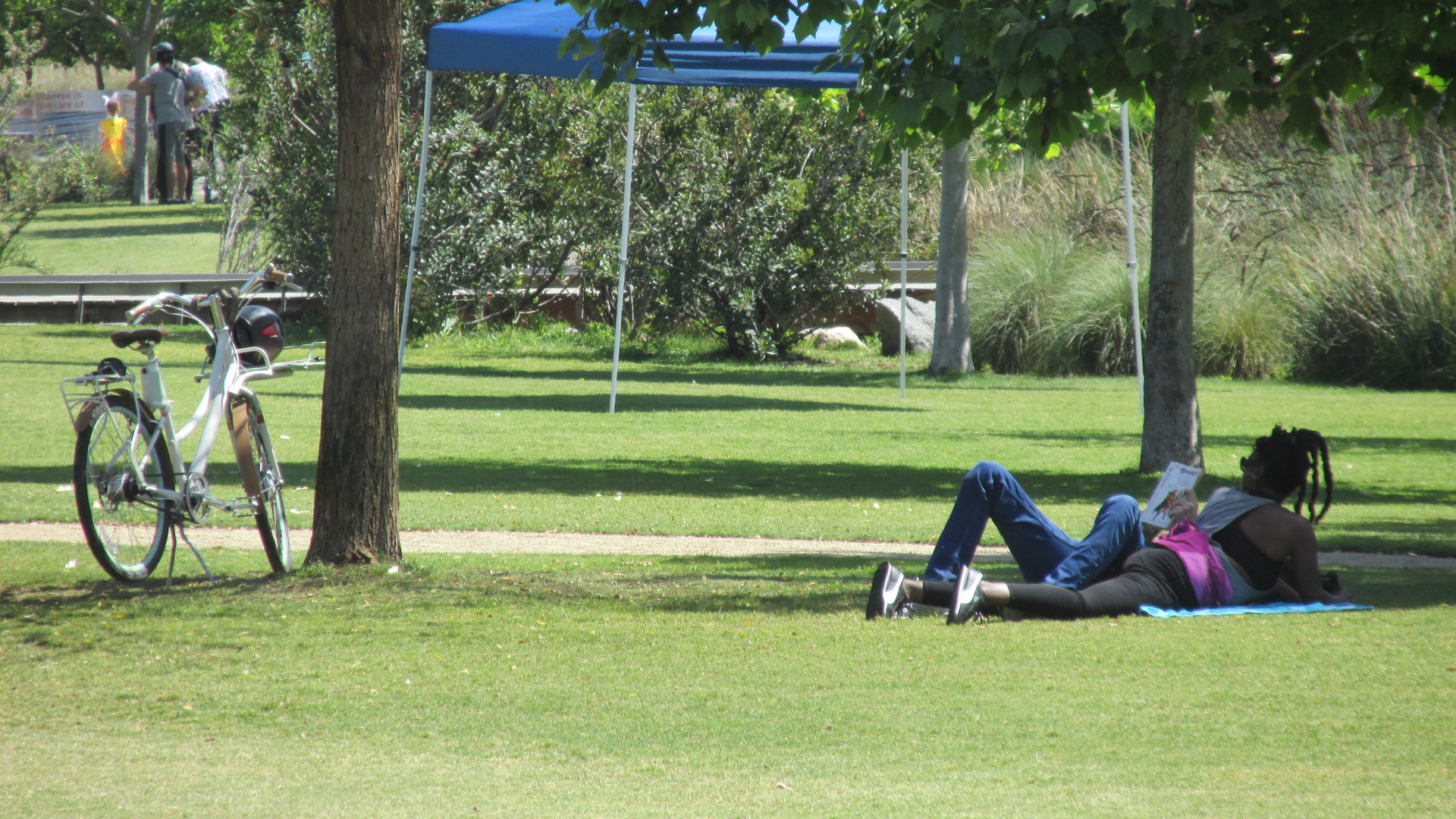
It certainly seems popular. On the day I showed up there were plenty of folks enjoying the park, and it’s not hard to see why. It’s impeccably landscaped, with gently curving paths winding through the grass, and rows of beautiful trees. There’s a good-sized field for those who want to get a game going. It seemed like the crowd was mostly younger, with a number of moms and dads and little kids.
It also seemed like the crowd was mostly made up of relatively affluent millennials. I have no hard data on where they came from, but I suspect that many of them live in Downtown. If that’s the case, they’d have to be making fairly good money. The listings on Apartment.com show that most of the studio apartments in the 90012 zip code start around $2,000, with one-bedrooms going for between $2,500 and $3,000. Rents at the Llewellyn, a fairly new building just across the street from the park, go from $2,450 to $5,155.
The City has had a good deal of success in luring people to Downtown, but let’s face it. Downtown is not open to everybody. If we go with the standard assumption that you’re supposed to spend about a third of your income on housing, you’d need to make $72,000 a year to afford a studio apartment in the area. A small family would probably have to have a combined income close to six figures just to get into a one-bedroom.
Back in March, I was listening in on a meeting of the City Council’s PLUM Committee where Director of Planning Vince Bertoni boasted about how proud he was of the City of LA’s Transit-Oriented Development program. I can’t imagine why. While City Planning has approved numerous residential skyscrapers near transit stops over the last decade, transit ridership has been declining steadily since 2014. Even in 2014, LA Metro was actually serving fewer people than it did back in the 80s, and it’s only been downhill since then.
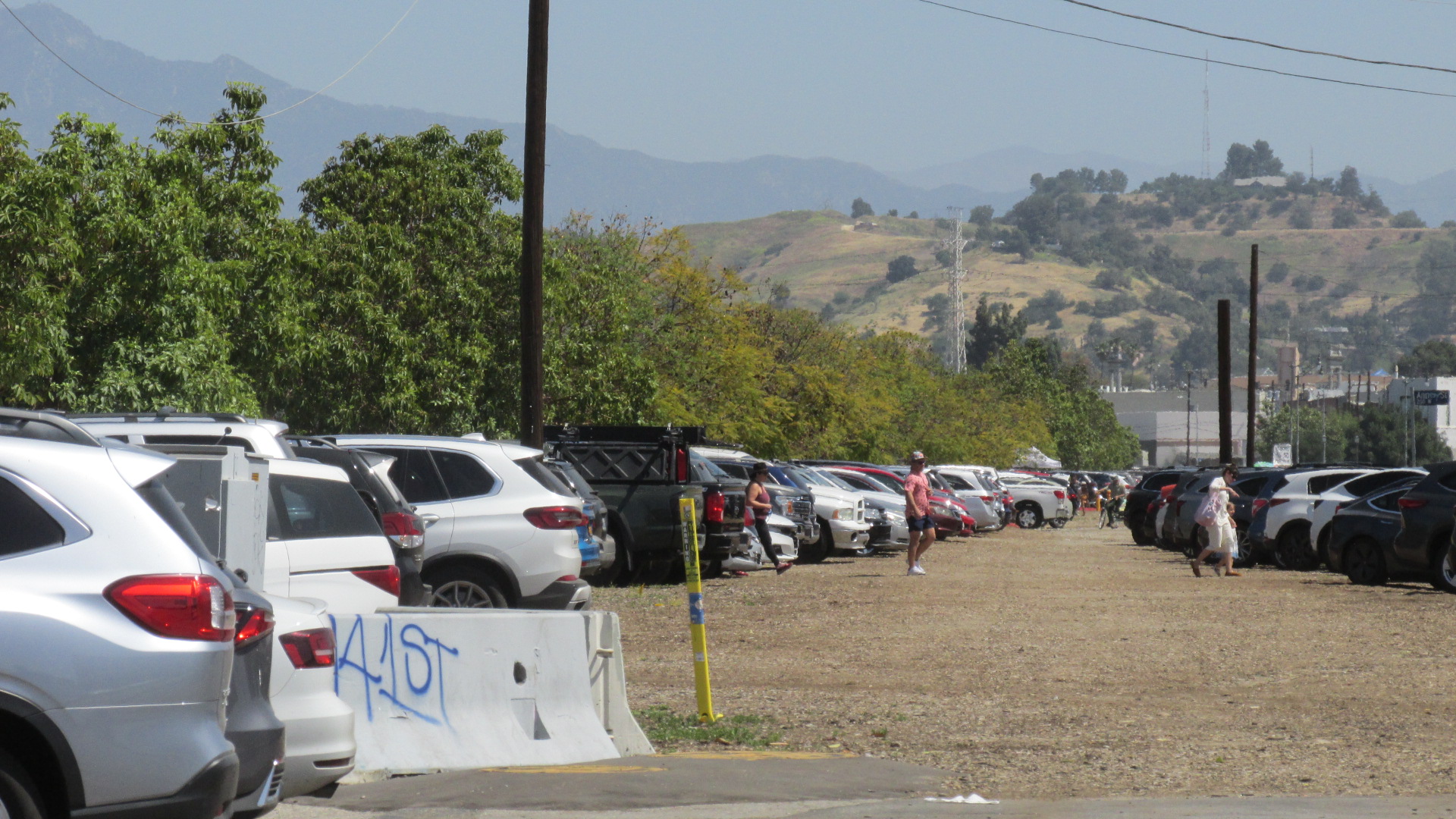
If you want to know how successful LA’s attempts at Transit-Oriented Development have been, take a look at the parking area next to the State Historic Park. It was packed with cars on the morning I was there. And Spring St., which is on the park’s perimeter, was also lined with cars.
Please note in the last photo above that the L Line (Gold Line) Station is visible in the background. I’m sure some of the folks who showed up at the park that day rode the train, but obviously a lot of people decided to drive instead, in spite of the fact that the station is just a few hundred feet from the park entrance.
LA City Planning talks a lot about revitalizing LA’s urban centers, but we need to ask what they actually mean by “revitalization”. The cost of renting an apartment Downtown makes it clear that living there is mostly for the affluent. While thousands of new units have been built in Downtown over the past decade, the vast majority of them are for the upscale crowd. The same is true citywide. According to LA City Planning’s Housing Progress Dashboard, of the more than 184,000 new units that have been approved since July 2013, only about 26,000, or 14%, have been for middle-income, low-income and very low-income households. To be clear, these three categories COMBINED make up just 14% of the new housing approved.
As I said before, the City has been successful in luring people to live in Downtown, and I’m glad of that. Looking at US Census data for the 90012 zip code, which covers much of central Downtown, it’s clear that the area has seen substantial growth. According to the American Community Survey (ACS), the population in 90012 has grown from 29,298 in 2011 to 37,268 in 2020.
Unfortunately, even as Downtown’s population has grown, ridership on transit lines serving the area has been dropping steadily. The graph below shows the changes in ridership on lines serving Downtown in 2014 and 2019. It includes all rail lines serving the area, but only selected bus lines.
You can see there’s been a significant drop. It’s important to point out that the biggest decline was on the A Line (Blue Line), and much of this was due to the fact that portions of the line were closed during 2019 for repairs and upgrades. (They didn’t do much good. Problems arose soon after the line re-opened.)
But even if we pull the A Line out of the chart, we still see a loss in ridership. If the City’s Transit-Oriented Development program is such a success, then why is transit ridership declining in Downtown, even as the population grows. (If you don’t trust my numbers, and you want to do your own research, visit Metro Ridership Stats. Under the heading Systemwide (Bus and Rail), click Details.)
I think the answer has to do with the kind of people who are moving to Downtown. While I hear a lot of hype about young urbanites who love walkable neighborhoods, the crush of cars I saw crowding around State Park leads me to believe that many of Downtown’s new residents own some kind of vehicle. Of course, that’s just my personal view based on my personal experience. To get a more accurate idea of how many Downtown residents are car owners, let’s take another look at the U.S. Census’ American Community Survey.
Looking again at the 90012 zip code, let’s check out the stats for vehicle ownership in 2011.
2011 ACS Data on Vehicles Available to Population in 90012 Workers 16 Years and Over in Households
No vehicle available 10%
1 vehicle available 42.9%
2 vehicles available 36.4%
3 or more vehicles available 10.7%
Now let’s look at the stats for 90012 in 2020.
2020 ACS Data on Vehicles Available to Population in 90012 Workers 16 Years and Over in Households
No vehicles available 6.6%
1 vehicle available 42.4%
2 vehicles available 40.0%
3 or more vehicles available 11.0%
You can see that the number of workers 16 years and over with no vehicle available dropped from 10% to 6.6%. The number with one vehicle available is basically unchanged. Those with two vehicles available went up from 36.4% to 40%. These are not huge changes, but they do show that percentages of workers 16 years and over with access to a vehicle has gone up, not down. And when we consider that the population in 90012 rose from 29,298 in 2011 to 37,268 in 2020, this seems to indicate that there are a lot more cars than there used to be in Downtown. Put this together with the drop in transit ridership, and it’s hard to understand why the City thinks its efforts at Transit-Oriented Development have been a success. (If you believe there are a lot more people walking and biking in the central city, feel free to show me the data. I’ve looked, and I can’t find anything less than six years old.)
I want to emphasize that I’m a transit rider and I don’t own a car. I also want to say that I believe we need to focus new development around transit hubs, in areas where jobs and businesses are close by. In theory all this is great. In reality, though, the City of LA doesn’t seem to have achieved anything. In fact, it seems like the numbers are going in the wrong direction. And if we’re going in the wrong direction, shouldn’t the City assess the situation, find out what’s wrong, and try to do better?
Unfortunately, rather than being used as a strategy to create a more sustainable city, Transit-Oriented Development seems to have become an excuse to approve residential projects that are far too expensive for the average Angeleno. I can’t tell you how many times I’ve been at hearings held by City Planning where staff and/or Commissioners claim that big, new residential projects geared toward the affluent are exactly what the City needs to get people out of cars and onto busses and trains. When I present data showing that transit ridership has been going down since 2014, they don’t seem to hear. I’ve never gotten a response. The projects are always approved.
I think the State Park is cool. I’m glad people are spending time there. But I don’t buy the story that young urbanites are ditching their cars for busses, trains and bikes. The cars lined up across the street from the park seem to tell a different story, one that City Hall doesn’t want to hear.
I love cities. And I love Downtown LA. But the older I get, the more I think about the damage that cities do to the environment. At the beginning of the 20th century, Downtown was largely undeveloped. In a little over a hundred years, it’s become a dense urban landscape crowded with office buildings and residential towers, crisscrossed by roads and freeways. As a result, LA is hotter and drier, the air is dirtier, and like every other urban center, we’re contributing to climate change in a big way.
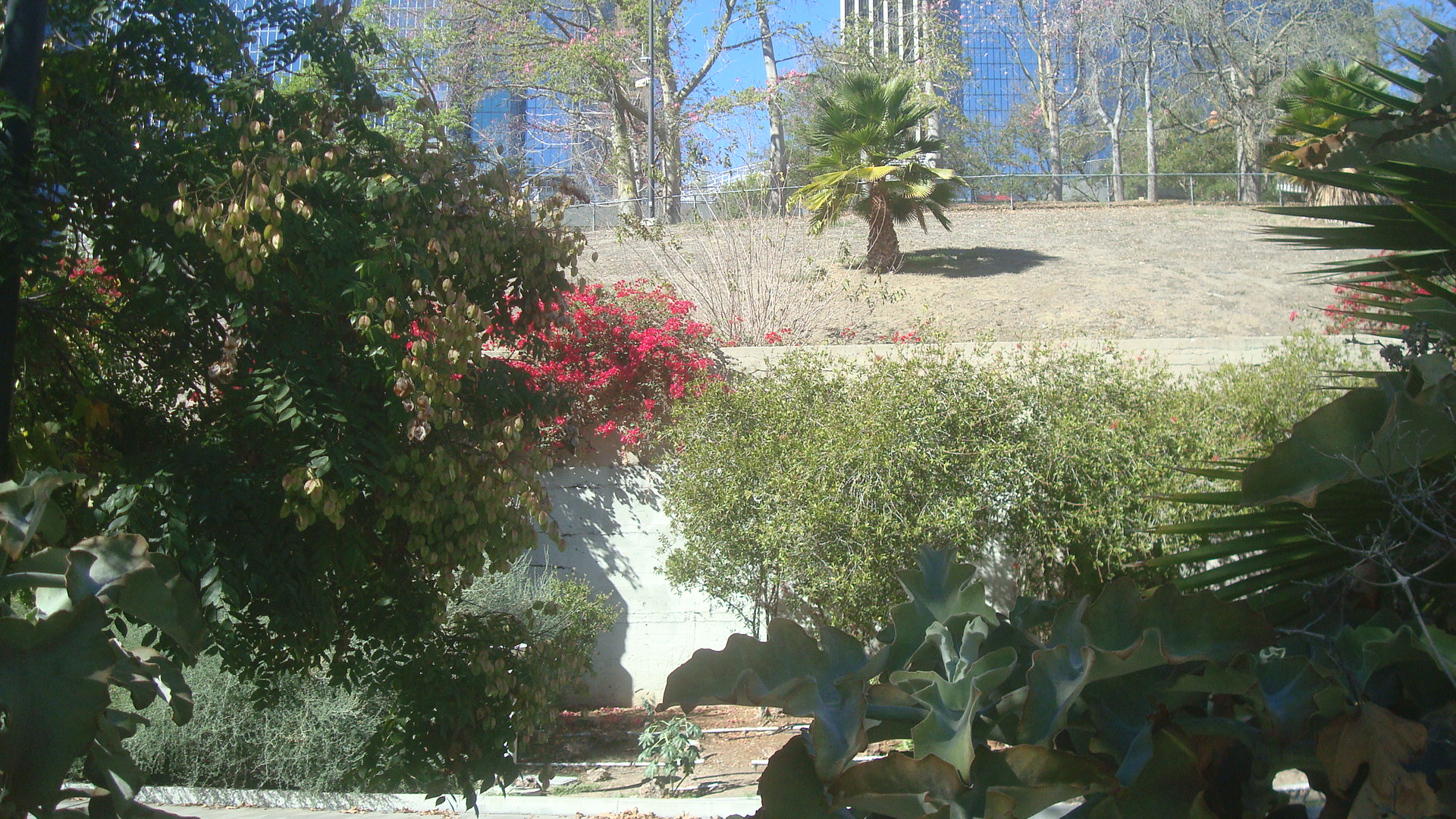
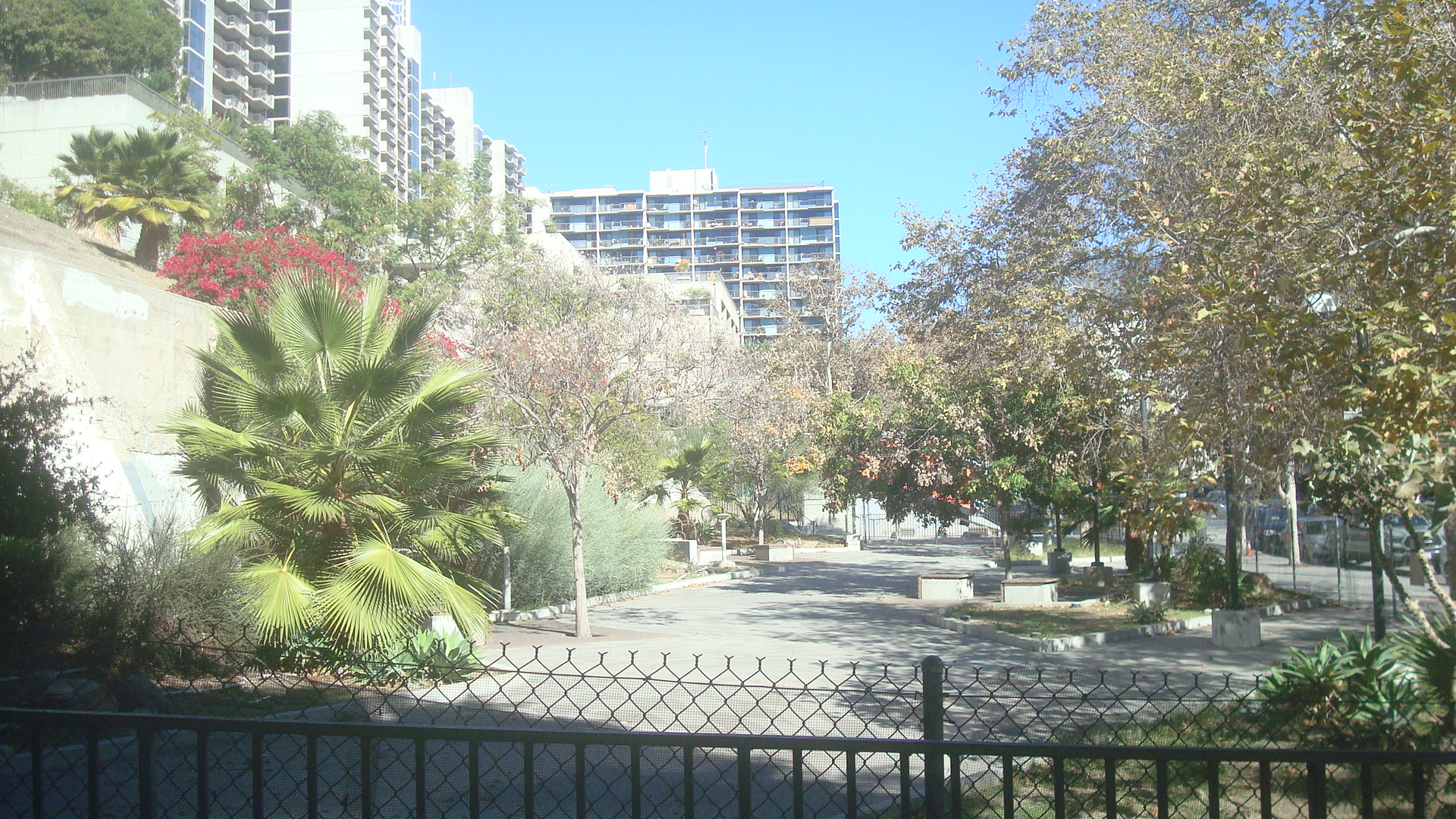
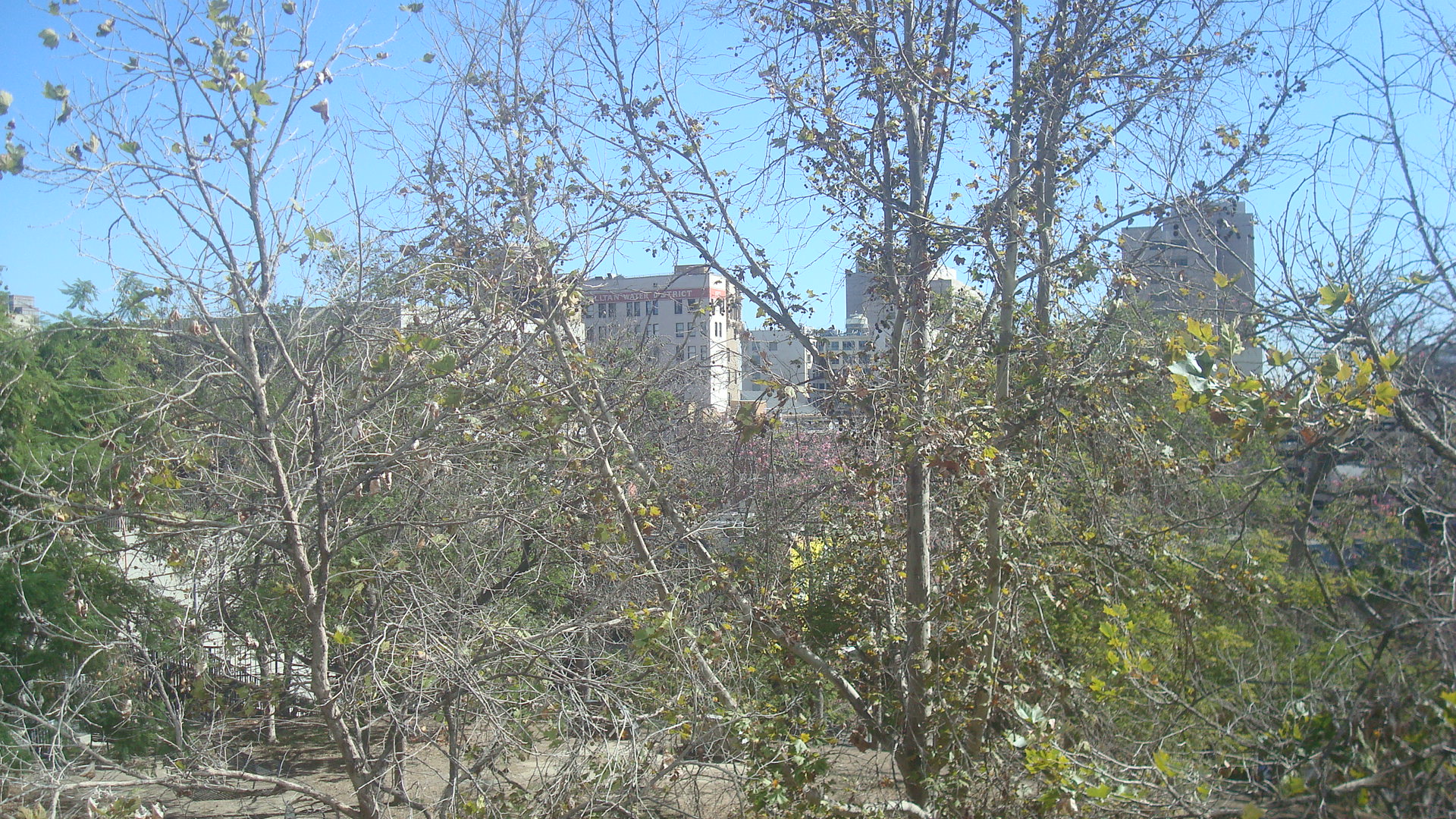
I was wandering around Cal Plaza a while ago, and ran across a piece of Downtown I’d forgotten about. As I looked out over the city in the direction of Hill Street, I saw that directly below me there was a small park. It took me a minute to realize it was the same park I’d seen many times at the intersection of Fourth and Hill. It’s been fenced off for years. Much of the greenery is dry, and the trees could certainly use some attention, but it was so cool to run across a patch of green space in the middle of all the steel and concrete.
Actually, it’s not technically a park. It’s a small patch of land called Angels Knoll that had been owned by the Community Redevelopment Agency (CRA). (I assume it got the name because it’s right night next to Angels Flight.) When the CRA was dissolved in 2012, a petition was circulated asking the City to turn the land over to the Department of Parks & Recreation. But that didn’t happen. As one of the few remaining undeveloped parcels in the Downtown area, the property is worth a fortune. The decision was made to put it up for sale.
A June, 2021 memo from CRA/LA, the successor agency to the CRA, sets the price of the parcel at $50 million. The buyer, Angels Landing Partners, is actually a joint venture by the Peebles Corporation, MacFarland Partners and Claridge Partners. According to the LA Department of City Panning web site, the proposed Angels Landing project involves the construction of two skyscrapers, one rising 63 stories and the other rising 42 stories. In addition to two hotels and 72,000 square feet of commercial space, the project also includes 180 condos and 252 apartments. Apparently some affordable housing is supposed to be provided, but at this point it’s not clear how much.
Of course, the project will generate lots of jobs and economic activity. According to the Environmental Impact Report, it will also generate 10,179 metric tons of CO2 equivalent during the construction phase alone. Beyond that, it will contribute to the steadily increasing temperatures in the LA area, along with a number of other massive projects planned for Downtown, Hollywood, Warner Center and elsewhere.
And we’ll also be losing one of the few remaining patches of green in Downtown. City Hall has made its priorities clear. They want the skyscrapers. Of course, LA was built by developers and politicians who prioritized growth over everything else. That’s how LA got to be what it is today. But the older I get, the more I feel that this addiction to growth is incredibly destructive. Our warming climate and shrinking water resources are a direct result of unchecked development.
We really don’t need another skyscraper. We absolutely need more parks.
The City of Los Angeles couldn’t exist without the water it imports from sources far beyond its borders. While the ratios vary widely from year to year, on average we get about 10% of our annual supply from groundwater within the city limits. The remaining 90% has to be imported from places hundreds of miles away.
Which means we really should pay attention to the Water Supply Alert issued by the Metropolitan Water District (MWD) on August 17. The entire State of California, and in fact much of the Western US, is experiencing extremely dry conditions. At this point the MWD is asking for citizens, businesses and public agencies to make voluntary reductions, but there’s a good chance that stricter measures will be needed in the not too distant future. Through careful planning and good stewardship, the MWD has managed to build up significant reserves which might provide a buffer for the next year or two. But we can’t be complacent. This year the California Department of Water Resources has cut allocations from the State Water Project to just 5% of requested supplies. It’s possible that next year the allocation could be reduced to zero. On top of that, for the first time ever, the Bureau of Reclamation has declared a shortage on the Colorado River. Lake Mead supplies much of the water that Southern California relies on, and storage there has been declining faster than even the most pessimistic observers predicted. Right now the water level is lower than it’s been at any time since Hoover Dam was constructed.
Which leaves us with the LA Aqueduct. At the beginning of the 20th century, Los Angeles business leaders were working hard to promote the city’s growth, but they knew that the area’s water resources were limited. In looking for solutions to this problem, they set their sights on the Owens Valley, over 200 miles away. Using secretive and dishonest means, the City of LA managed to purchase rights to much of the water in the Owens Valley, and then began construction of the LA Aqueduct under the supervision of William Mulholland. In LA the completion of the Aqueduct was hailed as an engineering marvel, and for a time Mulholland was celebrated as a hero. Needless to say, the people of the Owens Valley didn’t see things quite the same way. For them, the diversion of water resources to the Aqueduct resulted in disastrous environmental impacts, and set the stage for decades of litigation.
Mulholland Memorial Fountain from DWP Photo Collection at LA Public Library
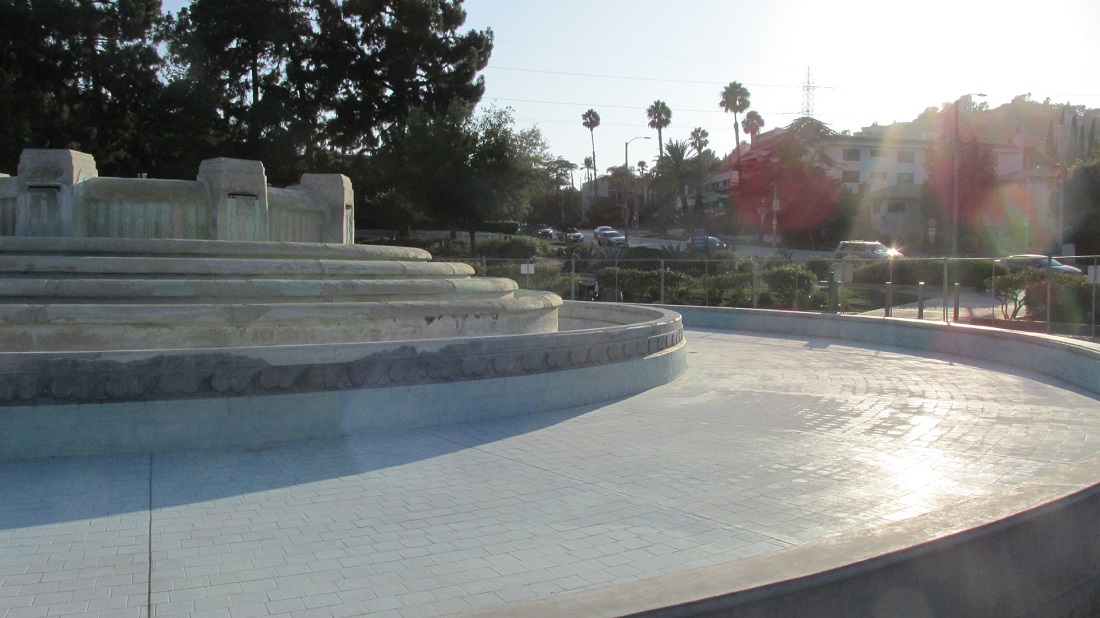
In 1940, five years after Mulholland’s death, a fountain was built at the intersection of Los Feliz Boulevard and Riverside Drive to honor the man primarily responsible for the construction of the LA Aqueduct. The choice to create a fountain was considered a fitting way to commemorate the role Mulholland played in securing the water that was necessary for the city’s growth. For decades cool, crystalline plumes arched into the air and cascaded into the rippling pool below.
Today the fountain is dry and it’s surround by a chain link fence. While a search on the net didn’t reveal any explanation, it seems likely that LADWP shut it down in response to the looming water shortage. This is certainly a sensible step to take, but it should also raise questions about LA’s future. Mulholland was celebrated because of his efforts to provide water that would support the city’s growth. If the fountain is now dry, maybe this should be a cue to start asking how much LA can realistically grow in the future?
While government officials and the media routinely describe the situation as a drought, I don’t think that’s accurate. In fact, I think it’s seriously misleading. “Drought” is generally defined as a prolonged period of dry weather. This implies that at some point the drought will end and things will get back to normal. But there’s growing evidence that this is the new normal. Both the State Water Project and the LA Aqueduct are fed by snowmelt from the Sierra Nevadas. The Sierra snowpacks have been declining for years, and climatologists predict that they’ll continue to decline for the foreseeable future. As for the Colorado River, California, Nevada and Arizona draw more water from this resource than it can deliver on an annual basis. The construction of Hoover Dam masked this fact for decades, but the rapid decline of Lake Mead should be a wake-up call for all of us. Right now it seems inevitable that water allocations to all three states will have to be reduced, but this will be a long, contentious, brutal process.
So if all of the city’s water resources are declining, our public officials need to let go of the myth that LA can keep growing forever. LA’s 2020 Urban Water Management Plan (UWMP) assumes that all it will take is more stormwater capture and a concerted effort to conserve. Unfortunately, stormwater capture doesn’t really work when you’re hardly getting any rain. And while Angelenos have shown a willingness to save water in the past, current forecasts seem to indicate that we’d have to push conservation to a whole new level. The more you cut, the harder it is to cut further. The UWMP’s conservation projections are extremely optimistic. It’s hard to say whether they’re realistic.
The Mulholland Memorial was intended as a monument to the man who oversaw the construction of a massive infrastructure project that allowed the city to grow rapidly. In the state it’s in now, it seems more like a monument to the folly of those who believed you could build a city of 4,000,000 people in an area with minimal water resources.














 The Horizon and the Skyline