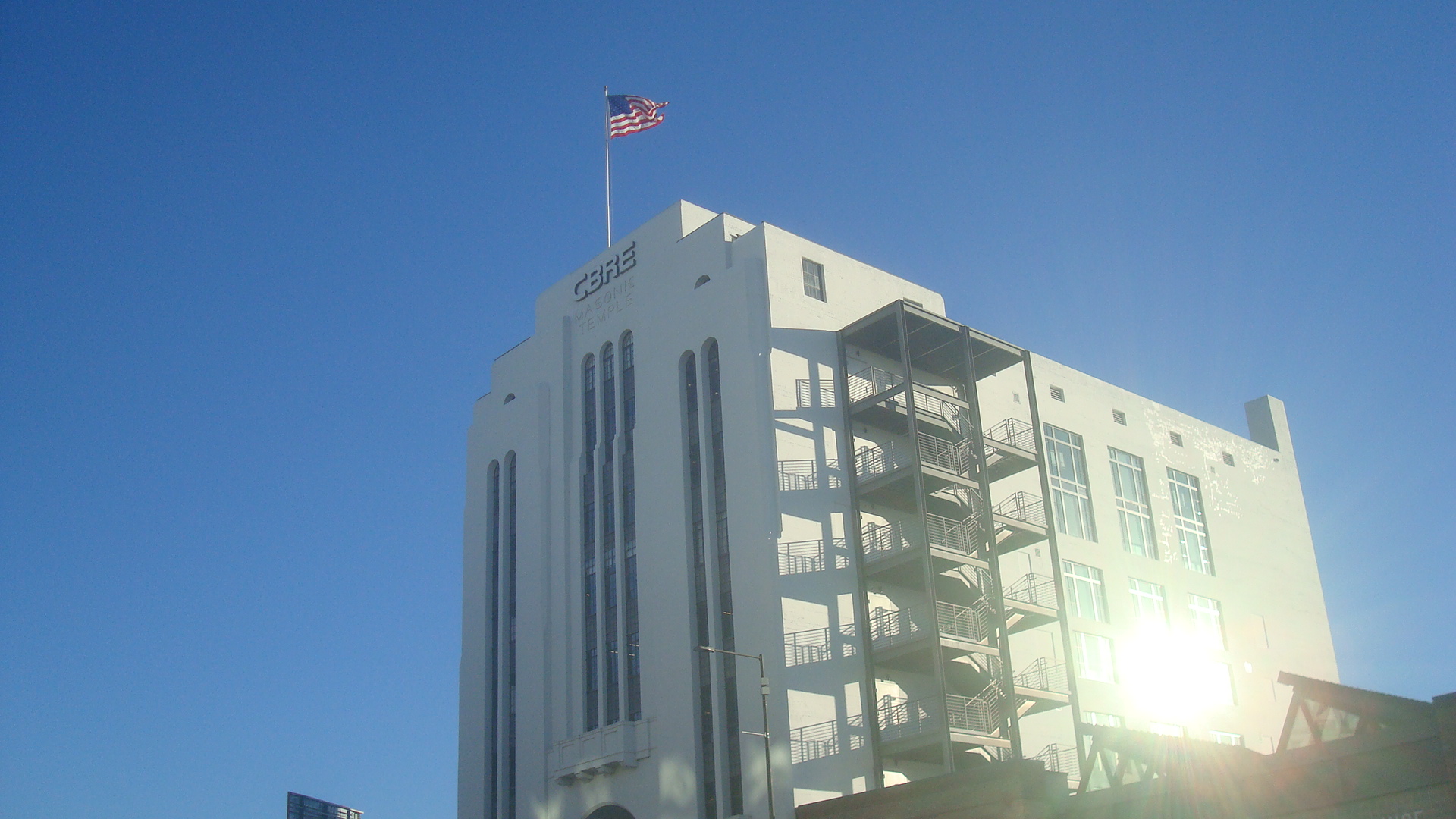
There’s a notice posted on the Glendale Masonic Temple at 234 S. Brand Boulevard. The text says that the City of Glendale is considering an amendment to its Advertising Signage Overlay Zone (ASOZ) which would expand the zone’s boundaries. It gives no further details about the scope of the expansion, or what kind of outdoor advertising is being contemplated.
But I’d be willing to bet that the City of Glendale wants to let advertisers install digital billboards, possibly on the side of the Masonic Temple. You can already find digital signage at the Americana mall on the south side of Brand. Outdoor ad companies are lobbying cities all over the US to open up to bigger and more invasive digital signage. It’s a hugely profitable business that’s growing rapidly.
Personally, I’m against outdoor digital advertising for a few reasons. One reason is that I see it as urban blight. But more importantly, I’m concerned about the way digital advertisers are collecting and sharing cell phone data. There are huge privacy risks here, and most city officials are completely oblivious.
A public hearing is scheduled later this month. If you’re interested in attending, here’s the info….
DATE: Wednesday, November 19, 2025
TIME: 5:00 PM
LOCATION: 633 E. Broadway (MSB), #105, Glendale, 91206
You can also contact Roger Kiesel, of the Glendale Community Development Department, at 818 937-8152.
The Glendale Masonic Temple was dedicated in 1929 and served as a meeting place for different Masonic Lodges into the 50s. It was designed by Arthur Lindley, who also designed the nearby Alex Theatre. Rick Caruso’s company bought the building about a decade ago and refurbished it, making some changes to the design. The building is a Glendale Historical Landmark and also on the National Register of Historic Places.
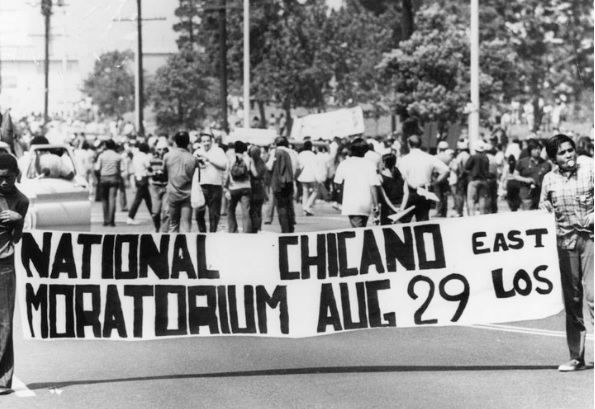
Photo by Sal Castro, Security Pacific Bank Collection, LA Public Library
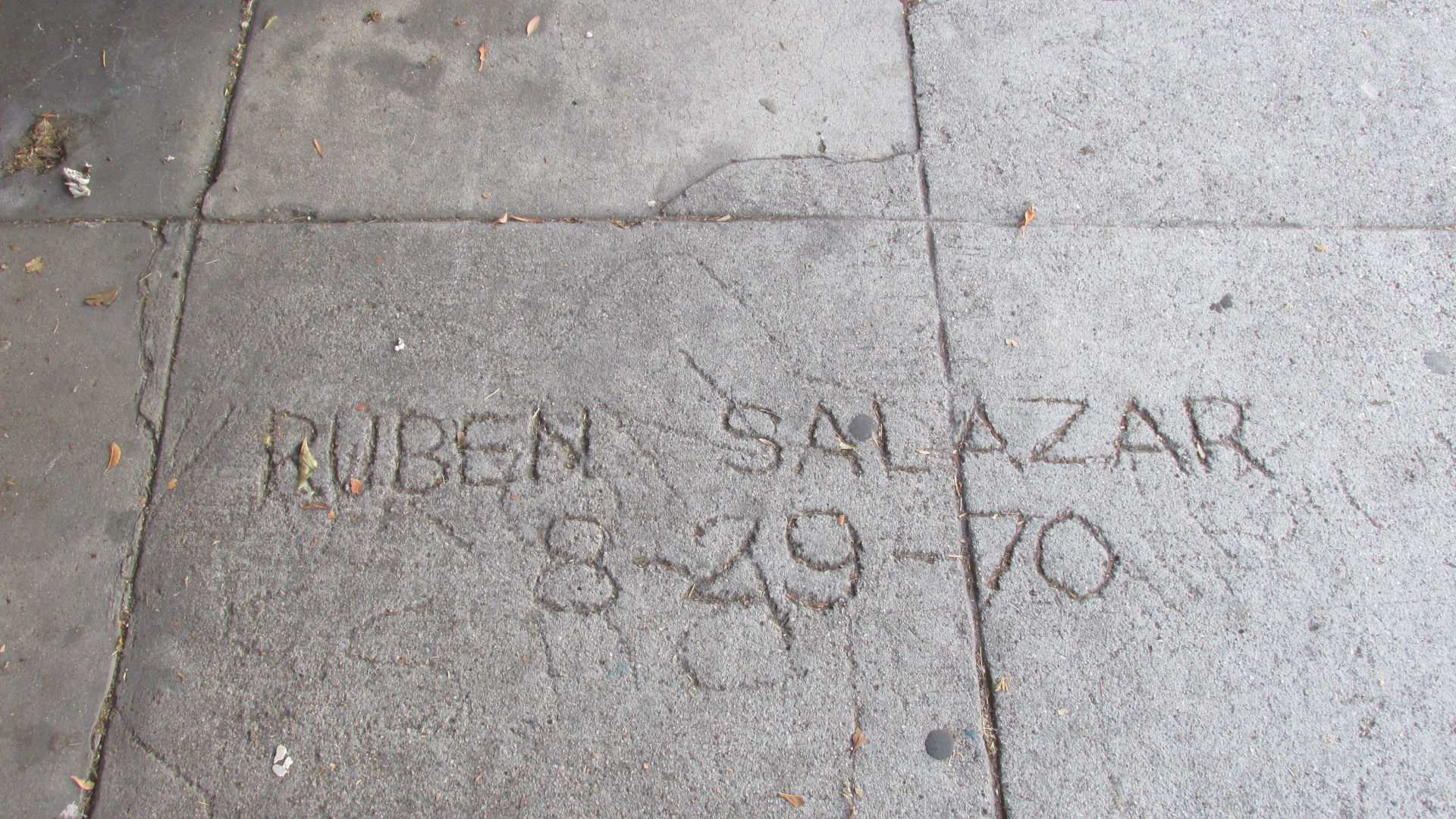
Journalist Rubén Salazar was killed 55 years ago today. He’d been covering a large protest in East LA that was part of the Chicano Moratorium. Salazar was taking a break at the Silver Dollar Cafe when a sheriff’s deputy standing outside fired a tear gas canister into the bar. The canister hit Salazar in the head and killed him instantly.
Salazar worked at the LA Times in several capacities for more than a decade. At the time of his death, he was news director at Spanish-language KMEX-TV, though he still wrote a weekly column for the Times. Salazar reported on tensions between the Latino community and the cops, and it was no secret that law enforcement officials weren’t happy about his reporting.
It’s important to remember Salazar’s work, but also to think about his death in the context of what journalists are facing today. Both in the US and abroad, journalists are increasingly being targeted for doing their job. Beyond that, fair and objective journalism is increasingly threatened by the changing economic landscape and a social media sphere that values likes more than facts.
LA Times columnist Gustavo Arellano wrote an excellent piece on Salazar today. See below. I’m also including a link to Salazar’s own reporting. It’s worth taking some time to think about Rubén Salazar today. Fifty five years later, his life and his death still hold meaning for us.
We all have places we’re attached to, places that are important to us, places that become part of our landscape. In most cases it’s easy to explain why they mean so much. Maybe it’s a restaurant we’ve been going to for years, or a club where we used to hang out with our friends. Usually, it’s a place where we’ve had a lot of good times, a locale that’s loaded with memories. But in some cases it’s hard to explain why the place means so much to us. Why its disappearance feels like a loss.
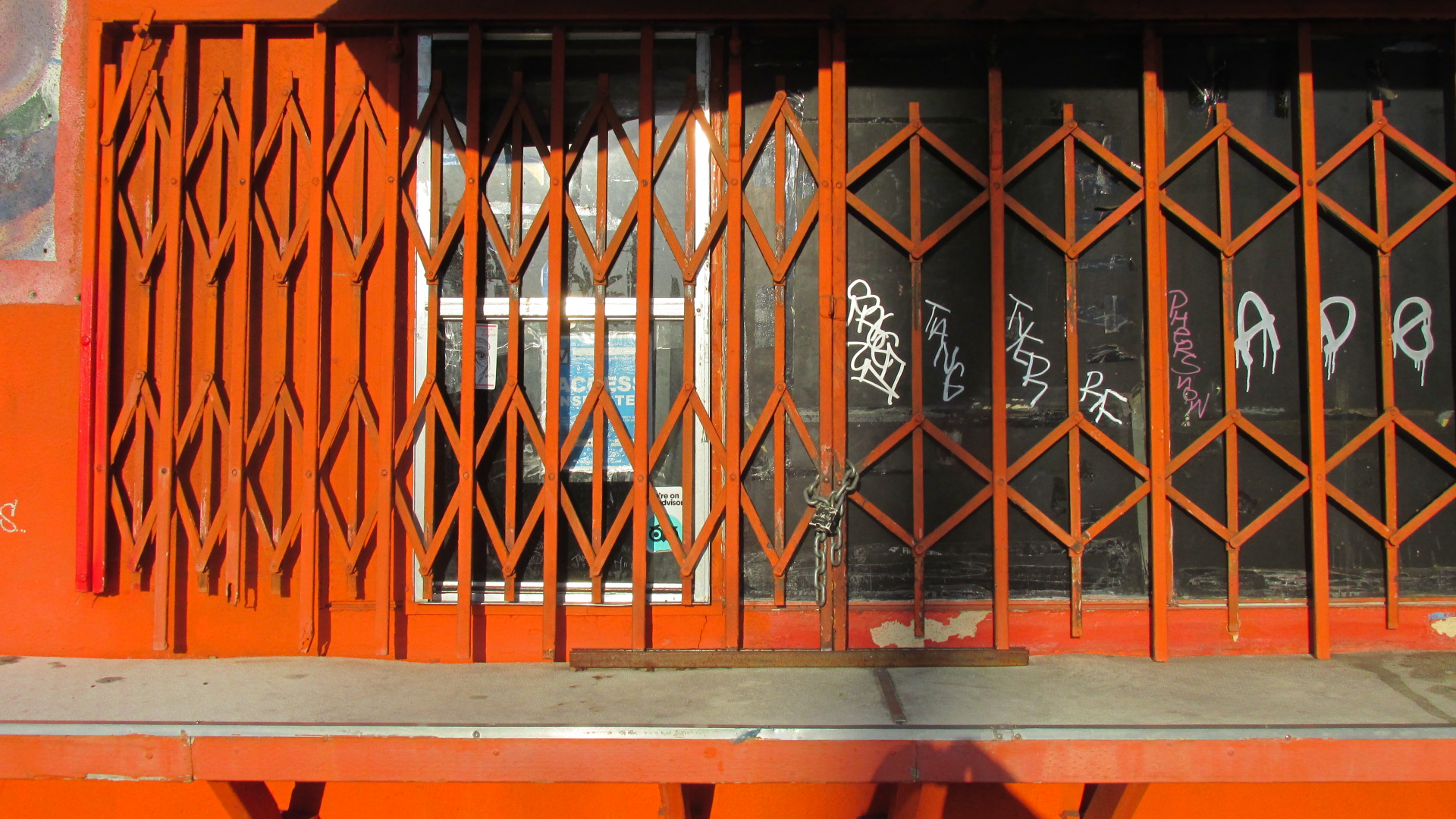
Counter outside the building.
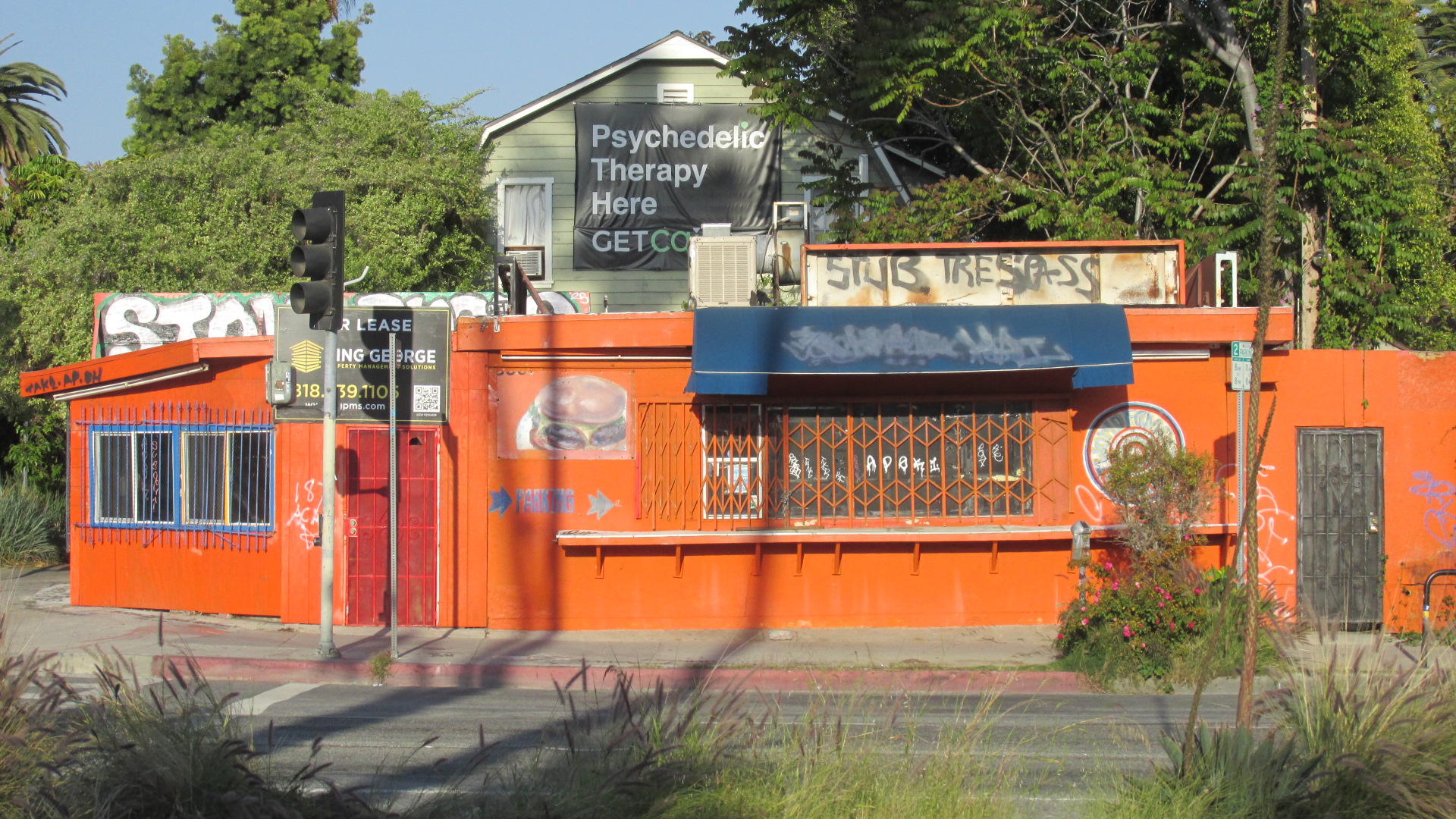
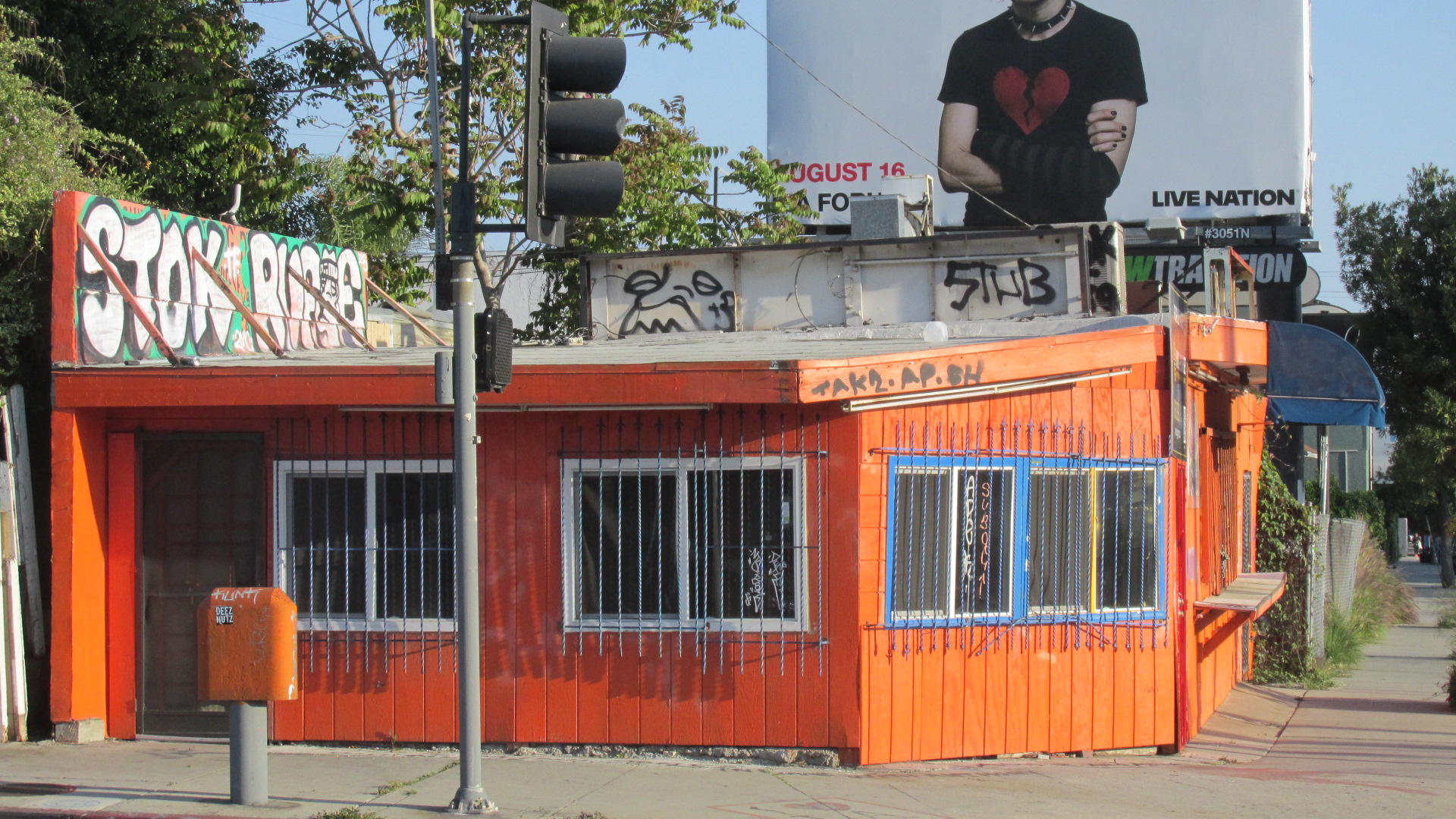
I was riding the bus down Fairfax last week and I saw that Oki Dog had closed. I can’t say I got choked up, but I did feel like I’d lost something. I’m not sure why. I never spent any time there with my friends. In fact, I never even ate there. But for decades now I’d seen it sitting there at the corner of Fairfax and Willoughby, a small, ramshackle building that only stood out because it was painted orange.
Painting on the front of the building.
The only reason I paid any attention to it at all was that I knew Darby Crash used to hang out there. Darby Crash, AKA Bobby Pyn, AKA Paul Beahm, was the lead singer for the Germs, one of the key bands on the LA punk scene back in the late 70s. They played a lot of shows, put out a few singles and an album, and then Darby killed himself by ODing on heroin on December 7, 1980. He was 22.
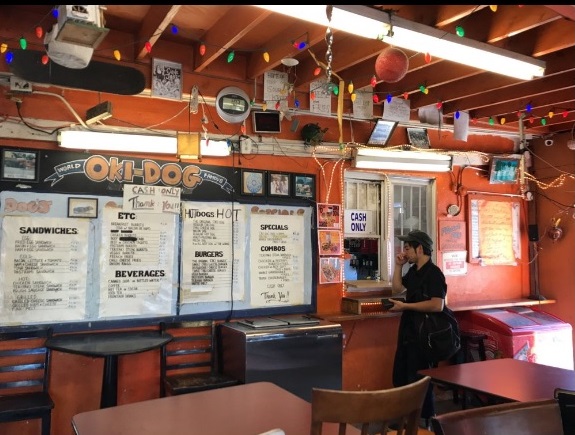
The tables inside are all empty now.
I never ate at Oki Dog because the food didn’t sound like my kind of thing, but the place had many diehard fans who raved about the messy, greasy hot dogs and hamburgers. I spent some time looking at the reviews on Yelp, and it was kind of hilarious how divided the comments were. Some commenters thought the food was disgusting, and were creeped out by the place’s grungy décor. Many of them said they’d never come back. Other commenters thought the food was amazing and loved the down-at-the-heels vibe. Many of them said they’d been eating there regularly for years.
Photo of Oki Dog when it was still open from Yelp by Eric F.Photo of Oki Dog interior from Yelp by Erica E.
But for me the only connection was knowing that Darby used to hang there with his friends and followers. I never saw the Germs live, but I’ve got the album, and a few of the singles and live recordings on various compilations. They were an amazing band. It’s tempting to say they were gone too soon, but like a lot great bands, they probably couldn’t have maintained the intensity much longer. When you play that hard and live that crazy, it’s probably impossible to hold everything together.
So for me, I guess that rundown orange shack at Fairfax and Willoughby that I never stepped inside is like a link to LA in the late 70s, when punk was raging through the clubs and it seemed like some kind of revolution was going on. And a young guy named Darby Crash was taking things all the way to the edge. Before he finally decided to jump off the edge.
RIP Darby.
UPDATE: Thanks to Margaret for pointing out that Oki Dog was originally located at 7450 Santa Monica Blvd., about two blocks up and eight blocks over from the location at Fairfax and Willoughby. The original restaurant opened in the late 70s, but I was not able to find out when it moved over to Fairfax.See this article from WeHo Times for more details.
It’s hard to believe that the Pantry is closed. It’s one of those places that seemed liked it had been around forever, and it seemed like it would go on forever. I think I started going to the Pantry back in the 70s. Back then it was open 24-hours. If you were going to a movie or to see a band in Downtown, it was the perfect place to stop afterwards. They served breakfast all day and the coffee kept coming.
The Pantry is now owned by a trust set up by former LA Mayor Richard Riordan. According to the trust, the Pantry is not profitable, and they’re hoping to sell it to fund the charitable work of the Riordan Foundation. It will be interesting to see who buys it. Obviously, the property, located in the heart of Downtown, is worth a fortune, but demolishing the restaurant to build something larger will probably not be easy. The Pantry is designated as an LA City Historic Cultural Monument. That would complicate any plans for new development.
This all just feels really sad. The older I get, the more I understand that the world is always changing and that nothing lasts forever. But I still feel like I’m losing a piece of my life. And I think a lot of other people are feeling the same way.
Map of current fires in LA area from Cal Fire, as of January 12, 2025
If you’re looking for updates on the fires in LA, this post won’t offer anything you haven’t heard already. The LA Times, Daily News, and local news stations have been doing an excellent job reporting on the situation. I’m writing this post because I want to talk about what comes next. While the fires are still burning, and may continue to burn through next week, we do need to start talking about the future of LA. And I think the best way to start talking about the future is to begin with the past….
The City of LA was built on real estate speculation. To some degree, this is true of most cities, but it’s especially true of Los Angeles. Writers have commented on the fact that this area lacks a number of the things that are generally the basis for large scale development, most fundamentally a reliable source of water. Nor did the City of LA initially have a port, and only gained one by annexing San Pedro in 1909. That area is only tenuously connected to the rest of the city by a narrow, 20-mile corridor that’s basically just a rail line.
LA did have oil. Drilling began in the 19th century, and in the early 20th century large sections of the city, including Downtown, were covered with oil wells. But real estate investors saw huge amounts of money to be made by residential and commercial development, and gradually most oil wells were either shut down or hidden. (The majority of wells that are still visible are located in the southern part of LA, and the low-income communities that are impacted don’t have the political clout to shut them down.) The real estate investors promoted Los Angeles aggressively, putting ads in newspapers nationwide, essentially selling the climate. LA had lots of sun and little rain. People came, but the investors knew that to sustain new development they’d need to bring more water to the area. The LA Aqueduct was completed in 1913, after business interests used dishonest means to buy up the rights to the Owens Valley’s water resources. As the city continued to grow, LA snagged more water from the Colorado River with the construction of Hoover Dam during the Depression. Then came the construction of the California State Water Project, which extended from the 50s through the 70s. The bottom line is, the City of LA is only able to support a population of almost four million people because it imports about 90% of its water from areas that are hundreds of miles away.
I’m talking about the way LA was built because I think it’s important to understand the city’s history in talking about the fires that have devastated LA’s communities. Real estate investors built LA because there were fortunes to be made. In the first past of the 20th century, the only efforts at planning were driven by investors looking for profit. In the second half of the 20th century, there was more of an effort to plan for growth, but efforts at responsible planning were often overridden by the same investors looking for more profits. In the 21st century, there’s a lot of talk about planning at City Hall, but really most of it boils down to upzoning large swaths of the city to promote more growth. Planning in the City of LA is still largely driven by investors and their lobbyists. If you don’t believe me, please read up on the recent convictions of former Councilmember Jose Huizar, former Deputy Mayor Ray Chan and others who were caught up in a massive scandal involving bribery, fraud and racketeering. And if you think those convicted were the only ones involved, it’s important to remember that projects backed by Huizar were almost without exception unanimously approved by the LA City Council.
Image from Cal Fire Update, January 11, 2025
The point here is that development in LA is not driven by responsible planning. Development in LA is driven by money. If you want to know why projects were approved and are still being approved in fire-prone areas, follow the money. While there have been individuals who chose to build their own homes in areas where fire risk is high, most of the residential development in these areas is the result of the creation of suburban subdivisions. Even when citizens expressed concern about fire risks in these areas, they were almost always ignored by the politicians, who had often received campaign contributions from the developers. The Porter Ranch area has been repeatedly threatened by fires, but that didn’t stop the City of LA from approving The Vineyards at Porter Ranch, a recent multi-phase mixed-use project that includes apartments, a hotel and a large retail component. The project location has been designated by the LA Fire Department as a Very High Fire Hazard Severity Zone (VHFHSZ). Another example is LA City Planning Director Vince Bertoni’s approval of the initiation of a General Plan Amendment (GPA) to make way for the Bulgari Hotel, a massive luxury hotel project that was to be located in another VHFHSZ in the Santa Monica Mountains. The request for the GPA was submitted by developer representative Stacey Brenner, whose husband served as a deputy to former Councilmember Paul Koretz. The project was in Koretz’ district. The Bulgari Hotel was only stopped because area residents put intense pressure on Koretz’ successor, Councilmember Katy Yaroslavsky, who promised to stop the project during her campaign for the office.
Many of the areas that have been burned in the current spate of fires have burned repeatedly before. In the last few decades there have been multiple fires in Brentwood, Bel Air and the Hollywood Hills. Other communities like Baldwin Hills, Sunland-Tujunga and Chatsworth have all been hit by devastating fires. But, with rare exceptions, the City of LA continues to approve new development in fire prone areas.
As fires continue to rage across Los Angeles County, talk of rebuilding has already begun. I wish our elected officials would take some time to think about this. We need to have a tough conversation about rebuilding. I understand that thousands of people have lost their homes, and their dearest wish would be to rebuild and return to their communities. If individuals have the resources to do this, and if they understand the risks, they should be able to make that choice. But with the death toll from the current fires at 16, and damages worth billions of dollars, our elected officials should think long and hard about pushing for large scale development in fire prone areas. In most of these areas, the question is not whether they’ll burn again but when they’ll burn again. The LA area has always been prone to fires. As climate change continues to make the region drier and warmer, the risks will only increase. And while our firefighters can work miracles when conditions are favorable, we’re now seeing a brutal demonstration of how hard it is to control wind-driven fires.
It remains to be seen how strong the push for rebuilding will be once the fires stop. No doubt the real estate investors are already weighing their options. Some may want to bet on rebuilding. Others may think the risk is too great and decide to put their money elsewhere. But California Governor Gavin Newsom has already announced the suspension of laws that would require environmental review for rebuilding in fire prone areas. This is just crazy. After this disaster we should be insisting on stronger environmental review. The California Environmental Quality Act (CEQA) requires an assessment of whether new development will result in wildfire risks. It also requires cities to ask whether fire departments can provide adequate protection and whether the site can be safely evacuated in an emergency. Instead of brushing these issues aside, we should be insisting on careful scrutiny.
CEQA also requires review of a project’s greenhouse gas emissions (GHGs), because of the growing threat of climate change. Most Environmental Impact Reports I’ve read make no meaningful effort to accurately assess a project’s GHG impacts. Instead, the preparers rely on the State’s CalEEMod platform, which allows them to input whatever numbers they want, thereby pretty much guaranteeing that no project will ever appear to cause significant GHG impacts. In reviewing the EIRs, LA City Planning generally accepts whatever the developers claim without question. While the City of LA and the State of California claim to be fighting climate change, in reality both of them usually support new development regardless of what the GHG impacts are.
Again, I totally understand that many of those who lost homes in the fire are anxious to rebuild. If I were in their situation, I’d probably feel the same way. But LA has been repeatedly hit by deadly and devastating fires. As much as we may want to hear inspiring words about rebuilding, we need to ask: Do we want to be reliving this tragedy over and over again?
Let’s think carefully before we start to build again. And let’s demand that our elected officials do the same.
Hollywood got a new mural earlier this month. A striking image of P-22, the mountain lion that made its home in Griffith Park, now gazes out on the boulevard. P-22 captured the public’s attention by migrating from the western Santa Monica Mountains to Griffith Park, which involved crossing both the 405 and the 101 Freeways. Angelenos mourned the mountain lion’s death in December 2022.
I knew there had been a number of tributes to P-22, but I didn’t realize how many murals he was featured in. There are at least six. Three were painted by muralist Jonathan Martinez. Multi-disciplinary street artist Corie Mattie has also painted three, of which the one on Hollywood Blvd. is the most recent.
It’s great that people remember P-22, but it would be even better if people started thinking about ways to keep these beautiful animals alive. One of the reasons P-22 caught the public’s attention was that he managed to cross two freeways without getting hit. Many mountain lions die from vehicle collisions every year. A 2024 study from the UC Davis Road Ecology Center reports that 613 mountain lions were killed on roads between 2016 and 2023, inclusive. That averages out to about 76 per year.
The P-22 mural is located at 6411 Hollywood Blvd., just a few doors west of Cahuenga.
Back in 2017, I walked across the Fourth Street Bridge and took a bunch of photos, thinking it would be a great subject to write about on this blog. Now, only seven years later, I’m finally getting around to doing this post. What can I say? Time flies….
Fourth Place, leading up to the Fourth Street Bridge.
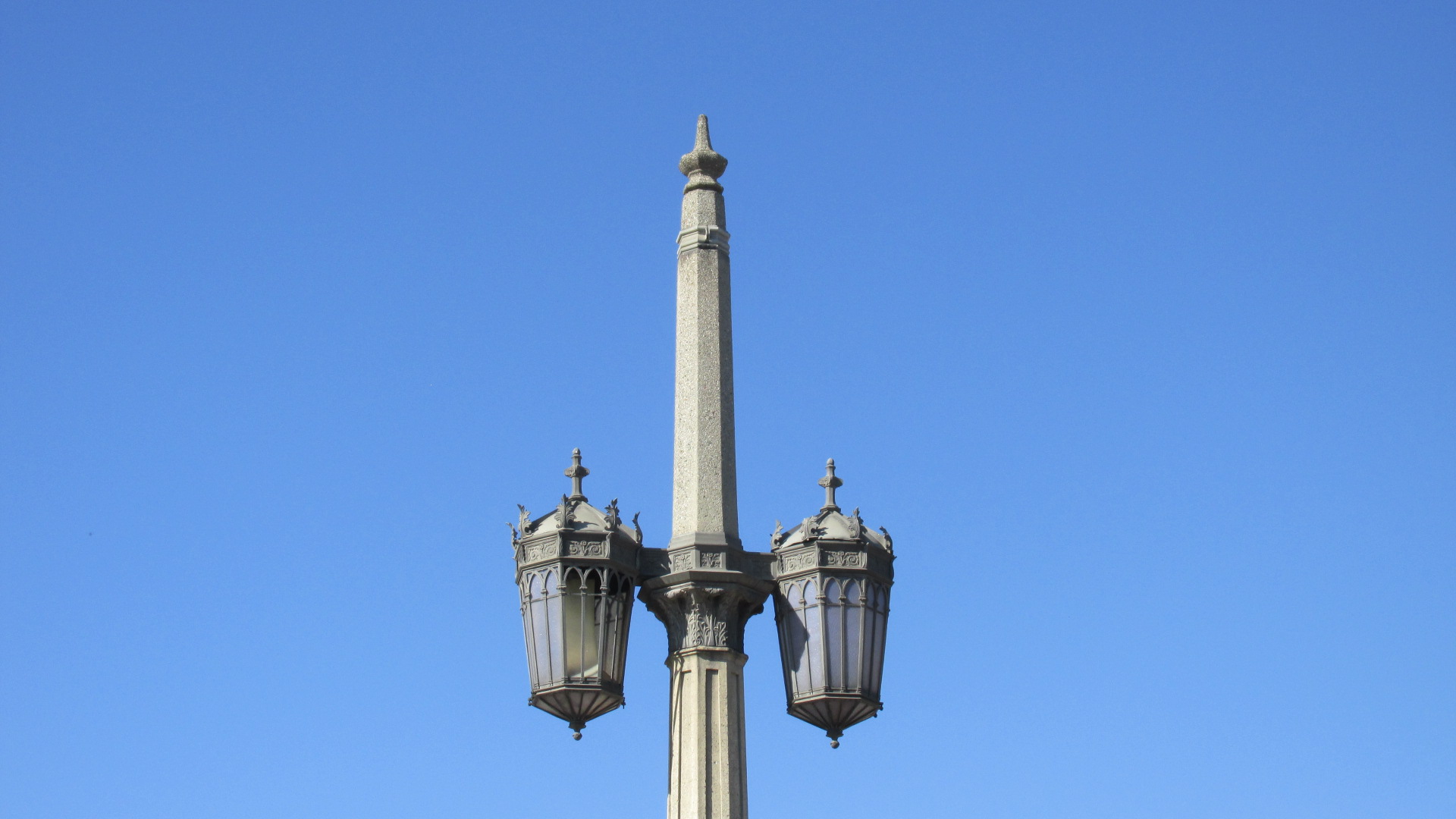
To my mind, the Fourth Street Bridge is one of the most striking bridges in LA. I don’t claim to be an architecture critic, but it seems like there was unusual amount of care put into the design. The streetlights, porticos and concrete railing were fashioned in a mix of Beaux Art and Gothic Revival styles that was carefully worked out by the architects. These aren’t just decorative elements that were tacked on. They’re well-suited to the scale and the massing of the bridge.
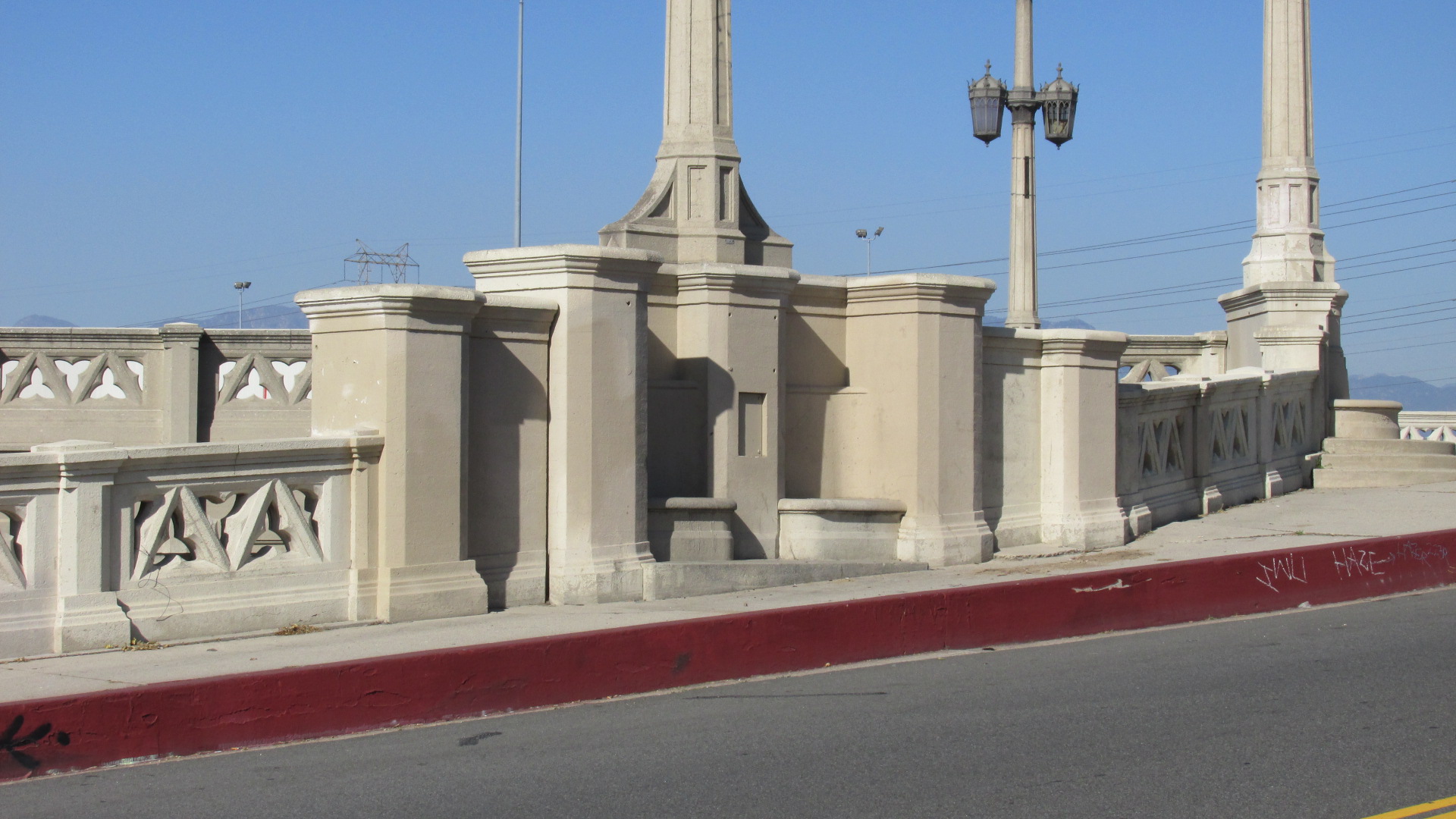
Fourth Place merges with the Fourth Street Bridge.The streetlights echo European Gothic design.Some of the piers feature built-in seating.
Constructed in 1931, the bridge was part of a massive investment in infrastructure made possible by the passage in the 20s of LA’s Viaduct Bond Act. (To show you how ignorant I am, I didn’t know until recently what the difference was between a bridge and viaduct. Apparently, a bridge is a small structure built to cross a fairly narrow river or ravine. A viaduct is a larger structure made up of a series of bridges that crosses a wide river or a valley. But I’m still going to call it the “Fourth Street Bridge”. Old habits die hard.)
A view of the bridge looking toward East LA.The San Gabriel Mountains to the north.Unfortunately, these days many of the porticos are filled with trash.
The Fourth Street Bridge was built by the LA City Bureau of Engineering under the supervision of Bridge and Viaduct Engineer Merrill Butler. Butler had a long career in LA, working for the City in various capacities until his retirement in 1961. Over the years the projects designed under his direction included the First Street (now Cesar Chavez) Bridge, the Hyperion Bridge, the Figueroa Street Tunnels and the Hyperion Sewage Treatment Plant.
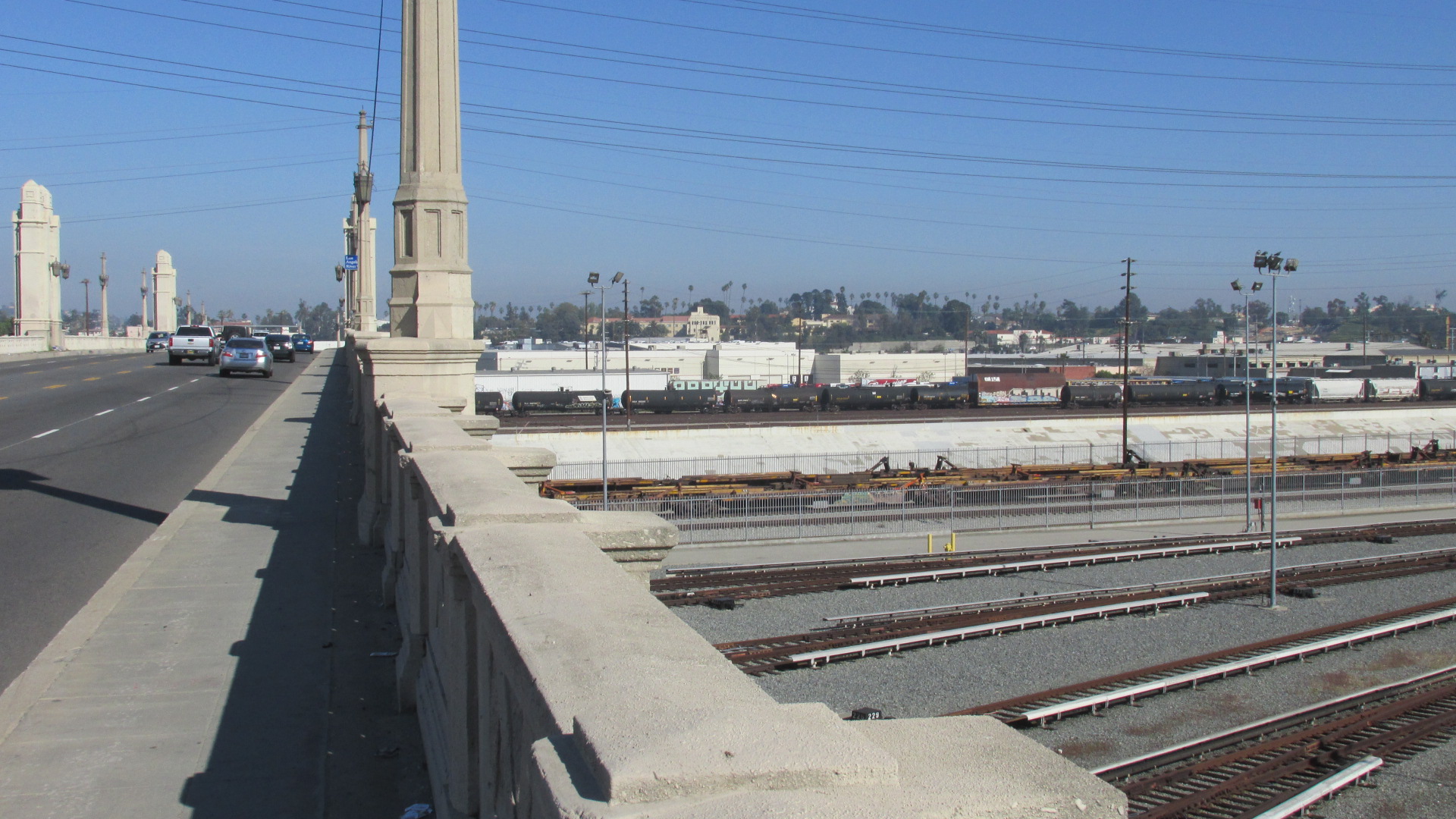
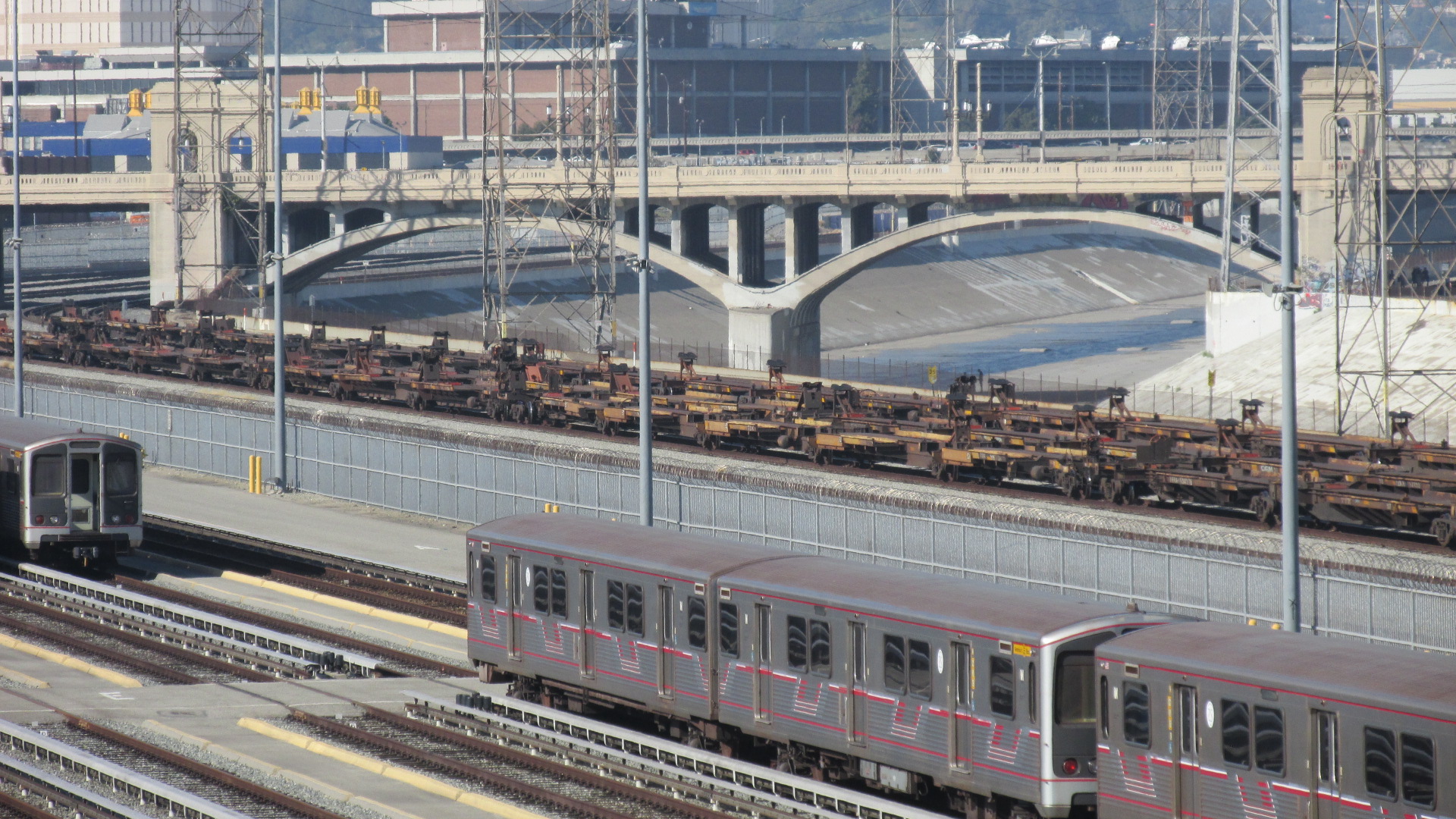
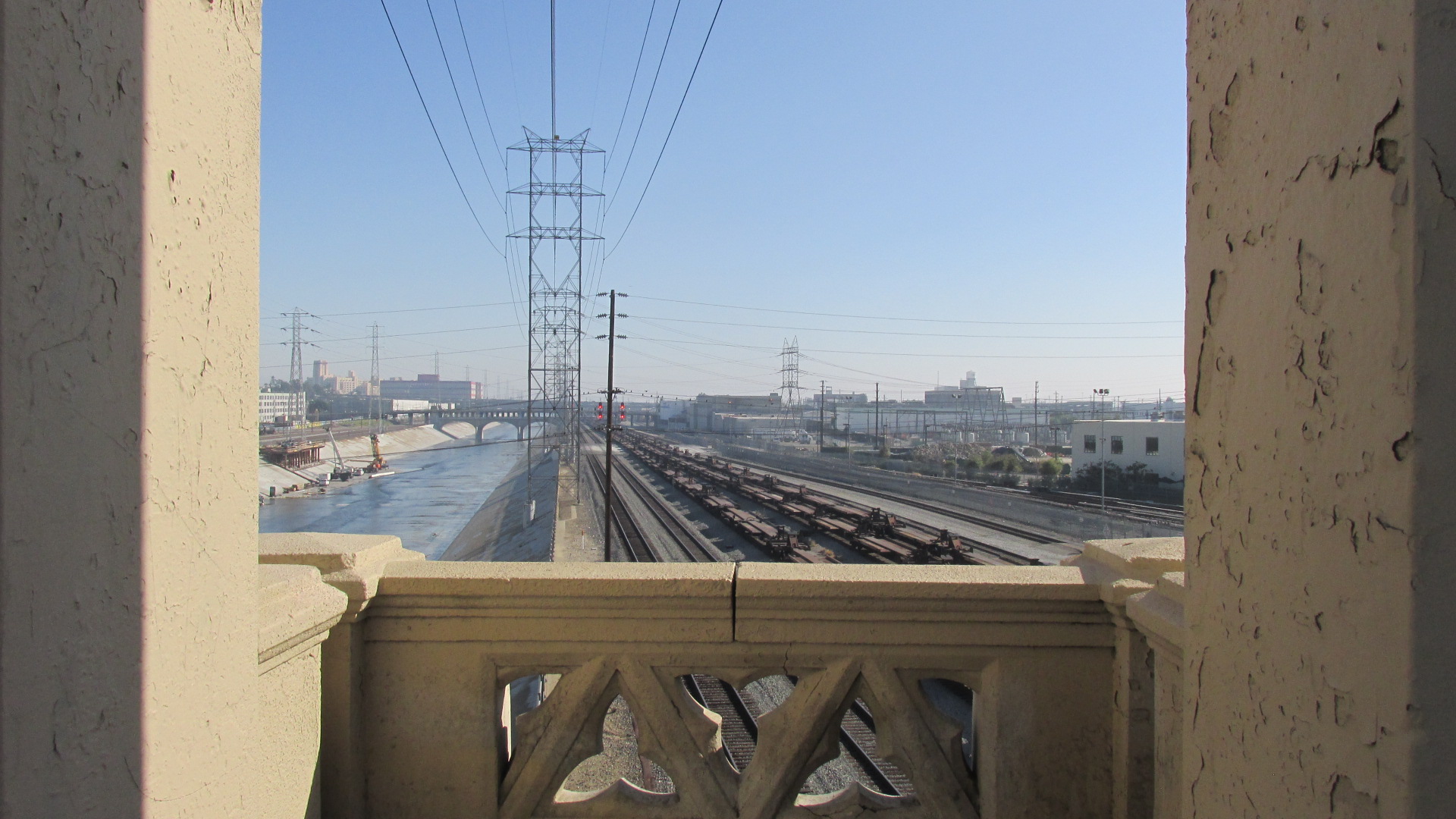
The series of bridges that connect East LA to Downtown are part of a massive infrastructure nexus that played a key role in LA’s growth. In the latter part of the 30s, work began on the flood control projects that would shape the LA River as we know it today. One of the reasons for encasing the River in concrete was to protect the rail lines that ran adjacent to it. You couldn’t move goods without trains. And rising above the concrete channel is a vast network of power lines.
Rail lines next to the LA River.Miles of power lines run above the River.Rows of flat cars lying on the tracks below.
In 1995, the Fourth Street Bridge was retrofitted to bring it into compliance with current seismic safety standards. And in 2008 it was declared a Historic Cultural Monument by the City of LA.
The Cesar Chavez Bridge lies just north of the Fourth Street Bridge.Looking west toward Downtown.
Here are a couple of links, for anyone who wants to dig a little deeper. Thie first will take you to Water & Power Associates, which has a number of historic photos of the Fourth Street Bridge. And if you’re into LA history, check out the Museum tab in the index on the left. Their virtual museum offers an amazing collection of images and information.
And here’s a brief bio on Merrill Butler that was apparently written at the time of his retirement. Not surprisingly, it’s pretty superficial, but it also seems to offer a small snapshot of mid-century LA. A different time, a different culture.
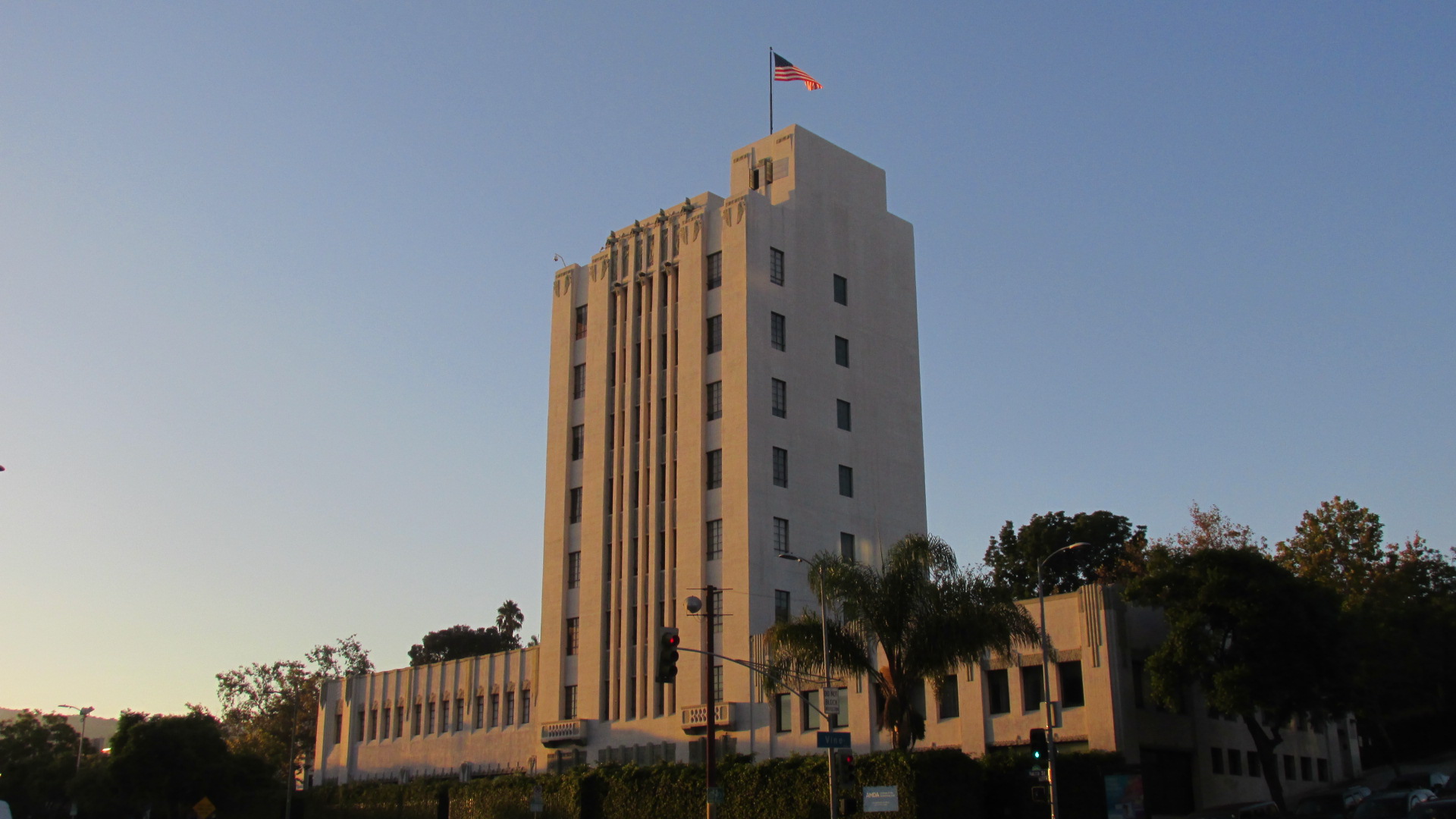
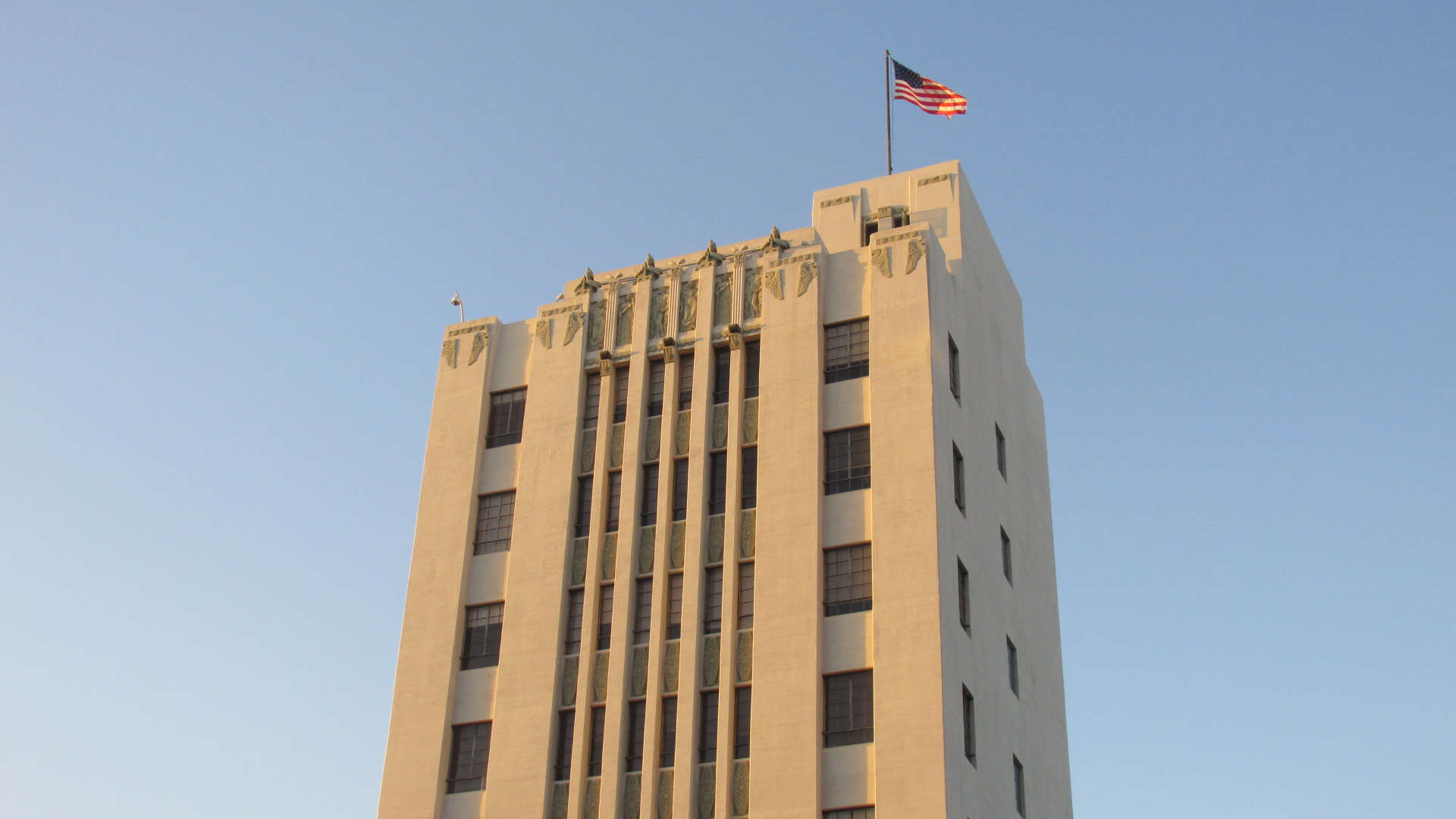
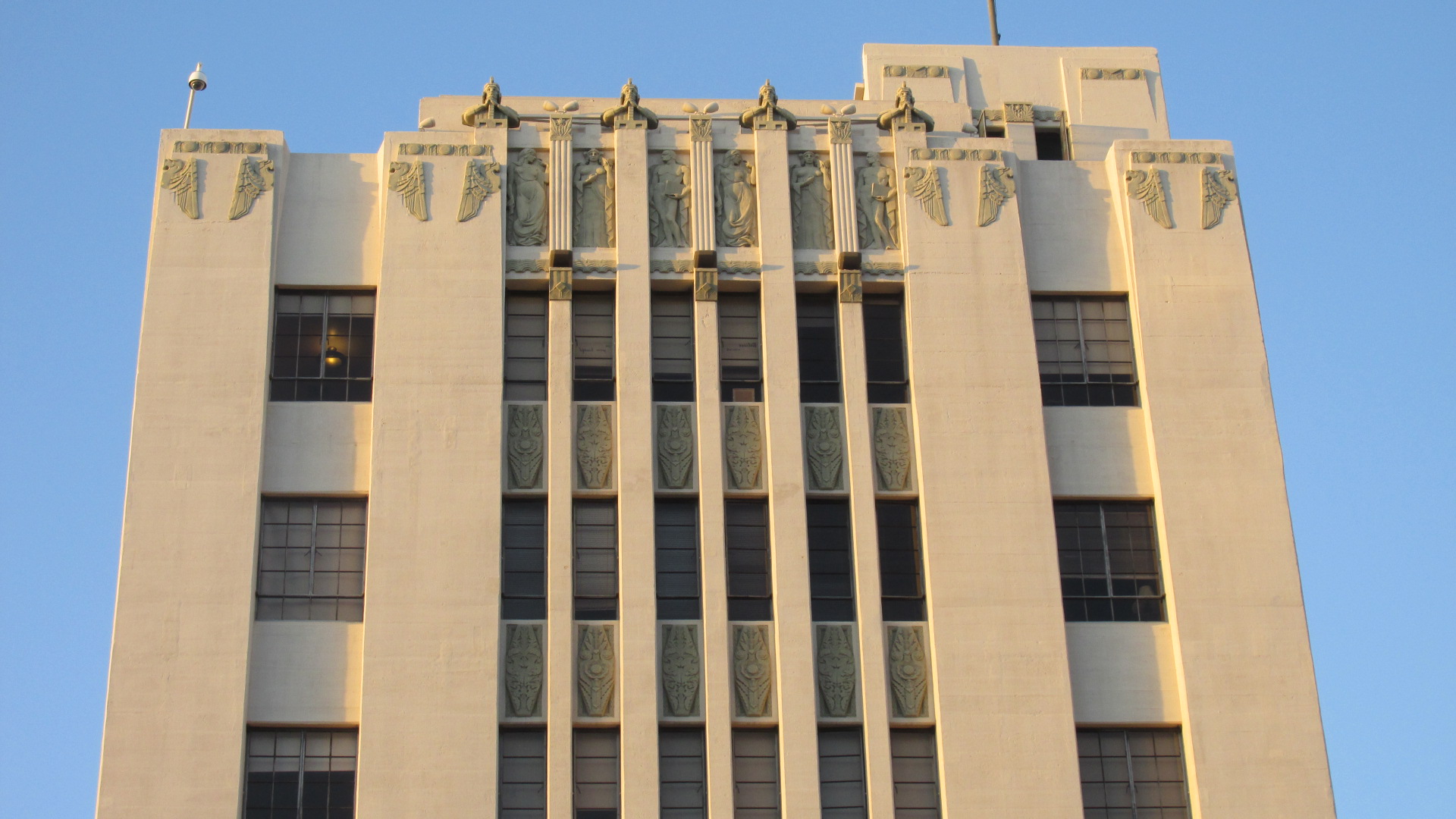
One of Hollywood’s most beautiful buildings is finally getting the recognition it deserves. On April 18, the City of LA’s Cultural Heritage Commission voted unanimously to recommend that the Yucca Vine Tower be designated a Historic Cultural Monument.
View of central tower.Top of central tower.
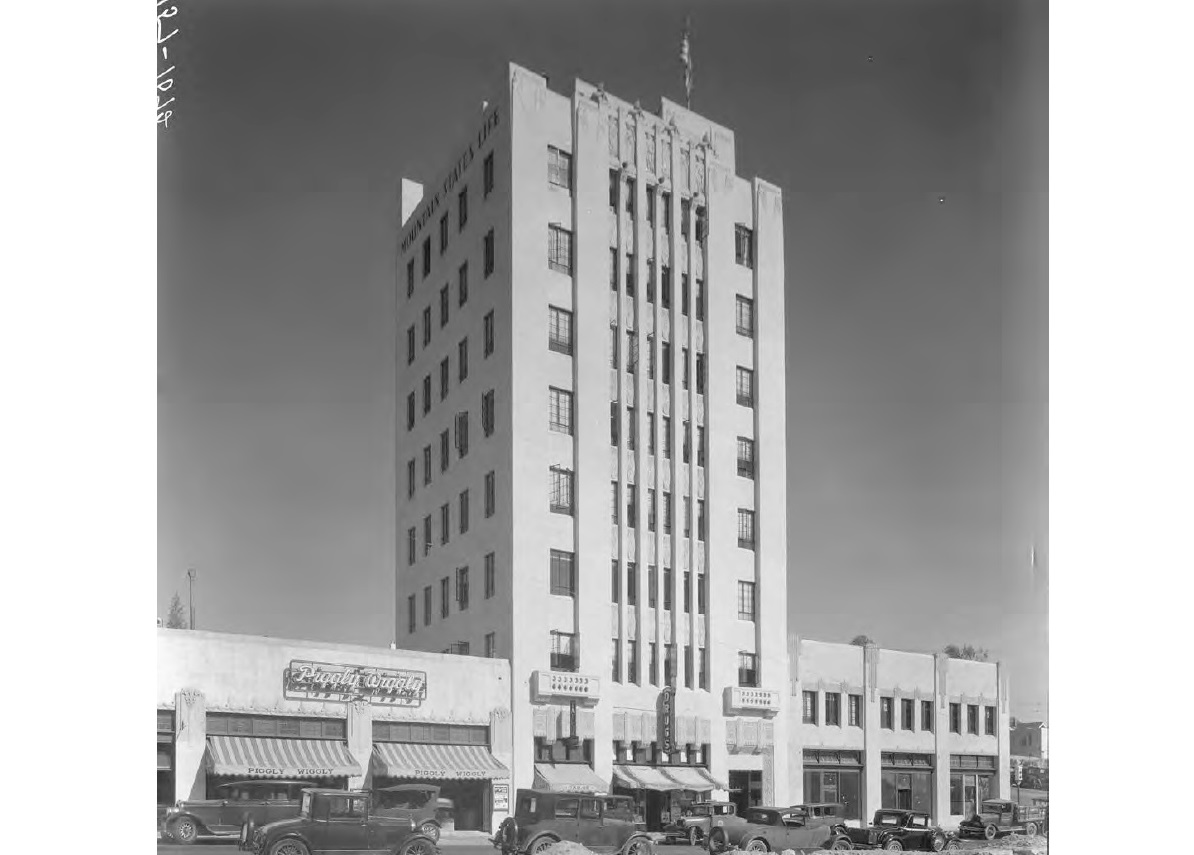
This Art Deco classic, constructed nearly 100 years ago as the Mountain States Life Building, was designed by LA-based architect Henry Gogerty. Currently occupied by the AMDA College of the Performing Arts, the list of former tenants includes Gene Autry’s Western Music Publishing, Motion Picture Daily, the Hollywood Anti-Nazi League, and Chao Praya, one of the first Thai restaurants in LA. In addition to designing other notable buildings in the Hollywood area, Gogerty worked on over 350 schools in Southern California. His firm is also credited with designing the Hughes Aircraft complex in Playa Vista and the Grand Central Air Terminal at the former Glendale Airport.
Historic image of Yucca Vine Tower from California State Library.
Thanks to John Girodo and the Art Deco Society of Los Angeles, who submitted the nomination. Thanks also to Kathleen Perricone, whose thorough research in preparing the nomination made an excellent case for historic designation. For more background on this amazing building, take a look at the CHC agenda packet, which is available here. The packet contains a wealth of historic photos. You can jump to them by clicking on Historic-Cultural Monument Application in the index on the first page.
View of Yucca Vine Tower from west.Detail of base.
The designation isn’t final yet. It still has to be approved by the full City Council. Hopefully they’ll vote soon to give this gorgeous building HCM status.
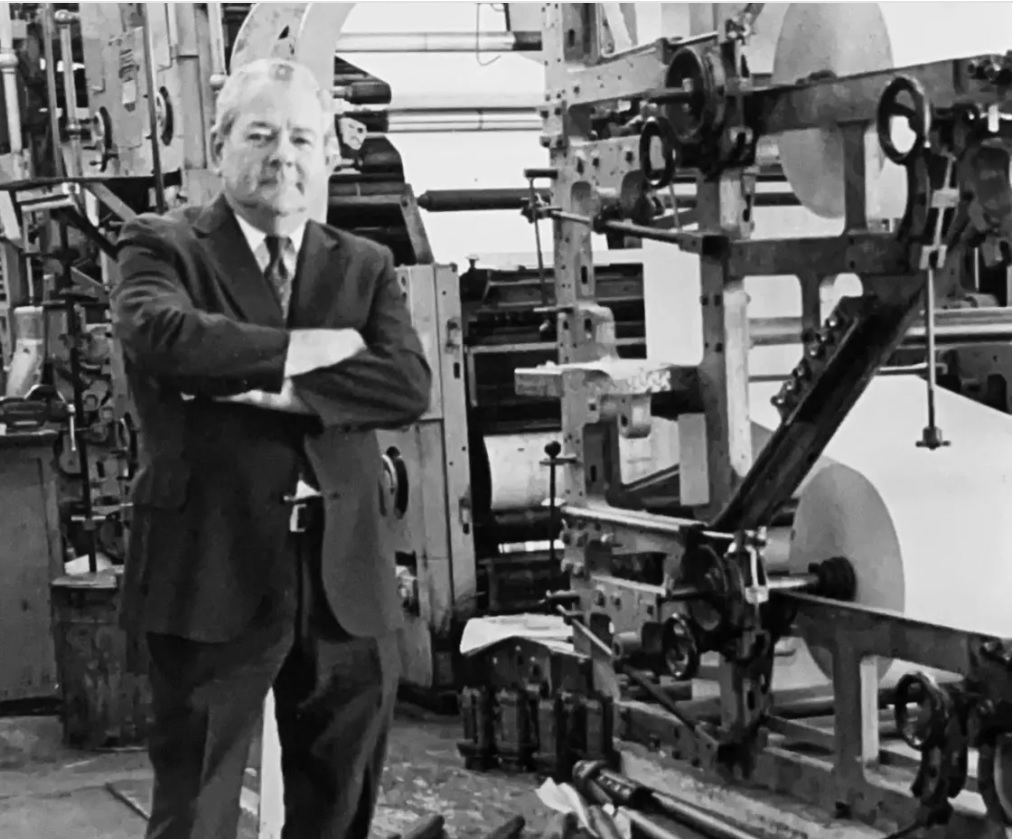
Ignacio Eugenio Lozano, Jr. (1927-2023), photo from La Opinión, courtesy of the Lozano family
Ignacio Eugenio Lozano, Jr., former editor and publisher of La Opinión, has died at 96. Lozano helped build the family-run newspaper into the most important Spanish-language print publication in Southern California. He holds a significant place in LA history, and La Opinión played a crucial role in giving voice to the region’s growing Latino population. Though the Lozano family is no longer involved in running La Opinión, it is still published today.
The LA area grew rapidly in the first half of the 20th century, and after WWII the population continued to climb. Spurred in part by the growth of the freeway system, subdivisions started springing up all over the place, and LA’s car culture kicked into high gear. Families went to see movies in drive-in theatres. Teen-agers spent Saturday night at drive-in restaurants.
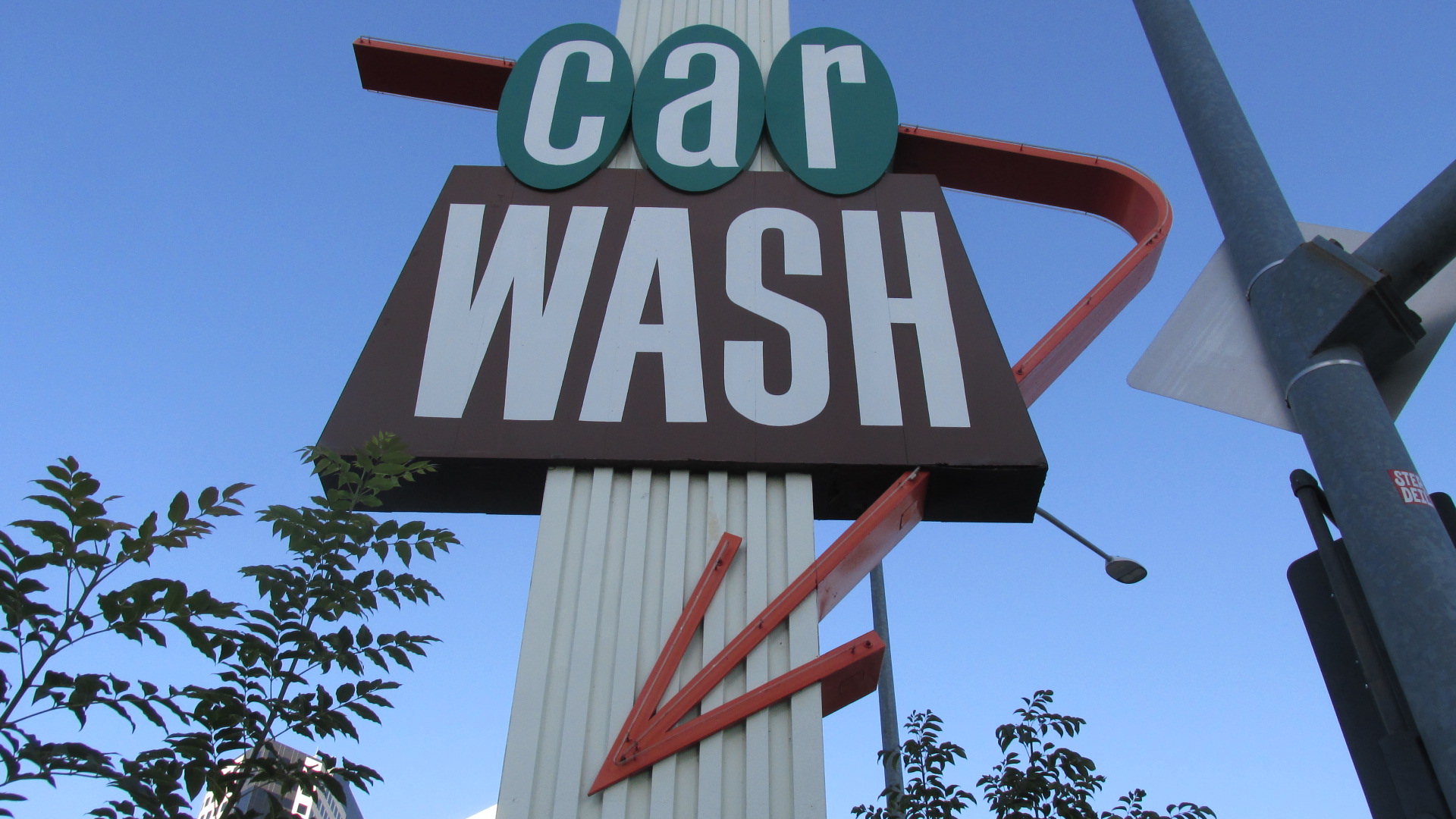
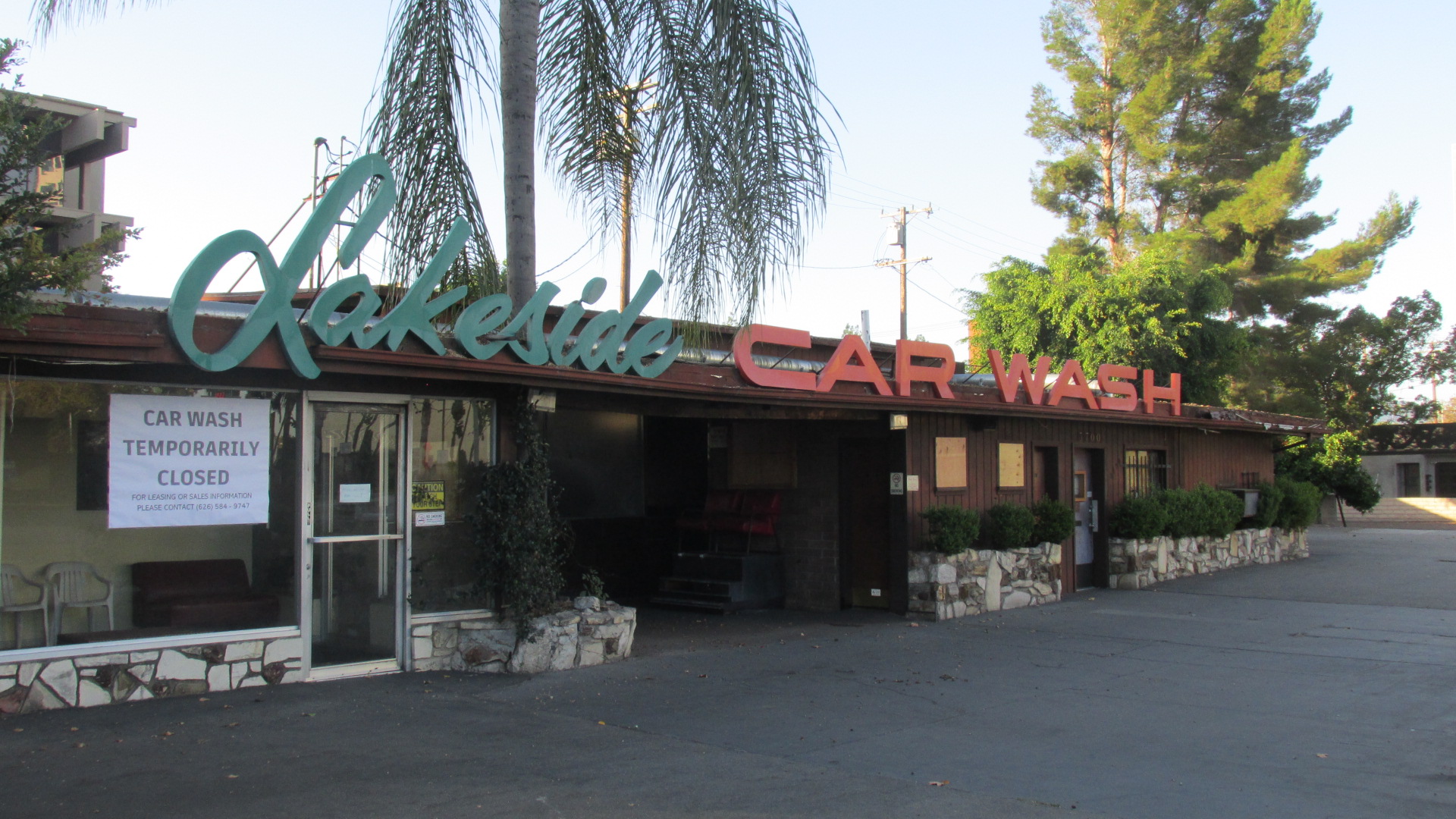
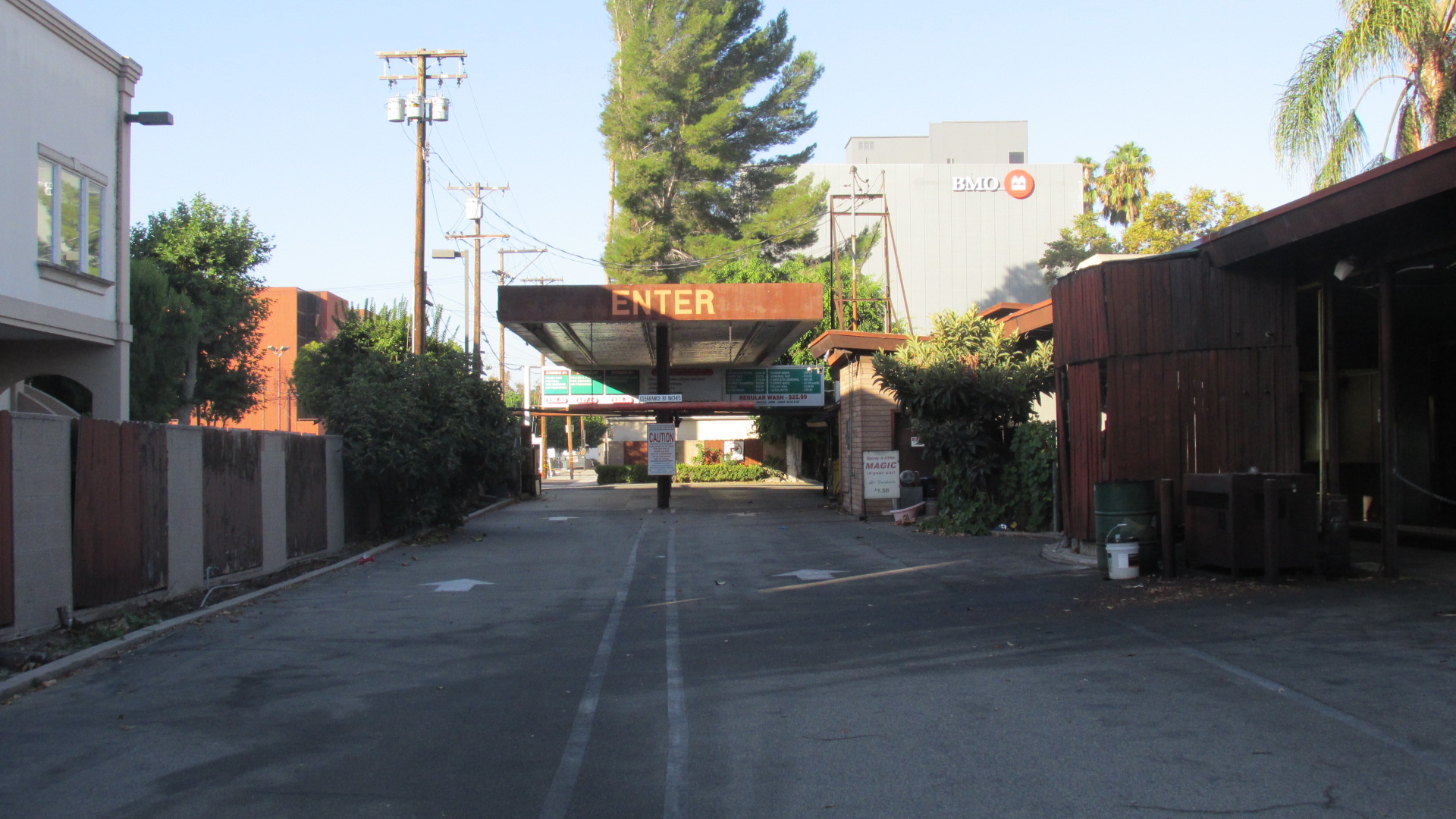
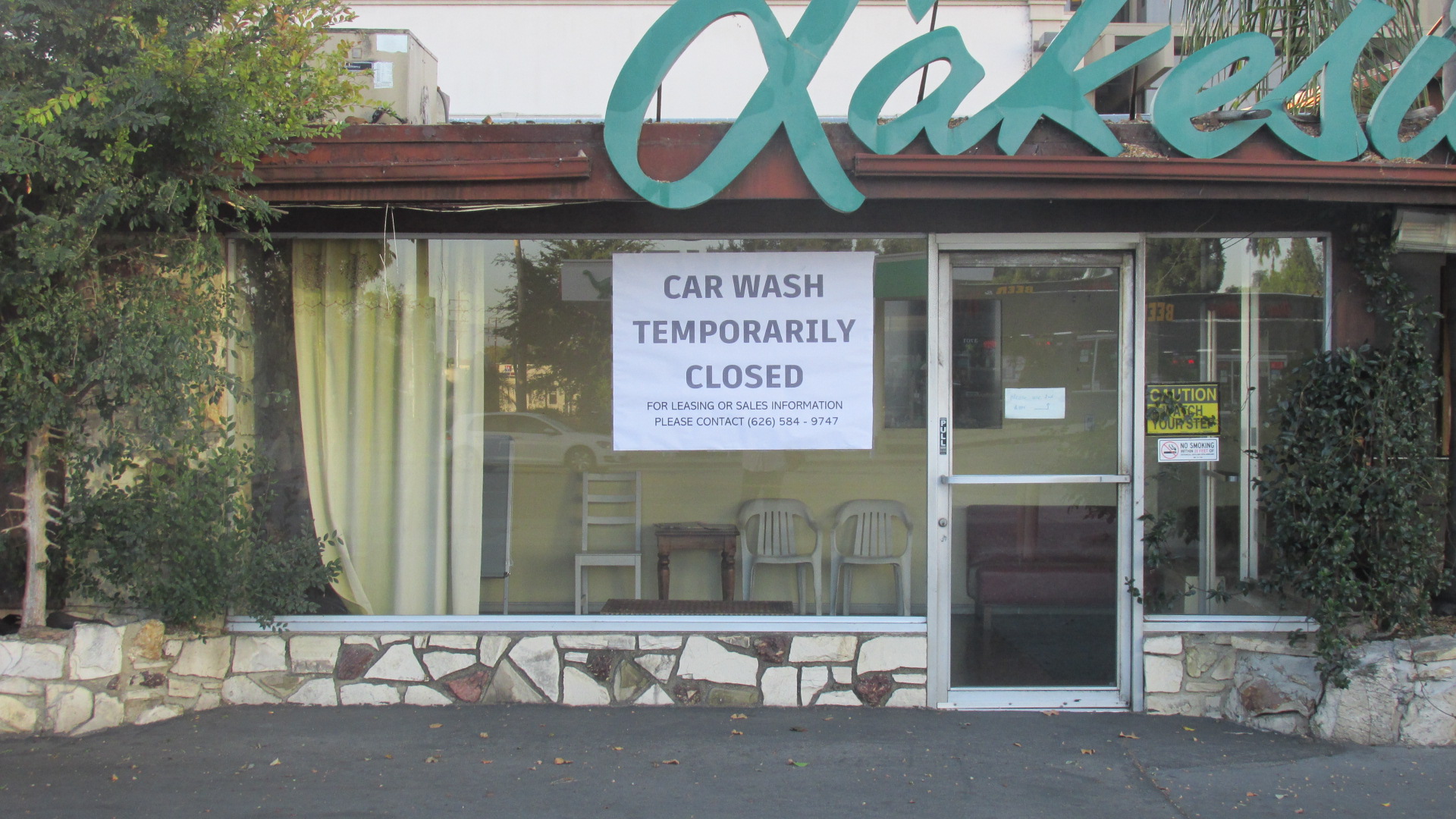
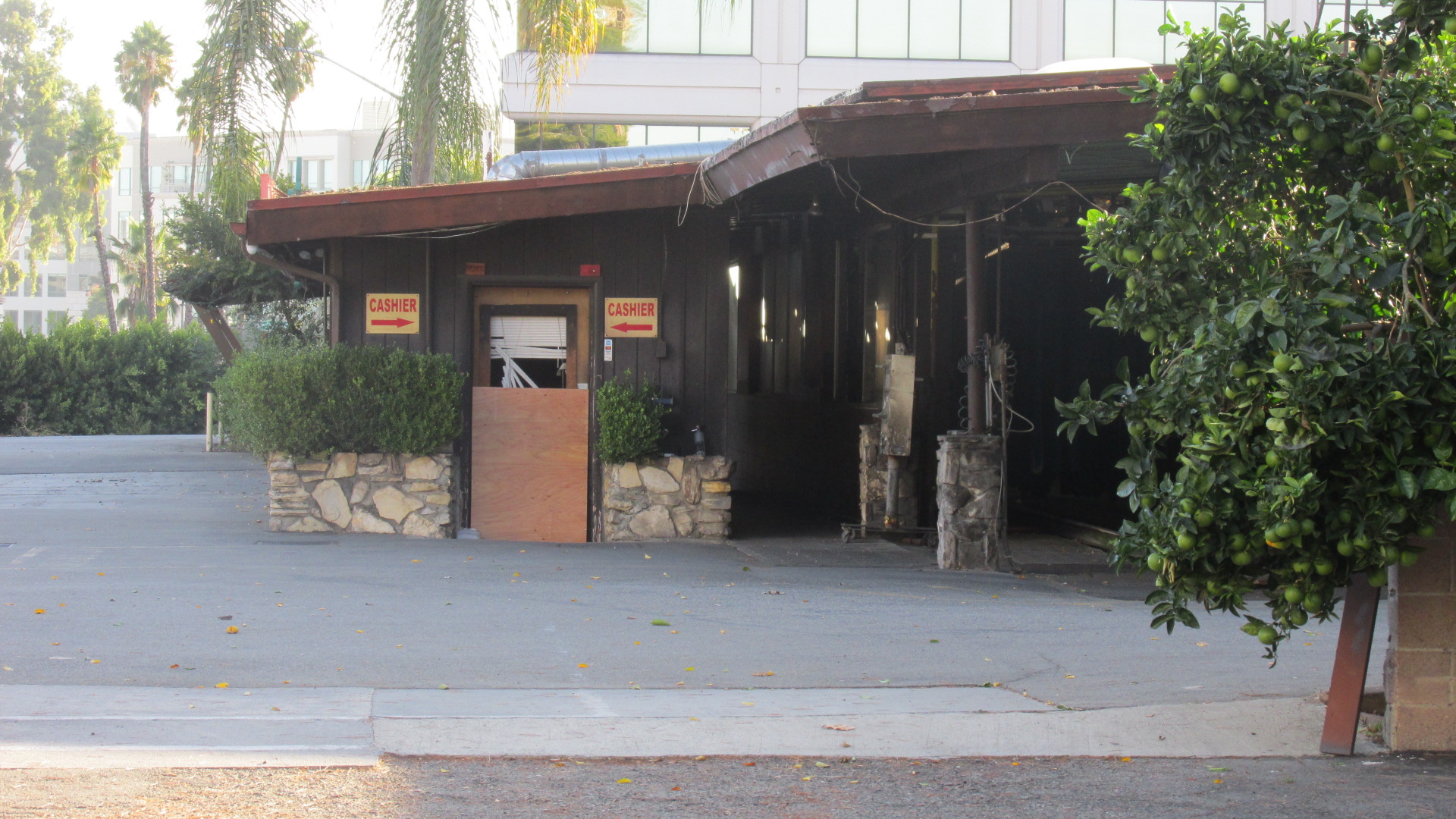
And the car wash became a familiar fixture in these new communities. According to the LA Conservancy, the Lakeside Car Wash, located at Riverside and Hollywood Way, debuted in 1956. The architect is unknown, but the structure stands out for its surprising combination of rustic ranch style and mid-century modern. The Conservancy points out the connections to the Googie coffee shops that were popping up all over LA at the time.
View of Lakeside Car Wash from Riverside Drive.Entrance to car wash
But whatever its architectural merits, the Lakeside Car Wash is now closed and will almost certainly disappear in the not too distant future. In April 2022, the City of Burbank approved the construction of a mixed-use project on the site, which includes 49 condos and 2,000 square feet of commercial space and open space located at street level.
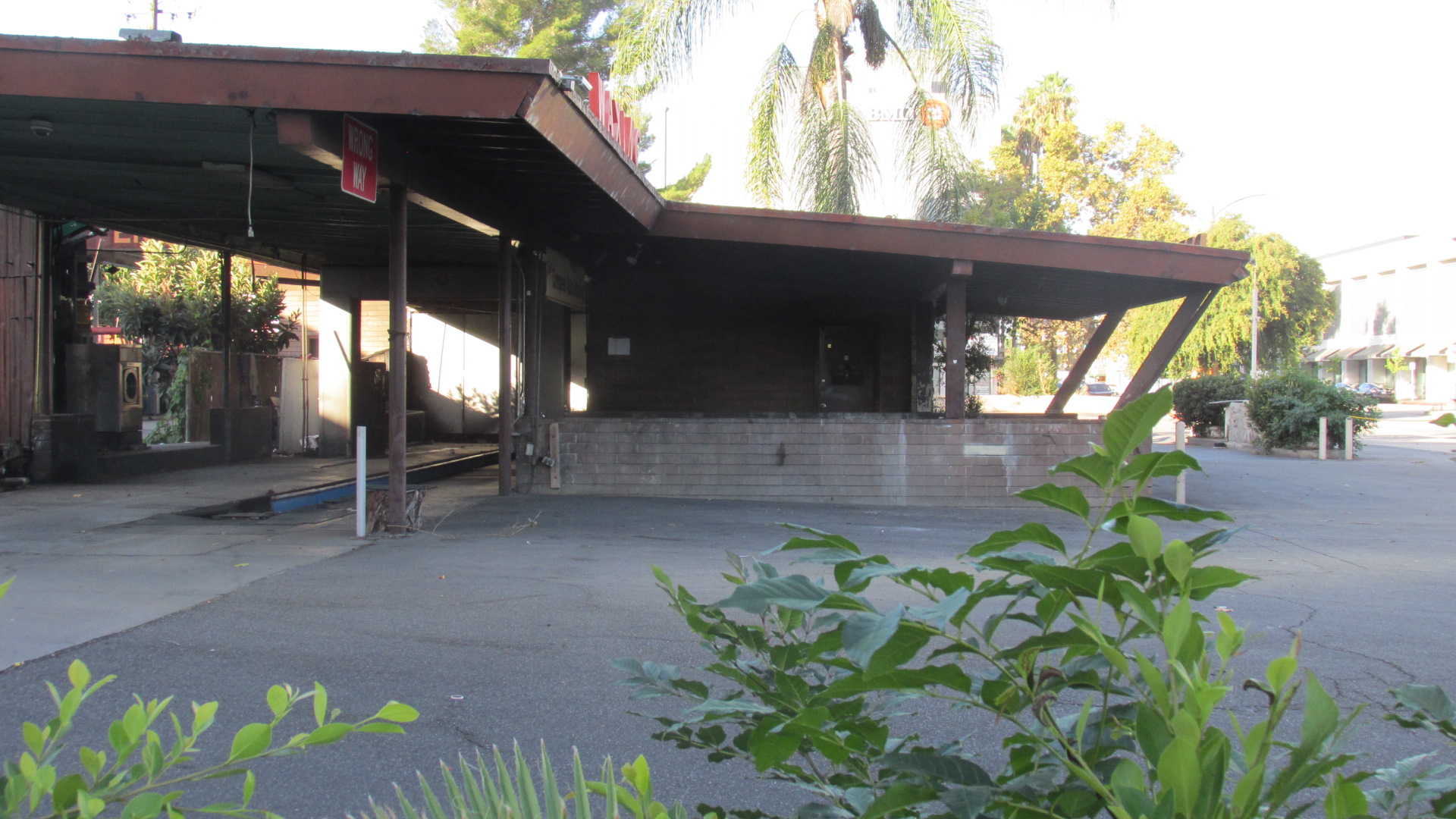
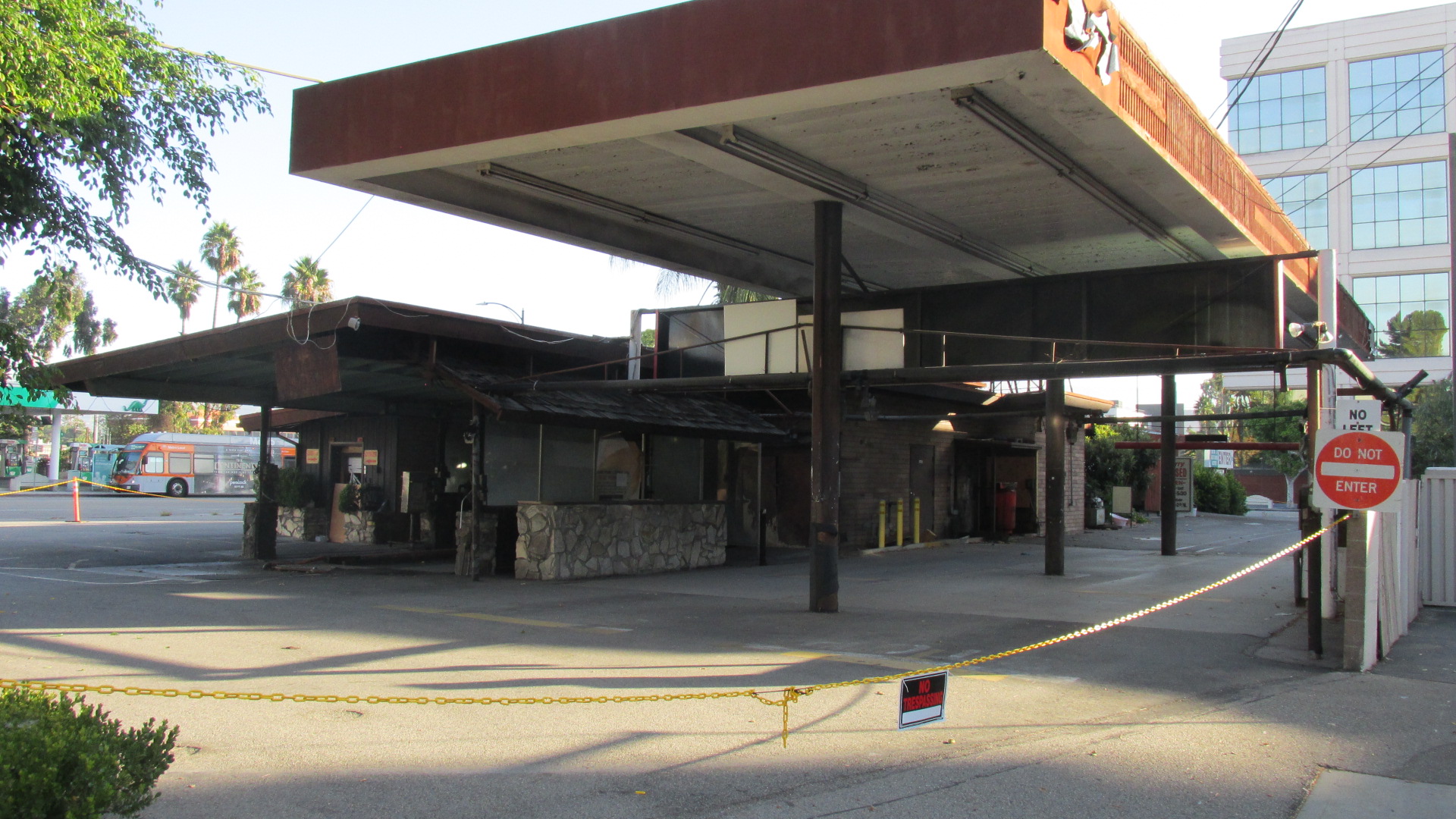
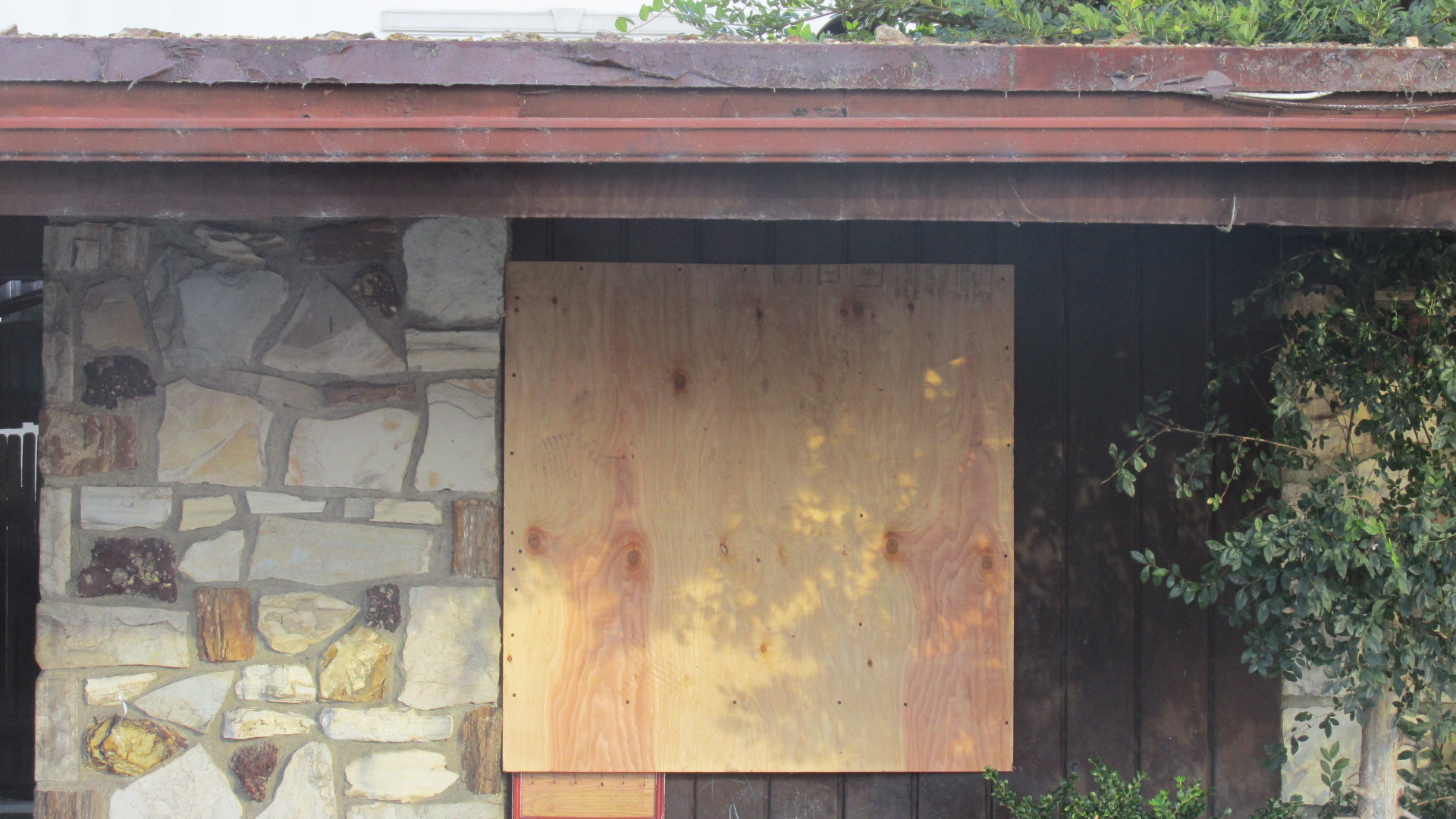
Side view from Hollywood WayThe back of the car washActually, the closure is probably permanent.The cashier’s office
Remnants of the early days of California’s car culture have been disappearing for years. The Reseda Drive-In Theatre was shuttered back in the 70s. The Tiny Naylor’s at Sunset and La Brea, a Googie classic, was demolished in the 80s. Burbank’s Pickwick Drive-In Theatre went dark in 1989 and is now a shopping center.
But car culture isn’t disappearing, it’s just changing. These days more California households have access to cars than ever before. Check out this quote from Falling Transit Ridership, a study published by UCLA in 2018….
Census summary file data show that from 2000 to 2015, the SCAG region added 2.3 million people and 2.1 million household vehicles (or 0.95 vehicles per new resident). To put that growth in perspective, from 1990 to 2000 the region added 1.8 million people but only 456,000 household vehicles (0.25 vehicles per new resident). The growth of household vehicles in the last 15 years has been astonishing.
The Lakeside Car Wash will soon be gone, but cars are here to stay. They’ll just have to go somewhere else to get clean.











 The Horizon and the Skyline