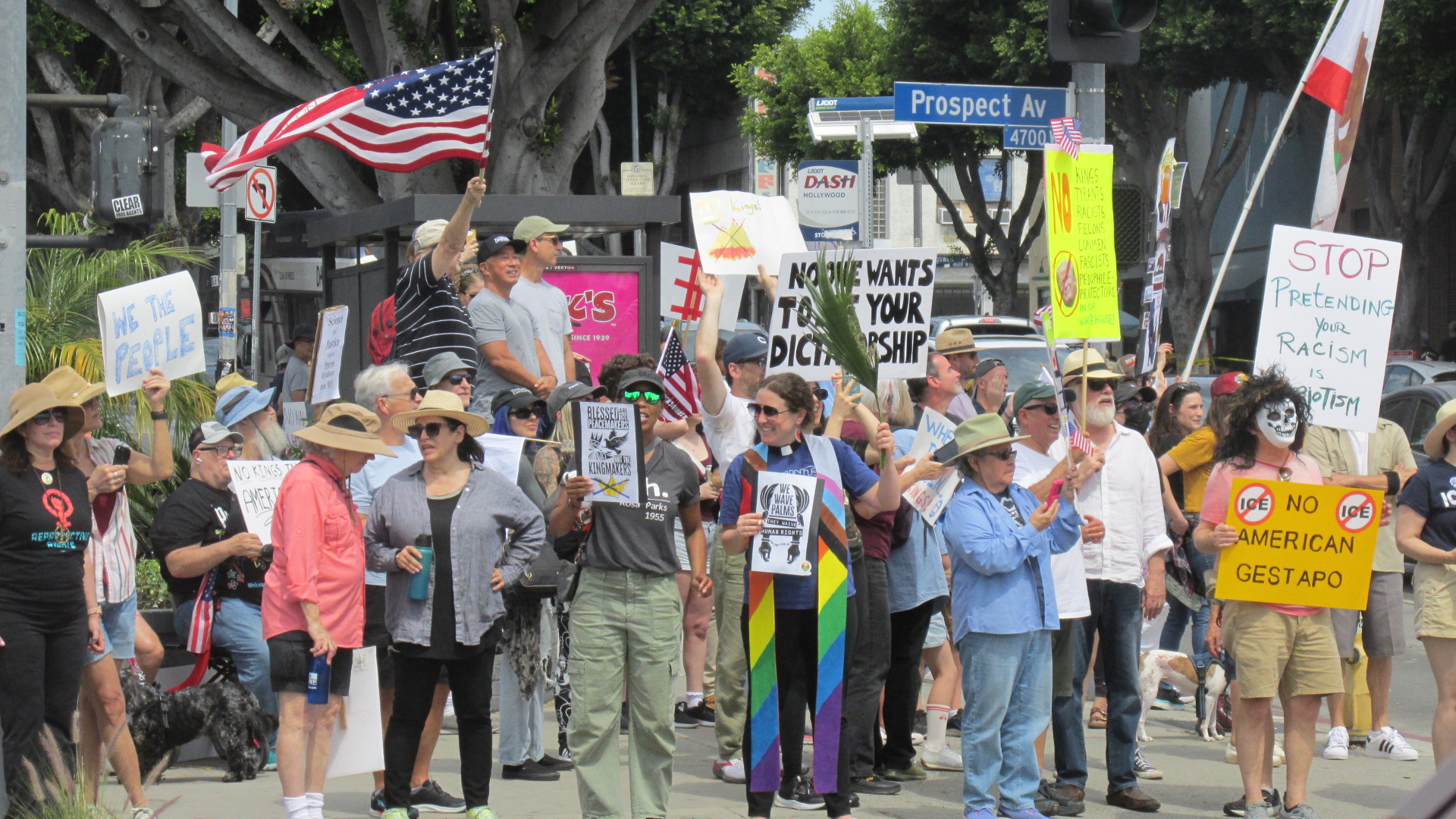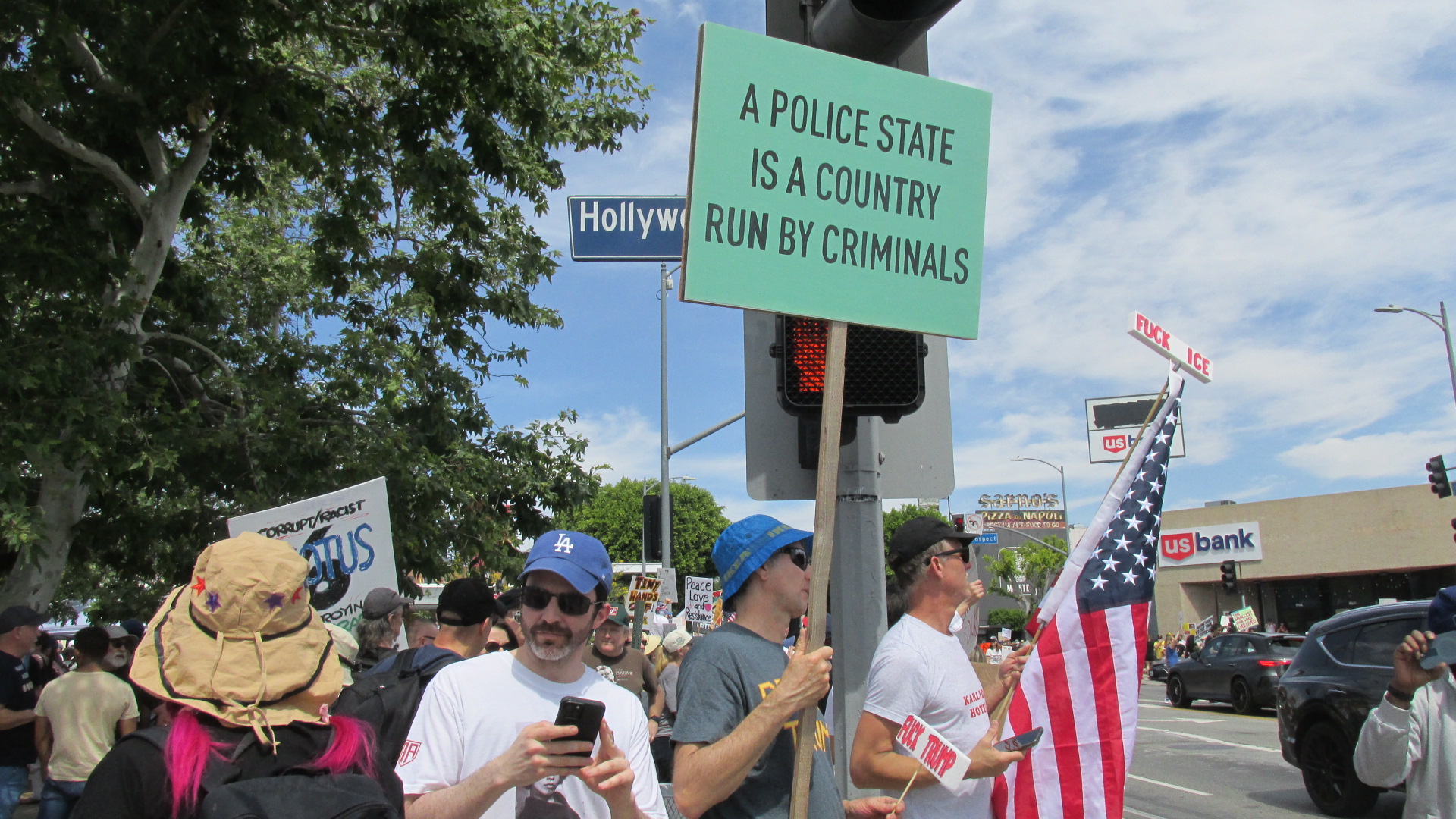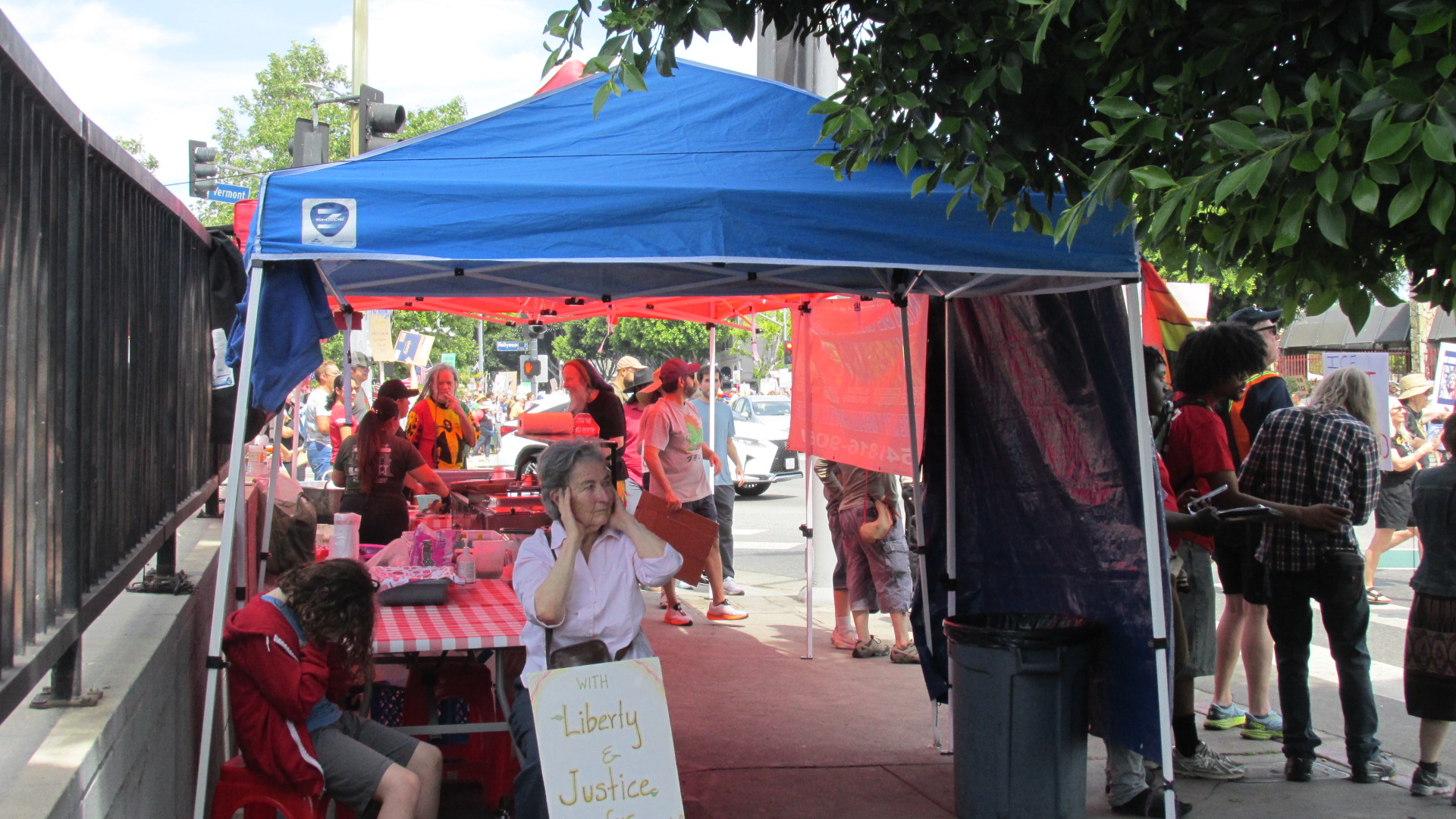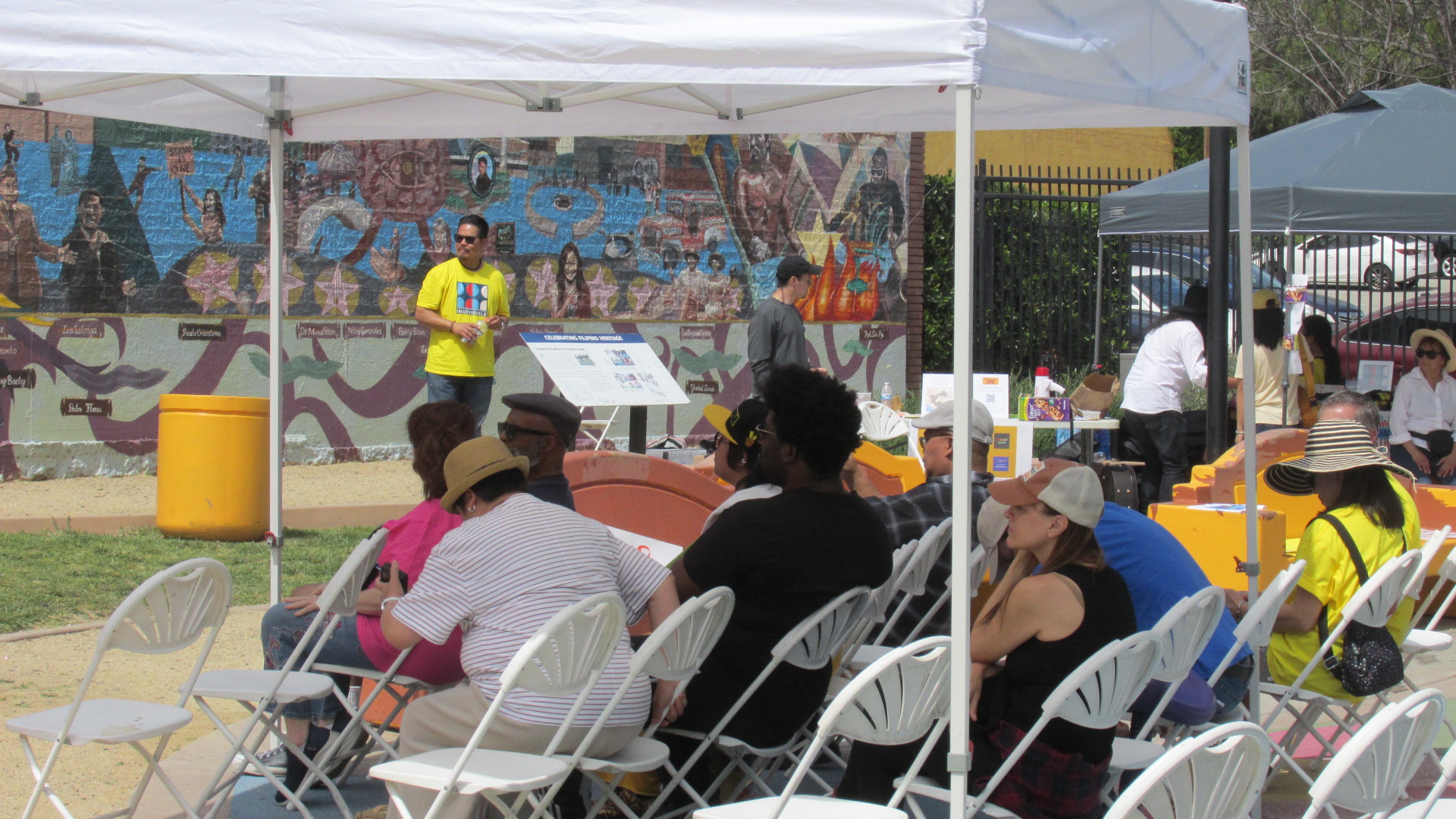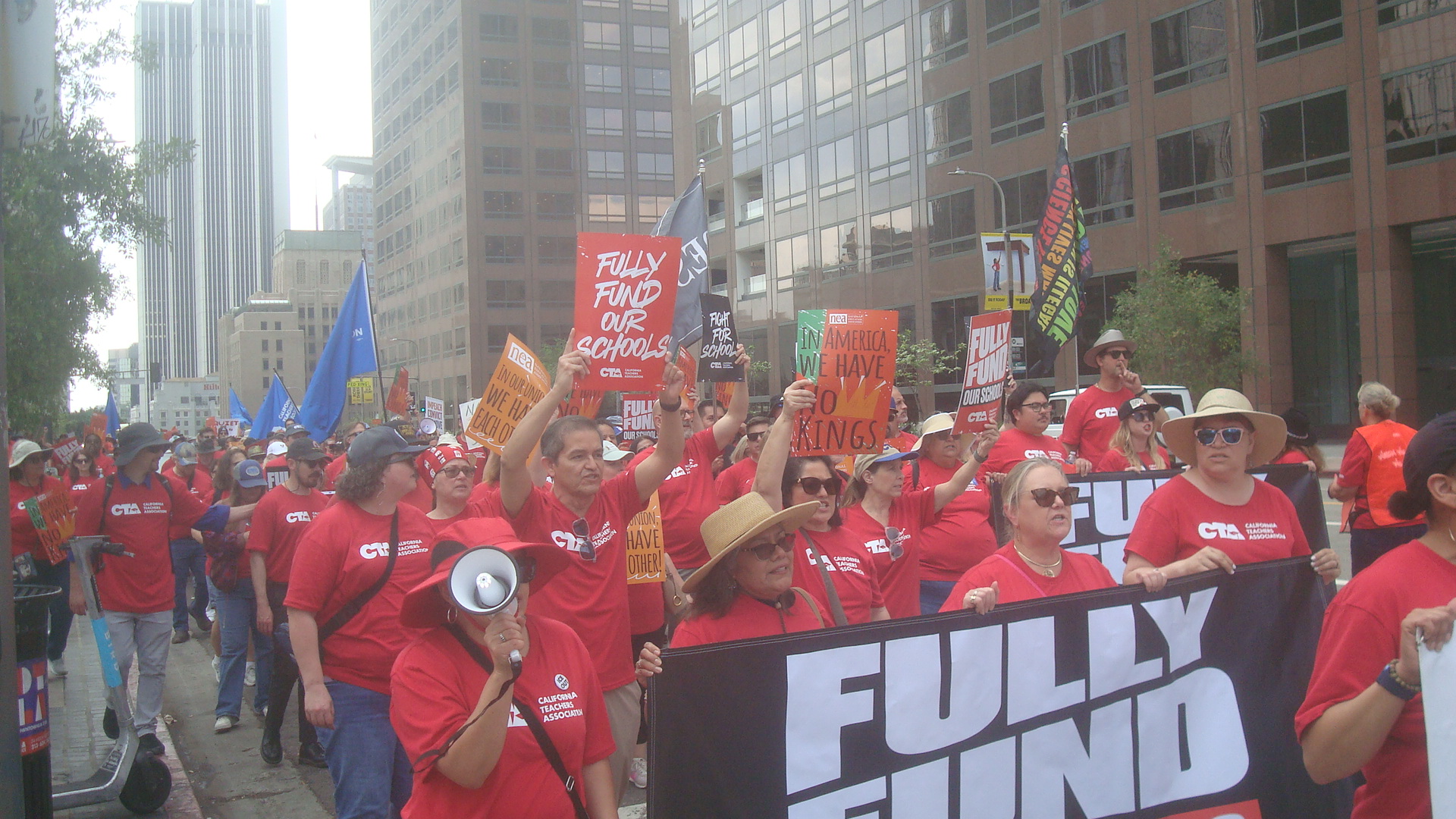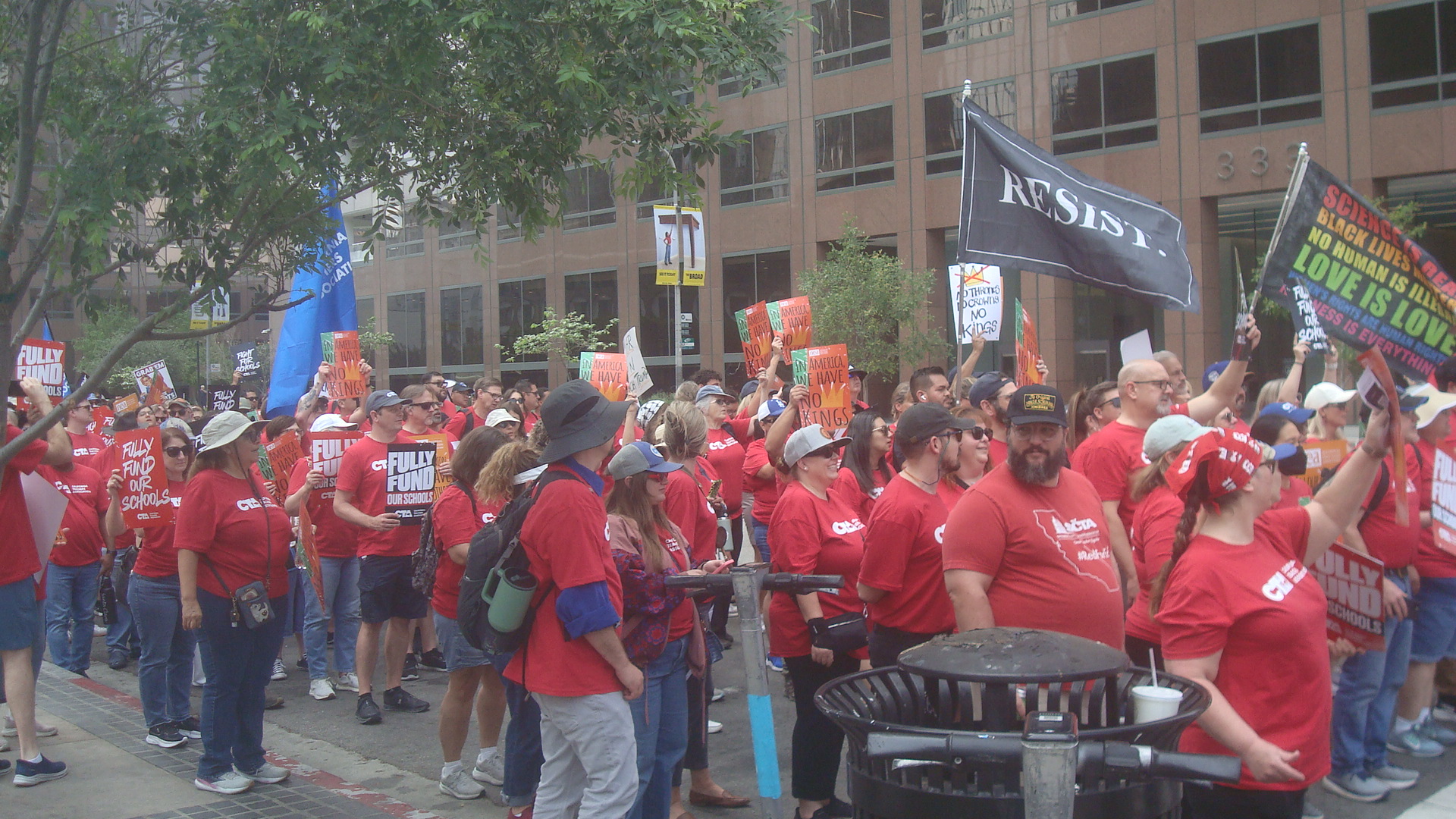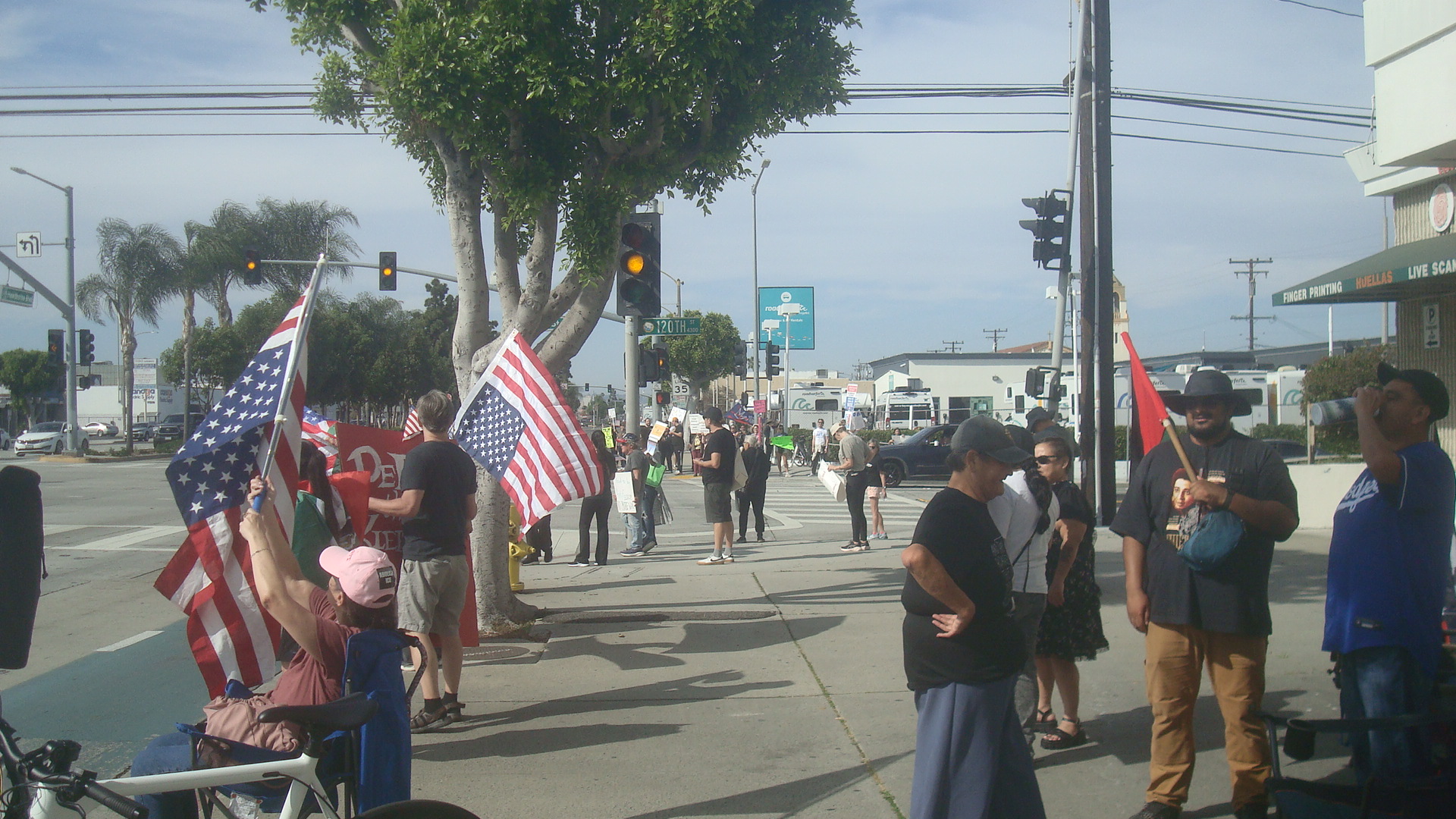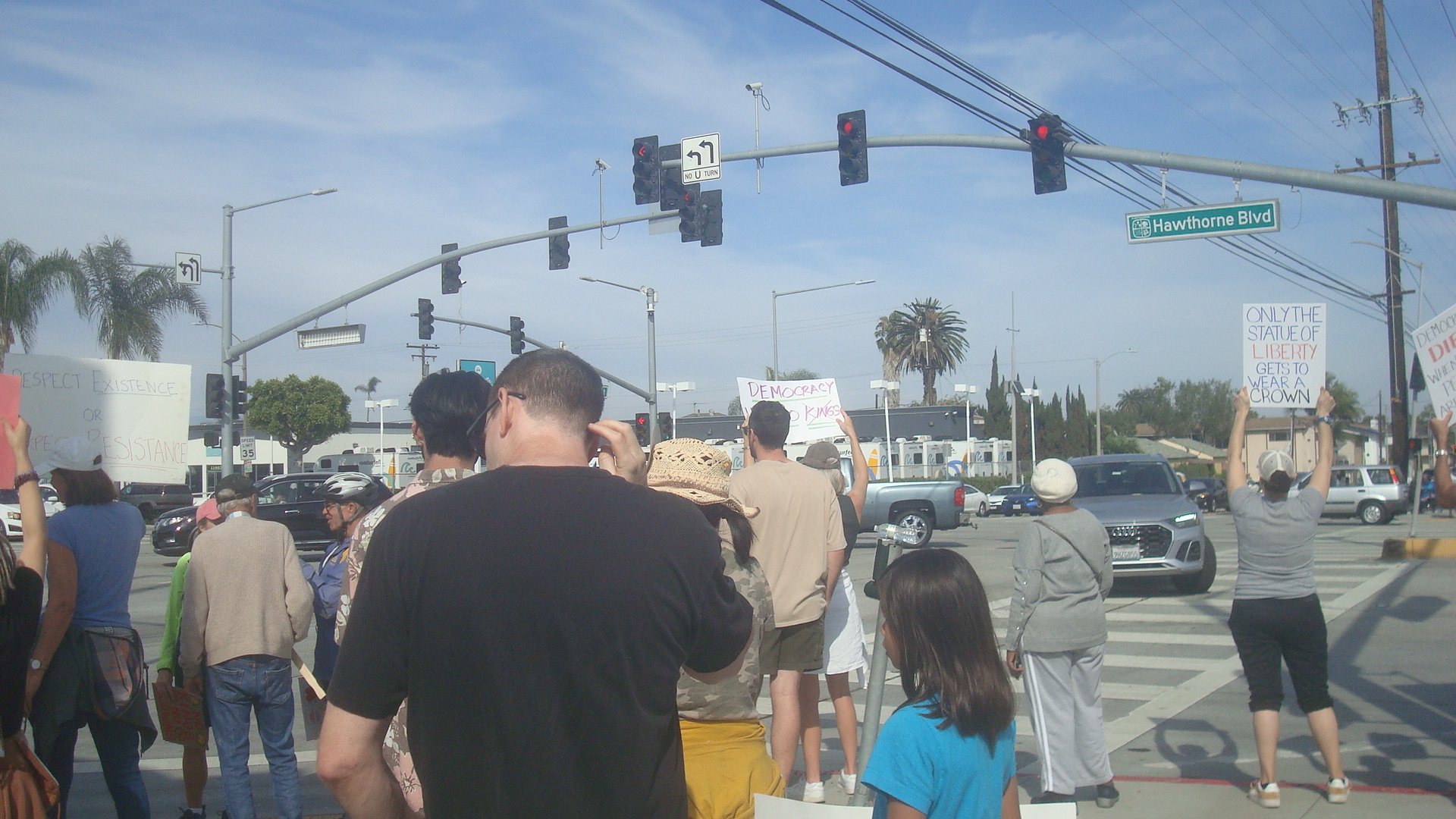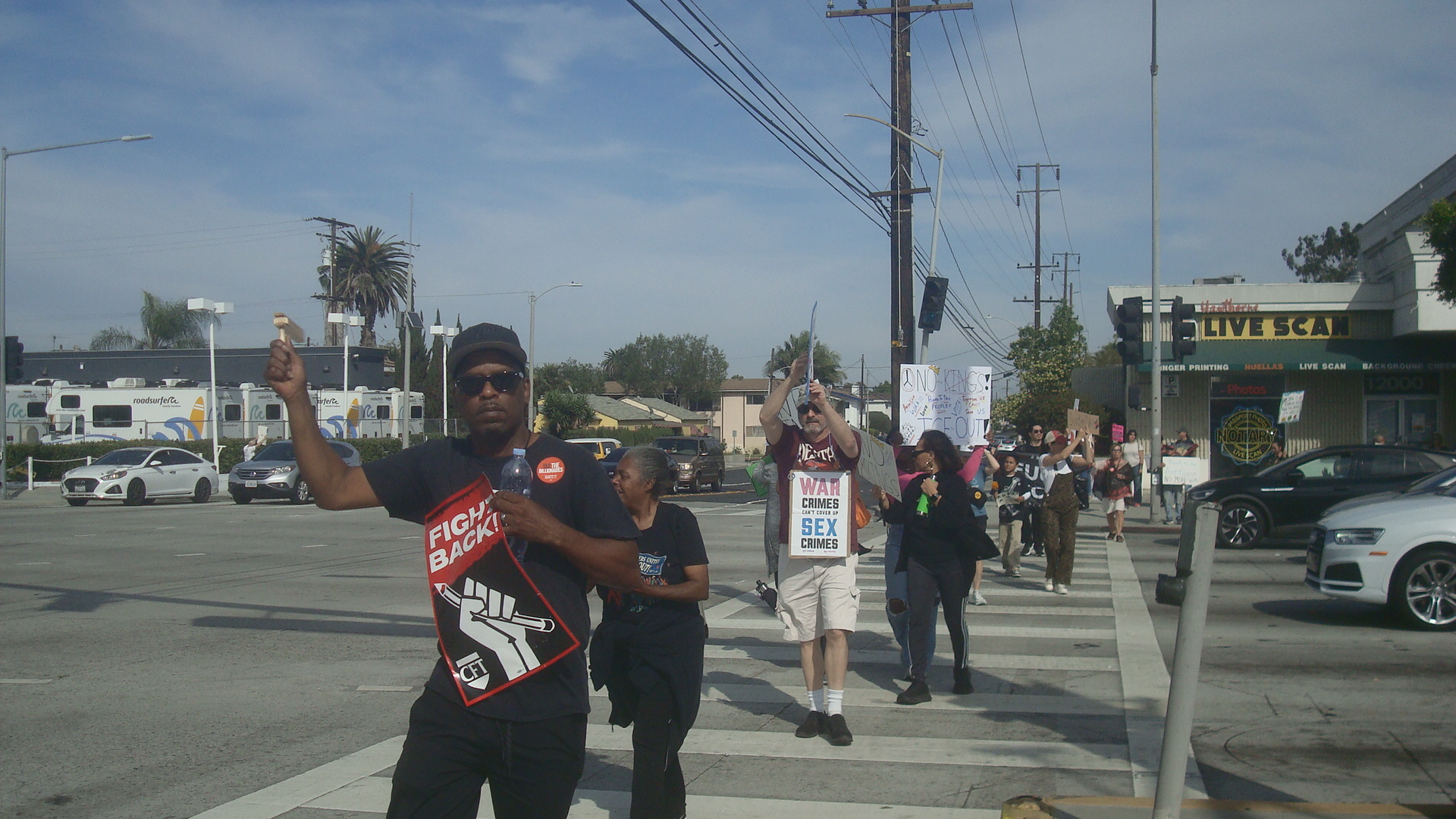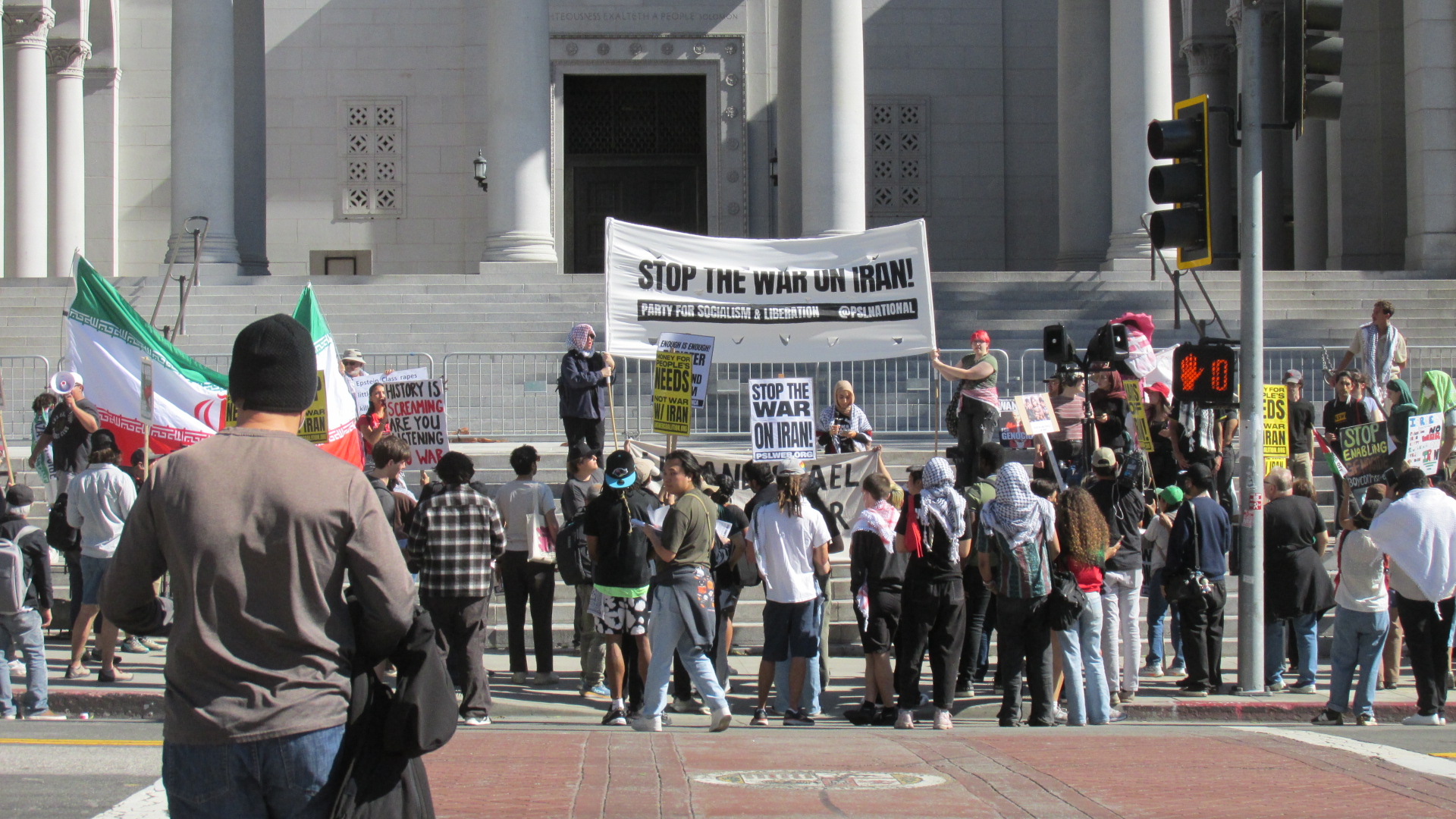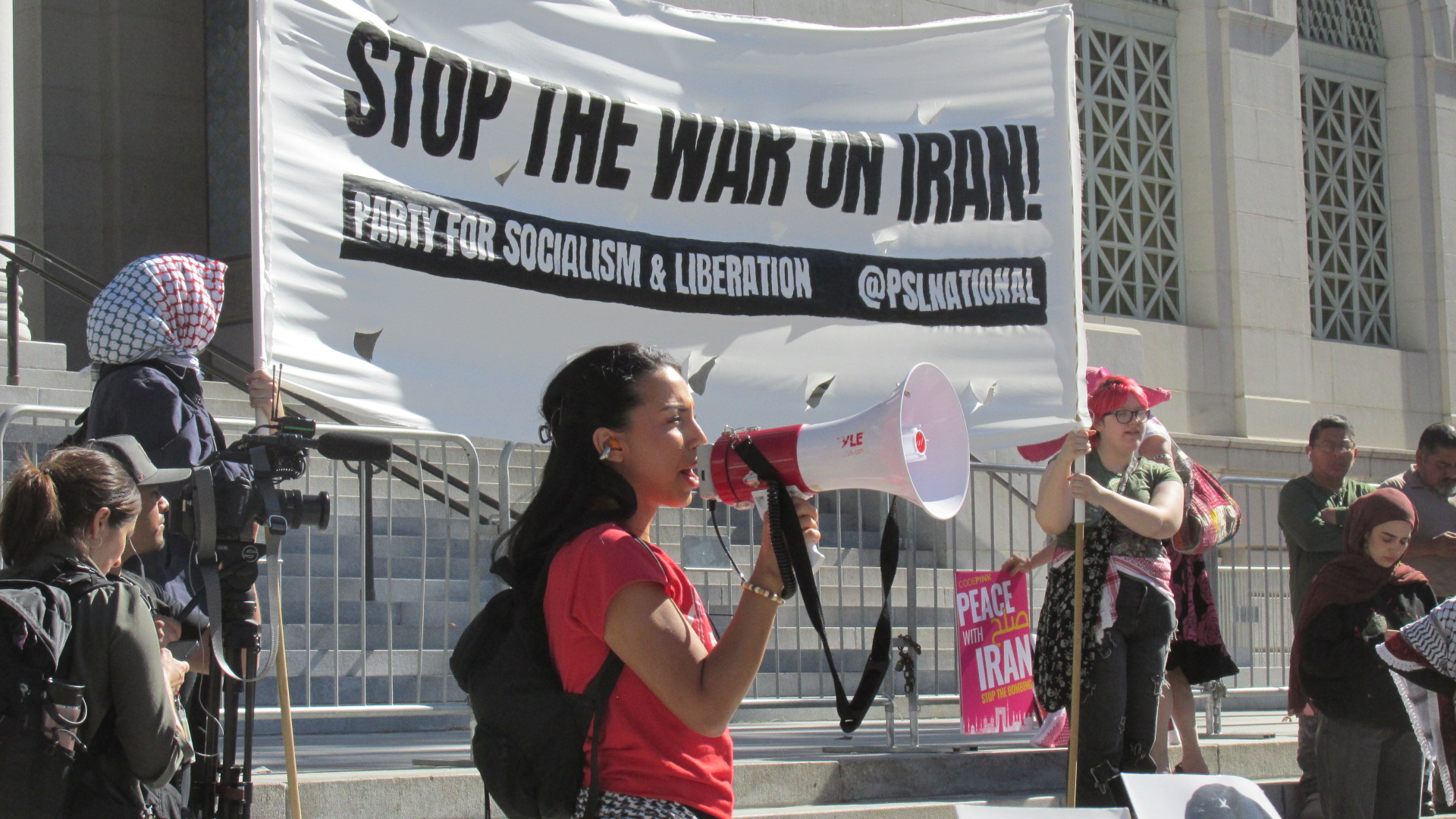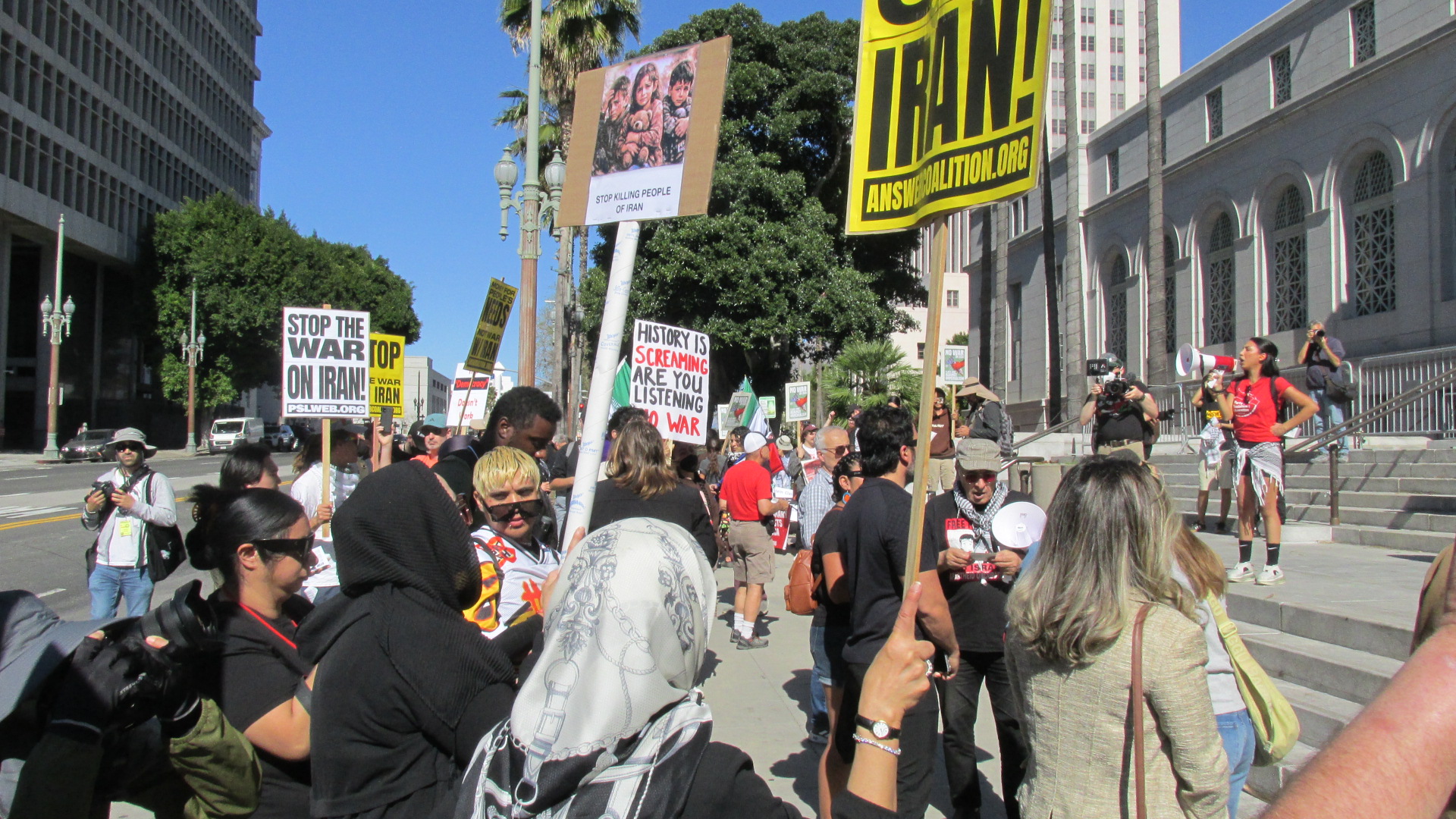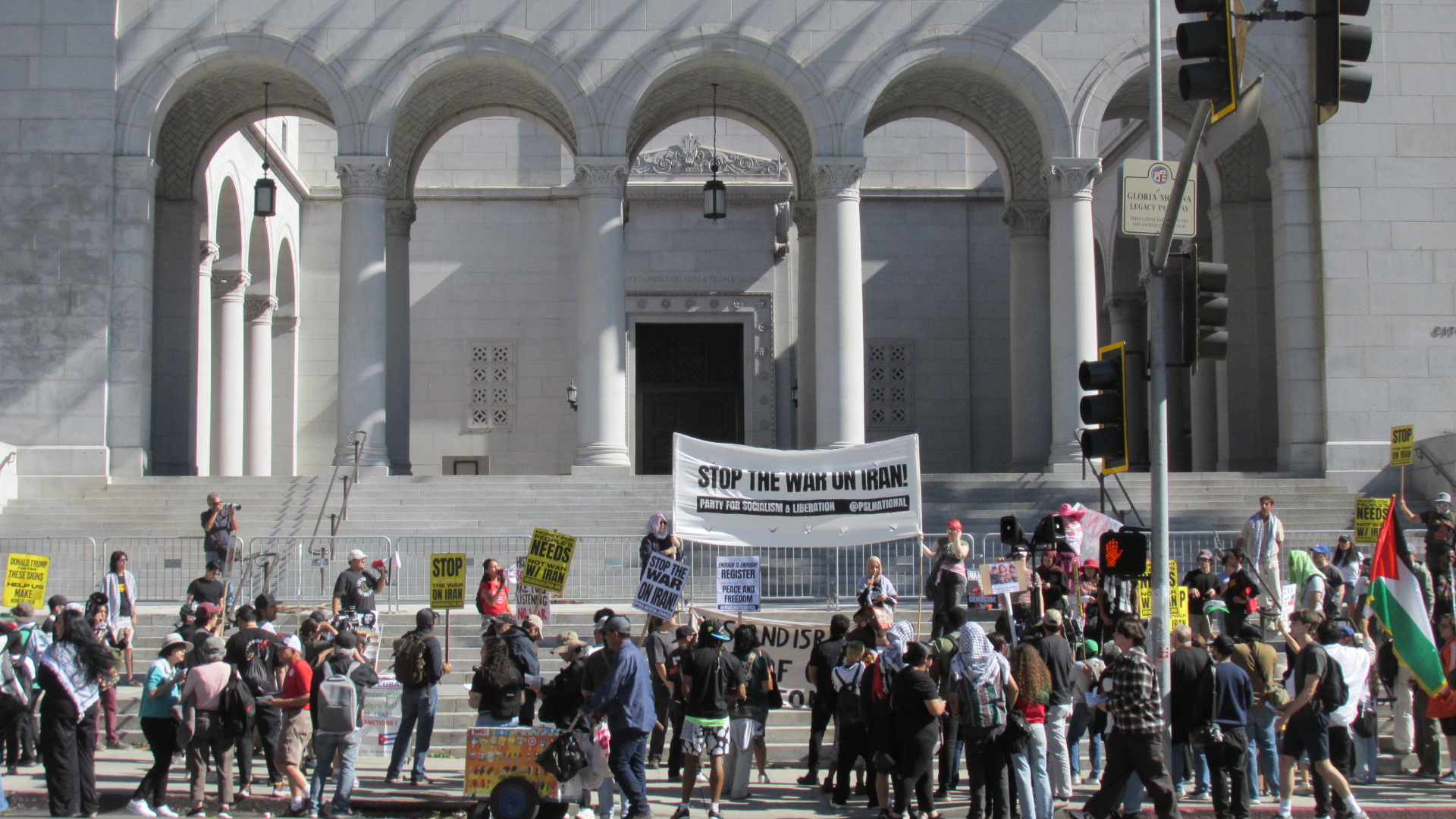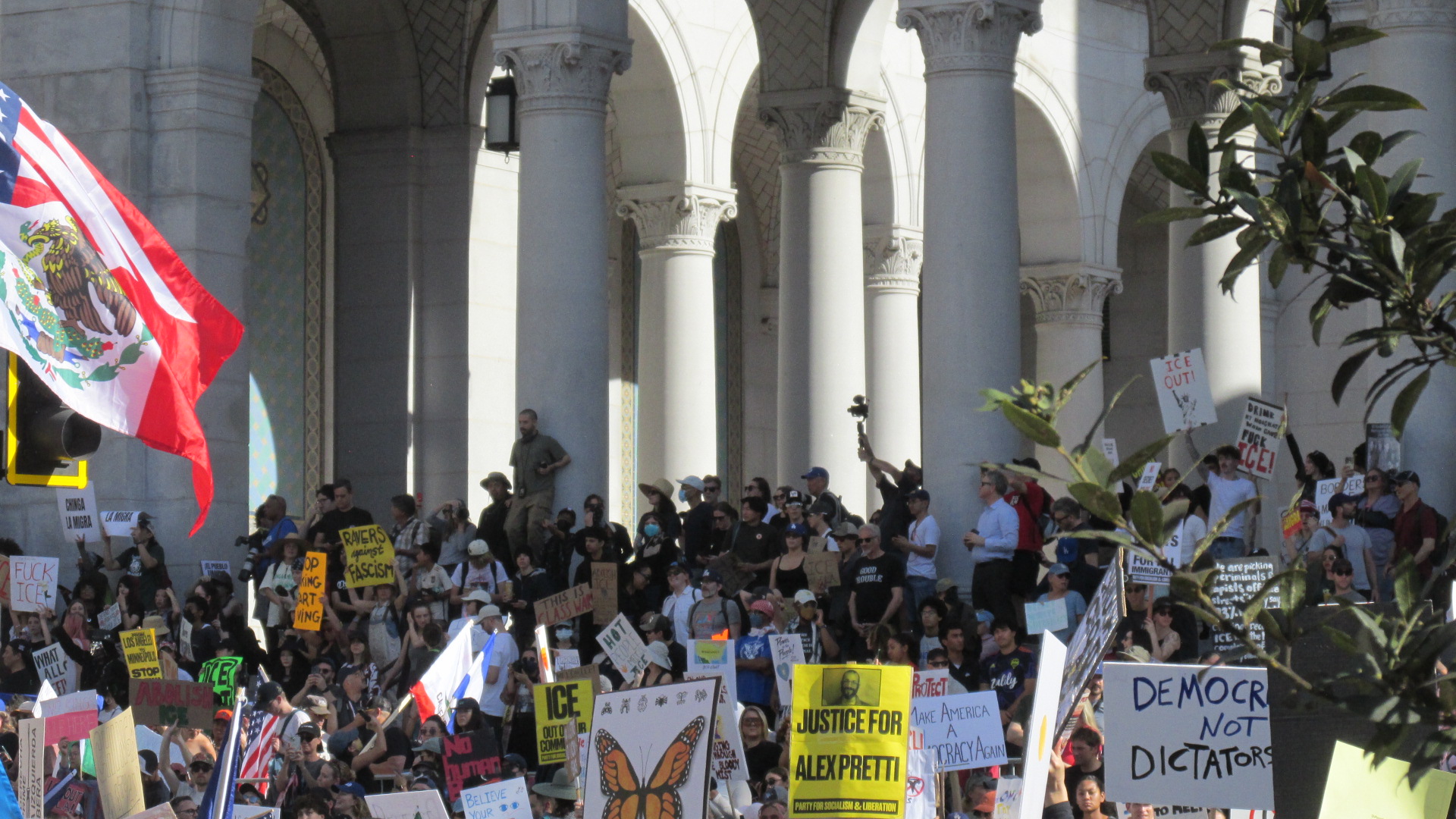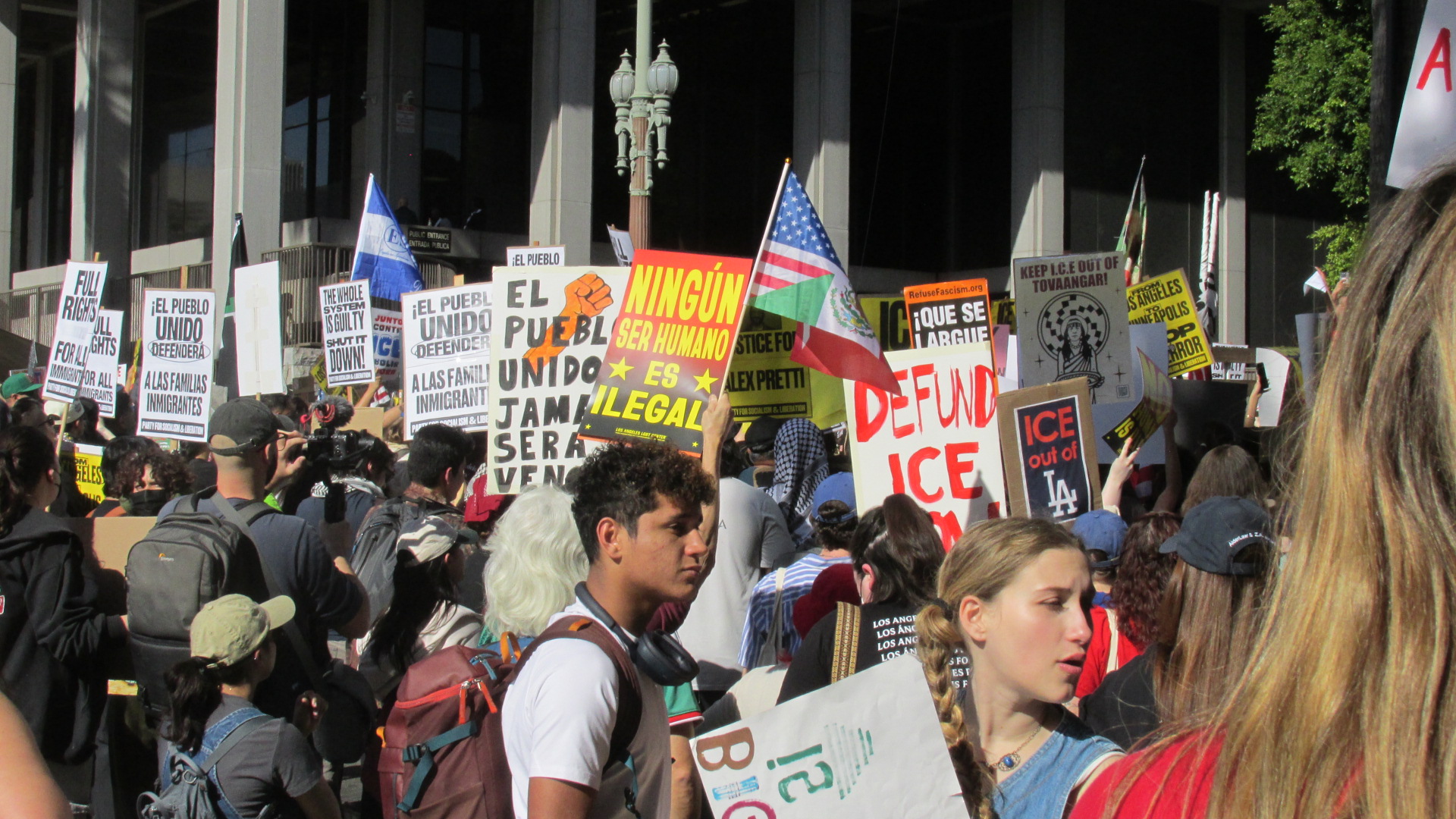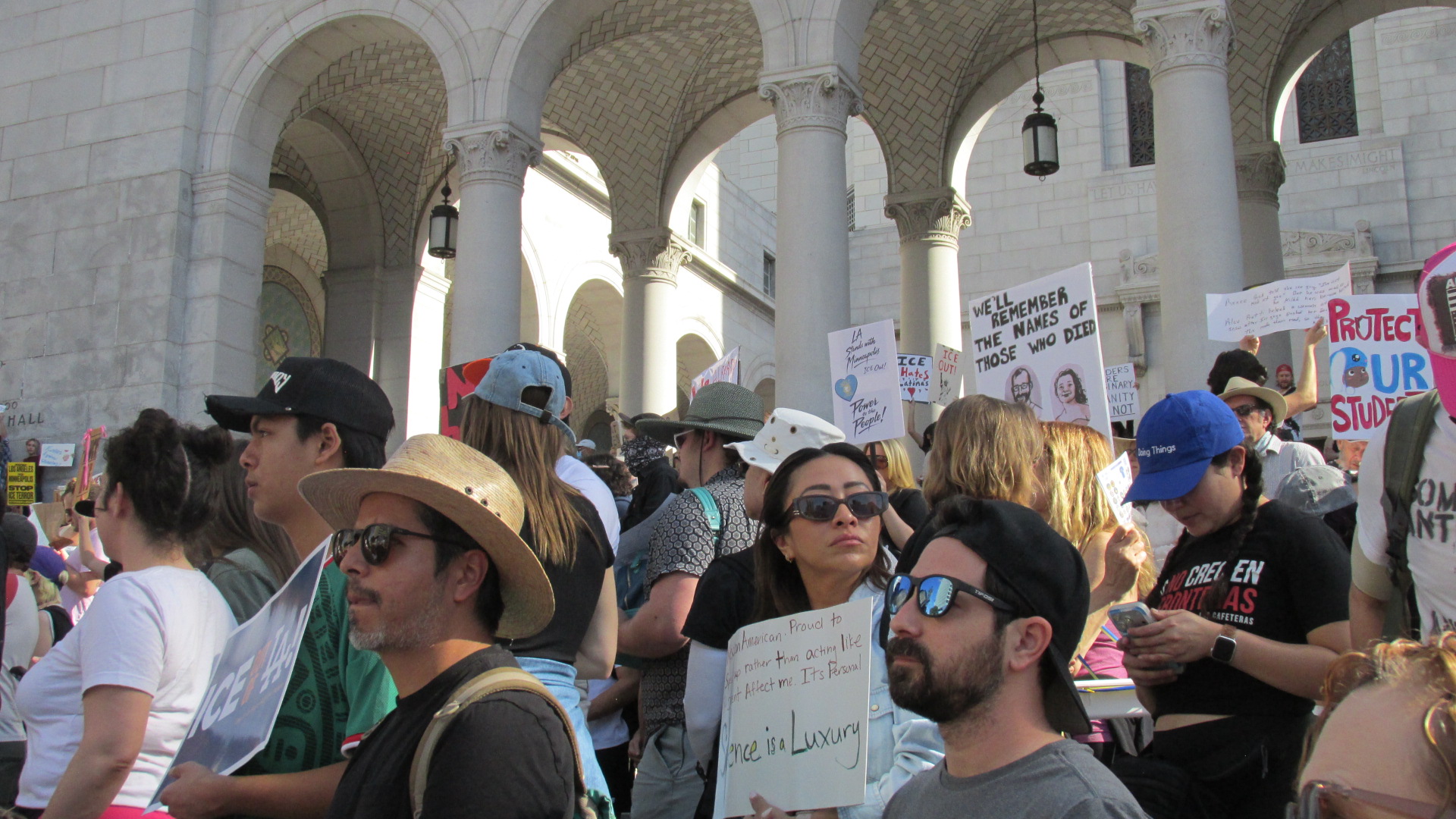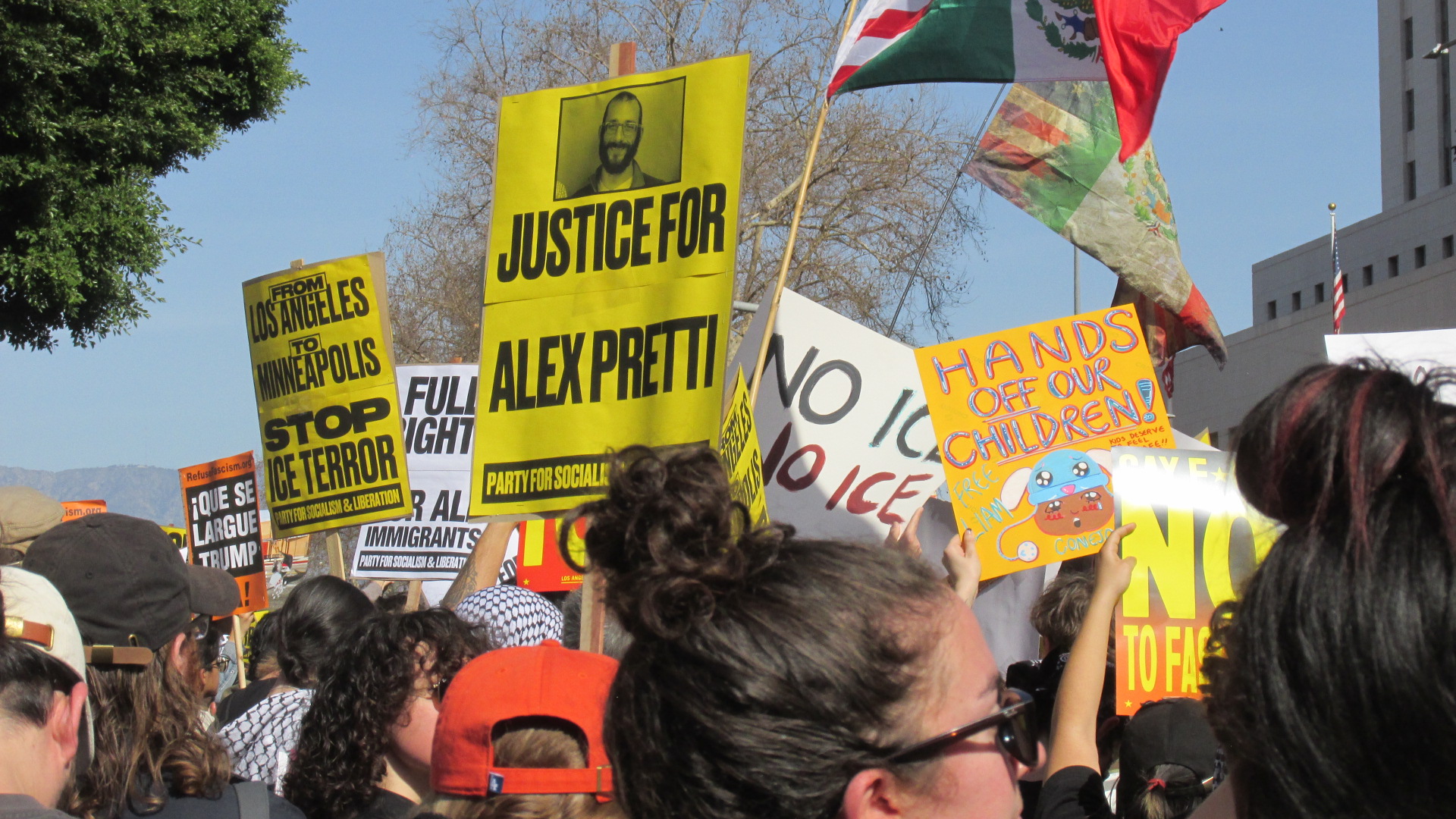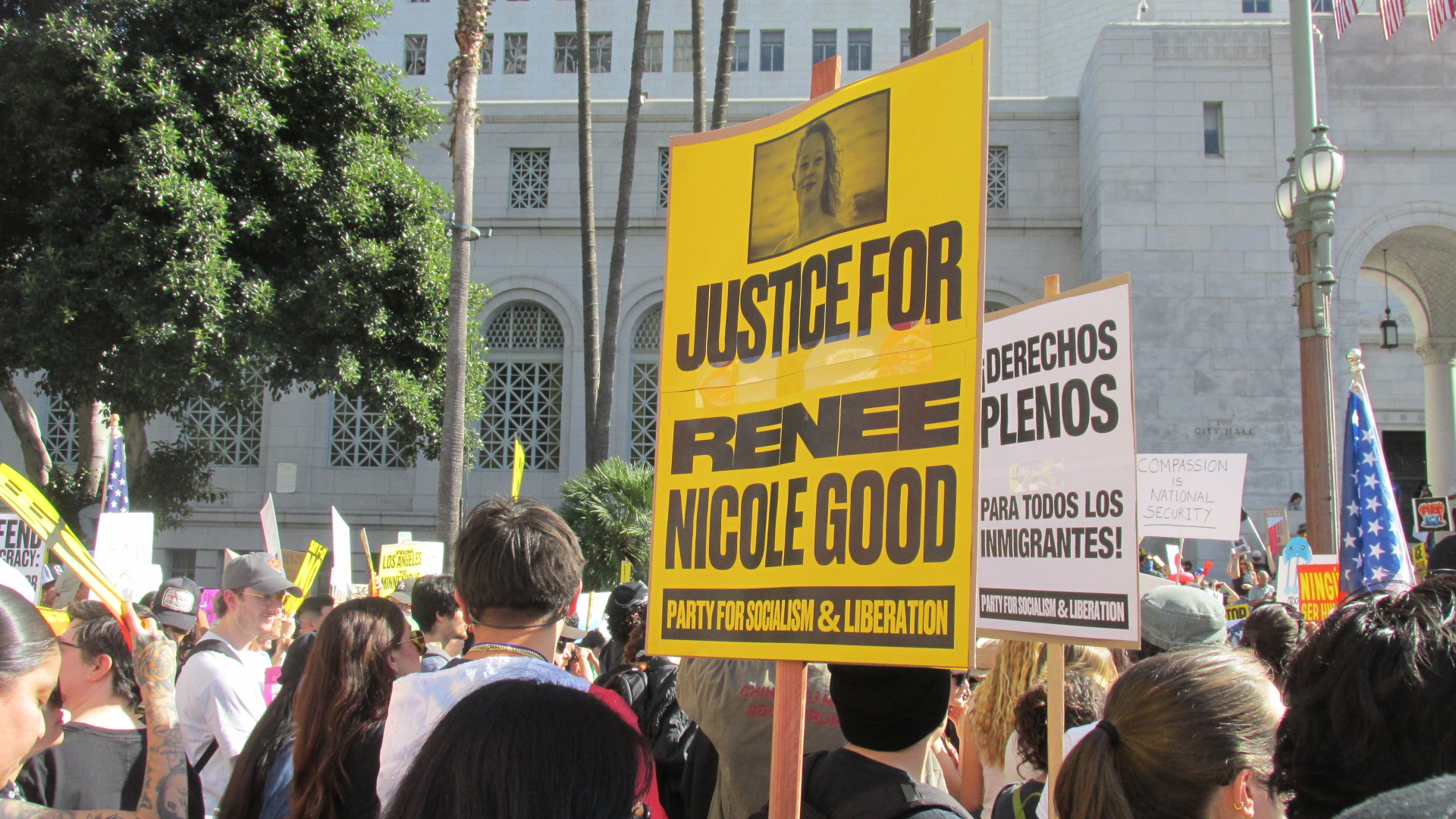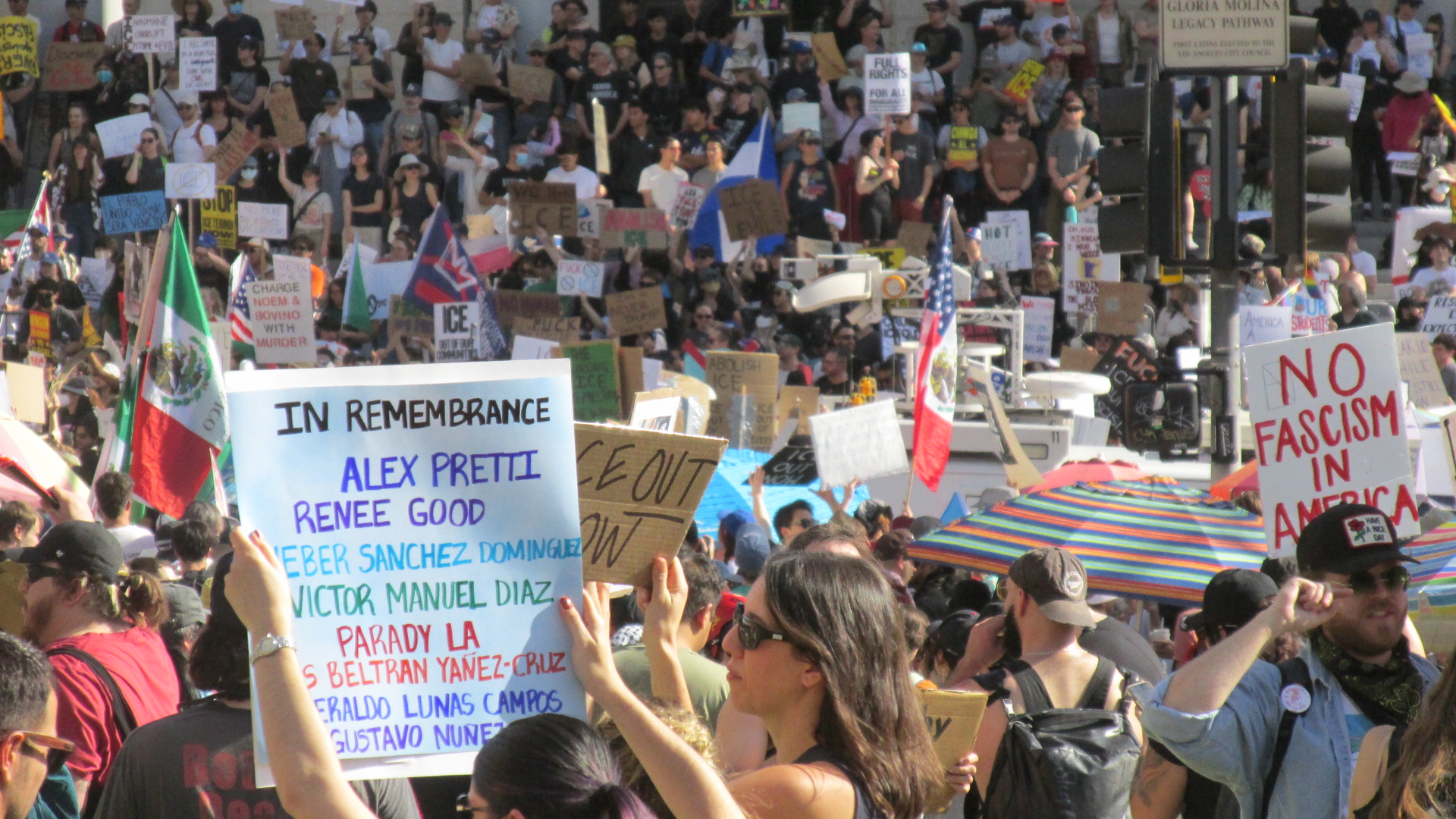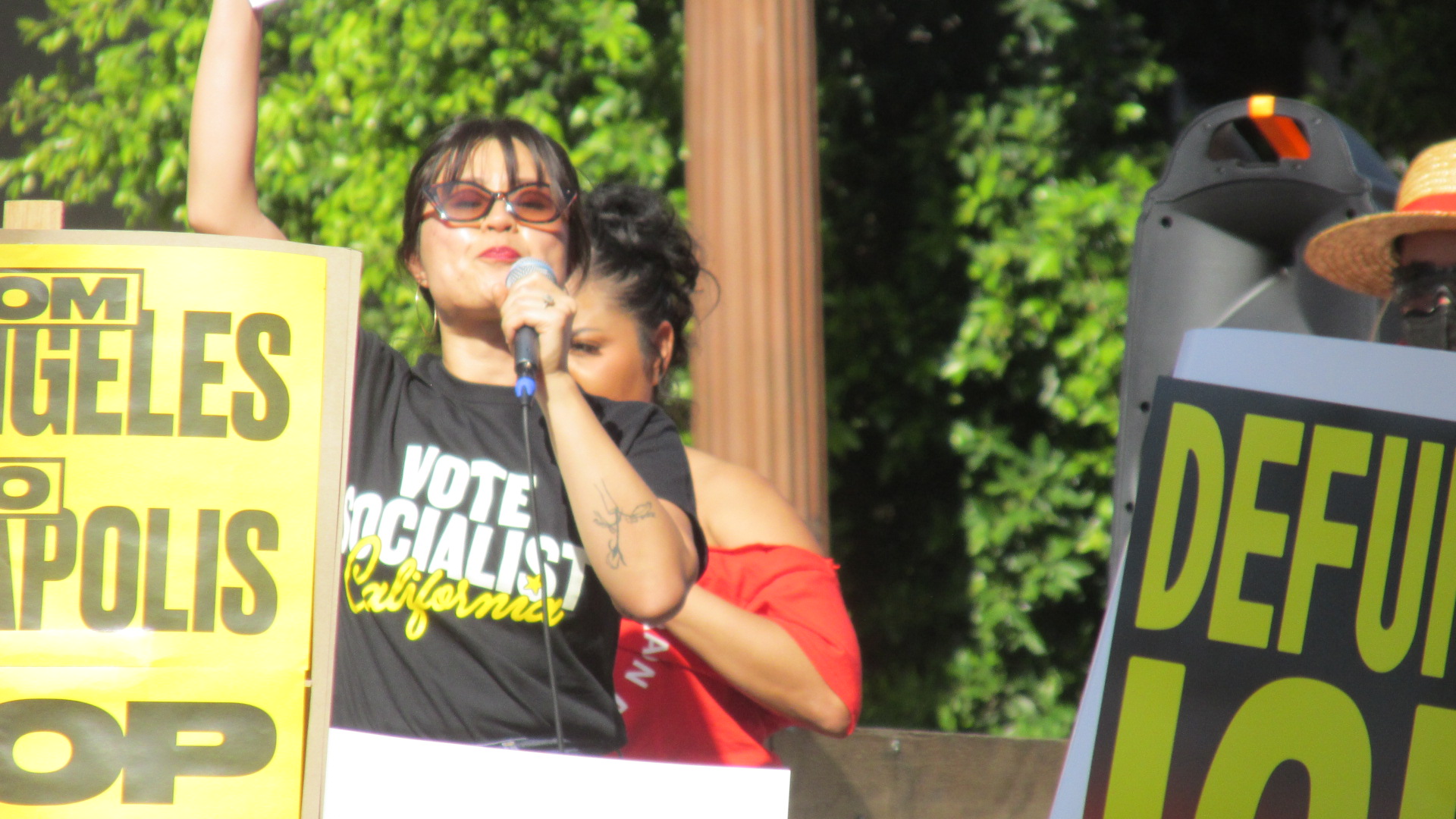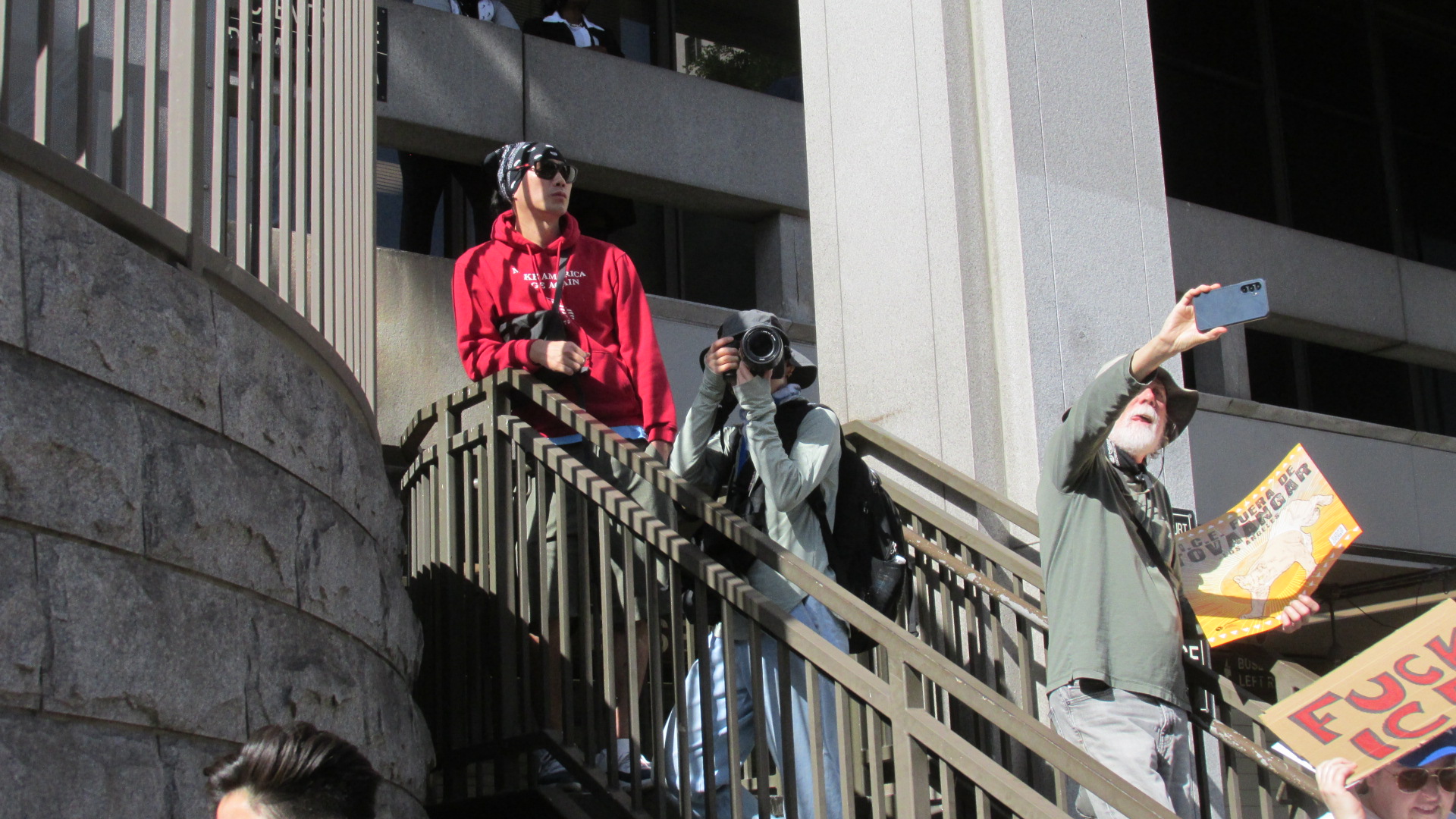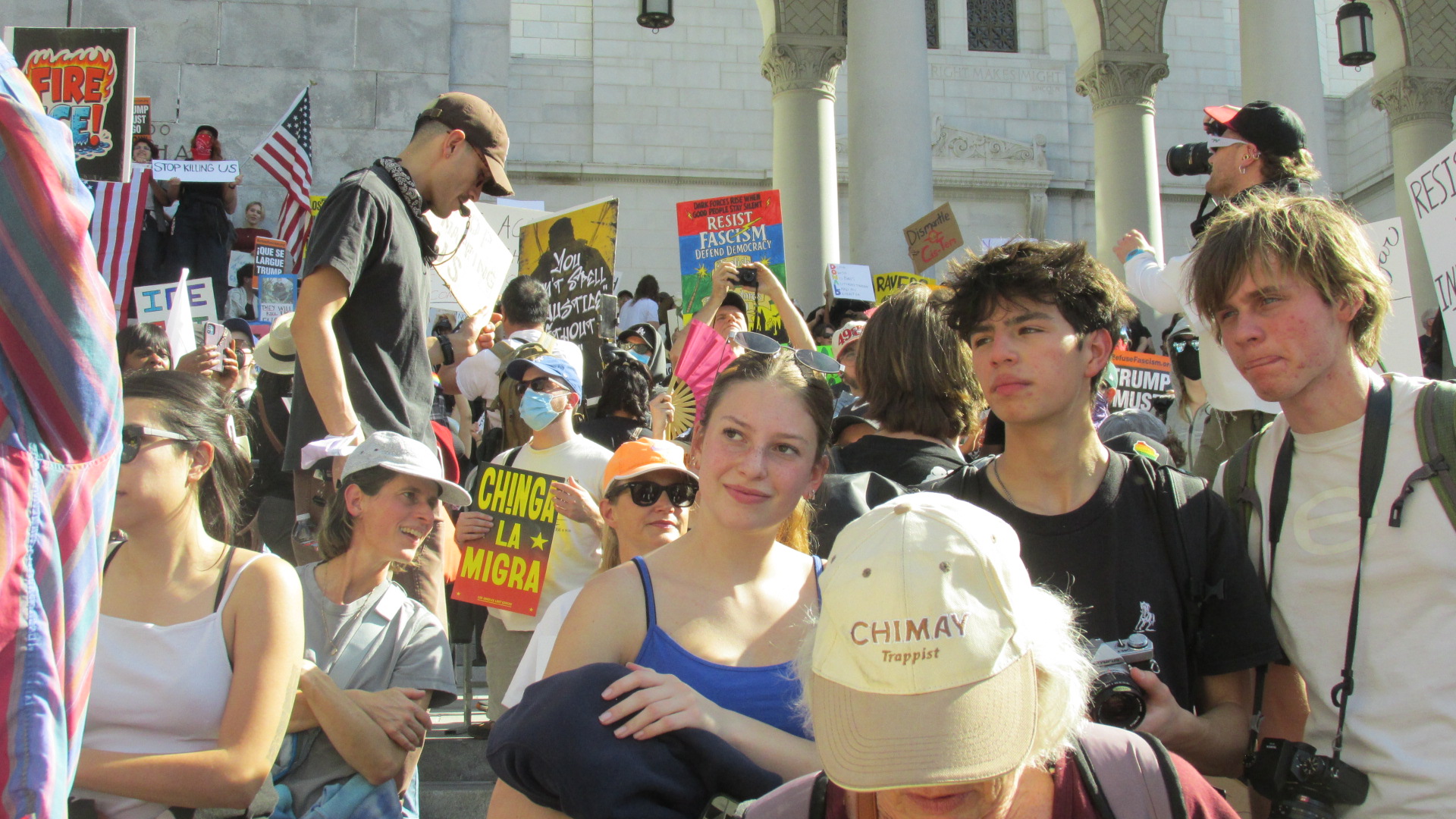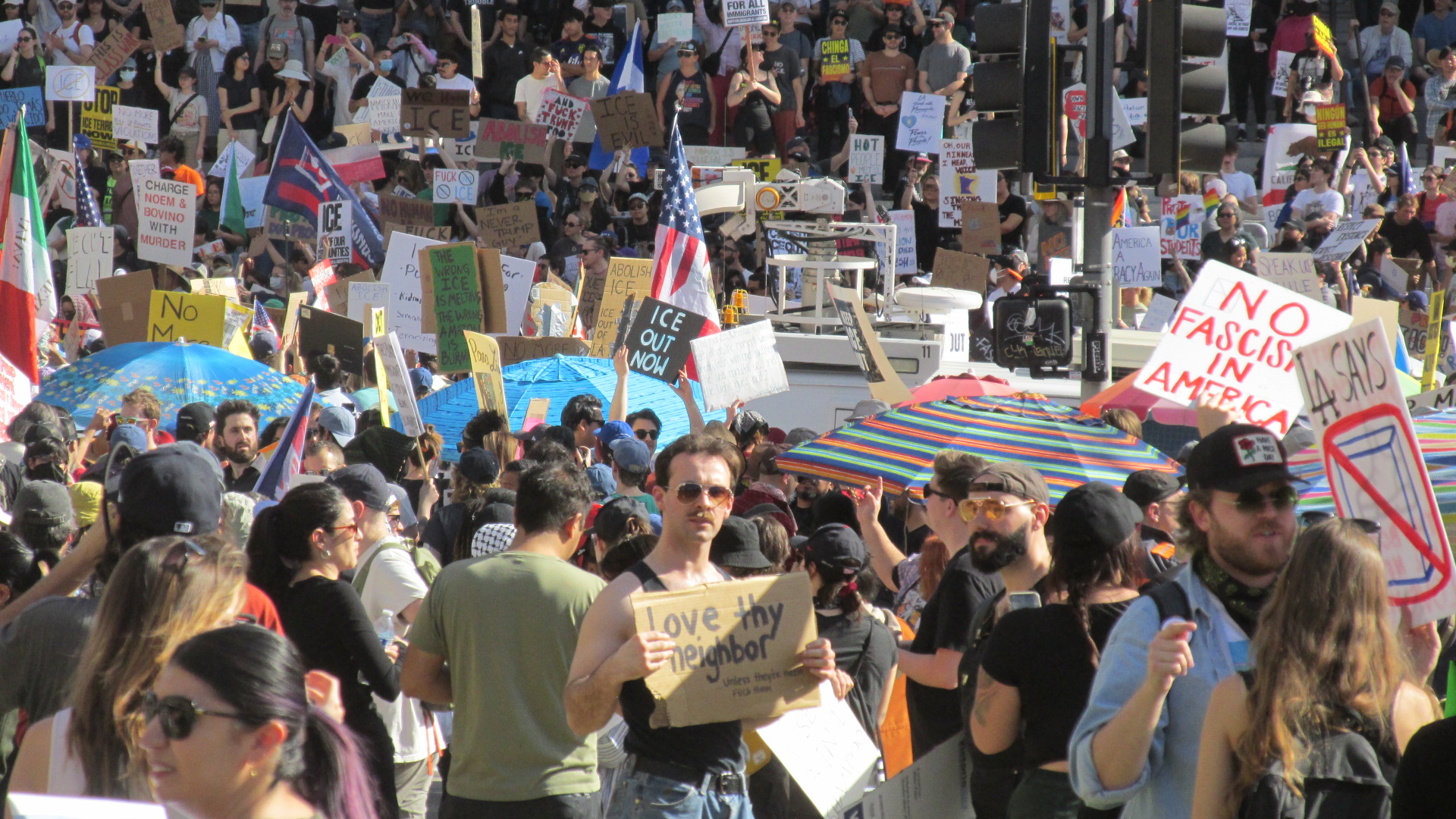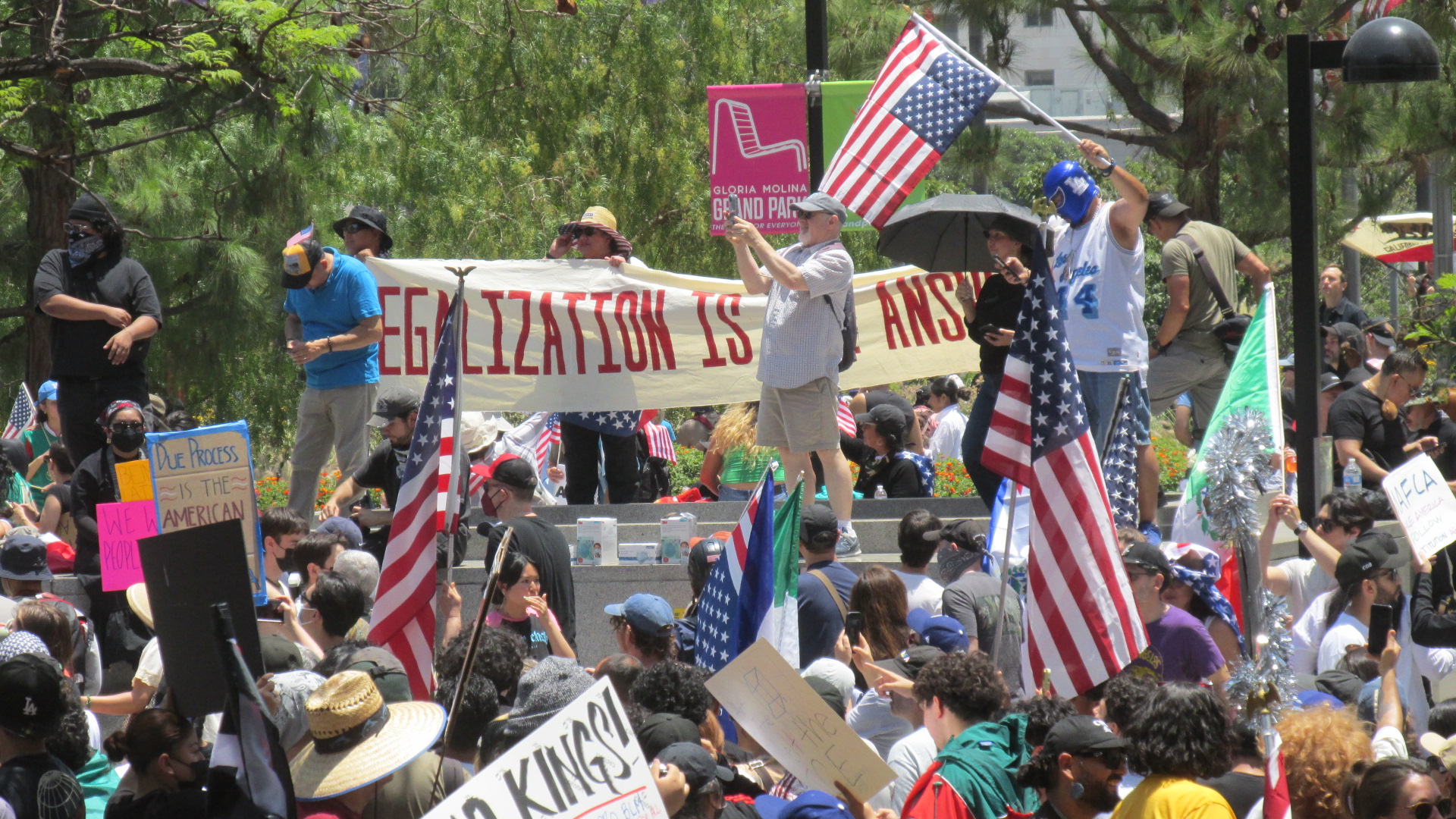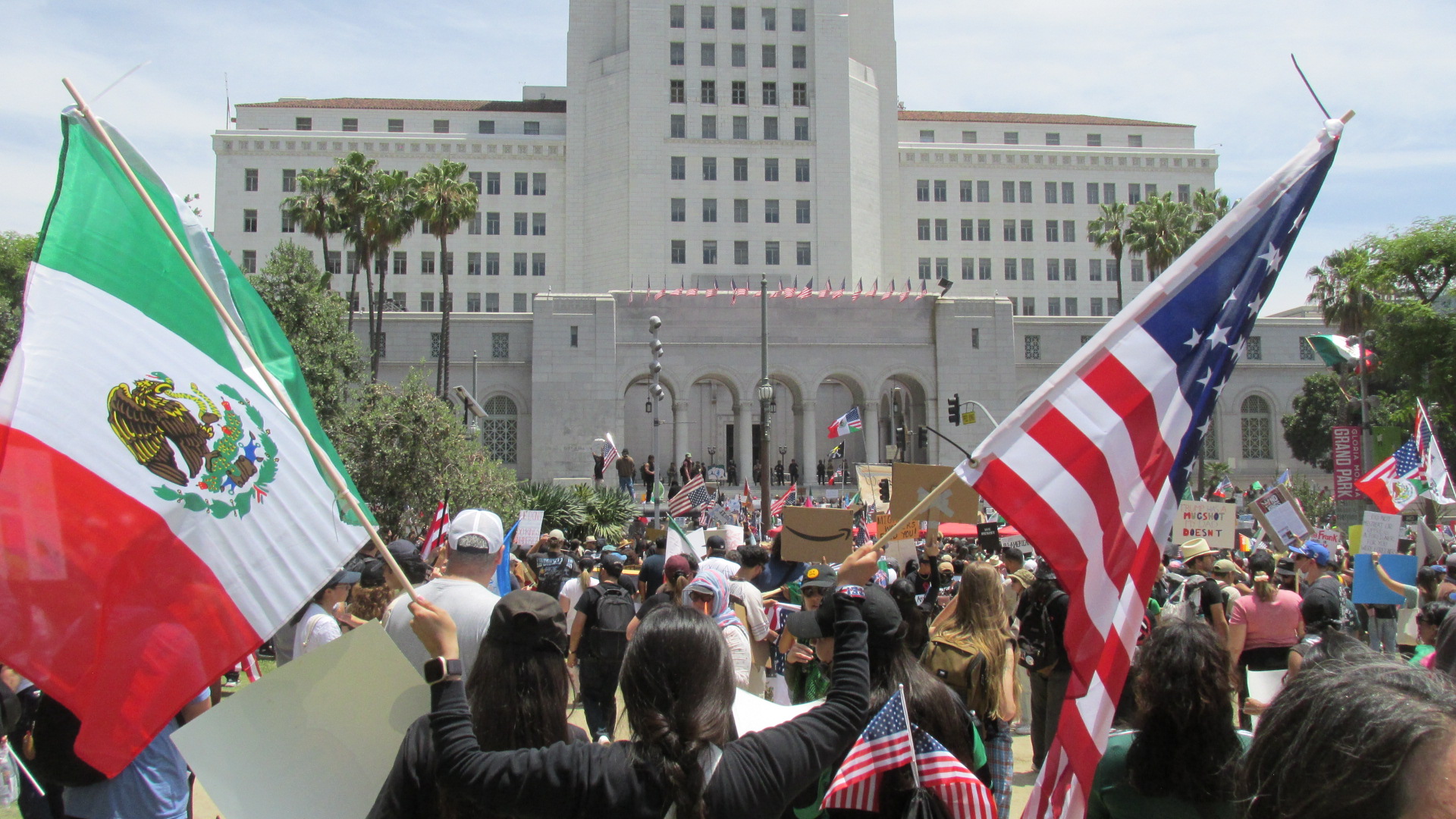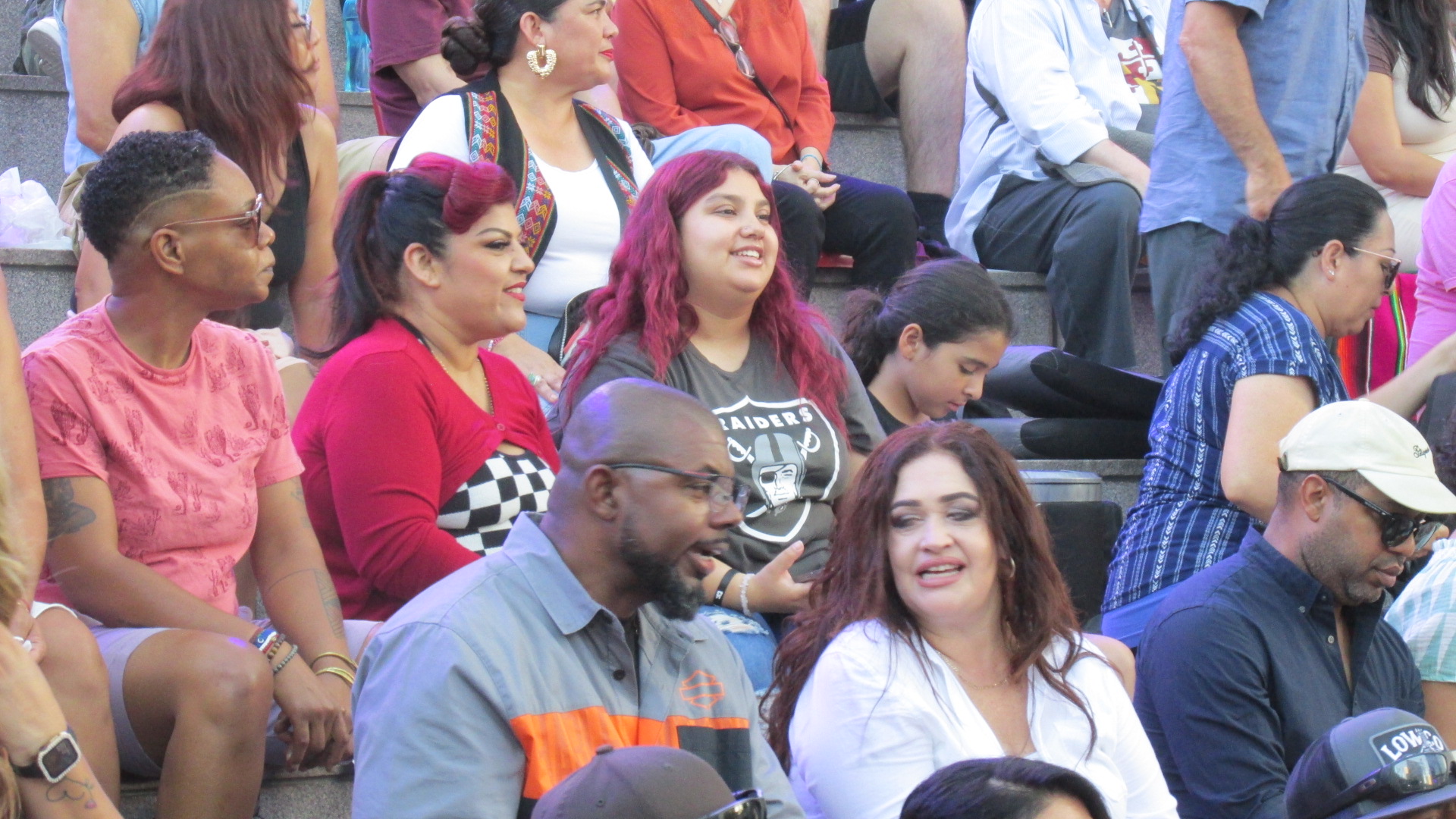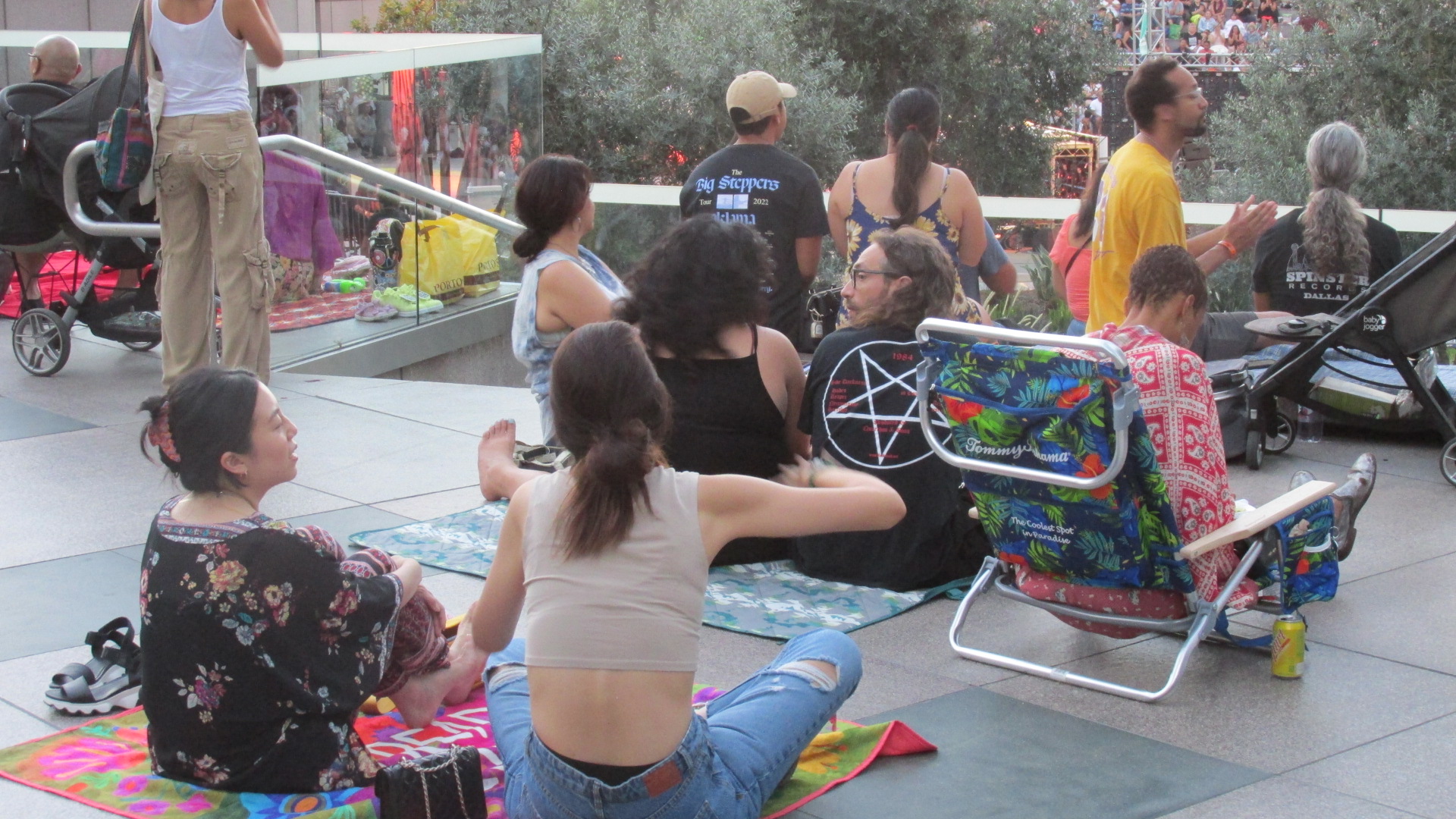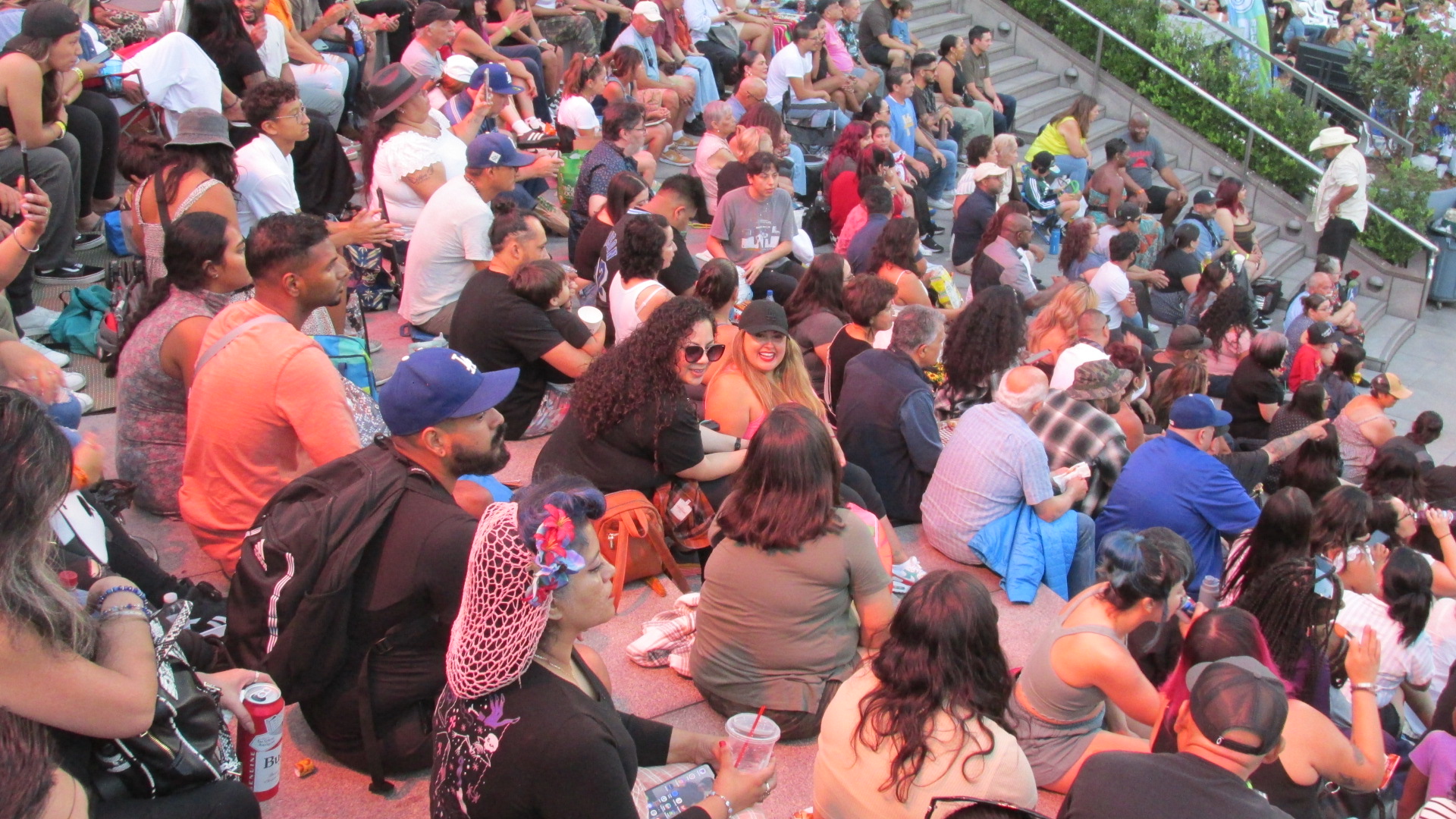
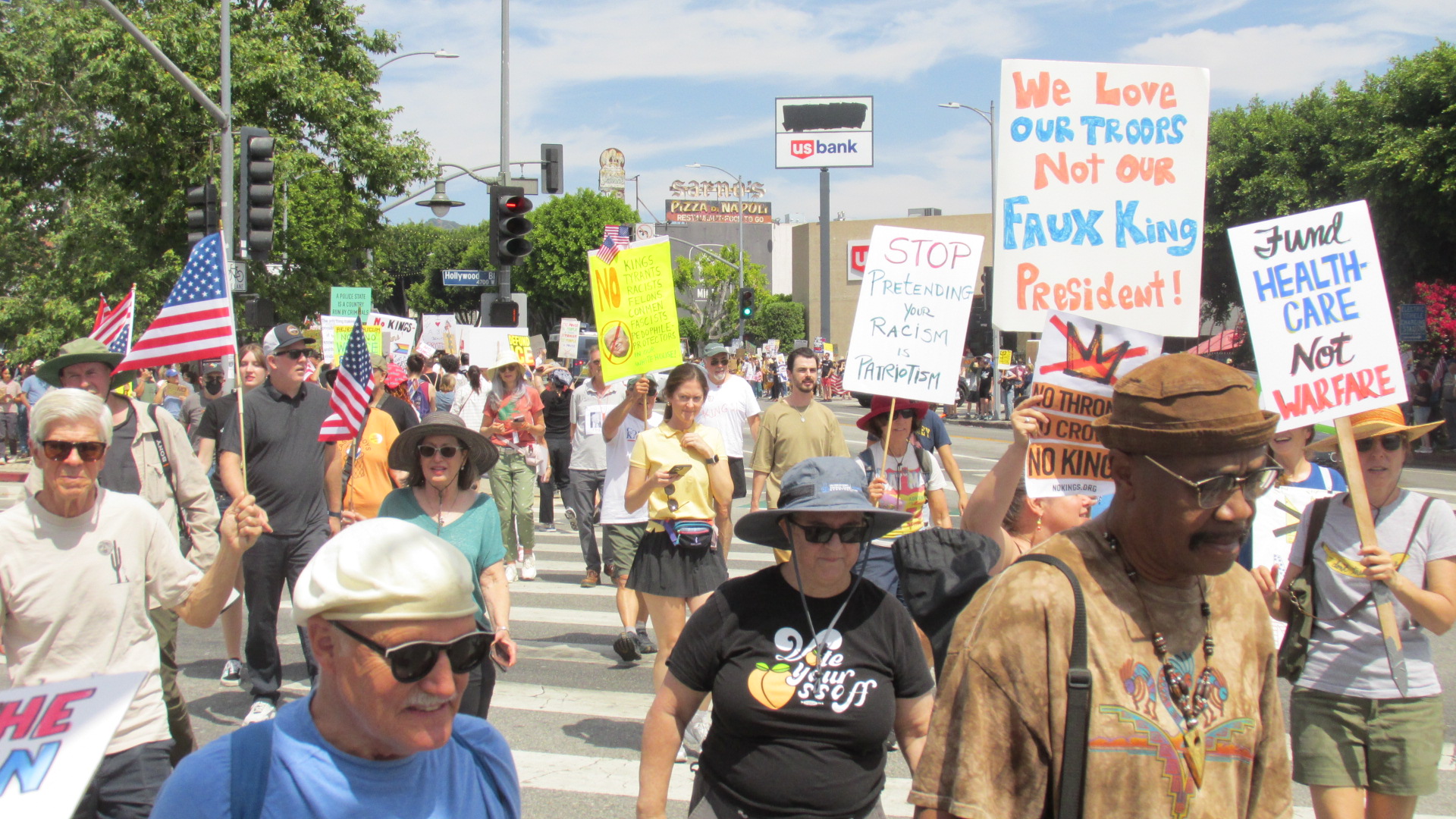
Protesters gathered in front of LA City Hall on Saturday, June 14.
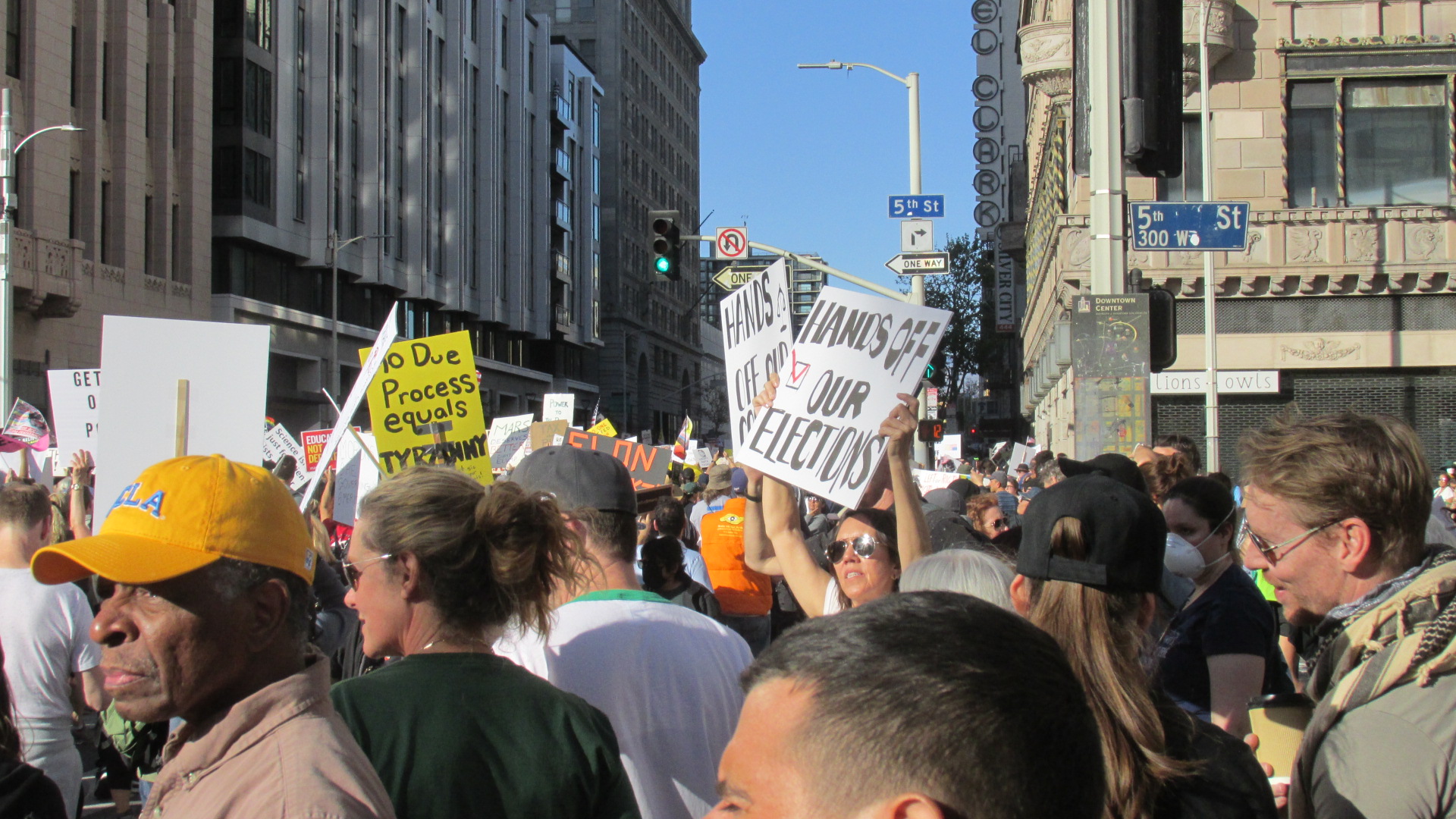
Thousands of people gathered in Downtown LA on Saturday for a boisterous, hours-long protest . Attendees held signs voicing anger over a number of issues, but the overarching message was that the protesters were not happy with President Trump. The air was filled with music and chanted slogans. Helicopters and drones flew overhead.
Protesters marching up Hill Street.
Late morning, a friend and I got on the subway heading to Downtown. Unfortunately, the driver announced that the stops at Pershing Square and Civic Center were closed due to police activity, so we got off at 7th and Metro. This meant we had to hike about a mile and a half to get to City Hall. While walking up Grand, we could see the throng of protesters marching up Hill Street in the distance.
Windows were covered with boards at the Museum of Contemporary Art (MOCA).
We also saw that the windows were boarded up at the Museum of Contemporary Art. A number of businesses had boarded up their windows to protect against the vandalism that’s been occurring in Downtown over the past week or so. The raids by Immigration & Customs Enforcement (ICE), where agents have grabbed undocumented immigrants, sparked an outpouring of anger, and groups opposing the raids have held numerous gatherings to voice their outrage. But it’s hard to say who exactly is responsible for the graffiti, broken windows and retail theft. No doubt, some of it’s tied to the protests, but I think it’s also likely that some of the damage has been caused to opportunists who are taking advantage of the unrest to grab some merchandise or promote general mayhem.
Protesters arriving at Grand Park after marching up Hill Street.
When we arrived at Grand Park, protesters were still streaming in from Hill Street. While many came to speak out over the ICE raids, as well as Trump’s order to send the National Guard and Marines to LA, the event had been planned long before as part of a nationwide movement to push back against the President’s policies. On Saturday protests were held in New York, Chicago, Sacramento, Raleigh, St. Louis, Dallas, and many other US cities.
“Legalization is the answer.”
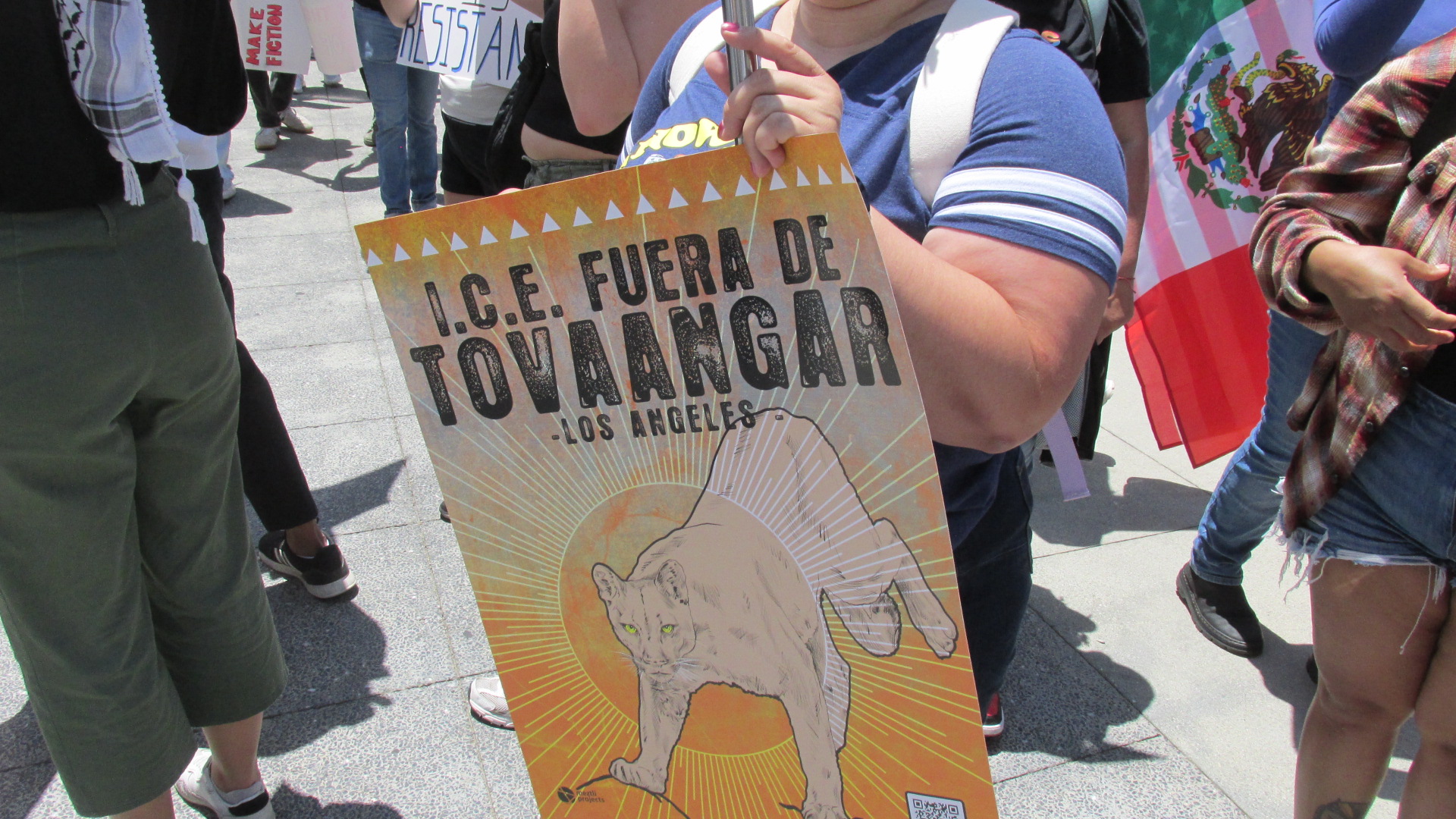
“I.C.E. Fuera de Tovaangar” (I.C.E. Out of Los Angeles) (Tovaangar is the name that was used by the indigenous people living in the LA area before Europeans arrived.)
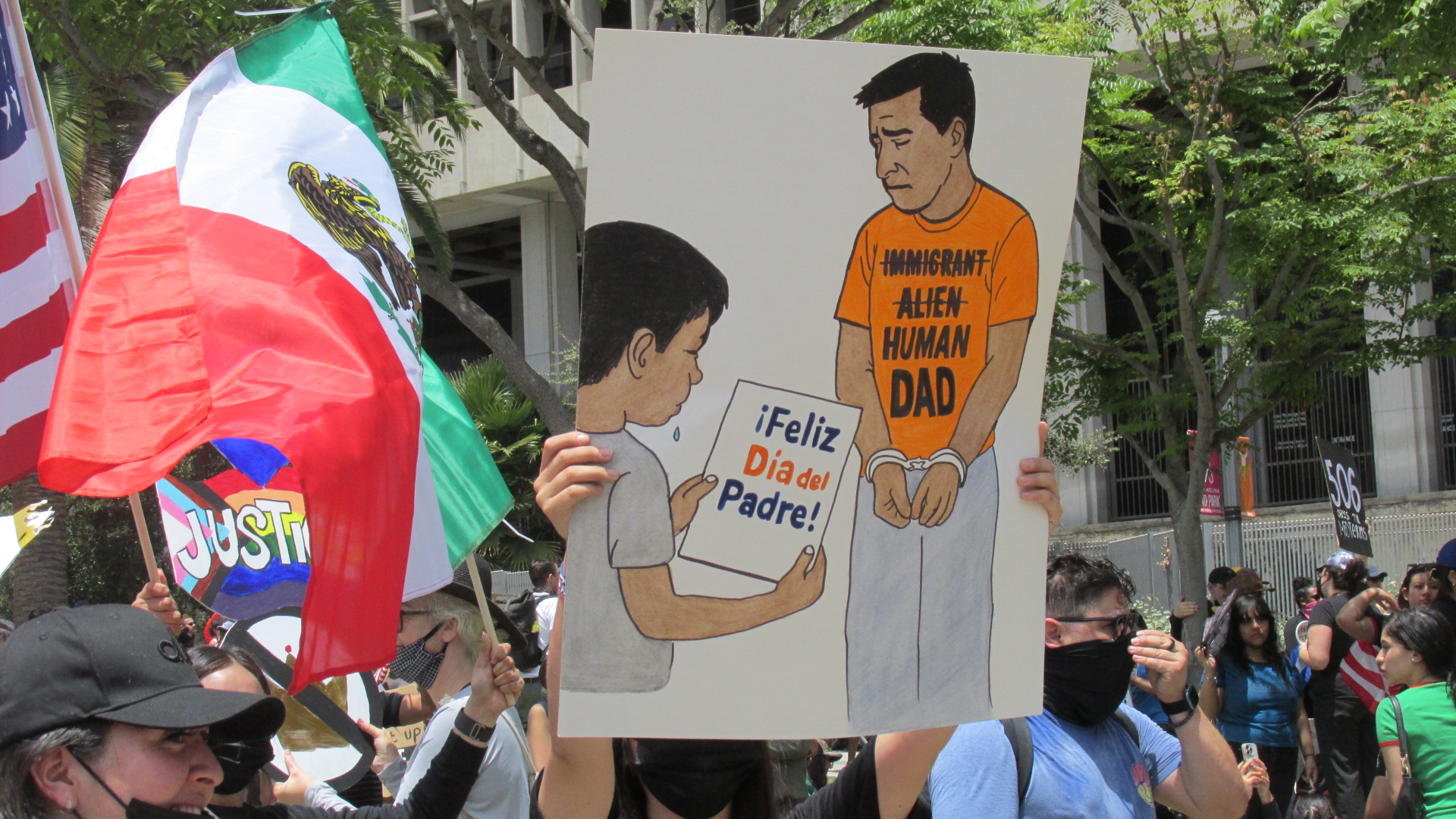
“Feliz Dia del Padre” (Happy Father’s Day)
While I was there, the protest seemed completely peaceful. Hard to say how many turned out, but I’d say several thousand. Apparently things got rough later in the afternoon. The LAPD said that around 4:00 pm some protesters began throwing rocks, bricks and bottles. They responded by issuing an order to disperse. From an account published in the LA Times, it appears officers then used rubber bullets and tear gas to clear the streets. No serious injuries were reported.
Law enforcement stationed above the steps to LA City Hall.
An image of the Constitution standing in front of City Hall.
The protests will continue. While most of Trump’s supporters seem to stand firmly behind him, there are millions of Americans who believe his administration is deliberately undermining the Constitution and that he’s trying to assume power as an authoritarian dictator. Personally, I think there are dark days ahead of us.
I went down to City Hall for a hearing this afternoon. I got off the subway at Civic Center and walked across Grand Park to Spring. The park seemed peaceful, as usual, but as I got closer to City Hall I saw a crowd of around a hundred protesters gathered on the steps at the entrance. Activists spoke passionately about the injustice of the ICE raids.
I entered City Hall and attended the hearing, which lasted until about four fifteen. Then, since I hadn’t had lunch, I walked up First Street looking for a place to eat. Unfortunately, these days its hard to find a restaurant that’s open in the Civic Center. As companies have reduced their footprint in Downtown or abandoned it altogether, many local businesses have cut their hours or closed down.
As I walked up First Street, I saw that the ground floor of the former LA Times building was covered with graffiti. A little farther up there was a row of parked police cars. Helicopters crisscrossed the sky overhead. Even though things were calm, there did seem to be tension in the air.
Thinking that the cafe at MOCA might still be open, I headed up to Grand. I walked into the cafe and saw that they were cleaning up. The woman behind the counter said they were open for another 20 minutes, so I ordered a sandwich. When it was ready, I went out to the patio and sat down to eat it.
The woman at the counter spoke with a heavy accent. My guess is that she had come from somewhere in Central America. In the time I was there, she made my sandwich, wiped off the tables in the patio, straightened the chairs and emptied the trash cans. When I left she was sweeping up inside the restaurant.
These are the people that keep this city going. These are the people that keep this country going.
Thousands of people gathered in Downtown on Saturday to voice their anger at the Trump administration’s actions since his January inauguration. The President began by firing off a series of executive orders, some of which have been called unconstitutional. He’s given Elon Musk unprecedented access to US agencies, allowing Musk and his team to view the government’s vast trove of sensitive data belonging to millions of Americans. And he’s imposed sweeping tariffs on trading partners that sparked a massive sell-off in the stock market.
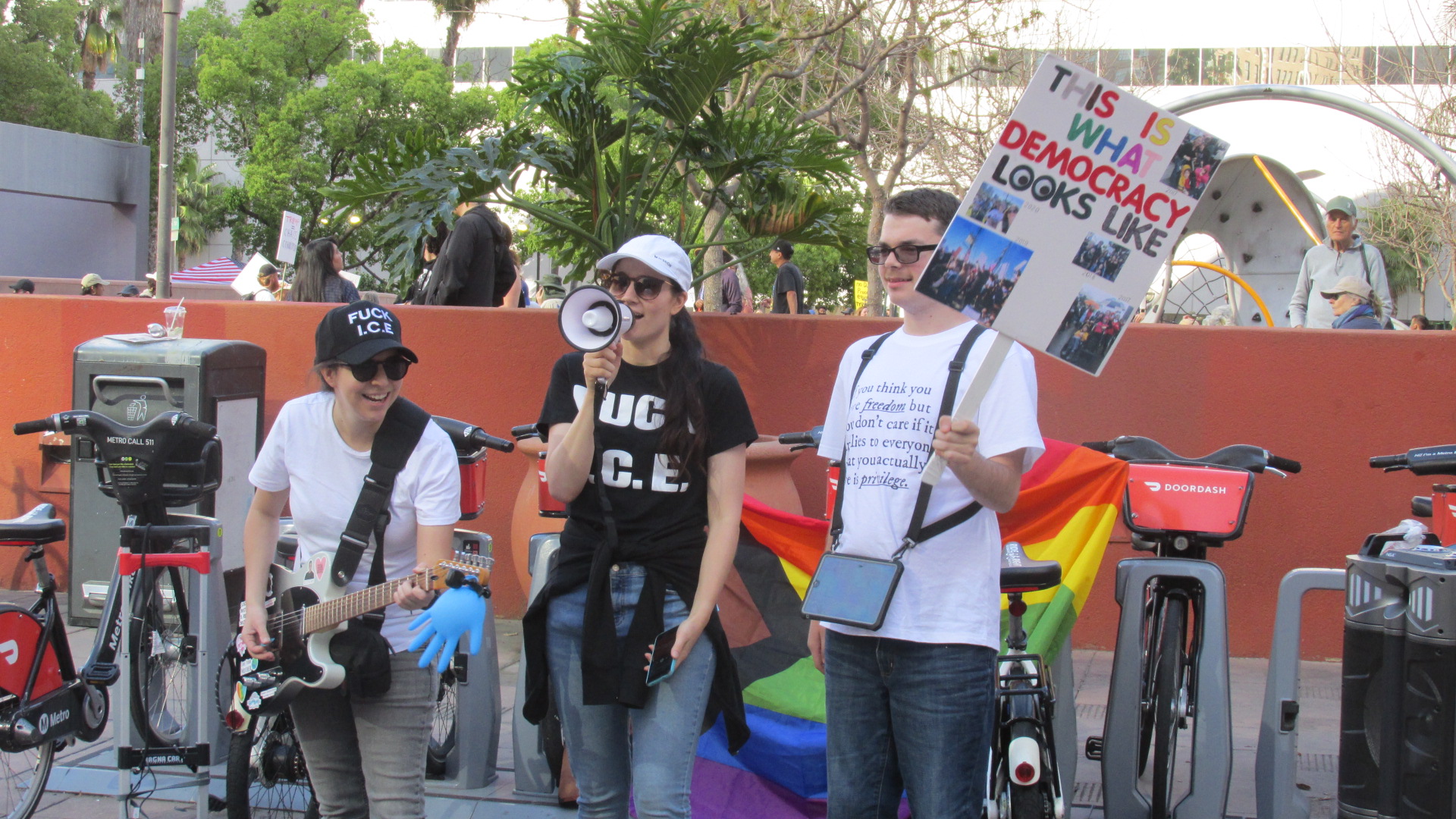
Many protesters came to defend immigrant rightsSome of the attendees made their points with music
The “Hands Off” protests were part of a nationwide day of action organized by a number of different groups. The Associated Press reported that protests were planned in over 1,200 locations across all 50 states. The signs at the LA protest spoke of anger on a wide range of issues, including deportations, the firing of Federal workers, LGBT rights and the economy.
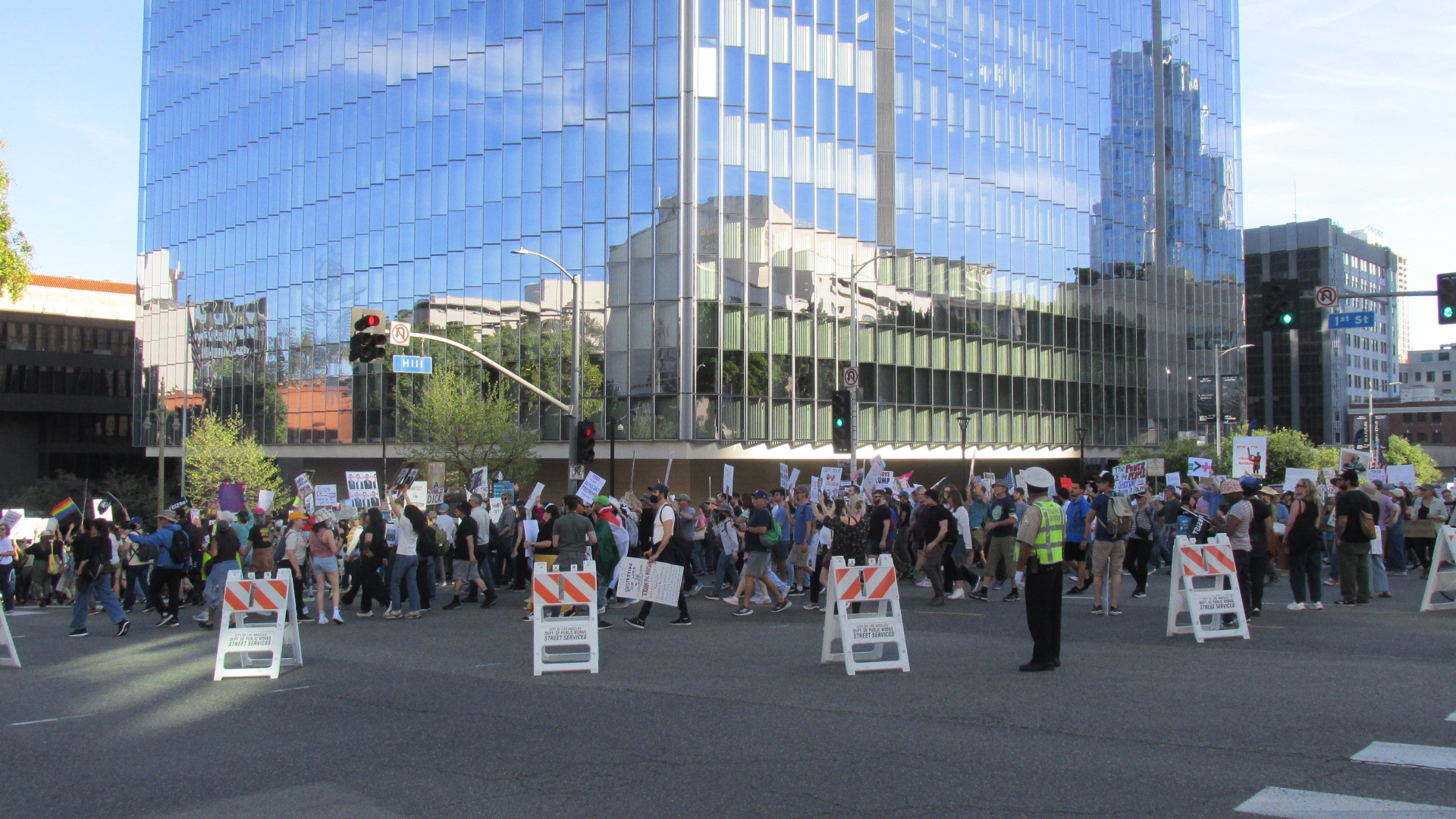
Protesters marching up Hill StreetThe marchers round the corner where the US Courthouse stands
The protest started around 4:00 pm in Pershing Square, and then the crowd marched to City Hall. The event was scheduled to last until 8:00 pm, but I left around 6:00 because I had a house guest coming. I didn’t get to hear the speakers, but the message from the crowd was clear: They don’t like the mass firings, they don’t like the deportations and they don’t like the funding cuts. But in spite of the anger in the air, the protest was peaceful. As of this morning, I haven’t seen any reports of arrests. This story from the LA Times has more details.
It’s hard to believe that the Pantry is closed. It’s one of those places that seemed liked it had been around forever, and it seemed like it would go on forever. I think I started going to the Pantry back in the 70s. Back then it was open 24-hours. If you were going to a movie or to see a band in Downtown, it was the perfect place to stop afterwards. They served breakfast all day and the coffee kept coming.
The Pantry is now owned by a trust set up by former LA Mayor Richard Riordan. According to the trust, the Pantry is not profitable, and they’re hoping to sell it to fund the charitable work of the Riordan Foundation. It will be interesting to see who buys it. Obviously, the property, located in the heart of Downtown, is worth a fortune, but demolishing the restaurant to build something larger will probably not be easy. The Pantry is designated as an LA City Historic Cultural Monument. That would complicate any plans for new development.
This all just feels really sad. The older I get, the more I understand that the world is always changing and that nothing lasts forever. But I still feel like I’m losing a piece of my life. And I think a lot of other people are feeling the same way.
Back in 2017, I walked across the Fourth Street Bridge and took a bunch of photos, thinking it would be a great subject to write about on this blog. Now, only seven years later, I’m finally getting around to doing this post. What can I say? Time flies….
Fourth Place, leading up to the Fourth Street Bridge.
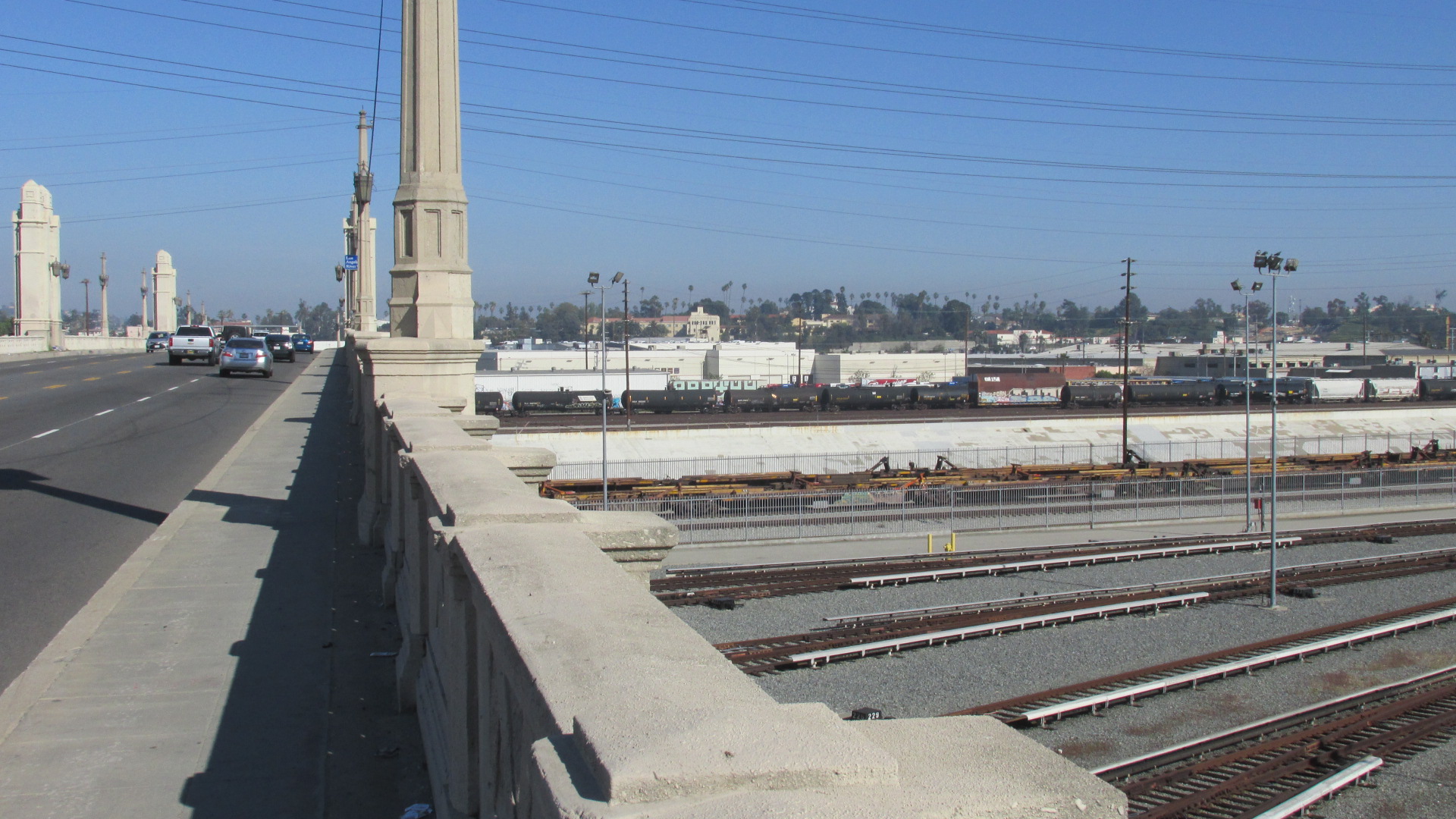
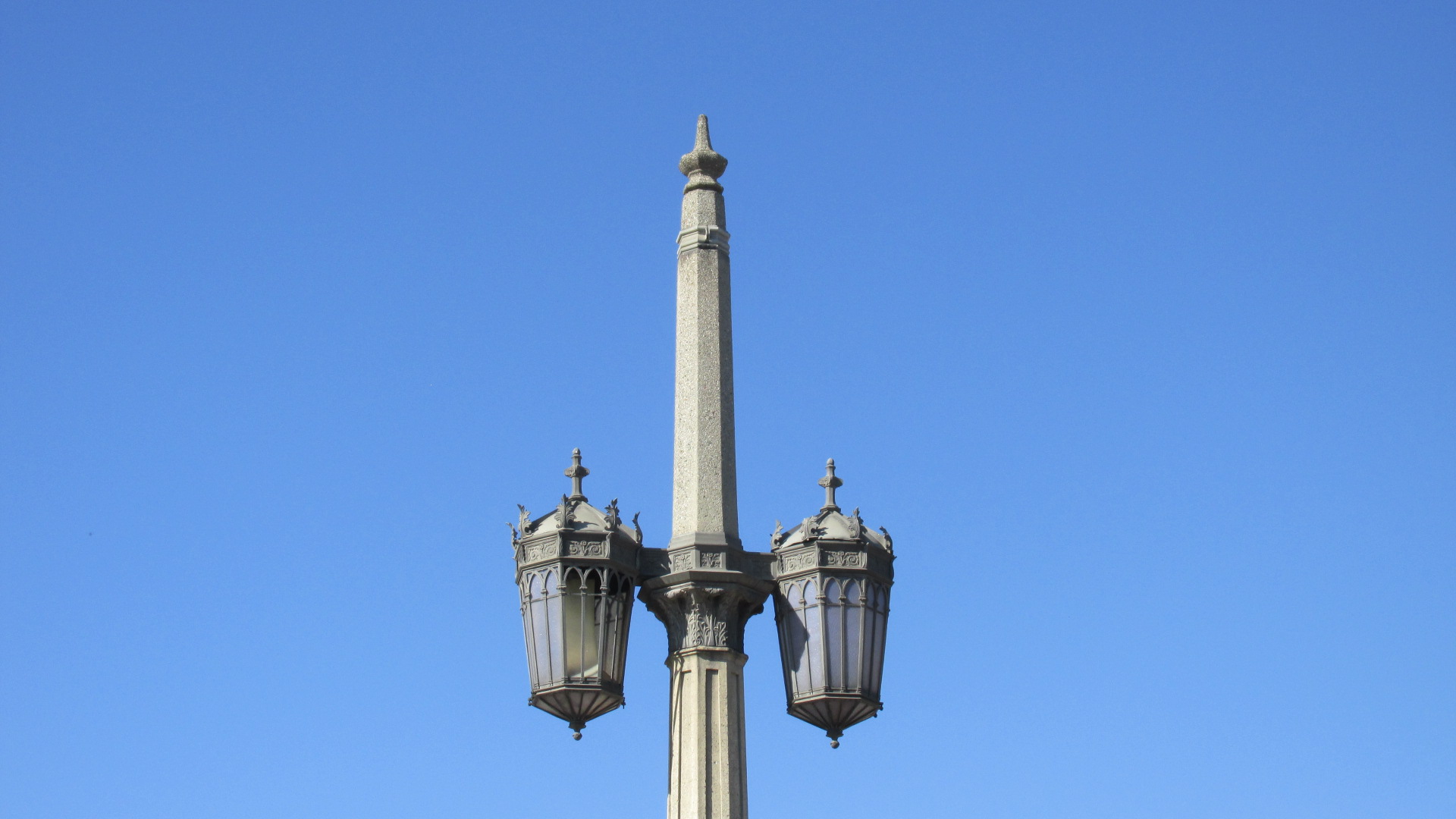
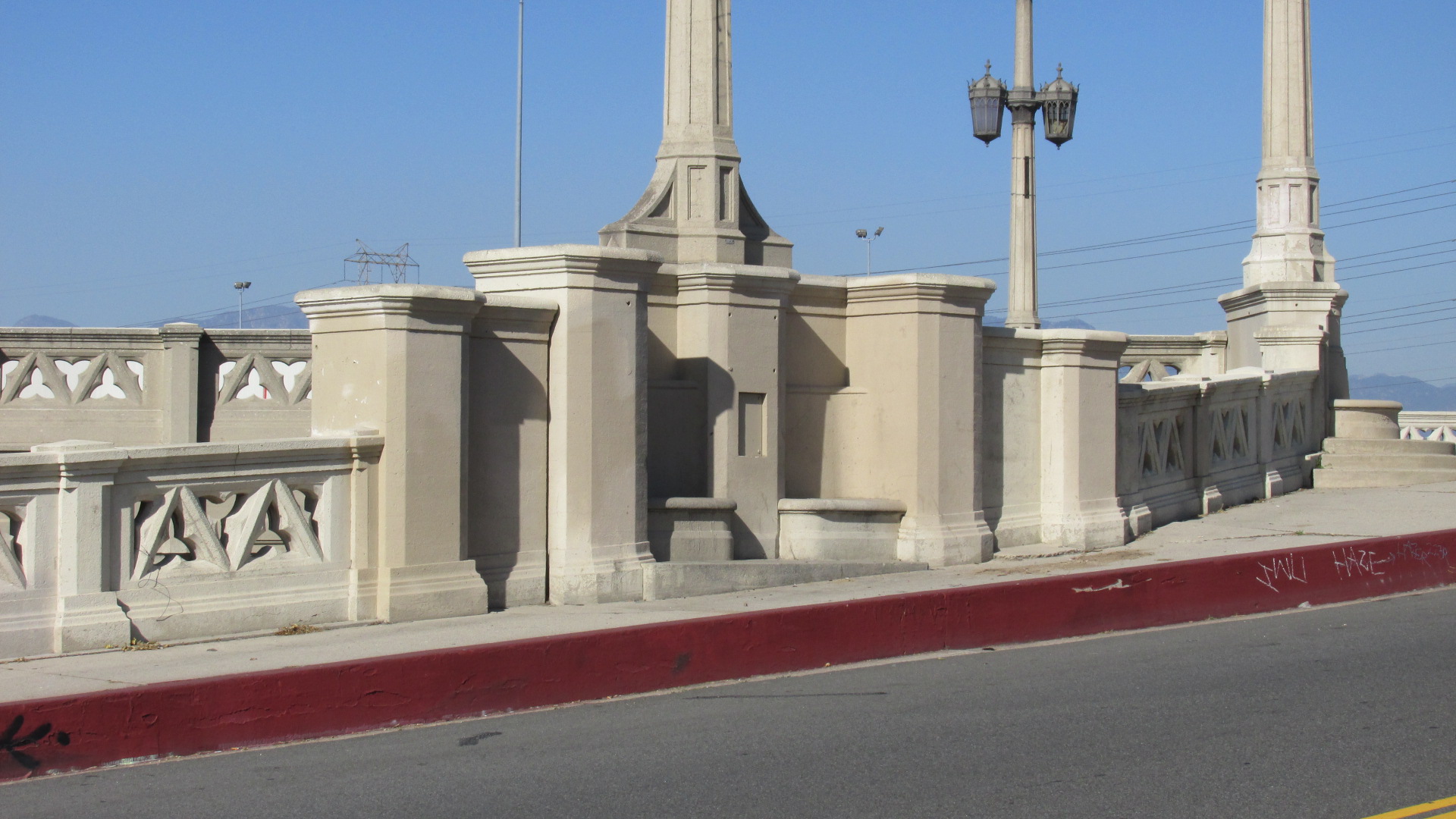
To my mind, the Fourth Street Bridge is one of the most striking bridges in LA. I don’t claim to be an architecture critic, but it seems like there was unusual amount of care put into the design. The streetlights, porticos and concrete railing were fashioned in a mix of Beaux Art and Gothic Revival styles that was carefully worked out by the architects. These aren’t just decorative elements that were tacked on. They’re well-suited to the scale and the massing of the bridge.
Fourth Place merges with the Fourth Street Bridge.The streetlights echo European Gothic design.Some of the piers feature built-in seating.
Constructed in 1931, the bridge was part of a massive investment in infrastructure made possible by the passage in the 20s of LA’s Viaduct Bond Act. (To show you how ignorant I am, I didn’t know until recently what the difference was between a bridge and viaduct. Apparently, a bridge is a small structure built to cross a fairly narrow river or ravine. A viaduct is a larger structure made up of a series of bridges that crosses a wide river or a valley. But I’m still going to call it the “Fourth Street Bridge”. Old habits die hard.)
A view of the bridge looking toward East LA.The San Gabriel Mountains to the north.Unfortunately, these days many of the porticos are filled with trash.
The Fourth Street Bridge was built by the LA City Bureau of Engineering under the supervision of Bridge and Viaduct Engineer Merrill Butler. Butler had a long career in LA, working for the City in various capacities until his retirement in 1961. Over the years the projects designed under his direction included the First Street (now Cesar Chavez) Bridge, the Hyperion Bridge, the Figueroa Street Tunnels and the Hyperion Sewage Treatment Plant.
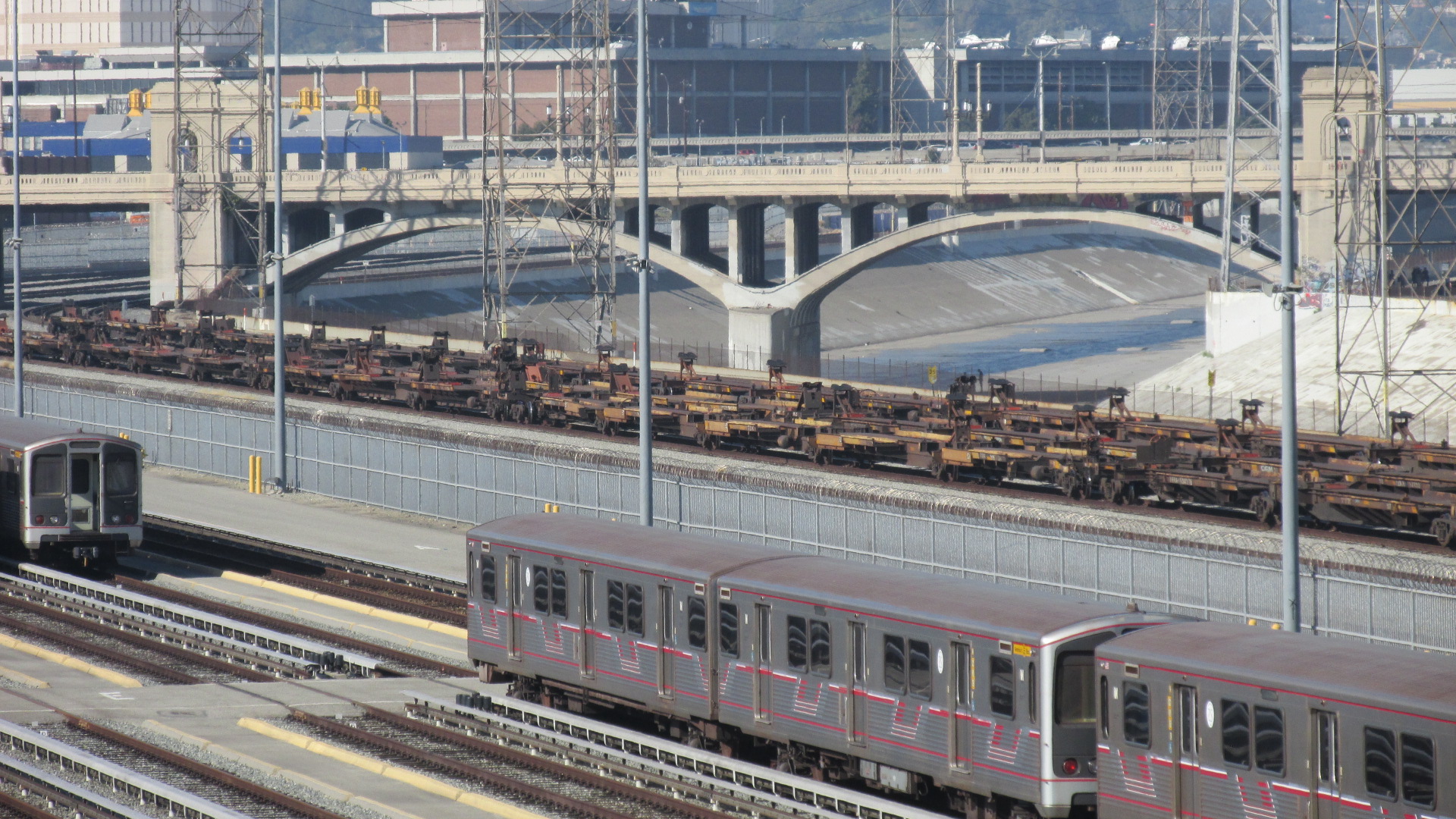
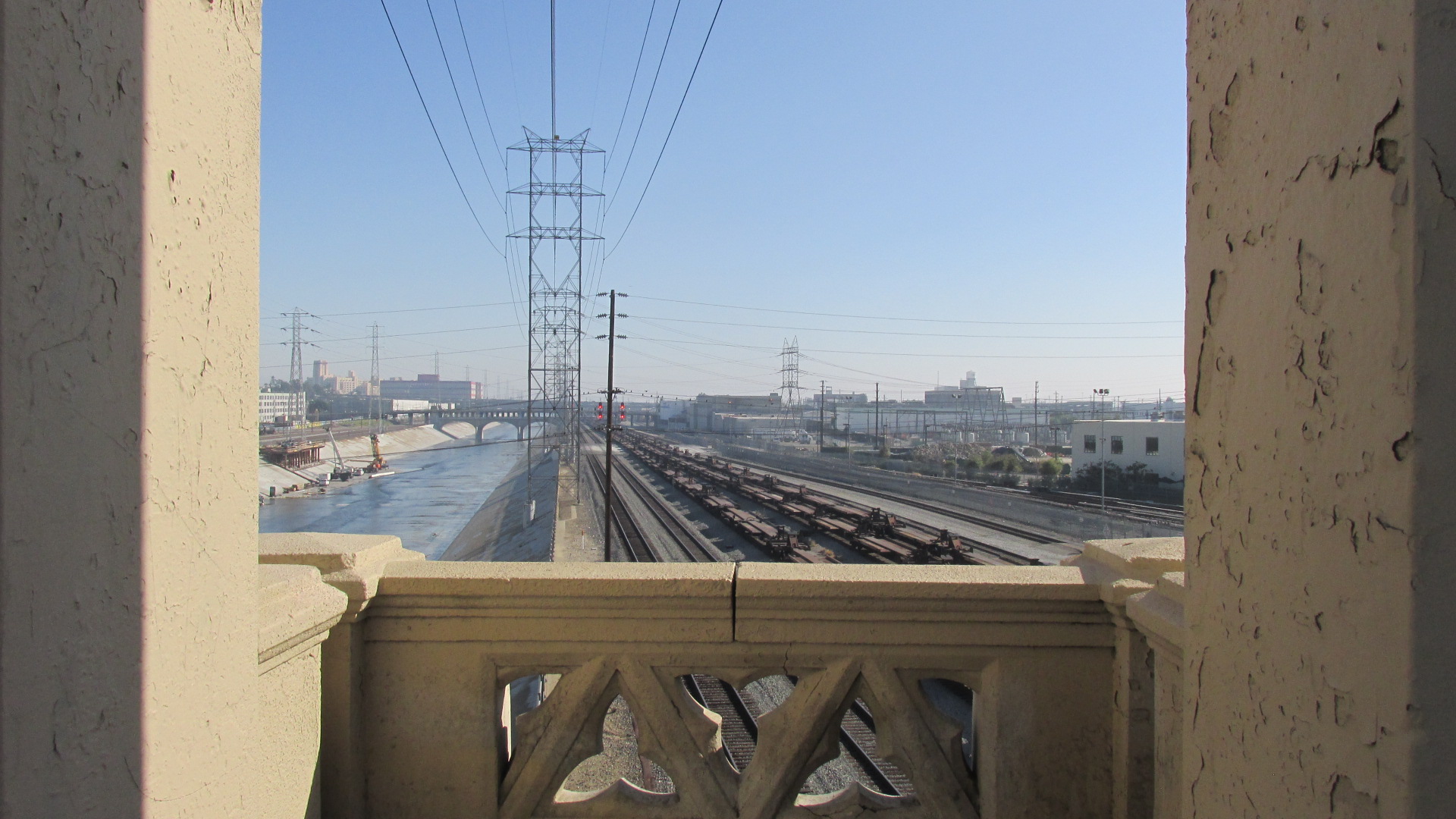
The series of bridges that connect East LA to Downtown are part of a massive infrastructure nexus that played a key role in LA’s growth. In the latter part of the 30s, work began on the flood control projects that would shape the LA River as we know it today. One of the reasons for encasing the River in concrete was to protect the rail lines that ran adjacent to it. You couldn’t move goods without trains. And rising above the concrete channel is a vast network of power lines.
Rail lines next to the LA River.Miles of power lines run above the River.Rows of flat cars lying on the tracks below.
In 1995, the Fourth Street Bridge was retrofitted to bring it into compliance with current seismic safety standards. And in 2008 it was declared a Historic Cultural Monument by the City of LA.
The Cesar Chavez Bridge lies just north of the Fourth Street Bridge.Looking west toward Downtown.
Here are a couple of links, for anyone who wants to dig a little deeper. Thie first will take you to Water & Power Associates, which has a number of historic photos of the Fourth Street Bridge. And if you’re into LA history, check out the Museum tab in the index on the left. Their virtual museum offers an amazing collection of images and information.
And here’s a brief bio on Merrill Butler that was apparently written at the time of his retirement. Not surprisingly, it’s pretty superficial, but it also seems to offer a small snapshot of mid-century LA. A different time, a different culture.
I don’t listen to the radio much. I remember hearing Art Laboe’s name when I was a kid. I knew he was a DJ, and I may have heard his show when I was growing up. But I really didn’t know much about him until I read his obituary last October.
Reading about his life, I felt a rush of happiness and sadness. I’m not sure I can explain why, but I think it had to do with the fact that he spent his time on earth bringing people together. From the lovers who called in asking him to dedicate a song to someone they cared about, to the kids from East LA, West LA, and South LA who gathered at the live shows he organized.
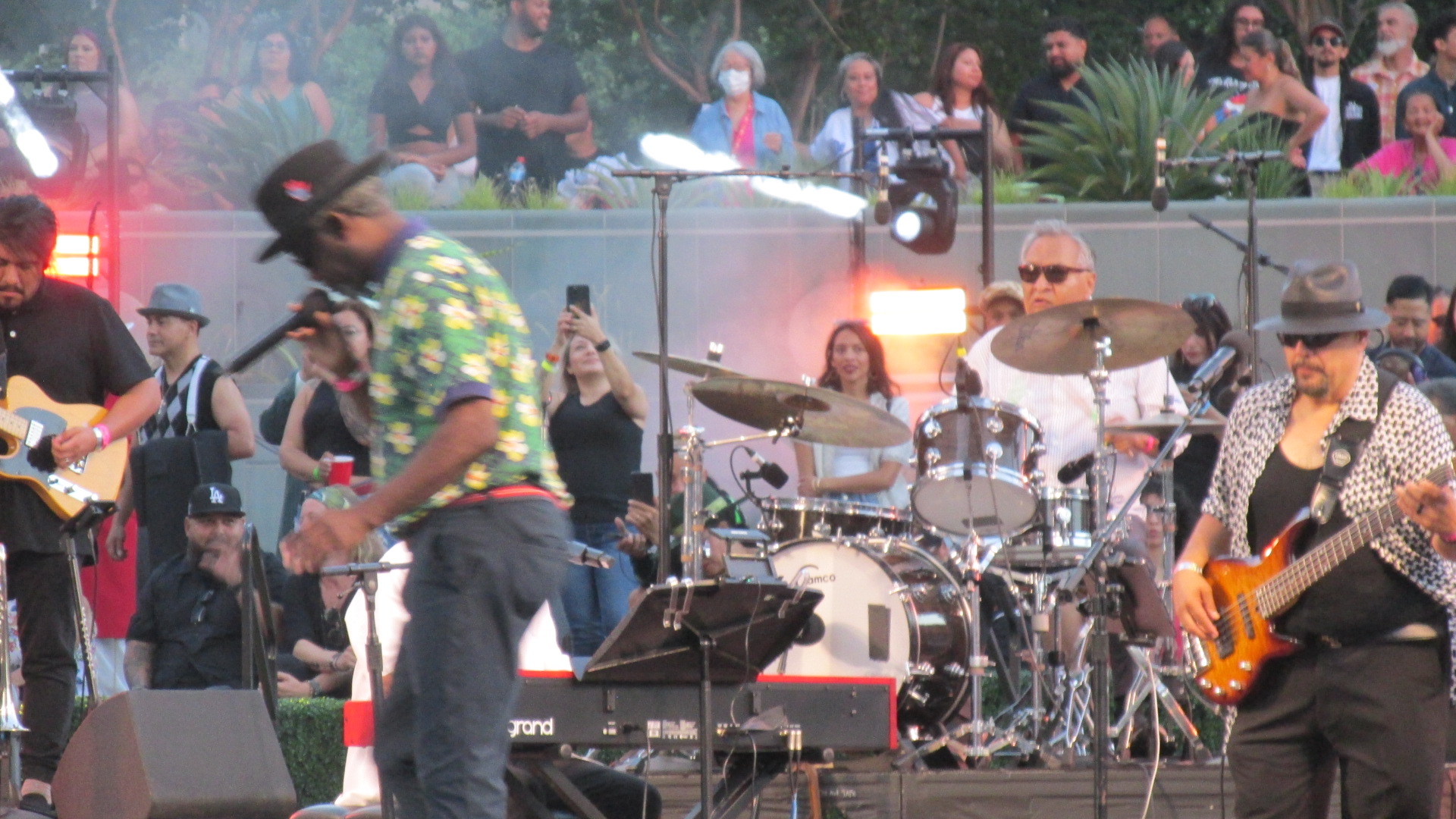
On Saturday, August 5, thousands of people gathered in Downtown LA to pay tribute to Laboe. DJs spun oldies and live performers took the stage to sing their versions of favorite tunes. People from all over Los Angeles showed up, and everybody seemed to be having a good time.
We are so divided these days. There are so many voices in the media that seem determined to drive us apart. We really need voices that can reach across the lines that divide us. Art Laboe understood the power of music, and he used it to erase those lines. We need people like him now more than ever.
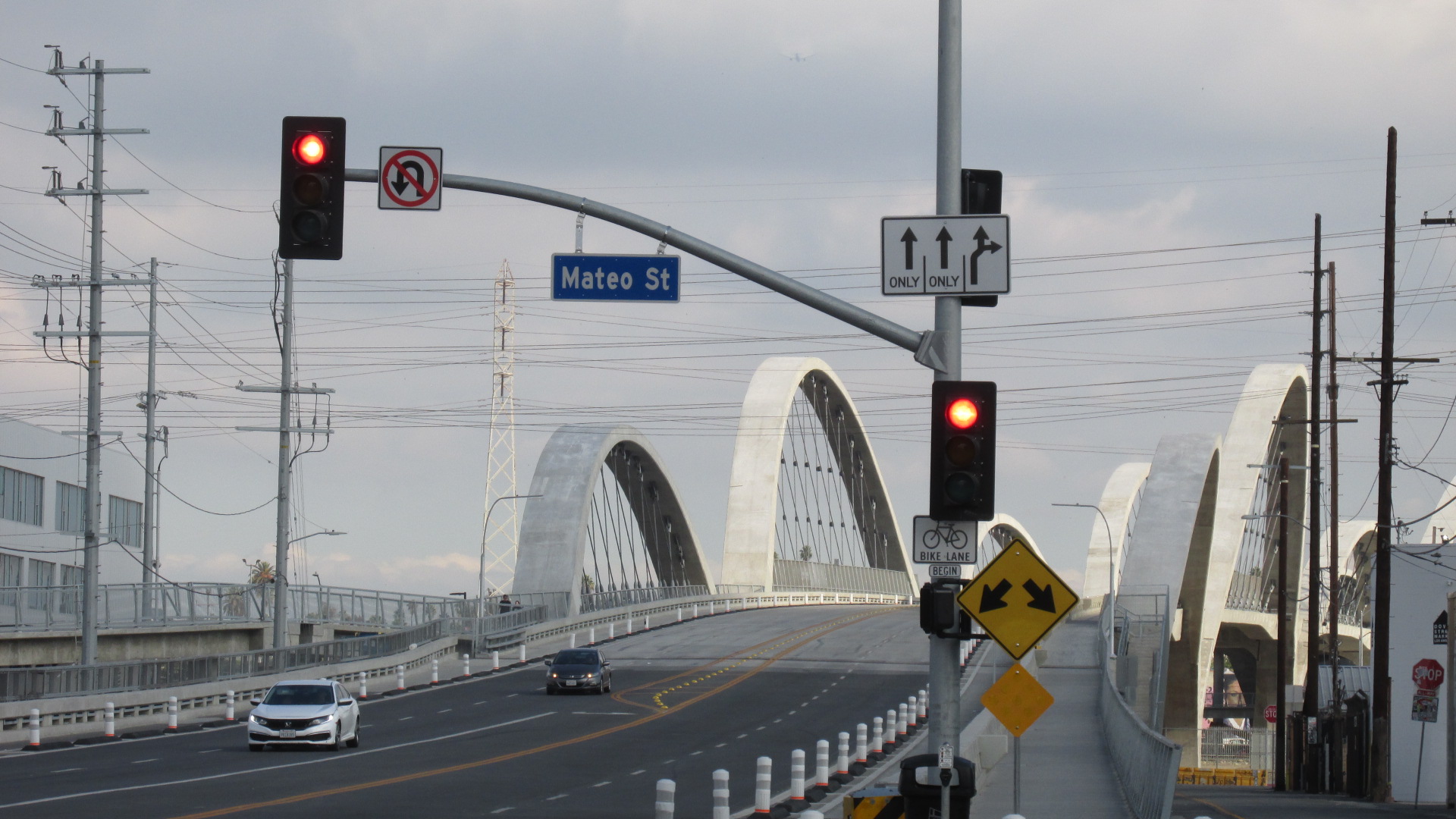
A view of the Sixth Street Bridge from Mateo Street.
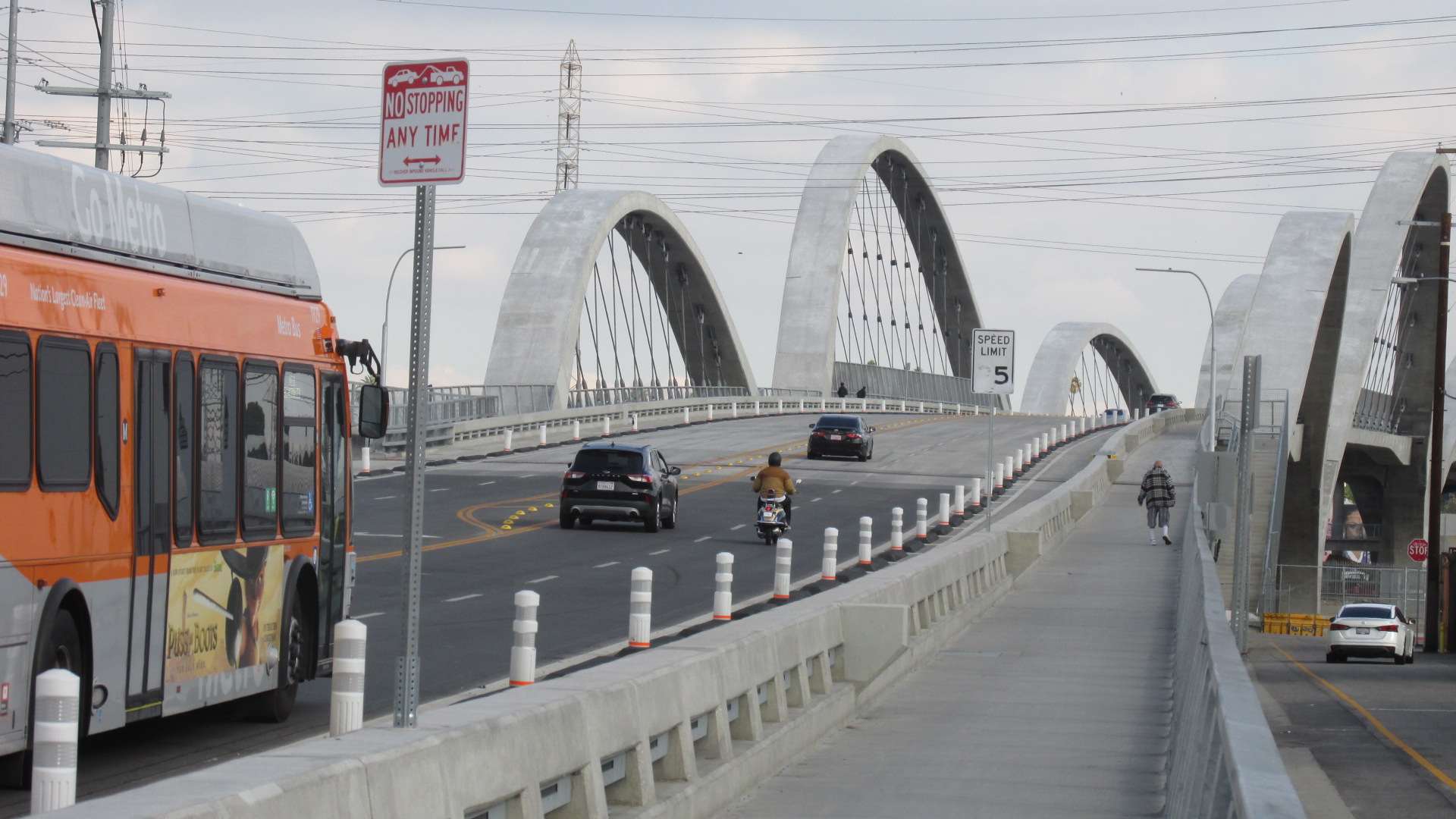
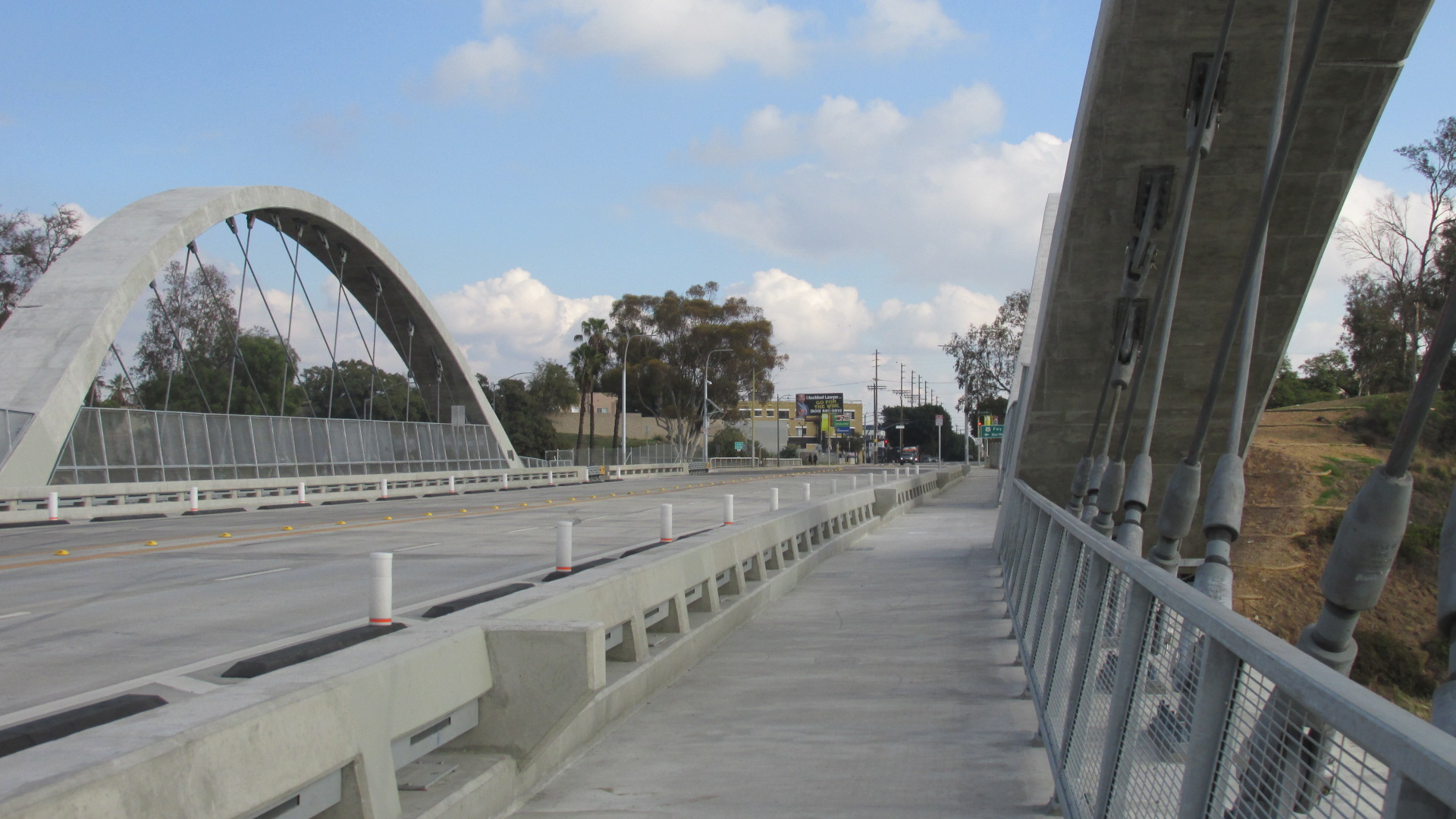
The new Sixth Street Bridge opened in July of this year. The first few weeks were pretty chaotic, with drivers doing stunts, daredevils climbing the arches, street artists getting creative with spray paint, and more. Things got so bad the LAPD ended up closing the bridge just to keep a lid on the mayhem. Scenes of crashes, fireworks and people partying were making the nightly news.
Starting across the bridge from the Downtown side.
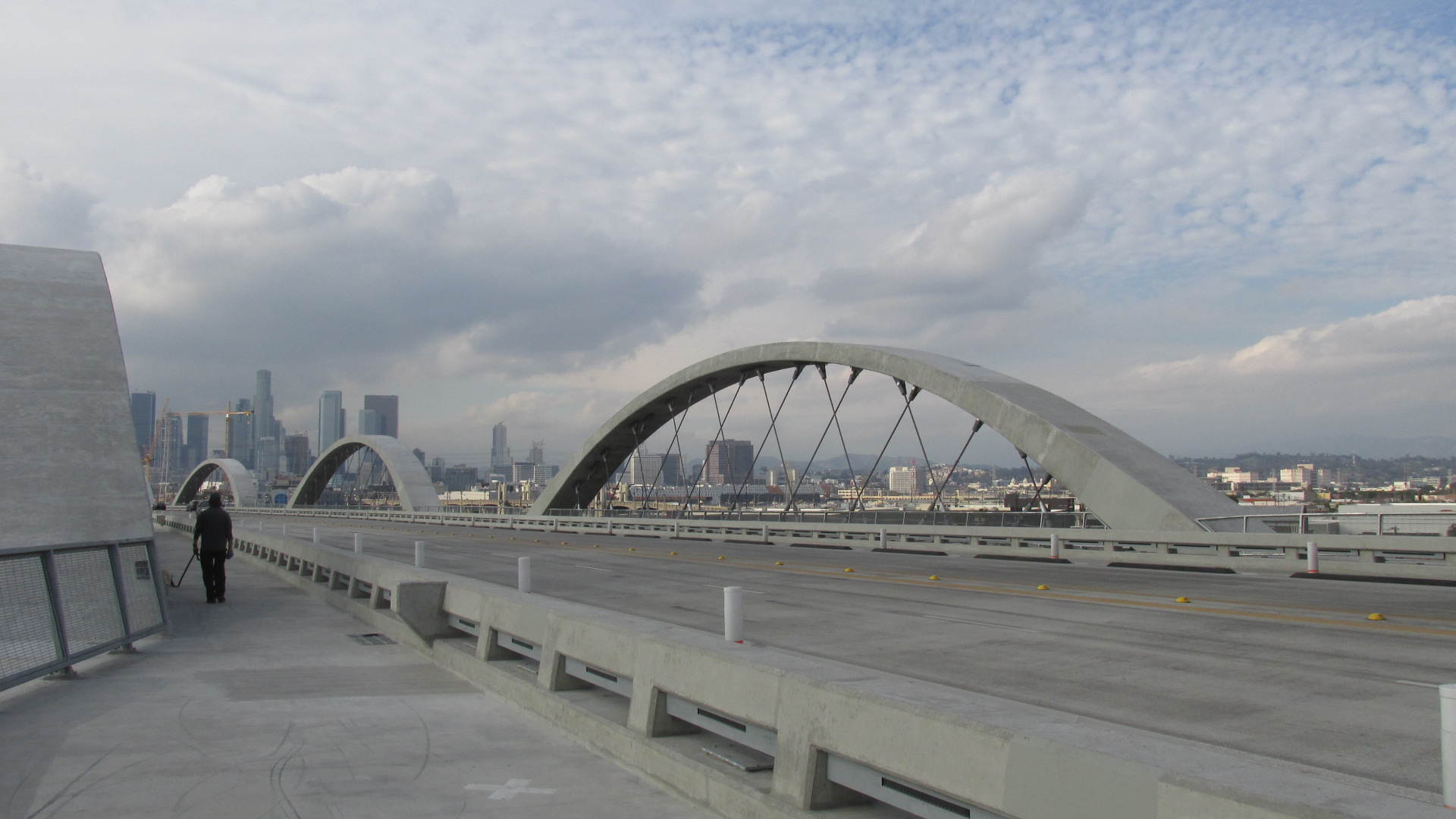
But now all the chaos seems to have faded away. When I took a walk across the bridge earlier in December, there wasn’t much traffic and I saw only a handful of pedestrians. It was a cool, cloudy day, and things seemed pretty peaceful.
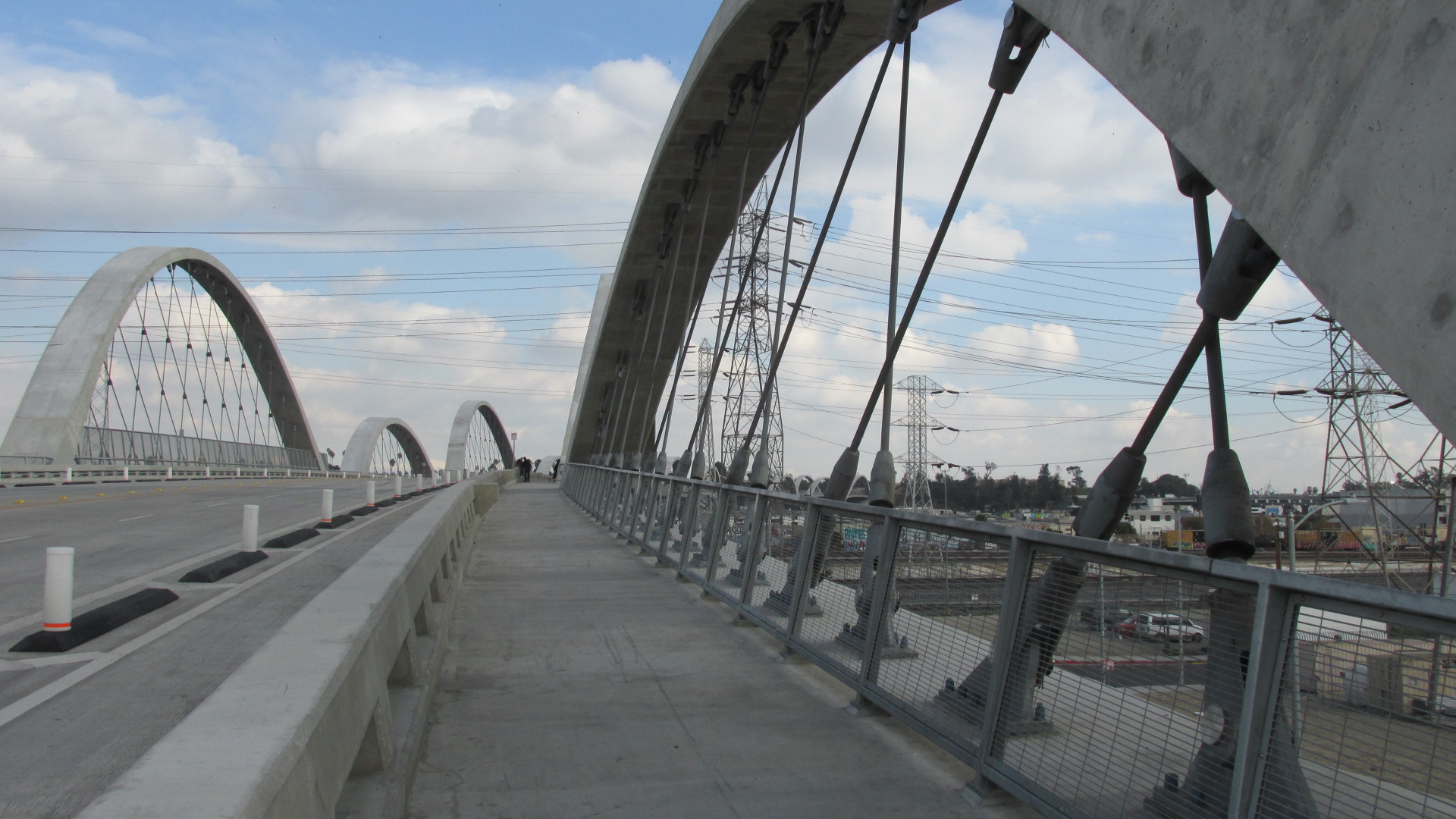
The bridge’s arches create a sense of energy.
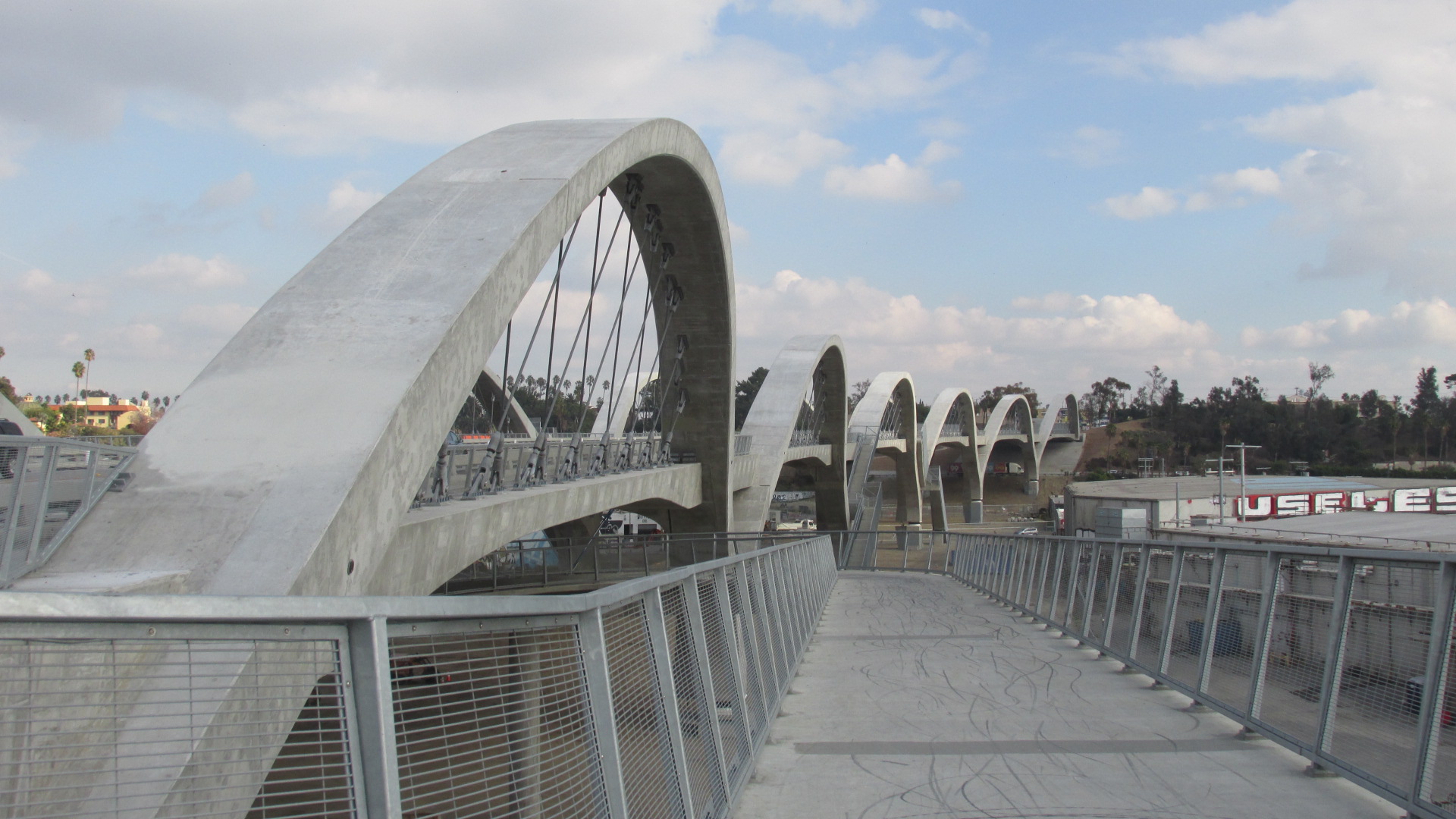
I have mixed feelings about the Sixth Street Bridge, which I’ve written about previously. In this post I want to focus on the positive. The bridge really is beautiful. The design, by Michael Maltzan, is impressive, with the fluid lines of the arches rolling off to the horizon. Walking across you get a sense of being lifted into the air, with stunning views of LA’s various landscapes surrounding you on all sides.
The new Sixth Street Bridge is actually a replacement for the previous version, which was built in the early 30s. It’s just one of a series of bridges that run across the LA River between Downtown and East LA, including the Cesar Chavez Bridge, the Fourth Street Bridge, and the Seventh Street Bridge. All of these were built in the first half of the 20th century.
A view of the Fourth Street Bridge.A view of the Seventh Street Bridge.
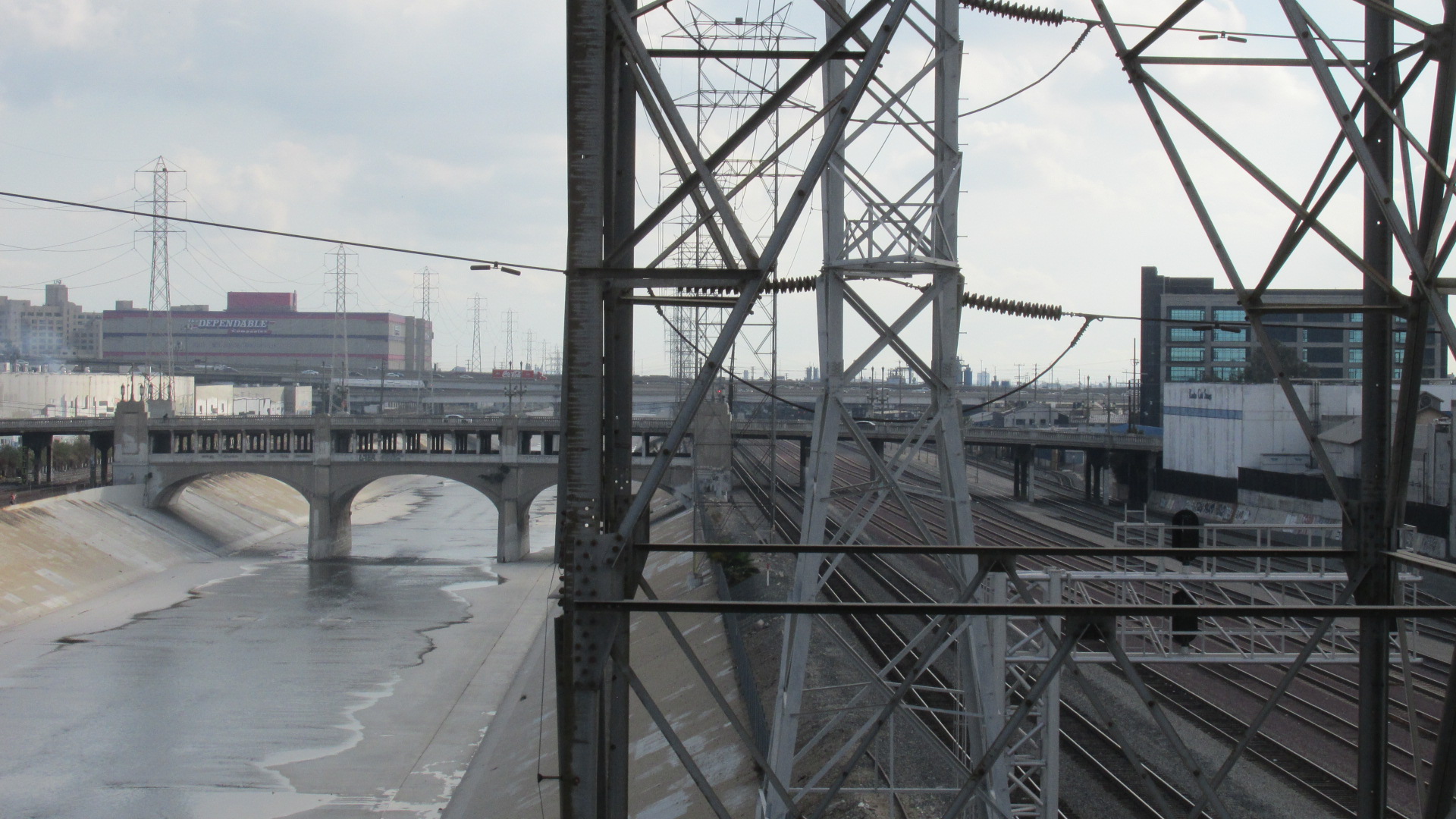
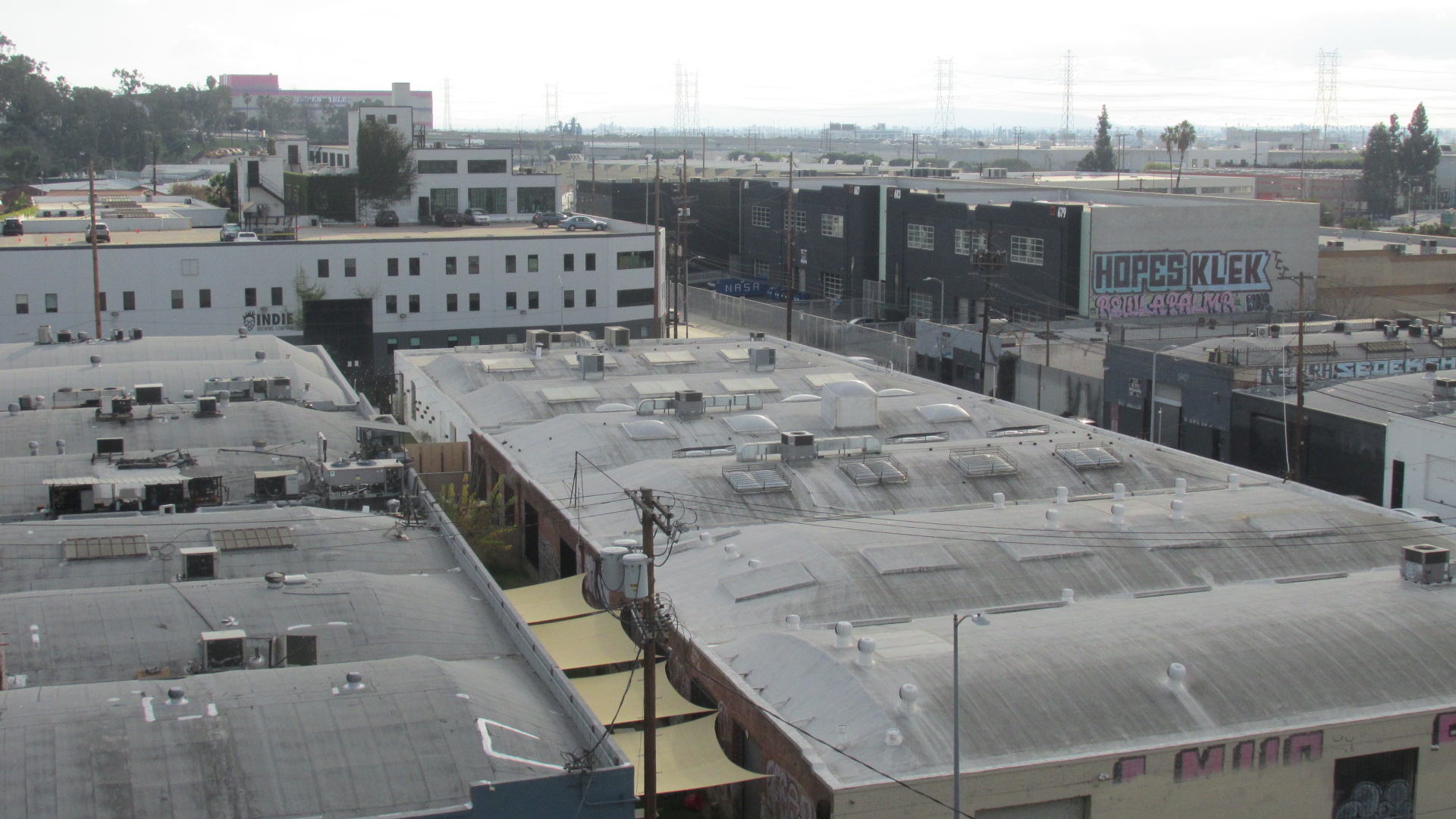
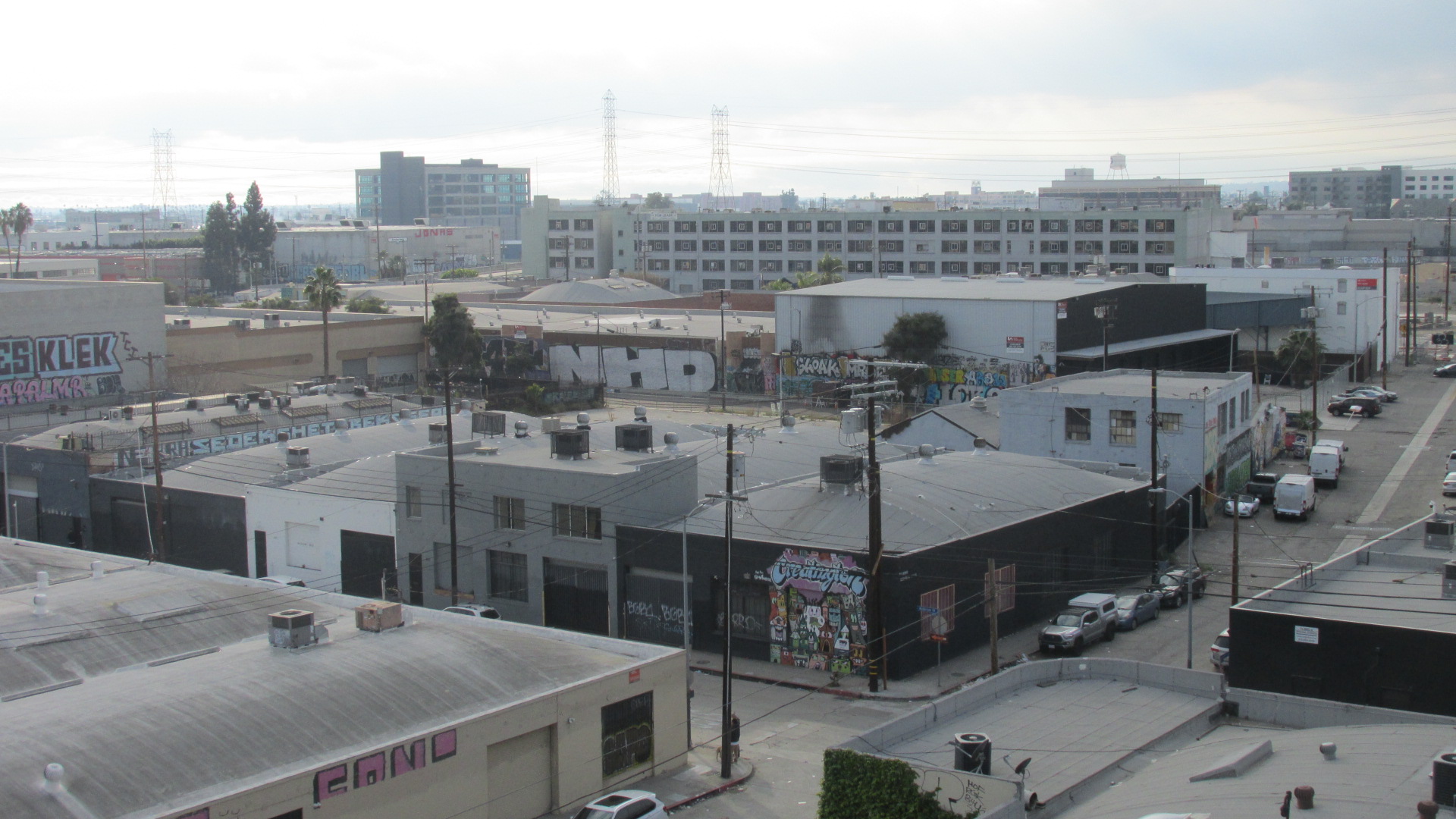
As you can see from the photo above, this area, which borders Downtown LA, is criss-crossed with multiple layers of infrastructure. Aside from the bridges, you have the concrete surface of the LA River, rows of train tracks, and miles of electric power lines, all surrounded by a massive industrial district.
The arches rolling off to the horizon.
Beneath the bridge you can see scores of large, nondescript buildings which were built for manufacturing and storage. These days you’ll probably find that a number of them have been converted to ghost kitchens and cannabis greenhouses.
A view of the industrial district that lies below the Sixth Street Bridge.Scores of drab buildings cover the landscape.
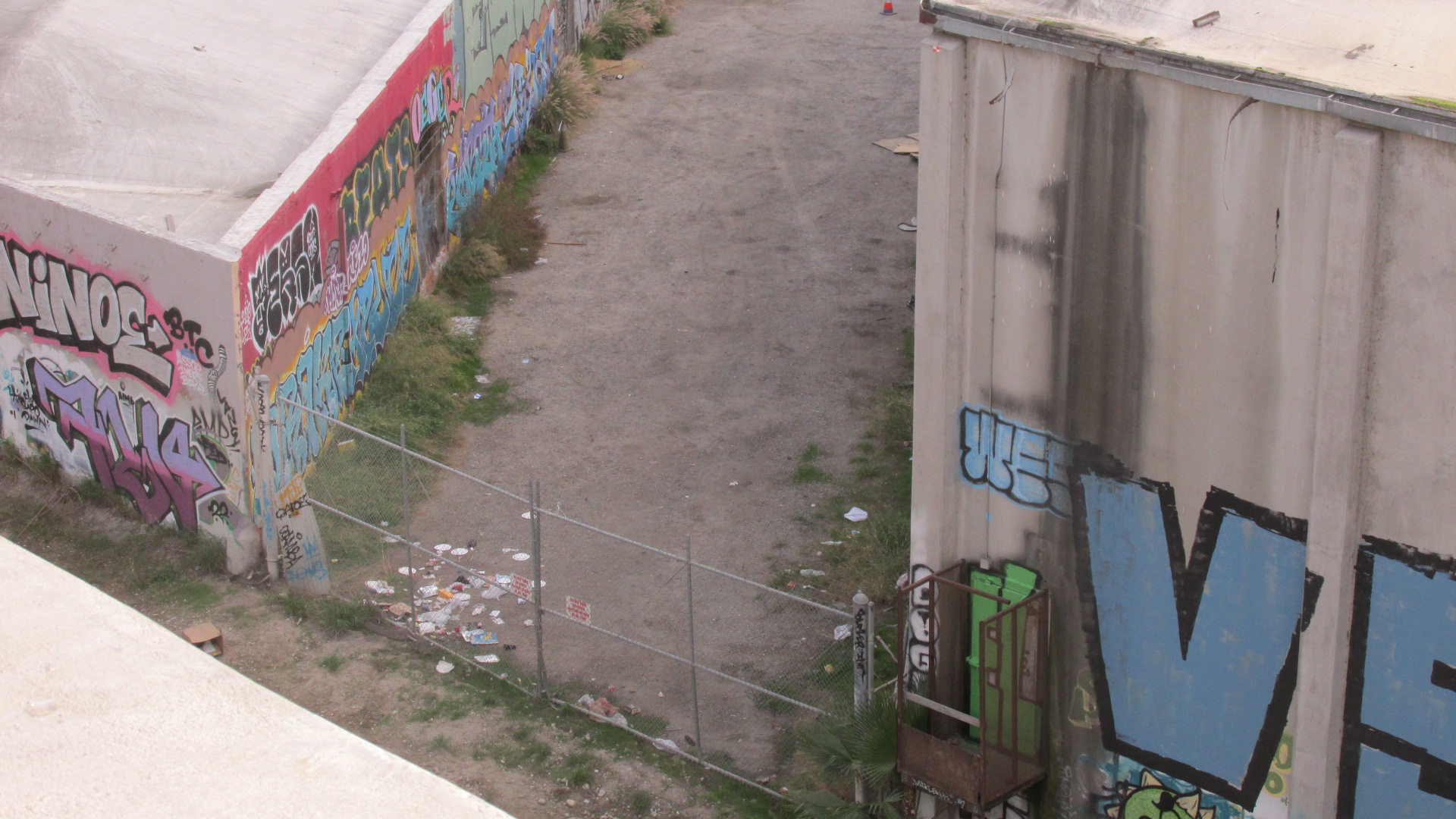
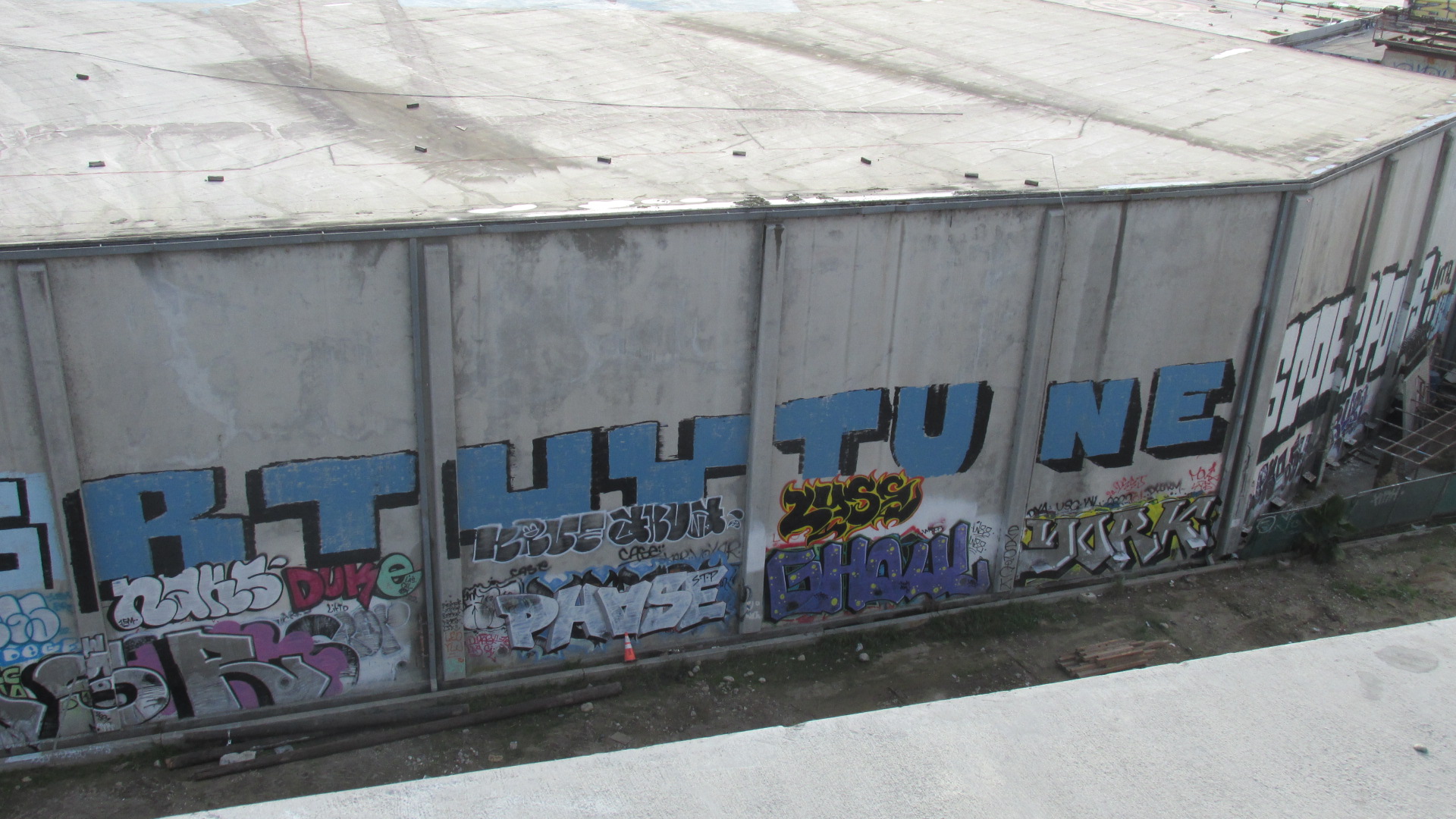
Nestled inside this vast maze of commercial buildings you’ll often come across pockets that seem neglected or deserted. These spaces are a magnet for street artists that love the expansive, windowless exterior walls.
The desolate spaces between these buildings draw street artists……who love the wide, windowless exteriors.
Coming down on the other side of the bridge, Sixth Street becomes Whittier Boulevard, which is lined with shops and restaurants serving the working class community of Boyle Heights.
The bridge lands in Boyle Heights.
It will probably be a long time before we can really see the impacts caused by the new Sixth Street Bridge. There’s been lots of hype about the upside of this new LA landmark, but it’s also likely to accelerate the waves of gentrification and displacement that have been sweeping across the city. Property values have already risen in Boyle Heights, and so has the number of evictions.
Like I said, though, for the moment I’ll focus on the positive. It is a lovely bridge.
It’s hard to know where to begin. The chain of events that’s unfolded in LA over the past few days is extraordinary, but maybe it’s just the logical outcome of the way this city has been run for the past several years. Honestly, while it’s surprising that the recording of three councilmembers talking about redistricting has been leaked, there’s really nothing surprising about the discussion. Anybody who’s been following LA City politics over the last decade knows that Los Angeles is run by a corrupt elite that’s rigged the system. We should all be angry, but I don’t know why anyone would be surprised.
The first City Council meeting after the Times broke the story was intense. I watched it on video. The Council chambers were filled with angry people chanting and yelling. President Pro Tem Mitch O’Farrell kept trying to calm the protesters down, but they were furious and wanted to let the Council know it. The crowd finally got quiet when it was announced that Councilmember Mike Bonin was going to speak. Bonin’s son was the target of one of the numerous racist slurs that Nury Martinez utters on the recording, and Bonin was visibly upset. He gave an emotional speech condemning racism in general, and thanking all those who had reached out to support him and his family since the news broke.
It’s understandable that Bonin was shaken by the release of recording, and I don’t doubt that his speech was heartfelt. He loves his son, and he knows that this episode will likely cause his son to feel pain and anger. But I wish Bonin would acknowledge all the pain that he’s inflicted on low-income people of color during his time in office. When public comment began, I wasn’t surprised to hear one of the speakers accuse Bonin of hypocrisy because of his actions as a member of the City Council. Referring to Bonin, the speaker exclaimed, “The one that’s pointin’ the finger has done the most name callin’. Put us off Venice Beach. All the black people. He put us all off Venice Beach for some real estate. Fuck you, Mike Bonin.”
Now, I’ve never heard Mike Bonin use any racial slurs, but there’s no doubt that Venice has grown a lot wealthier and whiter during his two terms on the City Council. (Bonin didn’t start this trend, but he’s done nothing to stop it, either.) And Bonin has taken plenty of campaign cash from developers and lobbyists during that time. While Bonin may talk about ending racism and creating a just society, he’s voted over and over again, along with the rest of the City Council, to support policies and projects that promote displacement and gentrification.
Former Councilmember Jose Huizar is facing trial on corruption charges, in part because he helped a developer reduce the amount of affordable housing required for the 520 Mateo project in Downtown. Did Mike Bonin object to reducing the affordable housing requirement? Hell no. He voted to approve the project.
Interestingly, many of the biggest residential projects recently approved in Downtown have zero affordable housing, and the developers of these projects are often allowed to skip paying the Affordable Housing Linkage Fee. Other residential projects in LA have to provide affordable units to get increased density, but in Downtown they can get more density by asking for a Transfer of Floor Area Rights. Has Bonin spoken out against developers using this loophole to dodge affordable housing requirements? Hell no. He voted to approve these projects just like the rest of his colleagues on the Council.
When a property owner wanted to demolish 40 rent-stabilized units in Hollywood to make way for a new hotel, did Mike Bonin object to the eviction of low-income families in the middle of a housing crisis? Hell no. He voted to approve the project. Mike Bonin has joined his fellow councilmembers over and over again in awarding zone changes and general plan amendments to developers, delivering huge profits for investors and fomenting real estate speculation while thousands of low-income people of color were kicked out of their homes and LA’s homeless crisis spiralled out of control. During his time on the Council, Mike Bonin has presented himself as a progressive who wants to fight injustice, but if he really wants to learn about the root causes of injustice, maybe he should take a look in the mirror.
The other speaker who caught my attention was Damien Goodmon, of Downtown Crenshaw Rising. Damien’s comments at the meeting were thoughtful and incisive, as usual, but one thing he said rang especially true for me….
“This entire city government is in need of an exorcism.”
That sentence really sums up how I feel about City Hall right now. The environment created by the Mayor and the City Council is so toxic, and the poison has also bled into the City departments and boards and commissions that are supposed to be serving the people.
Instead of real planning to confront the challenges that LA faces, we get plans formulated by lobbyists and land use attorneys that seemed designed to enrich their clients. Instead of meaningful debate on the issues by well-informed public servants, we get cheerleaders who pat each other on the back for doing a great job, no matter how bad the outcomes are.
Damien is right. LA City government needs an exorcism. But holy water and Latin chants aren’t going to do the job. Instead, we, the people, are going to have to take action. This isn’t just a matter of electing a new mayor and a few new councilmembers. This is a matter of changing the deeply corrupt culture at City Hall. We need to pay attention to what they’re doing. We need to call them out when they’re serving themselves instead of the people. We need to show them that there are consequences for their actions, whether that’s at the ballot box or in the courts.
And this isn’t a short-term commitment. This will take much more than a year or two. This is about long-term, concerted activism with the goal of making sure our public servants really serve us.
The pandemic wasn’t really over in April, but a lot of people, including me, were tired of being shut up at home. I wanted to get out into the world again. I’d been thinking for a while about paying a visit to Los Angeles State Historic Park on the outskirts of Downtown. I finally just got on the train and headed down there.
The park has been a work in progress for over a decade. I wrote a post about it in 2014, when many people still called it The Cornfield. Back then it was mostly just grass and dirt. Since then, it’s been transformed into a well-manicured open space….
It certainly seems popular. On the day I showed up there were plenty of folks enjoying the park, and it’s not hard to see why. It’s impeccably landscaped, with gently curving paths winding through the grass, and rows of beautiful trees. There’s a good-sized field for those who want to get a game going. It seemed like the crowd was mostly younger, with a number of moms and dads and little kids.
It also seemed like the crowd was mostly made up of relatively affluent millennials. I have no hard data on where they came from, but I suspect that many of them live in Downtown. If that’s the case, they’d have to be making fairly good money. The listings on Apartment.com show that most of the studio apartments in the 90012 zip code start around $2,000, with one-bedrooms going for between $2,500 and $3,000. Rents at the Llewellyn, a fairly new building just across the street from the park, go from $2,450 to $5,155.
The City has had a good deal of success in luring people to Downtown, but let’s face it. Downtown is not open to everybody. If we go with the standard assumption that you’re supposed to spend about a third of your income on housing, you’d need to make $72,000 a year to afford a studio apartment in the area. A small family would probably have to have a combined income close to six figures just to get into a one-bedroom.
Back in March, I was listening in on a meeting of the City Council’s PLUM Committee where Director of Planning Vince Bertoni boasted about how proud he was of the City of LA’s Transit-Oriented Development program. I can’t imagine why. While City Planning has approved numerous residential skyscrapers near transit stops over the last decade, transit ridership has been declining steadily since 2014. Even in 2014, LA Metro was actually serving fewer people than it did back in the 80s, and it’s only been downhill since then.
If you want to know how successful LA’s attempts at Transit-Oriented Development have been, take a look at the parking area next to the State Historic Park. It was packed with cars on the morning I was there. And Spring St., which is on the park’s perimeter, was also lined with cars.
Please note in the last photo above that the L Line (Gold Line) Station is visible in the background. I’m sure some of the folks who showed up at the park that day rode the train, but obviously a lot of people decided to drive instead, in spite of the fact that the station is just a few hundred feet from the park entrance.
LA City Planning talks a lot about revitalizing LA’s urban centers, but we need to ask what they actually mean by “revitalization”. The cost of renting an apartment Downtown makes it clear that living there is mostly for the affluent. While thousands of new units have been built in Downtown over the past decade, the vast majority of them are for the upscale crowd. The same is true citywide. According to LA City Planning’s Housing Progress Dashboard, of the more than 184,000 new units that have been approved since July 2013, only about 26,000, or 14%, have been for middle-income, low-income and very low-income households. To be clear, these three categories COMBINED make up just 14% of the new housing approved.
As I said before, the City has been successful in luring people to live in Downtown, and I’m glad of that. Looking at US Census data for the 90012 zip code, which covers much of central Downtown, it’s clear that the area has seen substantial growth. According to the American Community Survey (ACS), the population in 90012 has grown from 29,298 in 2011 to 37,268 in 2020.
Unfortunately, even as Downtown’s population has grown, ridership on transit lines serving the area has been dropping steadily. The graph below shows the changes in ridership on lines serving Downtown in 2014 and 2019. It includes all rail lines serving the area, but only selected bus lines.
You can see there’s been a significant drop. It’s important to point out that the biggest decline was on the A Line (Blue Line), and much of this was due to the fact that portions of the line were closed during 2019 for repairs and upgrades. (They didn’t do much good. Problems arose soon after the line re-opened.)
But even if we pull the A Line out of the chart, we still see a loss in ridership. If the City’s Transit-Oriented Development program is such a success, then why is transit ridership declining in Downtown, even as the population grows. (If you don’t trust my numbers, and you want to do your own research, visit Metro Ridership Stats. Under the heading Systemwide (Bus and Rail), click Details.)
I think the answer has to do with the kind of people who are moving to Downtown. While I hear a lot of hype about young urbanites who love walkable neighborhoods, the crush of cars I saw crowding around State Park leads me to believe that many of Downtown’s new residents own some kind of vehicle. Of course, that’s just my personal view based on my personal experience. To get a more accurate idea of how many Downtown residents are car owners, let’s take another look at the U.S. Census’ American Community Survey.
Looking again at the 90012 zip code, let’s check out the stats for vehicle ownership in 2011.
2011 ACS Data on Vehicles Available to Population in 90012 Workers 16 Years and Over in Households
No vehicle available 10%
1 vehicle available 42.9%
2 vehicles available 36.4%
3 or more vehicles available 10.7%
Now let’s look at the stats for 90012 in 2020.
2020 ACS Data on Vehicles Available to Population in 90012 Workers 16 Years and Over in Households
No vehicles available 6.6%
1 vehicle available 42.4%
2 vehicles available 40.0%
3 or more vehicles available 11.0%
You can see that the number of workers 16 years and over with no vehicle available dropped from 10% to 6.6%. The number with one vehicle available is basically unchanged. Those with two vehicles available went up from 36.4% to 40%. These are not huge changes, but they do show that percentages of workers 16 years and over with access to a vehicle has gone up, not down. And when we consider that the population in 90012 rose from 29,298 in 2011 to 37,268 in 2020, this seems to indicate that there are a lot more cars than there used to be in Downtown. Put this together with the drop in transit ridership, and it’s hard to understand why the City thinks its efforts at Transit-Oriented Development have been a success. (If you believe there are a lot more people walking and biking in the central city, feel free to show me the data. I’ve looked, and I can’t find anything less than six years old.)
I want to emphasize that I’m a transit rider and I don’t own a car. I also want to say that I believe we need to focus new development around transit hubs, in areas where jobs and businesses are close by. In theory all this is great. In reality, though, the City of LA doesn’t seem to have achieved anything. In fact, it seems like the numbers are going in the wrong direction. And if we’re going in the wrong direction, shouldn’t the City assess the situation, find out what’s wrong, and try to do better?
Unfortunately, rather than being used as a strategy to create a more sustainable city, Transit-Oriented Development seems to have become an excuse to approve residential projects that are far too expensive for the average Angeleno. I can’t tell you how many times I’ve been at hearings held by City Planning where staff and/or Commissioners claim that big, new residential projects geared toward the affluent are exactly what the City needs to get people out of cars and onto busses and trains. When I present data showing that transit ridership has been going down since 2014, they don’t seem to hear. I’ve never gotten a response. The projects are always approved.
I think the State Park is cool. I’m glad people are spending time there. But I don’t buy the story that young urbanites are ditching their cars for busses, trains and bikes. The cars lined up across the street from the park seem to tell a different story, one that City Hall doesn’t want to hear.
The Sixth Street Bridge’s arches rising above the surrounding landscape.
Work on the new Sixth Street Bridge is still moving along. Originally scheduled for completion in 2019, it’s now supposed to be finished by summer of 2022. This shouldn’t surprise anyone who follows the progress of large infrastructure projects. It’s also no surprise that the cost of the project has risen from $420 million to $588 million. But even though repeated delays and cost overruns are fairly common with projects of this kind, it seems like LA is especially prone to these problems. (I guess it could be worse. Just take a look at the California High Speed Rail.)
LA River running beneath the Sixth Street Bridge.
When the bridge is done, there are plans to create a 12-acre park within the bed of the LA River, with public art and recreational programs. I hate to be cynical, but it will be interesting to see what actually materializes. While the FTA and CalTrans are helping with funds for the construction of the bridge, I don’t know if they’re also kicking in for the park. I mention this because the LA Recreation & Parks Department is chronically underfunded, and can’t even maintain existing parks. I’m also concerned because it seems some of the features that were supposed to be included in the new bridge have been cut. The original design had protected bike lanes. Apparently those are gone. And I’ve seen some chatter on-line about the removal of the stairs that would have connected the bridge to the park, but I haven’t been able to find any confirmation.
Downtown side of the bridge.
But the biggest cause for concern is that the completion of the bridge will bring further gentrification and displacement on the east side of the LA River. Many residents of Boyle Heights and surrounding communities are worried that the Sixth Street Bridge will bring another wave of real estate investors looking to cash in. The eviction of the seniors at Sakura Gardens is not a good sign.
Many people are excited about the new Sixth Street Bridge and its promised benefits. I hope their optimism is justified. When I first heard about the project years ago, I was excited, too. I have to say that now my hopes are outweighed by a deep cynicism. The City of LA’s leaders have been promising a more livable, equitable city for years. Instead it seems that the population is increasingly divided and increasingly desperate. Bridges are supposed to bring people together, but I’m worried that this one will end up driving people apart.