High-Rise Cynicism

Eric Garcetti's vision for the future of Los Angeles

Eric Garcetti’s vision for the future of Los Angeles

It should come as no surprise to anyone that last week a judge ruled that the Hollywood Community Plan Update (HCPU) was fatally flawed. From the beginning, the plan was basically a tool to overrule those who want responsible, sustainable growth and give carte blanche to developers. It would have allowed the construction of skyscrapers fifty stories high, without any serious consideration given to how such high-density development would affect traffic, infrastructure and emergency services. The Hollywood Chamber of Commerce seems to believe that Hollywood should become a west coast version of Las Vegas, with massive high-rises filled with luxury condos and trendy clubs on every corner. Sadly, rather than choosing to protect the interests of local residents, the Mayor and the City Council jumped on board to promote this destructive plan.

Fortunately, they ran into a judge that actually expected the city to comply with state law. LA County Superior Court Judge Allan J. Goodman said that,

….forging ahead in the processing of the HCPU, EIR and related documents in this case based on fundamentally flawed factual premises has resulted in a failure to proceed in the manner required by law.

The biggest problem was that the plan was based on a population estimate that was obviously wrong. In preparing the Environmental Impact Report for the HCPU, the City claimed that approximately 224,426 people lived in the Hollywood area. They got this number, an estimate, from the Southern California Association of Governments (SCAG). Using this figure, the City argued that Hollywood was growing and would continue to grow, meaning that high-density development was the only solution.

But the judge points out that the city didn’t produce any documentation from SCAG to support this figure. On the other hand, the groups fighting the HCPU took a look at the US Census, which says that in 2010 Hollywood’s population was actually about 198,228. Hollywood has actually lost over 12,000 residents since 2000. While the Census info wasn’t available when the Draft EIR was originally prepared, it was available before the City Council voted to approve the plan. But they weren’t going to let the facts stand in their way. The City also insisted that Hollywood was going to experience substantial growth over the next twenty years, but in fact growth has slowed considerably in Los Angeles, and right now there’s no reason to expect that will change in the near future.

Community groups were alarmed at the problems with the plan, and asked the City to revise it. The City refused, and voted to adopt the HCPU in spite of strong opposition by many Hollywood residents, leading the judge to conclude,

The evidence in this record strongly supports petitioners’ contention that there has been an insufficiently-reasoned rush to completion of the EIR process, and that the process was administered in a way that is clearly contrary to well-established laws as interpreted by the appellate courts.

It’s not surprising to see developers running high-pressure campaigns to push their projects through. That’s what they do. But our elected officials are supposed to be protecting our interests. They’re supposed to be serving us. Instead, Garcetti and the City Council approved a plan that they knew was seriously flawed from the beginning. They knew the population figures were wrong. They knew the plan didn’t adequately consider alternatives. They knew there were serious questions about infrastructure and emergency services. They knew the plan didn’t follow state law. Then, as if to prove how completely cynical they are, to show us how little they care about serving the citizens, they spend our tax dollars fighting to ram the HCPU down our throats, when they knew it should never have been approved in the first place.

No wonder voter turnout is so low in LA. It’s easy to see that our elected officials have complete contempt for us.

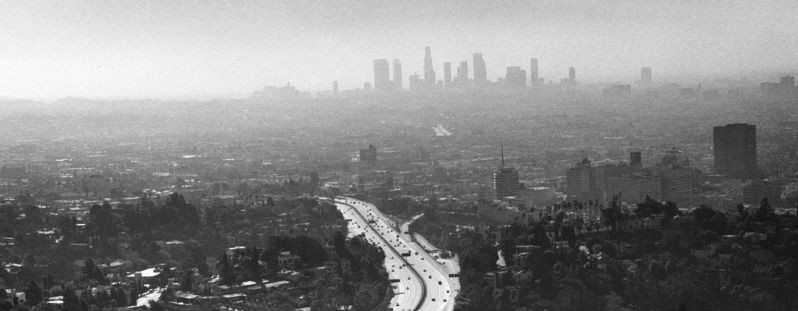
The image above is from Bladerunner, directed by Ridley Scott, photographed by Jordan Cronenweth, production design by Lawrence Paull, art direction by David Snyder.

A New “Urban Village” at Jordan Downs?

Los Angeles really needs affordable housing. The problem is, developers would rather build high-end housing for the rich because they can make a lot more money. Scads of luxury apartments and luxury condos are being constructed these days, but this really isn’t helping the average angeleno who needs a place to live.

The people who live in the Jordan Downs complex in Watts have been struggling for years. The area needs development badly, but it’s hard to lure investment to a community that’s been plagued by poverty and crime. And you don’t want a developer to go in and demolish the existing housing without giving the current residents an alternative.

So what do you do? Well, in August the LA City Council approved an interesting project. The idea is to build an “urban village” that would combine affordable housing with market rate housing, in other words to create an economically diverse community. The existing seven hundred units would be demolished and eighteen hundred new units would be constructed. The other component of the project is a large retail complex, which would provide jobs and access to stores.

If it works, this project could mark a turnaround for the neighborhood. But some residents and community activists fear that rather than create a diverse community, the result will be gentrification and the families who currently live in the area will be forced out. In the Times article I read, it says,

Officials have promised that the 2,300 Jordan Downs residents “in good standing” can stay in their old units until they move into new ones.

My assumption is that the new units will be rented to the residents at the same price as their old ones. This is an important factor, since any significant increase in their rent could force low-income families out of the new complex.

The idea of creating a mixed income neighborhood is worth pursuing. One of the problems in LA (and other cities) is that there’s an increasing schism between the rich and the poor. It used to be that whites who could afford to live in the suburbs left the city taking their money with them. Now we see more people choosing to live in the city, but this has resulted in the creation of wealthy enclaves in urban areas. Mayor Garcetti and the City Council have been encouraging this trend by catering mostly to developers who want to construct high-end housing for the wealthy. We need to build communities where everyone is welcome, not just the upper class.

Here’s the article that the Times ran back in August when the City Council granted its approval.

City Gives OK to “Urban Village” from LA Times, 8/14/13

Funding for this project isn’t in place yet, so it may not even happen. And even if it does happen, there’s no guarantee it will work. But it is encouraging to see the City of LA promoting a plan that could bring people together, instead of creating islands for the wealthy amid oceans of the poor.

Brake Lights at Midnight

I wanted to follow up on my earlier post about two proposed projects, one at Highland and Selma and the other at Highland and Franklin. Together these developments will bring over four hundred new residential units to an already crowded corridor. But the problem isn’t just on Highland. As anybody who lives in the area knows, traffic on Franklin is also pretty damn bad. Highland is a major thoroughfare that is primarily commercial north of Melrose. From Highland to Cahuenga, Franklin is completely residential, and has only one lane running in each direction.

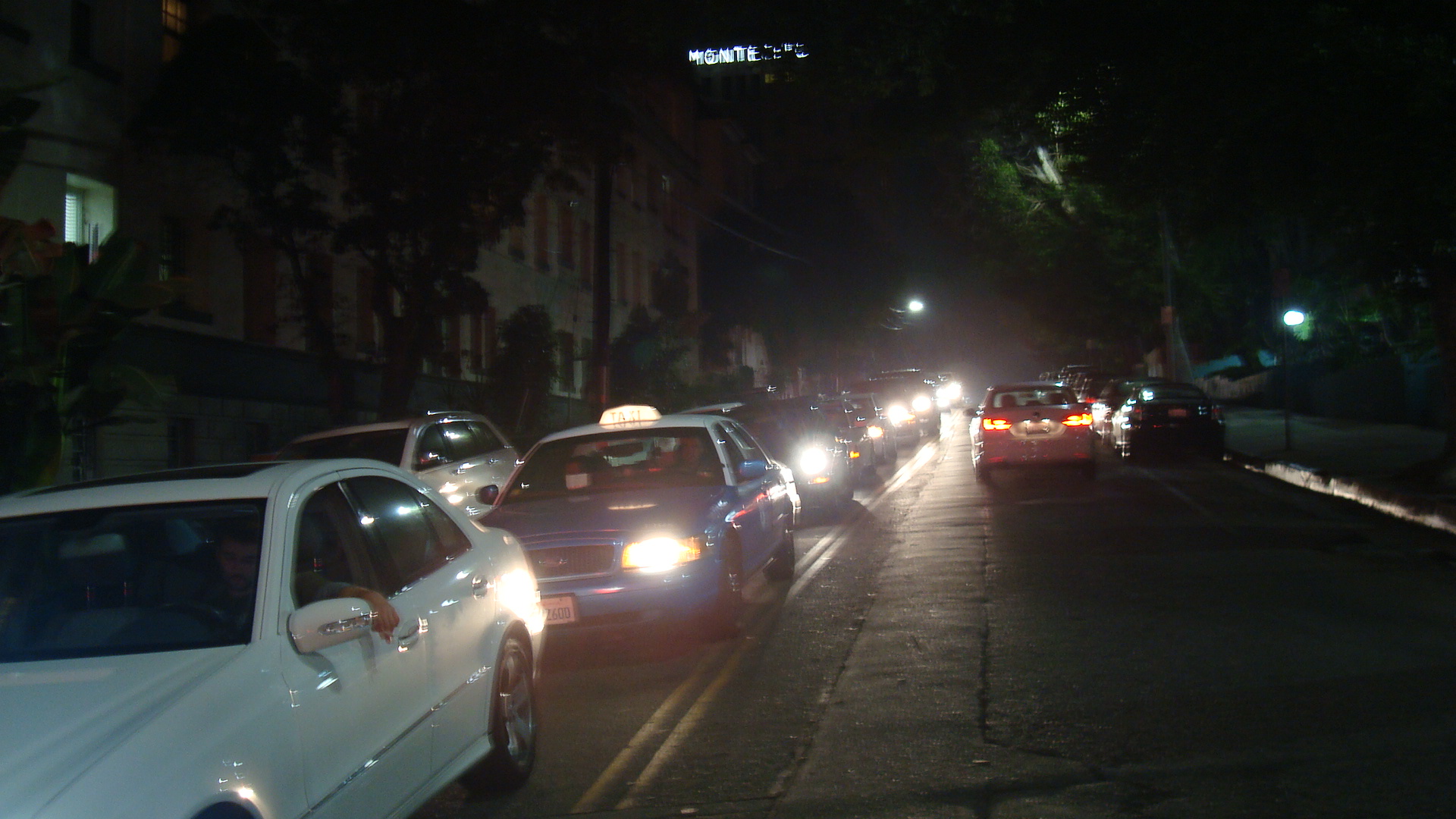
Twenty years ago, this was not a problem. These days, though, Franklin is carrying much more traffic than it was designed for. In an earlier post (Hell on Highland, October 25), I talked about the night Katy Perry played the Hollywood Bowl, and traffic was backed up all the way to the freeway. That’s by far the worst I’ve even seen on Franklin. But check out these photos of a couple other traffic jams I witnessed lately. These were both taken at the intersection of Franklin and Whitley….

DSC02737

The photo above shows traffic heading toward Cahuenga. And this next one…

DSC02738

…shows traffic coming from the direction of Highland. Locals looking at these pictures are probably saying, Big deal. It’s always like that at rush hour. But these weren’t taken at rush hour. These were taken around twelve thirty am. A car had stalled near Grace, and a steady flow of westbound traffic kept drivers from getting around it.

Now check these out.

DSC02764

This was taken just before eight o’ clock on a Saturday morning as I was coming up on Whitley. And this next one…

DSC02771

…was taken as I was approaching Las Palmas. Pretty nasty for a Saturday morning. Now in this case, one of the left turn lanes at Highland was closed. Not sure why, but it may have had something to do with the fact that Hollywood was closed at Highland that morning.

Now in all three cases I’ve mentioned, there are unusual circumstances that caused the back-up. A concert at the Bowl, a stalled car, a closed lane. But it shows that it doesn’t take much to turn this residential street into a sea of brake lights. Franklin is already carrying way beyond the capacity it was designed for. It amazes me not only that the city wants to add to the congestion, but that they have determined that the two new complexes mentioned above will have no significant negative impacts.

Again, if you disagree with the city’s finding, if you think Franklin is maxed out as it is, please let the City Council know how you feel.

LA City Council

Trading Trees for Astroturf

The hillside opposite Harvard Westlake school that will be removed if their planned project goes forward.

The hillside opposite Harvard Westlake school that will be removed if their planned project goes forward.

Isn’t traffic on Coldwater Canyon bad enough already? Because of LA’s unusual geography, there are only a few corridors that drivers can use to go from the city to the valley and vice-versa. Coldwater is one of those roads. Originally a quiet ride through a scenic canyon, in the last few decades Coldwater has become a major route for commuters going to and from work. Under ordinary circumstances, congestion is a problem during the work week. But for several months now the back-ups have been worse than usual because the DWP has been replacing an aging pipeline. Residents of Sherman Oaks and Studio City are understandably frustrated.

Now the Harvard Westlake School, which is located on Coldwater just a few hundred yards from Ventura Blvd., has decided it wants to expand. They have let the community know that they plan to build a three level parking structure on the hillside directly opposite the school. On top of the parking structure will be a playing field, illuminated by powerful lights during night games, and a pedestrian bridge to connect that structure to the school’s main campus.

As you might imagine, local residents are freaking out. Traffic is one concern, but just as important is the damage this project will do to the environment. In order to build the parking structure, the school will have to remove a large chunk of the hillside, including scores of trees. If you want more detailed information, follow the link below.

Save Coldwater Canyon

At this point the Draft Environmental Impact Report is being circulated. The City of LA will be accepting comments on the DEIR until Nomember twenty fifth. Also, the Studio City Neighborhood Council will be meeting on November seventh, and they will hear comments from the public at that time. But I would imagine that there are a number of people who live outside of the immediate area that might be concerned about the traffic and environmental impacts. If you think this plan is unacceptable, please contact your city council rep and tell them so. Click on the link to access the city council directory.

LA City Council

Traffic on Coldwater Canyon heading towards Ventura Blvd., just after six pm on a Wednesday evening.

Traffic on Coldwater Canyon heading towards Ventura Blvd., just after six pm on a Wednesday evening.

Hell on Highland

An image from Jean-Luc Godard's "Weekend". Frustrated drivers, stuck in an endless traffic jam,  start attacking each other.

An image from Jean-Luc Godard’s “Weekend”. Frustrated drivers, stuck in an endless traffic jam,
start attacking each other.

I wish I’d had a camera with me last night. I got off the Red Line in Hollywood around seven, and started walking north on Highland. The northbound traffic was backed up and moving slowly, but that’s not unusual. Then I got to Franklin and saw that westbound traffic was backed up there, too. That’s when I realized something was probably going on at the Bowl. (Later I learned it was a Katy Perry concert.) Again, this is nothing out of the ordinary. As the Bowl continues to schedule more off-season events, the horrible congestion that used to be confined to summer is becoming a year-round phenomenon.

But then I got to Wilcox, and I saw that the westbound traffic on Franklin was backed up all the way to freeway. I’ve seen congestion on Franklin before, but never this bad. This was also affecting the traffic on Wilcox, which was backed up as far south as I could see.

Now, I’m not bringing this up just to whine about traffic. The reason this spectacle freaked me out is because it seems like a vision of things to come. Anyone who lives in Hollywood knows how bad the traffic is already, but the City of LA continues to approve massive projects, often over the vocal objections of Hollywood residents. Just days ago I learned about two new residential complexes that are slated to be built on Highland, in this same area. Right at the corner of Highland and Franklin, a developer plans to build a residential complex with over a hundred units. And at Highland and Selma, just about a half mile away, the plan is to build a residential/retail complex with over three hundred units.

The fact that these two projects will make traffic on Highland even worse is probably obvious to everyone, except the people in the Department of City Planning. They are pushing these two projects forward using Mitigated Negative Declarations (MNDs), which means they have determined that building over four hundred new units within a half mile of each other in an already congested corridor will have no significant negative impacts. Remember, the recently completed Jefferson, at Highland and Yucca, contains two hundred and seventy units. And on La Brea there are a number of projects already under construction which will total over a thousand new units. Much of the traffic generated by these projects will be travelling through the Highland/Cahuenga corridor.

Is the City Council ever going to stop this insanity?! Not unless local residents apply a lot of pressure. If you live in Hollywood, and if you think the traffic is bad enough already, please call your City Council representative. It should be either Tom LaBonge or Mitch O’Farrell, but check the maps to make sure. The boundaries are tricky. Here’s the link….

LA City Council Directory

By the way, last night I stopped to have a cup of coffee at a place on the corner of Franklin and Cahuenga. When I left about a half hour later, the westbound traffic on Franklin was still backed up to the freeway.

Gentrifying Hollywood

Hollywood used to be for everybody.  Not so in recent years.  Around the time we slid into the new millennium, real estate agents and developers started paying a lot of attention to the area.  It used to be a place where people without a lot of money, musicians, artists, immigrants, students, could find a cheap apartment.  But for the past ten years or so rents have been rising steadily.  And the new units that have been built are geared towards people with money. There was a break in the cycle when the stock market crashed, but now it’s picking up again.

In short, the powers that be want to turn Hollywood into a gentrified enclave like Santa Monica.  The City Council and the Hollywood Chamber of Commerce are trying to transform the area into an upscale haven for club-hopping hipsters.    Anyone who makes less than fifty thousand a year is no longer welcome.

The LA Weekly recently ran an article on this trend.  I do feel the title, “Hollywood’s Urban Cleansing”, is too extreme, but the story does a good job of laying out what the politicians and the developers are doing to the area.  The link is below.

http://www.laweekly.com/2013-01-03/news/hollywood-latino-population-drop-12878-diaspora-gentrification/

Millennium Hollywood Project

One of the things that motivated me to start this blog is the proposed Millennium Hollywood Project.  As a resident of Hollywood, I’m really concerned about this for a number of reasons.  While I support responsible, sustainable development, neither one of those adjectives can be applied to the project in its current form.  My main gripe is that two huge, high-rise towers will be erected next to the Capitol Records building.  My objections are based in part on aesthetics, since if the project is built these towers would completely overwhelm this Hollywood icon.  But the biggest problem with this project is that it will make traffic much worse.

The City of LA has been pursuing a policy of building high-density residential projects near transit centers.  In theory this sounds like good planning, and I used to support the idea.  But there have been a number of large residential projects built in Hollywood over the past several years, most of them less than a block away from subway stations, and traffic has only gotten worse.  The concept of having people live next to a subway so they won’t need to use their car sounds good, but the reality is that most Angelenos still take their cars most of the time.  The Millennium Hollywood Project will only make traffic worse, and the proposed mitigations are not sufficient.

I’ll write more later, but if you’re interested in finding out more about the project, here’s a link to an article that includes renderings of the finished development.

http://www.archdaily.com/290508/las-millennium-hollywood-project/