No surprise that after a major disaster like LA’s fires there are a lot of people playing the blame game. Politicians are pointing fingers, TV personalities are airing their theories and social media is abuzz with angry people who have suddenly become experts on firefighting.
If you’d like to hear a real scientist give fact-based information about the circumstances that led to these fires, I urge you to listen to this interview where Adam Conover talks to climate scientist Daniel Swain. Swain works at the UCLA Institute of the Environment and Sustainability, and aside from his climate expertise, he has a deep understanding of the tactics firefighters use when faced with conflagrations like what we saw in Altadena and Palisades.
The interview last about 90 minutes, but it’s well worth the time. Swain talks about the limited options firefighters actually have when fighting wind-driven fires on this scale. More importantly, he explains the role climate change played in creating the conditions that led to these holocausts.
As we should know by now, there are numerous areas in LA that are prone to fires. Many of these areas have burned repeatedly, because fire is a natural part of the ecology. As climate change continues to alter weather patterns, and LA continues to grow hotter and drier, we should expect more frequent and more intense fires.
Map of current fires in LA area from Cal Fire, as of January 12, 2025
If you’re looking for updates on the fires in LA, this post won’t offer anything you haven’t heard already. The LA Times, Daily News, and local news stations have been doing an excellent job reporting on the situation. I’m writing this post because I want to talk about what comes next. While the fires are still burning, and may continue to burn through next week, we do need to start talking about the future of LA. And I think the best way to start talking about the future is to begin with the past….
The City of LA was built on real estate speculation. To some degree, this is true of most cities, but it’s especially true of Los Angeles. Writers have commented on the fact that this area lacks a number of the things that are generally the basis for large scale development, most fundamentally a reliable source of water. Nor did the City of LA initially have a port, and only gained one by annexing San Pedro in 1909. That area is only tenuously connected to the rest of the city by a narrow, 20-mile corridor that’s basically just a rail line.
LA did have oil. Drilling began in the 19th century, and in the early 20th century large sections of the city, including Downtown, were covered with oil wells. But real estate investors saw huge amounts of money to be made by residential and commercial development, and gradually most oil wells were either shut down or hidden. (The majority of wells that are still visible are located in the southern part of LA, and the low-income communities that are impacted don’t have the political clout to shut them down.) The real estate investors promoted Los Angeles aggressively, putting ads in newspapers nationwide, essentially selling the climate. LA had lots of sun and little rain. People came, but the investors knew that to sustain new development they’d need to bring more water to the area. The LA Aqueduct was completed in 1913, after business interests used dishonest means to buy up the rights to the Owens Valley’s water resources. As the city continued to grow, LA snagged more water from the Colorado River with the construction of Hoover Dam during the Depression. Then came the construction of the California State Water Project, which extended from the 50s through the 70s. The bottom line is, the City of LA is only able to support a population of almost four million people because it imports about 90% of its water from areas that are hundreds of miles away.
I’m talking about the way LA was built because I think it’s important to understand the city’s history in talking about the fires that have devastated LA’s communities. Real estate investors built LA because there were fortunes to be made. In the first past of the 20th century, the only efforts at planning were driven by investors looking for profit. In the second half of the 20th century, there was more of an effort to plan for growth, but efforts at responsible planning were often overridden by the same investors looking for more profits. In the 21st century, there’s a lot of talk about planning at City Hall, but really most of it boils down to upzoning large swaths of the city to promote more growth. Planning in the City of LA is still largely driven by investors and their lobbyists. If you don’t believe me, please read up on the recent convictions of former Councilmember Jose Huizar, former Deputy Mayor Ray Chan and others who were caught up in a massive scandal involving bribery, fraud and racketeering. And if you think those convicted were the only ones involved, it’s important to remember that projects backed by Huizar were almost without exception unanimously approved by the LA City Council.
Image from Cal Fire Update, January 11, 2025
The point here is that development in LA is not driven by responsible planning. Development in LA is driven by money. If you want to know why projects were approved and are still being approved in fire-prone areas, follow the money. While there have been individuals who chose to build their own homes in areas where fire risk is high, most of the residential development in these areas is the result of the creation of suburban subdivisions. Even when citizens expressed concern about fire risks in these areas, they were almost always ignored by the politicians, who had often received campaign contributions from the developers. The Porter Ranch area has been repeatedly threatened by fires, but that didn’t stop the City of LA from approving The Vineyards at Porter Ranch, a recent multi-phase mixed-use project that includes apartments, a hotel and a large retail component. The project location has been designated by the LA Fire Department as a Very High Fire Hazard Severity Zone (VHFHSZ). Another example is LA City Planning Director Vince Bertoni’s approval of the initiation of a General Plan Amendment (GPA) to make way for the Bulgari Hotel, a massive luxury hotel project that was to be located in another VHFHSZ in the Santa Monica Mountains. The request for the GPA was submitted by developer representative Stacey Brenner, whose husband served as a deputy to former Councilmember Paul Koretz. The project was in Koretz’ district. The Bulgari Hotel was only stopped because area residents put intense pressure on Koretz’ successor, Councilmember Katy Yaroslavsky, who promised to stop the project during her campaign for the office.
Many of the areas that have been burned in the current spate of fires have burned repeatedly before. In the last few decades there have been multiple fires in Brentwood, Bel Air and the Hollywood Hills. Other communities like Baldwin Hills, Sunland-Tujunga and Chatsworth have all been hit by devastating fires. But, with rare exceptions, the City of LA continues to approve new development in fire prone areas.
As fires continue to rage across Los Angeles County, talk of rebuilding has already begun. I wish our elected officials would take some time to think about this. We need to have a tough conversation about rebuilding. I understand that thousands of people have lost their homes, and their dearest wish would be to rebuild and return to their communities. If individuals have the resources to do this, and if they understand the risks, they should be able to make that choice. But with the death toll from the current fires at 16, and damages worth billions of dollars, our elected officials should think long and hard about pushing for large scale development in fire prone areas. In most of these areas, the question is not whether they’ll burn again but when they’ll burn again. The LA area has always been prone to fires. As climate change continues to make the region drier and warmer, the risks will only increase. And while our firefighters can work miracles when conditions are favorable, we’re now seeing a brutal demonstration of how hard it is to control wind-driven fires.
It remains to be seen how strong the push for rebuilding will be once the fires stop. No doubt the real estate investors are already weighing their options. Some may want to bet on rebuilding. Others may think the risk is too great and decide to put their money elsewhere. But California Governor Gavin Newsom has already announced the suspension of laws that would require environmental review for rebuilding in fire prone areas. This is just crazy. After this disaster we should be insisting on stronger environmental review. The California Environmental Quality Act (CEQA) requires an assessment of whether new development will result in wildfire risks. It also requires cities to ask whether fire departments can provide adequate protection and whether the site can be safely evacuated in an emergency. Instead of brushing these issues aside, we should be insisting on careful scrutiny.
CEQA also requires review of a project’s greenhouse gas emissions (GHGs), because of the growing threat of climate change. Most Environmental Impact Reports I’ve read make no meaningful effort to accurately assess a project’s GHG impacts. Instead, the preparers rely on the State’s CalEEMod platform, which allows them to input whatever numbers they want, thereby pretty much guaranteeing that no project will ever appear to cause significant GHG impacts. In reviewing the EIRs, LA City Planning generally accepts whatever the developers claim without question. While the City of LA and the State of California claim to be fighting climate change, in reality both of them usually support new development regardless of what the GHG impacts are.
Again, I totally understand that many of those who lost homes in the fire are anxious to rebuild. If I were in their situation, I’d probably feel the same way. But LA has been repeatedly hit by deadly and devastating fires. As much as we may want to hear inspiring words about rebuilding, we need to ask: Do we want to be reliving this tragedy over and over again?
Let’s think carefully before we start to build again. And let’s demand that our elected officials do the same.
If you’ve been watching the news at all, you’ve heard about the unprecedented flooding in Pakistan. Millions have been displaced. Over 1,300 people have died. It’s hard to estimate the impact on the economy at this point, but it’s likely that much of the population will be facing extreme hardships for a long time to come.
Many of the news sources reporting on this catastrophe have quoted scientists who believe that this extreme weather event is linked to climate change. The horrible irony is that Pakistan produces only a tiny fraction of the greenhouse gas emissions that are driving climate change, and yet it’s suffering some of the worst impacts.
Who are the biggest culprits when it comes to greenhouse gas emissions? China and the US are the top two nations pouring CO2 into the atmosphere, but even though the US is second in overall emissions, its per capita emissions are about twice that of China. Within the US, California has over 14 million registered vehicles, far more than any other state, and the vast majority of them run on fossil fuels. Of that 14 million, over 7 million are registered in LA County.
So we definitely need to take some of the responsibility for the climate crisis. But we shouldn’t waste time feeling guilty. We should get to work on changing the situation. There are a number of things we can do. We can start by driving less. This could mean taking transit to work one day a week, or carpooling with a friend, or if your job allows it, working from home when it’s convenient. We can also try to minimize the amount of plastic we use. This may sound easier than it really is. Many of the products we use in daily life are made of plastic, and so much of what we buy comes wrapped in plastic. But if you start thinking about it, you can probably find at least a few items that you can do without. And if you shop on-line, it’s important to consider the way things are packaged.
But we also need to support legislation that will reduce greenhouse gas emissions. This is the hard part, because there are powerful interests targeting bills intended to curtail the use of fossil fuels. This year the Western States Petroleum Association and the California Independent Petroleum Association used their clout to either stop or weaken a series of bills that were written to address climate change. Capital and Main lays out the gory details in this article.
We shouldn’t be discouraged. We have clout, too. According to a poll by the Public Policy Institute of California, 80% of the state’s residents say that climate change is a serious threat to our economy and quality of life. That means an overwhelming majority of California voters understand the gravity of the situation. We need to let our representatives in Sacramento know that they should be listening to us, not the fossil fuel lobby. If you don’t know who your representatives are, use this link to find out.
While this blog is mostly focussed on LA, it would be foolish to think that Angelenos live in a magic bubble that isn’t affected by what’s happening in the rest of the world. (Thought we often act that way.) Crucially, we need to understand that the water shortages affecting this area aren’t just local, they’re global. In order to understand LA’s water problems, we have to look at the larger context.
This morning I read an interview with Jay Famiglietti that lays the situation out in the starkest terms. It’s a disturbing message, but one we all need to hear. Famiglietti is Executive Director of the Global Institute for Water Security at the University of Saskatchewan, and formerly lead researcher at NASA’s water science program at the Jet Propulsion Laboratory in Pasadena. He’s spent years studying the water landscape and he knows what he’s talking about.
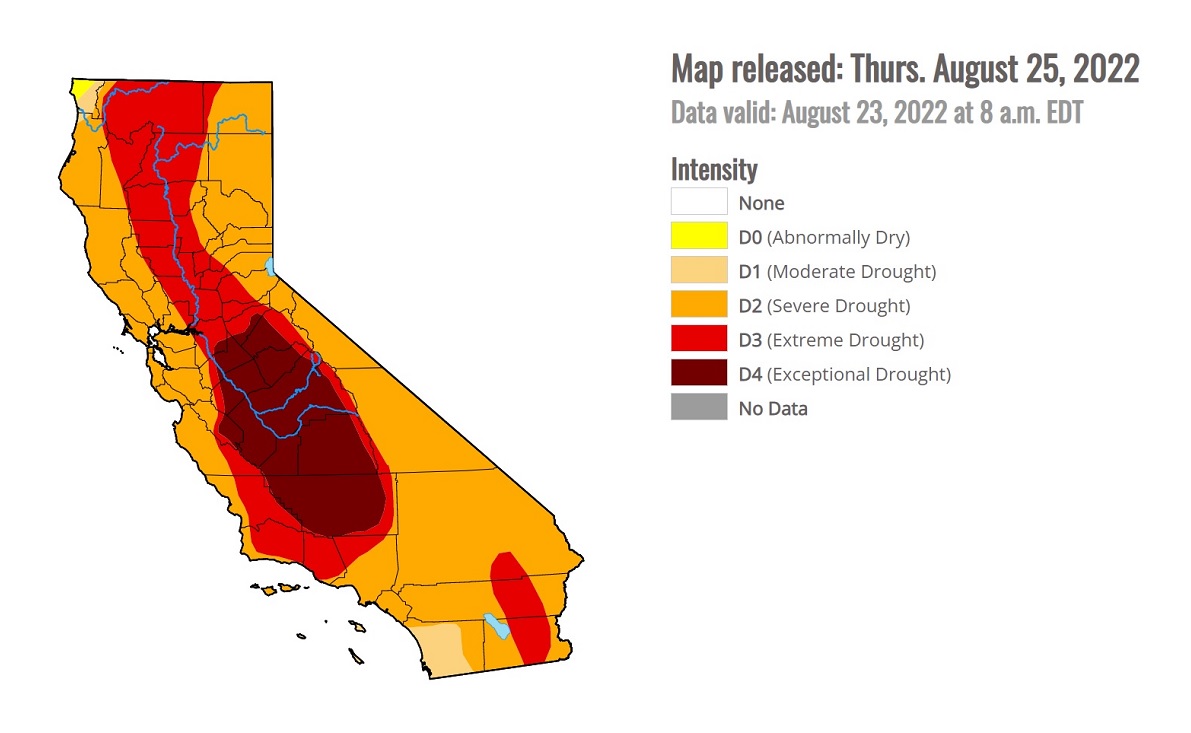
First, please take a look at the graphic above from the U.S. Drought Monitor. It shows that all of LA County is in severe or extreme drought. Looking at the rest of the state, you’ll see that almost all of California is experiencing conditions ranging from severe drought to exceptional drought. My only problem with this map is that they use the word “drought”, which doesn’t describe the situation any more. “Drought” implies we’re in a dry period, and that things will eventually go back to normal. That’s no longer true. Because of climate change, scientists agree that our fresh water resources will continue to decline for the foreseeable future. This is the new normal.
This isn’t just a problem for LA or California, this is a problem that the whole country needs to deal with. Famiglietti talks about how we need a national water policy and we need it now. We can’t afford to wait while cities and states bicker over what they can and can’t do, while lawsuits are filed and politicians posture. We need to take action as a nation now.
Famiglietti isn’t the only one saying this. Back in 2009 the Clean Water America Alliance published a paper explaining the need for a national water policy. Here’s a brief excerpt….
Each day, more and more Americans are confronting an unsettling fact of life in the 21st Century – our supplies of clean, dependable, economical water are more fragile than at any time in our recent history. Population growth, economic development, changing weather patterns, new energy supply strategies, and the needs of endangered ecosystems are threatening to overwhelm both the physical infrastructure and management systems that have previously provided for our water needs.
What have we done since then? Not much. And we can’t afford to wait. Things have gotten much worse over the last decade, and many scientists believe that climate change is accelerating.
Here’s the Famiglietti interview. Read it and weep. No, seriously, don’t weep. Take action. Contact your representatives in the House and Senate and ask them what they’re doing about creating a national water policy. If their answer isn’t good enough, keep after them.
The water situation just keeps getting more dire. A brief recap: Last August the US Bureau of Reclamation (USBR) declared a Tier 1 shortage on the Colorado River, the first time it had ever taken this step. This was not good news for Southern California, which relies heavily on water from the Colorado. Then, in March of this year, California water officials announced that they’d be cutting allocations for the State Water Project (SWP) to 5% of requested supplies. Another blow to Southern California, which also gets much of its water from the SWP.
Things got even worse today, when USBR announced the first-ever Tier 2 shortage on the Colorado River. This will not affect California immediately, since the State has senior water rights, but the way things are going it’s likely that we’ll be impacted in the next couple of years. Scientists are predicting that the Western US will continue to get hotter and drier for the foreseeable future.
The City of LA is in especially bad shape. While some cities in Southern California have significant groundwater resources, Los Angeles’ supply is relatively small. In recent years, groundwater has made up about 10% of what we use annually. We do get water from the LA Aqueduct, but that’s not as reliable as it used to be, since snowpacks in the Sierra Nevadas have continued to decline in recent years.
Recycled water? LADWP has been talking about that for years. While there are big plans to reuse more of our water, right now recycling only accounts for about 2% of our supply. It will be years before that number grows much. Then what about desalination? It’s very costly, very energy intensive, and causes significant environmental impacts. There are other experimental processes out there, but nothing we can scale up quickly to replace what we’re losing from the SWP and the Colorado.
There are no easy answers. Scientists do not see a turning point in the near future. We’re going to have to learn to live with less water. This isn’t necessarily a bad thing. Over the past few decades, the City of LA has already cut its per capita water usage by quite a bit, and there’s still more we can do. But remember, we don’t know how far this trend is going. It’s likely we could learn to live with the level of water deliveries we’re getting now, but scientists predict that our snowpacks will continue to decline and our climate will continue to get warmer. We haven’t seen the worst yet.
I have to say, the older I get, the more I question the wisdom of building a city of 4 million people in a place with such limited water resources. People talk about how Hoover Dam and the State Water Project were great accomplishments, and yeah, in a way they were. But as the water level in Hoover Dam continues to decline, as the State Water Project continues to suck the life out of the Sacramento-San Joaquin Delta, I have to wonder where this is all going.
Right now, it doesn’t look good.
Here’s an excellent breakdown of the current situation from CalMatters.
Even if you don’t pay attention to the news, you’re probably aware that Los Angeles has been unusually dry for the past few years. If you do follow the news, you may have heard that right now California’s snowpacks are well below their 20th century average. And if you really pay attention to this stuff, you probably saw the news that the past 22-year period is the driest the American West has experienced in over a millennium.
Scary stuff. And as the impacts of climate change grow more pronounced, there’s a good chance things will get even scarier. Since it doesn’t seem likely that government officials or the public at large are going to make any real progress in cutting back on fossil fuels, the weird weather we’ve been seeing for the past couple decades is likely to get a whole lot weirder.
So what can we do? Well, the first thing we should do is stop lying to ourselves about how much water we have access to. A recent study from UC Davis shows that water rights allocations to California’s water users are about five times the state’s annual runoff. In other words, we’ve promised to deliver about five times more water than we actually have.
How did this happen? Well, back in the 20th century, when everyone was convinced that California was going to keep growing forever and that we had endless supplies of everything, Federal, State and regional agencies built a ridiculous number of dams and canals to deliver lots of water to everyone who wanted it. Two decades into the 21st century, it should be clear to all of us that we can’t keep growing forever and that our resources are definitely limited.
CalMatters recently ran an excellent piece by Carolee Krieger, Executive Director of California Water Impact Network, where Krieger clearly states the most important takeaway from the UC Davis report: We have to manage our water resources based on the amount of water that’s actually available. Here’s the link to Krieger’s article.
California faces huge challenges in meeting its future water needs. The first step is to be honest about how much water we actually have. Let’s stop pretending. It’s time to get real.
FOLLOW-UP:
I want to add some additional info as a postscript to this post. I was looking at On the Public Record, a blog I follow that deals with water issues in California. (I recommend it highly.) The author wrote a post on Max Gomberg’s resignation from the State Water Resources Control Board. While the post itself is well worth reading, one of the comments raised questions about the accuracy of the UC Davis report that Carolee Krieger cites in her CalMatters post.
There are lots of comments, but I’d ask you to scroll down to those written by Waterwonk, who questions the methodology used by Theodore Grantham and Joshua Viers, the authors of the UC Davis report. According to Waterwonk, Grantham and Viers make the mistake of adding up the face value of water rights without looking at terms and conditions and overlapping rights. For instance, Waterwonk says that some users have the right to divert water, store water, and then redivert the stored water. Waterwonk asserts that Grantham and Viers added up the face value of the water in cases like this, when in fact these separate rights apply to the same water.
Waterwonk believes that Grantham and Viers got some things right, but says their claim that California has handed out water rights amounting to five times what’s actually available is grossly overstated. I don’t understand these issues well enough to judge who’s right, but I think Waterwonk makes effective arguments. I wanted to include them for those readers who are interested in digging further. Here’s the post from On the Public Record.
There are lots of comments, including from Carolee Krieger. You’ll have to scroll down a ways to find Waterwonk’s arguments.
But whether or not Grantham and Viers’ work is accurate, there’s no question that State agencies and local governments have been over-promising for decades when it comes to water. The status quo is not sustainable. We have to be more realistic about how much water is actually available.
With the State continuing to enjoy a strong surge in revenue, Gov. Gavin Newsom’s proposed budget includes substantial funds to address housing needs. Newsom wants to spend $2 billion on homelessness, and another $2 billion to address housing in general. Of course, there are those who say this still isn’t enough, and others who say Newsom’s priorities are wrong, but there are a lot of good things in his proposed budget. I’m not a Newsom fan, but I think that in some ways he’s on the right track. As usual, the devil is in the details.
One of the things Newsom wants to promote is urban infill development, in other words building dense residential housing where infrastructure already exits, as opposed to more suburban sprawl. This is nothing new. State and local politicians have been pushing this for years, and in theory it makes perfect sense. One of the main goals of this policy is to make people less reliant on cars, encouraging them to take transit instead, or to ride a bike or maybe even just walk. The overriding goal is to fight climate change by reducing greenhouse gas emissions.
So what do we do? Well, there is evidence suggesting that high-priced new development in urban centers is causing gentrification, which displaces low-income transit riders. I can tell you I’ve seen numerous instances in Hollywood where low-income tenants have been thrown out of their apartments to make way for new projects. We need to preserve existing housing that’s accessible to low-income households, and to build a lot more affordable housing. That’s why I’m glad that Newsom is setting aside $500 million for Low-Income Housing Tax Credits, and another $500 million to preserve and increase affordable housing stock. Of course, much more money is needed, since the federal government has slashed funding for affordable housing over the last several years. But the money Newsom is providing is a step in the right direction. In LA, the vast majority of transit riders live in low-income households. We need to help them remain near the transit hubs they rely on.
Another smart move Newsom has made is to earmark $100 million to support the conversion of office buildings to apartments. This makes a lot of sense, not just because more people are working from home these days, but because it helps minimize the significant environmental impacts caused both by the demolition of old buildings and the construction of new ones. As many people have said, the greenest building is the one that’s already standing.
The funding Newsom has proposed will not solve our housing problems, but it will help. That is, assuming the legislature supports his budget. This article from CalMatters offers a more detailed breakdown.
I love cities. And I love Downtown LA. But the older I get, the more I think about the damage that cities do to the environment. At the beginning of the 20th century, Downtown was largely undeveloped. In a little over a hundred years, it’s become a dense urban landscape crowded with office buildings and residential towers, crisscrossed by roads and freeways. As a result, LA is hotter and drier, the air is dirtier, and like every other urban center, we’re contributing to climate change in a big way.
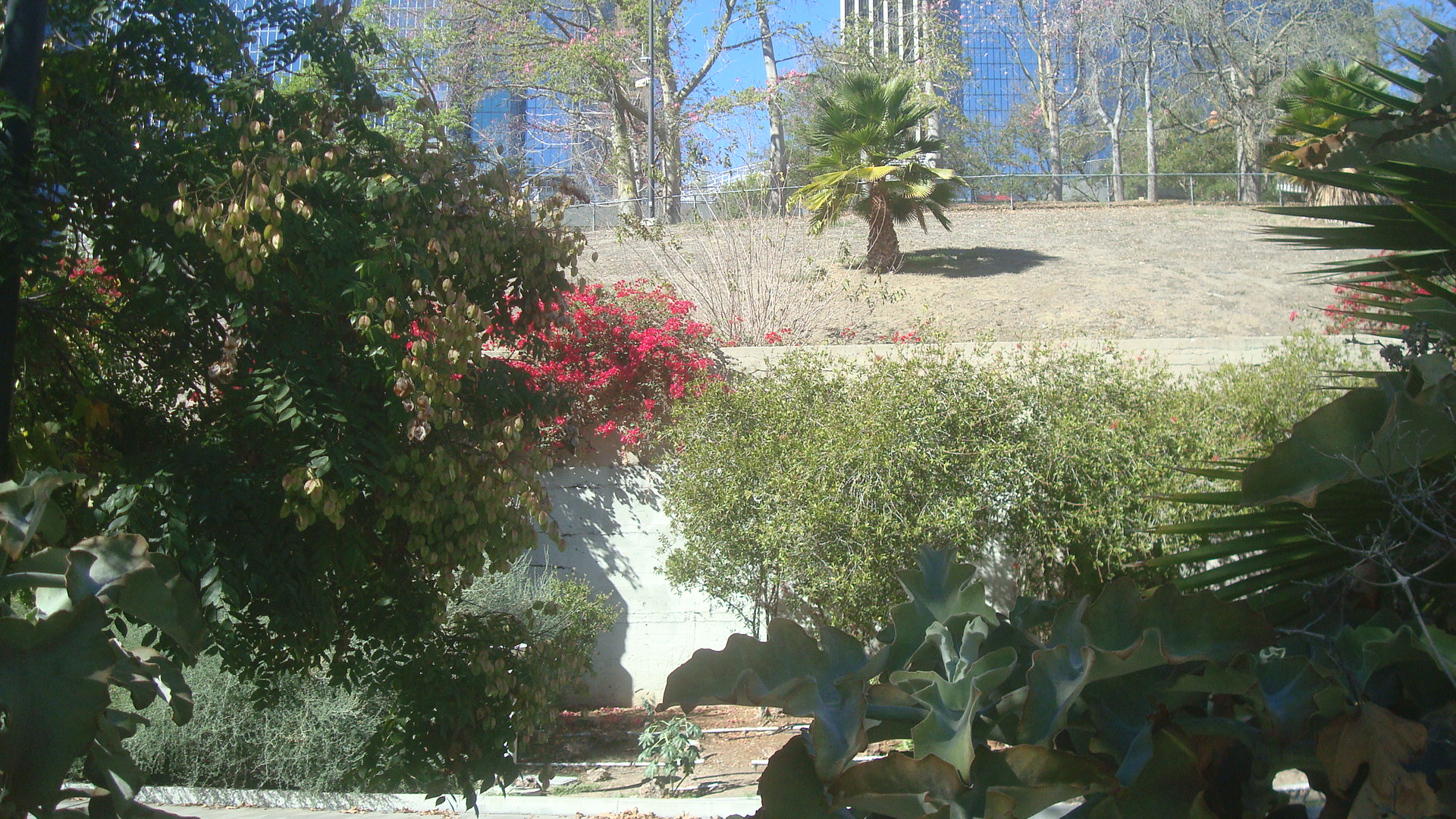
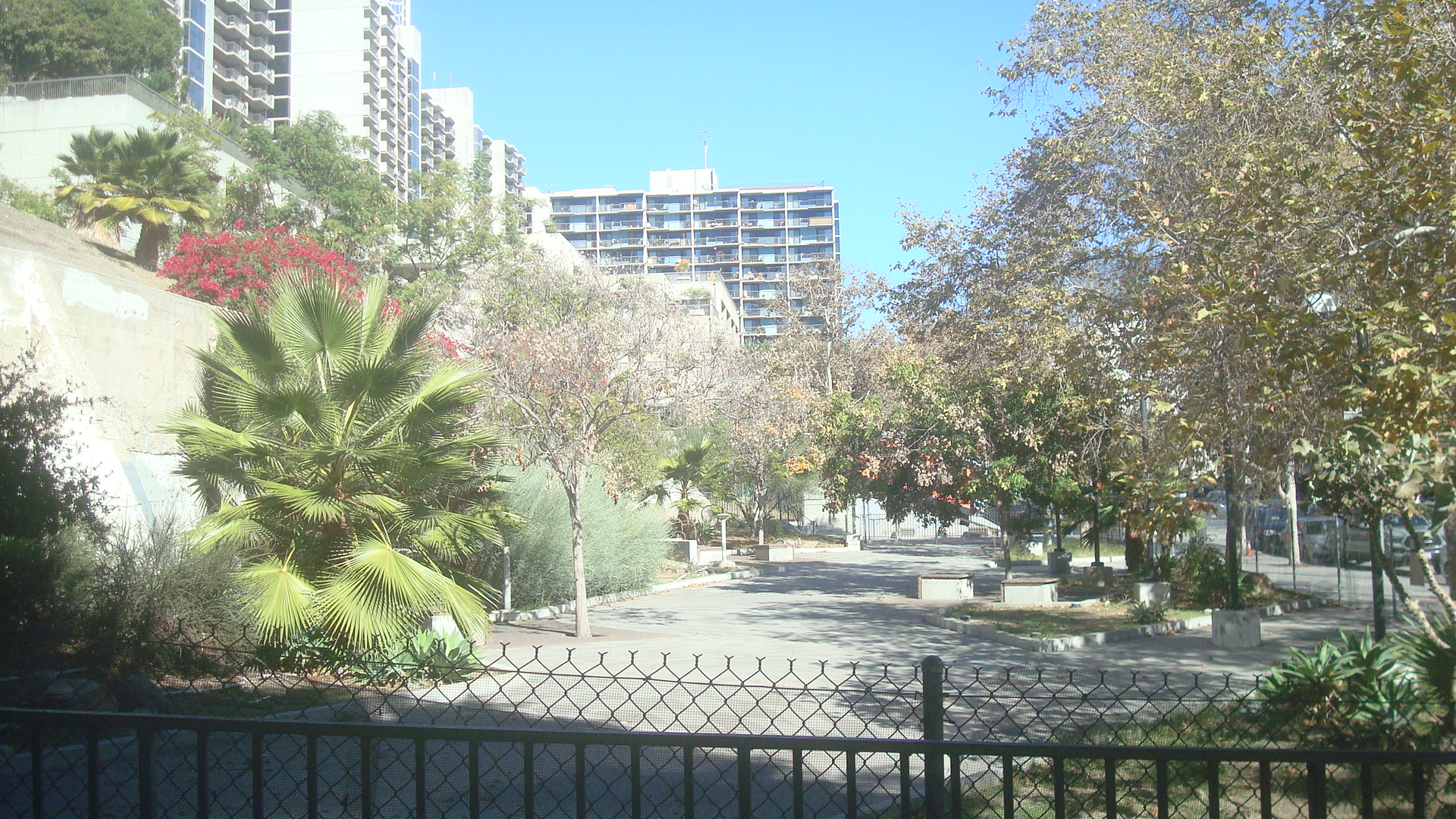
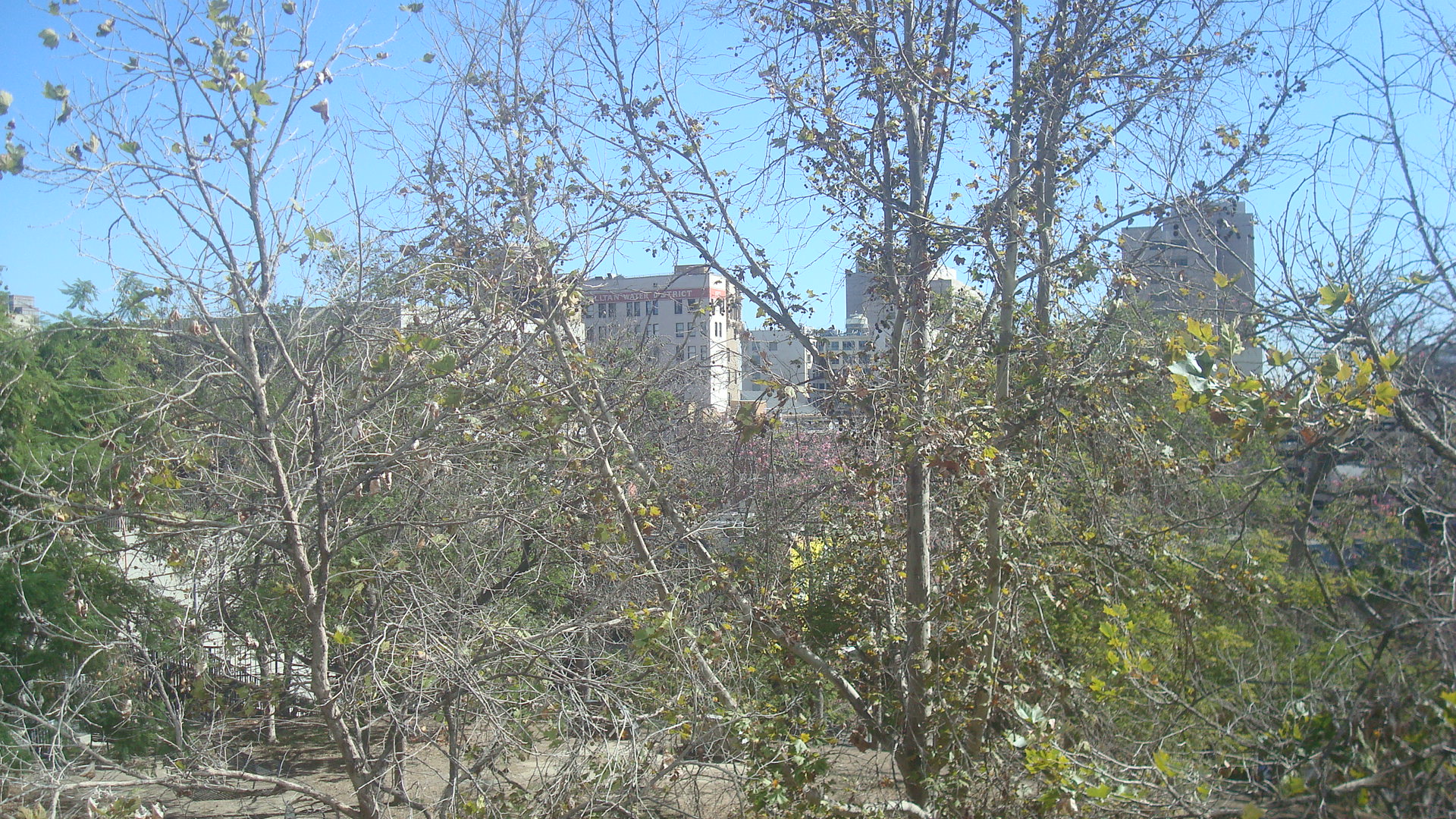
I was wandering around Cal Plaza a while ago, and ran across a piece of Downtown I’d forgotten about. As I looked out over the city in the direction of Hill Street, I saw that directly below me there was a small park. It took me a minute to realize it was the same park I’d seen many times at the intersection of Fourth and Hill. It’s been fenced off for years. Much of the greenery is dry, and the trees could certainly use some attention, but it was so cool to run across a patch of green space in the middle of all the steel and concrete.
Actually, it’s not technically a park. It’s a small patch of land called Angels Knoll that had been owned by the Community Redevelopment Agency (CRA). (I assume it got the name because it’s right night next to Angels Flight.) When the CRA was dissolved in 2012, a petition was circulated asking the City to turn the land over to the Department of Parks & Recreation. But that didn’t happen. As one of the few remaining undeveloped parcels in the Downtown area, the property is worth a fortune. The decision was made to put it up for sale.
A June, 2021 memo from CRA/LA, the successor agency to the CRA, sets the price of the parcel at $50 million. The buyer, Angels Landing Partners, is actually a joint venture by the Peebles Corporation, MacFarland Partners and Claridge Partners. According to the LA Department of City Panning web site, the proposed Angels Landing project involves the construction of two skyscrapers, one rising 63 stories and the other rising 42 stories. In addition to two hotels and 72,000 square feet of commercial space, the project also includes 180 condos and 252 apartments. Apparently some affordable housing is supposed to be provided, but at this point it’s not clear how much.
Of course, the project will generate lots of jobs and economic activity. According to the Environmental Impact Report, it will also generate 10,179 metric tons of CO2 equivalent during the construction phase alone. Beyond that, it will contribute to the steadily increasing temperatures in the LA area, along with a number of other massive projects planned for Downtown, Hollywood, Warner Center and elsewhere.
And we’ll also be losing one of the few remaining patches of green in Downtown. City Hall has made its priorities clear. They want the skyscrapers. Of course, LA was built by developers and politicians who prioritized growth over everything else. That’s how LA got to be what it is today. But the older I get, the more I feel that this addiction to growth is incredibly destructive. Our warming climate and shrinking water resources are a direct result of unchecked development.
We really don’t need another skyscraper. We absolutely need more parks.
The City of Los Angeles couldn’t exist without the water it imports from sources far beyond its borders. While the ratios vary widely from year to year, on average we get about 10% of our annual supply from groundwater within the city limits. The remaining 90% has to be imported from places hundreds of miles away.
Which means we really should pay attention to the Water Supply Alert issued by the Metropolitan Water District (MWD) on August 17. The entire State of California, and in fact much of the Western US, is experiencing extremely dry conditions. At this point the MWD is asking for citizens, businesses and public agencies to make voluntary reductions, but there’s a good chance that stricter measures will be needed in the not too distant future. Through careful planning and good stewardship, the MWD has managed to build up significant reserves which might provide a buffer for the next year or two. But we can’t be complacent. This year the California Department of Water Resources has cut allocations from the State Water Project to just 5% of requested supplies. It’s possible that next year the allocation could be reduced to zero. On top of that, for the first time ever, the Bureau of Reclamation has declared a shortage on the Colorado River. Lake Mead supplies much of the water that Southern California relies on, and storage there has been declining faster than even the most pessimistic observers predicted. Right now the water level is lower than it’s been at any time since Hoover Dam was constructed.
Which leaves us with the LA Aqueduct. At the beginning of the 20th century, Los Angeles business leaders were working hard to promote the city’s growth, but they knew that the area’s water resources were limited. In looking for solutions to this problem, they set their sights on the Owens Valley, over 200 miles away. Using secretive and dishonest means, the City of LA managed to purchase rights to much of the water in the Owens Valley, and then began construction of the LA Aqueduct under the supervision of William Mulholland. In LA the completion of the Aqueduct was hailed as an engineering marvel, and for a time Mulholland was celebrated as a hero. Needless to say, the people of the Owens Valley didn’t see things quite the same way. For them, the diversion of water resources to the Aqueduct resulted in disastrous environmental impacts, and set the stage for decades of litigation.
Mulholland Memorial Fountain from DWP Photo Collection at LA Public Library
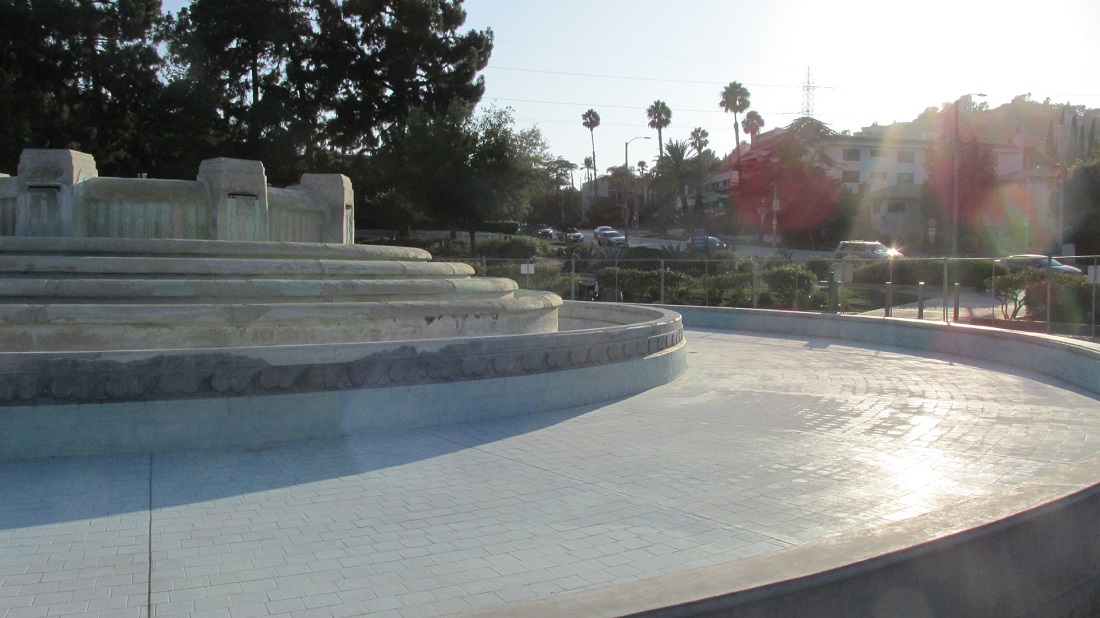
In 1940, five years after Mulholland’s death, a fountain was built at the intersection of Los Feliz Boulevard and Riverside Drive to honor the man primarily responsible for the construction of the LA Aqueduct. The choice to create a fountain was considered a fitting way to commemorate the role Mulholland played in securing the water that was necessary for the city’s growth. For decades cool, crystalline plumes arched into the air and cascaded into the rippling pool below.
Today the fountain is dry and it’s surround by a chain link fence. While a search on the net didn’t reveal any explanation, it seems likely that LADWP shut it down in response to the looming water shortage. This is certainly a sensible step to take, but it should also raise questions about LA’s future. Mulholland was celebrated because of his efforts to provide water that would support the city’s growth. If the fountain is now dry, maybe this should be a cue to start asking how much LA can realistically grow in the future?
While government officials and the media routinely describe the situation as a drought, I don’t think that’s accurate. In fact, I think it’s seriously misleading. “Drought” is generally defined as a prolonged period of dry weather. This implies that at some point the drought will end and things will get back to normal. But there’s growing evidence that this is the new normal. Both the State Water Project and the LA Aqueduct are fed by snowmelt from the Sierra Nevadas. The Sierra snowpacks have been declining for years, and climatologists predict that they’ll continue to decline for the foreseeable future. As for the Colorado River, California, Nevada and Arizona draw more water from this resource than it can deliver on an annual basis. The construction of Hoover Dam masked this fact for decades, but the rapid decline of Lake Mead should be a wake-up call for all of us. Right now it seems inevitable that water allocations to all three states will have to be reduced, but this will be a long, contentious, brutal process.
So if all of the city’s water resources are declining, our public officials need to let go of the myth that LA can keep growing forever. LA’s 2020 Urban Water Management Plan (UWMP) assumes that all it will take is more stormwater capture and a concerted effort to conserve. Unfortunately, stormwater capture doesn’t really work when you’re hardly getting any rain. And while Angelenos have shown a willingness to save water in the past, current forecasts seem to indicate that we’d have to push conservation to a whole new level. The more you cut, the harder it is to cut further. The UWMP’s conservation projections are extremely optimistic. It’s hard to say whether they’re realistic.
The Mulholland Memorial was intended as a monument to the man who oversaw the construction of a massive infrastructure project that allowed the city to grow rapidly. In the state it’s in now, it seems more like a monument to the folly of those who believed you could build a city of 4,000,000 people in an area with minimal water resources.
Most people who live in LA are probably already aware that this year has been an especially dry one. We’ve gotten less than half of our average rainfall. But it’s really important to say that it’s not just LA and it’s not just this year. Actually, much of the Western US is dangerously dry, and there’s an increasing amount of research which seems to indicate that this could be a long-term trend. In other words, it’s likely that things will continue to get drier and hotter in LA, California and the West.
I’d been wanting to write about this for a while, but LA Times columnist Michael Hiltzik saved me the trouble. He recently wrote an excellent piece laying out the serious challenges California is facing, both in the near term and the long term. To put it briefly, all of California’s water resources are declining. The snowpacks that feed our rivers and lakes are shrinking. We’ve depleted much of the groundwater that was so plentiful at the beginning of the 20th century. And because western states have been taking more water from the Colorado River than is actually available, we’ll probably continue to see reduced deliveries from Hoover Dam for the foreseeable future.
This is all very bad news.
Whether or not this dry spell is partly the result of cyclical changes in the weather, research increasingly shows that climate change is going to take a serious toll on LA and the West. It seems inevitable that some farmland will have to be taken out of production, though that will be a difficult and hugely controversial process. Many species of California’s trout, steelhead and salmon will probably be extinct by the end of this century. And while we’ve all seen the horrific damage that wildfire has caused in California’s vast natural forests, we should also be worried about the less visible but still serious impacts to our urban forests.
Here in LA we may be spared from having to take immediate action to deal with this crisis. The Los Angeles Department of Water and Power and the Metropolitan Water District have been managing our resources carefully, building up reserves that could see us through the next few years. But I’m afraid this is creating a false sense of security. The way it looks now, it’s not just a matter of riding out a few dry years until things go back to normal. This is the new normal. Even if annual precipitation stays roughly the same in the future, shrinking snowpacks and the decline of the Colorado River mean water deliveries to the LA will continue to fall, and we have limited groundwater resources. Unfortunately, our local leaders don’t seem to want to deal with this situation. LA’s Mayor and City Council have been silent on this issue, and I don’t hear anything from the Board of Supervisors, either. Maybe they think that if they just ignore the problem it will go away.
This problem isn’t going away. We need to start dealing with it. Hiltzik explains how serious and how widespread the challenges are. The time to act is now.












 The Horizon and the Skyline