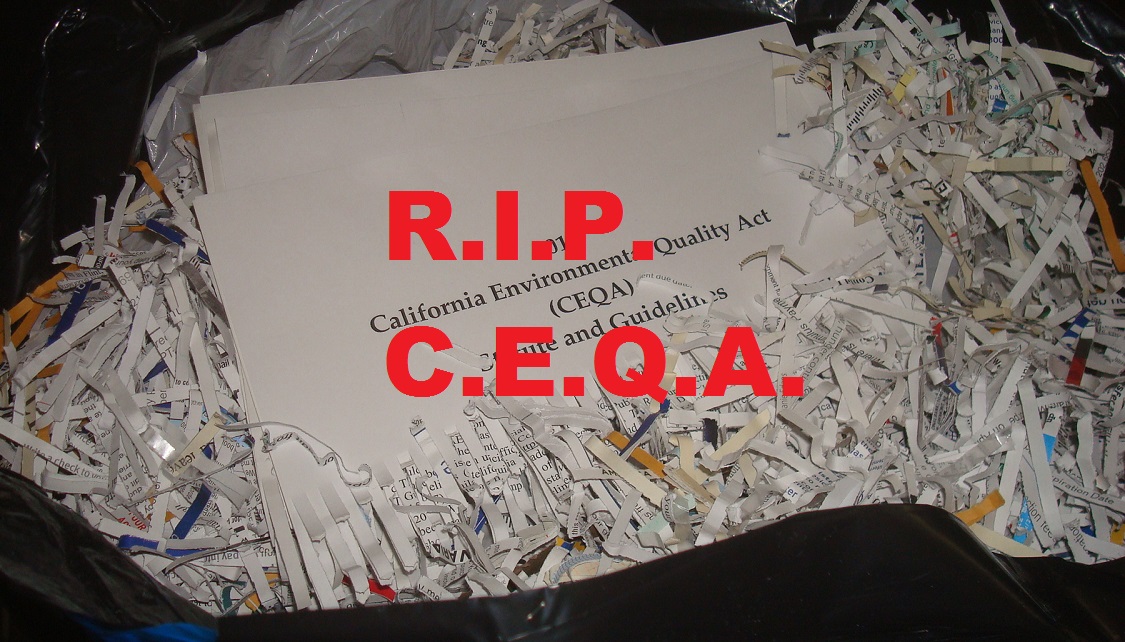
Last year Gov. Gavin Newsom strongarmed the State legislature into gutting the California Environmental Quality Act. Newsom told the legislature that he wouldn’t sign off on the State’s $321 billion spending plan unless they approved his “reforms”.
Many legislators were worried that the bill Newsom was pushing for, SB 131, would create a slew of exemptions from the California Environmental Quality Act (CEQA). While exemptions had already been created for housing and transit projects, SB 131 would allow exemptions for “advanced manufacturing” projects. These legislators were concerned because approval of the bill involved removing language from the State’s Public Resources Code that defined what could be considered an “advanced manufacturing” project. People in leadership said, don’t worry, we’ll fix this before the end of the session.
But of course, nothing got fixed. The definitions weren’t clarified. While there’s a push now in the legislature to clarify the definitions, it will be an uphill battle because well-financed business interests prefer the lack of clarity.
What kinds of “advanced manufacturing” projects might now be exempt from environmental review now that SB 131 has passed? Here’s a partial list from the web site Legal Planet.
aerospace manufacturing animal feed and organic fertilizer plastic bottle manufacturing semiconductor fabrication lithium ion batteries lithium recovery and processing rare earth materials production
Among the most concerning would be last four on the list. Making semiconductors involves the use of toxic materials such as arsenic and antimony, as well as toxic chemicals like sulfuric acid and hydrofluoric acid. Lithium processing involves the production of significant toxic waste, and many rare earth minerals are themselves toxic.
Would you be okay with one of these “advanced manufacturing” projects being approved in your neighborhood? If not, you might want to to contact your representatives in the State Assembly and the State Senate.
Graph from California Legislature’s report “Recent Legislative Actions to Increase Housing Production in California”
As has become usual over the past several years, the California legislature is considering a number of bills that would override local planning control and weaken environmental review for new development projects. Two of the most controversial bills are SB 79 and SB 607. SB 79, from State Senator Scott Wiener, would remove local zoning restrictions for housing projects proposed on sites near transit. SB 607, also from Senator Wiener, along with principal co-author Assembly Member Buffy Wicks, would essentially gut the California Environmental Quality Act (CEQA), giving local agencies broad latitude in deciding what level of environmental review was needed for a project, if any. (On May 19, both bills were placed in the Senate Appropriations Committee suspense file, which generally means a bill is on hold, but both are scheduled to be heard again by the Committee today, May 23.)
You probably won’t be surprised to hear that, while these bills have a long list of supporters, they’ve also generated major pushback from both individuals and established organizations. SB 79 is opposed by Public Counsel, the Public Interest Law Project, the Western Center on Law & Poverty, and numerous California cities. SB 607 is opposed by a number of environmental groups, including the Center for Biological Diversity, Sierra Club California and Friends of the LA River. (Full disclosure: I work with a group that has sent letters opposing both bills, United Neighborhoods for Los Angeles.)
This has turned into a routine. Every new session, state legislators present a number of bills designed to allow developers to build bigger and faster, with little or no environmental review. The legislators claim it’s the only way to solve the housing crisis. What’s unusual about this year is that Governor Gavin Newsom has upped the ante. As the efforts of citizens and organizations opposed to these bills seem to be having an impact on legislators, Newsom has come forward to say that he’s going to use the budget process to achieve the goal of speeding up new development. Like Wiener, Wicks and many others, Newsom sees the housing affordability crisis purely as a matter of supply and demand. They believe that housing prices will go down if they erase local planning authority and let developers build with little or no environmental review. It’s the classic supply-side economics argument. Unleash the free market, and it will solve your problems.
Unfortunately, the legislature has been unleashing the free market for years now, and it doesn’t seem to working. Take a look at the graph above. This is taken from a report produced by the State Senate and State Assembly Housing Committees. The report is titled….
California’s Housing Crisis: More Construction Is Needed to Meet the State’s Housing Needs
The paper was produced by the State Senate and Assembly Housing Committees. It argues that California has failed to produce enough housing for decades, and that lawmakers in Sacramento have been reversing this trend with the many bills that have been passed in recent years. They cite reforms to density bonus law, reforms to the Surplus Lands Act, faster approval timelines, and increases in “by-right” approvals. (When a project is approved “by-right”, it means an application is approved automatically, with no public hearings and no environmental review.) The text emphasizes large increases in the percentage of Low-Income and Very Low-Income units completed, and says there’s been a 61.5% overall increase in affordable housing production. That’s great, but the report doesn’t give numbers for rent-stabilized units lost during the same period, or the number of affordable units that converted to market-rate when their covenant expired, which means we don’t know if there’s really been a net gain.
And in spite of the report’s claims about increased housing production, the graph seems to show the opposite. By my count, the report lists 98 bills that were intended to spur housing growth over the last two decades. Things really kicked into high gear in 2017, when Sacramento passed 15 pieces of legislation related to housing. Looking at the lists compiled in the report, it appears that from 2017 through 2024 the Legislature approved a startling 87 bills to jump start housing. Based on the number of bills, if you accept the arguments that Wiener and friends are making, you’d expect housing production to go through the roof. But if we look at the chart above, you can see that the number of units permitted since 2017 is well below the number permitted during the first decade of this century. While it looks like there’s been a slight increase in multi-family units produced over that period, there’s been a huge drop in the number of single-family homes produced. The numbers look even worse if we go back to the 80s. The quantities of both multi-family and single-family homes produced in that decade are far higher than the quantities produced since 2017.
Which brings us to the question, What has this onslaught of legislation actually accomplished? Wiener and his pals have spent years pushing bills to override local zoning restrictions, and they’ve also been busy hacking away at the California Environmental Quality Act (CEQA). They argue that loosening local zoning and sidelining CEQA will spur new housing growth. But look at the numbers. Wiener and friends started their assault on local zoning and CEQA back in 2017. While the text of the report seems to be telling us that their campaign has been a resounding success, the graph the authors lead off with tells a different story. Housing production since 2017 is well below what it was in the 2000s, and it’s WAY below what it was in the 1980s. And it’s important to point out that in both of these earlier periods, local zoning was more restrictive than it is now, and CEQA was in full force. No doubt some will argue that the pandemic held down new construction, but California’s own housing dashboard shows that the number of permits issued actually increased during the crisis. (See slide 8 on the housing data dashboard.)
Newsom, Wiener, Wicks and their cohorts keep telling us that local zoning and environmental review are two of the biggest roadblocks to new housing. But given the numbers that we see in the Legislature’s own report, it seems these folks have no idea what they’re talking about. The graph they lead off with tells the story. California was producing more new housing before the Legislature began its attack on local zoning and environmental review.
With the State continuing to enjoy a strong surge in revenue, Gov. Gavin Newsom’s proposed budget includes substantial funds to address housing needs. Newsom wants to spend $2 billion on homelessness, and another $2 billion to address housing in general. Of course, there are those who say this still isn’t enough, and others who say Newsom’s priorities are wrong, but there are a lot of good things in his proposed budget. I’m not a Newsom fan, but I think that in some ways he’s on the right track. As usual, the devil is in the details.
One of the things Newsom wants to promote is urban infill development, in other words building dense residential housing where infrastructure already exits, as opposed to more suburban sprawl. This is nothing new. State and local politicians have been pushing this for years, and in theory it makes perfect sense. One of the main goals of this policy is to make people less reliant on cars, encouraging them to take transit instead, or to ride a bike or maybe even just walk. The overriding goal is to fight climate change by reducing greenhouse gas emissions.
So what do we do? Well, there is evidence suggesting that high-priced new development in urban centers is causing gentrification, which displaces low-income transit riders. I can tell you I’ve seen numerous instances in Hollywood where low-income tenants have been thrown out of their apartments to make way for new projects. We need to preserve existing housing that’s accessible to low-income households, and to build a lot more affordable housing. That’s why I’m glad that Newsom is setting aside $500 million for Low-Income Housing Tax Credits, and another $500 million to preserve and increase affordable housing stock. Of course, much more money is needed, since the federal government has slashed funding for affordable housing over the last several years. But the money Newsom is providing is a step in the right direction. In LA, the vast majority of transit riders live in low-income households. We need to help them remain near the transit hubs they rely on.
Another smart move Newsom has made is to earmark $100 million to support the conversion of office buildings to apartments. This makes a lot of sense, not just because more people are working from home these days, but because it helps minimize the significant environmental impacts caused both by the demolition of old buildings and the construction of new ones. As many people have said, the greenest building is the one that’s already standing.
The funding Newsom has proposed will not solve our housing problems, but it will help. That is, assuming the legislature supports his budget. This article from CalMatters offers a more detailed breakdown.


 The Horizon and the Skyline