Let’s Do Some Planning

Planning Graphic

A friend recently sent me a link to an article from The Planning Report where Bill Witte, CEO and Chairman of Related California, talks about the toxic development debate in California. He focusses mostly on LA, and discusses the factors that drove activists to put Build Better LA and the Neighborhood Integrity Initiative on upcoming ballots. I have to say it was really refreshing to hear a developer talk honestly about why the situation has gotten so bad, and to offer a plausible solution.

What does Witte recommend? That we actually do some planning. And he’s not talking about blueprints drawn up in a backroom by politicians and lobbyists. Witte urges developers to engage with communities in order to create a realistic framework that will allow us to build for the future. And he also asks for leadership from City Hall that will make this happen.

Really, this is the only way to break the current stalemate. People all over LA are furious because they feel they’ve lost control of their communities. Developers are constantly asking for zone changes and general plan amendments, and City Hall hands these out freely. When people complain, our elected officials often adopt a condescending tone and insist that they have to grant entitlements to encourage growth. They also tend to characterize anyone who objects as an anti-development NIMBY. City Hall tells us they’re acting in our best interests, but affordable housing is disappearing, the number of homeless keeps growing, traffic is steadily getting worse, air quality is declining, crime is on the rise, and our water resources are drying up.

But if our elected officials made a serious attempt to bring developers and communities together to plan for the future, we could make some real progress in addressing these problems. It wouldn’t be easy. Witte says flat out that developers would have to make concessions. Community stakeholders would also have to give some ground. But the end result would offer huge rewards for both sides. Residents would finally feel like they had some control over how their community was going to grow. Developers would know exactly what the plan allowed and could build their projects without going through endless meetings and without facing court challenges.

Could this really happen? It’s probably a long shot. Developers would be reluctant to give up potential profits. No doubt some communities would be averse to making any significant concessions. And while City Hall is good at staging dog and pony shows, they’ve shown zero interest in seeking meaningful input from LA’s communities. In fact, in recent years they seem to be doing everything they can to shut the public out.

Still, it would be great if we could all get together and do some planning. It’s really the only way out of this mess.

Here’s the link to Witte’s comments. They’re worth a read.

Related’s Witte Tells Developers to Engage in Planning from The Planning Report

Silverlake in Crisis: Acute Boutique Hotel Shortage

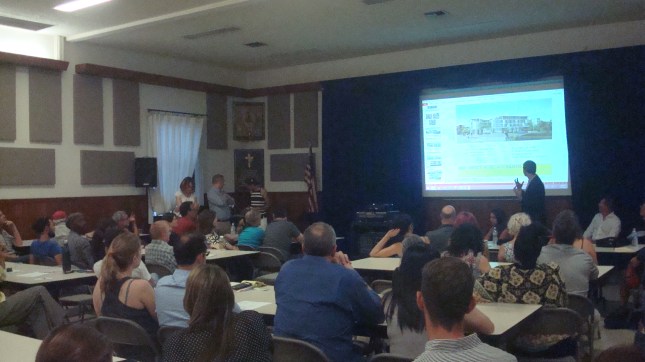
Town hall meeting on proposed Junction Gateway project.

Town hall meeting on proposed Junction Gateway project.

On Wednesday night the Silver Lake Neighborhood Council (SLNC) hosted a town hall meeting where the topic was the proposed Junction Gateway project. For those of you who haven’t been following this story, developer Frost Chaddock wants to build three structures on three sites along Sunset Blvd. in Silverlake. Two of the buildings are mixed-use, including residential, restaurant and retail space. The third is a boutique hotel. Predictably, the developer is asking for a number of entitlements, among them increases height and Floor Area Ratio (FAR). And predictably, a lot of the locals are ticked off.

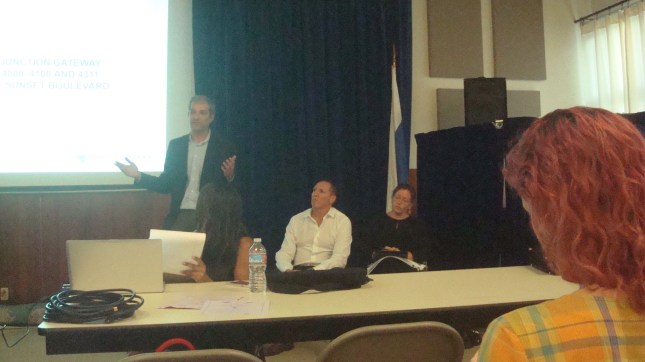
By my count, the town hall drew about fifty area residents. The developer was there, along with the project architect, and a very smooth land use attorney from a high-powered law firm. They kicked the meeting off with a presentation on the project, emphasizing the ways they felt it would be beneficial to the community. Then two board members from the SLNC took turns reading questions that had been submitted by audience members. I want to say in passing that the SLNC board members handled the whole thing very well. The tension in the air was palpable, but they did an excellent job of minimizing disruption and keeping things on track.

A land use attorney explains why his client's project will be a boon to the community.

A land use attorney explains why his client’s project will be a boon to the community.

I have to admit I left early since I was taking the bus to Burbank and didn’t want to get started too late. But as I listened to the questions being read, it all sounded very familiar. While the developer claimed that Junction Gateway was absolutely right for the neighborhood, the tone of the questions made it clear that there was intense opposition in the community. The land use lawyer kept saying they had met with residents and made changes based on their input. But the changes mentioned were mostly cosmetic, and it was clear that the developer intended to build the project regardless of neighborhood oppostion. For me, the funniest moment was when the developer’s land used attorney insisted that in talking to the community, “We heard over and over again that Silverlake is lacking in boutique hotels.” That was a surprise to me. I know people who live in Silverlake, and I’ve never heard any of them complain about a shortage of boutique hotels.

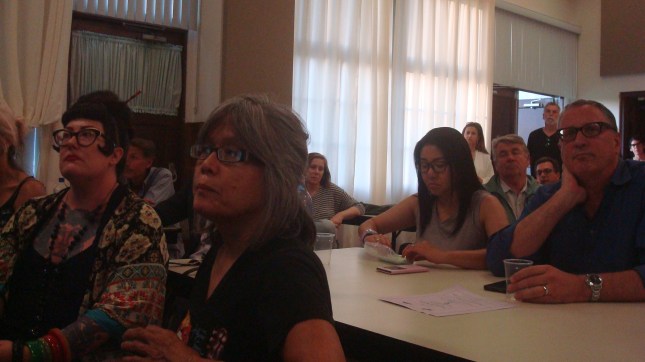
The audience is skeptical.

The audience is skeptical.

But to my mind, the most crucial questions that were raised shouldn’t have been addressed to the developer. They should have been addressed to Councilmember Mitch O’Farrell, whose district includes Silverlake.

First, why are developers continually encouraged to build projects that violate the existing community plan for Silverlake and Echo Park?  According to the Department of City Planning web site, “the 35 Community Plans provide the specific, neighborhood-level detail, relevant policies, and implementation strategies necessary to achieve the General Plan objectives.”  When our City Council reps routinely allow developers to build beyond what the existing framework allows, they make planning meaningless.  Why do we have community plans if our elected officials are happy to toss them out for any developer with deep pockets?

Second, what about doing a meaningful assessment of all projects currently being considered for the area?  The developer’s team pointed out that Junction Gateway has been in process for years, and they argue that their assessment of cumulative impacts included everything that was happening when they started out.  Even if we accept this argument, there are a number of other projects that are coming through the pipeline and there hasn’t been any serious attempt to gauge their impacts on the community.  Infrastructure is already strained, air quality is deteriorating, and the streets are more congested than ever.  And yet O’Farrell keeps pushing new projects forward as though none of these problems existed.

The City of LA’s refusal to respect the planning process shows that our elected officials are far more interested in serving developers than in serving the citizens. Instead of creating a rational planning framework that starts with a genuine effort to engage the community, we get an avalanche of projects being dumped haphazardly on neighborhoods all over LA.

It’s no wonder the people at the meeting were ticked off. Affordable housing in Silverlake is fast becoming a distant memory, small-lot subdivisions are a plague sweeping the community, traffic keeps getting worse, the number of homeless is increasing. And still Mitch O’Farrell continues to back one project after another, blithely insisting that this onslaught of reckless overdevelopment will lead to a better and brighter future for his constituents.

Not surprisingly, a lot of people aren’t buying it. A number of those who attended the meeting belong to a group called Save Sunset Junction. If you’d like to connect with them, here’s the link.

Save Sunset Junction

TH Crwd Cls

Moving Forward in Reseda

The Reseda Theater

The Reseda Theater

A little over a year ago I wrote a post about how people in Reseda were frustrated. For years the business district in the heart of the community has been struggling, and projects that were supposed to revitalize the area somehow never materialized.

Well, there’s been some progress since then. Just recently a deal was struck to reopen the long vacant Reseda Theater as a multiplex, and to create 34 units for senior citizens adjacent to the building. The multiplex will be operated by Laemmle Theatres, which played a part in revitalizing North Hollywood with its complex there.

This deal is just a first step. Members of the community have been struggling for years to revitalize the neighborhood, and many hope that this project signals a turnaround. The Reseda Neighborhood Council and Councilmember Bob Blumenfield have worked hard to engage the community and rustle up the money to make this happen. For more details, see this article from the Daily News.

Reseda Theater to become Laemmle Multiplex

But redevelopment is only part of the equation. Bringing new life to a community requires a lot more than investment. It’s really about people. Creating community means creating a sense that the people who live in the area are connected, that they share something more than a zip code. This piece from the LA Weekly caught my attention.

Reseda Rising Artwalk Proves the Valley Is Cool

The artwalk was put together by 11:11 ACC and the Department of Cultural Affairs. I’d never heard of 11:11 ACC before, so I took a look at their web site and found out that they’re an artists’ collective operating in the San Fernando Valley. Sounds like an interesting group. If you want to check them out, here’s the link.

11:11 ACC

Seems like things are finally happening in Reseda. Hopefully this is just the beginning.

Pushing for Change at Jordan Downs

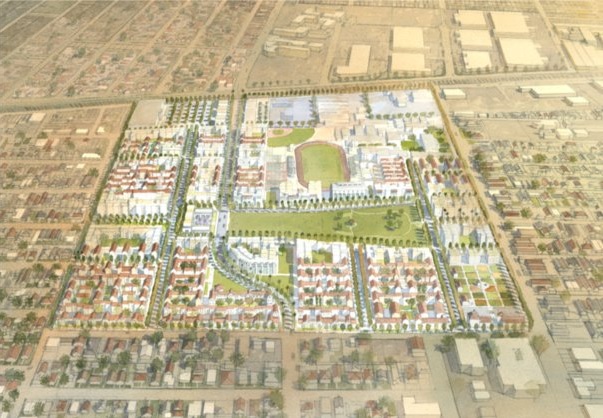
Aerial view of proposed Jordan Downs redevelopment project.

Aerial view of proposed Jordan Downs redevelopment project.

Sometimes you hear people complain that our elected officials are afraid to try anything new, that they devote most of their careers to propping up the status quo. I’ve said it myself, and I do feel like our politicians need to spend more time thinking outside the box.

But there are reasons why the folks at City Hall don’t like taking chances. It’s one thing to come up with an innovative idea. Making it a reality is a whole different story. It’s not uncommon for good ideas to get ground into dust by the system. Pushing for change can be a long, brutal process, sometimes dragging on for years and wearing everyone involved down. It’s not easy changing the status quo.

I first read about the Jordan Downs redevelopment initiative back in 2013. The idea was to take an aging housing project that was mired in poverty and remake it from the ground up. But this wasn’t just about knocking down one building and putting up another one. The idea was to create an expanded mixed-income complex where low-income families would live next door to middle class families. The project also included a new park and over 100,000 square feet of retail, bringing jobs and amenities to a community that hasn’t had had easy access to either.

Back in 2013 it was clear there were plenty of challenges, and the path hasn’t been easy. Though many of the current residents support the project, there are also fears about gentrification and displacement. And the process was complicated further by the news that the soil on the site was heavily contaminated, meaning that a long, costly clean-up would be necessary.

On top of all that, getting the funding for the project has been a huge hassle. Councilmember Joe Buscaino didn’t hide his anger when a grant application was rejected by the US Department of Housing and Urban Development (HUD), at least in part because the city agency handling it hadn’t submitted all the required materials. This was the second time that HUD had declined to award funds for the project.

But things are still moving forward, and it’s hoped that construction will begin by the end of this year. No doubt there will be more challenges. The concerns about displacement are certainly well founded. The Housing Authority of the City of Los Angeles (HACLA) has said that tenants “in good standing” will be guaranteed units in the new complex. However, they haven’t yet defined exactly what “in good standing” means. This could be a problem. A recent affordable housing project in Boyle Heights proposed the demolition of existing units to allow the construction of new ones. This sounded like a good idea until the residents of the existing units learned that strict conditions regarding right of return would have excluded many of them from moving into the new units.

The contamination also needs to be dealt with. I wondered how the clean-up was progressing, so I sent an e-mail to Joe Buscaino’s office. I got an answer within hours from Planning Deputy Heather Anderson. To put it in context, it’s important to understand that HACLA purchased additional property adjacent to Jordan Downs, and her response focusses on work at that site.

The Housing Authority of the City of Los Angeles (HACLA) purchased the property knowing that it was a former industrial site, and with the intent to remove the contamination and clean up the property. They have been in the process of remediation with the oversight of the California Department of Toxic Substances Control (DTSC) for a few months now. After removing 200,000 tons of contaminated soil, they are close to finished with the remediation. There has been testing of the soil around the site to ensure that nearby soil is safe.

She also attached a report documenting the clean-up through February. It sounds like the City and State are taking this seriously, which is good news. But it’s important to remember that there’s also concern about contaminants within the site that Jordan Downs currently occupies. Hopefully, as demolition of the existing buildings progresses, the City and State will continue to do the same thorough job of remediation.

There are those in the community who are skeptical about how this will all play out. This article from the LA Wave reports some of their concerns.

Feds Greenlight Plan to Redevelop Jordan Downs

Buscaino and Congressional Rep Janice Hahn both deserve credit for staying with this redevelopment effort. They could have stuck with the status quo and saved themselves a lot of headaches. And the residents of Jordan Downs also deserve a lot of credit for the hard work they’ve done as they’ve fought to improve their neighborhood. No doubt community activists and elected officials will be facing off as further issues arise. That’s to be expected. But hopefully everybody will continue to work together to build a better future for the people of Jordan Downs.

There are all sorts of possible pitfalls, but here’s the bottom line. If this project doesn’t go forward, the residents of Jordan Downs will continue to be trapped in the same cycle of poverty that has held the community back for decades. And that’s not an option. We can’t accept the status quo.

 Aerial view of Watts, looking northeast. Jordan Downs can be seen at lower center.  Photo by Howard D. Kelly, 1956.  From the Los Angeles Public Library, Kelly-Holiday Collection.


Aerial view of Watts, looking northeast. Jordan Downs can be seen at lower center. Photo by Howard D. Kelly, 1956. From the Los Angeles Public Library, Kelly-Holiday Collection.

Creating Community

New development in Boyle Heights, right next to the historic Mariachi Hotel.

New development in Boyle Heights, right next to the historic Mariachi Hotel.

I’ve heard people complain that Angelenos don’t know their neighbors. To a large degree that’s true. We tend to build our own little self-contained worlds, and get nervous when outsiders try to invade. In order to make it through the day, I try to keep interaction with strangers to an absolute minimum. In part, this is because I’ve found that some strangers want way more than I’m willing to give. Living in the city, you have to be at least a little wary.

But the downside is that there are very few places in LA where you can find a real sense of community. You might find a scene where you can hang out with people who share your passions, but chances are they’re coming from all over the city. You don’t find too many neighborhoods where everybody knows each other. And because of that, we don’t know our neighborhoods. The tenants in the building next to ours could be getting evicted for a condo conversion, and we might not be aware of it until the construction crews show up. Even when we find out what’s going on, we’re likely so wrapped up in ourselves that we don’t start worrying until the eviction notice shows up in our own mailbox.

So I was really intrigued when I heard about Union de Vecinos (UV), which could be translated as Neighbors United. It’s a grassroots group that’s been working in Boyle Heights for twenty years. They got their start back in 1996 when public housing in Pico Aliso was threatened with demolition, and they worked to protect renters threatened by displacement. But UV isn’t just reactive. They’re also creative. Starting with neighborhood committees, they work within the community for positive change. This is from their web site.

[Union de Vecinos promotes] economic and environmental justice, civic engagement, preservation of housing, and building healthy and stable community neighborhoods. We do this through community organizing, popular education and direct action. In our model, solutions to a problem are developed by those most affected – community – this is what drives us and is at the heart of our work.

The part of this paragraph that jumps out at me is, “solutions to a problem are developed by those most affected.” So often in the City of LA we have elected officials meeting behind closed doors with bureaucrats and business interests to devise plans that really don’t address the needs of the citizens. When they do hold public meetings and ask for input, it’s generally just for show. They’ve already decided what they want to do, and the meeting is really about selling their own agenda.

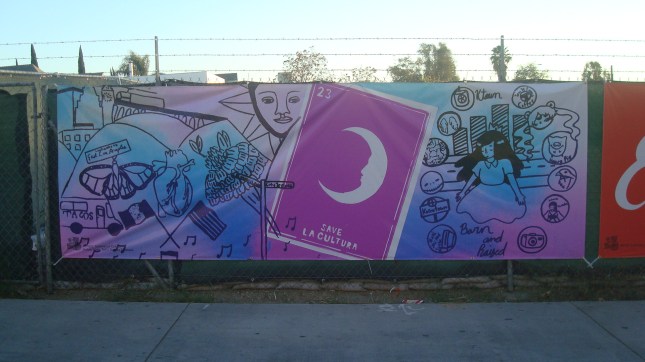
Banner on fence at a construction site on First Street.  Art by Gabriella Claro, Salma Sosa, and Tatei Torres Thomas.

Banner on fence at a construction site on First Street. Art by Gabriella Claro, Salma Sosa, and Tatei Torres Thomas.

So the idea of a neighborhood group that sets its own priorities and creates its own agenda sounded really good to me. I went to Boyle Heights to talk to UV members Leonardo Vilchis and Elizabeth Blaney about the challenges the Boyle Heights community is facing these days. A lot of it has to do with development, and the related problem of gentrification.

In early 2015, the Metropolitan Transit Authority (MTA) announced plans for a project to be built on Mariachi Plaza. Unfortunately, the MTA didn’t bother to ask the community how they felt about it. There was a huge public outcry, and Union de Vecinos was one of the groups that raised their voices in protest. The MTA shelved the project for the time being, but they’re planning to come back with another version. I asked Leonardo if he thought the public would have more of a voice this time.

“They said they’d reach out to us, but it’s really just pro forma,” he said. “The MTA sets up these meetings with focus groups, where you have to be invited.” He didn’t seem optimistic about the process. “They have these meetings, but they don’t really seem to be seeking input.”

Elizabeth spoke about UV’s engagement with the East LA Community Corporation, one of the developers building on and around MTA land. ELACC is working on creating affordable housing in Boyle Heights, but displacement of low-income families is still an issue. “We want affordable housing for the 7,000 families that make less than $25,000 in our community,” she explained, “but if they’re demolishing existing units, we have to make sure that those tenants will be welcome in the new project.” Recently UV negotiated a deal with ELACC to ease some restrictions to allow displaced tenants the right of return.

I asked what kind of projects UV was working on in the neighborhood.

“Garcetti talks about his Great Streets Initiative…,” Leonardo said with a smile, “but we’ve been doing great streets here in Boyle Heights for years.” When local alleys were attracting criminal activity, UV got residents involved in finding a solution. Elizabeth spoke with pride about the way the community turned the situation around. “We held movie nights and swap meets to reactivate these spaces. Residents went on to build street furniture, paint murals and install solar-powered lighting. Before people had been afraid to walk down these alleys, and now they’re gathering places for the community.”

What a concept. People taking responsibility for their neighborhood and working together to make it better. It’s not a new idea, but it’s something many of us who live in LA have forgotten how to do. Maybe we could learn a few things by following Union de Vecinos’ example.

If you want to learn more about what they’re up to, here’s the link to their web site.

Union de Vecinos

Leonardo Vilchis and Elizabeth Blaney of Union de Vecinos.

Leonardo Vilchis and Elizabeth Blaney of Union de Vecinos.

Remaking the May Co.

Construction of the new Academy Museum has begun.

Construction of the new Academy Museum has begun.

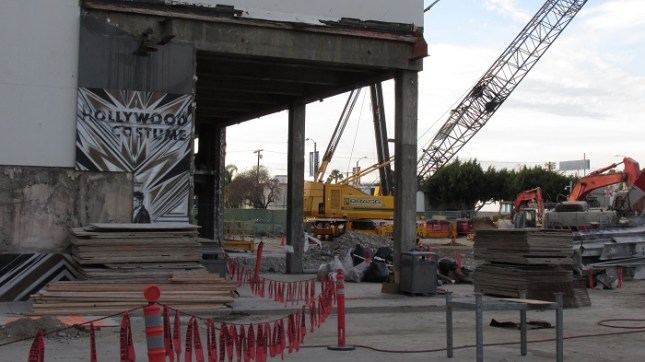
A while ago I was at LACMA, and as I walked down a flight of stairs on the west side of the campus I looked over at the May Co.. It had a big hole in it. Construction had started on the new museum for the Academy of Motion Picture Arts & Sciences.

May Co. building with a section removed.

May Co. building with a section removed.

Looking through the May Co. to Fairfax.

Looking through the May Co. to Fairfax.

It’s taken a long time to get to this point. The project has been hampered by controversy, ranging from construction impacts on the community to issues with the design. Hopefully all that’s been resolved. At any rate, the May Co. is being taken apart so that it can be put back together again, this time with a massive annex that will contain a state of the art theatre.

A view of the site facing Fairfax.

A view of the site facing Fairfax.

The rear of the building.

The rear of the building.

The original May Co. building was designed by Albert C. Martin and Samuel Marx and it opened in 1939. For decades it was a major department store, but as malls began to draw more shoppers it went into decline. LACMA took it over 1994, but it seemed like they never used it much. In 2014 the Academy made a deal to lease the property with the goal of building a museum. After a long search, Renzo Piano was brought on as architect.

A view of the site facing Wilshire.

A view of the site facing Wilshire.

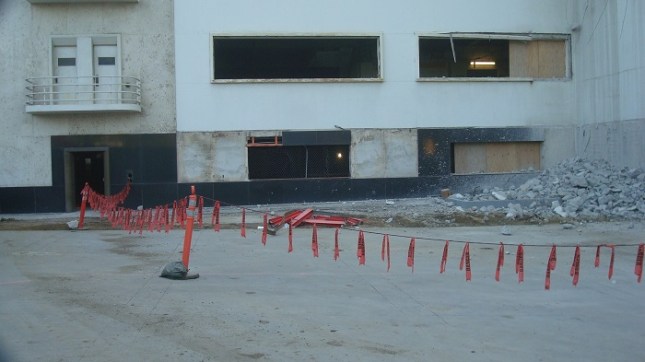
A view of the empty structure.

A view of the empty structure.

And a closer view of the interior.

And a closer view of the interior.

I’m glad things are moving forward. People have been talking for years about how LA should have a museum devoted to film, and it’s high time somebody made this happen. According to the Academy web site, “The Museum will provide interactive, immersive, and engaging exhibitions that will pull back the curtain on moviemaking and highlight the history and future of the arts and sciences of film.” Sounds good to me.

Heavy machinery and piles of debris.

Heavy machinery and piles of debris.

Check out the Academy’s web site to learn more.

Academy Museum

They’ve also got a cool timeline for the May Co., showing photos of the building through the years.

May Co. Building Timeline

I know it hasn’t been easy for the Academy to deal with all the challenges of creating a new museum, but it looks like they’re on their way. Let’s hope it’s smooth sailing from here on.

The corner of the building at Wilshire and Fairfax.

The corner of the building at Wilshire and Fairfax.

Developers Hijack Coastal Commission

CCC Web Page 2

You may have already heard about the California Coastal Commission firing its Executive Director, Charles Lester. This is a statewide issue, and beyond the scope of what I usually cover in this blog, but the CCC’s actions will have direct consequences for LA’s coastline. On top of that, it’s directly related to the threat this city faces from developers who want to gut our laws and public agencies so they can cash in.

On Wednesday the CCC board voted seven to five to fire Lester. The move is widely seen as a coup by the developer-friendly commissioners, and I have to say I totally agree. The commissioners who voted to get rid of Lester claim that this is all about performance, but the charges they’ve made publicly aren’t convincing in the least. Their criticisms of Lester’s management skills were not only disputed by the five members who voted to retain him, but also by numerous people who’ve worked with him. The seven who led the coup against the Director refused to present their complaints at Wednesday’s hearing, claiming that they were protecting Lester’s privacy. This is rubbish. Lester chose to have a public hearing to dispute his dismissal. The Commission’s legal counsel even advised them that they were free to discuss anything relating to his performance at the hearing. They chose not to because they knew their claims were bogus.

The California coastline is one of the state’s major resources. Precisely because it’s breathtakingly beautiful and largely unspoiled, developers see a huge opportunity. With the CCC now controlled by developer puppets, there are billions of dollars to be made, and you can rest assured that investors will not be shy about carving up our shoreline.

It’s real simple. Lester should stay. The seven who voted to fire him should step down. But that’s not likely to happen unless there’s a massive outcry from the public, and that’s where you come in. If you care about California’s coastline, you need to take action. You can start by sending Governor Brown an e-mail telling him how you feel about this.

Governor Brown

Next, contact your state assembly and senate reps and give them a piece of your mind, too. If you don’t know who your reps are, you can find them by clicking on the link below.

Find Your California Representative

For a detailed account of the whole mess, check out this story in the Times.

Firing of Charles Lester Leaves Deep Divisions from LA Times

Numerous individuals and organizations have spoken out about this travesty. You can read the statements from the Sierra Club and Heal the Bay below.

Sierra Club Statement

Lester Ousted as Chief of Coastal Commission

Again, if you care about preserving the coastline, you need to make your voice heard. The only thing that will turn this situation around is a firestorm of public protest. Let’s turn up the heat on the folks in Sacramento.

Mariachi Plaza

BH 01 Virg 1

Mariachi Plaza isn’t just a place. It’s a part of LA’s history. A piece of the city’s culture. Musicians have been gathering there since the 1930s, making music, looking for work, hanging out with friends, killing time. The plaza is also a gathering place for the community in Boyle Heights, vendors setting up booths to sell their wares, crowds gathering for a celebration.

Mariachi music is the result of hundreds of years of cultural give and take between the indigenous people of Mexico and the colonists from Spain. It started to take the shape we recognize today in the nineteenth century in the state of Jalisco. Mariachi ensembles come in many different sizes. There are the full orchestras with a string section, a couple of trumpets, a variety of guitars and a harp, but the musicians often play in smaller groups, too. It depends on the occasion and how much money’s being offered.

A view of First Street, bordering the plaza.

A view of First Street, bordering the plaza.

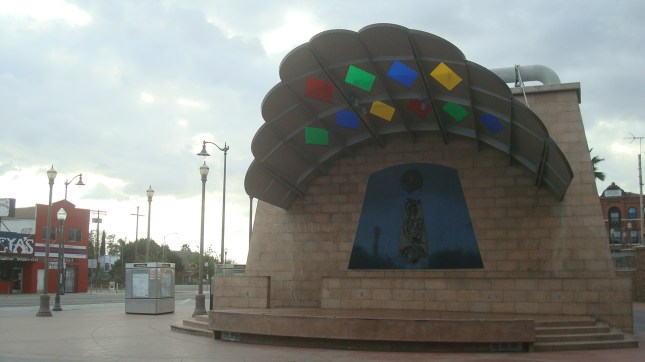
On the plaza there’s a large bandstand that was donated by the people of Jalisco, as well as a small amphitheatre which was built in the process of constructing the MTA Gold Line station. There are also a few modest buildings that have stood on the plaza for years, their walls decorated with colorful murals. Aside from the changes that came with the construction of the Gold Line stop, the plaza has looked pretty much the same for decades.

The bandstand.

The bandstand.

The amphitheatre.

The amphitheatre.

But the future of Mariachi Plaza is being hotly debated now, and it’s hard to say who will win in the struggle to shape its future. At the beginning of 2015 there was a huge uproar when the MTA unveiled its plan to develop the site. In the agency’s view, they were doing the community a big favor by bringing in an eight story project that included medical offices, a gym, restaurants and shops. Unfortunately, the MTA forgot to ask the community how they felt about it. Local residents were furious. The people of Boyle Heights were understandably angry about the fact that City and County officials had not brought them into the planning process. The MTA backed down, saying that they were going to start from scratch, and promising to involve residents this time. Some in the community are concerned, though, that all the agency intends to do is hold a few public meetings to steer people towards a plan they’ve already decided on. If that’s what happens, it wouldn’t be surprising. That’s standard operating procedure in LA.

The people of Boyle Heights are used to being ignored. Historically, few people at City Hall have shown much interest in this largely Latino community. It’s only in recent years, with the arrival of the Gold Line and the onset of gentrification that developers have started paying attention to the area. No one would argue that the community needs investment, and some locals feel that Boyle Heights would benefit from “gentefication”, in other words, a push for revitalization that maintained the neighborhood’s Latino character. But the past several years have shown that the City really doesn’t care much about preserving the character of existing communities. Residents of Hollywood, the Crenshaw District, Koreatown, Sherman Oaks and other neighborhoods have been hammered by the unholy alliance between City Hall and real estate speculators.

I went down to Mariachi Plaza a few weeks ago to take some pictures. It was a cloudy day, and not much was happening. This didn’t bother me because I always get a little nervous about shooting photos when people are walking by. I’m not crazy about having my own picture taken, and I don’t want to intrude on other people’s privacy. But then I realized, Hey, you’re at Mariachi Plaza. You’ve gotta get at least one shot of the musicians. And there’s another layer of anxiety here, because I knew some of the guys hanging out on the plaza were probably undocumented. It’s understandable that some immigrants get a little nervous when a stranger with a camera walks up and starts snapping photos. I finally did ask a group six guys if I could take a picture. Three of them walked away, but the other three were cool with it.

Musicians hanging out on the plaza.

Musicians hanging out on the plaza.

On the west side of the plaza you can see the Mariachi Hotel, also called the Boyle Hotel, originally the Cummings Hotel.

The Mariachi Hotel.

The Mariachi Hotel.

It has stood at the corner of Boyle and First since the end of the nineteenth century. Today it’s home to a number of the musicians who populate the plaza. You can see by the sign at the top of the hotel that some residents are concerned about outsiders taking over their community.  It says, “Alto a la Gentrificación.  Un Boyle Heights, Por Boyle Heights, Para Boyle Heights.”  (“Stop Gentrification.  One Boyle Heights, by Boyle Heights, for Boyle Heights.”)

Libros Schmibros

Libros Schmibros

Libros Schmibros is right on the plaza. It’s a lending library dedicated to making books available to everybody. The statement on their web site says that, “Libros Schmibros champions the pleasures of literature and its power to change lives,” which sounds pretty cool to me. Here’s the link if you want to learn more.

Libros Schmibros

Just around the corner I found an artist working on a mural.

Artist working on a mural just off the plaza.

Artist working on a mural just off the plaza.

Another view of the mural.

Another view of the mural.

Sorry, but the alley was really narrow, and I couldn’t get far enough away to take a picture of the whole thing. I guess if you want to see how beautiful it really is, you’ll just have to go down there yourself.

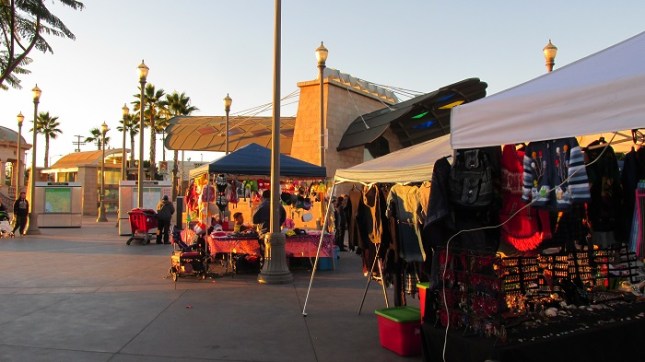
I went back another day and things were much more lively. A band was on stage in the amphitheatre, people were dancing on the plaza, and the place was crowded with booths offering all sorts of stuff.

People having a good time on the plaza.

People having a good time on the plaza.

The plaza crowded with booths.

The plaza crowded with booths.

I don’t think many of the residents of Boyle Heights would argue against the need for development. What they want is to have a voice in the planning. So many of the projects proposed in this city are the result of deals made between politicians and developers behind closed doors. That’s got to stop. The only way to plan for a community is to invite the community’s participation. This can be a long, slow, difficult process, but in the end it’s more efficient than the City’s current approach. If the MTA had talked to the people of Boyle Heights first, they could have avoided the huge embarrassment of having their project shut down. If the MTA had spent some time listening to residents, by now they might be well on the way to building something that they community could really support.

If you want to dig deeper into the history of Mariachi Plaza, check out the web site.

Mariachi Plaza

And this essay with photos is worth taking a look at.

The History of the Cummings Block

Banner by artist Dalia Ruiz.

Banner by artist Dalia Ruiz.

Money Talks, and the City Council Listens

Hills on the west side of Coldwater Canyon

Hills on the west side of Coldwater Canyon


This post was updated on March 14, 2016.

I saw an article on CityWatch today about Harvard-Westlake School’s continuing efforts to expand their campus on Coldwater Canyon. I’ve posted about this crazy project before, but reading the article made me want to do a follow-up. For those of you who haven’t been following the controversy, here’s a brief summary….

Harvard-Westlake, an elite prep school located in the hills just above Ventura Blvd., wants to build a three story parking lot that would hold 750 cars just across the road from their campus on Coldwater Canyon. But that’s not all. The structure would be capped by an athletic field, with the perimeter ringed by powerful lighting to accommodate night games. And to facilitate access, they want to build a bridge across Coldwater to connect the structure to the campus.

There are a lot of reasons to oppose this. The fact that the project would mean the removal of over 100 protected trees and 100,000 cubic yards of soil from the hillside is scary enough. Plus the loss of habitat for wildlife that lives in the hills. But we should also ask why, at a time when the City of LA is constantly telling us we need to reduce our carbon footprint, is Harvard-Westlake building a parking lot that will make it easier for people to drive to their campus?

But the CityWatch article focusses on efforts by people associated with Harvard-Westlake to push this project through. According to the author, a number of these people have given generously to Councilmember Paul Krekorian’s campaign committee. Now, there’s no law against giving money to a candidate, and for anybody living in LA, it’s certainly no surprise to hear about rich power players throwing money at the City Council. But it’s important to remember that the school is a 501C3, and there are strict rules about non-profit groups engaging in political activities. Here’s a quote from the IRS Compliance Guide for 501C3 Public Charities.

Political Campaign Intervention

Public charities are absolutely prohibited from directly or indirectly participating in, or intervening in, any political campaign on behalf of (or in opposition to) a candidate for public office. Contributions to political campaign funds or public statements of position made on behalf of the organization in favor of or in opposition to any candidate for public office clearly violate the prohibition against political campaign activity. Violation of this prohibition may result in revocation of tax-exempt status and/or imposition of certain excise taxes.

I took a look at the LA Ethics Commission web site, and found 14 people associated with Harvard-Westlake who all decided to throw something in Krekorian’s campaign coffers around the same time, from late October through late November 2014. That does seem a little suspicious. Especially since 9 of the 14 contributions are listed under the same date, November 3, 2014. Sure sounds like a coordinated effort to me. If that’s true, it would certainly be a violation of the law. The language in the IRS Compliance Guide is pretty clear. “Public charities are absolutely prohibited from directly or indirectly participating in, or intervening in, any political campaign on behalf of (or in opposition to) a candidate for public office.”

Sounds to me like these people broke the law. Does Krekorian care? I guess not, since he kept the money.

If you want to learn more about the situation, here’s a link to Save Coldwater Canyon, a group that opposes the project.

Save Coldwater Canyon

We Don’t Have the Water

WP 01 Head

Clearly, the crowd down at City Hall is totally out of touch with reality. They’re completely caught up in the delusion that they’re creating a dazzling new urban landscape, when in fact they’re doing tremendous damage to the City. They say they’re planning for the future, but rational people know that planning for the future means starting with the cold, hard reality of the present.

Here’s the reality. We don’t have enough water to support the current massive surge in development. Not by a long shot.

Recently the Downtown News ran an article listing more than 90 projects planned for Downtown LA. You read that right. Nine zero. But that’s only the beginning, because there are large projects planned for the Crenshaw District, Koreatown, Hollywood, West LA and Warner Center. These projects will bring thousands of new residential units, along with office space, retail and restaurants, and they will boost water consumption in LA by many thousands of acre feet per year. Yeah, I know they’ll have drought-tolerant landscaping and low flush toilets. Let me repeat. These projects will boost water consumption in LA by many thousands of acre feet per year.

Los Angeles, like the rest of the southwest, is facing a severe, long-term water shortage. The TV news tells us that the drought started four years ago, and everybody’s hoping it will end with El Niño. But the conditions that created this shortage have existed for decades. This isn’t just a matter of waiting out a few dry years until things get back to normal. This is the new normal.

Lawns are turning brown all over LA as people try to decide  whether to replace them or just let them die.

Lawns are turning brown all over LA as people try to decide whether to replace them or just let them die.

Let’s start with some basic facts. LA gets its water from four sources, the LA Aqueduct, the California Aqueduct/State Water Project, the Colorado River, and local groundwater. Here’s a breakdown of how each of these resources has been compromised in recent years.

LA Aqueduct
The LA Aqueduct was dammed from April through October of this year. This was done because the DWP has been ordered by the courts to mitigate environmental impacts in the Owens Valley. That means that for roughly six months out of the year, LA received no water from the LA Aqueduct. This is the first time in the one hundred year history of the Aqueduct that it’s been dammed, but there’s a good chance it will happen again as snow packs in the Eastern Sierras continue to decline.

California Aqueduct/State Water Project
The Metropolitan Water District (MWD), which serves LA, received only 20% of its allocation from the State Water Project (SWP) in 2015. The SWP depends on the Sierra Nevada snowpack for most of its water. On April 1, 2015, the statewide snowpack held only 5% of its average water content. Currently there’s no reason to believe that the decline of California’s snowpacks will be reversed in the near future, which means it’s likely that the MWD will receive only a fraction of its allotment for years to come.

Colorado River
This year the Colorado River was the one bright spot in the water picture, and local agencies received 100% of their allocations. But don’t expect that to continue. The amount of water flowing through the Colorado River has been declining for years. Lake Mead and Lake Powell are hitting record lows. It’s almost certain that allocations from the Colorado River will be slashed in the years to come.

Groundwater
For decades contamination from industrial waste has been encroaching on the wells in the San Fernando Valley. Right now about half the wells are closed. The DWP plans to build two new facilities to purify this water, but they haven’t even started construction yet, and it will be years before they’re completed.

Now maybe as you read this you’re saying, Oh, come on. It’s not so bleak. The weatherman says that El Niño is going to bring torrential rains to LA. All we need is a good wet year to fill up the reservoirs and recharge the aquifers and we’ll be okay. The drought will be over. Right?

Wrong.

Believe me, I hope we have a really wet winter this year. And if we get enough rain it could ease the drought for a couple of years. But it won’t solve the problem. All it will do is offer a reprieve.

Because the problem is not that we haven’t been getting enough rain in LA. The problem is that the snowpacks that we rely on for most of our water are shrinking steadily. This is not a new phenomenon. Snowpacks in the Western United States have been declining for decades. Check out this report issued by the American Meteorological Society.

Declining Mountain Snowpack in Western North America
American Meteorological Society, January 2005

It’s a lengthy document, and geared towards academics, so if you don’t want to plow through the whole thing I don’t blame you. Let me just give you this excerpt from the conclusion.

It is therefore likely that the losses in snowpack observed to date will continue and
even accelerate (Hamlet and Lettenmaier 1999a; Payne et al. 2004), with faster losses in milder climates like the Cascades and the slowest losses in the high peaks of the northern Rockies and southern Sierra. Indeed, the agreement in many details between observed changes in SWE [snow water equivalent, or water content of snowpacks] and simulated future changes is striking and leads us to answer the question at the beginning of this paragraph in the affirmative. It is becoming ever clearer that these projected declines in SWE, which are already well underway, will have profound consequences for water use in a region already contending with the clash between rising demands and increasing allocations of water for endangered fish and wildlife.

This report was written in 2005. Ten years later, the authors’ predictions have come true. We’ve seen California snowpacks decline drastically, and the data seems to indicate that they will continue to decline. This isn’t just limited to the West or to the US. This is part of a global trend. Check out the report released earlier this month by the Earth Institute at Columbia University.

Declining Snowpacks May Cut Many Nations’ Water

According to the DWP, between 2006 and 2010 we got about half our water from the Metropolitan Water District (SWP and Colorado River), about a third from the LA Aqueduct, and 11% from local groundwater. The water that flows from the SWP, Colorado River and LA Aqueduct originates as runoff from snowpacks. From all indications, those snowpacks are going to keep receding for the foreseeable future. That means we can no longer rely on the resources that used to supply about 90% of our water. And as for the aquifers that supply us with groundwater, it will be at least five years before the DWP can build the facilities to clean it up.

As the hillsides get drier, the risk of fire increases.

As the hillsides get drier, the risk of fire increases.

There are lots of ideas out there about how to cope with this crisis, recycling, greywater, stormwater capture, desalination. All of them have potential, but it’s going to be a long time before any of them start producing the quantities of water we need for a city of nearly 4,000,000 people. We can’t afford to squander water, but that’s exactly what our elected officials are doing. By allowing rampant, reckless development with no real planning behind it, they’re giving away water that we don’t have.

I am not saying we should put a halt to development. What we need to do immediately is make a realistic assessment of how much water will be consumed by all projects currently under construction, all those that are going through the approval process, and all those that are still in the planning stages. Then we need to set priorities, approving only projects that will truly benefit the people of LA, instead of continually greenlighting high-end high rises and luxury hotels.

Next we need to make a realistic assessment of how much water we can expect to have, and this is a good time to do so. The DWP is currently working on its 2015 Urban Water Management Plan (UWMP), and a draft will be released for public comment early next year. We need to make sure that the UWMP accurately reflects our current situation. The Plan will certainly emphasize conservation, recycling and stormwater capture, and that’s all to the good. But it also needs to reflect the fact that every source of water the City has depended on for a hundred years has been severely compromised.

Finally, we need to make sure that our elected officials acknowledge these limitations and start doing some real planning for the future. These days the people at City Hall are fervently, proudly, recklessly pro-development. That’s nothing new for LA politicians. This City was built by out-of-control, irresponsible development. Except for a few brief periods when voter backlash scared the people at City Hall, developers have almost always gotten their way. But that’s got to end. We can’t afford to keep doing business as usual.

We don’t have the water.

WP 50 River