The LA Department of Recreation & Parks (RAP) has been underfunded and understaffed for years. While LA politicians talk a lot about the importance of green space and open space, when it comes to actual funding, LA’s parks seem to be a very low priority. Some of the city’s parks are well-maintained, but these tend to be in more affluent areas, where residents have access to additional funding resources. Many of LA’s parks are in bad shape because RAP doesn’t have the money or the staff to give them proper care.
One of the biggest problems for RAP is that it’s one of only two LA City departments that’s subject to the “full cost recovery program”, something that City Hall imposed when it was dealing with the 2008 financial crisis. This means that RAP has to reimburse the City for the cost of the water and power it uses, in addition to the cost of employee benefits. (The only other department required to do this is the LA Public Library, and they were able to mitigate the loss of funding through a ballot measure.) This means that RAP is paying tens of millions of dollars every year to cover these costs, which is a huge chunk of its budget. To give you an idea of what a drain this is, here’s an excerpt from a memo sent by RAP General Manager Jimmy Kim regarding the Department’s 2023-24 budget….
CHALLENGES: RAP is required to continue to use $98M (28.92% of the total operating budget) to pay reimbursements to the City’s General Fund for employee benefits ($64.7M), the Department of Water and Power (DWP) for utilities ($30.4M), and the Bureau of Sanitation for refuse costs ($2.9M). These increases diminish RAP’s ability to meet and increase vital maintenance and recreational programming needs. Since the inception of these Department contributions in FY ‘08-09, approximately $969M has been diverted away from RAP’s core operations.
So if you’re wondering why the playground in your local park is looking so worn out, or why the restrooms aren’t properly maintained, or why the pool has been closed for so long, there’s a good chance it’s because RAP doesn’t have the money to take care of these things. A 2018 Parks Condition Assessment Report recommended that 20 recreation centers be replaced because they were in poor condition, needing major retrofits and renovation. The same report recommended that 12 pool and bathhouse facilities be replaced because many of them were over 60 years old and had surpassed their expected service life. But more than six years later, much of that work has still not been done because of insufficient funds.
The people of LA need clean, well-maintained parks. It’s possible to provide the funding to accomplish that, but any effort along those lines needs to be open and transparent, with strong public engagement and careful oversight. I’ll be writing a follow-up to this post where I’ll talk more about how we can make that happen.
As LA struggles to deal with the massive devastation of the recent fires (which are still not completely contained), I wanted to repost this article from The Lever, which argues that developers and real estate interests pushed back against efforts to limit development in fire prone areas. You have to sign up to read it, but it’s free, and it’s an interesting read.
It reminded me of the debate over SB 610, recently introduced in the California Legislature by State Senator Scott Wiener, which would have radically changed the approach to fire hazard rankings in California. Opponents saw it as an attempt to allow new development in areas where wildfire risk is high. The bill was not approved, but supporters have said they’ll try again.
As I said in my previous post, I believe we need careful review of new projects in areas where there’s a risk of fire. The fires that burned across LA this month resulted in lost lives, lost homes and lost businesses. We need to do everything we can to make sure a disaster like this doesn’t happen again.
Map of current fires in LA area from Cal Fire, as of January 12, 2025
If you’re looking for updates on the fires in LA, this post won’t offer anything you haven’t heard already. The LA Times, Daily News, and local news stations have been doing an excellent job reporting on the situation. I’m writing this post because I want to talk about what comes next. While the fires are still burning, and may continue to burn through next week, we do need to start talking about the future of LA. And I think the best way to start talking about the future is to begin with the past….
The City of LA was built on real estate speculation. To some degree, this is true of most cities, but it’s especially true of Los Angeles. Writers have commented on the fact that this area lacks a number of the things that are generally the basis for large scale development, most fundamentally a reliable source of water. Nor did the City of LA initially have a port, and only gained one by annexing San Pedro in 1909. That area is only tenuously connected to the rest of the city by a narrow, 20-mile corridor that’s basically just a rail line.
LA did have oil. Drilling began in the 19th century, and in the early 20th century large sections of the city, including Downtown, were covered with oil wells. But real estate investors saw huge amounts of money to be made by residential and commercial development, and gradually most oil wells were either shut down or hidden. (The majority of wells that are still visible are located in the southern part of LA, and the low-income communities that are impacted don’t have the political clout to shut them down.) The real estate investors promoted Los Angeles aggressively, putting ads in newspapers nationwide, essentially selling the climate. LA had lots of sun and little rain. People came, but the investors knew that to sustain new development they’d need to bring more water to the area. The LA Aqueduct was completed in 1913, after business interests used dishonest means to buy up the rights to the Owens Valley’s water resources. As the city continued to grow, LA snagged more water from the Colorado River with the construction of Hoover Dam during the Depression. Then came the construction of the California State Water Project, which extended from the 50s through the 70s. The bottom line is, the City of LA is only able to support a population of almost four million people because it imports about 90% of its water from areas that are hundreds of miles away.
I’m talking about the way LA was built because I think it’s important to understand the city’s history in talking about the fires that have devastated LA’s communities. Real estate investors built LA because there were fortunes to be made. In the first past of the 20th century, the only efforts at planning were driven by investors looking for profit. In the second half of the 20th century, there was more of an effort to plan for growth, but efforts at responsible planning were often overridden by the same investors looking for more profits. In the 21st century, there’s a lot of talk about planning at City Hall, but really most of it boils down to upzoning large swaths of the city to promote more growth. Planning in the City of LA is still largely driven by investors and their lobbyists. If you don’t believe me, please read up on the recent convictions of former Councilmember Jose Huizar, former Deputy Mayor Ray Chan and others who were caught up in a massive scandal involving bribery, fraud and racketeering. And if you think those convicted were the only ones involved, it’s important to remember that projects backed by Huizar were almost without exception unanimously approved by the LA City Council.
Image from Cal Fire Update, January 11, 2025
The point here is that development in LA is not driven by responsible planning. Development in LA is driven by money. If you want to know why projects were approved and are still being approved in fire-prone areas, follow the money. While there have been individuals who chose to build their own homes in areas where fire risk is high, most of the residential development in these areas is the result of the creation of suburban subdivisions. Even when citizens expressed concern about fire risks in these areas, they were almost always ignored by the politicians, who had often received campaign contributions from the developers. The Porter Ranch area has been repeatedly threatened by fires, but that didn’t stop the City of LA from approving The Vineyards at Porter Ranch, a recent multi-phase mixed-use project that includes apartments, a hotel and a large retail component. The project location has been designated by the LA Fire Department as a Very High Fire Hazard Severity Zone (VHFHSZ). Another example is LA City Planning Director Vince Bertoni’s approval of the initiation of a General Plan Amendment (GPA) to make way for the Bulgari Hotel, a massive luxury hotel project that was to be located in another VHFHSZ in the Santa Monica Mountains. The request for the GPA was submitted by developer representative Stacey Brenner, whose husband served as a deputy to former Councilmember Paul Koretz. The project was in Koretz’ district. The Bulgari Hotel was only stopped because area residents put intense pressure on Koretz’ successor, Councilmember Katy Yaroslavsky, who promised to stop the project during her campaign for the office.
Many of the areas that have been burned in the current spate of fires have burned repeatedly before. In the last few decades there have been multiple fires in Brentwood, Bel Air and the Hollywood Hills. Other communities like Baldwin Hills, Sunland-Tujunga and Chatsworth have all been hit by devastating fires. But, with rare exceptions, the City of LA continues to approve new development in fire prone areas.
As fires continue to rage across Los Angeles County, talk of rebuilding has already begun. I wish our elected officials would take some time to think about this. We need to have a tough conversation about rebuilding. I understand that thousands of people have lost their homes, and their dearest wish would be to rebuild and return to their communities. If individuals have the resources to do this, and if they understand the risks, they should be able to make that choice. But with the death toll from the current fires at 16, and damages worth billions of dollars, our elected officials should think long and hard about pushing for large scale development in fire prone areas. In most of these areas, the question is not whether they’ll burn again but when they’ll burn again. The LA area has always been prone to fires. As climate change continues to make the region drier and warmer, the risks will only increase. And while our firefighters can work miracles when conditions are favorable, we’re now seeing a brutal demonstration of how hard it is to control wind-driven fires.
It remains to be seen how strong the push for rebuilding will be once the fires stop. No doubt the real estate investors are already weighing their options. Some may want to bet on rebuilding. Others may think the risk is too great and decide to put their money elsewhere. But California Governor Gavin Newsom has already announced the suspension of laws that would require environmental review for rebuilding in fire prone areas. This is just crazy. After this disaster we should be insisting on stronger environmental review. The California Environmental Quality Act (CEQA) requires an assessment of whether new development will result in wildfire risks. It also requires cities to ask whether fire departments can provide adequate protection and whether the site can be safely evacuated in an emergency. Instead of brushing these issues aside, we should be insisting on careful scrutiny.
CEQA also requires review of a project’s greenhouse gas emissions (GHGs), because of the growing threat of climate change. Most Environmental Impact Reports I’ve read make no meaningful effort to accurately assess a project’s GHG impacts. Instead, the preparers rely on the State’s CalEEMod platform, which allows them to input whatever numbers they want, thereby pretty much guaranteeing that no project will ever appear to cause significant GHG impacts. In reviewing the EIRs, LA City Planning generally accepts whatever the developers claim without question. While the City of LA and the State of California claim to be fighting climate change, in reality both of them usually support new development regardless of what the GHG impacts are.
Again, I totally understand that many of those who lost homes in the fire are anxious to rebuild. If I were in their situation, I’d probably feel the same way. But LA has been repeatedly hit by deadly and devastating fires. As much as we may want to hear inspiring words about rebuilding, we need to ask: Do we want to be reliving this tragedy over and over again?
Let’s think carefully before we start to build again. And let’s demand that our elected officials do the same.
Proposed conceptual plan for Headworks Site Development Project.
When I first started this blog over a decade ago, one of the first things I posted about was the construction of the Headworks Water Complex on the LA River just north of Griffith Park. (I also posted a follow-up in 2028.) The project consisted primarily of two underground reservoirs that were built in response to Federal laws that prohibited storing drinking water in open reservoirs, but the LA Department of Water & Power (LADWP) is now moving forward with other components, including a water quality laboratory, a direct potable reuse demonstration facility, and a public park.
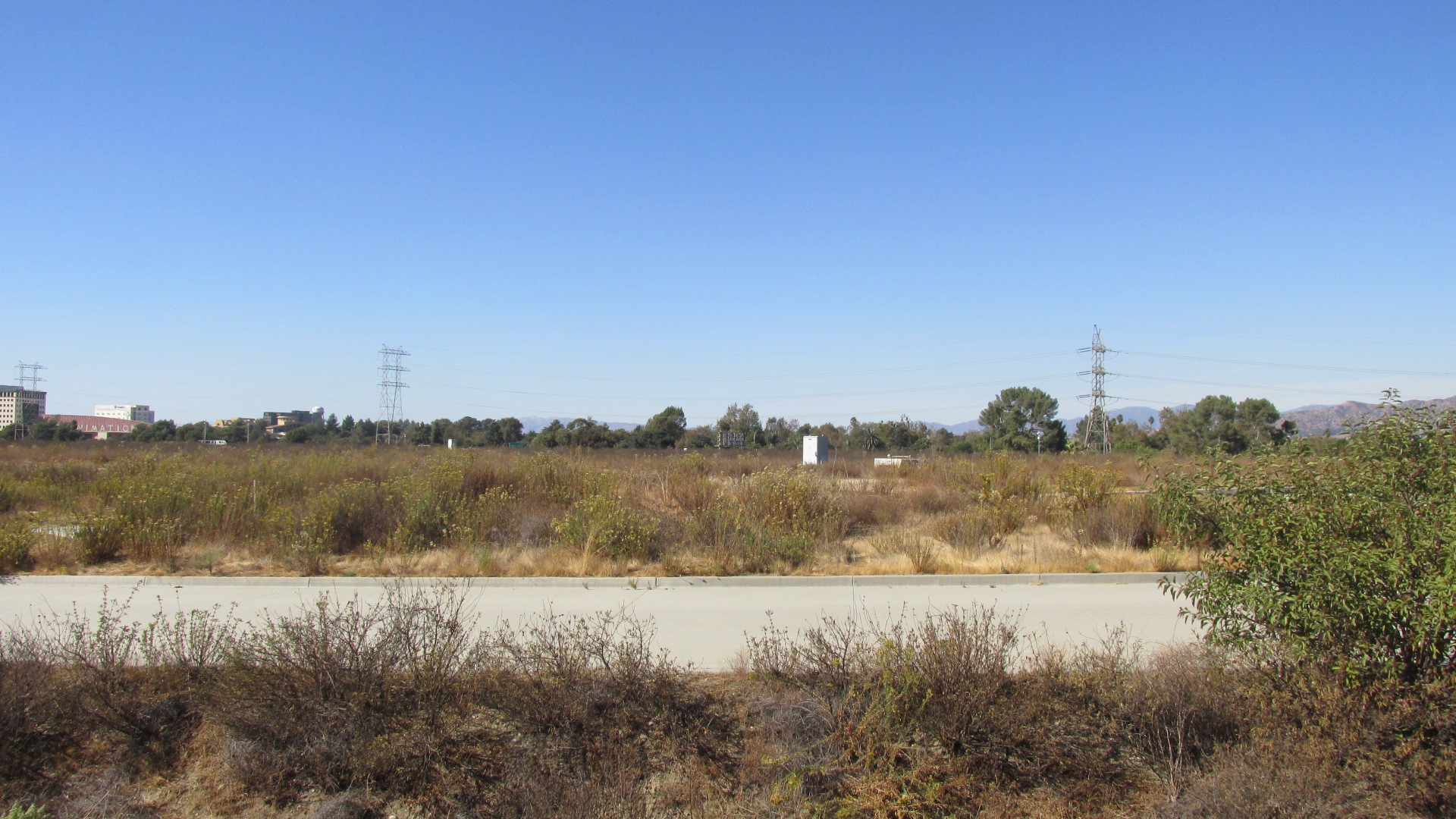
View of Headworks site from Forest Lawn Drive, looking north toward Burbank.
The first reservoir was completed in 2015, and the second in 2022. The public park was part of the original proposal, and I’d been wondering for years if it was ever going to happen, but in 2024 LADWP released an environmental study which includes the park proposal. It looks like it’s moving forward.
Another view of Headworks site from Forest Lawn Drive.
In addition to providing new recreational space, the proposed Headworks Restoration Park would provide facilities to educate the pubic about local ecosystems and water use. The centerpiece would be the gardens constructed on top of the West Reservoir. Currently the plan for the gardens includes a series of ramps, landings, and walkways along with groves of trees and bike paths. The image at the top of this post gives a general idea of what it would look like.
Top of reservoir protruding through landscape at Headworks site.
Right now LADWP is projecting that the park would be completed in 2028. Let’s hope it happens, but it’s important to remember that infrastructure projects have a way of dragging out longer than expected.






 The Horizon and the Skyline