LAUSD Student Data Breach: Lots of Hype, Little Oversight

LAUSD Superintendent Alberto Carvalho.

These days government agencies are trying hard to modernize the way they operate by revamping their data management systems.  This is understandable.  Entities that interact with thousands or millions of citizens are trying to offer 21st century efficiency to the people they serve.

The problem is, very few government agencies actually understand the 21st century digital landscape.  Often unelected bureaucrats are making decisions about tech contracts without having any idea whether the vendors can actually deliver what they’re promising.  It’s even worse when politicians get involved, because as we know, politicians sometimes try to steer contracts toward people that have supported them.

So it’s really not surprising to learn that the Los Angeles Unified School District (LAUSD) has had some serious problems handling student data.  In June it was reported that data belonging to LAUSD students had been obtained by a hacker and was being offered for sale on the dark web.  This was related to the massive Snowflake breach, in which customers of AT&T, Live Nation and dozens of other companies had their info exposed.  Then, at the beginning of July, it was reported that a whistleblower had alleged that AllHere, a vendor working with LAUSD, had violated the District’s privacy policies in the course of setting up an on-line information system to serve students and parents.  The icing on the cake is that AllHere seems to have collapsed, and it’s unlikely it will be able to fulfill its contract.

If the whistleblower’s account is accurate, it appears that AllHere promised way more than it could deliver, and LAUSD didn’t vet the company thoroughly enough.  This is actually a fairly common story.  You may remember a few years back when the City of LA was trying to force neighborhood councils to switch to on-line voting.  The City had signed a contract with a company called Everyone Counts, which claimed they were offering a tech breakthrough that would boost citizen engagement.  They also claimed that the personal data submitted by citizens to verify their identity was absolutely secure.  Not surprisingly, Everyone Counts was bought by another company, Votem, which collapsed soon after.  All the hype about on-line voting turned out to be just hype, and no one was ever able to explain what happened to the personal data that citizens had submitted for verification. 

LAUSD Superintendent Alberto Carvalho deserves a good deal of the blame for what’s gone down.  Carvalho spent a lot of time hyping LAUSD’s tech ambitions.  AllHere was supposed to be creating a comprehensive data management system that would allow LAUSD students and parents to find all sorts of information quickly and easily.  The face of the system was an AI chatbot named “Ed”, which appeared as a bright, smiling sun.  Carvalho went on the road telling everybody how great it was going to be.  Check out this video from the ASU+GSV Airshow, where the Superintendent lays out his vision for what “Ed” could do for students and parents.

At the time, it seems that Carvalho thought LAUSD was on the cutting edge of a major breakthrough.  Now it’s clear that he had no idea what he was talking about.  Carvalho is just one of the legions of people who have been hyping so-called Artificial Intelligence without really understanding what it is or what its impacts will be.  At this point nobody really knows how AI will affect the landscape, but there are still lots of people out there making ridiculous statements that have no basis in fact.  As an example, check out this quote from the web page for the ASU+GSV Airshow.

Artificial Intelligence…

Ubiquitous. Invisible. Required for life.

Unfortunately, this kind of idiotic blather is saturating the media.  Why?  Because tech companies want you to buy in to an untested technology that they don’t even understand yet.  It’s not about taking society to the next level.  It’s about conning you into spending your money on something you don’t need.

To be fair, Carvalho is doing a tough job at a time when LAUSD (and school districts across the US) are facing serious challenges.  He probably saw this tech initiative as a rare piece of good news that he could boast about.  And the members of the LAUSD Board also deserve a good deal of blame.  Just last March, the District issued a press release where board members lined up in support of the project. 

This is a serious problem.  Thousands of LAUSD students had their personal data posted for sale on the dark web.  If the whistleblower’s allegations are correct, the problem could be much larger.  Politicians and bureaucrats making decisions about technology need to realize the dangers.  They need to stop believing the hype, and start getting serious about due diligence, or we’ll be seeing a lot more disasters like this one.

The Fourth Street Bridge

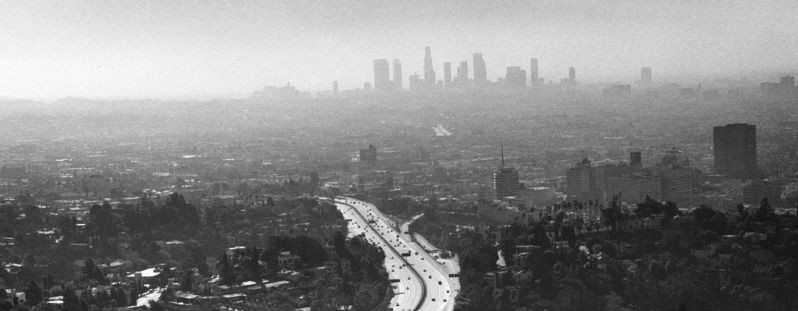
A view of Downtown from the Fourth Street Bridge.

Back in 2017, I walked across the Fourth Street Bridge and took a bunch of photos, thinking it would be a great subject to write about on this blog.  Now, only seven years later, I’m finally getting around to doing this post.  What can I say?  Time flies….

Fourth Place, leading up to the Fourth Street Bridge.

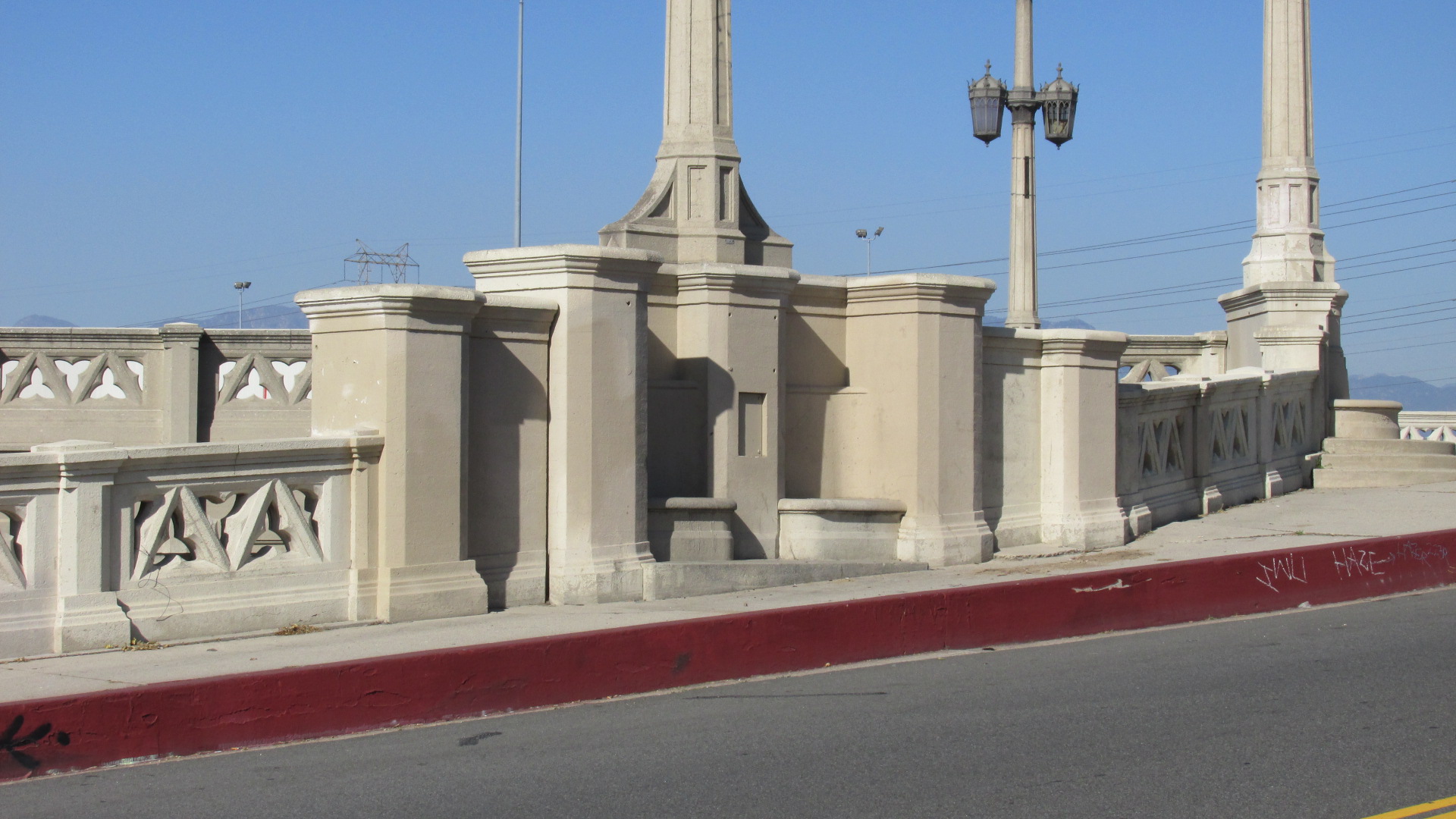
To my mind, the Fourth Street Bridge is one of the most striking bridges in LA.  I don’t claim to be an architecture critic, but it seems like there was unusual amount of care put into the design.  The streetlights, porticos and concrete railing were fashioned in a mix of Beaux Art and Gothic Revival styles that was carefully worked out by the architects.  These aren’t just decorative elements that were tacked on.  They’re well-suited to the scale and the massing of the bridge.

Fourth Place merges with the Fourth Street Bridge.
The streetlights echo European Gothic design.
Some of the piers feature built-in seating.

Constructed in 1931, the bridge was part of a massive investment in infrastructure made possible by the passage in the 20s of LA’s Viaduct Bond Act.  (To show you how ignorant I am, I didn’t know until recently what the difference was between a bridge and viaduct.  Apparently, a bridge is a small structure built to cross a fairly narrow river or ravine.  A viaduct is a larger structure made up of a series of bridges that crosses a wide river or a valley.  But I’m still going to call it the “Fourth Street Bridge”.  Old habits die hard.)

A view of the bridge looking toward East LA.
The San Gabriel Mountains to the north.
Unfortunately, these days many of the porticos are filled with trash.

The Fourth Street Bridge was built by the LA City Bureau of Engineering under the supervision of Bridge and Viaduct Engineer Merrill Butler.  Butler had a long career in LA, working for the City in various capacities until his retirement in 1961.  Over the years the projects designed under his direction included the First Street (now Cesar Chavez) Bridge, the Hyperion Bridge, the Figueroa Street Tunnels and the Hyperion Sewage Treatment Plant.

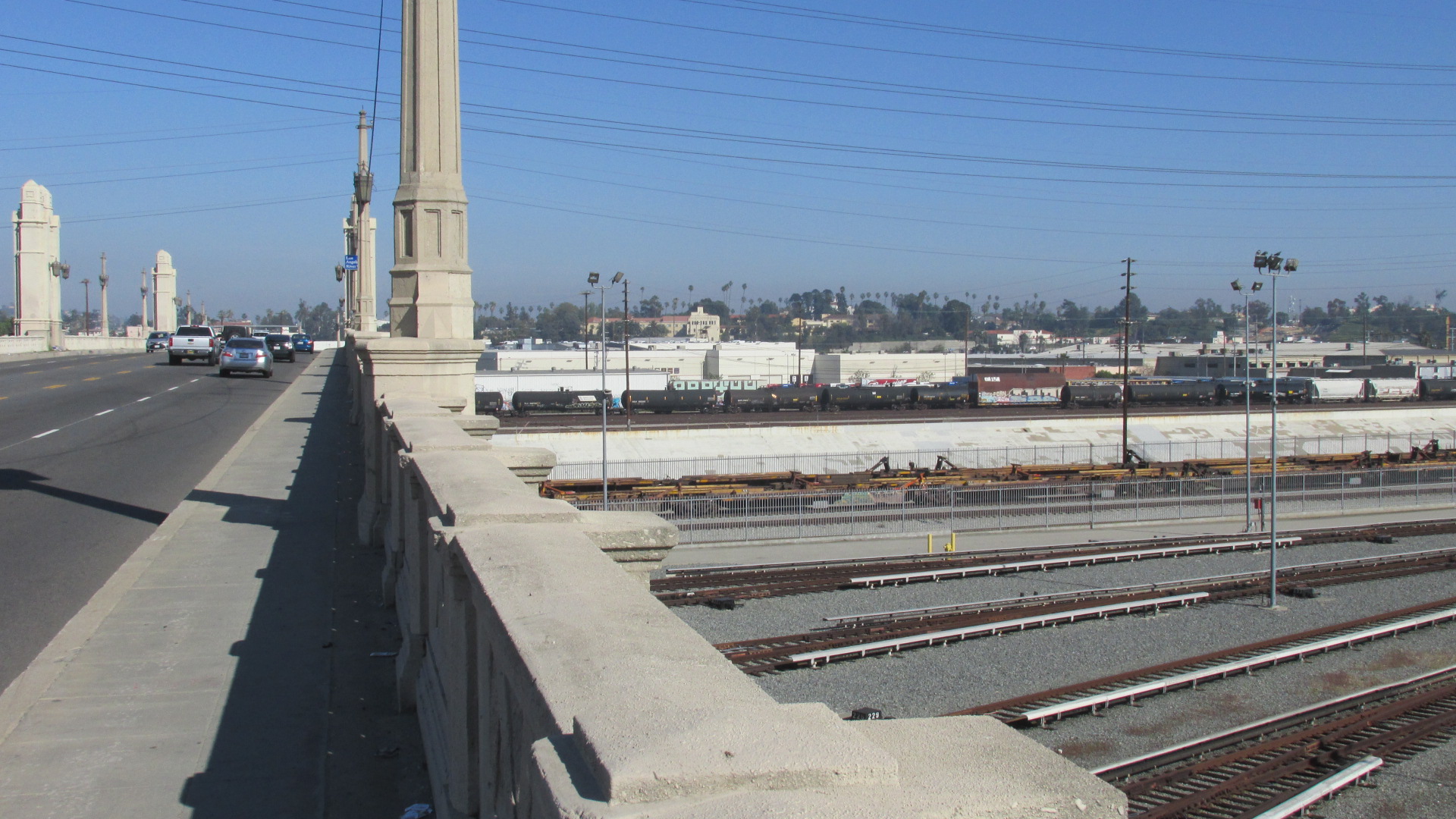
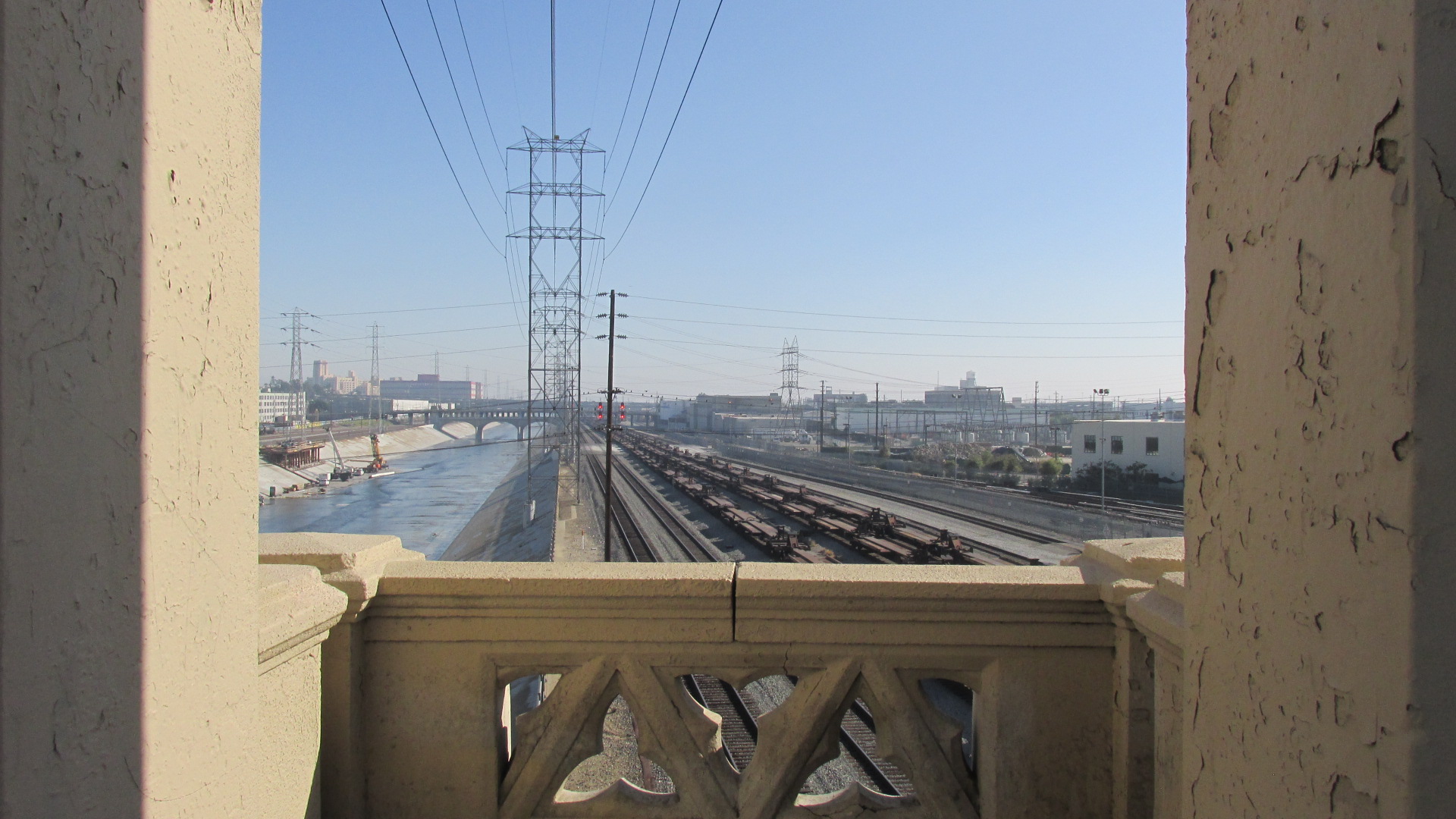
The series of bridges that connect East LA to Downtown are part of a massive infrastructure nexus that played a key role in LA’s growth.  In the latter part of the 30s, work began on the flood control projects that would shape the LA River as we know it today.  One of the reasons for encasing the River in concrete was to protect the rail lines that ran adjacent to it.  You couldn’t move goods without trains.  And rising above the concrete channel is a vast network of power lines.

Rail lines next to the LA River.
Miles of power lines run above the River.
Rows of flat cars lying on the tracks below.

In 1995, the Fourth Street Bridge was retrofitted to bring it into compliance with current seismic safety standards.  And in 2008 it was declared a Historic Cultural Monument by the City of LA.

The Cesar Chavez Bridge lies just north of the Fourth Street Bridge.
Looking west toward Downtown.

Here are a couple of links, for anyone who wants to dig a little deeper.  Thie first will take you to Water & Power Associates, which has a number of historic photos of the Fourth Street Bridge.  And if you’re into LA history, check out the Museum tab in the index on the left.  Their virtual museum offers an amazing collection of images and information.

Fourth Street Viaduct at Water & Power Associates

And here’s a brief bio on Merrill Butler that was apparently written at the time of his retirement.  Not surprisingly, it’s pretty superficial, but it also seems to offer a small snapshot of mid-century LA.  A different time, a different culture.

Merrill Butler Bio from LA Public Library

Are We Making Any Progress on Homelessness?

Homeless encampment on Hollywood Blvd. near Gower.

The results of the 2024 Homeless Count have been released, and the CEO of the Los Angeles Homeless Services Authority (LAHSA) says “the numbers we are seeing are very encouraging.”  Honestly, I don’t agree.  I guess you could say the fact that the growth in the homeless population appears to have levelled off is a good sign, but the fact that we still have around 75,000 homeless persons in LA County does not seem “encouraging” to me.

If you haven’t already seen it, I highly recommend Tim Campbell’s most recent article in CityWatch.  Campbell digs into the data and points out that, as we’ve spent increasingly large sums on homelessness over the last eight years, the numbers of people living on the streets have continued to rise.  Here’s a quote:

LAHSA’s fiscal year 2016-17 budget was $132.1 million, and it had 200 employees.  The 2016 PIT [Point-in-Time] count showed 46,874 homeless in L.A. County.  By fiscal year 2023-24, LAHSA’s budget ballooned to mor [sic] than $840,000,000 and it had 800 employees.  The 2024 PIT count showed more than 75,000 homeless in the County.  For a six-fold increase in budget, and a quadrupling of staff, the County suffered a 60 percent increase in homelessness.

That doesn’t sound like progress to me. 

In another recent article, Campbell talks about the structural problems with LAHSA.  He points out that the agency doesn’t do a good job of gathering or tracking data, and there’s no meaningful accountability.

In my view, the problems with LAHSA go back to its beginnings.  By the early 90s, LA City and LA County had been bickering for years over who was to blame for homelessness, with each pointing the finger at the other.  So their solution was to create a joint powers authority that would supposedly provide better coordination and more effective services. 

It hasn’t worked, largely because LAHSA was never given the authority to do the job.  LAHSA actually has no power.  It basically serves to funnel public money to various homeless services providers.  Some of them do a good job, some of them don’t, but it doesn’t matter how well they perform because the agency just keeps writing checks.  As Campbell points out, it would be hard for anyone, no matter how smart or talented, to make needed changes because LAHSA’s culture doesn’t allow that.  LAHSA’s culture seems to designed to keep the money flowing and the bureaucracy growing. 

Why is this?  In my opinion, it’s because it’s run by politicians.  The LAHSA Commission is 10-member body made up of politicians and political appointees.  Two LA County Supervisors serve on the Commission, along with three people appointed by the remaining Supervisors.  Mayor Bass also serves on the Commission, along with a Bass appointee, and two Garcetti appointees.  One seat is vacant. 

Of the five non-politicians on the Commission, apparently only one (Dr. Melissa Chinchilla) actually has a background in working with the homeless.  The others are described as “an attorney, equity advocate and mom”, an “educator and community leader”, a “chief impact officer and owner at […] a social-sector consulting firm”, and a “passionate advocate” with a “Bachelor of Science degree in Child Development”.  So on the 10-member LAHSA board, we only have one person who actually has a real background in serving the homeless.  This seems like a serious problem to me.

As long as the agency is run by politicians, decisions will be made based on political considerations.  These people are sitting on top of hundreds of millions of dollars.  If LAHSA were to be restructured to provide better coordination and higher efficiency, it might turn out that it could provide more effective services for less money.  This, of course, is not the outcome most politicians want.  The point is to keep the money flowing, whether the program is effective or not. 

There’s no simple solution to homelessness.  It’s not just a matter of providing housing.  These days homelessness is entwined with a drug abuse crisis and a mental health crisis.  It should be clear by now that if someone’s addicted to fentanyl, just giving them the keys to an apartment is not going to keep them housed.  Someone with serious mental illness needs treatment before they can move to independent living.

So I don’t want to pretend solving homelessness will be easy.  But in my view, we could make more progress if we got the politicians out of the mix.  LAHSA needs to be restructured to give it the power to create and implement policy.  Instead of doling money out to various service providers, it needs to have its own staff working to accomplish definite goals with clear metrics.  And instead of a commission made up of politicians and their appointees, it needs a commission made up of people with credible credentials in homeless services, mental health and substance abuse. 

I realize the chances of something like this happening are close to zero.  But as long as we keep stumbling along with the current, broken system, I doubt we’ll make any real progress on homelessness.