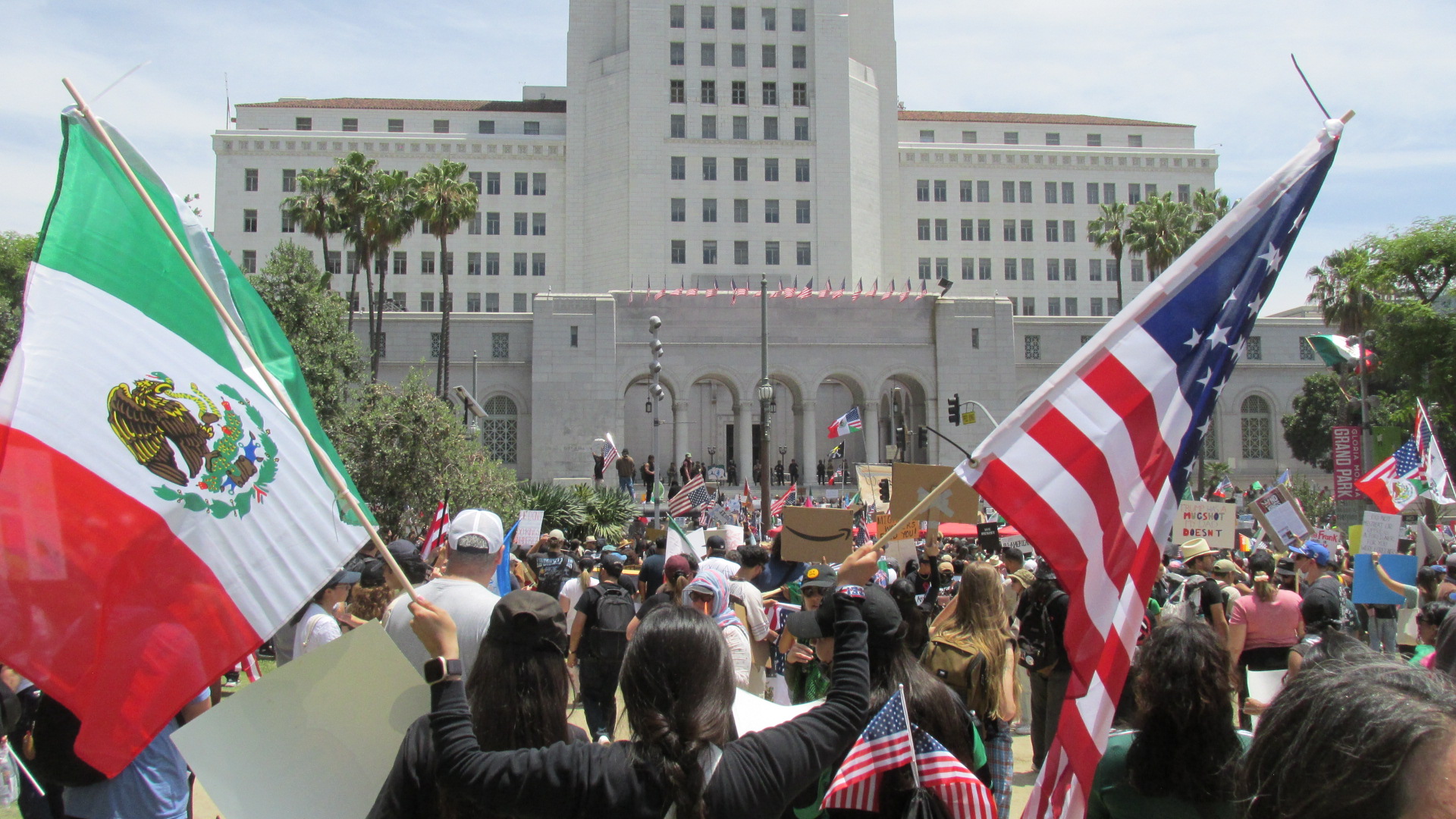
Protesters gathered in front of LA City Hall on Saturday, June 14.
Thousands of people gathered in Downtown LA on Saturday for a boisterous, hours-long protest . Attendees held signs voicing anger over a number of issues, but the overarching message was that the protesters were not happy with President Trump. The air was filled with music and chanted slogans. Helicopters and drones flew overhead.
Protesters marching up Hill Street.
Late morning, a friend and I got on the subway heading to Downtown. Unfortunately, the driver announced that the stops at Pershing Square and Civic Center were closed due to police activity, so we got off at 7th and Metro. This meant we had to hike about a mile and a half to get to City Hall. While walking up Grand, we could see the throng of protesters marching up Hill Street in the distance.
Windows were covered with boards at the Museum of Contemporary Art (MOCA).
We also saw that the windows were boarded up at the Museum of Contemporary Art. A number of businesses had boarded up their windows to protect against the vandalism that’s been occurring in Downtown over the past week or so. The raids by Immigration & Customs Enforcement (ICE), where agents have grabbed undocumented immigrants, sparked an outpouring of anger, and groups opposing the raids have held numerous gatherings to voice their outrage. But it’s hard to say who exactly is responsible for the graffiti, broken windows and retail theft. No doubt, some of it’s tied to the protests, but I think it’s also likely that some of the damage has been caused to opportunists who are taking advantage of the unrest to grab some merchandise or promote general mayhem.
Protesters arriving at Grand Park after marching up Hill Street.
When we arrived at Grand Park, protesters were still streaming in from Hill Street. While many came to speak out over the ICE raids, as well as Trump’s order to send the National Guard and Marines to LA, the event had been planned long before as part of a nationwide movement to push back against the President’s policies. On Saturday protests were held in New York, Chicago, Sacramento, Raleigh, St. Louis, Dallas, and many other US cities.
“Legalization is the answer.”
“I.C.E. Fuera de Tovaangar” (I.C.E. Out of Los Angeles) (Tovaangar is the name that was used by the indigenous people living in the LA area before Europeans arrived.)
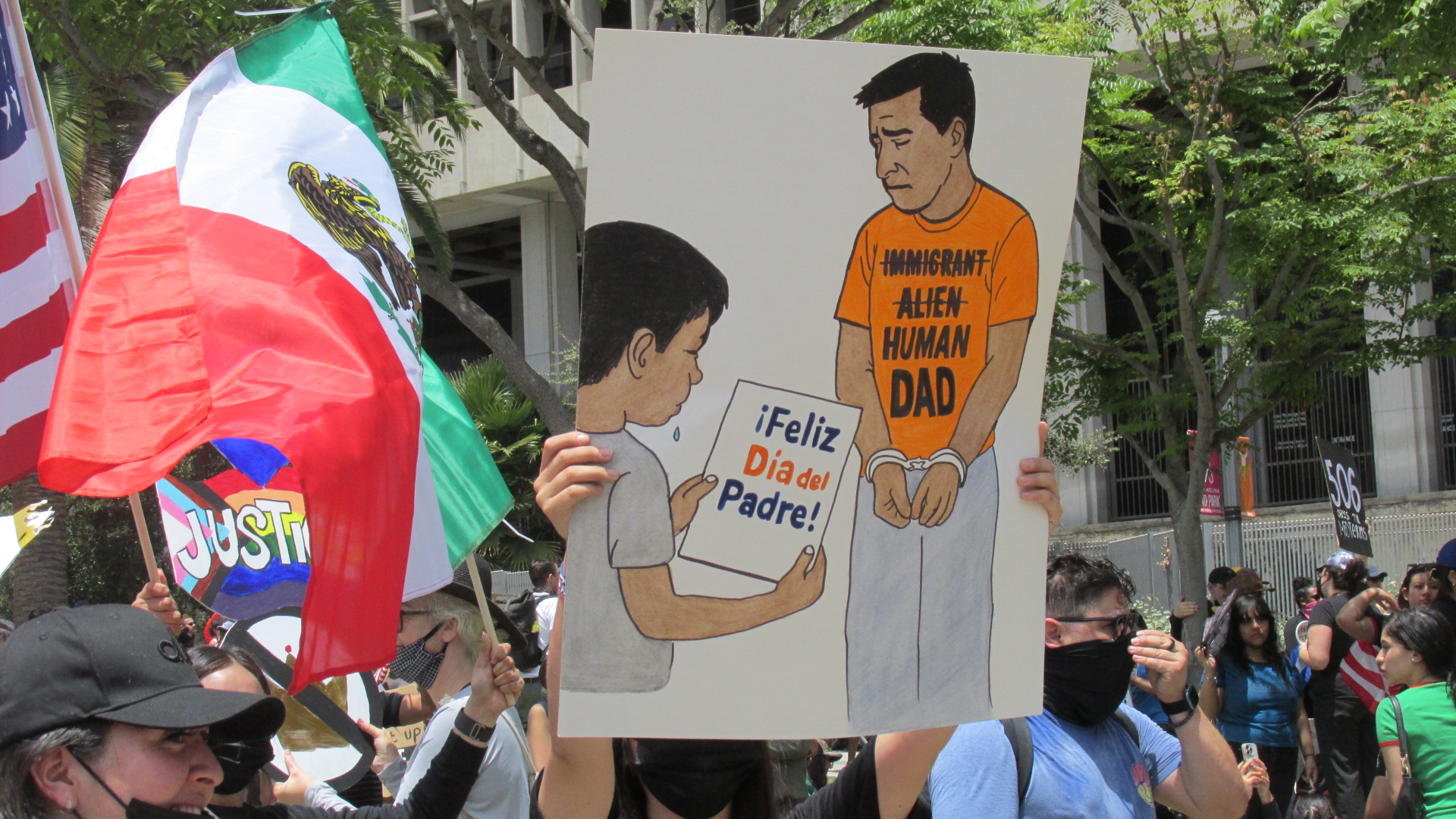
“Feliz Dia del Padre” (Happy Father’s Day)
While I was there, the protest seemed completely peaceful. Hard to say how many turned out, but I’d say several thousand. Apparently things got rough later in the afternoon. The LAPD said that around 4:00 pm some protesters began throwing rocks, bricks and bottles. They responded by issuing an order to disperse. From an account published in the LA Times, it appears officers then used rubber bullets and tear gas to clear the streets. No serious injuries were reported.
Law enforcement stationed above the steps to LA City Hall.
An image of the Constitution standing in front of City Hall.
The protests will continue. While most of Trump’s supporters seem to stand firmly behind him, there are millions of Americans who believe his administration is deliberately undermining the Constitution and that he’s trying to assume power as an authoritarian dictator. Personally, I think there are dark days ahead of us.
I went down to City Hall for a hearing this afternoon. I got off the subway at Civic Center and walked across Grand Park to Spring. The park seemed peaceful, as usual, but as I got closer to City Hall I saw a crowd of around a hundred protesters gathered on the steps at the entrance. Activists spoke passionately about the injustice of the ICE raids.
I entered City Hall and attended the hearing, which lasted until about four fifteen. Then, since I hadn’t had lunch, I walked up First Street looking for a place to eat. Unfortunately, these days its hard to find a restaurant that’s open in the Civic Center. As companies have reduced their footprint in Downtown or abandoned it altogether, many local businesses have cut their hours or closed down.
As I walked up First Street, I saw that the ground floor of the former LA Times building was covered with graffiti. A little farther up there was a row of parked police cars. Helicopters crisscrossed the sky overhead. Even though things were calm, there did seem to be tension in the air.
Thinking that the cafe at MOCA might still be open, I headed up to Grand. I walked into the cafe and saw that they were cleaning up. The woman behind the counter said they were open for another 20 minutes, so I ordered a sandwich. When it was ready, I went out to the patio and sat down to eat it.
The woman at the counter spoke with a heavy accent. My guess is that she had come from somewhere in Central America. In the time I was there, she made my sandwich, wiped off the tables in the patio, straightened the chairs and emptied the trash cans. When I left she was sweeping up inside the restaurant.
These are the people that keep this city going. These are the people that keep this country going.
Graph from California Legislature’s report “Recent Legislative Actions to Increase Housing Production in California”
As has become usual over the past several years, the California legislature is considering a number of bills that would override local planning control and weaken environmental review for new development projects. Two of the most controversial bills are SB 79 and SB 607. SB 79, from State Senator Scott Wiener, would remove local zoning restrictions for housing projects proposed on sites near transit. SB 607, also from Senator Wiener, along with principal co-author Assembly Member Buffy Wicks, would essentially gut the California Environmental Quality Act (CEQA), giving local agencies broad latitude in deciding what level of environmental review was needed for a project, if any. (On May 19, both bills were placed in the Senate Appropriations Committee suspense file, which generally means a bill is on hold, but both are scheduled to be heard again by the Committee today, May 23.)
You probably won’t be surprised to hear that, while these bills have a long list of supporters, they’ve also generated major pushback from both individuals and established organizations. SB 79 is opposed by Public Counsel, the Public Interest Law Project, the Western Center on Law & Poverty, and numerous California cities. SB 607 is opposed by a number of environmental groups, including the Center for Biological Diversity, Sierra Club California and Friends of the LA River. (Full disclosure: I work with a group that has sent letters opposing both bills, United Neighborhoods for Los Angeles.)
This has turned into a routine. Every new session, state legislators present a number of bills designed to allow developers to build bigger and faster, with little or no environmental review. The legislators claim it’s the only way to solve the housing crisis. What’s unusual about this year is that Governor Gavin Newsom has upped the ante. As the efforts of citizens and organizations opposed to these bills seem to be having an impact on legislators, Newsom has come forward to say that he’s going to use the budget process to achieve the goal of speeding up new development. Like Wiener, Wicks and many others, Newsom sees the housing affordability crisis purely as a matter of supply and demand. They believe that housing prices will go down if they erase local planning authority and let developers build with little or no environmental review. It’s the classic supply-side economics argument. Unleash the free market, and it will solve your problems.
Unfortunately, the legislature has been unleashing the free market for years now, and it doesn’t seem to working. Take a look at the graph above. This is taken from a report produced by the State Senate and State Assembly Housing Committees. The report is titled….
California’s Housing Crisis: More Construction Is Needed to Meet the State’s Housing Needs
The paper was produced by the State Senate and Assembly Housing Committees. It argues that California has failed to produce enough housing for decades, and that lawmakers in Sacramento have been reversing this trend with the many bills that have been passed in recent years. They cite reforms to density bonus law, reforms to the Surplus Lands Act, faster approval timelines, and increases in “by-right” approvals. (When a project is approved “by-right”, it means an application is approved automatically, with no public hearings and no environmental review.) The text emphasizes large increases in the percentage of Low-Income and Very Low-Income units completed, and says there’s been a 61.5% overall increase in affordable housing production. That’s great, but the report doesn’t give numbers for rent-stabilized units lost during the same period, or the number of affordable units that converted to market-rate when their covenant expired, which means we don’t know if there’s really been a net gain.
And in spite of the report’s claims about increased housing production, the graph seems to show the opposite. By my count, the report lists 98 bills that were intended to spur housing growth over the last two decades. Things really kicked into high gear in 2017, when Sacramento passed 15 pieces of legislation related to housing. Looking at the lists compiled in the report, it appears that from 2017 through 2024 the Legislature approved a startling 87 bills to jump start housing. Based on the number of bills, if you accept the arguments that Wiener and friends are making, you’d expect housing production to go through the roof. But if we look at the chart above, you can see that the number of units permitted since 2017 is well below the number permitted during the first decade of this century. While it looks like there’s been a slight increase in multi-family units produced over that period, there’s been a huge drop in the number of single-family homes produced. The numbers look even worse if we go back to the 80s. The quantities of both multi-family and single-family homes produced in that decade are far higher than the quantities produced since 2017.
Which brings us to the question, What has this onslaught of legislation actually accomplished? Wiener and his pals have spent years pushing bills to override local zoning restrictions, and they’ve also been busy hacking away at the California Environmental Quality Act (CEQA). They argue that loosening local zoning and sidelining CEQA will spur new housing growth. But look at the numbers. Wiener and friends started their assault on local zoning and CEQA back in 2017. While the text of the report seems to be telling us that their campaign has been a resounding success, the graph the authors lead off with tells a different story. Housing production since 2017 is well below what it was in the 2000s, and it’s WAY below what it was in the 1980s. And it’s important to point out that in both of these earlier periods, local zoning was more restrictive than it is now, and CEQA was in full force. No doubt some will argue that the pandemic held down new construction, but California’s own housing dashboard shows that the number of permits issued actually increased during the crisis. (See slide 8 on the housing data dashboard.)
Newsom, Wiener, Wicks and their cohorts keep telling us that local zoning and environmental review are two of the biggest roadblocks to new housing. But given the numbers that we see in the Legislature’s own report, it seems these folks have no idea what they’re talking about. The graph they lead off with tells the story. California was producing more new housing before the Legislature began its attack on local zoning and environmental review.
Would you want these diesel trucks driving through your neighborhood?
How would you like to have hundreds of diesel trucks driving up and down your street, spewing diesel exhaust, 24 hours a day, 7 days a week? Residents living on Redondo Beach Boulevard in the Harbor Gateway area have been trying for years to stop a massive distribution center from being built right across the street from their homes, but it seems that no one at LA City Hall is listening.
Back in 2018 I posted about the LA City Planning Commission’s approval of this toxic project directly across the street from residents’ homes in the Harbor Gateway community. Developer Prologis had filed an application to build a 300,000+ sq.ft. warehouse which would generate hundreds of diesel truck trips every day, and would operate all night long. The LA Department of City Planning had allowed Prologis to slide by with low-level environmental review that didn’t begin to address the impacts. Thankfully the State’s then-Attorney General, Xavier Becerra, stepped in to let the City know that they weren’t doing enough to protect the residents’ health. The people who had been fighting the project were overjoyed, but it turns out the reprieve was only temporary.
Apartments right across the street from the proposed distribution center.
The Prologis distribution center is back, and will be heard again by the City Planning Commission on Thursday, May 8. Given the CPC’s record of approving pretty much everything that comes before them, it’s likely the project will again be given the green light. The folks at LA City Hall do not seem to care that the residents are already subject to vehicle exhaust from the nearby 110 Freeway. Nor do they seem to care that the area ranks in the top 5% for pollution burden and vulnerability according to the California Environmental Protection Agency’s screening tool. And apparently it makes no difference that, in addition to the residential buildings, the project site is surrounded by a public park, an LAUSD school, nursing homes, and two churches. This project will bring the trucks already travelling the freeway right into the neighborhood, and air pollution has been shown to have serious health impacts on children, adults and seniors.
Area residents will be showing up at the CPC meeting to voice their opposition. If you can make it down to City Hall, they’d appreciate your support. The meeting starts at 8:30 am, but it’s hard to say exactly what time the item will be taken up by the Commissioners.
If you can’t make it down, you can also submit comments to the following e-mail address.
cpc@lacity.org
Be sure to identify the project in the subject line.
We all have places we’re attached to, places that are important to us, places that become part of our landscape. In most cases it’s easy to explain why they mean so much. Maybe it’s a restaurant we’ve been going to for years, or a club where we used to hang out with our friends. Usually, it’s a place where we’ve had a lot of good times, a locale that’s loaded with memories. But in some cases it’s hard to explain why the place means so much to us. Why its disappearance feels like a loss.
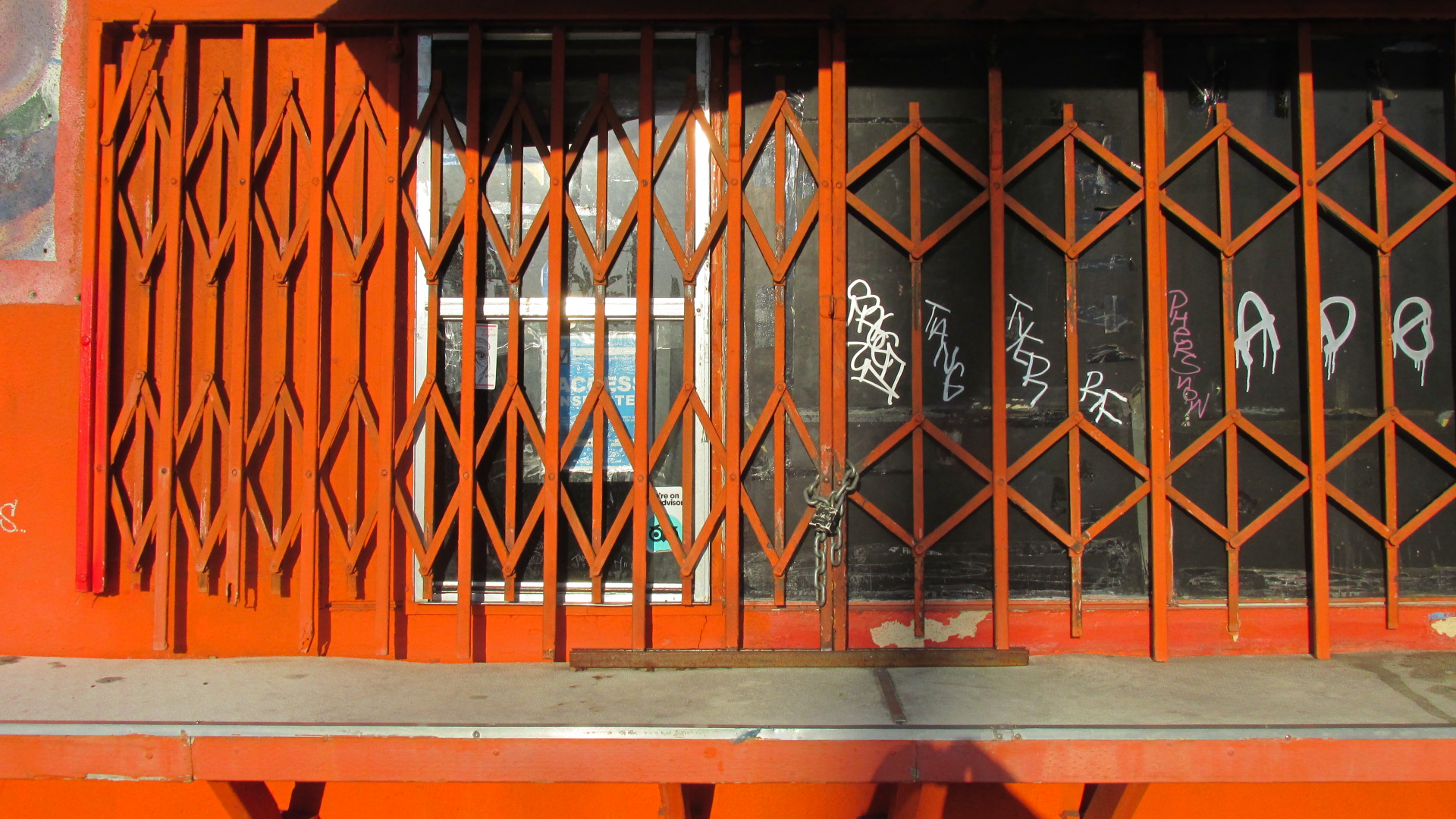
Counter outside the building.
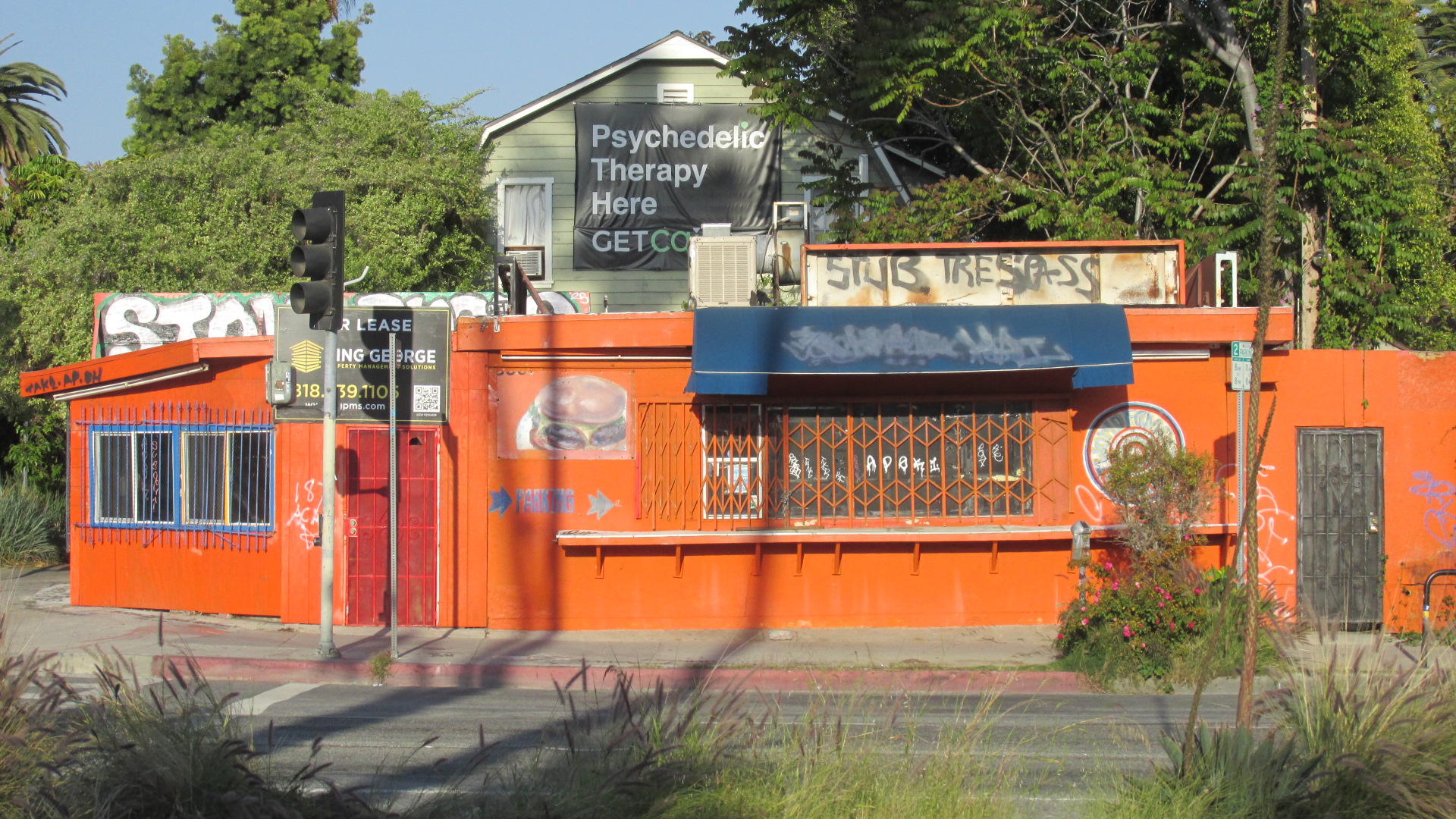
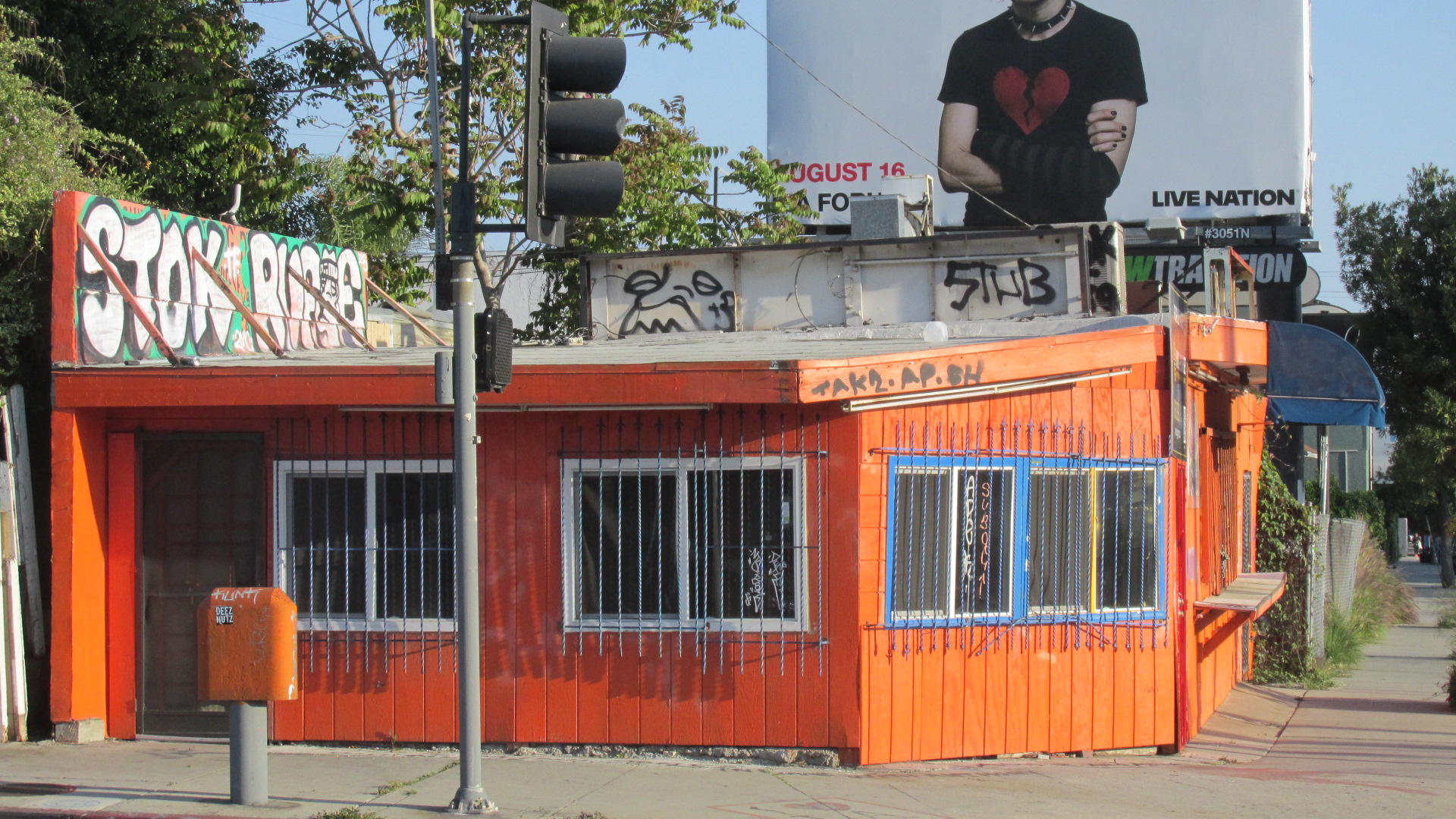
I was riding the bus down Fairfax last week and I saw that Oki Dog had closed. I can’t say I got choked up, but I did feel like I’d lost something. I’m not sure why. I never spent any time there with my friends. In fact, I never even ate there. But for decades now I’d seen it sitting there at the corner of Fairfax and Willoughby, a small, ramshackle building that only stood out because it was painted orange.
Painting on the front of the building.
The only reason I paid any attention to it at all was that I knew Darby Crash used to hang out there. Darby Crash, AKA Bobby Pyn, AKA Paul Beahm, was the lead singer for the Germs, one of the key bands on the LA punk scene back in the late 70s. They played a lot of shows, put out a few singles and an album, and then Darby killed himself by ODing on heroin on December 7, 1980. He was 22.
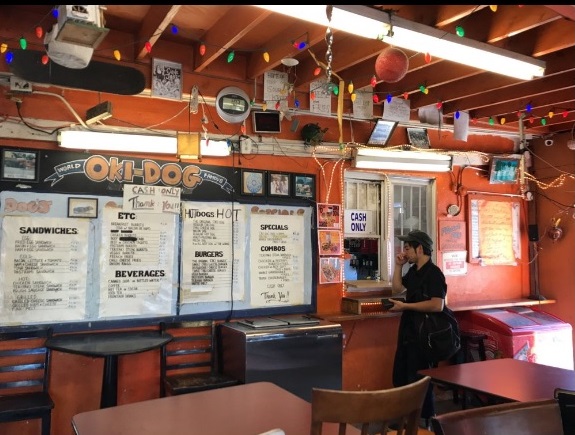
The tables inside are all empty now.
I never ate at Oki Dog because the food didn’t sound like my kind of thing, but the place had many diehard fans who raved about the messy, greasy hot dogs and hamburgers. I spent some time looking at the reviews on Yelp, and it was kind of hilarious how divided the comments were. Some commenters thought the food was disgusting, and were creeped out by the place’s grungy décor. Many of them said they’d never come back. Other commenters thought the food was amazing and loved the down-at-the-heels vibe. Many of them said they’d been eating there regularly for years.
Photo of Oki Dog when it was still open from Yelp by Eric F.Photo of Oki Dog interior from Yelp by Erica E.
But for me the only connection was knowing that Darby used to hang there with his friends and followers. I never saw the Germs live, but I’ve got the album, and a few of the singles and live recordings on various compilations. They were an amazing band. It’s tempting to say they were gone too soon, but like a lot great bands, they probably couldn’t have maintained the intensity much longer. When you play that hard and live that crazy, it’s probably impossible to hold everything together.
So for me, I guess that rundown orange shack at Fairfax and Willoughby that I never stepped inside is like a link to LA in the late 70s, when punk was raging through the clubs and it seemed like some kind of revolution was going on. And a young guy named Darby Crash was taking things all the way to the edge. Before he finally decided to jump off the edge.
RIP Darby.
UPDATE: Thanks to Margaret for pointing out that Oki Dog was originally located at 7450 Santa Monica Blvd., about two blocks up and eight blocks over from the location at Fairfax and Willoughby. The original restaurant opened in the late 70s, but I was not able to find out when it moved over to Fairfax.See this article from WeHo Times for more details.
Do we really need digital kiosks that could collect data from minors?
Advertising is invading our landscape in ever more intrusive ways these days, with digital signs, kiosks and billboards becoming increasingly present in our cities. What’s even more disturbing, advertising is also invading our privacy as technology makes it easier than ever to collect our personal information. It’s bad enough that advertisers are gathering information on millions of adults every day, but it’s even more disturbing when they’re gathering personal data from minors who often don’t even know that their info is being collected.
But the City of LA may be moving forward on an agreement that could put 300 to 500 digital kiosks on our streets, giving advertisers more opportunities to scoop up personal info. The LA City Council voted in 2023 to release a request for proposals (RFP) for interactive kiosks. While the RFP hasn’t been released yet, Councilmembers Tim McOsker and Curren Price have submitted a motion to push the process forward. In the meantime, a company called IKE Smart City and/or its parent company Orange Barrel Media have been busy securing letters of support from local chambers of commerce. They’re hoping to get a contract that would allow them to install their interactive digital kiosks in our communities.
So why should we be worried about the kiosks collecting our personal info? Because, in its privacy policy, IKE acknowledges that they collect and share all kinds of data about people who interact with the kiosks, starting with identifiers like your IP address, device name, phone number, and email address. They also collect and share geolocation and biometric data. IKE’s privacy policy is a classic example of how tech companies try to make you believe that they care about protecting your info. They start off saying that they respect your privacy and are committed to protecting your data. They also tell you that the kiosks don’t store any of the info you give them. But then they acknowledge that your data is being shared with their third-party partners, and that they have no control over the way those partners use the data. They also say that your data can be disclosed to their parent company, subsidiaries, affiliates, and any company that acquires their assets.
If you have kids, think about what this means. Say your teenage daughter is out with some friends, and they decide it would be fun to use the IKE kiosk’s photo booth option. Are they going to take the time to read through IKE’s terms and conditions before they start? Not likely. This means that while they’re having fun getting their picture taken with their friends, they could be giving away all sorts of personal info, including their device name, phone number, email address, location info and biometric data. And IKE acknowledges that, not only do they have no control over how their partners use the data, but they also have the option to share it with their subsidiaries and affiliates.
It gets worse. As part of the process for approving the Sidewalk & Transit Amenities Program (STAP) in 2022, the City Council also approved an ordinance that removed restrictions on any outdoor advertising structures in the public right-of-way that were part of a program approved by the Board of Public Works (BPW). Basically what this does is open up our sidewalks to a flood of new digital ad structures. You may have already seen the STAP bus shelters with digital ads. Digital kiosks are probably the next phase. (IKE’s kiosks appear to be about eight feet tall.) Because there are now no meaningful restrictions on these structures in the public right-of-way, we can expect these things to keep coming. If the BPW gives the green light, it’s a done deal. And don’t expect the BPW to be too particular. If it means revenue for the city, it’s unlikely the members of the board will raise any objections.
If you want to let your city council rep know how you feel about this, you can send them an e-mail or give them a call. If you don’t know who your council rep is, use this link to find out.
If you send an e-mail, you should include the following council file info in your subject line.
Council File: 22-1154-S1, Interactive Kiosks/Installation and Maintenance
It’s bad enough that we’re constantly being bombarded with ads on our personal devices. Now the City of LA wants to put digital advertising on our streets. And if IKE gets the contract, it appears that minors will be at additional risk of having their data collected and shared.
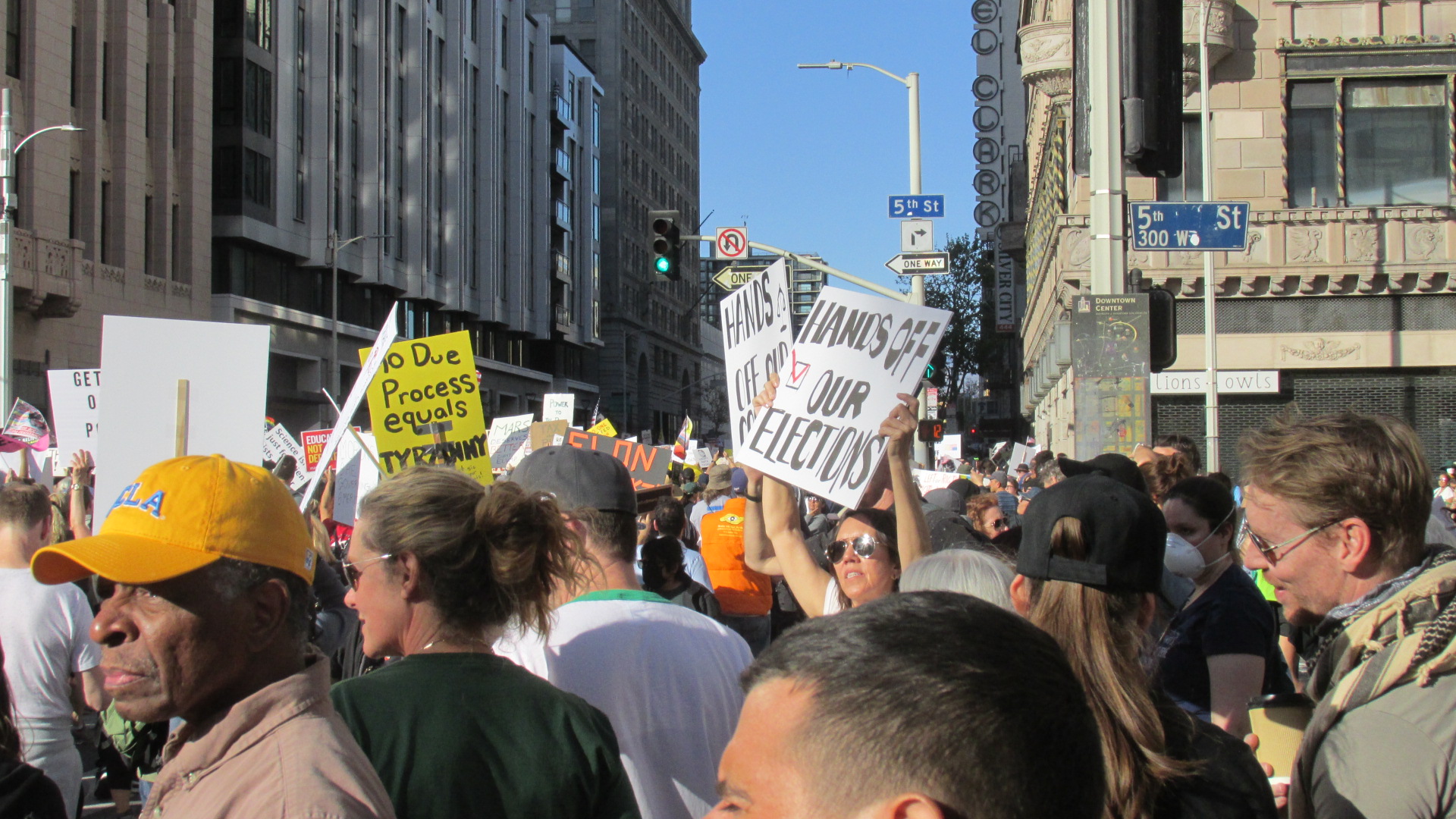
Thousands of people gathered in Downtown on Saturday to voice their anger at the Trump administration’s actions since his January inauguration. The President began by firing off a series of executive orders, some of which have been called unconstitutional. He’s given Elon Musk unprecedented access to US agencies, allowing Musk and his team to view the government’s vast trove of sensitive data belonging to millions of Americans. And he’s imposed sweeping tariffs on trading partners that sparked a massive sell-off in the stock market.
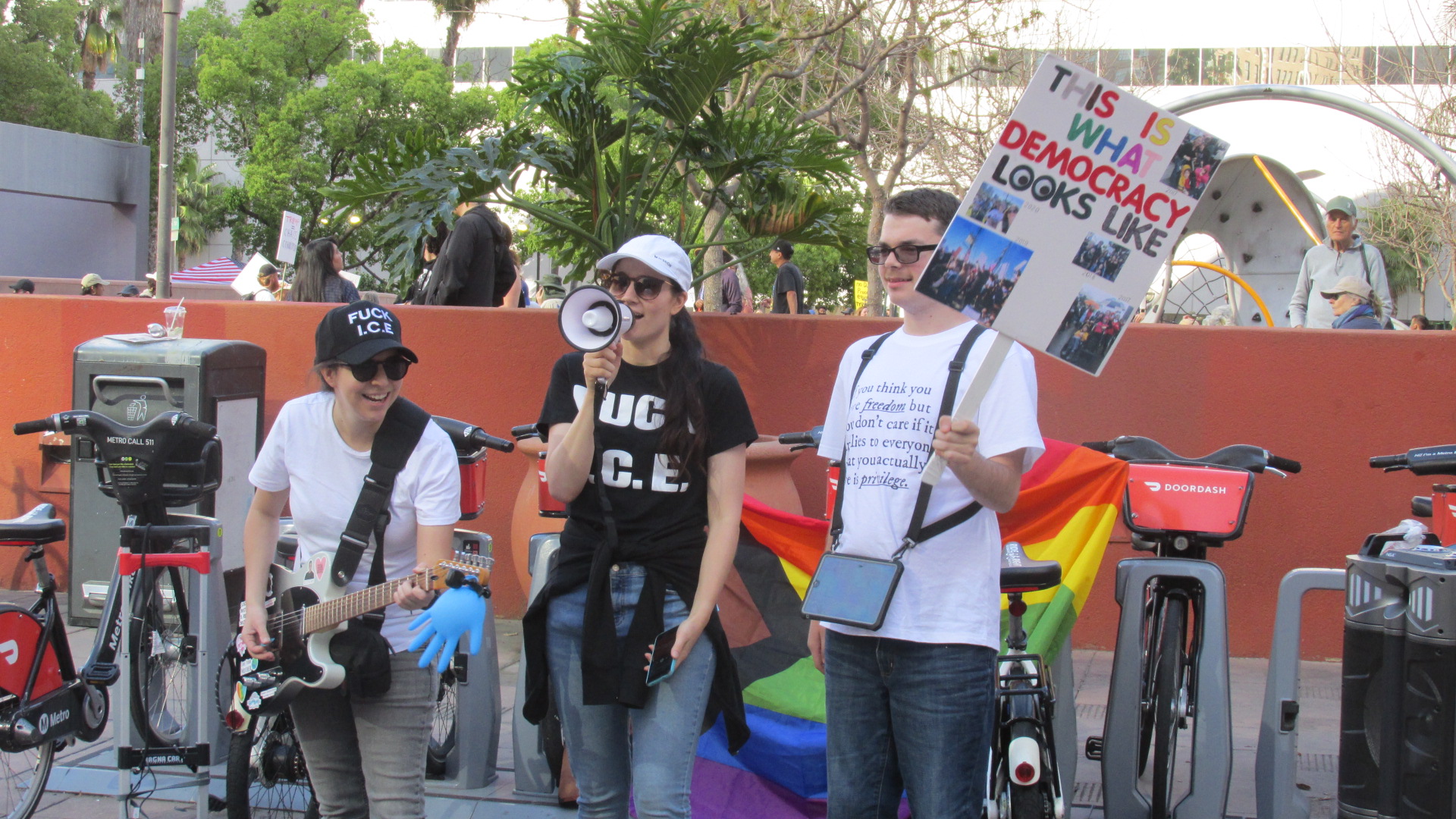
Many protesters came to defend immigrant rightsSome of the attendees made their points with music
The “Hands Off” protests were part of a nationwide day of action organized by a number of different groups. The Associated Press reported that protests were planned in over 1,200 locations across all 50 states. The signs at the LA protest spoke of anger on a wide range of issues, including deportations, the firing of Federal workers, LGBT rights and the economy.
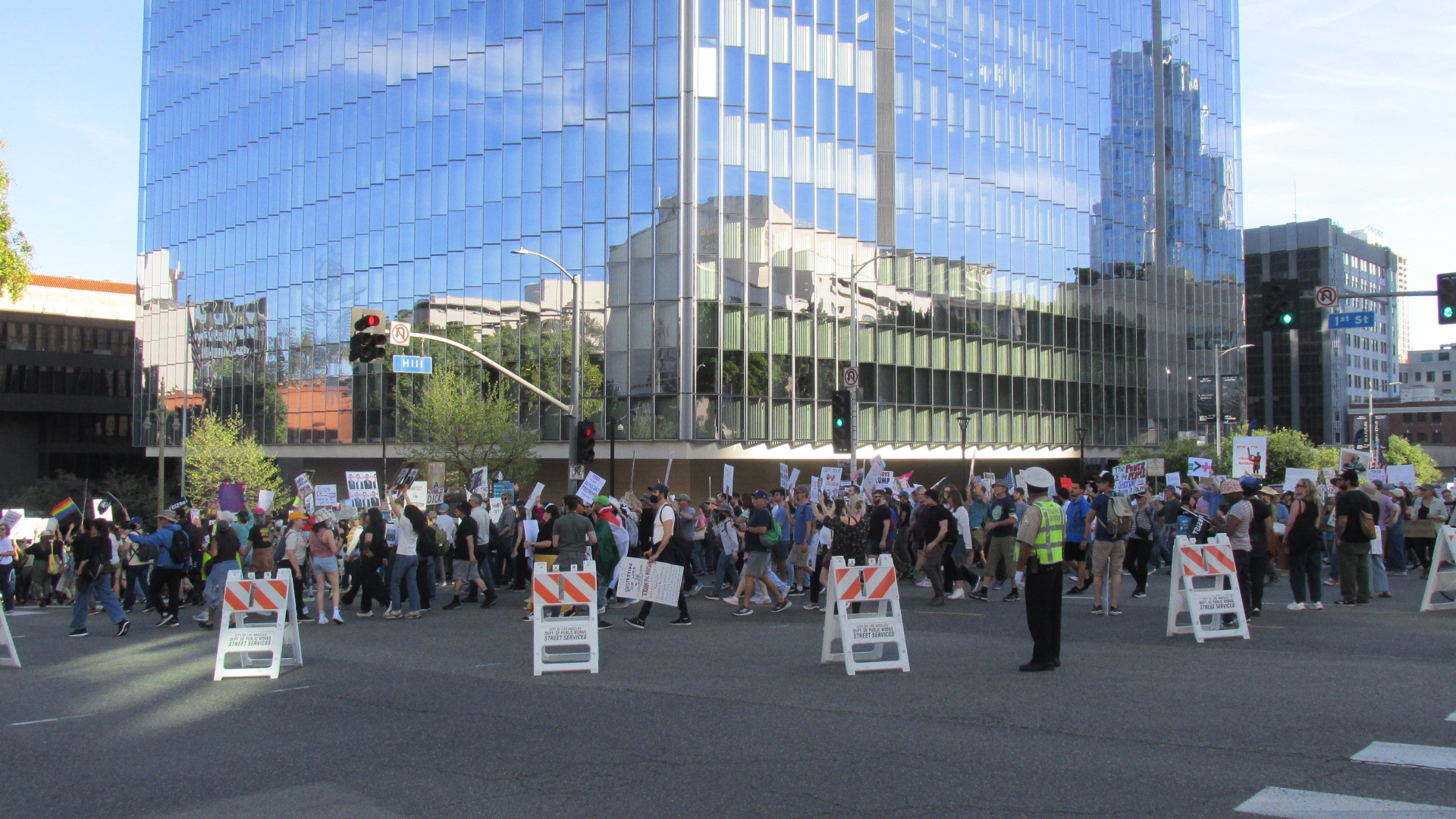
Protesters marching up Hill StreetThe marchers round the corner where the US Courthouse stands
The protest started around 4:00 pm in Pershing Square, and then the crowd marched to City Hall. The event was scheduled to last until 8:00 pm, but I left around 6:00 because I had a house guest coming. I didn’t get to hear the speakers, but the message from the crowd was clear: They don’t like the mass firings, they don’t like the deportations and they don’t like the funding cuts. But in spite of the anger in the air, the protest was peaceful. As of this morning, I haven’t seen any reports of arrests. This story from the LA Times has more details.
The City of LA’s parks are in trouble and they need your help. Lately I’ve been writing a lot about the City’s parks and the challenges they’re facing. The Department of Recreation & Parks (RAP) is aware of the problems, but at this point they don’t have the funding to invest in upgrading their facilities. One possible solution is a bond measure, but before the City goes that route, they want to get input from residents. That’s where you come in.
If you care about LA’s parks, get involved in the Park Needs Assessment. This is a process that will unfold over months. You can participate in community meetings, and if you can’t make the meetings there’s an on-line survey. Neighborhood Councils are also encouraged to submit comments. For more info, click on the link below.
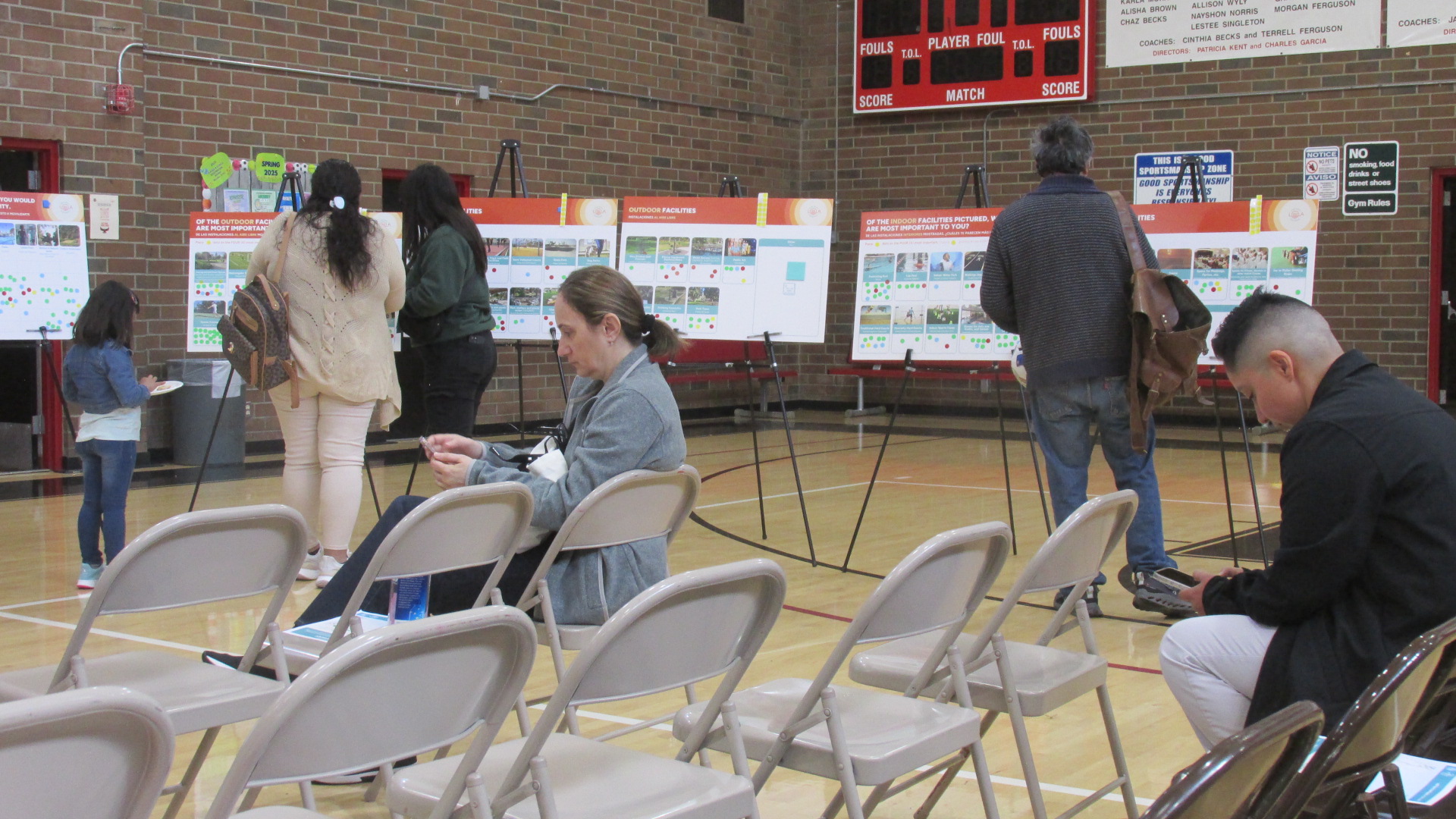
I went to a meeting at the Victory Vineland Community Center in February. They had lots of colorful boards with graphics. The presentation was brief and effective. And there were plenty of RAP staff members there to answer questions and take comments. I came away feeling like they really wanted to hear from the public.
So don’t be shy. Go to a meeting. If you can’t make a meeting, do the on-line survey. Let the City of LA know what kind of parks and recreation facilities you’d like to see. This is your chance to be heard.
It’s hard to believe that the Pantry is closed. It’s one of those places that seemed liked it had been around forever, and it seemed like it would go on forever. I think I started going to the Pantry back in the 70s. Back then it was open 24-hours. If you were going to a movie or to see a band in Downtown, it was the perfect place to stop afterwards. They served breakfast all day and the coffee kept coming.
The Pantry is now owned by a trust set up by former LA Mayor Richard Riordan. According to the trust, the Pantry is not profitable, and they’re hoping to sell it to fund the charitable work of the Riordan Foundation. It will be interesting to see who buys it. Obviously, the property, located in the heart of Downtown, is worth a fortune, but demolishing the restaurant to build something larger will probably not be easy. The Pantry is designated as an LA City Historic Cultural Monument. That would complicate any plans for new development.
This all just feels really sad. The older I get, the more I understand that the world is always changing and that nothing lasts forever. But I still feel like I’m losing a piece of my life. And I think a lot of other people are feeling the same way.
Following up on my recent posts about funding for parks in the City of LA, I wanted to offer an update on a recent action by the LA City Council. Because of the budget crisis that the City is currently facing, the Council is looking for ways to generate more revenue. Last week they approved a report from the Budget & Finance Committee which asks City departments to report back on a number of possible options, including a bond measure to raise funds for both the LA Fire Department and the Department of Recreation & Parks (RAP). They’re also looking at increasing the base funding formula for RAP in the City Charter. (It’s actually worth reading the whole report. Some of the options are interesting. Some are bound to be controversial.)
Park advocate Ron Bitzer, who serves as a volunteer on the City Park Advisory Board in North Hollywood, also sees a possible opportunity emerging as the City tries to rebuild after the recent fires. Bitzer has written an open letter to Steve Soboroff, who was selected to lead the recovery effort, where he argues that planning for more parks, and creating funding streams, should be part of the process.
In general, I think we should be making sure that open space, green space, and the urban forest are integrated into all of LA’s planning efforts. In recent years both our local and State government have worked to fast-track project approvals, in large part arguing that we just need to build housing as fast as possible. Unfortunately, this has led to the removal of more trees and the loss of more permeable surface area, which will make LA even hotter and drier. Instead of just rushing to build as much as possible, we should be planning to build healthy, sustainable communities.
















 The Horizon and the Skyline