The City of LA’s parks are in trouble and they need your help. Lately I’ve been writing a lot about the City’s parks and the challenges they’re facing. The Department of Recreation & Parks (RAP) is aware of the problems, but at this point they don’t have the funding to invest in upgrading their facilities. One possible solution is a bond measure, but before the City goes that route, they want to get input from residents. That’s where you come in.
If you care about LA’s parks, get involved in the Park Needs Assessment. This is a process that will unfold over months. You can participate in community meetings, and if you can’t make the meetings there’s an on-line survey. Neighborhood Councils are also encouraged to submit comments. For more info, click on the link below.
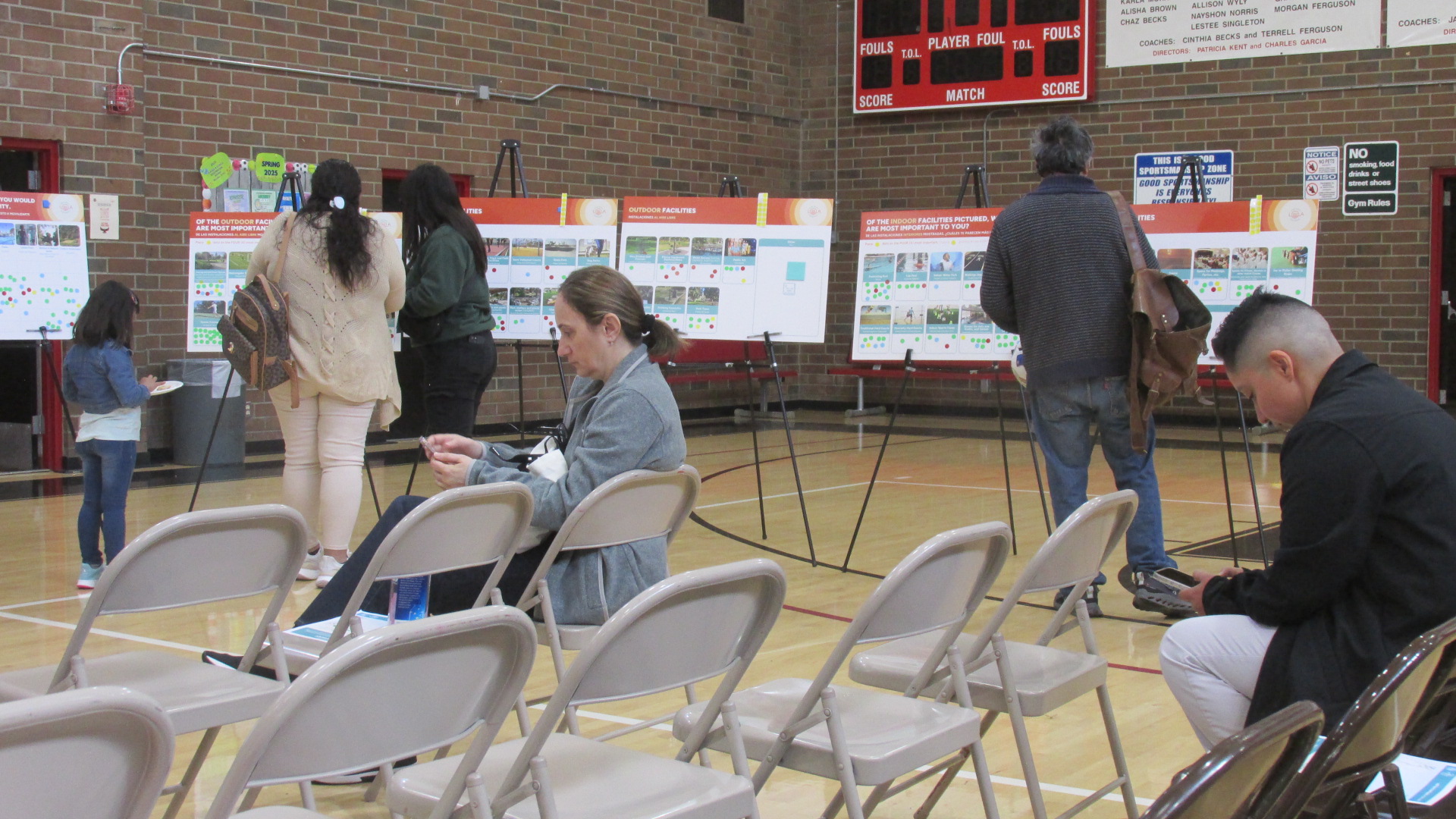
I went to a meeting at the Victory Vineland Community Center in February. They had lots of colorful boards with graphics. The presentation was brief and effective. And there were plenty of RAP staff members there to answer questions and take comments. I came away feeling like they really wanted to hear from the public.
So don’t be shy. Go to a meeting. If you can’t make a meeting, do the on-line survey. Let the City of LA know what kind of parks and recreation facilities you’d like to see. This is your chance to be heard.
Following up on my recent posts about funding for parks in the City of LA, I wanted to offer an update on a recent action by the LA City Council. Because of the budget crisis that the City is currently facing, the Council is looking for ways to generate more revenue. Last week they approved a report from the Budget & Finance Committee which asks City departments to report back on a number of possible options, including a bond measure to raise funds for both the LA Fire Department and the Department of Recreation & Parks (RAP). They’re also looking at increasing the base funding formula for RAP in the City Charter. (It’s actually worth reading the whole report. Some of the options are interesting. Some are bound to be controversial.)
Park advocate Ron Bitzer, who serves as a volunteer on the City Park Advisory Board in North Hollywood, also sees a possible opportunity emerging as the City tries to rebuild after the recent fires. Bitzer has written an open letter to Steve Soboroff, who was selected to lead the recovery effort, where he argues that planning for more parks, and creating funding streams, should be part of the process.
In general, I think we should be making sure that open space, green space, and the urban forest are integrated into all of LA’s planning efforts. In recent years both our local and State government have worked to fast-track project approvals, in large part arguing that we just need to build housing as fast as possible. Unfortunately, this has led to the removal of more trees and the loss of more permeable surface area, which will make LA even hotter and drier. Instead of just rushing to build as much as possible, we should be planning to build healthy, sustainable communities.
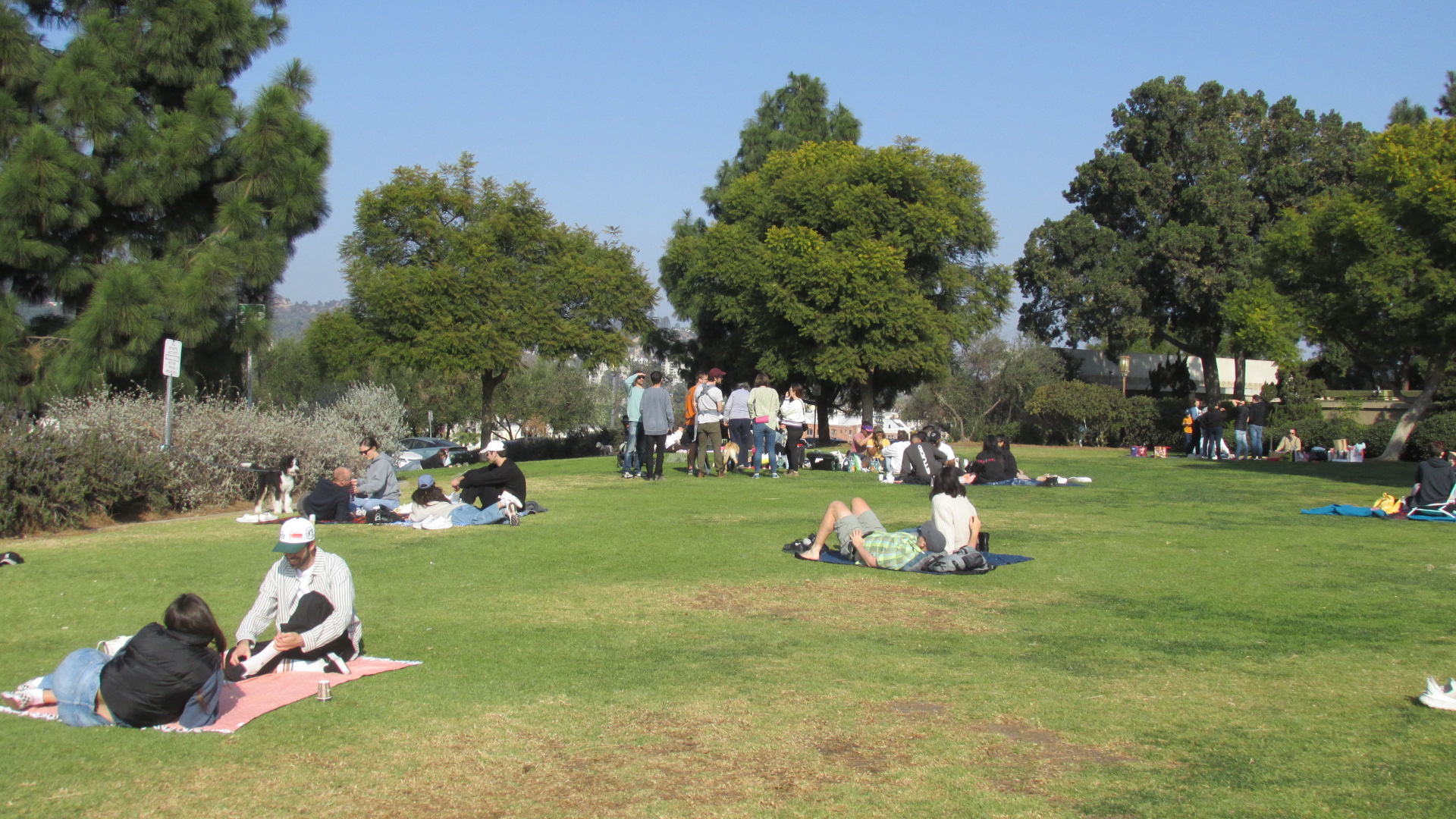
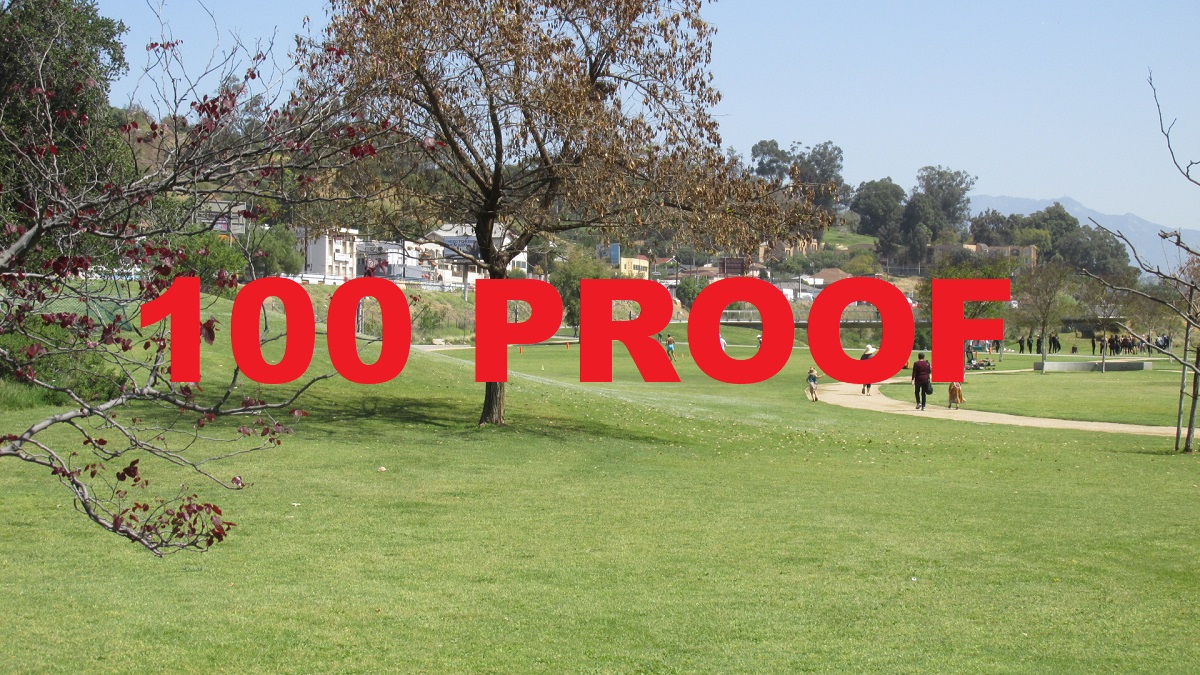
People enjoying the afternoon in one of LA’s parks.
In a recent post I talked about why the LA City Department of Recreation & Parks (RAP) is having such a hard time maintaining the parks in our communities. Mostly, it comes down to money. RAP doesn’t have the funds to hire enough staff or pay for upgrades, in large part because of what LA City Hall calls the “full cost recovery program”, and the City Council’s ongoing inability to create a balanced budget.
One solution to RAP’s problems would be a ballot measure, which has been done before. In 1996, voters approved Proposition K, the LA for Kids Program, which was designed to provide $25 million per year for 30 years. This money has been spent on capital improvements to parks, recreation, and community facilities. However, Prop K will expire in a few years, and this will leave RAP even more impoverished than it is now. But if we’re going to do another ballot measure, we need to do it right.
I’d like to introduce you to Ron Bitzer, who serves as a volunteer on the City Park Advisory Board in North Hollywood. Ron has been fighting for LA’s parks for years, and would like to see all Angelenos have access to clean, well-maintained areas for recreation and relaxation. In this article he offers a detailed breakdown of the challenges RAP is facing. He also talks about how we could create a funding stream to address these challenges.
UPDATE: RAP is in the process of preparing a Park Needs Assessment, and this will be discussed at a meeting of the Facility Repair & Maintenance Commission Task Force on Thursday, February 6, at 10:00 am. The meeting will be held at the Chevy Chase Recreation Center, 4165 E. Chevy Chase Drive. The Task Force will only take public comment from those who show up in person. Click on the link below for the agenda.
If you can’t make the meeting on February 6, see page 5 of the agenda for a tentative list of future meetings under the heading Public Engagement (Phase 1).
We can provide funding for LA’s parks, but the process must include real public engagement and meaningful oversight. Our parks belong to the people. Let’s make sure the people have a voice in planning for their future.
The LA Department of Recreation & Parks (RAP) has been underfunded and understaffed for years. While LA politicians talk a lot about the importance of green space and open space, when it comes to actual funding, LA’s parks seem to be a very low priority. Some of the city’s parks are well-maintained, but these tend to be in more affluent areas, where residents have access to additional funding resources. Many of LA’s parks are in bad shape because RAP doesn’t have the money or the staff to give them proper care.
One of the biggest problems for RAP is that it’s one of only two LA City departments that’s subject to the “full cost recovery program”, something that City Hall imposed when it was dealing with the 2008 financial crisis. This means that RAP has to reimburse the City for the cost of the water and power it uses, in addition to the cost of employee benefits. (The only other department required to do this is the LA Public Library, and they were able to mitigate the loss of funding through a ballot measure.) This means that RAP is paying tens of millions of dollars every year to cover these costs, which is a huge chunk of its budget. To give you an idea of what a drain this is, here’s an excerpt from a memo sent by RAP General Manager Jimmy Kim regarding the Department’s 2023-24 budget….
CHALLENGES: RAP is required to continue to use $98M (28.92% of the total operating budget) to pay reimbursements to the City’s General Fund for employee benefits ($64.7M), the Department of Water and Power (DWP) for utilities ($30.4M), and the Bureau of Sanitation for refuse costs ($2.9M). These increases diminish RAP’s ability to meet and increase vital maintenance and recreational programming needs. Since the inception of these Department contributions in FY ‘08-09, approximately $969M has been diverted away from RAP’s core operations.
So if you’re wondering why the playground in your local park is looking so worn out, or why the restrooms aren’t properly maintained, or why the pool has been closed for so long, there’s a good chance it’s because RAP doesn’t have the money to take care of these things. A 2018 Parks Condition Assessment Report recommended that 20 recreation centers be replaced because they were in poor condition, needing major retrofits and renovation. The same report recommended that 12 pool and bathhouse facilities be replaced because many of them were over 60 years old and had surpassed their expected service life. But more than six years later, much of that work has still not been done because of insufficient funds.
The people of LA need clean, well-maintained parks. It’s possible to provide the funding to accomplish that, but any effort along those lines needs to be open and transparent, with strong public engagement and careful oversight. I’ll be writing a follow-up to this post where I’ll talk more about how we can make that happen.
How much alcohol at LA City parks is too much alcohol? It appears that the City of LA doesn’t believe there’s any such thing as too much alcohol at city parks. At the April 20 meeting of the Board of Recreation and Park Commissioners, one of the agenda items was a proposal to revise the Recreation & Parks Alcoholic Beverage Policy.
The current policy says only beer and wine can be served at public events in LA City parks, and it limits the number of events where alcohol is served to no more than one event per park per year. The proposed revisions would allow the sale of a full line of alcoholic beverages and remove any limits on the number of events where alcohol is served.
Does that really seem like a good idea? Opening up our parks to an unlimited number of events that offer booze to attendees? There are so many problems with this it’s hard to know where to begin.
First, while the revised policy requires that event organizers hire security, the security is only going to be dealing with issues at the site of the event. What happens when people who’ve had too much to drink leave the area and start wandering around the park? Or get into their cars and start driving home? Just last year a cyclist riding through Griffith Park was hit and killed by a motorist. Police said the driver appeared to have been drinking.
Second, allowing more events that serve alcohol will likely bring a lot more people to LA’s parks, but the Department of Recreation & Parks hasn’t been able to properly maintain these important resources for years. Sadly, Rec & Parks has been the victim of severe budget cuts, and has been struggling without proper staffing. Increasing the number of visitors without increasing the budget for Rec & Parks just means the Department will be more burdened than ever.
And then there are the environmental issues. If increasing the number of events that offer alcohol would increase the number of visitors to LA’s parks, it seems likely that there would be significant impacts to the environment. This is especially true if the policy change means more live music festivals, which is almost certainly the case. There’s no sign that Rec & Parks has done any kind of environmental review, and there’s no way they could claim that this policy change wouldn’t have any impacts.
One impact would be traffic. I know our leaders like to pretend that nobody drives any more and everybody takes transit, but if you believe that’s true, you should check out the full parking lot and the cars lining the street on the periphery of the LA State Historic Park. You can see the same at many of LA’s other parks. Unfortunately, the vast majority of Angelenos still drive cars to get where they want to go.
Another impact is solid waste, and again, more music festivals would be a particular problem. The City will tell you that all the empty aluminum and plastic containers discarded at these events can be recycled, so there’s no impact to the environment. Sure, they can be recycled, but they’re often not, and the City has been struggling for years to comply with a State mandate that it divert 50% of its solid waste to recycling. More music festivals would also likely have significant impacts on habitat and wildlife, and these impacts should also be assessed.
One of the motivations for this policy change may be to generate more revenue for Rec & Parks, and the Department certainly needs more funding. But the change will probably result in higher costs, too, and there’s no sign that this has been analyzed. Before even considering increasing the number of events that offer alcohol, the Department should do a study to analyze whether increased revenue would offset the increased costs.
There may be good arguments for increasing the number of events that offer alcohol at LA’s parks, but lifting the current caps to allow an unlimited number, especially if serving a full line of alcohol is allowed, does not make sense. It might make sense to allow a small increase in the number of events with alcohol. Or it might make sense to designate certain parks that could host these events. Rec & Parks should study a few different options, and weigh the benefits against the costs. They also need to do environmental review.
If you’d like to offer input on the proposed revisions to Rec & Parks’ Alcoholic Beverage Policy, you can send an e-mail to the Board of Commissioners:
RAP.COMMISSIONERS@LACITY.ORG
You might also copy General Manager Jimmy Kim and his Administrative Assistant, Desiree Ramirez:
Jimmy.Kim@lacity.org
Desiree.Ramirez@lacity.org
It also couldn’t hurt to contact your LA City Councilmember to let them know how you feel.
There may be ways to update the current policy that would provide benefits, but just opening the door to an unlimited number of events with alcohol is not a good idea.



 The Horizon and the Skyline